V. Ershadi, T. Ebadi, A.R Rabani, L. Ershadi, H. Soltanian
Abstract— Nanosilica is the extremely fine silica that has been used for years as cement admixture both in the oil field and in construction and civil engineering industries. Because of its extremely fine nature and high reactivity pozzolanic material, nanosilica has been used to improve slurry impermeability and the mechanical properties of the hardened material. Using nanosilica in slurry composition, improved reological and mechanical properties of cement slurry and set cement. With the adoption of very fine silica particles in cement matrix, porosity and permeability significantly were declined 33.3% and 99% respectively and compressive strength grew from 1486 psi to 3801 psi. Finally the proper amount of nanosilica in slurry composition is presented. The novel slurry formulation with low porosity and permeability and high compressive strength, is suitable in zones where the possibility of gas migration is very high.
Index Terms—nanosilica; cement class G; porosity and permeability; slurry formulation
I. INTRODUCTION
Cementing is an essential operation during construction of an oil or gas well [1]. The quality of cement behind a casing plays a vital role during drilling and has a serious impact on the secondary cementing, workover and stimulation operation [2]. Poor quality of cement slurry and set cement may lead to remedial cementing and will increase the time and cost of cement job [3].whereas high quality of cement will ensure the long-term durability of borehole by providing a high-quality casing [4]. In recent years great efforts have been done to improve drilling and construction cement properties, using nano particles [5].
Cementing of deep wells requires materials that, while satisfying performance specifications, are quite different from those encountered in conventional processes, hence nano particles, especially nanosilica, nano-Fe2o3 [6, 7], and nanoalumina [8, 9] have been widely employed for increasing compressive and flexural strength of Portland and Belite cements [4].One of the most common additives in cement admixture both in oil field and in construction and civil engineering industries is nano silica [10].
Nanosilica is typically a highly effective pozzolanic material. It normally consists of very fine vitreous particles approximately 1000 times smaller than the average cement
particles. It has proven to be an excellent admixture for cement to improve strength and durability and decrease permeability [11, 12]. Roddy et al applied particulate nS in two specific ranges of particle sizes, one between 5 to 50 nm, and a second between 5 to 30 nm. Also they used nS dry powders in encapsulated form and concentration of 5 to 15% bwoc. The respective test results for the slurries demonstrated that the inclusion of nS reduces the setting time and increases the strength (compressive, tensile) of resulting cement in relation with other silica components that were tested [13]; therefore it has been a popular additive in the oil field industry. Its application encompasses the formulation of stronger lightweight cements as well as reducing the free fluid and enhancing the stability of large number of slurries [14].
This paper reports the effects of nano-sized spherical silica on porosity, permeability and compressive strength of oil well cement.
II. MATERIALS AND METHODS
A. Materials Cement
The cement powder used in this study, Kerman class G cement according to the American Petroleum Institute (API) standards, was provided by Research Institute of Petroleum Industry (RIPI) of Tehran. The cement suspensions are made by adding the powder to tap water in a Waring blender.
B. Spherical Nanosilica Powder
The spherical nanosilica that was utilized in this study was synthesized by Professor Alimorad Rashidi, one of the faculties of Nanotechnology Department of Research Institute of Petroleum Industry of Tehran. The particle size of nanosilica is about 20 nm.
Other additives such as dispersants, extenders, antifoam agent and fluid loss control were used in the admixture of cement slurry.
C. Experimental method
Sample preparation
The sample preparations were done in accordance with API [15].The specification gives the standard procedure for
The Effect of Nanosilica on Cement Matrix
sample conditioning prior to testing. For the initial mixing, a high speed propeller-type mixer is used. The additives were added to the water successively in the mixer with the mixing intervals of 20 s at 4000 rpm. Cement powder and spherical nanosilica were premixed and thereafter added to water and other additives in the mixer at the speed of 4000 rpm for 3 min and 35s at the speed of 1200rpm [16]. The water/cement ratio in all formulation in this study is 0.6.
D. Permeability and Porosity Test
Permeability is a measure of the ability of a fluid to flow through a porous media when subjected to a differential pressure and is mathematically equated by Darcy’s Law. The primary function of well cement is to isolate/seal the casing from the well bore. This seal prevents the migration of fluids into the annulus and upwards to the surface. Therefore, it is imperative that a well cement exhibit very low permeability. The applied formula to calculate the permeability of set cement is mentioned below:
k = (2,000 x OP x Q x µ x L) / (A x (IP2 - OP2))
Where:
Q = Flowrate (lit/s), k = Permeability (md),
A = Cross Sectional Area (cm3), OP = Outlet Pressure (atm)
IP = Inlet Pressure (atm), µ = Viscosity, L = Length (cm)
All of the permeability and porosity tests were applied and calculated according to API standard and under 3000 psi pressure in Core Research Unit of Research Institute of Petroleum Industry of Tehran.
E. Compressive Strength Test (Ultrasonic Cement Analyzer)
The cement slurry to be tested was placed in autoclave unit of ultra sonic cement analyzer (UCA) with temperature and pressure adjusted to simulate downhole conditions (T: 158 ͦ F and P: 3000 psi). The required pressure was applied to the cell through a pressure apparatus along the cement column. An acoustic signal was then transmitted through the cement sample. As the strength of the cement increased over time, the faster the acoustic signal traveled through the sample.
A computer running customized Windows based software measures the transit times of the signal over time and interpolates the compressive strength values.
III. RESULT AND DISCUSSION
A.
Effect of nanosilica on cement porosity and
permeability
Using nano particles is one of the best methods to decrease permeability and porosity of concrete in Construction Industry [6, 7]. In this study a similar way was performed to decrease porosity and permeability of drilling cement. If it is required to use a formulation with high W/C, the porosity problems should be resolved by changes in the arrangement of structure. Table (1) shows the changes of porosity and permeability versus different percentages of nanosilica.
TABLE I. POROSITY AND PERMEABILITY OF 5 TESTED SLURRIES AT 5 DIFFERENT PERCENTAGE OF NANOSILICA
No. of
slurry
Porosity and Permeability in different amount of
nanosilica
%nanosilice Porosity (%) permeability(md)
S1 0 45 0.1
S2 1 30 0.001
S3 1.5 30 0.01
S4 2 29 0.019
S5 3 28.5 0.02
Adding 1% BWOC of nanosilica to slurry admixture, decreased porosity and permeability 33.3% and 99% respectively figure (1).
Fig.1. the Percent of Porosity and Permeability Reduction
and permeability reduction, but it seems that non-uniformed distribution of particles has greater impact in reducing the permeability to porosity.
As already mentioned, increasing the amount of nanosilica lessened slurry density, thus the permeability of slurries increased. Figure (2) shows the changes of permeability versus various percentage of nanosilica.
Fig.2. Changes of permeability at different percentage of nanosilica
As it is observed in figure 3, by increasing the amount of nanosilica, permeability increased too, and this can be considered due to increased density. Subsequently small samples of set cement powder were taken for scanning electron microscope (SEM), to determine the effect of nanosilica on the structure of the composition and permeability reduction of cement. SEM images of S1 and S2 are shown in figure 3(a) and 3(b). As seen in figure 3, fine particles of nanosilica have been placed as well in the pores of cement paste. Figure 3(b) shows more condensed structure rather than figure 3(a).
Fig.3. SEM images of (a) slurry No.1, (b) slurry No.2. . Figure 3 (a), shows the porous structure of cement paste and 3(b) exhibits the application of
nanosilica in filling the porosities
B. Effect of Nanosilica on Compressive Strength (CS)
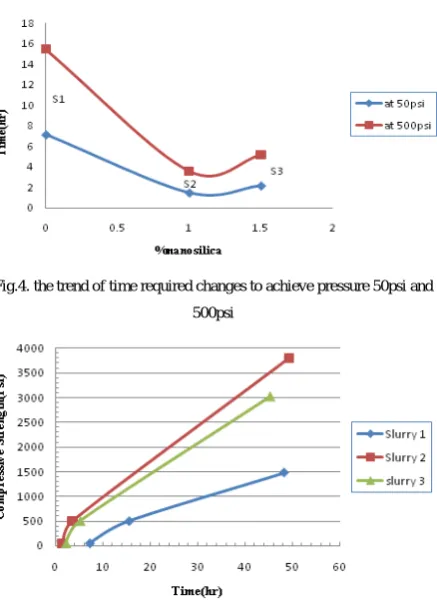
According to the results of UCA tests to determine the compressive strength of cement, is quite evident that in the new system design of slurries the growth of compressive strength will be faster, figure (4),(5).
Fig.4. the trend of time required changes to achieve pressure 50psi and 500psi
Fig.5. Changes of Compressive Strength versus time for S1, S2, S3
Using nanosilica to the system not only reduced permeability and porosity and improved rheological behavior of slurries (with proper percentage) but also, could provide the early strength of them [13].
Figure (6) shows the trend of increasing 48-hour CS by adding nanosilica to raw slurry. S2 showed the maximum 48-hour CS with 1% nanosilica in the admixture, but increasing in amount of this additive decreased the compressive strength. As mentioned before, increasing the amount of nanosilica reduced slurry density which ultimately leads to reduction of CS [13].
It is worth noting that the CS of S4 and S5 were not measured, since they were thickened after heat and showed inappropriate rheology behavior, so was not suitable to use in cementing job.
C. Effect of Nanosilica on Reological Properties and Slurry
Density
Table (2) is presented to provide the results of laboratory tests for density, yield point and plastic viscosity of the slurries in different percentage of nanosilica. All experiments were performed three times and average results are presented in the table (2). Slurry No.1 is defined as control slurry. As it is observed adding nS to the combination of control slurry led to improve rheological properties (PV and YP). Figure (2) shows the trend of rheological properties changes. It should be noted that excessively increase in nanosilica percentage, will thicken the slurries and have negative effects on rheology. Subsequently, the better yield point, lead to better pumpability. In fact the appropriate percentage of nanosilica can be obtained by the same test. The rheology tests of entire slurries have been performed at both ambient and bore hole circulating temperature (BHCT= 70 ͦ C). The slurry number 5, was thickened after heat, this indicated that the amount of nanosilica should not exceed 30% BWOC. The slurries were left to stand for 2 hours. Slurry No. 1 had 33% BWOW free water while the others` were zero. This shows that the present nanosilica in other formulations (No.2 to No.5) led to increase of slurry stability.
Laboratory results of 5 slurries at different percentages of nanosilica.
TABLE II. LABORATORY RESULTS OF 5 SLURRIES AT DIFFERENT PERCENTAGES OF NANOSILICA
No. of
slurry
%nanosilice w(pcf) PV(cP) YP(Ibf/100ft2)
Slurry 1 0 100 28.5 1.5
Slurry 2 1 92.5 48 4
Slurry 3 1.5 92 61.5 10.5
Slurry 4 2 90 72 17
Slurry 5 3 80 83.5 33
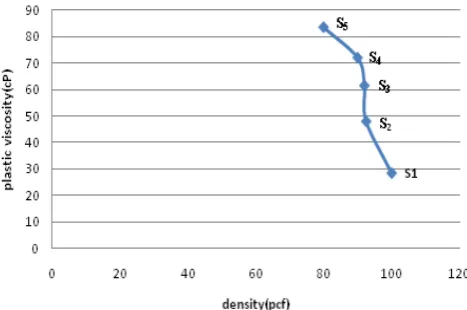
Silica is considered as a lightener agent [3], therefore, nanosilica showed this specification greater due to the fineness of the particles. Adding this additive to cement slurry, the density was decreased. Figure (7) describes changes of density versus plastic viscosity. It should be noted that in the rest of the paper, S1, S2, S3, S4 and S5 serves as slurries No.1 to No.5.
Fig.7. Trend of change in plastic viscosity with density reduction
D. Effect of Nanosilica on Thickening Time
According to laboratory results, much time was required to thicken the raw slurry No.1. Adding this additive to the raw formulation, enormous reduction in thickening time was observable figure (8)
Fig.8. reduction of thickening time by adding nanosilica
As it is clear in figure 8, adding %1 nanosilica (BWOC), resulting in decrease time to less than 2 hours. This point should be noted that the suitable thickening time depends on well conditions, time limits, working depth of cement operation and other drilling conditions, hence adding retarders can be reached to thickening time-optimal. Very little time is not suitable for cementing job so for benefit of nanosilica properties, the present formulation should be improved.
E. Effect of Nanosilica on Fluid Loss
did not allow the solid phase of the slurry to be separated from liquid, hence the water in slurry mix would be prevented leaving cement matrix. This fact will help to reduce fluid loss.
Fig.9. Fluidloss of the slurries reduced by adding nanosilica It is important to note that the slurry No.5 thickened after heat so; the fluid loss of this slurry was not measured.
IV. CONCLUSION
The slurry that was intended as control slurry with W/C 0.6 had very long thickening time, high porosity, permeability and low compressive strength. According to the results, adding proper amount of nanosilica to slurry No.1 as an accelerator additive with tiny particles and high effective surface area, could improve mechanical properties of the slurry. Pursuant to results 1% nanosilica is the most appropriate amount in order to improve properties. The effect of nanosilica would not be observable by using less. An overview of the results can be noted the followings as the advantages of using nanosilica in the mixture of drilling cement:
• High compressive strength (3023 psi at T= 158 ͦ F & P= 3000 psi) of low density slurries (80-90pcf)
• Very low porosity and permeability (respectively 33.3% , 99% reduction compared to initial slurry)
• Low costs of remedial cementing operation
ACKNOWLEDGMENT
The authors are grateful to the Research Institute of Petroleum Industry (RIPI) of Tehran and Amirkabir
University of Technology research funds for the financial support. In addition, the authors wish to thank Mr. Yaser Pourmazaheri and Mr. Mehdi Fathi for their sincerely cooperation during laboratory tests.
REFERENCES
[1] Backe, K.R. Lile, O.B. Lyomove, S.K., 1997. Laboratory Study on Oilwell Cement and Electrical Conductivity,in::ciety of Petroleum Engineers(SPE56539).
[2] Backe, K.R. Lile, O.B. Lyomove, S.K. Elvebakk, H. and Skalle, P., 1997. Characterising curing cement slurries by permeability, tensile strength, and shrinkage. Society of petroleum Engineers(SPE38267) [3] Nelson, E.B. 1990 Well Cementing, Chap. 11 . P Rae. Cement Job
Design. Hohston : Schlumberger Educational Services,3.01- 3.35. [4] Pourafshary, P. Azimipour, S.S. Motamedi, P. Samet, M. Taheri, S.A.
Bargozin, H.Priority, 2009. Assessment of Investment in Development of Nanotechnology in Upstream Petroleum Industry. Society of Petroleum engineers(SPE126101)
[5] Luciano, S.J. Labrincha, A. Ferreira, V.M. Dachamir, H. Wellington, L. R., 2009. Effect of nano-silica on rheology and fresh properties of cement pastes and mortars, Construction and Building Materials. 23, pp. 2487-2491.
[6] Li, G., 2004. Properties of High-Volume Fly Fsh Concrete In Corporating Nano-SiO2, Cement and Concrete Research. 34, pp.1043-1094.
[7] Shih, J. Y. Chang, T. P. and Hsiao, T., 2006. Effect of Nanosilica on Characterization of portland composite, Material Science and Engineering.A. 424, pp. 266-274.
[8] Campillo, A. Guerrero, J.S. Dolado, A. Porro, J.A. Goñi, S., 2007. Improvement of initial mechanical strength by nanoalumina in belite cements, Materials Letters. 61, pp. 1889-1892.
[9] Doladoa, J.S. , Campillo, I. Erkizia, E. Ibanez, J.A. Porro, A. Guerrero, A. and Goni, S., 2007. Effect of Nanosilica Addition on Belite Cement Pastes Held in Sulfate Solutions, Journal of the American Ceramic Society. 90, pp. 3973-3976.
[10] Daou, F. and Piot, B., 2008. Cement Slurry Performance and Set Cement Properties vs. Microsilica Densification, Society of Petroleum Engineers(SPE112701)
[11] Loland. K.E., 1981. Silica Fume in Concrete, University of Trondheim, Norway. sft65-F81011.
[12] Aitcin, P. C. Hershey, P.A., 1981. and Pinsonneault, effect of the addition of condensed silica fume on the compressive strength of mortars and concrete, American Ceramic Society. 22 pp. 286-290. [13] Roddy, W. Craig. O.K.Duncan, 2008. Well Treatment Compositions
and Methods Utilizing Nano-Particles. nited States, patent NO,02777116 A1 U.
[14] Nelson, E.B. Michaux, M. and Drochon, B., 2007. Cement Additive and Mechanisms of Action. Nelson and Guilot. Well Cementing Ch 3. second eddition. Sugar LND,Texas: SCHLUMBERGER EDUCATIONAL SERVICES, pp.49-90.
[15] American Petroleum Institute. Specification for Materials and Testing for Well Cements,API Spec.10, 1990.5th edn. Dallas, TX, USA, Washington DC: American Petroleum Institue, July 1.