ADVERTISING: THE SOUL OF MARKETING
NISHA TELANGA
ASSISTANT PROFFESSOR IN COMMERCE CMK NATIONAL PG GIRLS COLLEGE, SIRSA
Abstract:
Advertising plays an important role in our everyday life. It mainly determines the image and way of life and it has an impact on our thinking as well as on the attitude towards ourselves and the world around us. According to American Marketing Association "advertising is any paid form of non-personal presentation and promotion of ideas, goods and services by an identified sponsor".
This research characterizes the role of advertising in effective promotion, presents general characteristics of advertising and its mission and describes the basis of the organization of promotional activities as well as how to evaluate the effectiveness of advertising campaigns.
The objective of this paper is to analyze the impact of advertising on the consumer buying behavior. Another goal is to describe the effect of advertising on a product life cycle and find out the right ways and methods of advertising and how to apply them at every stage of the product life cycle. This research studies two important persuasive processes often employed in the management of businesses; Advertising and Marketing Management. Advertising and Marketing Management is necessary in order to have a complete understanding of how producers and sales companies work effectively.
Keywords:Advertising; Innovations; Marketing; Persuasion in marketing; Marketing mix; Personal selling; Promotion.
INTRODUCTION:
The word advertising comes form the Latin word "advertere meaning to turn the minds of towards". The dictionary meaning of the term advertising is "to give public noticeor to announce publicity". This suggests that advertising acts as a marketing vehicle and is useful for drawing the attention of people towards a specific product/service/manufacturer. Advertising can be defined as "any paid form of non-personal presentation and of ideas, goods or services by an identified sponsor."
Advertising is used for communicating business information to the present and prospective customers. It usually provides information about the advertising firm, its product qualities, place of availability of its products.
informative and persuasive in nature. Advertising may be targeted at promoting a new product or designed to promote existing ones. Advertising has become greatly popular and even common place in today‟s world. It is an important tool for business marketing. Consumers can learn every detail information by advertising. Moreover, creative advertisings facilitate businesses to improve their market share.
Features of advertising:
Advertising provides information: The basic purpose of advertising is toprovide information about products/services to prospective buyers. The details of products such as features, uses, prices, benefits, manufacturer's name, and instructions to be followed while using the product are given in the advertisements. However, the information given should be complete and true.
Paid form: Advertising is a form of paid communication.Advertising is published or broadcast because the advertiser has purchased time or space to tell the story of a certain product or service.
Non-personal presentation:Salesmanship is personal selling whereas advertising is non-personal in character. Advertising is not meant for anyone individual but for all. However even in advertising target consumers or target market can be selected for making an advertising appeal.
Idea, goods and services:Advertising is for giving information to consumers: This information is always related to the features and benefits of goods and services of different types. Advertising gives new ideas to consumers as its contents are meaningful.
An Identified Sponsor:A sponsor may be an individual or a firm who pays for the advertisement.
Mass Communication Media: It is designed to convey the concept of multiple messages delivered to groups of people simultaneously.
Basically for persuasion: Advertising aims at persuasion of potential customers.Advertising has psychological impact on consumers. It influences the buying decisions of consumers.
An Art, Science and Profession: It is now universally accepted that advertising is an art, science and a profession. It is an art, as it needs creativity for raising its effectiveness. Advertising is a science as it has its principles and rules. Advertising is now treated as a profession with its professional bodies and code of conduct for members
Important element in marketing mix: Advertising is an important element in marketing mix. Advertising has proved to be of great utility to sell goods and services.
Creativity- the essence of advertising: Advertising is a method of presenting a product in an artistic, attractive and agreeable manner. This is possible through the element of creativity. Without creativity, advertising will a body without a soul.
Profit Maximisation:True advertising does not attempt at maximising profits by increasing the cost but by promoting the sales.
ROLE OF ADVERTISING IN MARKETING:
advertising plays is the informative role. Advertising serves as the channel through which consumers get to know about products and services. Companies involved in the commercial production of goods and services need advertising for several important reasons. The main reason is that advertising helps to publicize and promote their products to the public thereby helping to improve sales.
Moreover Advertising serves as a tool for competition. Advertising has several advantages like promotes products because people become aware of the existence products and services and lead them to making a purchase so sales are increasing. Advertising through creative appeals persuades the public to take action and make a purchase.
The promotion and preservation of the brand image is another role advertising plays in marketing. Advertisingthrough the use of creativity, appropriate media and persuasive tactics can influence consumerscausing them to alter beliefs and desires about particular products or services. Marketing mix consist of four important variables of marketing, i.e. 4Ps-Product, Price, Promotion and Place.
Advertising is an element of promotion. However, it not only assists in promoting the product, but also affects the other variables of marketing mix.Advertising facilitates the introduction of new products. Due to advertising, information about new products is given to theprospects. This creates demand and the manufacturer is able to sell new productsalong with the existing ones.
Advertising spreads information and encouragesconsumers to purchase new products. Various concessions are offered to consumers in the initial period. Advertising creates proper background forpersonal selling. It gives advance information to the prospects. They visit the shopin order to purchase a particular product, which they know through advertisingmedia. The job of a salesperson becomes easy as consumers develop affinity tospecific products. In brief, advertising supports and supplements personal selling. Advertising builds brand image and this develops consumer loyalty towards aspecific brand.
Advertising creates demand and promotes sales.This enables a manufacturer to conduct production on a large scale. This leads toreduction in the cost of production and distribution. As a result, the profit margin of the manufacturer increases.A manufacturer can face market competition effectively andcan make his products popular through advertising. He can removemisunderstanding among consumers about his products through appropriateadvertising.
A manufacturer can build up goodwill and good image in thebusiness world and also among the consumers through advertising. The socialwelfareprogrammes and community service activities can be given wide publicitythrough advertising. Even the progress of the Organization can be brought to thenotice of the public through advertising.Advertising has become an essential marketing activity in themodern era of large scale production and serve competition in themarket.
Advertising message about the utilityof a product enables the people to widen their knowledge. It has contributed a lot towards thebetterment of the standard of living of the society.Advertising provides an important source ofrevenue to the publishers and magazines. It enables to increasethe circulation of their publication by selling them at lower rates.People are also benefited because they get publications at cheaperrates.
Conclusion:
Advertising has become essential to promote sales, tointroduce new product, to create good public, for large scale ofproduction, for educating people etc. Advertising is the integral part of every day's life. Withoutadvertising modern society cannot survive.Advertising is useful tosociety as it encouraging people to purchase goods and services,it bridges the gap among people by communicating varied culturethrough advertising message, it contributes to bring about all rounddevelopment of the economy by increasing demand, it provides opportunities to people to improve their income.
This research is a modest discussion of two highly complex processes advertising and marketing. As shown in this research, advertising and marketing arecommercially driven with the aims of informing the public about goods and services, persuadingpeople to buy, building and maintaining brands as well as maximizing profits for the organization.Advertising thrives on marketing; it is part of the marketing process.
As people increasingly turn to new media as a sourcefor communication, knowledge and business, advertisers and marketers need to tailor their strategiesand tactics in creative and innovative ways to meet the needs of the new generation.
So we can surely say that advertising is a soul of marketing and without which marketing is no more possible.
References:
Adams, K. (2005). The Sources of Innovations and Creativity. USA National Center on Education and the Economy. Available at: http.//www.fpspi.org/pdf/innovcreativity.pdf.
Akrani, G. (2010). 5Ms of Advertising-Features, Role and Advantages of Advertising. Available at: http://kalyan-city.blogspot.com/2010/07/5-ms-of-advertising-advertising.html.
Arens&Bovee(1994): Contemporary Advertising; 5th edition IRWIN; Australia. Belch &Belch(2001): Advertising & Promotion; 5th edition; Tata McGraw Hill. Benson-Eluwa, V. (2004). Advertising: Principles and Practice. Enugu: Magnet
Business Enterprises.
Biel, A. (1993). Converting Image in to Equity Brand Equity and Advertising: Advertising‟s Role inBuilding Strong Brands. New Jersey: Lawrence Erlbaum 67-82.
Boone, L., Kurtz, D. (1995) Contemporary Marketing Plus. Florida: The Dryden Press.
Chowdhury, V.(2011) Advertisements: Advantages and Disadvantages of Advertising http://www.indiastudychannel.com./resources/139778
Dominick, J. (2013). The Dynamics of Mass Communication, New York: McGraw-Hill.
Don Milner(1995): Advertising & Promotion; 1st edition; London.
Drewniary, B., Jewler, A. (2008) Creative Strategy in Advertising. Boston: Thomson Wardsworth.
Drucker, P.F. (1973). Management: Tasks, Responsibilities and Practices. New York: Harper & Row.
Jefkins, F. (1992) Public Relations. London: Pitman Publishing.
Kirmani, A., Zeithmal, V. (1993) Advertising Perceived Quality and Brand Image Brand Equity and Advertising: Advertising‟s Role in Building Strong Brands. New Jersey: Lawrence Erlbaum 143-158.
Kotler, P. (2002) Marketing Management Millenium Edition. Boston: Pearson. Mahendr J Mohan(2002): Advertising Management - Concept & Cases; Tata
McGraw Hill.
Mallory, D. (2013) What is the Difference between Advertising and
Marketing?http://www.wahm.com/articles/what-is-the-difference-between-advertisingand marketing. Html.
O‟Shaughnessy, J., O‟Shaughnessy, N. (2004) Persuasion in Advertising. London:Routledge.
Petley, J. (2003) Advertising. Library of Congress Cataloging – in - Publication Data.
Phillips, M., Raspberry, S. (2008) Marketing without Advertising: Easy ways to Build a Business Your Customers. Berkeley: Ralp Warner.
Priya, N., Vishal, M. (2007) What creativity means in Advertising. Available http://www.indianmba.com/Faculty_Column/FC1200/fc1200.html
Saxena, R. (2005) Marketing Management. New Delhi: Tata McGraw-Hill. SarojitDalla (1994): Advertising Today.
Stan Le Roy Wilson (1994); Mass Media/Mass Culture; McGraw Hill.
Thorson, E., Duffy, M. (2011) Advertising: The Principles of Advertising and Marketing Communication at Work. Stamford: Cengage Learning.
Trehan, M., Trehan, R. (2010) Advertising and Sales Management. New Delhi: V.K Enterprises.
Tyagi, C.L., Kumar, A. (2004) Advertising Management. New Delhi: Atlantic Publishers and Distributors.
FIXED POINT THEOREMS IN d-COMPLETE TOPOLOGICAL SPACES
SAVITA SHARMA
Abstract
The material of this paper has been mainly drawn from the paper of Popa [3]. In 2002, Popa [3] extended and generalized results due to Saliga [4].I have done generalization of paper Abdelkrim [1]in which he proved a common fixed point theorem for four maps in d-complete topological spaces and Tiwari and Shukla [5] generalized the results due to Abdelkrim [1]. They proved common fixed point theorem in d-complete topological spaces for six commuting maps satisfying an implicit relation.
Keywords: Fixed Point, d-Complete Topological Space, Hausdorff Space
Introduction
The present paper deals with fixed point theorems on pairs of mappings satisfying an implicit relation defined on d-complete topological spaces which are introduced by Hicks [2], in 1992.
The material of this paper has been mainly drawn from the paper of Popa [3]. In 2002, Popa [3] extended and generalized results due to Saliga [4] in which Saliga [4] consider the function : R3 R satisfying the following conditions:
(C1) : is lower semi-continuous in each coordinate variable;
(C2) : let v, w R+ such that u (w, v, w) or v (w, w, v). Then v hw, where h = (1, 1, 1) > 1.
Where as Popa [3] considered the extended function F(t1, ...., t4) : R4 R which is continuous and satisfying the following properties :
(H1) : There exists h>1 such that for every u0, v0 with F(u, v, u, v)0 or F(u, v, v, u)0, we obtain u hv;
(H2) : There exists h1 such that f
or every u>0, v>0 with F(u, v, u, v)0 or F(u, v, v, u)0, we obtain u hv; (H3) : F(0, v, 0, v) 0 or F(0, v, v, 0) 0, implies that v 0;
(H4) : F(u, u, 0, 0) < 0 for all u > 0. Paper Description
Theorem 1 : Let C be a subset of a d-complete topological space (X, , d) and suppose that A, B map C into (onto) X such that C A(C), C B(C). Moreover, assume that
F(d(Ax, By), d(x, y), d(x, Ax), d(y, By)) 0 (1.1) for all x, y in X, where F satisfies condition (H4).
Then A and B have at most one common fixed point.
F(d(Az, Bz´), d(z, z´), d(z, Az), d(z´, Bz´)) 0 F(d(z, z´), d(z, z´), 0, 0) 0,
which is a contradiction of (H4). Hence A and B have at most one common fixed point. Theorem 2: Let (X, , d) be a d-complete topological space where d is a continuous symmetric. Let A and B map C, a closed subsets of X into (onto) X such that C A(C), C
B(C). If A, B satisfies the inequality (1.1) for all x, y in C, where F satisfies condition (H1), then A and B have a common fixed point. Further, if F satisfies in addition condition (H4), then the common fixed point is unique.
Proof : Suppose x0 C. As C A(C) there exists x1 C such that Ax1 = x0. Also C
B(C) so there exists x2 C such that Bx2 = x1 and hence, we obtain the sequence {xn} by
1 n 2 2 n 2 n 2 1 n
2 x ,Bx x
Ax .
Now, if x2n+1 = x2n for some n, then x2n+1 is a fixed point of A as Ax2n1x2n= x2n+1.
Then, from (3.1.1), we obtain
d Ax ,Bx ,dx ,x ,dx ,Ax ,d x ,Bx
0 F 2n1 2n2 2n1 2n2 2n1 2n1 2n2 2n2 ;
d x ,x ,d x ,x ,0,d x ,x
0 F 2n 2n1 2n1 2n2 2n2 2n1 . From (H1), 0 hd(x2n+1, x2n+2).Thus, x2n+1 = x2n+2 and Bx2n+1 = Bx2n+2 = x2n+1. Hence, x2n+1 is a common fixed point of A and B.
Now, if x2n+1 = x2n+2, that is, x2n+2 is a fixed point of B for some n, then from (1.1), we obtain
F(d(Ax2n+3, Bx2n+2), d(x2n+2, x2n+3), d(x2n+3, Ax2n+3), d(x2n+2, Bx2n+2)) 0; F(d(x2n+2, x2n+1), d(x2n+2, x2n+3), d(x2n+3, Ax2n+2), d(x2n+2, Bx2n+2), 0) 0; F(0, d(x2x+2, x2n+3), d(x2n+3, x2n+2)) 0.
From (H1), 0 hd(x2n+3, x2x+2).
Thus, x2n+2 = x2n+3 and hence Ax2n+2 = Ax2n+3 = x2n+2 and x2n+2 is also a fixed point of A. Assume that xn xn+1 for all n, then from (3.1.1), we obtain
F(d(Ax2n+1, Bx2n+2), d(x2n+1, x2n+2), d(x2n+1, Ax2n+1), d(x2n+2, Bx2n+2)) 0; F(d(x2n, x2n+1), d(x2n+1, x2n+2), d(x2n+1, x2n), d(x2n+2, x2n+1)) 0.
Again, d(x2n+1, x2n) hd(x2n+1, x2n+2) or d(x2n+1, x2n+2)
h 1
d(x2n, x2n+1). Also
F(d(Ax2n+3, Bx2n+2), d(x2n+3, x2n+2), d(x2n+3, Ax2n+3), d(x2n+2, Bx2n+2)) 0. From (H1), we obtain
d(x2n+2, x2n+3) h 1
d(x2n+1, x2n+2). By induction, we obtain
d(xn+1, xn+2)
n h 1
Hence,
1 n 1 0 n 1 n 2 n 1n d(x ,x )
h 1 ) x , x ( d .
Since X is d-complete so xn p where p C, as C is closed. We also obtain x2n p as n
. This gives Ax2n+1 p and Bx2n+2 p as n . As p C, p A(C) and p B(C), thus, there exist v, w C such that Av = p and Bw = p.
Now, F(d(Ax2x+1, Bw), d(x2n+1, w), d(x2n+1, Ax2n+1), d(Bw, w)) 0. As F is a continuous mapping, letting n which gives
F(0, d(p, w), 0, d(p, w)) 0 (1.2)
and from (H1), 0 hd(p, w). Thus, p = w.
Also,
F(d(Av, Bx2n+2), d(v, x2n+2), d(Av, v), d(x2n+2, Bx2n+2)) 0. Letting n , which gives
F(0, d(v, p), d(v, p), 0) 0 (1.3)
and so, 0 hd(p, v).
Thus p = v and hence Ap = Av = p = Bv = Bp.
If F satisfies condition (H4), then from Theorem 1, p is the unique common fixed point of A and B.
Theorem 3 : Let (X, , d) be a d-complete topological space where d is a continuous symmetric. Let A and B map C, a closed subset of X, into (onto) X such that C A(C), C B(C). If A and B satisfies inequality (3.1.1) for all x, y in C, where F satisfies condition (H2) and (H3), then A and B have a common fixed point.
Further, if F satisfies in addition condition (H4), then the common fixed point is unique. Proof : Since in Theorem 2, xn is a Cauchy sequence and thus lim xn = p. As p C, p A(C) and p B(C), so there exist v, w C such that Av = p and Bw = p. Since in Theorem 2, we obtain that (H3) implies (1.2) that d(p, w) = 0. By Theorem 2, we obtain that (H3) implies (3.1.3) that v = p.
In addition, if F satisfies condition (H4), then from Theorem 1, p is the unique common fixed point of A and B.
Theorem 4 : Let (X, , d) be a d-complete topological Hausdorff space where d is a continuous symmetric. Let A and B map C, a closed subset of X, into (onto X), such that C
A(C), C B(C). If A and B satisfies inequality (1.1) for all x, y in C, where F satisfies condition (H2) and A and B are continuous, then A and B have a common fixed point. Proof : Since in Theorem 2, xn is a Cauchy sequence and thus has an unique limit p. By the continuity of A,
A(p) = A(lim x2n+1) = lim Ax2n+1 = lim xn = p. Similarly, B(p) = p.
Result 1: Let A, B, S and T be self maps of M ( Hausdorff topological space (X, ) with d-symmetric) such that
(ii) S(M) is d-complete.
(iii) (A, S) and (B, T) are semi-compatible and
(d(Ax, By), d(Ax, Sx), d(By, Ty)) d(Sx, Ty) for all x, y M and . Then A, B, S and T have a unique common fixed point.
Result 2: Let A, B, S and T be self maps of M ( Hausdorff topological space (X, ) with d-symmetric) such that
(i) A(M) T(M), B(M) S(M) (ii) S(M) is d-complete.
(iii) (A, S) and (B, T) are semi-compatible and
F(d(Sx, Ty), d(Ax, By), d(Ax, Sx), d(By, Ty)) 0 x, y X and F F4. Then A, B, S and T have a unique fixed point.
Notation: F6 is family of all real maps satisfying below: F:R+6 R is a continuous map such that
(i) there exit h>1 such that for all u, v, w 0 with F(u, v, v, u, 0, w)0 or F(u, v, u, v, w, 0)0, we have u hv.
(ii) F(u, u, 0, 0, u, u) < 0 for all u > 0.
Theorem 5: Let A, B, S, ,T, I and J be self maps of M satisfying the following:
AB(M) J(M) and ST(M) I(M), (1.4)
F(d(Ix, Jy), d(ABx, STy), d(ABx, Ix), d(STy, Jy), d(Ix, STy), d(ABx, Jy)) 0. (1.5) for all x, y M and F F6.
Assume that one of I(M) or J(M) is d-complete. Pair (AB, I) and (ST, J) are weakly compatible. Pairs (A, B), (A, I), (B, I), (S, T), (S, J) and (T, J) are commuting pairs of maps. Then A, B, S, T, I and J have a unique common fixed point in M.
Proof : Suppose x0 M. In M by (1.4), define a sequence {yn} such that
y2n = ABx2n = Jx2n+1 and y2n+1 = Ix2n+2 = STx2n+1 (1.6) for all n = 0, 1, 2, 3, ....
By using (1.5), (1.6), we obtain (that is, take x = x2n, y = x2n+1),
0 F(d(Ix2n, Jx2n+1), d(ABx2n, STx2n+1), d(ABx2n, Ix2n), d(STx2n+1, Jx2n+1), d(Ix2n, STx2n+1), d(ABx2n, Jx2n+1))
= F(d(y2n-1, y2n), d(y2n, y2n+1), d(y2n-1, y2n), d(y2n, y2n+1), d(y2n-1, y2n+1), 0). From definition of F6, we obtain
d(y2n-1, y2n) hd(y2n, y2n+1). Then, d(y2n, y2n+1)
h 1
d(y2n-1, y2n)
Similarly, d(y2n+1, y2n+2) h 1
(y2n, y2n+1).
So, d(yn, yn+1) h 1
(yn-1, yn) By induction, we obtain
d(yn, yn+1) n h
1
This implies
1
n
1 n n,y )
y (
d is convergent as
1 n
n
h 1
is convergent. Now, assume that I(M) is d-complete.
Then, {y2n+1} = {Ix2n+2} I(M), for some u M, converges to a point z = Iu, and the subsequence (ABx2n), (STx2n+1), (Ix2n) and (Jx2n+1) converges to z.
If z ABu, then by (1.5), we obtain
0 F(d(Iu, Jx2n+1), d(ABu, STx2n+1), d(ABu, Iu),
d(STx2n+1, Jx2n+1), d(Iu, STx2n+1), d(ABu, Jx2n+1)). For n , we get
F(0, d(ABu, z), d(ABu, z), 0, 0, d(ABu, z)) 0. By using (1.5), z = ABu = Iu.
As AB(M) J(M), there exists v M such that z = ABu = J(v).
If z STv, then by using (1.5), we obtain
F(d(Iu, Jv), d(ABu, STv), d(ABu, Iv), d(STv, Jv), d(Iu, STv), d(ABu, Jv)) = F(0, d(z, STv), 0, d(z, STv), d(z, STv), 0) 0.
which is a contradiction Thus, z = STv = Jv
As (AB, I) is weakly compatible, we obtain ABz = Iz.
If z Iz, then by using (1.5), we obtain
F(d(Iz, Jv), d(ABz, STv), d(Abz, Iz), d(STv, Jv), d(Iz, STv), d(ABz, Jv)) = F(d(Iz, z), d(Iz, z), 0, 0, d(Iz, z), d(Iz, z)) 0,
which is a contradiction. Hence, z = Iz = ABz.
As (ST, J) is weakly compatible, we obtain STz = Jz.
If z Jz, then by using (1.5), we obtain
F(d(Iz, Jz), d(ABz, STz), d(ABz, Iz), d(STz, Jz), d(Iz, STz), d(ABz, Jz)) = F(d(z, Jz), d(z, Jz), 0, 0, d(z, Jz), d(z, Jz)) 0,
which is a contradiction. So, z = Jz = STz.
This implies z is a common fixed point of AB, ST, I and J. Now, assume that J(M) is d-complete.
Then {y2n} = {Jx2n+1} J(M) converges to a point z = Jv for some v X, and the subsequences {ABx2n}, {STx2n+1}, {Ix2n} and {Jx2n+1} converges to z.
If z STv, then by using (1.5), we obtain z = STv = Jv, as I(M) is complete.
Next, if AB(M) is complete, then z AB(M) J(M) and if ST(M) is complete, so z
This implies z is a common fixed point of AB, ST, I and J. From (1.5), the uniqueness of z follows.
Now, we claim that common fixed point of A, B, S, T, I and J is z which is unique. By commuting condition of pairs, we obtain
Az = A(ABz) = A(BAz) = AB(Az), Az = A(Iz) = I (Az).
Bz = B(ABz) = (BA)(Bz) = AB(Bz), Bz = B(Iz) = I(Bz).
which shows that Az and Bz are common fixed point of (AB, I). Then, Az = z = Bz = Iz = ABz.
Similarly, we obtain Sz = z = Tz = Jz = STz
and we can say that z is a common fixed point of A, B, S, T, I and J.
Uniqueness, for the uniqueness, let us suppose that z and w are two common fixed point of A, B, S, T, I and J, then clearly z = w.
Hence, z is a unique common fixed point of A, B, S, T, I and J. This completes the proof.
References
1. Abdelkrim, A.: A common fixed point theorem in d-complete topological spaces, Southeast Asian Bulletin of Mathematics, 34(2010), 193-199.
2. Hicks, T.L.: Fixed points theorems for d-complete topological spaces I, Internat. J. Math. Math. Sci., 15(1995), 435-440.
3. Popa, V.: Fixed point theorems for mappings in d-complete topological spaces, Mathematica Moravica, 6(2002), 87-92.
4. Saliga, L.M.: Fixed point theorems for non-self maps in d-complete topological spaces, Internal. J. Math. Sci., 19(1996), 103-110.
A STUDY ON CLOUD COMPUTING
SANTANU SIKDAR 1,
Research Scholar, Department of Computer Science & Engineering, Sri Satya Sai University of Technology and Medical Sciences, Sehore, MP
DR. ANIL VASHISHTHA 2
Department of Computer Science & Engineering, Sri Satya Sai University of Technology and Medical Sciences, Sehore, MP
ABSTRACT
“Cloud” computing – a relatively recent term, builds on decades of research in virtualization, distributed computing, utility computing, and more recently networking, web and software services. It implies a service-oriented architecture, reduced information technology overhead for the end-user, great flexibility, reduced total cost of ownership, on-demand services and many other things. This paper discusses the concept of “cloud” computing, some of the issues it tries to address, related research topics, and a “cloud” implementation available today.
Keywords: “Cloud” computing, virtual computing lab, virtualization, utility computing,
end-to-end quality of service.
INTRODUCTION
“Cloud computing” is the next natural step in the evolution of on-demand information technology services and products. To a large extent cloud computing will be based on virtualized resources. Cloud computing predecessors have been around for some time now, but the term became “popular” sometime in October 2007 when IBM and Google announced a collaboration in that domain.
This paper discusses the concept of “cloud” computing, some of the issues it tries to address related research topics, and a “cloud” implementation available today. This paper discusses concepts and components of “cloud” computing. Also, this paper describes an implementation based on Virtual Computing Laboratory (VCL)technology. VCL has been in production use at NC State University since 2004, and is a suitable vehicle for dynamic implementation of almost any current “cloud” computing solution.
Cyber-infrastructure
“Cyber-infrastructure makes applications dramatically easier to develop and deploy, thus expanding the feasible scope of applications possible within budget and organizational constraints and shifting the scientist‟s and engineer‟s effort away from information technology development and concentrating it on scientific and engineering research. Cyber-infrastructure also increases efficiency, quality, and reliability by capturing commonalities among application needs, and facilitates the efficient sharing of equipment and services.”
Today, almost any business or major activity uses, or relies in some form, on IT and IT services. These services need to be enabling and appliance-like, and there must be an economy of-scale for the total-cost-of-ownership to be better than it would be without cyber-infrastructure.
Technology needs to improve end user productivity and reduce technology-driven overhead. For example, unless IT is the primary business of an organization, less than 20% of its efforts not directly connected to its primary business should have to do with IT overhead even though 80% of its business might be conducted using electronic means. Service-oriented Architecture
SOA is not a new concept, although it again has been receiving considerable attention in recent years. Examples of some of the first network-based service-oriented architectures are remote procedure calls (RPC), DCOM and Object Request Brokers (ORBs) based on the CORBA specifications. A more recent example are the so called “Grid Computing” architectures and solutions.
In an SOA environment, end-users request an IT service or an integrated collection of such services at the desired functional, quality and capacity level, and receive it either at the time requested or at a specified later time. Service discovery, brokering, and reliability are important, and services are usually designed to interoperate, as are the composites made of these services. It is expected that in the next 10 years, service-based solutions will be a major vehicle for delivery of information and other IT-assisted functions at both individual and organizational levels, e.g., software applications, web-based services, personal and business “desktop” computing, high-performance computing.
Components
The key to a SOA framework that supports workflows is componentization of its services, an ability to support a range of couplings among workflow building blocks, fault-tolerance in its data- and process-aware service-based delivery, and an ability to audit processes, data and results i.e., collect and use provenance information.
Component-based approach is characterized by reusability (elements can be re-used in other workflows), substitutability (alternative implementations are easy to insert, very precisely specified interfaces are available, runtime component replacement mechanisms exist, there is ability to verify and validate substitutions, etc.), extensibility and scalability
(ability to readily extend system component pool and to scale it, increase capabilities of individual components, have an extensible and scalable architecture that can automatically discover new functionalities and resources, etc.), customizability(ability to customize generic features to the needs of a particular scientific domain and problem), and
also are very important. Those include reliability and availability of the components and services, the cost of the services, security, total cost of ownership, economy of scale, and so on.
In the context of cloud computing we distinguish many categories of components: from differentiated and undifferentiated hardware, to general purpose and specialized software and applications, to real and virtual “images”, to environments, to no-root differentiated resources to workflow-based environments and collections of services, and so on.
Workflows
An integrated view of service-based activities is provided by the concept of a workflow. An IT assisted workflow represents a series of structured activities and computations that arise in information-assisted problem solving. Workflows have been drawing enormous attention in the database and information systems research and development communities. Similarly, the scientific community has developed a number of problem-solving environments, most of them as integrated solutions. Scientific workflows merge advances in these two areas to automate support for sophisticated scientific problem solving.
A workflow can be represented by a directed graph of data flows that connect loosely and tightly coupled and often asynchronous processing components. One such graph is shown in Figure. It illustrates a Kepler-based implementation of a part of a fusion simulation workflow.
In the context of “cloud computing”, the key questions should be whether the underlying infrastructure is supportive of the work-flow oriented view of the world. This includes on demand and advance-reservation-based access to individual and aggregated computational and other resources, autonomics, ability to group resources from potentially different “clouds” to deliver workflow results, appropriate level of security and privacy, etc.
Virtualization
-highly distributed and pervasive computing devices, such as sensors and personal cell-based access devices, the driving technology behind the next waive in IT growth.
Not surprisingly, there are dozens of virtualization products, and a number of small and large companies that make them. Some examples in the operating systems and software applications space are VMware, Xen – an open source Linux-based product developed by Xen-Source and Microsoft virtualization products, to mention a few. Major IT players have also shown a renewed interest in the technology e.g., IBM, Hewllet-Packard, Intel, Sun, RedHat). Classical storage players such as EMC, NetApp, IBM and Hitachi have not been standing still either. In addition, the network virtualization market is teeming with activity. Research Methodology
The general cloud computing approach discussed so far, as well as the specific VCL implementation of a cloud continues a number of research directions, and opens some new ones. For example, economy-of-scale and economics of image and service construction depends to a large extent on the ease of construction and mobility of these images, not only within a cloud, but also among different clouds. Of special interest is construction of complex environments of resources and complex control images for those resources, including workflow-oriented images. Temporal and spatial feedback large-scale workflows may present is a valid research issue. Underlying that is a considerable amount of meta-data, some permanently attached to an image, some dynamically attached to an image, some kept in the cloud management databases.
Cloud provenance data, and in general metadata management, is an open issue. The classification we use divides provenance information into
• Cloud Process provenance – dynamics of control flows and their progression, execution information, code performance tracking, etc.
• Cloud Data provenance – dynamics of data and data flows, file locations, application input/output information, etc.
• Cloud Workflow provenance – structure, form, evolution of the workflow itself
• System (or Environment) provenance – system information, O/S, compiler versions, loaded libraries, environment variables, etc.
Open challenges include: How to collect provenance information in a standardized and seamless way and with minimal overhead –modularized design and integrated provenance recording; How to store this information in a permanent way so that one can come back to it at any time, – standardized schema; and How to present this information to the user in a logical manner – an intuitive user web interface: Dashboard .
software, data and processes, there should exist considerable assurances that services are highly reliable and available, as well as secure and safe, and that privacy is protected. This raises the issues of end-to-end service isolation through VPN and SSH tunnels and VLANs, and the guarantees one may have that the data and the images keep their integrity in the “cloud”. Some of the work being done by the NC State Secure Open Systems Initiative involves water-marking of the images and data to ensure verifiable integrity. While NC State experience with VCL is excellent and our security solution has been holding up beautifully over the last four years, security tends to be a moving target and a lot of challenges remain. Direct comparisons with existing solutions are lacking at this point. However, the cost of service construction, maintenance and commonality definitely plays a role.
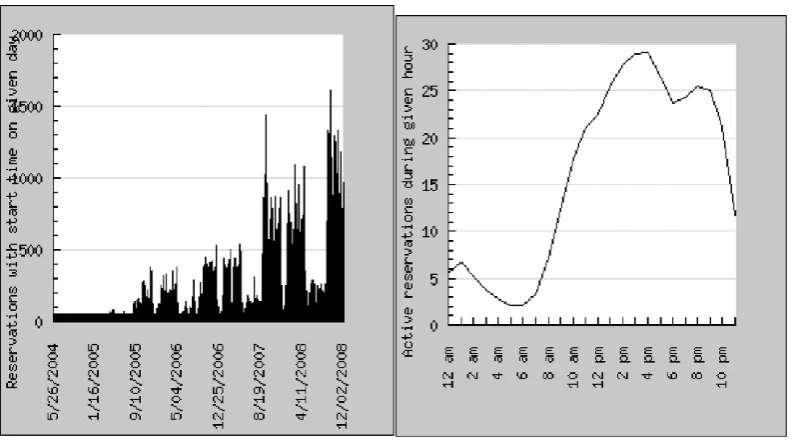
Figure shows utilization of the VCL seat-oriented resources by day over the last 4 years. Currently, the average number of blades participating on the single-seat side is over 200 however, initially it was in the 40-ies. The overall number of reservation transactions covered by the graph exceeds 200,000. A much more agile re-distribution of the resources(perhaps nightly) is possible since we have all the necessary meta-data, but we are not exercising that option right now. This is illustrated in Figure.
It is not clear that this may be a cost-saving measure. Another option is to actually react to the rising issues with data-center energy costs and turn off some of the equipment during the low-usage hours. There are issues there too – how often would one do that, would that shorten lifetime of the equipment, and so on.
Users
The most important Cloud entity, and the principal quality driver and constraining influence is, of course, the user. The value of a solution depends very much on the view it has of its end-user requirements and user categories.
Domain– the K-20 and continuing education –would be expected to:
of student contact hours per year).
b. Support construction and delivery of content and curricula for these users. For that, the system needs to provide support and tools for thousands of instructors, teachers, professors and others that serve the students.
c. Generate adequate content diversity, quality, and range. This may require many hundreds of authors.
d. Be reliable and cost-effective to operate and maintain. The effort to maintain the system should be relatively small, although introduction of new paradigms and solutions may require a considerable start-up development effort.
Developers
Cyber-infrastructure developers who are responsible for development and maintenance of the Cloud framework. They develop and integrate system hardware, storage, networks, interfaces, administration and management software, communications and scheduling algorithms, services authoring tools, workflow generation and resource access algorithms and software and so on. They must be experts in specialized areas such as networks, computational hardware, storage, low level middleware, operating systems imaging, and similar. In addition to innovation and development of new “cloud” functionalities, they also are responsible for keeping the complexity of the framework away from the higher- level users through judicious abstraction, layering and middleware.
Authors
Service authors are developers of individual base-line “images” and services that may be used directly, or may be integrated into more complex service aggregates and workflows by service provisioning and integration experts. In the context of the VCL technology, an “image” is a tangible abstraction of the software stack. It incorporates
a. any base-line operating system, and if virtualization is needed for scalability, a hypervisor layer,
b. any desired middleware or application that runs on that operating system c. any end-user access solution that is appropriate e.g. web, RDP, VNC, etc.
Images can be loaded on “bare-metal”, or in to an operating system/application virtual environment of choice. When a user has the right to create an image, that user usually starts with a“ No App” or a base-line image e.g., Win XP or Linux without any except most basic applications that come with the operating system, and extends it with his/her applications. Similarly, when an author constructs composite images (aggregates of two or more images we call environments that are loaded synchronously), the user extends service capabilities of VCL. An author can program an image for sole use on one or more hardware units, if that is desired, or for sharing of the resources with other users.
provenance collection tools, cloud component aggregations tools, resource mapping tools, license management tools, fault-tolerance and fail-over mechanisms and so on.
It is important to note that the authors, for the most part, will not be cloud framework experts, and thus the authoring tools and interfaces must be appliances: easy-to-learn and easy-to-use and they must allow the authors to concentrate on the “image” and service development rather than struggle with the cloud infrastructure intricacies.
Service Composition
Similarly, services integration and provisioning experts should be able to focus on creation of composite and orchestrated solutions needed for an end-user. They sample and combine existing services and images, customize them, update existing services and images, and develop new composites. They may also be the front for delivery of these new services e.g. an instructor in an educational institution, with “images” being cloud-based in-lab virtual desktops), they may oversee the usage of the services, and may collect and manage service usage information, statistics, etc. This may require some expertise in the construction of images and services, but, for the most part, their work will focus on interfacing with end-users and on provisioning of what end-users need in their workflows. Their expertise may range from workflow automation through a variety of tools and languages, to domain expertise needed to understand what aggregates of services, if any, the end-user needs, to management of end-user accounting needs, and to worrying about inter-intra- and extra-cloud service orchestration and engagement, to provenance data analysis.
The need may range from “bare metal” loaded images, images on virtual platforms (on hypervisors), to collections of image aggregates (environments, including high performance computing clusters), images with some restrictions, and workflow-based services. A service management node may use resources that can be reloaded at will to differentiate them with images of choice. After they have been used, these resources are returned to an undifferentiated state for re-use.
previous resources as needed and then manage their use and release based on an automated workflow.
Users of images that load onto undifferentiated resources can be given root or administrative access rights since those resources are “wiped clean” after their use. On the other hand, resources that provide access to only some of its virtual partitions, may allow non-root cloud users only: for example, a z-Series mainframe may offer one of its LPARS as a resource. Similarly, an ESX-loaded platform may be non-root access, while its guest operating system images may be of root-access type.
End-users
End-users of services are the most important users. They require appropriately reliable and timely service delivery, easy-to-use interfaces, collaborative support, information about their services, etc. The distribution of services, across the network and across resources, will depend on the task complexity, desired schedules and resource constraints. Solutions should not rule out use of any network type (wire, optical wireless) or access mode (high speed and low speed). However, VCL has set a lower bound on the end-to-end connectivity throughput, roughly at the level of DSL and cable modem speeds. At any point in time, users‟ work must be secure and protected from data losses and unauthorized access.
End-users may range from single seat desktops (“computer images”) that may deliver any operating system and application appropriate to the educational domain, to a group of lab or classroom seats for support of synchronous or asynchronous learning sessions, one or more servers supporting different educational functions, groups of coupled servers or environments e.g., an Apache server, a database server, and a workflow management server all working together to support a particular class, or research clusters and high-performance computing clusters.
Conclusions
References
The Grid: Blueprint for a New Computing Infrastructure,2nd Edition, Morgan Kaufmann. ISBN: 1-55860-933-4.
D. GEORGAKOPOULOS, M. HORNICK, AND A. SHETH, “An Overview of Workflow Management: From Process Modeling to Workflow Automation Infrastructure”, Distributed and Parallel Databases, Vol. 3(2). GLOBUS: http://www.globus.org/.
HADOOP: http:// hadoop.apache.org/core/
ELIAS N.HOUSTIS, JOHN R. RICE,
EFSTRATIOSGALLOPOULOS,RANDALL BRAMLEY (EDITORS), Enabling Technologies for Computational Science Frameworks, Middleware and Environments, Kluwer-Academic Publishers, Hardbound, ISBN0-7923-7809-1.
M. HSU (ED.), “Special Issue on Workflow and Extended Transaction Systems”,
IEEE Data Engineering, Vol. 16(2).
IBM, “IBM Launches New System x Servers and Software Targeting Large Scale x86 Virtualization, http://www-03.ibm.com/press/us/en/pressrelease/19545.wss.
IBM, “Google and IBM Announced University Initiative to Address Internet-Scale
Computing
Challenges”,http://www-03.ibm.com/press/us/en/pressrelease/22414.wss
ADVERTISING: THE SOUL OF MARKETING
NISHA TELANGA
ASSISTANT PROFFESSOR IN COMMERCE CMK NATIONAL PG GIRLS COLLEGE, SIRSA
Abstract:
Advertising plays an important role in our everyday life. It mainly determines the image and way of life and it has an impact on our thinking as well as on the attitude towards ourselves and the world around us. According to American Marketing Association "advertising is any paid form of non-personal presentation and promotion of ideas, goods and services by an identified sponsor".
This research characterizes the role of advertising in effective promotion, presents general characteristics of advertising and its mission and describes the basis of the organization of promotional activities as well as how to evaluate the effectiveness of advertising campaigns.
The objective of this paper is to analyze the impact of advertising on the consumer buying behavior. Another goal is to describe the effect of advertising on a product life cycle and find out the right ways and methods of advertising and how to apply them at every stage of the product life cycle. This research studies two important persuasive processes often employed in the management of businesses; Advertising and Marketing Management. Advertising and Marketing Management is necessary in order to have a complete understanding of how producers and sales companies work effectively.
Keywords:Advertising; Innovations; Marketing; Persuasion in marketing; Marketing mix; Personal selling; Promotion.
INTRODUCTION:
The word advertising comes form the Latin word "advertere meaning to turn the minds of towards". The dictionary meaning of the term advertising is "to give public noticeor to announce publicity". This suggests that advertising acts as a marketing vehicle and is useful for drawing the attention of people towards a specific product/service/manufacturer. Advertising can be defined as "any paid form of non-personal presentation and of ideas, goods or services by an identified sponsor."
Advertising is used for communicating business information to the present and prospective customers. It usually provides information about the advertising firm, its product qualities, place of availability of its products.
informative and persuasive in nature. Advertising may be targeted at promoting a new product or designed to promote existing ones. Advertising has become greatly popular and even common place in today‟s world. It is an important tool for business marketing. Consumers can learn every detail information by advertising. Moreover, creative advertisings facilitate businesses to improve their market share.
Features of advertising:
Advertising provides information: The basic purpose of advertising is toprovide information about products/services to prospective buyers. The details of products such as features, uses, prices, benefits, manufacturer's name, and instructions to be followed while using the product are given in the advertisements. However, the information given should be complete and true.
Paid form: Advertising is a form of paid communication.Advertising is published or broadcast because the advertiser has purchased time or space to tell the story of a certain product or service.
Non-personal presentation:Salesmanship is personal selling whereas advertising is non-personal in character. Advertising is not meant for anyone individual but for all. However even in advertising target consumers or target market can be selected for making an advertising appeal.
Idea, goods and services:Advertising is for giving information to consumers: This information is always related to the features and benefits of goods and services of different types. Advertising gives new ideas to consumers as its contents are meaningful.
An Identified Sponsor:A sponsor may be an individual or a firm who pays for the advertisement.
Mass Communication Media: It is designed to convey the concept of multiple messages delivered to groups of people simultaneously.
Basically for persuasion: Advertising aims at persuasion of potential customers.Advertising has psychological impact on consumers. It influences the buying decisions of consumers.
An Art, Science and Profession: It is now universally accepted that advertising is an art, science and a profession. It is an art, as it needs creativity for raising its effectiveness. Advertising is a science as it has its principles and rules. Advertising is now treated as a profession with its professional bodies and code of conduct for members
Important element in marketing mix: Advertising is an important element in marketing mix. Advertising has proved to be of great utility to sell goods and services.
Creativity- the essence of advertising: Advertising is a method of presenting a product in an artistic, attractive and agreeable manner. This is possible through the element of creativity. Without creativity, advertising will a body without a soul.
Profit Maximisation:True advertising does not attempt at maximising profits by increasing the cost but by promoting the sales.
ROLE OF ADVERTISING IN MARKETING:
advertising plays is the informative role. Advertising serves as the channel through which consumers get to know about products and services. Companies involved in the commercial production of goods and services need advertising for several important reasons. The main reason is that advertising helps to publicize and promote their products to the public thereby helping to improve sales.
Moreover Advertising serves as a tool for competition. Advertising has several advantages like promotes products because people become aware of the existence products and services and lead them to making a purchase so sales are increasing. Advertising through creative appeals persuades the public to take action and make a purchase.
The promotion and preservation of the brand image is another role advertising plays in marketing. Advertisingthrough the use of creativity, appropriate media and persuasive tactics can influence consumerscausing them to alter beliefs and desires about particular products or services. Marketing mix consist of four important variables of marketing, i.e. 4Ps-Product, Price, Promotion and Place.
Advertising is an element of promotion. However, it not only assists in promoting the product, but also affects the other variables of marketing mix.Advertising facilitates the introduction of new products. Due to advertising, information about new products is given to theprospects. This creates demand and the manufacturer is able to sell new productsalong with the existing ones.
Advertising spreads information and encouragesconsumers to purchase new products. Various concessions are offered to consumers in the initial period. Advertising creates proper background forpersonal selling. It gives advance information to the prospects. They visit the shopin order to purchase a particular product, which they know through advertisingmedia. The job of a salesperson becomes easy as consumers develop affinity tospecific products. In brief, advertising supports and supplements personal selling. Advertising builds brand image and this develops consumer loyalty towards aspecific brand.
Advertising creates demand and promotes sales.This enables a manufacturer to conduct production on a large scale. This leads toreduction in the cost of production and distribution. As a result, the profit margin of the manufacturer increases.A manufacturer can face market competition effectively andcan make his products popular through advertising. He can removemisunderstanding among consumers about his products through appropriateadvertising.
A manufacturer can build up goodwill and good image in thebusiness world and also among the consumers through advertising. The socialwelfareprogrammes and community service activities can be given wide publicitythrough advertising. Even the progress of the Organization can be brought to thenotice of the public through advertising.Advertising has become an essential marketing activity in themodern era of large scale production and serve competition in themarket.
Advertising message about the utilityof a product enables the people to widen their knowledge. It has contributed a lot towards thebetterment of the standard of living of the society.Advertising provides an important source ofrevenue to the publishers and magazines. It enables to increasethe circulation of their publication by selling them at lower rates.People are also benefited because they get publications at cheaperrates.
Conclusion:
Advertising has become essential to promote sales, tointroduce new product, to create good public, for large scale ofproduction, for educating people etc. Advertising is the integral part of every day's life. Withoutadvertising modern society cannot survive.Advertising is useful tosociety as it encouraging people to purchase goods and services,it bridges the gap among people by communicating varied culturethrough advertising message, it contributes to bring about all rounddevelopment of the economy by increasing demand, it provides opportunities to people to improve their income.
This research is a modest discussion of two highly complex processes advertising and marketing. As shown in this research, advertising and marketing arecommercially driven with the aims of informing the public about goods and services, persuadingpeople to buy, building and maintaining brands as well as maximizing profits for the organization.Advertising thrives on marketing; it is part of the marketing process.
As people increasingly turn to new media as a sourcefor communication, knowledge and business, advertisers and marketers need to tailor their strategiesand tactics in creative and innovative ways to meet the needs of the new generation.
So we can surely say that advertising is a soul of marketing and without which marketing is no more possible.
References:
Adams, K. (2005). The Sources of Innovations and Creativity. USA National Center on Education and the Economy. Available at: http.//www.fpspi.org/pdf/innovcreativity.pdf.
Akrani, G. (2010). 5Ms of Advertising-Features, Role and Advantages of Advertising. Available at: http://kalyan-city.blogspot.com/2010/07/5-ms-of-advertising-advertising.html.
Arens&Bovee(1994): Contemporary Advertising; 5th edition IRWIN; Australia. Belch &Belch(2001): Advertising & Promotion; 5th edition; Tata McGraw Hill. Benson-Eluwa, V. (2004). Advertising: Principles and Practice. Enugu: Magnet
Business Enterprises.
Biel, A. (1993). Converting Image in to Equity Brand Equity and Advertising: Advertising‟s Role inBuilding Strong Brands. New Jersey: Lawrence Erlbaum 67-82.
Boone, L., Kurtz, D. (1995) Contemporary Marketing Plus. Florida: The Dryden Press.
Chowdhury, V.(2011) Advertisements: Advantages and Disadvantages of Advertising http://www.indiastudychannel.com./resources/139778
Dominick, J. (2013). The Dynamics of Mass Communication, New York: McGraw-Hill.
Don Milner(1995): Advertising & Promotion; 1st edition; London.
Drewniary, B., Jewler, A. (2008) Creative Strategy in Advertising. Boston: Thomson Wardsworth.
Drucker, P.F. (1973). Management: Tasks, Responsibilities and Practices. New York: Harper & Row.
Jefkins, F. (1992) Public Relations. London: Pitman Publishing.
Kirmani, A., Zeithmal, V. (1993) Advertising Perceived Quality and Brand Image Brand Equity and Advertising: Advertising‟s Role in Building Strong Brands. New Jersey: Lawrence Erlbaum 143-158.
Kotler, P. (2002) Marketing Management Millenium Edition. Boston: Pearson. Mahendr J Mohan(2002): Advertising Management - Concept & Cases; Tata
McGraw Hill.
Mallory, D. (2013) What is the Difference between Advertising and
Marketing?http://www.wahm.com/articles/what-is-the-difference-between-advertising and marketing. Html.
O‟Shaughnessy, J., O‟Shaughnessy, N. (2004) Persuasion in Advertising. London:Routledge.
Petley, J. (2003) Advertising. Library of Congress Cataloging – in - Publication Data.
Phillips, M., Raspberry, S. (2008) Marketing without Advertising: Easy ways to Build a Business Your Customers. Berkeley: Ralp Warner.
Priya, N., Vishal, M. (2007) What creativity means in Advertising. Available http://www.indianmba.com/Faculty_Column/FC1200/fc1200.html
Saxena, R. (2005) Marketing Management. New Delhi: Tata McGraw-Hill. SarojitDalla (1994): Advertising Today.
Stan Le Roy Wilson (1994); Mass Media/Mass Culture; McGraw Hill.
Thorson, E., Duffy, M. (2011) Advertising: The Principles of Advertising and Marketing Communication at Work. Stamford: Cengage Learning.
Trehan, M., Trehan, R. (2010) Advertising and Sales Management. New Delhi: V.K Enterprises.
Tyagi, C.L., Kumar, A. (2004) Advertising Management. New Delhi: Atlantic Publishers and Distributors.
A STUDY ON ELECTROPHILIC FLUORINATION REACTIONS AND THEIR SIGNIFICANCE
SATPAL SINGH, PGT CHEMISTRY GSSS RAMSARA, FATEHABAD HARYANA
ABSTRACT
There are two main approaches to introducing a fluorine atom directly into a molecule to generate a C-F bond. One is by nucleophilic fluorination, involving a negatively charged fluoride ion. Elemental fluorine is essentially an electrophilic fluorinating reagent. However, there are challenges associated with elemental fluorine, particularly due to its high reactivity and lack of selectivity, as well as its high toxicity. The current paper highlights the electrophilic fluorination reactions.
KEYWORDS:
Electrophilic, Fluorination, Reaction INTRODUCTION
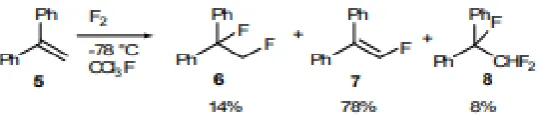
One example is the fluorination of 1,1- diphenylethene 5 which gives a mixture of mono- and poly- fluorinated products 6, 7 and 8
Figure 1: Fluorination of 1,1-diphenylethylene with F2.
However, under controlled conditions, synthesis using diluted F2 in an inert gas such as nitrogen or argon has proven to be very successful. An early example of such a success is the synthesis of 5-fluorouracil and its related analogues. The synthesis of 5-fluorouracil in this way is one of the few syntheses using elemental fluorine, which is still carried out in industry, other than in uranium enrichment.
Due to a general reticence to using F2, a large range of electrophilic fluorination reagents have been developed. In order to create such reagents, several strategies have emerged. One good candidate involves the use of RO-F type compounds, organofluoroxy reagents. An early example was the fluoroxytrifluoromethane, which has been extensively developed and used successfully for the fluorination of pharmaceutical products.
Another example of a popular organofluoroxy reagent is acetyl hypofluorite. In 1981 this reagent was shown to fluorinate aromatic rings. Acetyl hypofluorite has been intensively studied in this regard as well as for addition to double bonds, fluorination of lithium enolates and synthesis of α-fluorocarboxylic acid derivatives from the corresponding carboxylic acids.
Figure 3: Fluorination of methyl phenylacetate 10 with acetyl hypofluorite
Other XO-F electrophilic fluorinating agents have been developed such as perchloryl fluoride FClO3, xenon difluoride, XeF2 or caesiumfluoroxysulfate, CsSO4F. But many have shown a strong oxidising property or selectivity issues which compromises their utility.
ELECTROPHILIC FLUORINATION REACTIONS AND THEIR SIGNIFICANCE
Major progress in the field of electrophilic fluorinating reagents came with the development of the N-F reagents. The main advantage of this class of reagents comes from the lower electronegativity of the nitrogen compared to oxygen, and the corresponding higher strength of the N-F bond compared to the O-F bond. This decreases the electrophilicity of the N-F reagents, giving them improved stability and thus making them easier to handle. We can distinguish three types of N-F electrophilic fluorinating agents: the N-fluoropyrimidiumtriflates and derivatives, the sulfonyl derivatives RSO2N(F)R‟ and Selectfluor® and its derivatives.
The N-fluoropyrimidiumtriflates and derivatives, mostly developed by Umemoto have been used to fluorinate aromatic rings, carbanions, enol ethers and their derivatives. The choice of the counter ion is important and needs to be non-nucleophilic for their stability. Several counter ions have been explored (X- = TfO- , BF4 - , ClO4 - and SbF6 - ) but it was found that triflate has the highest reactivity.
The choice of ring substituents is also important as the fluorinating power increases with the decrease of the electron density of the N+ -F bond, giving access to a wide range of reactivity and selectivity.
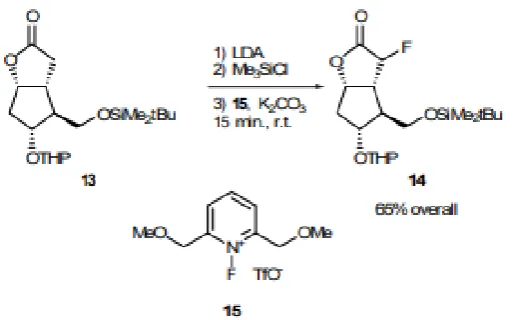
Umemoto reported only one stereoisomer, but unfortunately he was unable to determine the absolute configuration at the stereogeniccentre carrying the fluorine atom.
Figure 4: Preparation of a fluorinated Corey lactone
Since its preparation and study 15 years ago by Banks and co-workers Selectfluor has become a fantastic tool in the area of electrophilic fluorination. Selectfluor is air stable and easy to manipulate. Its reactivity can be tuned by modifying the substituent on the second nitrogen.
In order to increase its reactivity, a stronger electron-withdrawing group is required and the reagents can be classified from the less reactive to strongly reactive: CH3, C2H5, C8H7 < CH2Cl < CF3CH2. They have found a wide range of applications, including fluorination of aryl groups, nucleosides, steroids and other building blocks and organic substrates. With electrophilic fluorination reagents now widely available, the way to prepare αfluorinated carbonyls from enolates emerged, and with it came the challenge of asymmetric fluorination. A wide range of asymmetric fluorinating reagents have been created.
According to the X-ray structure, the nitrogen is highly pyramidalised and the fluorine is anti periplanar to the cyclohexyl group. The five membered ring is in an envelope conformation, resulting in a N-F bond which is almost perpendicular to the plane formed by the atoms S-Caromatic-Caromatic-C. The experimental evidence also suggests the importance of the coordination of the lithium enolate, as the addition of HMPA results in a drop in the enantioselectivity from 74% to 14%.
One limitation of these reagents is that none are commercially available and also the reactions require a stoichiometric quantity of the fluorination reagent. Furthermore, their preparation often requires several steps including fluorination with elemental fluorine or the explosive perchloryl fluoride.
DISCUSSION
preparation of selectively fluorinated compounds from cyclic silyl enol ethers, β-ketoesters, oxindoles, β-cyanoesters and allyl silanes with good yields and moderate to good enantioselectivities (up to 91%, 80%, 84%, 87% and 96% ee respectively).
Attempts at using a catalytic amount of alkaloid failed due to the faster reaction of Selectfluor with carbanions compared to the rate of transfer of fluorine to the alkaloid. This approach is impressive but requires a screening of different cinchona alkaloids for each reaction as the choice of the alkaloid is important for the optimisation of the rate of transfer and thus the enantioselectivity for each substrate. Several studies have shown that the presence of a Lewis acid during the fluorination of 1,3-dicarbonyls with N-F reagents will facilitate enolisation.
The first catalytic enantioselective electrophilic fluorination of a β-ketoester was reported by Togni and Hintermann in 2000 when they screened a series of transition metal complexes as Lewis acid candidates. The best results were obtained using a titanium TADDOL complex with Selectfluor, giving high yields and high ee‟s ranging from 62 to 91% ee on branched βketoesters
The choice of the ester is important, and again, the larger the alcohol used to prepare the ester, the better the resultant enantiomeric excess. A mechanism has been proposed and validated by theoretical studies. The metal complex coordinates the bidentate β-ketoester which leads to a fast enolisation with elimination of chloride. Then the naphthyl group blocks the Re face of the enolate, directing attack to the Si face and giving the S enantiomer as observed.
Metal-mediated fluorinations emerge as a powerful tool to generate C-F bonds in high ee. Although a wide range of compounds can be fluorinated, the method is more often limited to substrates with two binding points, and the product must not be easily enolisable. In order to overcome these limitations, other approaches to enantioselective electrophilic fluorination have also been investigated.
The aryl substituent of the pyrrolidine points towards the enamine, forming preferentially the (S, S) imminium intermediate. The remaining hydrogen atom of intermediate (S, S) is then protected by the bulky aryl substituent, preventing deprotonation by nucleophilic attack of water, and thus preventing the formation of the fluorinated enamine. On the other hand, the hydrogen atom of the disfavoured (R, S) imminium intermediate is situated on the Si-face and can be easily attacked to give to the fluorinated enamine which then leads to racemisation or difluorination resulting in (S) as the products.
Both imidazolidinones show better enantiomeric excesses than the proline derivative catalysts with good yields (54 to 96%) and high enantioselectivities (91 to 99% ee). This method could be applied using a wide range of solvents, including acetone, as long as there is 10% of isopropanol as a co-solvent. Similar to pyrrolidine, the imidazolidinone tolerates bulky substituents at the α-position of the aldehyde, and with a wide range of functional groups such as esters, amines, carbamates, double bonds and aromatic rings.
CONCLUSION
wide range of α-substituted groups, including very bulky groups, but also requires commercially available, easy to use reagents and does not require specialist equipment. REFERENCES