204 | 2017 | ISSUE 1 | VOLUME 12 © 2017 University of Alicante
Deutsche Sporthochschule Köln, Köln, Germany
ABSTRACT
To examine the effect of level of expertise on the flight phase of the straddled Tkatchev we analysed six male gymnasts (mass = 64.0 +/- 3.0kg, height = 1.67 +/- 0.06m) split into three proficiency levels Elite, Intermediate and Beginners. The preparation phase, flight phase and re-grip phase were sub-divided into ten steps that focussed on three different angularities (bar, shoulder and torso). Angular dimensions between the shoulder and torso and leg were measured using digitised points at the shoulder, trochanter major and lateral malleolus using Sportscode Elite (V10, Sportstec, Australia). A one-way ANOVA was conducted to determine differences between the groups. The results found different angles and body positions influence the flight phase of the Tkatchev. A late flexion in the downward phase with a straight position at the vertical line below the high bar influences the following movement of the Tkatchev positively. An early-piked position with a late straight/hyperextension upward phase increases the energy of the gymnast to reach a greater height above the bar. Both come with a shorten time of preparing and increased time during flight phase. By staring the preparing phase of Tkatchev before reaching the handstand position the gymnast also shorten the time of the giant swing. But then the athlete has to be faster in each execution for each segment, especially in hip flexion during the countermovement. The best time of re-grasping the bar is with a bonded body position and at an angle degree of 412°. Key words: GYMNASTICS, BIOMECHANICS, EXPERTISE, ANGULAR-MOVEMENT, TORQUE
1Corresponding author. Sports Performance Research Institute (SPRINZ), AUT, 90 Akoranga Drive, Auckland, NZ.
E-mail: [email protected] Submitted for publication November 2015 Accepted for publication May 2017
JOURNAL OF HUMAN SPORT & EXERCISE ISSN 1988-5202 © Faculty of Education. University of Alicante
doi:10.14198/jhse.2017.121.17
Cite this article as:
Spencer, K., & Schuhmann, M. (2017). The Influence of Body Position on the Straddled Tkatchev’s Flight
Phase in Men’s Horizontal Bar. Journal of Human Sport and Exercise, 12(1), 204-218.
VOLUME 12 | ISSUE 1 | 2017 | 205 INTRODUCTION
This analysis is about a flight element called Tkatchev in the field of apparatus gymnastics. It can be executed in two common ways: straddled and straightened. The third execution is a piked Tkatchev and usually exercised by women.
Apparatus gymnastics has been represented by men and women in Olympia since the first Olympic Games 1896 in Athens. Since then the Fédération Internationale de Gymnastique (FIG) has aided this international sport. During this time some apparatuses have changed. Nowadays ten apparatuses exist in total; four apparatuses for women and six apparatuses for men (FIG, 2013). In the Olympic order women do gymnastics on vault, uneven bar, balance beam and floor. Floor, pommel horse, rings, vault, parallel bars and horizontal bar are challenged by men. Each routine on an apparatus is made up of five element groups with a total skill of ten. Those element groups with its skills are listed in the Code de Pointage (FIG, 2013).
To focus on the research question; the contemplated Tkatchev is a skill of the “flight element” group of the
men’s horizontal bar. The other four element groups besides the flight elements are “Long-hang swings and
turns”, “In-bar elements”, “El-grip and dorsal hang elements” and “Dismounts”. This apparatus is a 2.4m
horizontal bar and 2.6m high which is made of high quality steel and fibre glass. Four steel cables attached to the bar and the ground fix this apparatus. Those four cables and the high quality steel bar make it elastic whereby gymnasts can perform their modern routine.
This analysis refers to the straddled Tkatchev. It is a popular international element which has been performed for approximately 40 years. Many elite athletes and world championship winners such as Fabian Hambüchen, Sam Mikulak and David Bishop have this release element in their routine. Despite its popularity only little research exists.
The Tkatchev can be divided into four phases (Cuk, et. al. 2009);
1. Preparation phase (from handstand to long hang in vertical position) 2. Release phase (from long hang up to the release)
3. Flight phase (from release to re-grasp)
206 | 2017 | ISSUE 1 | VOLUME 12 © 2017 University of Alicante
Picture 1. Straddled Tkatchev: The straddled Tkatchev is described by hang with over-grip swing front-ways, counter straddle reverse, hecht backwards into hang with over-grip swing backways. That means the gymnast travels backward over the bar with a forward body rotation (around the sagittal axis) (FIG. 2013).
Each phase has a biomechanical characteristic (A Arampatzis & Brüggemann, 1999). During the preparation phase the gymnast accumulates as much energy as possible. On one hand that energy is stored in the horizontal bar. On the other hand it comes from the gymnast by lengthening the pendulum. This signifies a larger distance between the bar and the centre of mass. Therefore the torque of inertia (I=m*r²) and the moment of force (F*r) is increased. The result is a higher kinetic energy (kin E=1/2*I*r²) (Kopp & Reid, 1980). The second phase is characterised by a shorter pendulum because of the negative effect of force of gravity on the gymnast. Thus, as much energy as possible has to be saved by the athlete to use it for the translator and rotation of the next phase (A Arampatzis & Brüggemann, 1999). During the flight phase angular moment is constant. An optimal trajectory of the centre of mass is described as a parabola (Cuk, et. al. 2009).
Summary
The aim of the flight phase is to achieve the highest trajectory possible in y-axis to extend the time of flight without shortening or lengthening the distance in x-axis and to let the Tkatchev look aesthetically pleasing. The re-grasping of the high bar is characterised by an optimal body position, not to close, nor too far away of the bar, to continue the routine without making a mistake (Cuk, et. al. 2009).
The aim of this research is to find out how the different body positions during those four phases influence the
Tkatchev’s flight phase. This will involve investigating the point of time of release, the flight duration and the
VOLUME 12 | ISSUE 1 | 2017 | 207 METHODS
The performances were gathered from two different events; at the Gymnastics World Championship 2014 in Nanning and during training at the Gymnastics Performance Centre Tri Star in Auckland in 2015. In both
cases a “Longines” branded horizontal bar was utilised. Performances were recorded using a Panasonic HC
-V500 full HD video camera with 50Hz. The camera recorded the movement of the gymnasts. In total six videos were analysed twice by Sportstec Elite Version software which was used to measure the angles between the bar and the centre of mass. Additionally, the angular dimensions between the shoulder and torso and leg were measured using digitised points at the shoulder, trochanter major and lateral malleolus.
Six male gymnasts (mass = 64.0 +/- 3.0kg, height = 1.67 +/- 0.06m) split into three groups, with a various proficiency level (Elite, Intermediate and Beginners) were analysed. The subdivision of these groups was based upon international level-grouping system. To be in the elite group participants needed to have taken part in the Gymnastics World Championship 2014 in Nanning. The intermediate group competed at the national Championship 2014 in their own country. Beginners were those who started learning the Tkatchev.
To analyse the data between each group a One-Way ANOVA was used to test for significance p <0.05. The reliability of the data collected was determined using the percentage error calculation (Hughes, et. al., 2004) %error=∑[mod(V1-V2)/Vtot]*100%.).
For this research the preparation phase, release phase, flight phase and re-grasp phase were subdivided into 10 steps (Picture 2 and Picture 3). This focused on three different angularities:
• Bar – centre of mass
• Shoulder – torso
• Torso – Hip
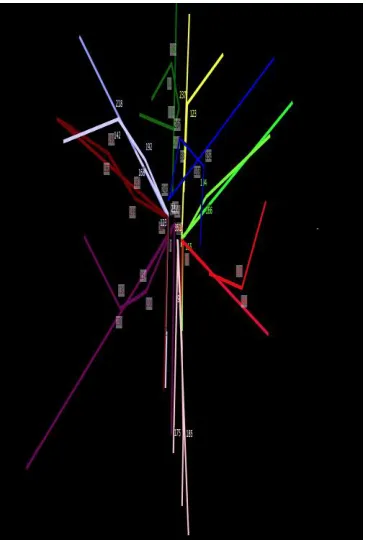
Each step represents a different colour: 1. Handstand – Yellow
2. Flexion downwards (dw) – Karkee 3. Straight downwards (dw) – light green 4. Hyperextension downwards (dw) – red 5. Straight downwards (lh) – light purple 6. Flexion/pike upwards (up) – purple 7. Straight upwards (up) – dark red 8. Release – light blue
208 | 2017 | ISSUE 1 | VOLUME 12 © 2017 University of Alicante
Picture 2. Steps A- E: A shows the handstand position at the beginning in y-axis. Moving forward in a circle B describes the first flexion phase, C the straight position, D the hyperextension an E the straight position in a long hang at the end of the preparation phase.
Picture 3. Steps F-G: F – H represent the release phase with an upwards flexion/pike position in F. G
describes the straight position before the actually release in H with a hyperextension phase. In I the gymnast’s
position above the bare during the flight phase is represented. J shows the re-grasping phase.
RESULTS
Each gymnast’s Tkatchev was analysed by Sportstec Elite Version 10 software (Pictures 4-9). The data for
VOLUME 12 | ISSUE 1 | 2017 | 209
Picture 4. Analysis of the body angles of Elite 1 Picture 5. Analysis of the body angles of Elite 2
210 | 2017 | ISSUE 1 | VOLUME 12 © 2017 University of Alicante
Picture 8. Analysis of the body angles of Beginner 1 Picture 9. Analysis of the body angles of Beginner 2
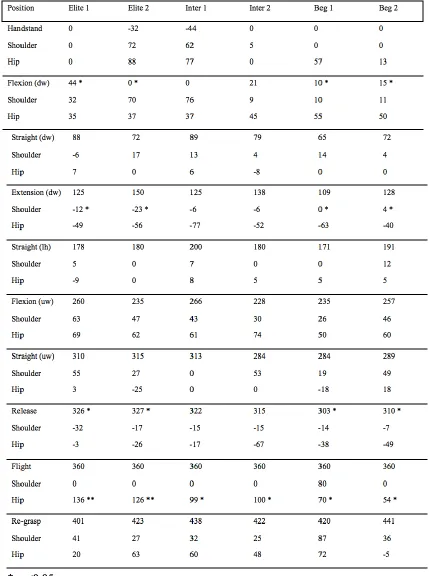
A fully extended body position is assigned an angle value of 0°. The analysis started when the gymnast was in the handstand position (Picture 2a) and had a perpendicular angle of 0° to the y-axis (Table 1). The measurement of the analysis for Elite 2 and Inter 1 started before they passed the longitudinal axis of angle 0° (Table 1 – Handstand position; Picture 5 and 6: orange line). Table 1; Picture 5 and 6 and Figure 1 and 2 show that these two gymnasts reached the piked position of the flexion dw phase before the Handstand position and the flexion dw phase. The giant swing before the release on the high bar characteristically contains two extension phases and two flexion phases at the shoulder and hip joints; the elevation of the arms is defined as a shoulder joint extension (Figure 1 and 2). The hip joint has a third flexion phase due to the straddled position during the flight phase.
VOLUME 12 | ISSUE 1 | 2017 | 211
212 | 2017 | ISSUE 1 | VOLUME 12 © 2017 University of Alicante
flight phase which is documented with a significance of p=0.05 between Intermediate and Elite group and with a significance of p=0.006 between Beginner and Elite group; in all cases a larger angle corresponds to a higher hip and shoulder flexion (Table 1, Figure 1 and 2). The re-grasping phase demonstrates that the Beginners either have an increased piked or hyperextended position in their hips in comparison to the Elites and Intermediates. The same is shown for the shoulder joint of Beginner 1.
Table 2. Duration: In the table the different times of preparing phase and flight phase of each athlete are given in seconds
Duration Elite 1 Elite 2 Inter 1 Inter 2 Beg 1 Beg2
Handstand – Release in sec 1.52s * 1.24s * 1.41s 1.61s 1.75s * 1.84s *
Release – Re-grasping in sec 0.73s * 0.79s * 0.71s 0.68s 0.6s * 0.62s *
* p<0.05
VOLUME 12 | ISSUE 1 | 2017 | 213 -90 -80 -70 -60 -50 -40 -30 -20 -100 10 20 30 40 50 60 70 80 90
-90 0 90 180 270 360 450
d egr ee s h o u ld er
Degree body position
Elite 1 Elite 2 Inter 1 Inter 2 Beg 1 Beg 2 Flexion Extension * p<0.05
Figure 1. Shoulder degree
The x-axis shows 1 ¾ circles around the bar. Some athletes start with their preparation for the Tkatchev before they reach the handstand position at 0°; that is shown by the negative degree. At 360° the gymnast is above the bar during the flight phase. Bigger than 360° shows the re-grasp. The y-axis shows the hyperextension (negative degree) and flexion (positive degree) of the shoulder during the movement show by the x-axis.
* p<0.05; ** p<0.01 Figure 2. Hip degree *
*
214 | 2017 | ISSUE 1 | VOLUME 12 © 2017 University of Alicante
For the two duration times of the “Handstand –Release” and “Release – Re-grasping” phases, data from
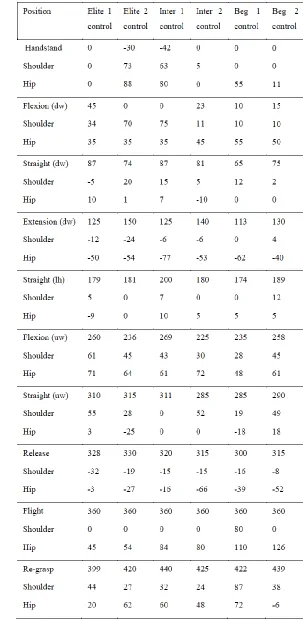
Table 2 were used for V1 and data of Table 4 was used for V2. In this case Table 4 shows the control durations
of each athlete which were also measured after one week.
VOLUME 12 | ISSUE 1 | 2017 | 215
216 | 2017 | ISSUE 1 | VOLUME 12 © 2017 University of Alicante DISCUSSION
VOLUME 12 | ISSUE 1 | 2017 | 217
All the gymnasts had a similar preparation phase from handstand to long-hang. Yet there is a difference at the first flexion phase dw and the hyperextension dw. The beginners and the Intermediate 2 had an early piked position (flexion dw) whereas the Elite 1 gymnast reach this position later in order to increase the torque of inertia more than the others and therefore the duration of the giant swing gets shorter (Table 1, Table 2). This is associated with a significance of p=0.03 (average duration handstand – release: Elite group: 1.38s; Beginner group: 1.79s). Because the Elites have a significantly (p=0.04) larger arch in their shoulder during the hyperextension dw phase than the other groups (Table 1, Figure 1). It was determined that the Elite gymnasts had a higher initial tension on their body which allowed them to get into a better the piked position at the flexion uw phase. At the long-hang straight phase the body should be in a vertical line to 180° fully straighten (Arampatzis, A. & Brüggemann, G. 2001). The Elite gymnasts almost have this position (Table 1). The Beginners are either too far behind or in front of the y-axis with Inter 1 the furthermost. That is because this athlete cannot transfer the velocity of his giant swing into the right movement to reach the straight position. Thus, his piked position at the flexion uw phase is very late (Table 1).
Furthermore, the more angular the hip and shoulder position is at the upward flexion phase the higher the angular velocity and therefore a longer duration of the flight phase. Additionally, the piked position should be taken as early as possible to decrease the torque of inertia. The Elites have these small angular parameters of the hip and shoulder joints and angle of centre of mass to the bar in order to reduce the torque of inertia (Table 1, Figure 1 and 2). The beginners have a lower average angular parameter of the hip and shoulder joints and angle of centre of mass. Therefore there is more negative force which slows down the gymnast’s
duration of preparing. The Intermediate athletes are in between these parameters. Table 2 displays the relationship between the piked position and flight time. The Elite group has the most piked position and the longest duration of flight phase. The degree of flexion facilitates the initial tension to get into the countermovement for the Tkatchev during and after the release. There is no significant difference between the groups at the flexion uw phase but between Elite and Beginner at flight time (p=0.02). But the piked position is not only important; the degree of release is also a main factor to improve the countermovement and flight time (Arampatzis, A. & Brüggemann, G. 2001).
218 | 2017 | ISSUE 1 | VOLUME 12 © 2017 University of Alicante
in each execution for each segment, especially in hip flexion during the countermovement. The best time of re-grasping the bar is with a bonded body position and at an angle degree of 412°.
An interesting future direction for this research would be a comparison between all the angles of each body position and the energy produced by the gymnast and the high bar. Additionally it would be exciting to find out how these angular body segments change while learning a straighten Tkatchev.
REFERENCES
1. Arampatzis, A., & Brüggemann, G. (1999). Mechanical energetic processes during the giant swing exercise before dismounts and flight elements on the high bar and the uneven parallel bars. Journal of biomechanics, 32(8), 811.
2. Arampatzis, A., & Brüggemann, G. (1999). Mechanical energetic processes during the giant swing exercise before dismounts and flight elements on the high bar and the uneven parallel bars. Journal of biomechanics, 32(8), 811.
3. Arampatzis, A., & Brüggemann, G.-P. (2001). Mechanical energetic processes during the giant swing before the Tkatchev exercise. Journal of biomechanics, 34(4), 505-512.
4. Čuk, I. (2009). Tkachev salto on high bar.
5. Hughes, M., Cooper, S., & Nevill, A. (2004). Analysis of notation data: reliability. Notational analysis of sport: System for better coaching and performance in sport, 2, 189-205.
6. Kopp, P., & Reid, J. (1980). A force and torque analysis of giant swings on the horizontal bar.