VOLUME 12 | ISSUE 1 | 2017 | 17
Evaluation of a test module to measure relevant
components of ball release height in jump throws
in team handball
JÖRG M. JÄGER1 , SASCHA GAIL2 , HERMANN MÜLLER1
1 Institute of Sport Science, Justus-Liebig-University Gießen, Germany 2Institute of Sports Science / Sports Centre, University Augsburg, Germany
ABSTRACT
This study aims to analyse different performance factors of jump throws in team handball. These factors cover anthropometric prerequisites (body height and Standing Reach Height – SRH), general jump abilities (Jumping Reach Height during a countermovement jump – JRH), aspects of the jump technique (Ball Height during a handball specific Jump – BHJ) as well as the throwing technique (Ball release Height during a jump Throw – BHT). 36 male team handball players from three different senior leagues were analysed to quantify the extent to which these components vary with competitive levels and playing positions. Additionally, 30 subjects (highest national junior league) were recruited to examine the appropriateness of the components with respect to predicting ball release heights in jump throws. Results show that SRH, JRH, BHJ and BHT differ significantly between leagues and playing positions. Furthermore, the prediction of BHT based on body height, SRH, JRH, and BHJ explained approx. 62 % of the variance in BHT compared to 15 % explained by the traditionally used jump and reach test (JRT). Thus, the factors measured in the test module seem to capture relevant information regarding the level of expertise and may be strong predictors of ball release height in jump throws. Results are discussed with respect to consequences for training and coaching in team handball. Key words: JUMP ABILITIES, PERFORMANCE FACTORS, COMPLEX DIAGNOSIS
1Corresponding author. Institute of Sport Science, Justus-Liebig-University Gießen, Kugelberg 62, 35394 Gießen, Germany. E-mail: [email protected]
Submitted for publication July 2016 Accepted for publication May 2017
JOURNAL OF HUMAN SPORT & EXERCISE ISSN 1988-5202 © Faculty of Education. University of Alicante
doi:10.14198/jhse.2017.121.02
Cite this article as:
18 | 2017 | ISSUE 1 | VOLUME 12 © 2017 University of Alicante INTRODUCTION
Team handball – part of the Olympic Games since 1972 – is very popular in Europe and North Africa (Langevoort, Myklebust, Dvorak, & Junge, 2007; Mohamed, et al., 2009). In this team sport, the players are required to score goals by passing, throwing, catching and dribbling a ball involving basic motor abilities like jumping and running (Milanese, Piscitelli, Lampis, & Zancanaro, 2011). Hence, a multitude of factors such
as the players’ physical capacities and motor skills influence the performance of a team.
Many studies examining the players’ physical capacity focus on anthropometric parameters (e.g. body height,
body mass) and physiological abilities (e.g. endurance, speed, strength), and confirm interdependencies with different competitive levels (e.g. league or division) or playing positions (Chaouachi, et al., 2009; Krüger, Pilat, Ueckert, Frech, & Mooren, 2013; Milanese, et al., 2011; Mohamed, et al., 2009). Research in the area of motor skills focuses on the quality of throwing movements as one of the key factors of individual handball performance (Volossovitch, 2013). Here, the jump throw as one of most frequently applied techniques is of special interest (Wagner, Buchecker, von Duvillard, & Müller, 2010). Consequently, various studies emphasise the kinematic analysis of the jump throw (Ohnjec, Antekolovic, & Gruic, 2010; van den Tillaar & Cabri, 2012; van den Tillaar & Ettema, 2009; Wagner, et al., 2010; Wagner, Pfusterschmied, von Duvillard, & Müller, 2011), leading to a comprehensive kinematic description of jump throws as a major achievement. This provides a thorough insight into the jump throws performed by the analysed athletes and may represent a valuable piece of information for training. For instance, increased trunk flexion and rotation angular velocity during a jump throw may be a promising target for training interventions in order to e nhance performance (Wagner, et al., 2010). Thus, in order to test jump throws in team handball, the test should be able to capture
aspects of a player’s anthropometric characteristics as well as kinematic features of this technique.
Additionally, there seems to be an interdependency between anthropometrics, kinematics, expertise level, competitive level, and playing position.
Very often, the performance of a throw is measured with respect to the ball velocity and throwing accuracy, because these factors are important and have a decisive effect on scoring (Gorostiaga, Granados, Ibanez, & Izquierdo, 2005). In most cases, these quantities are either measured with radar based systems, or motion capture systems and are thus depending on technical equipment which may be cost-intensive. An interesting alternative approach aims to predict the ball velocity based on anthropometric variab les and strength tests (Debanne & Laffaye, 2011). One conclusion that can be drawn is that a remarkable amount of variance (approx. 74 %) of ball velocity may be explained by the multiple regression approach based on the variables which were included in Debanne and Laffaye’s (2011) regression model, such as body mass, medicine ball
throwing distance and force during bench press.
VOLUME 12 | ISSUE 1 | 2017 | 19
countermovement jump is performed with no previous step and the take -off is characterised by a push-off from both feet. Thus, data of a countermovement or squat jump might be an insufficient measure to capture time in the air (as one of the performance factors) and, furthermore, data may not be specific enough to examine the ball release height (which is also of particular interest). Since the usual jump -and-reach-tests do not seem to reflect team handball specific demands appropriately, othe r jump tests are proposed and their relationship to levels of expertise in team handball are studied (Pielbusch, Marschall, Dawo, & Büsch, 2011). These jump tests include jumps with a one-legged take-off (left and right leg) as well as with and without a feint movement. Thus, in order to test jump throws, the test should also be able to measure specific jump aspects besides the usually applied countermovement jump.
Summing up, jump throws in team handball are one of the most important techniques and the ball release height is a crucial aspect. Using solely a countermovement jump to examine the jump abilities of a player is not sufficient, since it is not specific enough for jump throws. Therefore, we propose to use the CMJ as only one aspect in a jump throw diagnosis. Adding different measures and combining these measures to a more complex test module allows to distinguish between different performance factors. These factors assess anthropometrical prerequisites, general jump abilities (based on data of the CMJ), and also some kinematical aspects of the specific jump and throwing techniques (based on the ball height and throw height with a handball specific approach and take-off).
Therefore, the current study comprises two related parts. The aim of the first part was to show that the complex test module proposed in the following methods section measures relevant components of the jump throw, which vary with competitive levels and playing positions. The aim of the second part was to examine the quality of ball release height prediction based on four measured parameters of the test module. This prediction was compared to the prediction based only on the jump height calculated from the countermovement jump to assess, whether it can be improved.
METHOD
Participants
In part one of this study, 36 male team handball players from three different senior leagues participated. 13 (semi-)professional team handball players played at a high national level (the second German division), with 4 backcourt players and 9 others (age: M = 24.5 years, SD = 4.4; height: M = 191.3 cm, SD = 7.7; body mass: M = 89.5 kg, SD = 11.3). 12 participants played at a regional level (fourth German division), with 6 backcourt players and 6 others (age: M = 24.9 years, SD= 4.4; height: 185.9 cm, SD = 5.7; body mass: M = 84.6 kg, SD = 9.1). 11 participants played at a local level (sixth German division) with 6 backcourt players and 5 others (age: M = 22.0 years, SD = 2.2; height: M = 183.7 cm, SD = 7.8; body mass: M = 75.9 kg, SD = 10.8).
For the analysis in part two of this study, 30 additional subjects were recruited leading to a total of 66 subjects. These additional subjects were trainees (junior level) in the highest national league with 10 backcourt players and 20 others (age: M = 16.8 years, SD = 1.2; height: M = 184.8 cm, SD = 8.5; body mass: M = 79.5 kg, SD = 13.0).
All participants had no prior experience with the test module for diagnosing jump throws applied in this study. They gave written consent to participate in this study. This study has received approval from a local ethics committee.
20 | 2017 | ISSUE 1 | VOLUME 12 © 2017 University of Alicante
Each participant performed a standardised warm up procedure starting with 5 min cycling at 1 W/kg and 60
– 80 rpm. This was followed by a specific warm up which included 5 submaximal countermovement jumps, 5 submaximal standing overarm throws, and 5 submaximal jump throws. Stretching was not included in the
warm up procedures. The Molten HX 4000™ (Molten Corp., Hiroshima, Japan) handball was used during
tests (circumference: circa 590 mm; weight: circa 450 g).
VOLUME 12 | ISSUE 1 | 2017 | 21
Besides of body height, four additional variables were measured during the applied complex diagnosis of jump throws. Figure 1 gives an overview of the test module, i.e. the variables, the sequence of their measurement and the instructions given during each test.
The first variable was the standing reach height or stand-and-reach height with feet flat on the ground (SRH,
Standing Reach Height). This variable as well as body height mainly reflects the players’ anthropometric
prerequisites. Hence, it influences performance in team handball, but in turn it cannot be influenced by training interventions. The second variable measured the reach height while performing a countermovement
jump with arm swing (JRH, Jumping Reach Height). It is influenced not only by the athletes’ anthropometric
characteristics but also by their general ability to jump and to explosively contract their lower limb muscles within a stretch-shortening cycle. Although this variable generally reflects the ability to jump, it is non-specific with respect to the kinematics of a jump throw in team handball. Jump throws in team handball usually consist of the approach (up to three steps), take-off (with one foot), flight, throw and landing phases (Ohnjec, et al., 2010). In order to measure a handball-specific jump ability – while still excluding the kinematics of the overarm throw during flight phase – a third variable captured the ball height after a two-steps run-up and a one legged take-off (BHJ, Ball Height during a handball-specific Jump). Besides anthropometrics and a general jump ability, this measure also reflects a handball-specific jump technique. To measure this variable, subjects were asked to start from a self-chosen position, perform a two-steps run-up and then to jump and lift the ball as high as possible while still keeping it in hand. Thus, scores in this variable (BHJ) may be seen as the maximal ball height a player may achieve with his specific jump technique. Finally, a fourth variable measured the ball release height during a complete jump throw (BHT, Ball Height during a jump Throw). In addition to the factors contributing to BHJ, a handball-specific throwing technique is adding to BHT, since the players need to throw the ball instead of just rising it as high as possible. One might expect that actually throwing the ball may lead to a decrease in height compared to BHJ because the arm is usually flexed and not straight like in BHJ. The instruction for BHT was to throw the ball as fast and precisely as possible from a maximal release height.
Target areas were circular (radius approx. 20 cm) and located top right (for right handers) and top left (for left handers), respectively. Four Air-BodysTM (MGT-Sports GbR, Backnang, Germany) were used to simulate
opposing defensive players. They were placed between the player and the goal (75 cm behind the take -off line). The total distance from take-off to goal was approx. 8.1 m.
The whole test procedure was verbally explained. Additionally, video demonstrations were used to clarify the requested movements. A standardised instruction was used to ensure maximal effort of each participant. Every variable, i.e. the SRH, JRH, BHJ, and BHT, was captured with the Training TesterTM. This device
measures reach and ball heights between 211 and 389 cm with 1 cm resolution. Each variable was measured three times. The mean of these three trials was used for further analysis. This system has been demonstrated to be appropriate in previous studies (Gail & Maiwurm, 2013a; Gail & Maiwurm, 2013b).
Statistics
All statistical analyses were done with R 3.0.2 (R Core Team, 2013).
In part one, a MANOVA design was used to find differences in means of the four measured variables (dependent variables: SRH, JRH, BHJ, BHT) with respect to league and playing position (independent variables: league, playing position). In case of multiple comparisons (pairwise MANOVAs, correlation
analyses) Tukey’s post-hoc tests or Holm’s correction methods were used. A single comparison between 2nd
22 | 2017 | ISSUE 1 | VOLUME 12 © 2017 University of Alicante
In part two, bivariate relationships between metric variables were quantified using Pearson’s product-moment correlation coefficient. According to the number of predictors in the three different statistical models, a simple or a multiple regression analysis was used to predict the ball release height. The multiple regression model was evaluated with a 10-fold cross-validation and its precision assessed through the root mean square error.
Statistical requirements with respect to data distribution and residuals were examined prior to hypothesis testing. No indication of a violation of assumptions was found. No cases were eliminated after data screening and no transformations of variables were necessary. Statistical significance was set at p < 0.05 in all cases.
RESULTS
Differences between leagues and playing positions (part one)
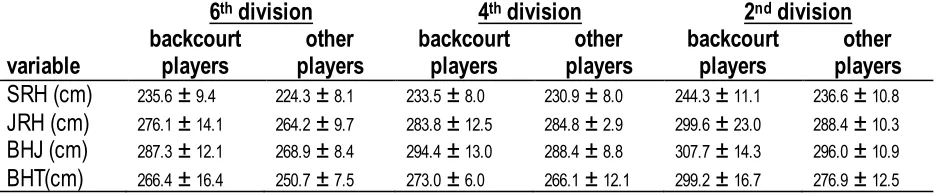
Table 1 shows mean values and standard deviations of measured variables according to leagues (2nd, 4th,
and 6th division) and playing positions (backcourt players vs. other players).
Table 1. Descriptive data of measured variables according to leagues and players’ positions of the N = 36
subjects (Mean values in cm ± standard deviations are shown).
6th division 4th division 2nd division
variable backcourt players players other backcourt players players other backcourt players players other
SRH (cm) 235.6 ± 9.4 224.3 ± 8.1 233.5 ± 8.0 230.9 ± 8.0 244.3 ± 11.1 236.6 ± 10.8 JRH (cm) 276.1 ± 14.1 264.2 ± 9.7 283.8 ± 12.5 284.8 ± 2.9 299.6 ± 23.0 288.4 ± 10.3 BHJ (cm) 287.3 ± 12.1 268.9 ± 8.4 294.4 ± 13.0 288.4 ± 8.8 307.7 ± 14.3 296.0 ± 10.9 BHT(cm) 266.4 ± 16.4 250.7 ± 7.5 273.0 ± 6.0 266.1 ± 12.1 299.2 ± 16.7 276.9 ± 12.5
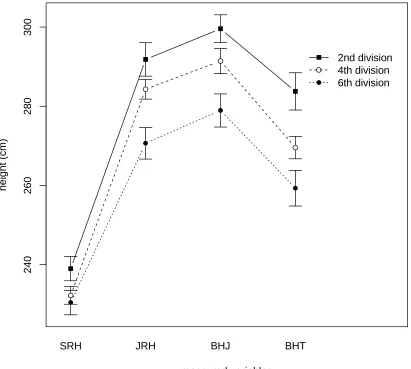
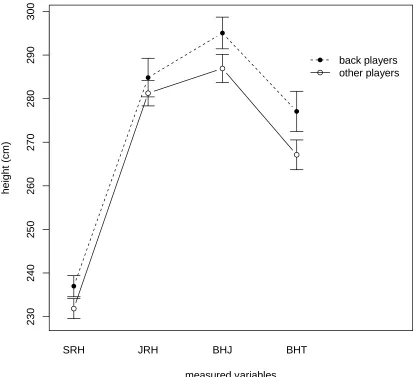
There was a general trend that scores rose with the competitive level of the league (Figure 2). Additionally, backcourt players generally achieved higher scores in all variables, except for 4th division players’ jumping
reach height. However, this exception had no big effect when taking all three divisions into account and comparing backcourt players to other players (Figure 3). Furthermore, figure 2 and 3 show that there was a general increase from SRH to JRH and from JRH to BHJ but a decrease from BHJ to BHT as expected. According to table 1, backcourt players of the 2nd division showed the smallest decrease of height from BHJ
to BHT, which was significantly lower than the decrease of the other players in this professional league (t = 2.41, df = 7.03, p = 0.047).
A two-factorial multivariate analysis of variance (3x2 MANOVA) was performed to test for significant differences in dependent variables (SRH, JRH, BHJ, BHT) between the level-combinations of the independent variables league (factor with three levels: 2nd, 4th and 6th division) and playing position (factor
with two levels: backcourt players and other players). This MANOVA revealed a significant main effect of league (Pillai’s trace = 0.759, F(8, 56) = 4.281, p < 0.001) as well as a significant effect of playing position (Pillai’s trace = 0.348, F(4, 27) = 3.607, p = 0.018). Evidence for an interaction effect (league and playing
position) was not found (Pillai’s trace = 0.159, F(8, 56) = 0.606, p = 0.769). Post-hoc pairwise comparisons
with p-value adjustment according to Holm revealed that the 6th division differed from both the 4th division (p
< 0.01) and the 2nd division (p < 0.01), whereas no difference was found between the two higher leagues (i.e.
the 2nd and the 4th division) (p = 0.257). Thus, the two upper leagues had significantly higher scores than the
VOLUME 12 | ISSUE 1 | 2017 | 23
Figure 2. Differences in means for the variables SRH, JRH, BHJ and BHT according to leagues (bars indicate a pointwise 95 % confidence interval).
Except for the factor playing position as explanatory variable for JRH (F(1, 30) = 2.756, p = 0.107), separate univariate analyses (3x2 ANOVAs) of the four dependent variables confirmed these results and showed both a significant main effect of league and of playing position. Interaction effects of these factors were not
significant in univariate ANOVAs. Tukey’s post-hoc analyses revealed that univariate differences between
2nd and 6th division occured in JRH, BHJ and BHT and additionally between the 2nd and the 4th division in
BHT (p < 0.05).
2
4
0
2
6
0
2
8
0
3
0
0
measured variables
h
e
ig
h
t
(c
m
)
SRH JRH BHJ BHT
24 | 2017 | ISSUE 1 | VOLUME 12 © 2017 University of Alicante
Figure 3. Differences in means for the variables SRH, JRH, BHJ and BHT according to playing positions (bars indicate a pointwise 95 % confidence interval).
Contribution of factors to ball release height BHT (part two)
BHT served as the criterion variable in a multiple linear regression analysis while body height, SRH, SJH, and BHJ served as predictor variables. Summary descriptive statistics of these variables are shown in table 2.
2
3
0
2
4
0
2
5
0
2
6
0
2
7
0
2
8
0
2
9
0
3
0
0
measured variables
h
e
ig
h
t
(c
m
)
SRH JRH BHJ BHT
VOLUME 12 | ISSUE 1 | 2017 | 25
Table 2. Descriptive data of the N = 66 subjects according to the variables used in multiple linear regression.
Variable Mean (cm) SD Min. (cm) Max. (cm)
predictor Body height 186.1 8.1 160.5 201.4
predictor SRH 234.1 10.6 214.0 261.0
predictor JRH 281.1 14.9 244.7 320.7
predictor BHJ 288.4 15.1 253.0 321.3
criterion BHT 267.2 17.3 235.3 312.7
Table 3 shows the full model of the multiple linear regression analysis that was used to evaluate how well the chosen independent explanatory variables (body height, SRH, JRH, BHJ) predict ball release height (BHT). A linear combination of all four predictors was significantly related to BHT and explained approx. 62 % of the variance in BHT (F(4, 61) = 27.41, p < 0.01).
In addition, table 3 shows the results of a simple regression based only on the jump height calculated from
the countermovement jump (ΔJRH-SRH = differences between JRH and SRH), i.e. how much height the players
gained in a CMJ. Although the regression model was significant (F(1, 64) = 12.6, p < 0.01), it only accounted for approx. 15 % of the variance in BHT. Thus, the prediction was drastically improved (from 15 % to 62 %) when using the additional information gained from the test module.
The full model was validated by a 10-fold cross-validation approach. An overall root mean square error (RMSE) of 11.4 cm was obtained.
Table 3. Model summary of the regression analysis including the model equations and the F-values for the overall tests of the regression.
Regression Model
Predictor Variables
Model equation F-value and
degrees of
freedom
P-value Adj.
R2
full model body height, SRH, JRH, BHJ
BHT = 0.34*(body height) –
0.0006*SRH + 0.08*JRH + 0.7*BHJ – 22.45
F(4, 61) = 27.41 p < 0.01 0.62
simple
regression ΔJRH-SRH BHT = 0.85*(ΔJRH-SRH) + 227.47 F(1,64) = 12.6 p < 0.01 0.15
DISCUSSION
This study focussed on jump throws in team handball as one of the key aspects of individual performance in team handball (Volossovitch, 2013; Wagner, et al., 2010). Instead of throw velocity (Debanne & Laffaye, 2011), precision, or a comprehensive kinematic description, we focussed on different factors that promote ball release height during a jump throw, because these are important parts of this technique as well (Cardinale, 2014).
Different variables were measured which were supposed to capture anthropometric prerequisites (SRH), jump ability in general (JRH), specific aspects of jump technique (BHJ), and the main criterion ball release height (BHT). Training TesterTM served as a measurement device that has previously been found to be an
26 | 2017 | ISSUE 1 | VOLUME 12 © 2017 University of Alicante
Part one: The proposed jump throw diagnosis we applied in this study was able to detect differences in measured variables according to both competitive level and playing positions (with respect to backcourt players vs. other playing positions). This is in accordance with studies that found comparable results, for instance in anthropometric, physical, or physiological profiles of handball players according to expertise level and playing positions (Chaouachi, et al, 2009; Milanese, et al., 2011). By capturing this information, the test module may be suitable to evaluate training intervention in future applications with respect to vertical jump ability, handball specific jump technique or throwing technique.
Summary statistics of these measurements may give a first suggestion of the level of performance that could be expected from a given team handball player. As a consequence, this may help to personalise training in order to improve the ball release height during a jump throw. As an illustrative example, supp ose two backcourt players in elite team handball (2nd division) achieve the following data: Player A has a standing
reach height (SRH) of 244 cm, a jumping reach height (JRH) of 289 cm (increase of 45 cm) and is able to raise the ball 297 cm (another increase of 8 cm) after a two steps approach and a single leg take-off (BHJ). By comparing the individual value of the athlete (45 cm) to the mean value in his peer group (55 cm, see table 1), one might be inclined to interpret this as a deficit in general jump ing ability and recommend an unspecific lower limb strength training to generally improve explosive strength in leg extensors. For another elite backcourt player (Player B) with the same SRH of 244 cm, the same BHJ of 297 cm but a different JRH of 299 cm (10 cm more than player A), consequences for training would be different: A general strength training may not be particularly beneficial, since the player B already outperforms the expected 55 cm (mean value of reference group) from SRH to JRH. Training of the specific team handball jump technique may be more efficient in this case, because player B is not able to increase height from JRH to BHJ, as most of the players in that league achieve. For player B, this indicates a lack of sufficient team handball sp ecific jump technique. Training of the two-steps run-up and one-leg take-off for a vertical jump could be more appropriate for this player. To draw a conclusion, although both players have the same score in BHJ, their training to further improve jump performance would differ substantially based on the results of the test module.
Descriptive data may provide even more information. They show that decrease from BHJ to BHT in 2nd
division backcourt players is less than in any other factor level combination. This can be interpreted as a clear indication that those players have developed a position specific throwing technique allowing them to release the ball higher than the players on other positions (even if these would have comparable body height as well as general and specific jump abilities). However, although we have studied a considerable number of subjects in our study, we tend to be careful with any direct recommendation for training and more data seems to be needed for these purposes.
VOLUME 12 | ISSUE 1 | 2017 | 27
It seems reasonable that at least two further aspects contribute to the unexplained variance of 38 %: Firstly, the lack of information about throwing technique may account for a substantial part, although it seems to be limited to the upper bound of approx. 40 %. Secondly, an unexplainable (random) error variance may also be a part of it, because no athlete is able to repeatedly perform identical jump throws with identical BHTs.
However, the thorough analysis of kinematics remains an important aspect for gaining insight into the technique of interest (van den Tillaar & Cabri, 2012; van den Tillaar, & Ettema, 2009; Wagner, et al., 2010; Wagner, et al., 2011).
CONCLUSIONS
In our study we aimed to validate a specific diagnostic test module for handball jump throws by showing that the measured variables are able to reveal relevant performance differences between leagues and playing positions (part one of the study) and, taken together, explain most of the variance (62 %) in ball release height (part two of the study).
With respect to these validation criteria, our specific test module clearly outperforms the traditionally used unspecific jump and reach test (JRT). Information based on the data of the JRT did only explain 15 % of the variance in ball release height.
This underlines the necessity to use a more complex and specific diagnosis for jump throws than only the countermovement jump used in the jump and reach test.
ACKNOWLEDGEMENTS
This work was in part supported by the Federal Institute of Sports Science under Grant IIA1-070512/13. The authors thank Dr. Gerrit Eichner from the Mathematical Institute of the Justus-Liebig-University Gießen for support and discussions with respect to statistical analyses. Furthermore, we thank the German Handball Association as well as Dr. Mathias Reiser, Dr. Franz Marschall, and PD Dr. Dirk Büsch for their cooperation in this study.
CONFLICT OF INTEREST
The authors do not have any financial interest or benefit arising from this research.
REFERENCES
1. Cardinale, M. (2014). Strength training in handball. Aspetar Sports Medicine Journal, 3(3), 130-134. 2. Carvalho, A., Mourao, P., & Abade, E. (2014). Effects of strength training combined with specific
plyometric exercises on body composition, vertical jump height and lower limb strength development in elite male handball players: a case study. Journal of Human Kinetics, 41, 125-132.
3. Chaouachi, A., Brughelli, M., Levin, G., Ben Brahim Boudhina, N., Cronin, J., & Chamari, K. (2009). Anthropometric, physiological and performance characteristics of elite team-handball players.
Journal of Sports Sciences, 27(2), 151-157.
28 | 2017 | ISSUE 1 | VOLUME 12 © 2017 University of Alicante
5. Gail, S., & Maiwurm, P. (2013a). Validity of an electronic based system (Training Tester) to measure the release height at the team handball jump throw. International Journal of Sports Science, 3(6), 229-232.
6. Gail, S., & Maiwurm, P. (2013b). Validity of an electronic based system (Training Tester) to measure vertical jump performance. International Journal of Sports Science, 3(6), 241-244.
7. Gorostiaga, E. M., Granados, C., Ibanez, J., & Izquierdo, M. (2005). Differences in physical fitness and throwing velocity among elite and amateur male handball players. International Journal of Sports Medicine, 26, 225-232.
8. Ingebrigtsen, J., & Jeffreys, I. (2012). The relationship between speed strength and jumping abilities in elite junior handball players. Serbian Journal of Sports Sciences, 6(3), 83-88.
9. Krüger, K., Pilat, C., Ueckert, K., Frech, T., & Mooren, F.-C. (2013). Physical perfomance profile of handball players is related to playing position and playing class. Journal of Strength and Conditioning Research, 28, 117-125.
10. Langevoort, G., Myklebust, G., Dvorak, J., & Junge, A. (2007). Handball injuries during major international tournaments. Scandinavian Journal Medicine & Science in Sports, 17(4), 400-407. 11. Marques, M. A., & González-Badillo, J. J. (2006). In-season resistance training and detraining in
professional team handball players. Journal of Strength and Conditioning Research, 20(3), 563-571. 12. Milanese, C., Piscitelli, F., Lampis, C., & Zancanaro, C. (2011). Anthropometry and body composition of female handball players according to competitive level or the playing position. Journal of Sports Sciences, 29(12), 1301-1309.
13. Mohamed, H., Vaeyens, R., Matthys, S., Multael, M., Lefevre, J., Lenoir, M., et al. (2009). Anthropometric and performance measures for the development of a talent detection and identification model in youth handball. Journal of Sports Sciences, 27(3), 257-266.
14. Ohnjec, K., Antekolovic, L., & Gruic, I. (2010). Comparison of kinematic parameters of jump shot performance by female handball players of different ages. Acta Kinesiologica, 4(2), 33-40.
15. Pielbusch, S., Marschall, F., Dawo, O., & Büsch, D. (2011). Handballspezifische Sprungdiagnostik.
Leistungssport, 41(6), 35-38.
16. R Core Team. (2013). R: A language and environment for statistical computing. R Foundation for Statistical Computing. Retrieved from http://www.R-project.org/
17. van den Tillaar, R., & Cabri, J. M. (2012). Gender differences in the kinematics and ball velocity of overarm throwing in elite team handball players. Journal of Sports Sciences, 30(8), 807-813. 18. van den Tillaar, R., & Ettema, G. (2009). Is there a proximal-to-distal sequence in overarm throwing
in team handball? Journal of Sports Sciences, 27(9), 949-955.
19. Volossovitch, A. (2013). Handball. In T. McGarry, P. O'Donoghue, & J. Sampaio (Eds.), Routledge Handbook of Sports Performance Analysis (380-392). London: Routledge.
20. Wagner, H., Buchecker, M., von Duvillard, S. P., & Müller, E. (2010). Kinematic description of elite vs. low level players in team-handball jump throw. Journal of Sports Science and Medicine, 9, 15-23.
21. Wagner, H., Pfusterschmied, J., von Duvillard, S. P., & Müller, E. (2011). Performance and kinematics of various throwing techniques in team-handball. Journal of Sports Science and Medicine,
10, 73-80.