E-ISSN 2308-9830 (Online) / ISSN 2410-0595 (Print)
Taking Binary Error Rate into Account to Improve OLSR Protocol
Tiguiane Yélémou1, Philippe Meseure2 and Anne-Marie Poussard3
1 Polytechnic University of Bobo-Dioulasso, Burkina Faso 2, 3 University of Poitiers, XLIM-SIC CNRS Lab, France
1
[email protected], [email protected], [email protected]
ABSTRACT
This paper presents BER-OLSR, an enhanced OLSR protocol. We modify OLSR standard route choice and Multi-Point Relays (MPR) selection processes. Particularly, our new protocol takes into account Bit Error Rate (BER) of links during MPR selection and routing table calculation. MPR set of a node is populated so that access to each 2-hop-neighbor is ensured by the best path in terms of BER. For routing table calculation, lowest BER is privileged over lowest number of hops. Performances of this protocol are evaluated by simulation with realistic propagation and mobility models. We show that this new approach of OLSR routing protocol provides better packet delivery ratio and delay than the original OLSR algorithm, even in unfavorable conditions such as mobility or several interfering communications.
Keywords:Wireless Networks, Routing Algorithm, Quality of Service, Binary Error Rate, OLSR.
1 INTRODUCTION
Ad hoc wireless networks are characterized by their unstable topologies. This is particularly due to the presence of obstacles in the propagation field that helps to amplify the radio signal attenuation and multipath effects. These phenomena, coupled with sharing of radio channel and mobility of node inherent to Mobile Ad hoc NETwork (MANET), induced bad transmissions. The average bit error rate (BER) in a wireless environment has an order of magnitude about 10-3 against 10-9 in a wired network [1]. Nevertheless, the BER is seldom directly used in the computing of routes between nodes, contrary to more immediate metrics such as delay or number of hops. Due to the transmission context, wireless networks fail to provide a quality of service able to fulfill the strict requirements of multimedia applications. Considering this challenge, the routing protocols play a crucial role. Using routes with bad BER can lead to a high packet loss rate and high delay since the MAC layer tries to send packets several times when errors have been detected [2]. This last behavior is especially met when large packets are transmitted.
To overcome this problem, BER-OLSR is proposed [3]. We aim at testing the effectiveness of this QoS-based protocol. In our methodology, we have heavily relied on simulation to show the efficiency of this approach. In particular, we chose
to base the simulation on a realistic propagation model that allows us to show the real impact of bad BER in ad-hoc routing protocols and to compute a more precise BER for each link. After conducting tests with single communication in static situation, we test the robustness of this algorithm under multi-communication and mobility effects. For mobility, we use VanetMobiCim [4], a realistic mobility model taking into account the interaction of moving objects with surrounding obstacles and with other moving objects.
The remainder of the paper is organized as follows: in Section 2, we present the related work and explain our objectives. We present in Section 3 our BER-based approach to take into account links BER in MPR selection and in routing table calculation for OLSR enhancement. After giving details about the simulation environment in Section 4, we discuss the simulation results in Section 5 before concluding.
2 POSITIONING OF OUR SOLUTION
AA Related Work
that can broadcast topology control (TC) messages. A node selects its MPR set such that all its 2-hop-neighbors are reached. The standard algorithm of MPR selection in OLSR is detailed below [5].
Instead of forwarding any broadcast packet, a node forwards this packet only if it comes from a neighbor that selected it as its MPR. It is clear that the smaller this MPR set is, the more efficient the broadcast will be. Nevertheless, the MPR selection process does not take into account links quality. Furthermore, OLSR considers that only links between nodes and their MPR should be announced in TC messages. This approach reduces the size of TC messages and therefore control messages overhead, but implies that routing algorithms are based on a subset of network links. Thus, we understand that MPR selection plays a major role, since it influences both broadcast and unicast diffusion. Considering our QoS objectives, it seems desirable to choose MPR so that good links are advertised instead of poor quality links, so the MPR selection should heavily rely on link quality. One of the most recent official reports on OLSR is RFC 3626 [5]. The standard algorithm of MPR selection in OLSR, presented earlier, considers the number of covered 2-hopneighbors and the degree of a neighbor to select it as MPR.
Some variants of this algorithm try to take into account quality of selected links. Munaretto et al. [6] and Ge et al. [7] propose a modification of selection process by selecting nodes with good quality links in terms of bandwidth as MPR. In the same idea, Ingelrest et al. [8] suggested to qualify links with the probability of correct reception to reflect fluctuations due to attenuations caused by obstacles. To mathematically model this prob-ability, the ―lognormal shadowing model‖ is used. The probability of good reception is then considered during MPR calculation. As a metric, Esposito et al. [9] advocate the use of ETT metric instead of ETX metric [10] also used in OLSR. All these metrics are based on the link PDR.
Nevertheless, PDR metric heavily depends on the size of the considered packets. BER is definitely a more objective metric of the link quality.
Besides, to better take into account mobility in MANETs, several modifications of OLSR have been proposed. Examples include fast-OLSR [11], PRD-OLSR [12] and KMPR [13], each with different mobility criteria. Finally, another point that impacts the probability of successful packet reception in wireless networks is interferences implied by other communications [14]. As pointed out by Gupta and Kumar [15], performances degrade as the number of nodes increases because each node has to share its radio channel with its neighbors. Thus, in order to route data packets over non-congested links and maximize overall network throughput, a protocol should use the maximal available capacity of the multiple calculated routes. On this subject, Jain et al. [16] advocate that routing or transport protocols in ad hoc networks should provide appropriate mechanisms to push the traffic further from the center of the network toward less congested links. Some researchers emit important assertions about the correlation between the number of nodes and source-destination throughput. Gupta and Kumar show in [15] that as the number of nodes n increases, the throughput per source-destination pair decreases approximately as O(1=n). Hekmat and Van Mieghem model [17] reveals the existence of a network saturation point, beyond which the network throughput no longer increases according to the number of nodes.
AB Principles of Our Contribution
Our objective is to base OLSR on an additional metric, namely the binary error rate. This metric must be taken into account in route calculation but also in MPR selection process. In our approach of MPR selection, a 2-hop-neighbor is considered covered only by the neighbor offering the best path in terms of BER. This allows the algorithm to consider BER as the most important value to minimize above all other metrics. In a preliminary presentation of the algorithm [3], the basic ideas have been detailed and restrictive simulation results were exposed. In this paper, we present the complete simulation results, including multi-communication and mobility situations to show the effectiveness of our algorithm in realistic conditions. Besides, simulation hypotheses have a major impact on the analysis of the effectiveness of a protocol [18][19]. Here, we aim at studying the protocol properties through simulations that are as much realistic as possible. Indeed, if this is admissible to simulate the behavior of a routing protocol in basic environments (no obstacle, simple Determine N (symmetric neighbor) et N2 (2hop
neighbors )
St ep 1 : Include in MPR set ( empty at start) , t he elements of N with willingness = ’Always ’
Step 2: Include in MPR set each element of N that is the only one to provide an access to a given node in N2 Step 3: Include in MPR set elements of N with ( order of priority ) :
- Largest additional willingness - Greater coverage of N2 nodes - The greatest degree
propagation model), such hypotheses are too restrictive and not convenient to experiment quality of service: Simulation should compute correct attenuation and error rate by taking into account obstacles, multipath effects, etc. Our simulation includes both a semi-deterministic propagation model based on a 3D ray tracing and the modeling of an environment with obstacles and different materials. Moreover, we consider (large) data packets instead of control messages whereas most previous algorithms [8][9][10] measure the packets delivery ratio in terms of number of Hello packets actually transmitted. Since small-sized packets (e.g. Hello messages) are less vulnerable to noise, their transmission succeeds more often than large sized packets one. Also delay metric based on smaller control packets than data packets is not suitable in situation taking into account link quality. Paths where these control packets are successfully transmitted can involve several attempts when bigger data packets are sent. Thus, taking only control messages into account does not reflect the capability of a network to support a given quality of service.
We also point out that research work that focused on OLSR performance in situations of mobility, used unrealistic mobility models: speed is usually constant and interactions between mobile entities are not considered. It is shown in [20] that mobility model may drastically affect protocol performances. In [21], Hamma et al. use Proba Walk and Modified Random Direction mobility models [22] to compare performances of AODV, DSR and OLSR. In [23], Haerri et al. use the simulation model VanetMobiSim [4], but do not consider obstacles, that yet affect links quality. Also these authors used a network where the average number of hops of the used paths is 2. This definitely does not permit to observe OLSR routing capabilities (since 2-hop-neighbors are known by each node through Hello message exchange and routing tables are not really exploited). For our part, we use the same realistic mobility model [4], but consider longer paths.
3 INTRODUCING BER IN OLSR
In order to enhance OLSR by taking BER into account, we propose to modify both MPR selection and routing algorithms. As shown in [3], both algorithms must be adapted. With MPR mechan-ism, a node has a partial view of the network. It is preferable to be the best links (lowest BER) that are known. They are potentially used for routes calculation. Also, routes calculation process should consider BER as a potential metric to compute
shortest path, instead of metrics such as number of hops or delay. In the algorithms presented below, we consider an additive metric based on BER [24], and even more, we show in Appendix A that BER in itself can be used as an additive metric. The next two subsections present the proposed modifications.
A. A BER-Based Approach of MPR Selection
To change MPR selection, BER-OLSR operates from the second step of standard MPR selection mechanism [5] instead of the third step as widely done. Indeed, Busson et al. [25] show that 75% of MPR are selected at the second step, so a modification at the third step appears too late in the algorithm. To modify both steps, our approach use a different strategy from OLSR when considering a 2-hop-neighbor as covered. Such a node is considered so and extracted from N2 only if the newly-selected MPR is the intermediate hop along the best path in terms of BER between the MPR selector and its 2-hop-neighbor.
At the second step of this BER-based approach of MPR selection, a node, alone to offer access to a 2hop-neignbor, is chosen as MPR but another 2hop-neighbor accessible by this new MPR is considered covered only if the path toward this selected neighbor is the best. At third step, the lowest BER path (score) is privileged to the highest number of 2-hop-neighbor covered by the neighbor. This algorithm tries to respect the overall structure of the original MPR selection. But it mainly consists in considering a 2-hop-neighbor covered only by the neighbor offering the best path in terms of BER.
B. BER-based Approach of Routing Table Calculation
Since only links with MPR selector neighbors are announced over the network by means of topology control (TC) messages, the BER-based MPR selection mechanism ensures that good links are available for data transmissions. However, this is not sufficient to guarantee an efficient routing [3]. Indeed, route selection algorithm should now privilege good paths in terms of BER.
Indeed, considering MAC retransmissions due to binary errors, a bad link appears equivalent to a multi-hop path. A trade-off metric considering both BER and the number of hops is surely desirable but takes into account the probability that packets should be transmitted several times over bad links. It therefore heavily depends on the size of the packets and on the type of application so is hard to calibrate in practice.
4 SIMULATION CHOICES AND HYPOTHESES
Our simulations need to rely on a realistic basis to take the impact of BER into account correctly. The experimental conditions are detailed in this section.
A. Performance metrics
Three important performance metrics for MANET are measured: Packet Delivery Ratio (PDR), average end-to-end delay of data packets and Normalized Oversize Load (NOL). PDR is the ratio of the number of successfully delivered data packets over the number of sent data packets. Delay concerns only successfully-delivered packets. NOL is the ratio of the number of control packets over the number of successfully delivered data packets. We decided to focus only on data packets since control packets are rather small and are more likely to be received correctly. Taking only control packets into account tends to artificially raise the ratio, which should be avoided in any QoS study. B. Experimental setup
Most research studies rely on simulation to show the effectiveness of their approach. However, they do not take into account any environment when modeling propagation channel. They rely on the unit disk graph and suppose that two nodes can communicate if the distance between them is below a given communication radius. Often, only the direct ray between transmitter and receiver is considered and no obstacle disturbs transmissions. Furthermore, other effects such as multiple paths induced by the environment cannot be taken into account although they highly influence the quality of received signals. The two-ray-ground approach is quite simplistic to compute such interferences. Shortly, if the environment is not considered, the obtained results are biased and rather optimistic. The influence of bad links is thus underestimated. To compute more significant simulations, we must use a realistic model of wave propagation taking into account the environment. Therefore, we
enhanced NS2 [26] with a raytracer simulator that has been developed at the XLIM-SIC laboratory [24]. Our BER-based protocols directly rely on BER values computed by this software. An additional field about link quality has been included in neighbors records. In our implementation, TC messages have been extended to support and broadcast the BER of advertised links.
The global parameters for the simulations are given in Table 1.
Table 1: Simulation parameters
Parameters Values
Network simulator ns 2
Simulation time 150s
Simulation area 1000m*1000m
Transmittion power 0.1w
Data types CBR
Data packet size 512 bytes
MAC layer IEEE 802.11a
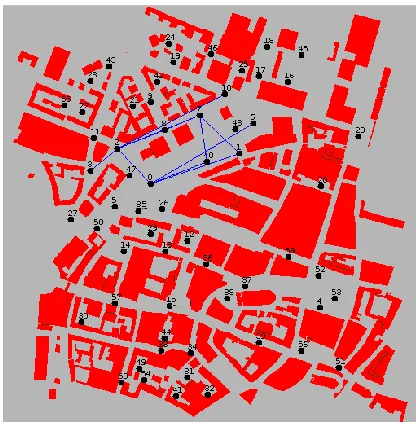
We have also used a realistic model of the Munich town (urban outdoor environment, see Fig. 1). In this figure, obstacles (building, etc) are printed red, points represent nodes and lines depict communication paths.
Fig. 1. Simulation environment when number of nodes is 60. Obstacles are printed red.
5 SIMULATION RESULTS
A. Fixed Nodes Scenario
To carry out our simulation and experiment the effectiveness of our new protocol, we focus on packet delivery ratio (PDR) measurement and the paths used during data transmissions.
In this section, nodes are fixed. This fixed nodes scenario facilitates the study of paths selected by nodes during routing process. In the presented environment (Fig. 1), node 0 transmits data to node 7. By adding more nodes to the network, MPR sets must be adapted since new neighbors and 2-hop neighbors appear. Additional routes between 0 and 7 can appear and be used. Note that the number of nodes is not significant in itself in the presented charts, but is convenient to check which nodes have been added to the simulation network.
Fig. 2 shows the PDR performance of protocols according to the number of nodes. We observe that BER-OLSR outperforms OLSR-3626 (standard OLSR), since it chooses better paths in terms of BER. We also observe that, unexpectedly, the PDR does not increase as new nodes and therefore new potential paths appear. This phenomenon results from incessant changes of selected paths by each router. Indeed, we introduce (large) data packets that are more subject to communication failures. The link-state system takes into account these failures to choose more adapted paths. On OLSR-3626 curve, one can notice a remarkable drop of PDR value between 40 nodes and 50 nodes which BER-OLSR does not exhibit.
Table 2 helps to understand this situation. We note that path 0 → 6 → 7, due to the poor quality of link 0→ 6, causes the largest number of packet loss. With BER-OLSR, this path is avoided.
To better understand this phenomenon, we analyze what happens when ten new nodes are added. Node 7 gets node 6 as new MPR, because it offers a better access to the 2-hop-neighbor 35 newly introduced (and not for node 0). 6 advert in its TC messages that it can reach node 7. Thanks to this information, node 0 uses path 0 → 6 → 7 to transmit packets. But link 0 → 6 has a poor quality (high BER), this leads to a significant loss of packets and then a bad PDR for this case. Contrary to node 0, node 35 would take benefit of a good communication with node 7 using path 35→ 6 →7.
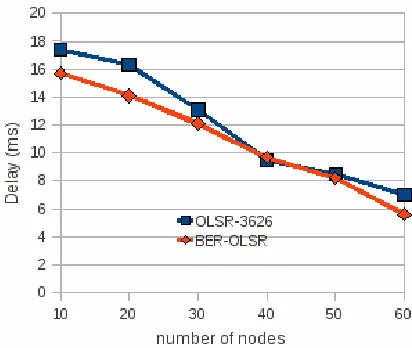
With standard OLSR, bad routes may be chosen when new nodes and then new paths toward the destinations appear in the area. This is avoided when routing table calculation takes into account links quality. In this case, with BER-OLSR, node 0 chooses node 40 to joint node 7 with a global BER near 0.0. Moreover, Fig. 3 shows that BER-OLSR delay is better because it uses paths inducing less retransmissions. The good results of BER-OLSR
for communications between 0 and 7 can be generalized to other communications, in different transmission conditions and contexts.
Fig. 2. Evolution of PDR According To the Number of Nodes in Fixed Scenario.
Fig. 3. Evolution of Transmission Delay According to the Number of Nodes in Fixed Scenario.
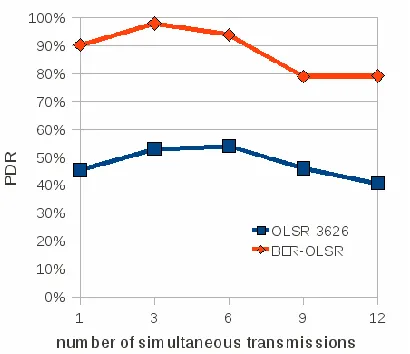
In Fig. 7, we find that the BER-OLSR PDR is in average twice better than standard OLSR (see OLSR_3626_average and BER_OLSR_average for up to 12 several different communications).
(NOL) and second, the average ratio of the number of MPR to the number of neighbors.
The evolution of Normalized Oversize Load based on the number of nodes is given in Fig.4. NOL curve shows that the BER-based MPR selection heuristic is slightly better than original OLSR one.
In Table 3, we present the average percentage of neighbors needed as MPR. We note that more neighbors are indeed used as MPR in our new MPR selection mechanism compared to standard OLSR, since more neighbors are usually needed to provide better routes toward 2-hop-neighbors. However, the difference remains reasonable. BER-OLSR needs more neighbors than OLSR-3626 but the difference is never beyond 9 points (Table 3).
Table 2: Paths taken with their BER value and Number of Successfully-delivered Packets (NSP) and Number of Failed Packets (NFP) with 50 nodes
Algori thmes
Paths global
BER
NSP NFP
OLSR -3626
0 → 1 → 7 0 → 2 → 7 0 → 6 → 7
4,37E-5
5,27E-5
0,0018 237
685
21 0
31
39
BER-OLSR
0 → 1 → 7 0 → 2 → 7 0 → 2 → 8 → 7 0 → 40 → 7
4.37E-5
5.27E-5
6.94E-6
0.0
2
147
10
834 0
6
0
0
Table 3: Average percentage of neighbors used as MPR.
number of nodes OLSR-3626 BER-OLSR
10 47.41% 51,11%
20 59.86% 67,98%
30 45.09% 54,08%
40 47.18% 58,29%
50 45..74% 51,47%
60 41.77% 46,73%
B. Multi-communication impact
The results shown in previous section rely on a single source-destination pair communication. In this section, we study the impact of multi-communication (simultaneous transmissions) on BER-OLSR protocol with static nodes. We increase the number of simultaneous source-destination packets transmission and measure the effects on performance metrics. The number of nodes in the area is fixed to 60. Other parameters remain the same.
Fig. 5. Impact of multi-communications on PDR.
Fig. 6. Multi-communication impact on Delay.
Fig. 7. Multi-communication impact on BER-OLSR PDR and compared with standard OLSR.
BER-OLSR behaves twice better than the original BER-OLSR algorithm in terms of PDR, and is therefore more resistant to multi-communications. The multicommunication significantly increases communication delays as shown in Fig. 6, but, more reasonably using BER-OLSR. To highlight the effect of multi-communication on this BER-based routing protocol, we compare in Fig. 7 the PDR of simultaneous communications with isolated
ones. Curves OLSR_3626_simulta and
BER_OLSR_simulta represent simultaneous communications, relying on selected source-destination pairs. Curves OLSR_3626_average and BER_OLSR_average represent averaged isolated communications between the same pairs. We confirm here the results of Hekmat and Van Mieghem [17]. Indeed, below a given saturation point, a positive effect of multi-communication is observed (the PDR is better in the case of communications). Beyond this point, the multi-communications reduce the performance of routing protocols. This saturation point is indeed observed and is the same for both standard OLSR and BER-OLSR protocols (between 7 and 8 simultaneous source-destination pairs sessions). Two reasons can explain this situation. First, the presence of data transmissions improves quantitatively and qualitatively the knowledge of the network. The transmission of real data packet allows nodes to detect and consider bad links more precisely. This effect highly influences routing algorithms. Indeed, paths established thanks to control messages are not always reliable for data packets transmissions which are bigger and consequently more vulnerable to interference and congestion.
Second, interferences make bad links be considered as worse or even broken. So other paths must be chosen to avoid these links and are more likely to ensure good communications. We illustrate these situations with a table showing paths used during the communication between node 11 and 6 (see
t
able 4).The BER of each path explains why transmissions fail. With an isolated communication (11 → 6), 82 packets are received successfully over 189 sent packets. In the case of three simultaneous transmissions (two other transmissions occurred during (11→ 6) one), node 6 receives 108 packets over 200 send by node 11. We find that in multi-communication, the path 11 → 2 → 5, that was bad (high BER which causes 98 failed transmissions against 4 successful ones) has been abandoned in favor of others with better BER. From 9 simultaneous transmissions, we begin to observe that the multi-communication degrade network performances, PDR decreases and NOL
increases, meaning that a large amount of data control are used while less data packets are successfully transmitted.
Table 4 : Distribution of the number of emitted data packets according to used path (NSP : Number of Successfuly-delivery Packets, NFP : Number of Failled Packets.)
path taken path BER NSP NFP
11 → 2 → 10 → 6 0,00015 10 1
11 → 2 → 7 → 6 0,00049 68 3
11 → 2 → 5 → 6 0,00144 4 98
11 → 2 → 0 → 6 0,003060 0 5
a. With unique communication
path taken path BER NSP NFP
11 → 2 → 10 → 6 0,00015 10 19
11 → 2 → 7 → 6 0,00049 94 6
11 → 2 → 0 → 6 0,003060 4 12
11 → 47 → - - - ——– 0 0 55
b. With three simultaneous transmissions
We obtain the same conclusions as Pham and Perreau [27]: in dense network with multiple simultaneous communications, hop-based routing protocols are inappropriate to deal with interferences. As spatial dimensions of mobile ad hoc networks are finite, network congestion is inherently encountered in the center of the network, since selected paths mostly lead traffic through there.
C. Mobility impact
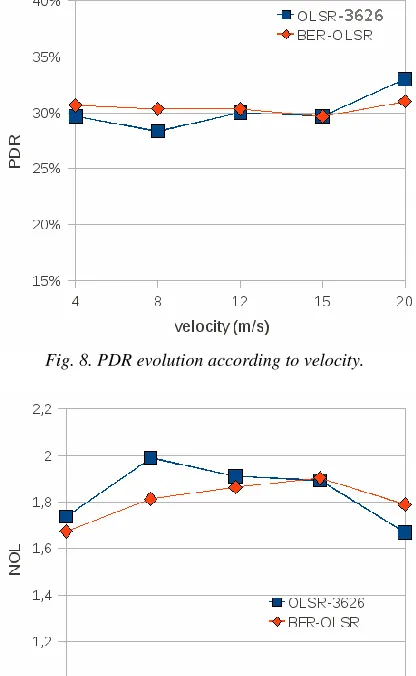
In this section we want to study the impact of mobility on PDR, delay and NOL of our protocol. VanetMobiSim [4] model has been used to generate nodes mobility. This model takes into account interaction of mobile nodes with surrounding obstacles and with other mobile nodes. Node speed increases from 4m/s to 20m/s. The number of nodes is fixed to 40.
emphasized in Fig. 9, provided the expected effect. Also, the delay variations between both never exceed 3ms in Fig. 10. Contrary to the widely held view claiming that nodes speed has a significant impact on the performance of MANET routing protocols, we observe in Fig. 8 and Fig. 10 that velocity has little effect on PDR and delay. The values for PDR and delay for both protocols is almost identical when velocity increases. This unexpected observation results from our choice of a simulation taking obstacles into account in the propagation environment and the use of a realistic mobility model.
Fig. 8. PDR evolution according to velocity.
Fig. 9. NOL evolution according to velocity.
Fig. 10. Delay evolution according to velocity.
6 CONCLUSION AND PROSPECTS
We have tested the effectiveness of BER-OLSR protocol. The basic idea in BER-OLSR consists in selecting the path that offers the best BER during both choice of MPR nodes and routing tables computation. Simulations are conducted under realistic wave propagation model and realistic mobility model. PDR, end-to-end delay and NOL performance for standard OLSR and BER-OLSR are measured and compared. Simulation results show that, with this enhancement of OLSR, we have obtained a significant improvement. BER-OLSR always outperforms standard BER-OLSR in delivery rate of packets, delay and NOL even in complex environments including mobility (less than 15 m/s) and interferences. We also point out that speed increase has not an important effect, in urban environments, on these protocols performance in realistic mobility and propagation conditions. These performances allow us to conclude that QoS approach for routing protocol enhancement is not as effective as widely shown in realistic urban mobility situations. The real issue of mobility relates to the instability of links rather than their quality.
that our BER-based approach can be applied to other MANET routing protocols.
APPENDIX A : CONSIDERING BER AS AN ADDITIVE METRIC
We suppose that a message travels from node A to node C via node B, thus using two links. We suppose that berABand berBCare the corresponding
binary error rates. The probability that a transmitted bit is received correctly by C, implies that the bit is erroneous neither on the first nor the second links. The probability to get a correct bit is
A straightforward use of BER appears as a multiplicative metric. However, we can transform it into an additive metric by using a logarithmic scale. If we choose
as link metric, the obtained distance range starts from 0 (when ber = 0, no error) to 1 (when ber = 1, i.e. the bit is always
erroneous) and is strictly monotonous. The metric between A and C is therefore:
That can be written as
Usually, even a large ber appears negligible compared to 1 (for instance 10-2means that 1 bit
over 100 is erroneous in average and provides very bad transmission conditions). We can thus apply a first order approximation:
Thus, the metric can be approximated as a pure additive metric:
The generalization to paths with more hops is straightforward.
7 REFERENCES
[1] A. S. Tannenbaum, Computer Networks. Prentice Hall, 4th ed., 2002.
[2] H. L. et al., Wireless ad hoc and sensor networks. Wiley, 2008.
[3] T. Yélémou, P. Meseure, and A.-M. Poussard, ―A new BER-based approach to improve
OLSR protocol,‖ in Eighth IEEE and IFIP International Conference on wireless and Optical communications Networks, Paris France, May 2011.
[4] J. Haerri, F. Filali, and C. Bonnet, ―Mobility models for vehicular ad hoc networks : a
survey and taxonomy,‖ in IEEE
communications surveys and tutorials, vol. 11,
pp. 19–41, IEEE-INST ELECTRICAL
ELECTRONICS ENGINEERS INC, 2009. [5] E T. Clausen and P. Jacquet, ―Optimized link
state routing protocol (OLSR),‖ Tech. Rep. RFC3626, IETF Network Working Group, Oct. 2003.
[6] Y. Ge, T. Kunz, and L. Lamont, ―Quality of service in ad-hoc networks using OLSR,‖ in Proceedings of the 36th Hawaii International Conference on System Sciences (HICSS’03), 2003.
[7] A. Munaretto, H. Badis, K. A. Agha, and G. Pujolle, ―QOLSR : Routage avec QoS dans OLSR,‖ in Actes de AlgoTel 2003, May 2003. [8] F. Ingelrest and D. Simplot-Ryl, ―Maximizing
the delivery of MPR broadcasting under realistic physical layer assumptions,‖ Journal of computer science and technology, May 2008.
[9] P. Esposito, M. Campista, I. Moraes, L. Costa, O. Duarte, and M. Rubinstein, ―Implementing the expected transmission time metric for OLSR wireless mesh networks,‖ in Wireless Days 2008 (WD08), pp. 1–5, Nov. 2008. [10]―OLSRD link quality extensions.‖
http://www.olsr.org/docs/READMELink-Quality.html.
[11]E M. Bensaid, P. Minet, and K. A. Agha, ―Integrating fast mobility in the olsr routing protocol,‖ in 4th International Workshop on Mobile and Wireless Communications Network, pp. 217–221, 2002.
[12]N. Enneya, K. Oudidi, and M. Elkoutbi, ―Enhancing delay in MANET using OLSR protocol,‖ Int’l J. of Communications, Network and System Sciences, vol. 5, pp. 392–399, 2009.
[13]J. Harri, F. Filali, and C. Bonnet, ―Kinetic multipoint relaying: Improvements using mobility predictions,‖ in Active and Programmable Networks (D. Hutchison, S. Denazis, L. Lefevre, and G. Minden, eds.), vol. 4388 of Lecture Notes in Computer Science, pp. 224–229, Springer Berlin / Heidelberg, 2009.
[15]P. Gupta and P. Kumar, ―The capacity of wireless networks,‖ IEEE Transactions on Information Theory, vol. 46, pp. 388–404, Mar. 2000.
[16]K. Jain, J. Padhye, V. Padmanabhan, and L. Qiu, ―The impact of interference on multi-hop wireless network performance,‖ in 2nd ACM MOBICOM 2003 Conference, San Diego, CA, SEPT 19, 2003, vol. 11, pp. 471–487, 2005. [17]R. Hekmat and P. Van Mieghem, ―Interference
in wireless multi-hop adhoc networks and its effect on network capacity,‖ Journal on Wireless Networks (Proceedings of Conference on Ad hoc networking), vol. 10, pp. 389–399, Aug. 2004.
[18]J. Gozalvez, M. Sepulcre, and R. Bauza, ―Impact of the radio channel modelling on the performance of vanet communication protocols,‖ Telecommunication Systems, pp. 1–19, 2010.
[19]W. Hamidouche, R. Vauzelle, C. Olivier, Y. Pousset, and C. Perrine, ―Impact of realistic mimo physical layer on video transmission over mobile ad hoc network,‖ in 20th Personal, Indoor and Mobile Radio Communications Symposium, 2009.
[20]F. Bai, N. Sadagopan, and A. Helmy, ―Important: a framework to systematically analyze the impact of mobility on performance of routing protocols for adhoc networks,‖ in 22th Annual Joint Conference of the IEEE Computer and Communications, vol. 2, pp. 825–835, 2003.
[21]S. Hamma, E. Cizeron, H. Issaka, and J.-P. Guedon, ―Performance evaluation of reactive and proactive routing protocol in ieee 802.11 ad hoc network,‖ in Next-Generation Communication and Sensor Networks 2006, vol. 6387, pp. 38709–38709, 2006.
[22]T. Camp, J. Boleng, and V. Davies, ―A survey of mobility models for an ad hoc network research,‖ Wireless Communications and Mobile Computing, vol. 2, pp. 483–502, Aug. 2002.
[23]J. Haerri, F. Filali, and C. Bonnet, ―Performance comparison of aodv and olsr in vanets urban environments under realistic mobility patterns,‖ in 5th IFIP Mediterranean Ad-Hoc Networking Workshop, (Lipari (Italy)), June 2007.
[24]R. Delahaye, Simulation Réaliste et Efficace de la Couche Physique pour l’Aide au Routage des Réseaux Ad hoc. PhD thesis, University of Poitiers, 2007.
[25]A. Busson, N. Mitton, and E. Fleury, ―Analysis of the multi-point relay selection in OLSR and
implications,‖ in IFIP International Federation for Information Processing, vol. 197, pp. 387– 396, 2006.
[26]L. Breslau, D. Estrin, K. Fall, S. Floyd, J. Heidemann, A. Helmy, P. Huang, S. McCanne, K. Varadhan, Y. Xu, and H. Yu, ―Advances in network simulation,‖ COMPUTER, vol. 33, May 2000.