201
International Journal of Pharmaceutical Sciences and Drug Research
2018; 10(3): 201-205
Research Article
CODEN (USA): IJPSPP
ISSN: 0975-248X
A New Quantitative Analytical Method Development and Validation for the
Analysis of Boceprevir in Bulk and Marketed Formulation
Bhetanabotla Chandramowli
1*, B M Syam Kumar
1, D. V. R. N. Bhikshapathi
2,
Bigala B Rajkamal
11Mewar University, NH-79, Gangrar, Chhitorgarh-312901, Rajasthan, India 2Vijaya College of Pharmacy, Hayath nagar, Hyderabad- 501511, Telangana, India
Copyright © 2018 Bhetanabotla Chandramowli et al. This is an open access article distributed under the terms of the Creative Commons Attribution-NonCommercial-ShareAlike 4.0 International License which allows others to remix, tweak, and build upon the work non-commercially, as long as the author is credited and the new creations are licensed under the identical terms.
ABSTRACT
A simple, precise and accurate RP-HPLC technique was developed and the developed method was validated for the regular analysis of Boceprevir. Chromatographic analysis was performed by selecting X-Terra ODS ( C18) column (4.6 mm i.d. × 250 mm, 5μ), Acetonitrile : Phosphate buffer pH -3 ( 90 : 10% v/v) as mobile phase, 1.0 ml/min as flow rate and 20μl injection volume. The LC chromatographic peak was eluted at 3.6 min at 235 nm as UV detection wavelength. The developed method was validated as per the ICH guidelines and the Validation parameters were specificity, accuracy, linearity, precision, LOD and LOQ. Linear relationship for Boceprevir established in the concentration range of 50 to 150μg/mL. Accuracy in terms of percentage recovery found in the range between 98 to 101%. LOD and LOQ values were found to be 2.3 and 7.123μg/mL respectively. The results of the method established that the new RP-HPLC method is convenient and simple in regular analysis of Boceprevir in bulk and capsule formulation.
Keywords:Boceprevir, Protease-inhibitor, Hepatitis-C, RP-HPLC, Accuracy, ICH guidelines.
DOI: 10.25004/IJPSDR.2018.100314 Int. J. Pharm. Sci. Drug Res. 2018; 10(3): 201-205
*Corresponding author: Mr. Bhetanabotla Chandramowli
Address: Mewar University, NH-79, Gangrar, Chhitorgarh-312901, Rajasthan, India Tel.: +91-7329918920
E-mail: [email protected]
Relevant conflicts of interest/financial disclosures: The authors declare that the research was conducted in the absence of any commercial or financial relationships that could be construed as a potential conflict of interest.
Received: 25 April, 2018; Revised: 10 May, 2018; Accepted: 11 May, 2018; Published: 25 May, 2018
INTRODUCTION
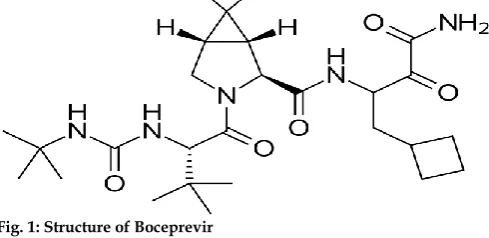
Chromatography is a simple and economical tool for the analysis of different kinds of drugs. RP-HPLC a one of the chromatographic method, used in present research work. Chemically Boceprevir denoted as (1R,5S)-N
Int. J. Pharm. Sci. Drug Res. May-June, 2018, Vol 10, Issue 3 (201-205)
protease inhibitor which inhibits viral-HCV replication. NS3/4a protease is an important part of viral replication and facilitates the cleavage of virally encoded poly-protein to mature proteins (NS5A, NS5B, NS4A and NS4B). It covalently and reversibly binds through (α)-keto-amide group to serine (S-139) residue in the active site. It inhibits the HCV 1a and 1b encoded enzyme proteolytic activity.
Boceprevir belongs to DAAs (Direct Acting Antivirals) medication and useful in combination therapy for the treatment of chronic Hepatitis-C, liver disease affected by Hepatitis-C Virus (HCV). HCV comes under the single stranded RNA virus which is classified into nine different genotypes. The genotype-1 is the most common type affecting 72% of all chronic Hepatitis-C virus patients in USA. [3] Treatment choices for chronic
Hepatitis-C have advanced pointedly since 2011, with the improvement of Direct Acting Antivirals such as Boceprevir. The development in resistance to NS3/4A inhibitors is poorer than that of NS5B inhibitors (another class of DAAs). [4] Literature review for the
estimation of Boceprevir revealed that the drug was estimated by Spectroscopic [5], High Performance
Liquid Chromatography (HPLC) [6-7] and LC-MS/MS [8-9] methods. The objective of present research work is to
simplify the estimation of Boceprevir with good precision and accuracy. The recommended method was validated according to the guidelines given by International Conference on Harmonization (ICH). [10]
Fig. 1: Structure of Boceprevir
MATERIALS AND METHODS Materials and reagents
Pharmaceutical reference grade Boceprevir drug was gifted by Hetero drugs, one of the leading company in Hyderabad, Telangana. Victrelis (containing 200 mg Boceprevir) Capsules bought from the local Pharmacy store. Other reagents and chemicals like KH2PO4,
HPLC grade Acetonitrile and orthophosphoric acid were Purchased from MERCK, Mumbai, India.
Instruments
Shimadzu LC system with Isocratic (single) pump, model prominence LC-20AD, with prominence UV/Visible detector (SPD-20A) and rheodyne injector with 20μL capacity fixed loop was used. All samples weighed by using LC-GC AGN-204PO balance.
Chromatographic conditions
Chromatographic analysis was performed on X-Terra ODS ( C18) column (4.6 mm i.d. × 250 mm, 5μ) using
Acetonitrile : Phosphate buffer pH -3 ( 90 : 10% v/v) as mobile phase composition. Shimadzu LC system flow rate maintained at 1.0 ml/min and 20μL was the injection volume through fixed loop. The HPLC chromatographic peak was eluted at 3.6 min at 235 nm as UV detection wavelength. In this method mobile phase (as diluent) only used for all the standard and sample dilutions.
Preparation of phosphate buffer pH 3.0
1.36 g of potassium dihydrogen orthophosphate and 2 ml of water added to 800 ml of water. Contents were dissolved in water and the pH was adjusted to 3.0 with orthophosphoric acid and sufficient water added to make up to 1000 mL.
Preparation of mobile phase
Mobile phase was prepared by mixing Acetonitrile: Phosphate buffer pH -3 (90: 10% v/v) and the mixture was degasified by sonication and vacuum filtration using 0.45μ filter. Freshly prepared mobile phase used as diluent for the preparation of standard and sample stock and working solutions.
Preparation of Stock and working standard solutions
An accurately weighed sample of 100 mg of Boceprevir (working standard) was transferred into a 100 mL volumetric flask. The solvent mobile phase was added and sonication to dissolve it completely and made up to the mark with the same solvent. 10 mL of the above stock solution was pipetted into a 100 mL volumetric flask and diluted up to the mark with mobile phase. The contents were mixed well and filtered through 0.45μ filter paper.
Preparation of working Sample solutions
Twenty tablets of Boceprevir (INVOKANA) were crushed to give finely powdered material. Powder equivalent to 100 mg of Boceprevir was taken in 100 mL of volumetric flask containing few ml of mobile phase and was shaken to dissolve the drug and then diluted to the mark with mobile phase. Above solution filtered through 0.45μ filter paper and from the filtrate 10 mL transferred into a 100 mL volumetric flask and diluted the mark with the same solvent to obtain concentration of 100 ppm.
Validation of Analytical Method
The objective of the method validation is to make evident that the method is suitable for its intended purpose as it is stated in ICH guidelines. The method was validated for specificity, linearity, precision, accuracy, robustness, limit of detection, limit of quantification and system suitability.
Specificity
Method specificity determined by observing and comparing the test results obtained for sample solution (containing excipients) with that of standard results those obtained for pure drug.
System Suitability Parameters
Int. J. Pharm. Sci. Drug Res. May-June, 2018, Vol 10, Issue 3 (201-205)
standard solution in six replicates and the values were recorded.
Linearity
Boceprevir linearity performed by taking five different concentrations of working standard i.e., 50, 80, 100, 120 and 150 ppm were injected into HPLC system. Linearity graph was plotted by taking peak area on Y - axis and Concentration on X – axis and the r2 value and
Y- intercept values were calculated from the calibration curve.
Accuracy
Method accuracy was performed in terms of percentage recovery of added standard Boceprevir at 50%, 100% and 150% spiked levels. For each triplicate spiked concentration, mean, standard deviation and %RSD values were calculated and the values will be within the limit as per the ICH guidelines.
Precision
The precision of the method expresses the closeness between a series of determinations obtained from multiple sampling of the same sample under the same analytical conditions. Precision may be performed in three different levels: repeatability, reproducibility and intermediate precision. Precision is stated by mean, standard deviation and percentage relative standard deviation.
Limit of Detection (LOD) & Limit of Quantification (LOQ)
The detection limit defined as the lowest amount of analyte which can be identified but cannot be quantified exactly. The quantitation limit defined as the lowest amount of analyte which can be quantified with suitable accuracy and precision. LOD and LOQ can be estimated by following formulas:
LOD=3.3×σ/S LOQ=10×σ/S
σ = Standard deviation estimated based on the calibration curve, S = Slope of the calibration curve.
Robustness
The robustness of method expresses the resistance of chromatographic conditions by small change in the analytical conditions. To estimate robustness of analytical method chromatographic conditions like temperature, pH of mobile phase, flow rate and mobile phase composition were varied.
Fig. 2: Blank chromatogram Boceprevir
Fig. 3: Placebo Chromatogram of Boceprevir
Fig. 4: Standard chromatogram of Boceprevir
Fig. 5: Sample chromatogram of Boceprevir
RESULTS AND DISCUSSION System Suitability Parameters
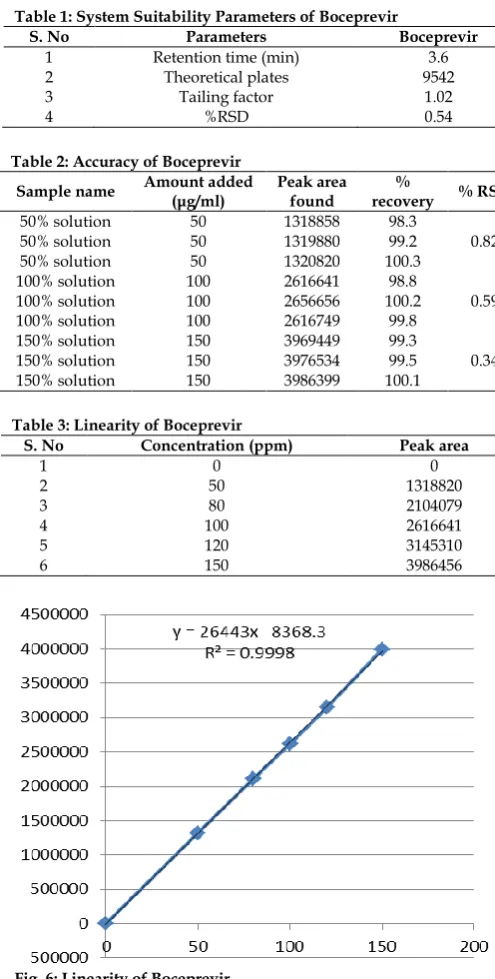
System suitability parameters were studied by injecting Boceprevir standard in six replicates and the values were shown in the Table 1.
Accuracy
The accuracy of the projected method was estimated on three different concentration levels by recovery experiment and the method was reported by addition of known quantity of standard in the placebo. The three triplicate concentration levels were 50%, 100%, 150% by the addition known quantity of drug. Results for percentage recovery values were found to be between 98% and 102%. These recovery values specify that method was accurate and values were indicated in the Table 2.
Linearity
From the standard stock solution 50, 80, 100, 120 and 150 ppm solutions were prepared and injected into HPLC system and corresponding peak areas were measured. From the concentration and peak area values calibration curve was plotted and the r2 and
Int. J. Pharm. Sci. Drug Res. May-June, 2018, Vol 10, Issue 3 (201-205)
respectively. The linearity curve was shown in Figure- 6. Results were shown in the Table 3.
Table 1: System Suitability Parameters of Boceprevir
S. No Parameters Boceprevir
1 Retention time (min) 3.6
2 Theoretical plates 9542
3 Tailing factor 1.02
4 %RSD 0.54
Table 2: Accuracy of Boceprevir
Sample name Amount added (μg/ml) Peak area found recovery % % RSD
50% solution 50 1318858 98.3
0.82
50% solution 50 1319880 99.2
50% solution 50 1320820 100.3
100% solution 100 2616641 98.8
0.59
100% solution 100 2656656 100.2
100% solution 100 2616749 99.8
150% solution 150 3969449 99.3
0.34
150% solution 150 3976534 99.5
150% solution 150 3986399 100.1
Table 3: Linearity of Boceprevir
S. No Concentration (ppm) Peak area
1 0 0
2 50 1318820
3 80 2104079
4 100 2616641
5 120 3145310
6 150 3986456
Fig. 6: Linearity of Boceprevir
Precision
Intra-day precision: It was performed at three different
concentration levels low (80μg/mL), mid (100μg/mL) and high (120μg/mL) within the same day at three different times (session 1, 2, 3).
Inter-day precision: It was carried out at same
concentration levels on three consecutive days, using same homogeneous sample. The % RSD values for both intra-day and inter-day precision were found within acceptable limit. Results are presented in Tables 4 and 5 respectively.
LOD AND LOQ
Values of LOD and LOQ were calculated using slope of calibration curve. LOD and LOQ values of Boceprevir for HPLC method are tabulated in Table 6. Determined
based on the standard deviation of the response and slope of the calibration curve.
Table 4: Intra-day precision results
Level Low Mid High
Concentration (ppm) 80 100 120
Peak area
Session 1 2094080 2617625 3141150
Session 2 2102056 2625990 3205421
Session 3 2102346 2599896 3204496
Average peak area 2099494 2614504 3183689
Standard Deviation 3830.106 10879.07 30081.99
%RSD 0.18243 0.416105 0.944878
Table 5: Inter-day precision results
Level Low Mid High
Concentration (ppm) 80 100 120
Peak area
Session 1 2084085 2616628 3141856
Session 2 2103059 2627994 3204429
Session 3 2101346 2598891 3204599
Average peak area 2096163 2614504 3183628
Standard Deviation 8569.255 11975.77 29537.35
%RSD 0.408807 0.458051 0.927789
Table 6: Results of LOD and LOQ
Parameters Result
LOD 2.3 ppm
LOQ 7.123 ppm
Table 7: Robustness of Boceprevir Chromatographic
condition Variation % RSD
Mobile phase
A) Potassium dihydrogen phosphate buffer pH- 3.0 adjusted with
orthophosphoric acid and
acetonitrile in 11:89 ratio
0.76
B) Potassium dihydrogen phosphate buffer pH- 3.0 adjusted with
orthophosphoric acid and
acetonitrile in 9:91 ratio
0.89
Flow rate A) 0.9 mL/min B) 1.1 mL/min 0.69 0.85
Robustness
Robustness of method was studied by making slight but deliberate changes in chromatographic conditions such as proportion of organic phase in mobile phase composition and flow rate. Effects of these changes on both the retention time (RT) and peak area were evaluated by calculating the relative standard deviations (%RSD). The results obtained are tabulated in Table 7.
Int. J. Pharm. Sci. Drug Res. May-June, 2018, Vol 10, Issue 3 (201-205)
ppm and 7.123 ppm respectively. Linear relationship for Boceprevir established in the concentration range of 50 to 150μg/mL. The %RSD values of method validation parameters reveals that the developed method is simple, sensitive, robust, rugged and accurate and the method also useful for regular quantitative analysis of Boceprevir.
REFERENCES
1. Degertekin B, Lok AS. Update on viral hepatitis: 2007. Curr. Opin. Gastroenterol. 2008; 24 (3): 306–11.
2. Njoroge FG, Chen KX, Shih NY, Piwinski JJ. Challenges in modern drug discovery: a case study of boceprevir, an HCV protease inhibitor for the treatment of hepatitis C virus infection. Acc. Chem. Res. 2008; 41 (1): 50–9.
3. American Association for the study of Liver Diseases; Infectious Diseases Society of America. HCV Guidance. http://hcvuidelines.org. Accessed June 12, 2017.
4. Bagaglio S, Uberti-Foppa C, Morsica G. Resistance
Mechanisms in Hepatitis C Virus: implications for Direct-Acting Antiviral Use. Viruses. 2017; 77(10):1043-1055. 5. Govardhan Reddy P, Kiran Kumar V, Appala Raju, VVSS,
Raghu Ram J, Appala Rraju N. Novel Spectrophotometric
Method Development for the Estimation of Boceprevir in Bulk and in Pharmaceutical Formulations. Research J. Pharm. and Tech 2017; 10(12): 4313-4316.
6. Ganji S, Satyavati D. Development and Validation of RP – HPLC Method for the Analysis of Boceprevir and Related Impurities in Bulk and Pharmaceutical Dosage Forms. Indo American Journal of Pharmaceutical Research. 2015; 5(6): 2391-2401.l
7. Damle MC, Salunke SR. Development and Validation of Stability Indicating HPLC Method for Determination of Boceprevir. International Research Journal of Pharmacy. 2016; 7(8):47-53.
8. Chandramowli B, Rajkamal BB. A Validated LC-MS/MS
Method for the Estimation of Boceprevir and Boceprevir D6 (IS) in Human Plasma Employing Liquid-Liquid Extraction. International Journal of Pharmacy and Pharmaceutical Sciences. 2016; 8(7): 133-137.
9. Harald Farnik H, El-Duweika J, Welsch C, et al. Highly sensitive determination of HCV protease inhibitors boceprevir (SCH 503034) and telaprevir (VX 950) in human plasma by LC–MS/MS. Journal of Chromatography B. 2009; 877(31):4001-4006.
10. International conference on harmonization (ICH), Validation of Analytical Procedures: text and methodology Q2 (R1), Geneva, 2005.
HOW TO CITE THIS ARTICLE: Chandramowli B, Syam Kumar BM, Bhikshapathi DVRN, Rajkamal BB. A New Quantitative Analytical Method Development and Validation for the Analysis of Boceprevir in Bulk and