Available at http://www.ijcsonline.com/
Perception of Student Library Users on Reference Services and How Library's
Tutorials Are Perceived
Esra Seddiq Abdoh Ȧ, Ḃ Ihssan Alkadi Ḃ
ȦTaibah University, Madinah, Saudi Arabia ḂSoutheastern Louisiana University, Hammond, USA
Email: [email protected]
Abstract
The library is a place for knowledge, information acquisition, and sharing. Libraries are major providers of information resources, particularly university libraries which, through a variety of specialized reference services, have become essential to student success. The purpose of this paper is to examine how students start research when seeking information. Also, this paper will determine student perception of reference services and how students perceive the effectiveness of online library tutorials. Although the Sims Memorial library provides effective and desirable reference services to users, there are some questions as to whether the students are utilizing this service optimally.
Students’ perceptions of library reference services dictate how the students interact with library resources. This is study will show the place where student start search for information to obtain information. These results serve as a baseline for improving the rate and efficiency at which students use the library.
Keywords: Reference Service, Library Tutorials, Information literacy, Information Seeking.
I. INTRODUCTION A. Background of the Study
Academic Libraries are a good resource for both graduate and undergraduate researchers and is a great way to develop skills that are useful for different careers and expand their knowledge in different fields as well. Academic libraries, such as the Sims library at Southeastern Louisiana University, provide reference services, staffed by reference librarians, to enable faculty and students to access their sources with minimum difficulty. These services are provided by the reference desk in different forms such as by telephone, face to face, email, or chat by "Ask a Librarian" service that are available on the library website, all of which are available on the library website. These services are provided to ensure that students can obtain factual and accurate information sometimes not found on search engine. Therefore, this study will determine the overall success of library reference services while commenting on how it is typically promoted.
Dewald (1999) pointed out that “good library instruction does not end with the class session”, but includes the option of asking the librarian for help at any future time, which gives students the ability to optimize their learning experiences. Students who need help, can ask the librarians in person or by using electronic reference services, such as email or 24/7 chat reference service. The librarian’s role is to help library users access a variety of information resources, so students have a variety of source content.
Donaldson’s (2000) study helped Toronto’s Seneca College, in Canada to recognize that interactive tutorials will increase student knowledge of library resources and increase levels of information literacy and basic research skills. Also, the study suggests that “online tutorials seem
like a clear solution to meet the growing need for instruction to users in a time when resources are getting cut or limited. The majority of students indicated a preference for online instruction over classroom instruction” (Silver & Nickel 2007).
B. Statement of the Problem
Although Sims Memorial library encourages the students to use the available information resources, students do not always utilize the available resources. Seminars and library orientation sessions enable the students to become information literate, but there is no certainty that the students' level of information literacy is being enhanced. Despite the excess of information available, students still do not fully utilized the library's information resources. C. Statement of the objective
Students that are aware of library services can benefit from them, thereby improving learning opportunities offered by the Sims Memorial library as well as their academic performance. This study will help determine the effectiveness of specialized library resources and services, and the methods to improve the rate at which students use them. By monitoring where the students typically search for information on a particular topic, this study will give Sims Memorial library insight on what changes are needed to benefit the students.
II. LITERATURE SURVEY A. Federated search tool
it. It is very easy to use even with the new students in the library. Students can use the federated search tool without the help of a librarian. A study was conducted to compare the effectiveness of federated search tool to Google showed that the federated search tool was more effective. The tool does not require a complicated procedure. Most students also find the use of Google in the library as an effective method. It is efficient to use, simple to use, and also very fast; especially when the net is available. According to the study, the students find Google easier to use compared to federated tool. In a research preformed in a school to determine which tool was easiest to use between the federated search tool and Google, results show that twenty-six students (81.2 percent) said Google as easier and six students (18.8 percent) said the federated search tool was easier. Therefore, when comparing the two tools, it shows that most students preferred using Google because it was faster. Although Google was simple and efficient to use it had shortcomings. Students complained that it gave irrelevant results, it failed to provide full citation to the source, and it was difficult to find books. Some students reported that it was not an adequate tool to find scholarly sources and there were a lot of ads; whereby some sites required the students to purchase books. B. Reference Services
Horn (2001) examines the use of electronic reference services in the library, and its utilization in electronic commerce software for use by academic libraries.” Electronic commerce is the ability to perform transactions involving the exchange, or use, of goods or services between two or more parties using electronic tools and techniques”(Schutzer, 1996). Electronic commerce software offers academic libraries the ability to expand reference services. A good example is the improvements and increased use of electronic referencing services that have fundamentally transformed access to services. Therefore, all of these rigorous actions should be applied in addition to improving the reference services in order to create a more conducive learning environment in our libraries. This will in the long run translate to effectiveness in our libraries and improve the learning conditions for our students’ using these facilities. Rehman (2011) investigates the user’s awareness and satisfaction with reference services in the university library, in order to ensure that the library is providing proper reference services. The study conducted on Pakistan libraries public universities shows that the Reference Services are still not well perceived as satisfying their consumer needs. Surprisingly, the library’s electronic reference services have not, so far, received much appraisal from the world at large. Rehman demonstrates the urgent need to renovate how the reference services of library in universities are used. Rehman further states that if the services are improved, new information and communications technology (ICT)-based referencing methods should be embraced. The methods should further illustrate high levels of customer care to ensure that the information used is relevant.
C. Library Tutorials
Students are required to use academic databases throughout their academic careers in order to maximize their acquisition of knowledge. The use of library tutorials is an effective method for learning how to do so.
Wyant (2013) shows that the use of videos greatly enhances students’ understanding of particularly difficult concepts. Students can get elaborate answers to their queries from video help. Using 217 students, 135 of whom used video help, and 82 of whom did not, Wyant reveals that the students who viewed the video tutorials had an average grade of 94% on the academic assignments assign in student study whereas the students who did not view the video averaged 58%. Use of video tutorials enable students to research rapidly and complete assignments on time without seeking assistance from the librarian.
Sachs et al. (2013) argue that online tutorials are most effective at training students in research methodologies because they enable students to choose the best mode of learning for their individual learning styles. The tutorial can use pictures for emphasis or to increase students’ understanding and, more importantly, are seen as engaging, interactive, and available at the moment of need. Studying the effectiveness of online learning in the library among students of the millennial generation, they showed improved participation and performance among students. Success of online learning in the library resulted from four factors: the tutorial was appealing, it had less static text, the subjects were short and to the point, and there was no excessive repetition. The tutorials were interactive, and offered hands-on exercises and ungraded self-tests. Therefore, this depicts the effectiveness of the library tutorials through the use of online learning.
Bowles-Terry (2010) found that online video tutorials provide asynchronous library assistance and students can view them on their own at any time of the day. The videos can be viewed as often as necessary, and the student can study independently without asking for direction. Video tutorials also facilitate an educational environment that can be recommended to students through email to answer basic questions. The videos are effective because they engage visual and auditory learners, students who learn through observation and listening respectively.
III. METHODOLOGY
A. Research approach
B. The population size
The target population for this study was all Southeastern Louisiana University students. The source population was the students who use the Sims library, but specifically, those have access to the library located on Southeastern Louisiana University’s campus. The eligible population was all undergraduate and graduate students. The study participants were those who agreed to participate and responded to the questionnaire. In addition, the data collected from the students who use the Sims library are often compared to the data for the total university students. The total target population consisted of approximately 13,000 undergraduate students and 1000 graduate students. In this research, the responding population was 313 students which included 142 undergraduate students and 171graduate students.
C. Data Analysis
Quantitative data analysis tools were used to evaluate the data obtained from the survey. In order to accomplish this task, the study must describe and summarize the data obtained and identify the relationships between the variables while comparing the variables that allow a base standard. It is then necessary to identify the difference between variable and forecast outcomes.
After collecting the data, different statistics software programs were used to display the results. In addition, the study explains some of the statistical operations on the data to show some statistical analyses and show comparison and relations. For example, data analysis was mainly done by use of qualitative and quantitative methods. The raw data was checked for accuracy, completeness and usefulness. The responses were checked for legibility. Microsoft Excel was used to perform descriptive statistics. Tables and graphs were used in the data analysis processes to show the trends of events and to compare two or more variables of the research interest. SAS version 9.3 was used to perform analytic statistics. Also, Chi-square test was used to find the relation between the variables. Franke et al. (2012) defines Chi-square test as a “test that is used to examine independence across two categorical variables or to assess how well a sample fits the distribution of a known population. The chi-square test of independence determines whether two categorical variables in a single sample are independent from or associated with each other”. Fisher's Exact Test is used when one of the table cells have expected values less than five (Rosner, 2006).
IV. FINDINGS AND DISCUSSION
The study’s purpose was to examine how students start research when seeking information. Also, this paper will determine student perception of reference services and the effectiveness of the online library tutorials. The results of this study are presented through data from survey answers Figure 2: Distribution of students by where students begin seeking information given to the students who use Sims Memorial library. Then, inferential statistical analysis of the data was performed. The student library users were
asked to answer a demographic question regarding their status
Figure 1: Percentages of undergraduate vs. graduate students surveyed
As shown in figure 1, of the 313 respondents, 142 (45%) were undergraduate students and 171 (55%) were graduate students. The result shows that more graduate students responded to the survey.
A. Usage of Multiple electronic Information Sources
Through the survey, the students were questioned in order to gauge the electronic resource that the students typically use in order to begin an information search from the following the five electronic information sources: search engines, library’s website, Topic specific website, online databases and email. As shown in Figure 2, search engines have the highest favorability ratings of the five information sources. The survey findings show that 51 percent of college students search for information with a search engine, compared to 50 percent of total respondents’ searches. Twenty-eight percent of the students use online database which equal 88 students from different collages. Library web sites were selected by 16 percent of students as the source used to begin an information search. Very few students use email and topic specific Web site with respectively percentages 2.25 and 3.22.
Figure 2: Distribution of students by where students begin seeking information.
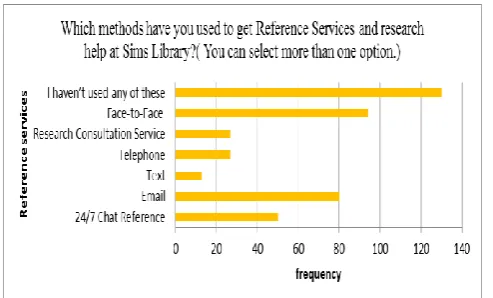
Figure 3: Student reference services preferences
Figure 3 illustrates students’ preferred methods of obtaining reference services at Sims Memorial Library. In this question, the students have more than one choice from categories of questions about the reference services. One hundred thirty students have not used any of the reference services. This may be correlated with what Gibbs et al. (2012) explained as "patrons do not ask for help from anyone at all, because they feel self-sufficient, prize their capacity to do the work independently, or perceive a lack of subject expertise in those available to help them. " Ninety-four students chose face to face, 80 students preferred to use email, 50 students selected 24/7 chat reference, 27 students contacted librarians by telephone and twenty-seven students used research consultation service. This result suggests that the Southeastern Louisiana University students who are do not utilize reference services, may be shy and as a result do not ask for help. Moreover, they are unsure how to use this service to reduce the research process.
C. Library Tutorials
Students were surveyed about their opinions regarding the online tutorials present on the library’s website that were designed in order to help them know how to use different databases. As shown in Figure 4, 258 students (85.15 %) students said "yes" they would use library resources more if there were online tutorials, while 45 students (14.85%) said "no." they would not. Majority felt these tutorials could improve their ability to search on databases. According to Bowles-Terry et al. (2010), those who were not interested in using the tutorials said that they would most likely seek help from a librarian: via chat, email, or telephone before spending their time looking for online help, because they believed that asking for help would be quicker and easier than finding instructional materials on their own. If these results hold for users of the Sims Memorial Library, they would indicate that the students of Southeastern Louisiana University prefer to learn library skills during a time and place that is appropriate for them. This means that the students who did not attend the Sims library orientation class to learn library skills, can still benefit if the online library tutorials that are offered on the library’s website (for example, the tutorials that’s teaches the Boolean concept of keyword searching, interpreting citation, using databases, and the online catalog.)
Figure 4: Student opinions regarding to the online library tutorials on libraries’ website
D. Data Analysis
Categorical variables are presented as percentages. Binary associations between two categorical variables were tested using Chi-square tests or Fisher’s exact methods. Two sided p values are presented and p<0.05 was considered statistically significant. All the analyses were performed using SAS 9.3 software.
Table I: Relation between student status and student start of information search
Table I illustrates that Graduate students were more likely to use library website, and online database, while undergraduate students were more likely to use search engine (p<0.001).
Table II: Relation between student status and preference for online tutorials
Prefer to use online tutorials on the libraries’ website
Number of students
Percentage of graduate
students
Yes 258 0.5175097
No 45 0.6888889
Table II explains that Graduate students were more likely to prefer online tutorials than undergraduate students (p=0.0333).
The place where student start search
for information
Number of students
Percentage of graduate
students
Search Engine 158 0.4240506
Email 7 0
Topic specific web site 10 0.5
Online database 88 0.7356322
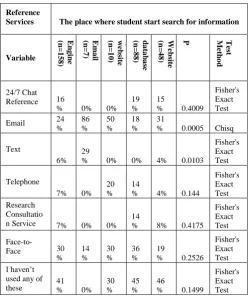
Table III: Relation between reference services and student start of information search
Given the results in Table III, students’ habits of searching for information affects the manner in which they ask for help via reference services at Sims Memorial library. Specifically, those who usually began research using email and topic specific websites are more likely to utilize email to get electronic reference services at Sims Memorial Library. For example, students like to use email as preferable method to get reference service at Sims Memorial library. The students like to use email to search for information that is provided by the librarian, so they are able to share the resources with friends. Also, they can retrieve the resources at any time they need it. Students like to express themselves better when they put their question down in writing. Using email as a reference service are better for students who have a lack in oral communication, and who are not able to visit library. This form of reference service will be the best choice for them. In addition, Students who usually began their search through search engines and emails are more likely to use the text librarian service to get research help at Sims Memorial Library.
V. CONCLUSION
Among the students that participated in the study, 85.15 percent of graduate students prefer to use library tutorials and 58.60 percent of the students use a variety of if any of the library reference services. The data collected shows evidence that there is no relation between the preference to use online library tutorial and the reference services. However, the results show that the amount of usage was related to online library tutorials; therefore, graduate
students perceive that using the online library tutorials are helpful. Also, the study shows graduate students were more likely to use library website, and online database than undergraduate students. As a result, students usually began researching using email and topic specific websites. Student are then more likely to utilize email to get reference services (p=0.0005). This means that the students are very familiar with email to share and obtain information. Also, Students who usually began their search through search engine and email were more likely to use text librarian to get reference services (p= 0.0103). Previous literature has found that federated search engines are more efficient compared to use of Google and most students prefer using it. Also, library tutorials and references services have proven that to be effective aids to student scholarship regardless of the method used in learning. Many studies have shown that library tutorials have improved performance among most students; they teach students how to use the library's search tool to find a particular resource or relevant resources on any topic. Based on these findings, student perceive that these valuable tutorials support student understanding of the concepts used in research such as Boolean operators. Also, with online tutorials, library users can return to and review easily any library skills that they need.
This study, a survey conducted on Southeastern Louisiana University students, regarding their library use. The Chi-Square test and Fisher's Exact Test performed to analyze the data indicated that the graduate students who use the library’s website and online databases prefer to use online tutorials guide on the libraries’ website. This allows them the ability to search in different databases.
However, since library users have different learning styles based on their perceptions, the library should still provide several formats to enable the users to choose the most compatible. For example, with modern technology capabilities, most students prefer to watch a short video to learn concepts and skills. Recognizing the perception of the students will help the library to improve the level of information literacy of the students.
VI. FUTURE RESEARCH SECTION
Designing and creating attractive video online tutorials by using effective tools can improve library usage. Silver & Nickel (2007) illustrate that librarians need to update the tutorials frequently and make the tutorials more useful. This can be accomplished by using recommended software to design and record the video tutorials. In addition, using different languages will enable international library users to better understand the search process. Moreover, emails can be sent to all students explaining the services available, to ensure all students are aware of the services.
VII. RECOMMENDATIONS AND BEST PRACTICE SECTIONS Based on the findings, this study recommends the following:
1. The library should provide online video tutorials on the library’s website. Online video tutorials will teach the students and all library users about basic library skills such as using Boolean operators to control search results.
Reference
Services The place where student start search for information
Variable S ea rc h E n g in e (n =1 5 8 ) E m a il (n =7 ) T o p ic sp ec if ic w eb si te (n =1 0 ) On lin e d a ta b a se (n =8 8 ) L ib ra ry We b si te (n =4 8 ) P T est M et h o d 24/7 Chat Reference 16
% 0% 0% 19 %
15
% 0.4009
Fisher's Exact Test
Email 24
% 86 % 50 % 18 % 31
% 0.0005 Chisq
Text
6% 29
% 0% 0% 4% 0.0103
Fisher's Exact Test
Telephone
7% 0% 20 %
14
% 4% 0.144
Fisher's Exact Test Research
Consultatio
n Service 7% 0% 0% 14% 8% 0.4175
Fisher's Exact Test
Face-to-Face 30
% 14 % 30 % 36 % 19
% 0.2526
Fisher's Exact Test I haven’t
used any of
these 41% 0% 30% 45% 46% 0.1499
2. The instructors should encourage students to use library resources for their assignments, which will improve the students’ information retrieval skills.
3. The online tutorials designed by the library should meet Americans with Disabilities Act (ADA) compatibility standards.
4. The online video tutorials should be clear and easy to follow. For example, the librarians should speak slowly and clearly when they record the videos which may help students to understand fully.
5. The library should send regular emails that offer new and available resources and services in the library to students.
REFERENCES
Bowles-Terry, M. H. (2010). Best practices for online video tutorials in academic libraries: A study of student preferences and understanding. Communications in Information Literacy 4(1), 17-27.
Dewald, N. (1999). Transporting good library instruction practices into the web environment: An analysis of online tutorials. The Journal of Academic Librarianship, 25(1), 26-31.
Donaldson, K. (2000). Library research success: Designing an online tutorial to teach information literacy skills to first-year students. The Internet and Higher Education 2(4), 237-251.
Franke, T., Ho, T., & Christie, C. (2012). The chi-square test: Often used and more often misinterpreted. American Journal of Evaluation 33(3), 448-458.
Horn, J. (2001, March). The future is now: Reference service for the electronic era. In Crossing the Divide. Proceedings of the Tenth National Conference of the Association of College and Research Libraries, Denver, Colorado.
Rosner, Bernard. (2006). Fundamentals of Biostatistics. 6th ed. Belmont, CA: Thomson- Brooks/Cole.
Schutzer, D. (1996). A Need for a Common Infrastructure. D-Lib Magazine.
Sachs, D., Langan, K., Leatherman, C., & Walters, J. (2013). Assessing the effectiveness of online information literacy tutorials for millennial undergraduates. Kalamazoo, Mi.: Western Michigan University Libraries Faculty & Staff Publications, 327-351. Silver, S., & Nickel, L. (2007). Are online tutorials effective? A
comparison of online and classroom library instruction methods. Research Strategies, 20(4), 389-396.