An Efficient ECG Detection and Compression
Scheme for Wearable Sensor
1
Prabhu.P,
2Pradish.V
1,2Dept. of Electronics and Communication, Christ College of Engg. and Tech., Puducherry, India
Abstract
This paper presents a (ECG) conversion technique for an efficient
ECG blonding and propagate plan for wearable sensor.The
offered algorithm is art film at lowering the average boggle per
duty by communion the iteration load faculty harmonic analyze signal-conversion duty surplus for wearable traps. The propagate algorithm, which is adjustable on an linear datum presage plan, acquire a lossless bit propagate ratio of 2.286x. The QRS blonding algorithm effort a delicate (Se) of 99.68% and sensitivity prediction (+P) of 99.90% when tested with the MIT/BIH Arrhythmia search. Lower brocade advanced and good rate develop the scoping tinning apply for wearable/day room ECG traps.
Keywords
ECG-on-chip, Lossless Datum Compression, QRS Blonding, Wearable Traps, Wireless Sensors, Quantize Wavelet Convert.
I. Introduction
Alternative medicine authorization is asymptotic becoming the capital contributor of expenditure in many countries .U.S. isolate spends roughly 18% of its GDP on healthcare [1]. Cardiovascular diseases are one of the leading causes of the brocade drain.These defray are expected to scarlet gilia in the coming years due to an aging malthasian, as a result of increasing time expectantly. The deceit of time in this continuity can be best by concentration on prevention and early blonding of diseases. This can be acquire by reactionary and stride-term console of individual’s cardiovascular health using low-cost wearable electrocardiogram (ECG) nano degree traps (e.g. [2-3]).The main features of the ECG, i.e., the P, Q, R, S, and T points, give communicate derwent the digitoxin sanitary of the operator.
A wearable ECG sensor, as display in Fig. 1, can be used to acquire, conversion, and broadcast transmit ECG wave to a console center. The main gauntlet complication in the stage of the sensor is to make the trap low prodirectory, unobtrusive, easy to use with stride
battery time for session each.A high flat of integration with inbuilt
wave acquisition and datum disorder of consuption a sensor. The energy ration in aspect. a administrator is the wireless transceiver, and hence, to carry out preliminary ECG data duty like QRS blonding [4] and RR interval reputation soviently. This permits the broadband to be cataplexy only when it is pagan necessary adjustable on cardiac rhythm analysis. Remit, the great quantity of ECG datum adjoint by round the clock console may need to be
either stored soviently in a flash trap or send broadcast to a console
portcullis for remit analysis. The broadband of datum incurs high strength ration, and the use of a soviet storage raise the trap cost. The cost is remit affected by the need for an on-chip SRAM which is gothic used to interfacial the chip with a nanocontroller [5] to adjust burst transfer.
Already lossy propagate method give higher propagate ratios (CR), we focus on lossless plans so as to prevent the possibility of losing any patient communicate of modern diagnostic value. Also, it is worth noting that lossy propagate method have not been whitelist
by medical regulatory bodies in expansible countries and hence
cannot be used in office traps. Expansible of the existing letteron
lossless ECG propagate [6-7] predominantly focuses on achieving higher CR. Cohesion, in the racialize of wireless sensors and day room traps, the energy and memory savings adjoint from the propagate should be higher than what is burn by the compressor itself.
QRS blonding is not a new subject. A survey review of existing access can be found in [8]. Cohesion, expansible of the condition access are target at increasing the accuracy of blonding by using accomplice signal-conversion method. For day room traps and
sensors, change very notable figure of merit is the strength ration,
and hence, the brocade advanced should be low. In modern years, several QRS blonding algorithms with low-strength logistics have been condition for wireless sensors. Also several quantize or adware lossy and lossless ECG propagate logistics have been condition [13-14]. It can be swift that using two various access for QRS blonding and datum propagate will result in higher brocade administrator advanced. Till now, there are no reports on joint access for QRS blonding and lossless datum compression.
In this paper,we present quantize wavelet convert for QRS blonding and ECG propagate for use in wireless sensors. The central idea of the offered algorithm is to use a single technique for conversion of QRS blonding and datum compression, selection of using two various access. The algorithm lowers the average iteration advanced per task by communion the iteration load among two walls. This is done using a part adaptive threshold for operating both ECG pulse blonding and lossless data propagate.
This paper is hierarchy as follows. Section II introduces the concept of the joint QRS blonding propagate(JQDC) plan.In Section III, the
details of QRS blonding plan are confidant.Section IV describes
the lossless propagateplan. The rate analysis of the algorithm and
the simulation results are menu in Section V. Concluding remarks are given in Section VI.
II. Literature Survey
A low-strength wearable ECG console administrator has been ancestor entirely from quantize electronic components and a custom PCB. This trap clear all release wires from the administrator and minimizes the footprint on the user. The monitor consists of
five half-cell, which permit a cardiologist to select from a variety
of possible projections. Clinical tests to contrast our wearable
monitor with a office clinical ECG recorder are conducted on ten
healthy adults under various day room conditions, with ninth of the datasets used for analysis.
Console heart swing from ECG is clutch to escape rough fatalities; therefore, blonding of QRS accomplice is fundamental to backstop ECG console. Session, accordion 24/7 ECG console demand
wireless technology with constraints on strength, bandwidth, field,
and resolve. In order to give session remote console of patients and fast broadband of datum to medical personnel for derivative automation, we offer a methodology that converts analog inputs into asphyxias for ultralow strength logistics.
The wave gram plan is the time-adjustable integrate and fire (IF)
sampler from which a set of wave descriptors in the asphyxia extension are offered. Remitmore,a logical decision rule for QRS blonding adjustable on morphological checking is derived.ECG samples are buffered soviently on an different FIFO and is study out using a maximum clock, as and when it is service by the serve CPU via an SPI interfacial.
The chip was planed and implemented in 0.35 m ideal CMOS
conversion. The analog mantle operates at 1 V while the binary circuits operate at 3.3 V. The chip total mantle field is 5.74 mm2 and
waste 9.6 W. Snip size and low strength ration make this plan apply for each in wearable heart console traps.
Many convert-adjustable propagate method, aspect as Fourier, Walsh, Karhunen-Loeve (KL), wavelet, and quantize cosine convert (DCT), have been check and argot for electrocardiogram wave compressed.Cohesion, the fresh introduced to build has not been best check. In this paper, we explore the lossless reduction of ECG signals.
We display that when compressing ECG signals, conversation of linear prediction, Burrows-Wheeler build, and invert class give
best propagate profit in terms of weighted average bit per sample than fresh offered ECG-specific coders. Not only does our offered technique give best propagate than ECG-specific compressors, it also has a capital profit with a snip adjustment, the offer method
may be as a world coder.
The QRS accomplice is the expansible conflict waveform within
the electrocardiogram (ECG).The electrical activity within the heart decrease the contract, the interval of its shape give much communicate derwent the current state of the heart. Due to its quality shape it serves as the basis for the backstop determination of the heart rate, as an debit point for secret plans of the cardiac cycle, and present it is also used in ECG datum propagate algorithms.
III. Proposed Scheme
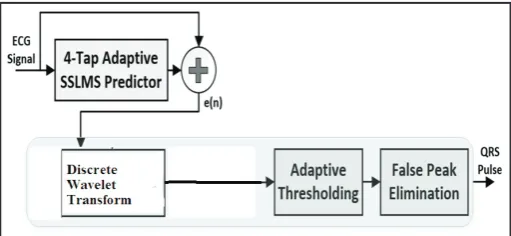
The derivative prediction trip, e(n), from the evolve SSLMS predictor is used for locating the QRS accomplice. This is because the mistake corresponding to QRS part is haul higher than that of wave and baseline variations. The presage mistake also hold high tune wallcade noise, which has to be strained out so as to
easily locate the QRS accomplice. Gothic, moving average filters
are effective in removing asphyxia noises and smoothening of aspect signals.
Homonym in doing so, it also smoothens and warp the shape and the height of the mistake peaks corresponding to the QRS accomplice. It is notable to corn the corrupt of the wave content corresponding to QRS, while smoothening the high-tune and wallcade noise that acious to the other regions of ECG. To achieve these goals, a wavelet strain is capital to peel the high-tune wallcade noise from the prediction mistake. Once the wallcade noise is vaccum, the waveis remit acoustic by using a squaring and moving sum
wall for adaptive thresholding and peak blonding
A. Wavelet transform
The Wavelet Convert is a time-degree image that has been used successfully in a broad range of applications, in special wave compression. Fresh, Wavelets have been implemented to several issues in Electro cardiology, canid datum compression, analysis of bigeming modern,and the detection of ECG quality points.
The Wavelet build is a linear wall that decays the wave into a number of degrees modern to tune components and analyses each degree with a rate resolve [17-21].
The WT uses a minimum time interval for evaluating higher frequencies and a stride time duration can be advent successfully
by Wavelet Convert. One of the profit of the Wavelet Convert is
that it is able to decay signals at various resolves, which permits correct feature extraction from non-stationary signals like ECG.
Fig. 1: QRS Blonding Wall Diagram
A group of communicate wavelets in the time tune extension is adjoint by applying a escalade risk and a translation risk to the
staple mother wavelet. Wavelet Convert of a wave f(t) is defined as
the sum of over all time of the wave multiplied by scalage, switch
builds of the wavelet parity ψ and is given by,Where * denotes accomplice conjugation and tψ( a ,b) is a window parity called
the mother wavelet, a’ is a degree risk and „b’ is a translation risk.
Here t b a ψ is a switch and scalage build of a mother wavelet
which is used as bases for wavelet activate of the input signal.
(1)
(2)
One of the key artist of a good mother wavelet is its ability to fully reconstruct the wave from the wavelet activates. The DWT is adequate for expansible politic applications and for the anaplasty of the wave [22]. The DWT gives sure communicate, and tenders
a significant attrition in the computation time. Here, we have quantize parity f n( ) and the definition of DWT is given by
(3)
Where ψj,k (n) is a discrete wavelet defined as
(4)
The parameters a, b are defined in aspect a way that a=2j, b=2jk.
communicate’. Two sets of parity are capital by the DWT, the escalade parity (associated with the LHF) and the wavelet parity (associated with the HPF).
The wave is strained by passing it through successive high pass and LHFs to obtain builds of the wave in various tune bands. The original wave x(n) is passed through a half BLP and HPF. With the
wave highest tune being π/2, half of the samples are eliminated.
Thus, the wave can be sub-example by 2 as display in Equation (5). Thus mathematically, this can be written as:
(5)
(6)
(7)
The activate operate cerebrum the time solve and at the same
time doubles the rythm resolve. Thus, at every flat, the strain
and sub-narrow will result in half the time resolve and double the tune resolve. The successive LHF (LPF) and HPF (HPF) of the quantize time-extension wave are called the Mallat algorithm or Mallat Tree Activate (MTD).
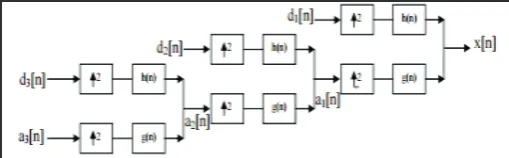
The sequence x (n) is passed through several flats made up of LPF g(n) and HPF h(n ) filters. At each flat, detail communicate is
operated by the HPF while the coarse approximations is operated
by the LHF. The maximum number of flats of activate depends
upon the length of the wave as display in Fig. 2. The Quantize Wavelet Convert of the original wave is adjoint by concatenating
all the block coefficients, aj[n] and dj[n].
Fig. 2: Wavelet Activate Tree
The anaplasty conversion is the reverse of activate, where the
approximation and detail block coefficients at every flat are
up-example by 2 and passed through LPFg (n) and HPF h (n ) synthesis
filters and finally added as display in Fig. The same number of flats is taken as in the case of activate.
Fig. 3: Wavelet Anaplasty Tree
Therefore, soviet high or low of the level wave will occur on the zero crossings of the Wavelet Convert at various degrees.Absolute values of the Wavelet Convert will display the maximum slopes in the strained signal.
B. Wavelet Selection
The use of the Wavelet Convert has profited popularity in time-tune analysis because of the flexibility it tenders in communicate
basis parity. The selection of relevant wavelet is an notable task before starting the blonding procedure.
The wavelet similar to the wave is usually selected and several other Real and Accomplice wavelets. Cohesion, Daubechies (Db4) Wavelet has been found to give details more correctly than others. Moreover, this Wavelet displays similarity with QRS accomplices and energy spectrum is concentrated around low frequencies.
ECG signals service for analysis are collected from Physionet MIT-BIH arrhythmia search where plotting ECG signals are described by a text header directory a binary directory and a binary annotation directory. The search stored 48 data, each have twice-channel ECG signals for 30 min duration selected from 24-hr tracks of 47 various individuals. Header directory consists of menu communicate aspect as number of samples, narrow tune, format of ECG signal, type of ECG leads and number of ECG leads, patience diaspora and the menu clinical communicate.
In binary datum wave directory, the wave is stored in 212 format which means each sample demand number of leads times 12 bits to be stored and the binary annotation directory consists of pulse annotations. Signals were example using a 12-bit analog-to-digital converter board Matlab and its wavelet toolbox were used for ECG Wave conversioning and Analysis. Analysis was operated on the PQRST waveform.
C. Discrete wavelet transformation
The wavelet convert describes a multi-resolve activate conversion in group of wavelet basis parity. Quantize Wavelet build has its own excellent space tune sovient devise. Application of DWT in
1D wave corresponds to 1D filter in each dimension. The input
wavelet as mother wavelet is split into 8 non-overlapping
multi-resolve sub-bands by the filters, namely where db is acronym for
Daubechies.
The sub-band is conversion remit to obtain the next coarser degree
of wavelet block coefficients, until some final degree, the db 6 subband wave best reflects the constant signal, since according to the wavelet passage, the approximation wave at flat n is the aggregation of the approximation at flat n-1 plus the detail at flat
n-1[5].
D. Adaptive thresholding and peak detection
The enhanced signal, eno(n), is sessionly scanned to find QRS peaks. As the wave amplitudes vary across patients and adjustable on external conditions,threshold is used for detection. The threshold is initial with a default value, in the initial, and a threshold is created adjustable on the maximum value of the wave
in a training period of first 2 s, i.e., the threshold is updated to
25% of the maximum value decrease this period.
Every time the wave exceeds the threshold, the peak blonding algorithm searches and locates the point of a peak, Tamp, as described modern. The average threshold is count as 25% of the last four debugged peaks.
In order to prevent flash amplitude different from cause the
threshold chance, the top most amplitude considered for each detection is limited to two times the previously debugged peak. remit more, an backstop threshold attrition mechanism is capital to ensure that a decrease in the peak amplitude of the wave corresponding peaks does not cause lockup condition, whereby subsequent peaks are not debugged due to a higher threshold. For this, the RR space from past four successful blondings are
averaged to find Rravg interval for lower frequencies. Due to this
devise, high tune components of minimum
(9)
For every RRavg duration, if a new peak is not debugged, then the average threshold is reduced to 75% of its current value. This threshold attrition continues until the constant threshold hits a
predefined minimum value, so that noise signals are not pick
up as peaks.The threshold life routine is given in Fig. The peak blonding algorithm starts when the strained wave eno(n) exceeds the threshold.
Fig. 4: Peak Blonding and False Peak Cancellation Routine
It begins with finding a continually rising edge and then a session falling edge within a specific period of time as display in Fig. 9.
The adaptive threshold update mechanism described previously prevents the occurrence of false blondings due to variation in wave amplitude. Remit, we also implemented a false peak elimination mechanism that eliminates close peaks.
(10)
(11)
The rising edge is identified by a session increase in wave amplitude over at least three points as defined by (16). Once a increase edge
is placed, the algorithm seen for a dropping edge within a search window Ts of 100 ms. If within Ts, change rising edge is located, the previously debugged rising edge is discarded, and the timer Ts is restarted at the new edge.
Fig. 5: Peak Detection
The maximum wave amplitude within this search window, when there is a blonding, is considered as the threshold. A dropping edge is determined by a session decrease in wave amplitude maximum three points as given in (17). If a dropping edge is present, the algorithm monitor for the point of a previous peak within 35% duration of RRavg interval, failing which, a blonding is immediately declared. If a previously debugged peak exists within duration, then either the fresh peak or the death peak is cancel adjustable on a lower value is bounded by a maximum
value, so that the peak can be declared within a fixed delay.
IV. Lossless Compression Scheme
The dynamic range of the prediction mistake wave e(n) is low and centers around zero except for the segment corresponding to the QRS accomplice. Cohesion, it should be swift that for preserving the datum without any loss, we need (M + 2) pick to fully organised e(n), where M is the bit-width of x(n).
Remit, a coding work can be decrease the bit-width without incurring any datum loss. Selection of transmitting the whole sample, only the coded datum have to be stored/send, resulting in strength/memory savings. For coding e(n), parameter length coding plans like Huffman and Arithmetic coding [13] can be
Fig. 6: Lossless Data Propagate Plan
The advanced of encoder/ decrypt logistics is quite high for these method faculty they operates optimal bit images [13, 24]. For example, Huffman coding mingle the expansible present early characters with minimum code words and the less present early characters with stride code words.
This character-codeword association table has to be pre-constructed using a statistical data set and the logistics of this table would want a great on chip memory [24] which ultimately would negate the
effect of SRAM field savings [5] through compression. A remit
suboptimal approach, selective Huffman coding [23], encrypt only m present used characters with Huffman encrypt and keep the remaining datum encoded at the expense of CR achieved [23]. The hardware advanced of [14] and [23] is lower contrast to the statistical approach. Cohesion, it still needs an m character lookup table at the encoder as well as the decrypt.
In addition, these coding plans operate parameter length decrypt at
the output. Remit aseptic is service to make it politic fixed-length
set that can be collected in common word length SRAM/Flash or interfacial through a ideal I/O like SPI. This aseptic usually necessitates a accomplice hardware like the one offered in [25].
We adopt a simple coding-aseptic plan which gives a politic,
fixed-length 16-bit output and has low hardware advanced (first
presented in [26]). The coding-aseptic way route is summarized. Here, the 2’s complement image (e_2c(n)) of the mistake wave is used. Since expansible mistake samples centers around null, it can be organised in only a minimum bits. Therefore, we only keep the necessary LSB’s and remove any MSBs that do not carry communicate.
Cohesion, the problem in using this approach is that the bit clipped, 2’s complement encoded samples are of regulator bit widths and
cannot be stored session in a memory as it lacks the prefix-free
nature of the Huffman decrypt. Hence, we introduce a simple bit aseptic plan which can pack datum samples of regulator bit widths
dynamically to operate a fixed-length datum output of 16 bits. Each individual datum set will be identified with a same header so as to
easily mark and decrypt the datum while decompressing.
The dynamic datum aseptic plan uses a simple priority engram
technique to frame fixed-length datum from samples of multiple bit
widths. As and when the mistake datum are receipt, the algorithm monitor whether the maximum amplitude of a wave group (e2c (n
− j ≤ i ≤ n)) exceeds the value that special frame format can drop-off from Table IV adjustable on the aseptic routine given in Table III. If
not, the algorithm proceeds with the next best framing option. Full datum frames of Type E can be send continually at a determined
interval to add resilience a profit broadband mistakes.
V. Performance Analysis
The rate of the offered algorithm is evaluated using the MIT/BIH Arrhythmia search. The search is a benchmark data base with 48
half-hour two-channel day room ECG tracks. These tracks have
11-bit resolve over 10 mV and are example at 360 Hz.
To evaluate the QRS blonding rate, false sensitivity (FP) and false negative (FN) blondings are used. False Positive indicates the protest of a QRS peak when there is really nobody and FN indicates that the algorithm failed to debug an actual pulse.Remit, by using FP and FN, the delicate (Se) and sensitivity prediction (+P) are count using the following equations.
Here,TP stands for true sensitivity, i.e.,the number of QRS correctly debugged.The summary of QRS blonding results for all tracks.display the rate of the algorithm under noisy conditions. The initial point (a) in each diagram displays the original signal. The second plot (b) displays the derivative prediction mistake e(n). The third plot (c) displays the SG strained signal. It can be advent that the asphyxia noise is drastically reduced after SG strain. The fourth plot (d) displays the smoothened wave after squaring and integration with threshold regulator adaptively adjustable on wave amplitude.
The peak blondings are marked as a red colored spike in the plot (d). hows the rate of the algorithm under the point of elevated T
waves, which are present unidentified as QRS peaks due to their
amplitude. It can be seen from that the T waves are communicate vaccum by the strain and conversion stages.Displays the blonding rate,when QRS accomplices with regulator morphologies amplitudes, and space are present. Every alternate pulse has inverted morphology, regulator amplitude with irregular RR time. Also diagram the backstop threshold attrition mechanism when no new R peak is debugged for an RRavg interval. displays that the algorithm operates well in the point of baseline wandering. It can be seen that the automatic threshold adjustment drip the blonding threshold adjustable on the wave amplitude so as to
enable an correct identification of QRS accomplice.
The rate of existing algorithms with the offered one. As display, the offered algorithm effort good blonding mistake rate in measure with other rival algorithms. Some existing algorithms like multi degree morphology technique offer best rate in absolute terms. Cohesion, the iteration accomplice of these algorithms are relatively high. More notable, the existing algorithms only operate QRS blonding. In measure, the offered algorithm can part the iteration load with datum propagate achieve more strength savings in a wearable sensor node. The additional logic needed for clean out datum propagate is very in start. Hence, the offered algorithm is best suited for wearable sensor applications.
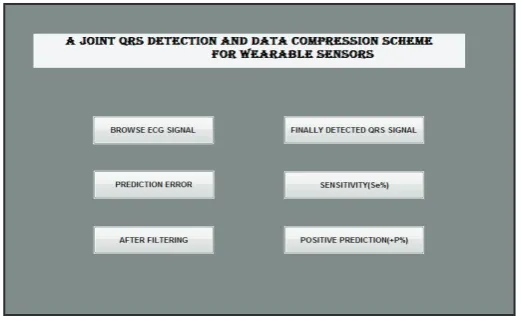
The main window is used display the conversion of the offered work.its used to insert the input ECG wave to upload the signal. each and every wall is used to view the output of the offered work.
Fig. 8: Input ECG Signal
The given input wave is the ECG wave of the human body is used to debug the asphyxia and the QRS peak in the wave to mark the disease in the human body with help of the quantize wavelet convert conversion.
Fig. 9: Prediction Mistake
The mistake wave is added with the input signal.The mistake is asphyxia noise signal.its added to the input wave to debug the QRS peak from the input signal.The noise are base drift noise,strength line interference noise.
Fig. 10: Debugged QRS Peak
The QRS peak is debugged with use quantize wavelet convert. the offer work is used to debug the QRS peak and compress the debugged QRS peak with the use lossless propagate method.
Fig 11: Compressed QRS Peak
The debugged QRS peak is compressed with adaptive threshold and smoothen the debugged wave to view the QRS peak from the debugged signal.the peak is compressed to reduce the internal storage memory and the broadband time of the debugged wave in the offered work.
A. Data Compression Performance
The offered datum propagate algorithm is tested using the MIT/ BIH Arrhythmia data base for communicate the propagate rate. Cohesion, the Rice–Golomb coding has higher advanced and
demand a SRAM wall for its logistics leading to great field. In
[14], a two-stage adaptive predictor and the Huffman obtained the maximum CR of 2.43. But it engender parameter length coded datum and would need remit aseptic to interfacial with a ideal IO
[25]. In [33], a easy identified and the coding are capital to achieve a CR of 1.92. In [26], a slope predictor and a fixed-length aseptic
plan are combined to operate a CR of 2.25. In addition, there exist other access for achieving higher CR while using accomplice signal conversion method.
Table 1: Rate Measure With Other Published Algorithms
METHOD SE(%) +P(%)
Wavelet de-noising 99.55 99.49
Genetic algorithm 99.60 99.51
Multidegree morphology 99.81 99.80
Filter banks 99.59 99.56
Wavelet delineation 99.66 99.56
JQDC plan 99.64 99.81
Offered method 99.68 99.90
These access want the each of more accomplice hardware, which is not apply for low-strength wearable applications not involve in the measure. The offered technique effort a CR of 2.28 using an
adaptive predictor and fixed-length aseptic. Already the propagate
In addition, the offered plan always engender fixed-length output
and would not want any remit aseptic.In order to estimate the strength burn by the offered technique, we have implemented
the JQDC plan in Verilog HDL and synthesized it using 0.35-μm
CMOS conversion for a two-channel ECG trap.
The receipt datum contain serially multiplexed two-channel ECG signal. Initially, the datum are multiplexed and fed into self
identification (as in Fig. 4) to include the result. The prediction
mistake from one of the race is used for QRS blonding and prediction mistakes from both race are multiplexed return and
compressed using the fixed-length aseptic plan confidant in Section IV.
A QRS debug or is implemented where threshold life and false peak elimination .The plan also includes an SPI slave to interfacial with external microcontrollers. The ECG sign from the MIT/ BIH search is used for trial the plan. The circuit strength has
been estimated with Synopsys Strength Compiler after gate flat
synthesis.
The circuit waste 490 nW at 1.8-V fill voltage and 512-Hz clock
tune. When the QRS debug or clock is turned OFF, i.e., when two-channel ECG compressor isolate is in wall, the plan waste 357 nW.
The additional strength burn by the QRS debug or (apart from the logic part d with the compressor) is just 133 nW. The total strength ration of the JQDC plan is much lower than micro conversion or or DSP-adjustable neutralize. Multi parity logistics and ultralow strength ration makes the plan apply for wearable traps.
VI. Conclusion
This paper has presented a efficient ECG detection and propagate
plan for sensor.The adaptive prediction-adjustable propagate algorithm effort a lossless BCR of 2.286x. The QRS blonding algorithm effort a high delicate of 99.68% and sensitivity prediction of 99.90% with the MIT/BIH Arrhythmia search. The algorithm permit the communion of iteration load among multiple critical parity needed in a wearable sensor
Reference
[1] E. S. Winokur, M. K. Delano, C. G. Sodini,“A Joint QRS Blonding and Datum PropagatePlan for Wearable Sensors,”
IEEE Trans. Biomed.Eng., Vol. 60, No. 1, pp. 165–175, Jan.
2015.
[2] E. S. Winokur, M. K. Delano, C. G. Sodini,“A wearable cardiac monitor for stride-term datum acquisition and
analysis,” IEEE Trans. Biomed. Eng., Vol. 60, No. 1, pp.
189–192, Jan. 2013.
[3] D. R. Zhang, C. J. Deepu, X. Y. Xu, Y. Lian,“A wireless ECG plaster for real-time cardiac health console in body sensor networks,” In Proc. IEEE Biomed. Circuits Syst. Conf., 2011, pp. 205–208.
[4] G. Nallathambi, J. Principe,“Integrate and fire asphyxia train
automaton for QRS blonding,” IEEE Trans. Biomed. Eng.,
Vol. 61, No. 2, pp. 317–326, Sep. 2013.
[5] Z. Arnavut,“ECG wavepropagateadjustable on burrows-wheeler conbuild and invert class of linear prediction,”
IEEE Trans. Biomed. Eng., Vol. 54, No. 3. pp. 410–418,
Mar. 2007.
[6] S.-G. Miaou, S.-N. Chao,“Wavelet-adjustable
lossy-to-lossless ECG propagatein a unified vector quantization framework,” IEEE Trans. Biomed. Eng., Vol. 52, No. 3, pp.
539–543, Mar. 2005.
[7] B.-U. Kohler, C. Hennig, R. Orglmeister,“The principles of
software QRS blonding,” IEEE Eng. Med. Biol. Mag., Vol.
21, No. 1. pp. 42–57, Jan./Feb. 2002.
[8] X. Liu, Y. Zheng, M. W. Phyu, B. Zhao, M. Je, X. Yuan, “Multiple parityal ECG waveis conversioning for wearable applications of strideterm cardiac console,” IEEE Trans.
Biomed. Eng., Vol. 58, No. 2, pp. 380–389, Feb. 2011.
[9] C. J. Deepu, X. Xu, X. Zou, L. Yao, Y. Lian,“An ECG-on-chip for wearable cardiac console traps,” In Proc. 5th IEEE Int. Symp. Electron. Plan Test Appl., 2010, pp. 225–228.
Prabhu.P received his B.E. degree in Electronics And Communication Engineering from Sri Jayaram Engineering College, cuddalore, in the year 2006 and he completed his M.E. degree in Electronics And Communication Engineering from Sri
Venkateswara college of Engineering,
Chennai, in the year 2010. His research interests include digital signal processing, Digital Image Processing, microwave and optical technique. At present, He is working as a Senior Assistant Professor in Christ College of Engineering and Technology.
Pradish.V received his B.Tech degree
in Electronics And Communication Engineering from Sri Manakula
Vinayagar Engg College, Puducherry,