International Journal of Basic & Applied Sciences IJBAS-IJENS Vol:17 No:06 7
172606-3131- IJBAS-IJENS @ December 2017 IJENS I J E N S Abstract-- The aim of this research is to develop the
imple-mentation of experiential learning model of microteaching learning through the role of model and cooperative group in the microteaching course and to develop a set of instruments needed to assess the validity, practicalities and effectiveness of the developed learning model. Development of experiential learning-based microteaching learning model uses the stages of learning model Plomp ( 1997) but researchers only use 4 stag-es namely: a) initial assstag-essment phase, b) dstag-esign stage, c) reali-zation / construction stage, d) test phase, evaluation and revi-sion. The subjects of the study were the students of the Education Economics Faculty of Teacher Training and Educa-tion of the University of PGRI Ronggolawe Tuban in the sixth semester who took Microteaching courses and in the seventh semester took the Field Teaching Practice 2. Data collection was done by questionnaire, observation and documentation. The data were analyzed by descriptive technique. The results of this study indicate that: 1) development learning tools in-cluded in good category and can be used, 2) instrument of as-sessment instrument of microteaching model based on Experi-ential Learning result of development (teaching book valuation instrument, lesson plan, student activity sheet assessment and assessment of modeling) included good category
I. INTRODUCTION
A. Background of the Study
This research is motivated by the researcher's concerns about the tendency of students in the seventh semester dur-ing teachdur-ing practice in schools that have many obstacles, especially in the mastery and application of basic teaching skills, including: basic teaching skills, material mastery, classroom management, time management, and creativity development. Based on the study on the students' grade teaching skill assessment sheets 2012 during PPL 2 re-vealed that 20% of them in good ability category, 60% cat-egorized as good enough and 20% in less category. (docu-mentation of Economic Education Study Program, 2015) Efforts have been made by the team of microteaching lec-turers by increasing the frequency of simulation exercises, but the results have not been optimal. This is because teach-ing is a complex act; sometimes they face different real sit-uation with the simulation. According to Brown (1975) alt-hough teaching is a complex act, the elements of basic teaching skills can be learned and trained. It is supported by the Hamalik (1999)which stated that teachers are not born,
but first formed through education and microteaching train-ing in order to be the professional teachers.
Microteaching learning began in Stanford University, USA in 1963, as one of the efforts to improve the quality of professional teachers, it is spread to Asian countries, espe-cially Malaysia and Philippines (Asril, 2012). In Indonesia micro learning was introduced by several LPTKs. In May 1977 a seminar was held that recommended Microteaching in syllabus and curriculum. Therefore Microteaching course is a compulsory course in educational institutions (LPTK), such as in Economic Education Study Program of FKIP Unirow, Tuban.
Various learning models have been applied in mi-croteaching lectures, such as observation and simulation model, learner centered model (Kartikowati, 2014, Killic, 2010), contextual model (Elmy, 2013), based on micro-teaching theory (Allen & Brown, 1975), Personal Model of Teaching and Social Model of Teaching (Weil and Joyce, 1996), and the theory of contextual teaching and learning (Johnson) and other experiential learning models and teach-ing practices. One of the learnteach-ing models that put forward direct experience is experiential learning. Experiential learn-ing orientates learnlearn-ing on direct experience; this is in line with the objectives of the microteaching course. As stated by Allen, the objectives of microteaching for prospective teachers are: 1) provide real teaching experience and prac-tice some basic teaching skills 2) prospective teachers can develop their teaching skills before they go into the real teaching 3) give some opportunities for prospective teachers to get various basic teaching skills.
The evidence of the success in using of experiential learning through modeling and the role of groups as a learn-ing approach that can improve teachlearn-ing skills presented by Fadlan (2009) which states that Modeling is part where the lecturer becomes a model in the learning directly and stu-dents can observe it, then they will adopt the lecturer’s style of teaching. Research on the application of Experintial Learning is also shown by research Septi Aprilia (2015) which states that Experiental learning is not only able to improve student achievement but also increase skills of teachers, on average cycle I teacher skills was 3, 11 with percentage of 48.3% (good in scale) in cycle II rose to 3,5 with percentage88.8% (very good in scale)
. According to Pasaoran and Liliasari (2010), modeling in learning is the first phase in the effort to improve prospec-tive teachers’ skills as well as the discussion phase, en-richment phase, and peer learning phase. This shows that
Improving Teaching Skills Through Learning Model
Development Microteaching Based on Experimental
Learning
Yudi Supiyanto, Dumiyati, Henny Sulistyoningrum
International Journal of Basic & Applied Sciences IJBAS-IJENS Vol:17 No:06 8
modeling phase has a very important role in providing di-rection for students in managing learning.
The role of cooperative groups in microteaching is re-quired to take turns of performing tasks for a skill compo-nent, such as the role of the teacher, the role of the written observer, the role of the oral observer, the role of the dents, the role of the supervisor. It is done so that all stu-dents can have direct experience related to these roles, thus supporting the improvement of teaching skills. Referring to the description, it is necessary to develop an experiential learning microteaching model through the role of model and cooperative group to improve teaching skill.
B. Problems of the study
Based on the previous description, it can be formulated the problems of the study as follow:
1. How to develop experiential learning-based mi-croteaching learning model through the role model and group to improve quality of teach-ing skill (valid, practical, and effective)?
2. How to develop a set of support equipment of microteaching learning model through role model and group to improve quality of teach-ing skill (valid, practical, and effective)?
C. Objects of the Study
The objects of this study are:
1. Develop experiential learning-based Microteaching learning model through the role model and group to im-prove quality of teaching skill (valid, practical, and effec-tive)
2. Develop a set of support equipment of microteaching learning model through role model and group to improve quality of teaching skill (valid, practical, and effective) Supporting instrument of this model includes: lesson plan, Student Activity Sheet, Student Book, Lecturer Handbook, and Valuation Sheet, a basic teaching skill model video.
D. Benefits of the Study
In general, the benefits of this study are:
1. Give a significant contribution in the education world, especially about learning model based on experiential learning microteaching through the role of models and groups to improve quality of teaching skills.
2. The use of the model can improve the quality of learning done in the class and help lecturers to produce learning process more effectively.
3. Assist the students in understanding the teaching materi-als in the form of: microteaching material books, basic teaching skills training videos, and direct practice comprehensively in order to improve students' teach-ing skills.
E. Urgency (the benefit) of the Research
Mastery of teaching skills for prospective teachers has be-come a necessity that cannot be postponed. Considering that students have to do real teaching in school during PPL 2, students must master teaching skills, so that they do not contribute more harm than good in the school during their apprenticeship. Through experiential learning students are expected to combine the acquisition experience (grasping experience) and the transformation of experience (transfor-mation of experience). Grasping experience can occur di-rectly, ie through the senses and indidi-rectly, ie in the form of symbolic forms, such as concepts. Activities transforming experience (transforming experience) is in the form of re-flection and involvement of students in a learning activity and teaching practice. Experiential learning model describes two models of information acquired: concrete experience and abstract conceptualization, and two experience trans-formation models, namely reflective observation and act ive experimentation.
It is assumed that if the learning process is done through direct experience, then the experience has an important role in the construction of knowledge. Madnesen & Sheal ar-gued that the meaningfulness of learning depends on how the way to learn. If you learn only by reading the meaning-fulness of learning can reach 10%, from hearing 20%, from seeing 30%, both listening and seeing 50%, communicating will reach 70%, furthermore learning by both doing and communicating can reach 90% (Suherman, 2006). It is clear that learning activities with an active role of students in real experience can optimize activities in achieving learning ob-jectives.
Therefore, it is necessary to develop a learning model of experiential learning through qualified model and group roles (valid, practical, and effective) to improve teaching skill
II. RESEARCH METHODOLOGY
A. Types and Research Design
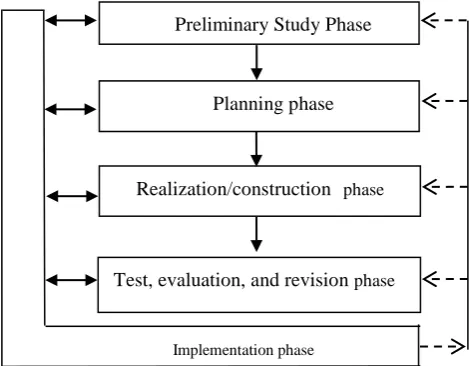
This research belongs to the type of research develop-ment. The research design used is the development plan ac-cording to Plomp (1997) and Ekawati (2017) as in Figure 2.
Implementation phase
Fig. 2.1. The Design of Plomp Development Preliminary Study Phase
Planning phase
Realization/construction phase
International Journal of Basic & Applied Sciences IJBAS-IJENS Vol:17 No:06 9
172606-3131- IJBAS-IJENS @ December 2017 IJENS I J E N S Research activities that will be done are research and
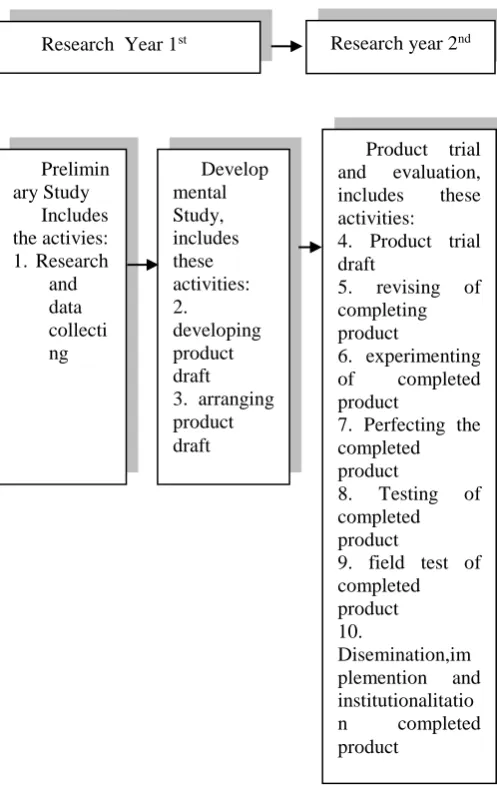
de-velopment or R & D. The general steps of the R & D meth-od are identified in Figure 2.2.
Fig. 2.2. General Research and Development Steps
B. Subject of the Study
This research was conducted in Economic Education Pro-gram-FKIP UNIROW Tuban, on the students of semester VI who engaged in Microteaching course (PPL 1), simula-tion, furthermore they took Real Teaching (PPL II) in the semester VII. It consists of 15 students.
C. Implementation of First Year Study
There are three components that will be developed in this development research: (1) learning model of experiential learning microteaching, (2) learning instruments to support experiential learning model of experiential learning and (3) instrument that will be used to evaluate the qualityof learn-ing model Microteachlearn-ing is experiential-based learnlearn-ing. The development of experiential learning-based stages of the Plomp model (1997: 6-15), which is only up to 4 stages from 5 stages: (a) preliminary study phase, (b) planning stage, (c) realization / construction stage, (d) test phase,
evaluation and revision, while the fifth stage of Implemen-tation will be done in second year. The components covered in the model refer to the components of the learning model which are stated by Joice, Weil, and Shower(1992): (a) syn-tax, (b) the social system, (c) the principle of reaction, (d) the support system, and (e) the impact of instructional and companions (Tompo et all, 2016).
The details of the activities undertaken at each stage in the development of the learning model can be explained:
1) Preliminary study phase: The activities undertaken at this stage are: (1) study of theoretical learning models especially related to: (a) model rationality, (b) theories that support the model, and (c) the components of the model: syntax, the social system, the principle of reac-tion, the support system and the impact of instructional and companions ( Zulkifli, M:2013); (2) microteaching theories based on experiential learning and its impact on teaching ability.
2) Planning Stage: The main activities at this stage are: (1) designing outline the components of experiential learning-based learning model, these includes: syntax, the social system, the principle of reaction, the sup-port system, and the impact of instructional and com-panions (2) outline the theories of model support. d) Designing the type of micro teaching video to be cre-ated.
3) Realization / Construction Stage: In this phase, proto-type I1of experiential based learning model is modeled
and grouped to improve student teaching capability which is arranged in 4 parts covering: (a) rationality, (b) supporting theories, (c) the components, and (d) the implementation guidance of experiential learning-based learning model. Prototype I1 is what will
contin-ue to be developed in the next development stage. Pro-totype I1 includes, the learning model tested on the
Economic Education Program-FKIP UNIROW Tuban.
Furthermore, for the development of learning devices, ex-periential learning-based learning model refers to the stages of "Plomp model" development:
1) Preliminary study phase: At this stage the study done are (1) learning device format that will be developed, namely: Lesson plan (RP), Student Activity Sheet (LKM), Student / Lecturer Book, and assessment Sheet, (2) the syntax of experiential learning-based learning model as a reference for developing RP, Stu-dent/ Lecturer book, and Assessment Sheet, (3) theo-ries of Microteaching based on experiential learning, 2) Planning Phase: The main activities details at this
stage are designing: (1) student books and lecturers' book about the implementation of microteaching, (2) lesson plan (RP) as guidance in teaching materials and practice of micro teaching, 3) student worksheets (MFIs) to strengthen students' understanding of teach-Prelimin
ary Study Includes the activies: 1. Research
and data collecti ng
Develop mental Study, includes these activities: 2.
developing product draft 3. arranging product draft
Product trial and evaluation, includes these activities: 4. Product trial draft
5. revising of completing product
6. experimenting of completed product
7. Perfecting the completed product
8. Testing of completed product
9. field test of completed product 10.
Disemination,im plemention and institutionalitatio
n completed
product
International Journal of Basic & Applied Sciences IJBAS-IJENS Vol:17 No:06 10
ing materials and at the same time train its application in the practice of micro teaching, and (4) assessment sheets. (5) Learning videos.
3) Realization / Construction Phase: In this stage, a Pro-totypeI1 instructional instruments are developed such
as: (1) student and lecturer books, (2) student work-sheets, (3) lesson plans (RPs), and Assessment Sheet. Prototype I1 includes, learning device for Economic
Education Program. Prototype I is then tested, evaluat-ed, and revised at the next stage of development (sec-ond year)
Furthermore, for the development of the instruments de-veloped are: 1) Model of Evaluation Sheet, 2) Student As-sessment Sheet, 3) Lecturer AsAs-sessment Sheet, 4) Observa-tion Sheet Model, 5) Student Microteaching ObservaObserva-tion Sheet, 7) Student Response Questionnaire on Application of Model, 8) Student Response Questionnaire to LKM, 9) Stu-dent Response Questionnaire to StuStu-dent Books, 10) Teach-ing Material TestTeach-ing, and 11) Instruments for the assess-ment of basic teaching and simulation skills.
The last step of the research of the first year, after pro-ducing the model book, equipments and instruments, before conducting the test, evaluation and revision, the validation test was conducted which includes: 1). Validation of model books, equipments and instruments which were done by validators. The validators consist of expert of technology of learning, language and content, 2) conceptual analysis and 3) revisions to development.
D. Data analysis technique
Data analysis activities conducted in this study refers to Nieven (1999), namely validation test, practicality test, and effectiveness test. For the first year of study only comes to the analysis of validation model. Activities undertaken in the process of data analysis and evaluation of experiential learning model based learning is:
1) Finding the mean validation results of all validators for
each criteria ( i)
2) Finding the mean of each aspect ( i)
3) Finding total mean ( )
4) Determining the category of validity of each criteria or aspect or whole aspect by matching the criteria mean
( i) or the mean aspect ( i) or the total mean ( ) with
the following categories:
3,5 M ≤ 4: very valid ; 1,5 M< 2,5: quite valid 2,5 M<3,5: valid ; M 1,5: invalid
Description: M = ( ) to find the validity of all aspects of what is being investigated,
The standard used to judged that experiential learning-based learning models have sufficient validity degrees are (i) the X value for the overall aspect is at least "quite valid",
and (ii) the value is in the "valid" category. If this is not the case, a revision is required based on the suggestion of the validator or by reviewing the aspects that are of less value until the minimum value falls within the valid category.
III. RESULT AND DISCUSSION
A. Initial data result
To ensure that this research is important and necessary in the development of Microteaching learning, it is necessary to retrieve preliminary data which will strengthen the re-search. Preliminary data as mentioned in addition has been showed the data about student achievement in PPL II that is based on the assess on the grade of students' teaching skill grade 2012 when PPL 2 shows 20% good ability category, 60% good enough and 20% less category. (The documenta-tion of Economic Educadocumenta-tion Program, 2015). Based on the results of this study indicates that there will be new efforts to improve student achievement that less satisfactory through the use of Experiential Learning approach. Howev-er, it is not enough to rely on the results of the study, it still needs a survey through questionnaires for lecturers of Mi-croteaching course and PPL II especially about their under-standing related to this experiential Learning approach. From the questionnaire data of 10 lecturers. It is obtained: 1). 90% of lecturers said they have known the term Experi-ential Learning and 10% have not, 2). 20% stated that they understand the implementation of the approach, 30% less understood and 50% of lecturers do not understand, 3). 30% said there was no need for special training, 60% percent needed and 10% stated it is significant necessary, 4). Then 85% stated that they were ready to implement experiential learning approach, 5% stated less ready and 10% stated not ready to do, and 5). When they were asked for a response to the belief that this approach is useful for improving student achievement, 80% said it was useful, 15% less useful. Based on the review results of the positive lecturer's re-sponse to the importance of the Experiential Learning ap-proach in the micro teaching course, it indicates that it needs to be done by introduction or short training.
International Journal of Basic & Applied Sciences IJBAS-IJENS Vol:17 No:06 11
172606-3131- IJBAS-IJENS @ December 2017 IJENS I J E N S
B. Validation test result
To know the validity of the designed model consisting of the following components: 1) Supporting theories, 2) Syn-tax, 3) Social System, 4) Principles of Management Reac-tion, 5) Supporting System, 6) Instructional Impact and Companion Impact 7) Learning Environment and Manage-ment Tasks, conducted by requesting an assessManage-ment based on the assessment instrument that has been prepared by re-searchers to two validators, namely the design expert of learning.
Based on the validation file of two validators after averag-ing the score obtained 3.3 in the category valid. Further-more, based on the results of this validation model, the mi-croteaching model book based on experiential learning model declared feasible to be implemented.
Furthermore, for learning devices that have been prepared consisting of: 1) Syllabus, 2) Lecture Units, 3) Semester Program Activity Plan, 4) Lesson Plan, 5). Textbooks. The validation results by the validator obtained results as fol-lows: 1) syllabus got a value of 3.35 in category Valid, 2). Lecture Units achieved a value of 3.7 in very valid category, 3) Semester Program Activity Plan got a value of 3.55 in very valid category, 4). Lesson Plan achieved a value of 3.6 in a very valid category, 5). Teachers got a value of 3.7 in a very valid category. Upon the results of research where all showed the level of validation then the next learning device will be used in the next stage of the implementation phase (on second year).
IV. CONCLUSSION
Based on the plan of achievement of the research results in this first year then based on existing data analysis process obtained results as in this brief exposure into conclusion: 1) the book model is categorized as valid category, 2) syllabus is categorized as Valid category, 3). Lecture Units is catego-rized as very valid category, 4). Semester Program Activity Plan is categorized as very valid category, 5). Lesson Plan is categorized as in very valid category, 6) .The lesson is cate-gorized as into the very valid category. Based on the results of the research where all showed a significant level of valid-ity then the next book model and learning equipment will be used in the next stage of the implementation phase.
V. REFERENCES
[1] Allen & Ryan. Microteaching. Reading, Massachusetts: Addi-son-WesleyPublishing Company. 1969.
[2] Allen DW, Ryan K. Reading. Microteaching. Massachusetts: Addison-Wesley. 1969
[3] Aprilia, Septi. Penerapan Pembelajaran Experiential Learning untuk Meningkatkan Kualitas Pembelajaran Ipa Kelas V Sekolah Dasar. Premiere Educandum, Volume 5 Nomor 1, Juni 2015, pp. 20 – 33
[4] Bhat, V.D. Experiential Learning, a Handout for Teacher Educator. Mysore: Regional Institute of Education . 2001.
[5] Brown G. Microteaching. A programme of teaching skills.London: Methuen and Co Ltd.1975
[6] Ekawati, EY.A Model of of scientific attitudes assessment by observation in physics learning based scientific approach : case study of dynamic fluid topic in high school, Journal of Physics Conference Series, 2017.
[7] Elmy, M. Penerapan Microteaching Berbasis Pembelajaran PKn Kontekstual dalam Pembangunan Kompetensi Mengajar (Peda-gogik) Mahasiswa (Studi Eksperimen Kuasi pada Mahasiswa Pkn Fkip Unlam Banjarmasin). Tesis.Tidak diterbitkan. 2013 [8] Joyce,Bruce;Weil,Marsha;&Showers,B.
ModelsofTeach-ing.Fourth Edition.Boston: Allyn&Bacon. 1992
[9] Kilic, A. Learner-centered Microteaching in Teacher Education. International Journal of Instruction, ISSN: 1694-609 x, Januari
2010. Vol 3 no. 1 (on line)
http://www.google.com/search?q=miroteaching+journal+&ie= utf-8&oe=utf-8 diakses tanggal 20 April 2014
[10]Kolb, A.D. Experiential Learning, Experience as The Source of Learning and Development. New Jersey: Prentice Hall, Inc., Englewood Cliffs. 1984
[11]Kolb, A.D. & Boyatzis, R.E. Experiential Learning Theory, Previous Research and New Direction. Case Western
Re-serve University. online pada:
[http://www.d.umn.edu/~kgilbert/educ5165-731/Readings/experiential-learning-theory.pdf] 1999. [12]Kolb, D. Powerful Learning Experiences.http://www.
Learning-from experience.com (diakses tgl. 7 Mei 2015)2002.
[13]Kpanja, E. A Study of The Effects of Video Tape Recording inMicroteaching Training.British Journal of Tecnology, 2001. 32 (4), pp. 483-486.
[14]Nieveen, Nienke. PrototypingtoReachProductQuali-ty.InJanVandenAkker,R.M.Branch,K.Gustafson,N.Nieveen& Tj.Plomp(Eds).DesignApproachesandTools inEducationand Training).KluwerAcademic Publishers,Dordrecht, the Neder-lands.1999, pp.125-135
[15]Plomp, Tjeerd. Educational and Training System De-sign.Enschede, The Netherlands:UnivercityofTwente. 1997.
[16]Suherman, H. E.. Model belajar dan pembelajaran berorientasi kompetensi siswa. Educare: Jurnal Pendidikan dan Budaya. 2008. Pp. 5(2).
[17} Tompo, Basman , Arifin, Ahmad, and Muris Muris. The Devel opment of Discovery-Inquiry Learning Model to Reduce the Science Misconceptions of Junior High School Students.