Page 174 www.ijiras.com | Email: [email protected]
Community-Based Projects In Kenya: Analytical Review Of
Application Of Logical Framework As A Project Design Tool For
Enhancing Performance
Wasike Wilberforce Walubengo
University Of Nairobi,
School Of Open And Distance Learning, Nairobi
Dr. Dorothy Ndunge Kyalo
Senior Lecturer, University Of Nairobi
School Of Continuing And Distance Education, Kikuyu
Dr. Angeline Sabina Mulwa
Lecturer, University Of Nairobi,
School Of Continuing And Distance Education, Kikuyu
I. INTRODUCTION
Across the globe, the improvement of performance has become ever more critical to the success of projects and has been the subject of a considerable amount of research and attention over the past two decades. Smyth (2010) pointed out that there has been a range of initiatives across many countries
over the last 10 to 15 years to introduce reform to the project process and, more specifically, on the tools used at project design phase in order to improve performance. Although a considerable programme is underway, there is concern associated with the frequent and lengthy delays relating to project design that have caused underachievement in project performance (Al-Kharashi & Skitmore, 2009).
Abstract: The purpose of this study was to establish how the application of logical framework influences performance of community-based projects in Kenya. The study employed descriptive research design. A sample of 128 was obtained from a target population of 192 respondents through stratified random sampling procedure from different community-based organizations. Data were collected by use of a questionnaire and an interview guide. Qualitative data was analysed through checking data, developing codes, identifying themes and patterns. Data was summarized and linked to the objectives and hypotheses. Quantitative data was analysed where both descriptive and inferential statistics were generated. Descriptive results were presented as frequency tables, percentages, arithmetic means and standard deviation. Inferential statistics were analysed using Pearson’s Product Moment correlation (r) from simple regression and multiple regression analysis. F-test was used to test the hypotheses. Tests of statistical assumptions were carried out before analysis. In this study ; r=0.121, R2=0.015, F 0.494 with p=0.688>0.05; therefore, H0 was not rejected and it was concluded that logical
framework has no statistically significant influence on the performance of community-based projects. In conclusion, the study findings provide evidence that for increased performance of community-based projects in Kenya, aspects of logical framework as a project design tool should be comprehensively addressed. Therefore this should be a consideration for organizations seeking congruence with the strategic plans of their projects. Organizations need to support and invest in the application of logical framework matrix from time to time. In addition, organizations need to frequently try out new ideas and seek out new ways of doing things based on technical advancements on the logical framework matrix. The findings add to Project Management Body of Knowledge by providing informative insights for project managers and other practitioners regarding logical framework as a project design tool and performance of community-based projects.
Page 175 www.ijiras.com | Email: [email protected]
According to Ling (2004), in order to measure the success of projects, one can create criteria and metrics which is a division refining the project success in achieving success in the product of the project by meeting quality standards; achieving success in the process by meeting the goals of time and budget by use of effective project design tools. For this, the author uses four metrics to evaluate the performance of projects: cost, time, quality and service customer satisfaction. Larson and Gobeli (1989) use the same indicators proposed by Ling (2004) to present some factors such as project design tools, project structure, project manager's competence and size of the project that may affect the success of projects. Another way to measure success is folding it in two different criteria. According to Cooke-Davies (2002), no system of metrics in projects can be considered complete without a package of measures (performance and success) and one should seek a method of connecting them, as a means of assessing the accuracy with which the performance of projects predict the success of the organization.
The failure of many community-based project in Kenya is mainly related to problems and failure in project design, tools and techniques used. Moreover, there are many reasons and factors which cause such problems. Long et al. (2004) remarked that performance problems arise in large construction projects in the US due to many reasons such as: incompetent designers/contractors, poor estimation and change management, social and technological issues, site-related issues, and improper techniques and tools. Navon (2005) stated that the main community-based project performance problem can be divided into two groups: unrealistic target setting, for example planning, or causes originating from the actual construction. In many cases, the causes for deviation originate from both sources.
The logical framework approach (LFA)was described by its developers as a set of interlocking concepts which must be used together in a dynamic fashion to permit the elaboration of a well-designed, objectively described and evaluable project. It should be noted that the LFA is not an integrated set of procedures; nor is it a set of guidelines for the evaluation of a particular type of project. On the other hand, by creating a sense of community ownership, participation leads to effectiveness and better decisions in projects. In order to ensure sustainability in projects, it is important to cultivate local ownership which is achieved through participation. Participation leads to learning, which is a requirement for behavioural changes and practices (Kelly, 2001).
The logical framework in project management is defined by Hailey and Sorgenfrei (2004) as a methodology for planning, managing and evaluating programmes and projects, using tools to enhance participation and transparency and to improve orientation towards objectives. This approach follows a hierarchical results-oriented planning structure and methodology which focuses all project planning elements on the achievement of one project purpose. According to Molander et al. (2005), drawing up an LFA has two main stages, analysis and planning, which are carried out progressively during the identification and design phases of the project cycle. Using LFA, the existing situation is analysed so as to develop a vision for the desired future situation and choose the strategies to apply to reach it. The key idea is that
projects/programmes are aimed at problems faced by the target group, whether of women or men, and their needs and interests.
A. STATEMENT OF THE PROBLEM
There has been a range of initiatives across many countries over the last 10 to 15 years to introduce reform to the project design process in order to improve the performance of community-based projects. Community-based projects are of particular interest due to the current rapid growth of the Kenyan economy, and the significant number of large projects being implemented in both the public and the private sectors. Although there are considerable project designs underway, there is concern associated with the frequent and lengthy delays that have caused underachievement in project performance among projects being undertaken in Kenya (Mkutu, 2011). Effective use of the logical framework as aproject design tool is considered one of the key aspects of project performance. Project management is a challenging task with many complex responsibilities and the relevant project design tools and techniques. Despite the fact that there are many tools to assist with accomplishing the tasks and executing the responsibilities, project managers face a problem of choosing the best project design tool that suits their management style and addresses all project management needs (Silverman, 2008).
Research has shown that the full potential of community based projects has yet to be tapped due to the existence of a number of constraints such as lack of planning, improper financing and poor management (Longenecker et al., 2006). It is not an easy task to sustain radical improvement in a diverse environment like the project industry. This requires the identification and implementation of suitable improvement programmes subjected to the project business cycle. With this in mind the current study sought to establish the influence of application of logical framework as a project design tool on the performance of community-based projects in Kenya, since no research study has given any conclusive evidence to show the link between the application of logical framework as a project design tool and the performance of community- based projects.
B. OBJECTIVES OF THE STUDY
The study was guided by the following objective:
To establish how application of logical framework influences performance of community-based projects in Kenya.
C. RESEARCH HYPOTHESIS
The research hypotheses guiding this study included the following:
Page 176 www.ijiras.com | Email: [email protected]
II. LITERATURE REVIEW
The importance of the logical framework to project performance cannot be underestimated as underlined by Milika (2011) who was of the opinion that the logical framework helps to analyse an existing situation like in relation to output as well as the identification of stakeholders’ needs and the definition of related objectives; and establish a causal link between inputs, activities, results, purpose and overall objective in the vertical logic. He further argues that the logical framework output enables organizations to define the assumptions on which the project logic builds; identify the potential risks for achieving objectives and purpose; establish a system for monitoring and evaluating a communication and learning process among the stakeholders -- like clients or beneficiaries, planners, decision-makers and implementers. It also considers strengths, weaknesses, opportunities and threats. The study did not test for moderating variables. The current study will establish the influence of the logical framework and managers` competences as the moderating variable on the performance of community-based projects.
A study by Leuzzi (2013) focusing on the development of the logical framework approach in Ghana indicates that a major component of logical framework is the formulation of a logical framework matrix based on activities, goals and purpose of the project. These are itemized in the logical framework matrix; and the logical framework is a more presentation that explains all components of a project. The logical framework matrix is in a table form that can be read at a glance by the relevant user. He concluded that the logical framework matrix is a participatory planning, monitoring and evaluation tool whose power depends on the degree to which it incorporates the full range of views of intended beneficiaries. The study used explanatory design; hence its results suffer from generalizability since it focused on Ghana as a country and covered the development of the logical framework. The current study was carried out in Kenya and it focused on community-based projects in all sectors and sought to establish how the application of the logical framework influences the performance of community-based projects.
On how the logical framework analysis is used for monitoring and evaluation, Bakewell and Garbutt (2005) carried out a study that used a simple-structured questionnaire from 18 different organizations, including donors, European and developing country NGOs, and consultancy organizations. The findings indicate that that the focus is often the logical framework to look at the expected project objectives laid out in the matrix, rather than the work itself. The findings further advance the argument that, in theory, the logical framework can be revised through the programme cycle and changes made, at least to the project objectives and output; however, this rarely happens in practice. This study did not test the influence of the logical framework on the performance of community-based projects which is the focus of the current study. The study used only the questionnaire as the data collection tool while the current study adopted a questionnaire and an interview guide as the main data collection tools.
A study by Busiinge (2010) in the Ugandan Rwenzori region used questionnaires for data collection with the unit of analysis being those in high positions of each firm. The study
found out that donors rarely operate outside the log frame approach whereby project activities are the core aspects of the frame. However, they are boxed in results that are put in the project logical framework, and yet sometimes the situation on the ground might affect the achievement of some of the activities, hence requiring some aspects of the project to be changed in regard to objectives. It was concluded that any suggested changes by the implementing organizations would go through prolonged to-and-fro communication. The study relied on longitudinal data and did not examine the cause and effect of the variables at a specific period of time. The current study used cross-sectional data to examine the cause and effect of hypothesized relationships at a specific period of time.
A. THEORETICAL FRAMEWORK
Page 177 www.ijiras.com | Email: [email protected]
B. PERFORMANCE OF COMMUNITY-BASED
PROJECTS
Jackson and Slocum (2009) approaches performance as each person’ work achievement after exerting effort. From this definition, project performance touches on how the ability of workers to finish the jobs they are responsible for and how those jobs help in achieving the goals of the organization. Performance measurement, as monitoring and controlling of projects by Thomas (2000), was on a regular basis. Kuprenas (2003) stated that project performance measurement means an improvement of cost, schedule and quality for design and construction stages. Long et al. (2004) stated that a project performance measurement is related to many indicators such as time, budget, quality, specifications and stakeholders’ satisfaction. They remarked that performance problems arise in large construction projects due to many reasons such as: incompetent designers/contractors, poor estimation and change management, social and technological issues, site-related issues and improper techniques and tools.
Cooke-Davies (2000) observes that for projects to perform well, there is need for close cooperation between the CBP and the community. They ought to work towards the same goal and share the same interests. He also adds that mean performance against budget (4% cost escalation) is generally better than mean performance against schedule (16% late); and when the adequacy of specific project management practices and the maturity of specific project management processes are compared with performance against each of these two criteria, different practices are found to correlate significantly. Williams (2009) asserts that the internal environment of any organization comprises firm-related factors that influence its capacity to achieve set objectives, develop and implement a viable plan, which consequently contributes to its performance.
Research has found that there are many cases of cost overruns as compared to projects that have been completed within budget. Chimwaso (2001), in his paper, sought to evaluate the cost performance of public projects in Botswana, and tried to identify factors that influence construction cost overruns in budget. The study was based on a questionnaire survey among professionals of the construction industry. The results, together with empirical data from ten completed projects, have been presented. Five significant factors that influence construction cost overruns have been identified and they include: incomplete design at time of tender, technical omissions at design stage and contractual claims. These factors have further been classified under such categories as variations and contractual claims, according to the format of final account reports. The paper recommends that there is need to identify significant factors that may influence construction cost overruns and deal with them from the inception of the project. This will result in significant decrease in the occurrence of cost overruns and improve cost performance of projects. Therefore, the findings were not applicable to projects outside construction. The current study addressed this gap by examining the relationship between completion of projects within budget and the performance of community-based projects.
III. METHODOLOGY
This study used the descriptive survey research design. The target population for this study was 15 projects which met the study criteria from the total number of community-based projects in Kenya which was 96. The study sought to sample 128 chosen randomly from the target population. The research instruments that were used for the survey were a structured questionnaire supplemented by an interview guide. The study generated both qualitative and quantitative data. Quantitative data was coded and entered into Statistical Packages for Social Scientists (SPSS Version 21.0) and analysed using descriptive statistics. Qualitative data was analysed based on the content matter of the responses. Responses with common themes or patterns were grouped together into coherent categories. Descriptive statistics involved use of absolute and relative (percentage) frequencies, measures of central tendency and dispersion (mean and standard deviation respectively). Quantitative data was presented in tables and graphs, and explanation was presented in prose. The study used Spearman correlation to establish the relationship between the independent variable and the dependent variable.
IV. RESULTS AND DISCUSSIONS
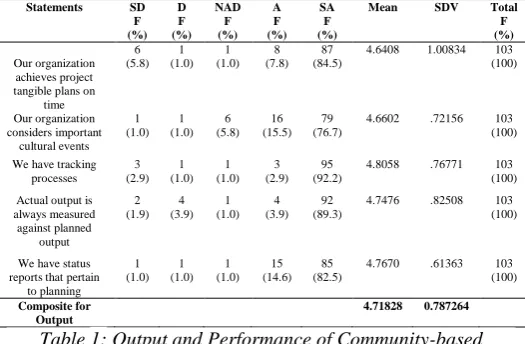
The study was interested in exploring how output, activities and project objectives influence performance of community-based projects in Kenya. Output of projects was measured by providing respondents with statements rated on a five-point Likert scale ranging from Strongly Disagree (SD); Disagree (D); Neither Agree Nor Disagree (NAD); Agree (A) and Strongly Agree (SA) from which to choose. The findings are presented in Table 1.
Statements SD F (%)
D F (%)
NAD F (%)
A F (%)
SA F (%)
Mean SDV Total
F (%)
Our organization achieves project tangible plans on
time
6 (5.8)
1 (1.0)
1 (1.0)
8 (7.8)
87 (84.5)
4.6408 1.00834 103 (100)
Our organization considers important
cultural events 1 (1.0)
1 (1.0)
6 (5.8)
16 (15.5)
79 (76.7)
4.6602 .72156 103 (100)
We have tracking processes
3 (2.9)
1 (1.0)
1 (1.0)
3 (2.9)
95 (92.2)
4.8058 .76771 103 (100)
Actual output is always measured
against planned output
2 (1.9)
4 (3.9)
1 (1.0)
4 (3.9)
92 (89.3)
4.7476 .82508 103 (100)
We have status reports that pertain
to planning 1 (1.0)
1 (1.0)
1 (1.0)
15 (14.6)
85 (82.5)
4.7670 .61363 103 (100)
Composite for Output
4.71828 0.787264
Table 1: Output and Performance of Community-based Projects
Page 178 www.ijiras.com | Email: [email protected]
planning. Overall, the surveyed employees agreed (M=4.72, SDV=0.79) on the need to establish output in the logical framework. This implies that getting project output is very critical in the performance of community-based projects particulary when using the logical framework.
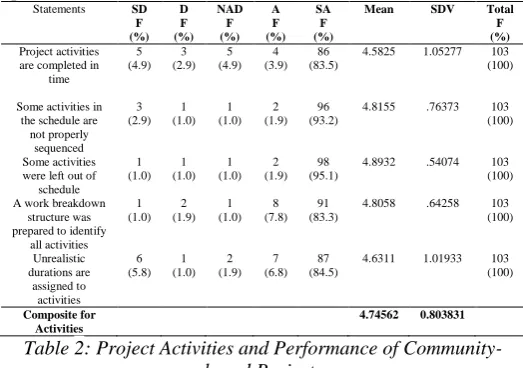
The influence of project activities was measured by providing respondents with statements rated on a five-point Likert scale ranging from Strongly Disagree (SD); Disagree (D); Neither Agree Nor Disagree (NAD); Agree (A) and Strongly Agree (SA) from which to choose. The findings are presented in Table 2.
Statements SD F (%) D F (%) NAD F (%) A F (%) SA F (%)
Mean SDV Total
F (%) Project activities
are completed in time 5 (4.9) 3 (2.9) 5 (4.9) 4 (3.9) 86 (83.5)
4.5825 1.05277 103 (100)
Some activities in the schedule are
not properly sequenced 3 (2.9) 1 (1.0) 1 (1.0) 2 (1.9) 96 (93.2)
4.8155 .76373 103 (100)
Some activities were left out of schedule 1 (1.0) 1 (1.0) 1 (1.0) 2 (1.9) 98 (95.1)
4.8932 .54074 103 (100)
A work breakdown structure was prepared to identify
all activities 1 (1.0) 2 (1.9) 1 (1.0) 8 (7.8) 91 (83.3)
4.8058 .64258 103 (100) Unrealistic durations are assigned to activities 6 (5.8) 1 (1.0) 2 (1.9) 7 (6.8) 87 (84.5)
4.6311 1.01933 103 (100)
Composite for Activities
4.74562 0.803831
Table 2: Project Activities and Performance of Community-based Projects
The research findings show that respondents strongly agreed (M=4.58, SDV=1.05) that project activities are completed in time. They also agreed (M=4.82, SD=0.76) that some activities in the schedule are not properly sequenced. Respondents strongly agreed (M=4.89, SDV=0.54) that some activities are left out of schedule. The participants strongly agreed (M=4.81, SDV=0.64) that a work breakdown structure is prepared to identify all activities; and they strongly agreed (M=4.63, SDV=1.11 that unrealistic durations are assigned to activities. Overall, the surveyed employees agreed (M=4.75, SDV=0.80) on the importance of identifying project activities. This implies that the choice of project activities is very important in the performance of community-based projects because the choice of activities to be undertaken can lead to project performance.
Project objectives were measured by providing respondents with statements rated on a five-point Likert scale ranging from Strongly Disagree (SD); Disagree (D); Neither Agree Nor Disagree (NAD); Agree (A) and Strongly Agree (SA) from which to choose. The findings are presented in Table 3.
Statements SD F (%) D F (%) NAD F (%) A F (%) SA F (%)
Mean SDV Total
F (%) Project objectives
are achieved on time 4 (3.9) 4 (3.9) 3 (2.9) 6 (5.8) 86 (83.5)
4.6117 1.00228 103 (100) Time required to
achieve project objectives is measured 2 (1.9) 2 (1.9) 1 (1.0) 4 (3.9) 94 (91.3)
4.8058 .72839 103 (100)
Our projects consider number of
beneficiaries 2 (1.9) 2 (1.9) 5 (5.9) 4 (3.9) 90 (87.4)
4.7282 .80676 103 (100) Information needs are provided 1 (1.0) 1 (1.0) 1 (1.0) 10 (8.7) 90 (87.4)
4.8155 .58991 103 (100) Budget is done to
achieve objectives 1 (1.0) 9 (8.7) 9 (8.7) 4 (3.9) 80 (77.7)
4.4854 1.03719 103 (100) Composite for
Project Objectives
4.68932 0.832906
Table 3: Project Objectives and Performance of Community-based Projects
The research findings show that respondents strongly agreed (M=4.61, SDV=1.00) that project objectives are achieved on time. They also agreed (M=4.81, SD=0.73) that time required to achieve project objectives is measured. Respondents strongly agreed (M=4.73, SDV=0.81) that their projects consider number of beneficiaries. The participants strongly agreed (M=4.82, SDV=0.59) that information needs are provided; and they strongly agreed (M=4.49, SDV=1.04 that budget is done to achieve objectives. Overall, the surveyed employees agreed (M=4.69, SDV=0.83) that community-based projects need to know what objectives they seek to achieve in the course of the project. The results imply that project objectives, particularly number of beneficiaries, are very critical in the performance of community-based projects.
Correlational analysis using Pearson’s Product Moment technique was done to determine the relationship between indicators of the logical framework and performance of community-based projects. The results are summarized in Table 4.
Correlations
Performance Output Activities Objectives
Performance Pearson
Correlatio n
1 0.048 0.099 -0.028
Output Pearson
Correlatio n
0.048 1 0.162 .229*
Sig. (2-tailed)
0.632 0.102 0.02
N 103 103 103 103
Activities Pearson
Correlatio n
0.099 0.162 1 .254**
Sig. (2-tailed)
0.319 0.102 0.01
N 103 103 103 103
Objectives Pearson
Correlatio n
-0.028 .229* .254** 1
Sig. (2-tailed)
0.78 0.02 0.01
N 103 103 103 103
*. Correlation is significant at the 0.05 level (2-tailed). **. Correlation is significant at the 0.01 level (2-tailed).
Table 4: Correlation Matrix for Logical Framework and Performance of Community-based Projects
The correlation results in Table 4 indicate that the indicators reviewed in these variables namely, project output had a correlation which was significant at the 0.005 level; while project activities and project objectives had correlation significant at the 0.01 level with performance of community-based projects.
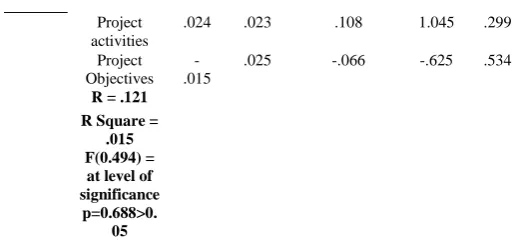
The null hypothesis was tested using the linear regression model and the results are presented in Table 5.
Model Unstandardize
d Coefficients
Standardized Coefficients
t Sig.
B
Std.
Error Beta
1 (Constant) .969 .156 6.230 .000
Project Output
Page 179 www.ijiras.com | Email: [email protected] Project
activities
.024 .023 .108 1.045 .299
Project Objectives
-.015
.025 -.066 -.625 .534
R = .121 R Square =
.015 F(0.494) = at level of significance
p=0.688>0. 05
Table 5: Regression Results for Influence of Logical Framework on Performance of Community-based Projects
The results indicate that project output had no statistically significant influence on the performance of community-based projects (β=0.045, t=0.438, p=0.662>0.05). Project activities had no statistically significant influence on the performance of community-based projects (β=0.108, t=1.045, p=0.299>0.05). Project objectives had no statistically significant influence on the performance of community-based projects (β=-0.066, t=-0.625, p=0.534>0.05). Hypothesis 1 was not supported by data and hence there was no significant relationship between application of the logical framework and the performance of community-based projects. It had been expected that application of logical framework would have a significant relationship with the performance of community-based projects since projects need to have output, activities and objectives to be achieved.
V. CONCLUSION
The most dominant indicator was project activities followed by project output and project objectives. The results indicate that project output had no statistically significant influence on the performance of community-based projects. Project activities had no statistically significant influence on the performance of community-based projects. Project objectives had no statistically significant influence on the performance of community-based projects. Overall, the application of the logical framework has no statistically significant influence on the performance of community-based projects.
VI. RECOMMENDATIONS
The application of the logical framework has no signficant influence on the performance of community-based projects. Therefore this should be a consideration for organizations seeking congruence with the strategic plans of their various projects. Therefore, organizations need to support and invest in the application of the logical framework matrix from time to time. In addition, organizations need to frequently try out new ideas and seek out new ways of doing
things based on technical advancements and on the logical framework matrix.
REFERENCES
[1] Abegunde, A.A. (2003). Rethinking Polarization of Raw-Material Inputs to region Centres: A Panacea to Rural Economic Development. Environment and Behavior, EBAN.
[2] Adeyemo, K. (2002). Factors influencing project success: the impact of human resource management. International Journal of Project Management, 22(1), 1-11.
[3] Al-Kharashi, A. & Skitmore, M. (2009). Causes of delays in Saudi Arabian public sector construction projects. Construction Management and Economics, 27(1), 3-23. [4] Bakewell, O. & Garbutt, A. (2005). The Use and Abuse
of the Logical Framework Approach. The International NGO Training and Research Centre (INTRAC). Retrieved from http://www.intrac.org/data/files/resources/ 518
[5] Busiinge, C. (2010). The impact of donor aided projects through NGOs on the social and economic welfare of the rural poor. ‘‘what do the donors want?’’: case study of Kabarole Research and Resource Centre. Uganda Martyrs University, Uganda.
[6] Jackson, E. (2013). Interrogating the theory of change: evaluating impact investing where it matters most. Journal of Sustainable Finance & Investment, 3:2, 95-110. [7] Kalsaas, B. T. (2012). The last planner system style of
planning: its basis in learning theory. Journal of Engineering, Project, and Production Management, 2(2), 88-100.
[8] Leuzzi, N. (2013). Logical framework approach to
development in Ghana.
www.mendeley.com/profiles/luca-leuzzi. Accessed February 2014.
[9] Milika, W. (2011). Guide to the logical framework
approach republic of Serbia.
www.naturaltherapypage.com Accessed February2014 [10] SAD. (2008). Performance of Projects of Standard Design
Models. Supervision Administrative, Annual Performance Review, 3, 2-189.
[11] Silverman, D. (2008). Interpreting qualitative data (3rd Ed.). London: Sage.
[12] Smyth, H. (2010). Construction industry performance improvement programmes: the UK case of demonstration projects in the ‘Continuous Improvement’ programme. Construction Management and Economics, 28(3) 255-270.