157801-6565-IJECS-IJENS © February 2015 IJENS
Geomorphic Evolution of The Kurkur-Dungul area in
Response to Tectonic Uplifting and Climatic
Changes, South Western Desert, Egypt
Kamal Abou Elmagd
1*, Mohamed W. Ali-Bik
2, Ashraf Emam
1 1Geology Department, Faculty of Science, Aswan University, Egypt 2 Geological Sciences Department, National Research Centre, Dokki, Cairo, Egypt
*Corresponding author: [email protected]
Abstract--
The Kurkur-Dungul area at South Western Desert
of Egypt is an unique hyper-arid region, in which one of the oldest civilizations appeared. The sedimentary record of the area is represented by Cretaceous Nubia Sandstone, Paleocene, Eocene and Quaternary deposits. The sedimentary sequences of the area are the end products of characteristic geomorphic processes developed in response to equilibrated constructive and destructive mechanisms. The area encompasses an outstanding variety of landforms of third order extent including River Nile, Nubian Plain, oases, playas, isolated crystalline hills
and Sinn El-Kaddab limestone plateau. Beside these
geomorphic features, there is also a number of small-scale characteristic landforms including terraces, terrestrial carbonates including travertine, conglomerate and scattered sheets of gravel, flint and sand as well as, deep-seated, strike-slip faults and accompanied folds. All of these landforms were developed mainly in response to tectono-magmatic and seismic activities, sea level fluctuation and climatic changes. The main natural agents of changes include the interaction of Tethys Sea, rain falls, tectonics, weathering, erosion and wind action. Damming of the Nile and the subsequent accelerated seismic effects as well as sand dune encroachment turned the area to be one of the most dynamic regions in the Arabian-Nubian Shield. Its landforms are susceptible to substantial changes in very short periods of time. In conjunction with the field observations, remote sensing and GIS techniques were applied using digital elevation model (DEM) and multispectral data to produce a digitized visual form of geomorphologic f e a t u r e s of the area including drainage network, basins, slope configuration and structures.
Index Term--
climatic changes - drainage network –
escarpment – landforms - remote sensing.
I. INTRODUCTION
The hyper-arid, Kurkur-Dungul area at South Western Desert of Egypt (Fig. 1) is a famous historic region, at which one of the oldest, unrivaled civilizations appeared. From a geomorphologic point of view, the area is dominated by bimodal gentle and steep slope distribution [1]. It encompasses an unique variety of landforms of third order extent including River Nile, Nubian Plain, oases, playas, isolated crystalline hills, and Sinn El-Kaddab limestone plateau (Fig. 2). Beside these geomorphic features, there is also a number of small-scale characteristic landforms including terraces, terrestrial carbonates including
travertine, conglomerate and scattered sheets of gravel, flint and sand as well as, deep-seated, strike-slip faults and accompanied folds.
All of these landforms had been formed mainly in response to tectono-magmatic and seismic activities, sea level fluctuation and climatic changes. The main natural agents of modifications include the mutual interactions of the Tethys Sea, River Nile, rain falls, hydrothermal springs, weathering, erosion and wind actions as well as tectonic and seismic disturbances.
Tectonically, the study area is located within the relatively unstable (?) Nubian Swell zone [2], which had suffered tectonic uplift during Cenozoic (Fig. 2); the process which is still episodically active. Damming of the River Nile at Aswan in the sixties of last century and the formation of the great Lake Nasser in the front of the Aswan High Dam accelerated and enhanced the agents of landform changes in the study area. The great artificial
Lake Nasser which covers an area of about 6000 km 2
is greatly impacted the geomorphology of the area in terms of filling the surrounding Khors (embayments) and the nearby depressions and hence, rejuvenating the major strike-slip faults of the area such as Kalabsha fault. Here we recall the famous 14 November 1981earthquake with 5.6 M magnitude which struck the area [3] and its still ongoing aftershocks.
157801-6565-IJECS-IJENS © February 2015 IJENS
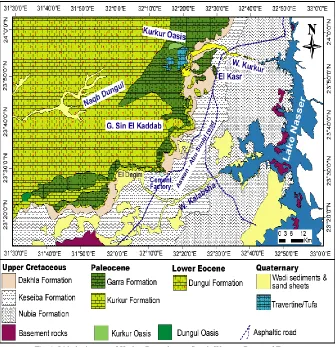
Fig. 1. Lithologic map of Kurkur-Dungul area, South Western Desert of Egypt.
Fig. 2. 3D model of the digital elevation relief data covering Kurkur-Dungul area. GIS technology integrates common database operations
such as query and statistical analysis with the unique visualization and geographic analysis benefits offered by maps [7]. Advances i n GIS technology a n d increasing availability of remote sensing data (particularly Digital Elevation Models, DEMs) have led to a growing application of GIS tools in many areas of geomorphology. These GIS
157801-6565-IJECS-IJENS © February 2015 IJENS
morphology [11], [12], assess surface biophysical conditions [13], [14], [15], [16], and link process with patterns [17].
Scope and limitations: The present study aims at using the remote sensing data and GIS tools in conjunction with the field observations to identify landforms, geomorphic units and then, area mapping of Sinn El-Kaddab plateau and environs in southern Egypt. Reclamation and cultivation of the uninhabited deserts (up to about 93% of the total area of Egypt) is the main challenge of the Egyptian government to increase the national income and to redistribute the current crowded population masses over the whole Egyptian territory. In this context, the land use planning is an important process in sustainable development of such remote area in southern Egypt. This is realized to be developed in an integrated and comprehensive manner based on tectono-geomorphologic investigation of the target area.
II. MATERIALS AND METHODOLOGY
The most significant contribution of remote sensing to geomorphology is the use of passive and active sensors to generate surface elevation data commonly referred to as a digital elevation model (DEM). To achieve the main objectives of the present study, geomorphologic mapping has been carried out using DEM data with 30 m resolution, obtained through Advanced Spaceborne Thermal Emission and Reflection Radiometer (ASTER).
Automation of drainage networks extraction from DEM in general has received considerable attention and has been the main objective for many natural resource management issues [18], [19], [20], [21], [22]. The drainage network of the study area was automatically extracted from ASTER DEM by using the hydrology toolset in ArcGIS software, version 10.2. This automated method for delineating streams followed a series of steps including sink filling, identification of flow direction, calculation of flow accumulation and stream ordering. Also, the morphometric measurements such as slope, aspect, relative relief, drainage density and drainage frequency, basins delineation were deduced and various thematic maps pertaining to all these aspects were generated.
III. RESULTS
Geology and geomorphology of the study area
The geological record of the area reveals episodes of late Neoproterozoic plutonic magma activity, followed by uplift, erosion and subaerial volcanism. This was followed in Phanerozoic by clastic and carbonate sedimentations, which are distinguishable in the field into: Cretaceous Nubia Sandstone, Paleocene, Eocene and Quaternary deposits (Fig.1). The youngest deposits and landforms include terrestrial carbonates (lacustrine limestone, hydrothermal groundwater travertine deposits and calcite), terraces, conglomerate, playas and sand sheets [23].
The outcropping sedimentary sequences of the area are the end products of characteristic geomorphic processes developed in response to equilibrated constructive (magmatic and sedimentation input) and destructive (weathering and erosion output) mechanisms. The main landforms of the Kurkur-Dungul area are best distinguished genetically and chronologically into: 1) Intrusive Precambrian crystalline basement outcrops and the extrusive Phanerozoic subaerial volcanics, 2) Aqueous systems, 3) Tectonic landforms, and 4) Aeolian landforms:
1. Intrusive Precambrian crystalline rocks and
Phanerozoic subaerial volcanic extrusives:
The intrusive late Neoproterozoic basement rock units (Fig. 1) of the area could collectively be distinguished into gneisses, amphibolites and granitoids. The contact between the gneisses and granitoids is of intrusive nature without any zones of transition. In the study area and its westward extension, towards Egyptian frontiers, the Precambrian crystalline basement rocks were suffered intensive ancient erosion. In the present time, the basement igneous and metamorphic rocks are feebly dipping to the north east and sink to the north under a thick Nubia Sandstone succession [24].
In the study area, the basement rocks are exposed along the crest of t h e exposed Aswan Hills as well as small inlier and islands in the Nubian Plain and Lake Nasser, respectively (Fig. 1). Of the granitoids, Aswan pink granite is peculiar as it exhibits fine to course grained texture and abundant orthoclase and microcline porphyroblasts. Genetically, the granitoids could be broadly classified into: a) subduction-related tonalite, granodiorite and granites, and b) within-plate granites and syenite. Reference[23] distinguished the granitoids of the study area into: 1) biotite hornblende tonalite, granodiorite and quartz diorite in addition to granites and monzogranites, 2) aegrine syenite (El-Hamra oval-shaped mass of ~ 0.8x0.3 km size), and 3) fine-grained granophyre and coarse-grained syenite and diorite (El- Soda mass of about 3.75x0.7 km size). The Precambrian basement rocks were subsequently extruded by Phanerozoic dike swarms of different compositions including diabase dikes, sheets and volcanic breccias.
2. Aqueous-related landforms:
2.1. Tethys landforms (inverted basins):
Sinn El-Kaddab plateau
157801-6565-IJECS-IJENS © February 2015 IJENS
Nubian plain (lower ledge) is composed –from bottom to top- of Dakhla Shale, Kurkur Formation and Garra Formation (Fig. 1). The main geomorphic landforms of the lower scarp (lower ledge) are Kurkur oasis, Wadi Kurkur, playa, mesas and cuestas and wind deflated surface. Wadi Kurkur is drained to Lake Nasser and pertains to the River Nile geomorphic system. The upper escarpment is built up of Dungul Formation, being composed of two members [25]: the lower shale unit (Abu Ghurra Member) and the upper limestone one (Naqb Dungul Member).
The Dakhla Formation (Dakhla basin) in the study area has a maximum thickness of 250 m, being composed mainly of grey, grayish-black and greenish shales. It overlies the variegated, marine shale unit which accumulated in the Dakhla basin [26]. This is followed upward in the study area by Kurkur Formation (see Fig. 1) which is composed of two siliceous limestone beds, intercalated by clastics with or without phosphatic components. The color of the formation is typically brown, and locally contains abundant marine invertebrate fossils. Sediments of the formation were deposited during the early Paleocene in shallow marine environments.
The Garra Formation (Garra basin) is composed of thick limestone beds with chalk, marl, and shale intercalations and unconformably overlies the Kurkur Formation (Fig. 1). The age of the unit is late Paleocene to early Eocene. The sediments were deposited in shallow, protected, marine shelf through deep marine environments. The Garra formation is exposed at Kurkur oasis near the wadi level and then it outcrops along the face of Sinn El-Kaddab escarpment, where it makes some prominent ridges to the west of Gebel Kalabsha, passing by Dungul oasis and further westwards.
On the other hand, the Dungul Formation (Fig. 1) consists of bentonitic shale beds at the base and a limestone ledge at the top. Flint concretions and chert bands are common features at the base of the limestone bed, which has a grey, faint green to faint yellow and white colored appearance. The Dungul Formation forms the topmost surface of the plateau, west of Kurkur oasis and stretches further to the extreme northwestern part of the area under investigation.
2.2. Nubian Plain
The Nubian Plain represents the eastern part of the Sandstone Pediplain [27], which extends from Gilf Kebir in the west to the boarder of the Lake Nasser in the east (Figs. 1 & 2). The Nubian Plain is composed chiefly from Nubia Sandstone with a wind-deflated surface [28], [29]. Its thickness varies from place to another (100-200m above sea level), probably reflecting the paleo-relief variation of the basement crystalline rock units. Based on the nature of the cement materials [30] the sandstone beds were classified into two varieties: a) sandstone cemented by silica, and b) sandstone cemented by calcite, dolomite and detritus clayey-size materials. The Nubia Sandstone –in general- exhibits varied depositional environments, ranging from shallow marine platform to continental and Aeolian and probably fluviatile environments [23]. Reference [30] gave a detailed lithofacies description of a complete section of the Nubia Formation at Aswan, where they discriminated five depositional facies of regression and
transgression nature. Accordingly, the older facies 1 points to regressive fluvial deposits, while facies 2 and 3 document a southward transgression of the Tethys accompanied by waning detrital input. Facies 4 and 5 reflect the interaction between a southward transgression of the Tethys in late Cretaceous and accompanied northward progradation of feldspathic sand derived from the south.
2.3. Watersheds and underground water systems
2.3.1. Drainage network
2.3.1.1. Automated extraction of drainage network
A major problem with drainage network delineation using DEM is the presence of sinks or depressions [31], [32], [33]. In this process, sinks are defined as cells which have no neighbors at a lower elevation and consequently, have no downslope flow path to a neighboring cell [32]. According to [34] the main problem is the positioning of the ends of drainage networks and the assignment of flow directions to individual cells, particularly in flat areas and depressions. Therefore, the sinks are commonly removed prior to DEM processing for drainage identification [35],[36] by increasing their cell values to lowest overflow points out of the sinks.
After the sink filling, the second step was the identification and calculations of flow directions from each cell in the raster data of DEM, using the procedures based on [36] algorithm. The flow direction is determined by finding the direction of the steepest descent from each cell taking into account its eight neighboring cells.
The flow direction raster is then used to compute the flow accumulation of each cell, where the value stored in the cell represents the accumulated number of cells flowing into it. A threshold value must be applied for its final delineation, whereas only the cells with a flow accumulation value above the proposed threshold will belong to the drainage network. The resulting grid outlining the drainage network of the Kurkur-Dungul area is given in Figure 3A, where the overall drainage picture reflects an early stage of dendritic pattern with visible traces of parallel dendritic and trellis patterns in between.
The streams of drainage network in the study area were ordered using the method given by [37] and transformed to vector layer for further analysis. During the stream ordering, the channel segments were ordered numerically, where the tributaries at the stream's headwaters being assigned as 1st order. The stream segments that resulted from the joining of 1st order segments were assigned as the 2nd order. Joining of 2nd order segments form the 3rd order streams and so on. The obtained stream ordering map (Fig. 3B) shows five orders of streams.
2.3.1.2. Drainage network analysis
157801-6565-IJECS-IJENS © February 2015 IJENS
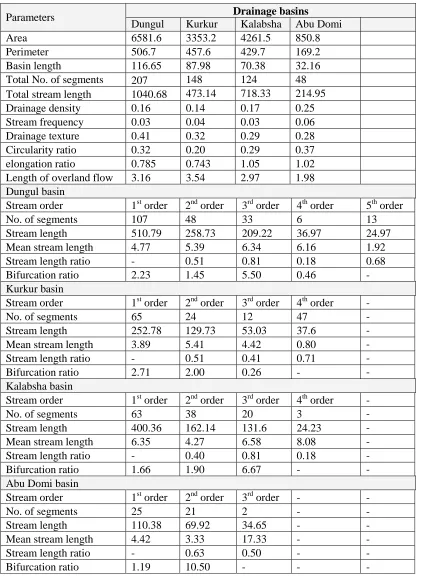
largest, having an area of 6581.6 Km2, perimeter of 506.7 Km and basin length of 116.65 Km. A total of 207 stream segments in Dungul drainage basin were ordered numerically and five stream orders were resulted (Fig. 3B). The number and total length of stream segments under each stream order were computed (Table 1). Kalabsha and Kurkur drainage basins have areas of 4261.5 and 3353.2 Km2, respectively. Kalabsha basin has 70.38 Km length and 124 stream segments, which
were clustered into four stream orders (Fig. 3B). On the other hand, Kurkur drainage basin has 87.98 Km length and 148 stream segments (Fig. 4A). Abu Domi drainage basin is the smallest, having an area of 850.8 Km2, perimeter of 169.2 Km and basin length of 32.16 Km.
Fig. 3. (A) Drainage network of Kurkur-Dungul area. (B) Stream orders of drainage network of Kurkur-Dungul area.
Drainage density is the sum of the length of the streams divided by the area of the basin i.e. the total length of the stream channel per unit area [38]. The values of drainage density for Dungul, Kalabsha, Kurkur and Abu Domi basins are 0.16, 0.17, 0.14 and 0.25 respectively. Meanwhile, the stream frequency is the number of streams per unit area and is obtained by dividing total number of streams by total drainage area [37]. The values of stream frequency for Dungul, Kalabsha, Kurkur and Abu Domi basins are 0.03, 0.03, 0.04 and 0.06 respectively. According to [39], the elongation ratio is defined as the ratio of diameter of a circle of the same area as the basin to the maximum basin length. The
157801-6565-IJECS-IJENS © February 2015 IJENS
length of stream of an order by total number of segments in the order. The mean stream length values obtained for the investigated drainage basins are illustrated in (Table 1). Moreover, the bifurcation ratio is the ratio of the number of streams of any order to the number of streams in the next higher order [39]. The computed values of bifurcation ratio are shown in (Table 1). The values of bifurcation ratio are either lower or higher than the range (3-5) indicating structural control over them.
2.3.2. Playas and oases:
In the study area and its environs there are remnants of three ancient and world-renowned playa-flats that embraced
one of the oldest human civilizations. These are Kurkur (Fig. 4B) , Dungul (Fig. 5A) and Nabta (to the south west of the study area). Reference [28] classified the playas of the western Desert of Egypt on the basis of two main aspects, either to their source of water or their sediments composition. Generally, the playas of clastic sediments and fed by surface water are the most common one. However, in the southern part of the western Desert of Egypt, the participation of underground water in addition to surface water in the formation of the playas are also common and attributed to the local tectonics [28].
157801-6565-IJECS-IJENS © February 2015 IJENS
Table I
Characteristics and morphometric parameters of drainage network in Kurkur-Dungul area.
Parameters
Drainage basins
Dungul
Kurkur
Kalabsha
Abu Domi
Area
6581.6
3353.2
4261.5
850.8
Perimeter
506.7
457.6
429.7
169.2
Basin length
116.65
87.98
70.38
32.16
Total No. of segments
207
148
124
48
Total stream length
1040.68
473.14
718.33
214.95
Drainage density
0.16
0.14
0.17
0.25
Stream frequency
0.03
0.04
0.03
0.06
Drainage texture
0.41
0.32
0.29
0.28
Circularity ratio
0.32
0.20
0.29
0.37
elongation ratio
0.785
0.743
1.05
1.02
Length of overland flow
3.16
3.54
2.97
1.98
Dungul basin
Stream order
1
storder
2
ndorder
3
rdorder
4
thorder
5
thorder
No. of segments
107
48
33
6
13
Stream length
510.79
258.73
209.22
36.97
24.97
Mean stream length
4.77
5.39
6.34
6.16
1.92
Stream length ratio
-
0.51
0.81
0.18
0.68
Bifurcation ratio
2.23
1.45
5.50
0.46
-
Kurkur basin
Stream order
1
storder
2
ndorder
3
rdorder
4
thorder
-
No. of segments
65
24
12
47
-
Stream length
252.78
129.73
53.03
37.6
-
Mean stream length
3.89
5.41
4.42
0.80
-
Stream length ratio
-
0.51
0.41
0.71
-
Bifurcation ratio
2.71
2.00
0.26
-
-
Kalabsha basin
Stream order
1
storder
2
ndorder
3
rdorder
4
thorder
-
No. of segments
63
38
20
3
-
Stream length
400.36
162.14
131.6
24.23
-
Mean stream length
6.35
4.27
6.58
8.08
-
Stream length ratio
-
0.40
0.81
0.18
-
Bifurcation ratio
1.66
1.90
6.67
-
-
Abu Domi basin
Stream order
1
storder
2
ndorder
3
rdorder
-
-
No. of segments
25
21
2
-
-
Stream length
110.38
69.92
34.65
-
-
Mean stream length
4.42
3.33
17.33
-
-
Stream length ratio
-
0.63
0.50
-
-
157801-6565-IJECS-IJENS © February 2015 IJENS
The Kurkur and Dungul playas represent shallow ancient lakes that drained internally in the low land of the Nubian plain (internal basins). They are oval in shape, sometimes with straight edges against the fault planes (Fig. 4B). In general, their soils are composed of finely laminated lacustrine sediments and characterized by mud cracks (Fig. 5A).
Kurkur (Fig. 5B) and Dungul oases are small uninhabited oases, but are of great importance in wildlife conservation for a number of animals such as deer. They represent ancient transit stations for the passengers and camel troops through Darb El Arbian desert track between Sudan and Egypt. They exhibit elongate form associated with E-W trending faults.
2.3.3. Flash floods and Quaternary ancient stream sediments
These outcrops are represented in the study area as natural levee of dry channels (Fig. 5C), conglomerate accumulations (Figs. 5D) and boulders & gravels sheets (Fig. 5E). The main conglomerate components (boulders, gravel and flint) were derived from Dungul Formation at the top of the Sinn El-Kaddab plateau. The boulders and gravel particles of the conglomerate sheets are subangular and cemented by clayey matrix. On the other hand,
non-cohesive free flint gravels spread and cover the low hills and lands of the study area.
2.3.4. Karst and karstification:
The Upper Eocene Naqb Dungul limestone exhibits a characteristic karst (cavernous) structure (Fig. 5F). It is highly engraved by voids and caves of varying size and shapes, implying the former presence of considerable siliceous components (chert nodules and flint particles).
2.3.5. River Nile and Lake Nasser:
The River Nile in the study area is a part of the so-called Nubian Nile, which was a narrow stream in the study area before damming the River in the 1960s. Water is naturally flow gravitationally northward forming a narrow valley with steep-sided bed rocks on the banks.
157801-6565-IJECS-IJENS © February 2015 IJENS
Fig. 5. Field photographs showing: (A) Sun cracks on playa of Naqb Dungul area. (B) Palm and Hyphaene thebaica trees in Kurkur Oasis. (C) Natural levee on the bank of dry channel. (D) Conglomerate accumulations. (E) Boulders and gravel sheet. (F) Karstification of limestone beds, dissolved parts leaving
large voids and caves, Dungul Formation.
following the ancient drainage patterns of the area [29]. However, the outlines of the Lake Nasser is still developing and its geomorphic impacts on the study area is ongoing by water flow through the cracks and the main fault planes, leading to the formation of swamps on the low-land areas. About 3 billion m3 of water is annually lost and evaporated only through the Khor Kalabsha [40].
2.3.6. Fresh water carbonates
These include terrestrial carbonates which are represented in the study area by lacustrine limestone, calcite deposits, travertine and tufa. Reference [23] considered all of these terrestrial carbonates as Quaternary deposits. Reference [23] recorded fresh water carbonates in the study area based on the lack of marine fossils and their intercalation with tufa. Based on field relations, [41] distinguished different tufa generations in the study area.
The distribution of the terrestrial carbonates in the study area seems to be structurally controlled. Ridges of travertine (Figs. 6A & 6B) as well as calcite deposits are concentrated along fault planes and seem to be formed by the circulation of supersaturated calcium bicarbonate-enriched hydrothermal groundwater through fissures and cracks.
3. TECTONIC LANDFORMS
157801-6565-IJECS-IJENS © February 2015 IJENS
the late decades by invasion and percolation of the Lake Nasser water through cracks and fissures after the construction of the High Dam and development of the great artificial Lake Nasser reservoir.
The tectonics and structural elements and patterns of the Kurkur-Dungul area were investigated in detail by [23], who subdivided the region structurally into 8 sectors. For each sector, he plotted the general structural trends on frequency distribution diagrams, Fig. 6 in [23]. In addition to the main E-W and N-S trending fault systems, there are also subordinate NE and NW trending, relatively small faults at the study area. In general, the E-W trending faults of the area are longer, compared to the N-S trending fault systems. Beside these brittle deformation styles, there are also a number of ductile deformation features in the form of elongate domes and basins
that scattered in different orientations. These deformational styles (˂250 m to ˃1.5 km length) are conspicuous in satellite images of the study area and southern parts of the Egyptian Western Desert as characteristic Desert Eyes [42]. Hence, a number of characteristic small-scale, open anticlines and synclines are prominent in the study area and scattered in different orientations. In general, two main ductile deformation systems are distinguishable in the area: the first are concentrated close to the main E-W and N-S trending fault planes, where their axial traces follow more or less the fault planes, whereas the second fold system is slightly apart from the fault planes and their axial traces mainly in NE direction. Of the crystalline basement rocks and Sinn El-Kaddab limestone plateau, Jointing is a common feature, where different jointing trends are recorded [23].
Fig. 6. (A) A low relief travertine ridge. (B) Crystalline spheroidal crusts of travertine.
(C) Desert eyes ductile structure along the E-W trending Seyal fault. (D) A syncline fold on the main Seyal fault plane.
3.1. E-W trending faults
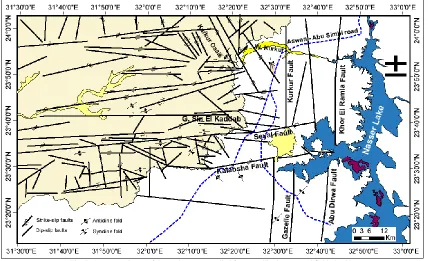
These are represented by a number of mainly E-W and ENE trending long faults such as Kalabsha (160km), Seyal (~85km), El Faliq (70km), Aba Silla and Barqat faults (Fig. 7). The Aba Silla (~ 100 km) and Barqat (~53 km) dissect in the limestone plateau, while Kalabsha and Seyal faults cut in the escarpment and Nubian plain and limestone plateau as well. Reference [3] studied the seismicity and earthquake hazards at Kalabsha area and distinguished five
157801-6565-IJECS-IJENS © February 2015 IJENS
Fig. 7. A structural map of the study area compiled from satellite images and field checking.
3.2. N-S trending faults
These are represented by a number of mainly N-S trending faults, which cut in the Nubian plain at the eastern part of the given map (Fig. 7) such as Khor El Ramla (~40km) and Kurkur (~40km) faults as well as Abu Dirwa (~20km) and Gazelle (~15km) faults, north and south of the E-W trending Kalabsha fault, respectively. The Khor el Ramla fault is seismically an active fault where seismicity is shallower, 0 to10km, [3]. The Kurkur fault is among the active old stream zone which extends to about 40km from Khor Kalabsha at the south to Khor Kurkur at the north [3]. The N-S trending Abu Dirwa fault, south of Kalabsha fault is an active strike slip and dip slip fault and belongs to the Abu Dirwa seismically active zone. Abu Dirwa fault zone, which is characterized by strike-slip and normal faulting with strike 177°N and dip 61° and the N-S trending fault system, in general exhibits a left-slip displacement of 0.01-0.02mm per year [3].
3.3. Desert eyes (folds, basins and domes)
According to [23], folds are of secondary importance in Kurkur-Dungul area, compared to the fault systems. The latter author distinguished a number of anticlines and synclines in addition to double plunging fold systems with axes trending mainly in NE-SW, E-W and N-S directions. Reference [23] also distinguished a number of closed basins and domes of different areal extent. Obviously, there is a linear alignment of these domes and basins [42] and all of these structural
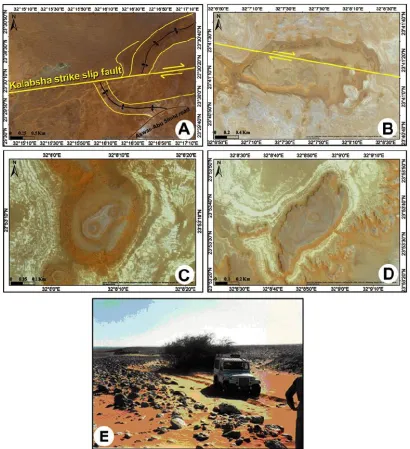
landforms are easily recognizable in Satellite images as desert eyes (Figs. 6C & 6D).
In general, all of these ductile deformational styles could be distinguished into two main systems: 1) folded basins and domes (up to 1.8 km length) that are spatially connected to the main E-W, N-S and NE trending fault systems (Figs. 6C, 6D, 8B, & 8A). As deduced from these figures, these ductile deformational features are older than nearby faults and clearly affected by them. 2) folded basins and domes away from the main faults (Figs. 8C & 8D) occur in between the major faults and in comparison with the faulted basins and domes, their country rocks do not exhibit the characteristic bubble warp (desert eyes) structures [42].
4. AEOLIAN LANDFORMS
These are the sand accumulations which are scattered as small sand sheets on the Nubian plain (Fig. 8E). Reference [44] monitored, on recent satellite images the steady southeasterly sand movement in the study area and calculated its creeping speed as 15 m/year. Other sand accumulations are obvious as hanging dunes southwest of the study area. Generally speaking, the prevailing winds in Egypt blow from the NW to the SE most of the time of the year [43]. It seems that this NW-SE wind direction was almost constant for the last 40 thousands of years as deduced from the characteristic NW-SE direction of the mega dune belts of the southern Western Desert of Egypt [44].
157801-6565-IJECS-IJENS © February 2015 IJENS
Fig. 8. Folds and desert eye structures. (A) Anticline fold on the main Kalabsha strike slip active fault. (B) A faulted out desert eye. (C) Circular basin confined two core smaller basins. (D) Non faulted out desert eye. (E) A fine sand sheet.
IV. DISCUSSION AND CONCLUSION
The study area is characterized by moderate to low relief and its continental crust ranges from ~ 35 to about 40 km thick [2]. The main stratigraphic column of the area was almost completed in Eocene with less voluminous Quaternary input, but sculpturing of the main landforms had been taken place under semiarid to hyper-arid climatic conditions in late Tertiary and early Pleistocene [1].
The Kurkur-Dungul area encompasses a number of unique geomorphic landforms including River Nile and Sinn El-Kaddab plateau with its two escarpments, each of them forms a characteristic ledge. The lower ledge over the Nubia sandstone is composed of shale (Dakhla Formation) and limestone intercalated with shale beds (Kurkur and Garra formations). The main geomorphic landforms of the lower scarp (lower ledge) are Kurkur oasis, Wadi Kurkur, playas, mesas,
157801-6565-IJECS-IJENS © February 2015 IJENS
On the other hand, the effect of pluvial periods on the Lower Eocene Naqb Dungul limestone is different. The Eocene limestone rocks of Egypt are characteristically siliceous and contain chert nodules and bands as well as large spherical flint concretions [46]. By the action of the rains, these insoluble components detached and separated leaving karst (cavernous) features (see Fig. 5F). The detached siliceous concretions fall down either by gravity in situ or transported away by the flash floods, and hence disintegrated as boulders, gravel and flint sheets (Fig. 5E). The natural levee (Fig. 5C) and terraces at the foot of the plateau scarp and the conglomerate accumulations (Fig. 5D) were deposited during the pluvial periods also (probably by Quaternary flash floods), whereas their clasts were derived from the top of the Sinn El-Kaddab plateau. The subangular nature of their boulders and gravel particles enhances their nearby sources.
The study area lies geographically in the tropics where it passes by the Tropic of Cancer. It characterized by arid to hyper-arid climate and dearth of rainwater. However, during the Holocene the conditions were not such cruelty, whereas the area experienced several pluvial periods with about 500 ml/cm [28]. The main drainage network (watersheds) of the study area (represented in present by wadies), seems to be constructed during these pluvial periods.
The present River Nile represents the fourth stage of the Neonile which commenced after the last glaciation period (13500 and 11500 BP) due to temperature rise on global scale [28]. According to the later author, the deepening and widening of the Neonile channel in Nubia and upper Egypt had been accomplished by the action of torrential flood water that flowed from the Nile headwaters in Africa (Victoria and Albert Lakes) across the White Nile during the period 12,500 to 12,000 BP. The contribution of the blue Nile started with the Holocene, in sync with the pluvial period that prevailed the southern Egypt and northern Sudan, giving rise to the formation of the fertile flood plain and Delta [28].
In general, the course, depth and extent of the Nile River is governed by pre-Nile topography of the area as well as the nature and type of the sculptured bedrocks [43]. Hence, where the crystalline basement rocks are dominate the stream is narrow and deep, while on passing on the Nubian Plain the river becomes much wider and shallower.
Reference [47] gave the relative radiocarbon ages of the sediments of both Kurkur and Dungul playas at about 7,900 BP. These playas drained internally and represent topographically low lands (ancient lakes). The Early Holocene small lakes (closed basins), were the cradle of the one of the oldest human civilization in Nabta Playa (south west the study area), Wadi Kurkur and Dungul area.
Archeological investigations revealed evidence for Pre-dynastic activity at Kurkur oasis [48]. Oases are located in the lowest topographic areas of the region which collect the flash flood water from time to time in addition to the little seasonal rain water. Generally, the area is dissected by a number of fold and fault systems and the Kurkur oasis is located along the axis of a syncline fold or failed rifting zone. At the present, these are
failed oases due to scarcity of groundwater which barely reach about 60 gallons /day of non-drinkable saline water. The Kurkur oasis is located on the surface of Garra Fm which encompasses alternating limestone and shale beds; hence the observed salinity of the oasis water is expected. On the basis of salinity nature and scarcity of the groundwater, it is fair to deduce a shallow source which definitely does not reach the huge Nubia Sandstone reservoir at relatively large depths. Thus the capillary flow of few – shallow- groundwater via small cracks and channel ways ensure the moisture of the oasis and provide a limited growth environment of some savanna plants as well as palms and Hyphaene thebaica [49], [50].
The contacts between the different rock units of the study area are structurally controlled. In general, the area is dissected by numerous deep-seated strike-slip and dip-slip faults, mainly in E-W, NNE-SSW and N-S directions (Fig. 7). Along these faults and in between, a number of small-scale, folded domes and basins are scattered, forming in many cases the so-called desert-eyes structure. The aligned fold chains along the fault planes are faulted out. Such spatial relation indicates extensional fault propagation folding [42]. The later authors attributed the small-scale folded domes of the study area to the rheological variation of the deformed rocks.
The mutual interaction of the Tethys with River Nile, rain falls, hydrothermal springs, weathering, erosion and wind actions in conjunction with tectonic and seismic disturbances are the main agents of landform changes. The study area pertains to the tectonically-active (?) region known as Nubian Swell [2]. Since the beginning of the Cenozoic the basement complex and the overlaid Phanerozoic sedimentary successions are suffering tectonic uplift, and hence were more susceptible to intensive weathering and sever erosion.
From geomorphologic point of view, the study area represents one of the most dynamic regions in the Arabian-Nubian Shield. Its landforms are susceptible to substantial changes in very short periods of time. Major risks and hazards that threaten the region and hamper the process of sustainable development can be summarized in the following notes:
1. Lake Nasser
157801-6565-IJECS-IJENS © February 2015 IJENS
2. Hazards of continuous sand encroachment
In general, wind blow in the southern Western Desert of Egypt predominantly from NW to the SE throughout the year. The NW-SE wind had played an important role in shaping the mega-dune belts in the Western Desert [44]. According to the latter authors, the NW-SE wind impacted the area for thousands of years. The mobile dunes and sand covered the ancient monuments and invaded oases, roads and had left catastrophic effects on all aspects of urbanization in the Western Desert. In the study area, the wind transfer huge quantities of sand annually to the Lake Nasser. It is very important to emphasize the need to continuous monitoring of the ongoing movement of sand across the area every three to five years via satellite images [43], [51].
ACKNOWLEDGMENT
This project was supported financially by the Science and Technology Development Fund (STDF), Egypt, Grant No. 4440.
REFERENCES
[1] K.W. Butzer, (1965) Desert landforms at the Kurkur Oasis. Egypt Ann Assoc Amer Geographers, 55, 578–591.
[2] A.K. Thurmond, R.J. Stern, M.G. Abdelsalam, K.C. Nielsen, M.M. Abdeen, E. Hinz, (2004). The Nubian swell. J Afr Earth Sci 39:401–407.
[3] R.E. Fat-Helbary, A.Tealb, (2002). A study of seismicity and Earthquake Hazard at the proposed Kalabsha Dam Site, Aswan Egypt. Natural Hazards 25: 117 - 133.
[4] J.S. Blaszczynski, (1997). Landform characterization with geographic information systems. Photogrammetric Engineering and Remote Sensing 63 (2), 183–191.
[5] M.P. Bishop, Jr. Shroder, JF, Eds., (2004a). Geographic Information Science and Mountain Geomorphology. Springer-Praxis, Chichester. 486pp.
[6] Jr. Shroder, JF, M.P. Bishop, (2003). A perspective on computer modeling and fieldwork. Geomorphology 53, 1–9.
[7] P.A. Burrough, (1986). Principles of Geographical Information System for Land Resources Assessment. Oxford University Press, 193 pp.
[8] M. Klimaszewski, (1982). "Detailed geomorphological maps”. ITC journal 3, 265-271.
[9] D. Barsch, K. Fischer, G. Stäblein, (1987) Geomorphological mapping of high mountain relief, Federal Republic of Germany (with geomorphology map of Königsee, scale 1:25 000)“. Mountain Research and Development 7, 4, 361-374.
[10] L.W.S. De Graaff, M.G.G. De Jong, J. Rupke, J. Verhofstad, (1987). A geomorphological mapping system at scale 1 :10,000 for mountainous areas. Zeitschrift für Geomorphologie N.F. 13, 229– 242.
[11] R.J. Pike, (2000). Geomorphometry - diversity in quantitative surface analysis. Progress in Physical Geography 24 (1), 1–20. [12] T. Hengl, H.I. Reuter, (Eds.), (2009). Geomorphometry: Concepts,
Software, and Applications. Developments in Soil Science, Elsevier, Amsterdam, 33: 31-63.
[13] I.V. Florinsky, (1998). Combined analysis of digital terrain models and remotely sensed data in landscape investigations. Progess in Physical Geography 22 (1), 33-60.
[14] S. Liang, (2007). Recent developments in estimating land surface biophysical variables from optical remote sensing. Progress in Physical Geography 31 (5), 501-516.
[15] M.J. Smith, C.F. Pain, (2009). Applications of remote sensing in geomorphology. Progress in Physical Geography 33 (4), 568-582. [16] P. Tarolli, J.R. Arrowsmith, E.R. Vivoni, (2009). Understanding
Earth surface processes from remotely sensed digital terrain models. Geomorphology 113, 1-3.
[17] T.R. Allen, S.J. Walsh, (1993) Characterizing multitemporal alpine snowmelt patterns for ecological inferences. Photogrammetric Engineering and Remote Sensing 59 (10), 1521-1529.
[18] W.T. Lin, W.C. Chou, C.Y. Lin, P.H. Huang, J.S. Tsai, (2005). Automated suitable drainage network extraction from digital elevation models in Taiwan’s upstream watersheds. Hydrological Processes, 20: 289-306.
[19] K. Paik, (2008). Global search algorithm for nondispersive flow path. Journal of Geographical Research, 113: F04001, doi:10.1029/2007JF000964.
[20] X. Liu, Z. Zhang, (2011). Drainage network extraction using LiDAR-derived DEM in volcanic plains. Area, 43 (1): 42–52. [21] S.R. Hosseinzadeh, (2011). Drainage Network Analysis, Comparis
of Digital Elevation Model(DEM) from ASTER with High Resolution Satellite Image and Areal Photographs. International Journal of Environmental Science and Development, Vol. 2, No. 3, 194-198.
[22] S. Gayen, G.S. Bhunia, P.K. Shit, (2013) Morphometric analysis of Kangshabati-Darkeswar Interfluves area in West Bengal, India using ASTER DEM and GIS techniques. Geol Geosci 2(4):1–10. [23] B. Issawi, (1968). The geology of Kurkur–Dungul area. Geol Surv
Egypt 46:1–102
[24] W.F. Hume, (1934). Geology of Egypt, Vol. II (The fundamental Pre-Cambrian rocks of Egypt and the Sudan; their distribution, age, and character). 300pp. and 124 pp., index.
[25] Kh. Ouda, & A. Tantawy, ( 1996): Stratigraphy of the Late Cretaceous-Early Tertiary sediments of Sinn El Kaddab-Wadi Abu Ghurra stretch, southwest of the Nile Valley, Egypt. In: The Cretaceous of Egypt. Geol.Soc. of Egypt. Sp. Publi. No. 2. [26] R. Said, (1962). The Geology of Egypt. Elsevier, Amsterdam-New
York, 377pp.
[27] R. Said, (1975). Some observations on the geomorphological evolution of the South Western of Egypt and its relation to the origin of the ground water. Ann Geol Surv Egypt 5:67–70 [28] N.S. Embabi, (2004) The geomorphology of Egypt, landforms and
evolution, Volume I: The Nile Valley and the Western Desert. Spec. Pub., Egypt. Geograph. Soc., 447 pp
[29] K. Abou Elmagd, M.W. Ali-Bik, S.D. Abayazeed, (2014) Geology and geochemistry of Kurkur bentonites, southern Egypt: provenance, depositional environment, and compositional implication of Paleocene–Eocene thermal maximum". Arab J Geosci., V.7, Issue 3, pp. 899-916.
[30] F.B. Van Houten, D.P. Bhattacharyya, (1979). Late Cretaceous Nubia Formation at Aswan southeastern Desert, Egypt. Annals Geol Surv. Egypt, IX, 408-431.
[31] J. Chorowicz, C. Ichoku, S. Riazznoff, Y.J. Kim, B. Cervelle, (1992). A combined algorithm for automated drainage network extraction. Water Resources Research, 28(5):1293-1302.
[32] L.W. Martz, J. Garbrecht, (1992). Numerical definition of drainage network and subcatchment areas from digital elevation models. Computer and Geosciences, 18(6):747-761. [33] K.G. Nikolakopoulos, E.K. Karmaratakis, N. Chrysoulakis,
(2006). “SRTM vs ASTER Elevation Products. Comparison for two Regions in Crete Greece,” International Journal of remote sensing, vol. 27(21), 4819-4838.
[34] A. Tribe, (1992). “Automated recognition of valley lines and drainage networks from grid digital elevation Models: a review and a new method. ,” Journal of Hydrology, 139, 263-293. [35] Wu. Simon, Li. Jonathan, G.H. Huang, (2008). “A study on
DEM-derived Primary Topographic Attributes for Hydrologic Applications: Sensitviy to Elevation Data Resolution”. Applied Geography, 28, 210-223.
[36] S.K. Jenson, J.O. Domingue, (1988). “Extracting Topographic Structure from Digital Elevation Data for Geographic Information System Analysis,” Photogrametric Engineering and Remote Sensing, vol. 54, pp. 1593-1600.
157801-6565-IJECS-IJENS © February 2015 IJENS
[38] K.J. Gregory, D.E. Walling, (1968). The variation of drainage density within a catchment, International Association of Scientific Hydrology - Bulletin, 13, 61-68.
[39] S.A. Schumm, (1956). Evolution of drainage systems & slopes in Badlands at Perth Anboy, New Jersey, Bulletin of the Geological Society of America, 67, 597-646.
[40] E. Elba, D. Farghaly, B. Urban, (2014) Modeling High Aswan Dam Reservoir Morphology Using Remote Sensing to Reduce Evaporation. International Journal of Geosciences, 5, pp. 156-169. doi.org/10.4236/ijg.2014.52017
[41] R. Said, B. Issawi, (1964). Preliminary report of a geological expedition to Lower Nubia and to Kurkur and Dungul oases, Egypt. Museum of New Mexico, Santa Fe. New Mexico, 28pp. [42] B. Tewksbury, M. Abdelsalam, C. Tewksbury, J. Hogan, T. Jerris,
A. Pandey, (2009). Reconnaissance study of domes and basins in Tertiary sedimentary rocks in the Western Desert of Egypt using high resolution satellite imagery. Abstract with Programs-Geological Society of America, Vol. 41, no 1, pp
[43] E. Khedr, K. Abou Elmagd, M. Halfawy, (2014). Rate and budget of blown sand movement along the western bank of lake Nasser, southern Egypt. Arab J Geosci, 7, 3441-3453.
[44] F. Wendorf, R. Schild, (1976) Prehistory of the Nile Valley. Academic, 627, New York.
[45] R. Said, (1990) Cenozoic. In: Said R (ed) The geology of Egypt. Balkema, Brookfield, pp 451–486
[46] M. Hermina, E. Klitzesch, and F.K. List (1989) Stratigraphic lexicon and explanatory notes to the geological map of Egypt: Conoco Coral and Egyptian General Petrol Corporation, (Cairo). [47] K.M. Banks (1984) Climates, Cultures, and Cattle: The Holocene
Archeology of the Eastern Sahara: Southern Methodist University. Dallas Circular.
[48] Darnell, Darnell (2006). The Archaeology of Kurkur Oasis, Nuq‘ Maneih, and the Sinn el-Kiddab. Copyright 2006 Yale Egyptological Institute in Egypt. http://www.yale.edu/egyptology/ae_kurkur.htm
[49] M.G. Sheded, L.M. Hassan, (1998) Vegetation of Kurkur Oasis in South-Western Egypt..J.Union Arab. Biol.Cairo:6:129-144. [50] R. Bornkamm, I. Springuel, F. Darius, M.G. Sheded, M. Radi,
(2000) Some observations on the plant communities of Dungul Oasis (Western Desert,Egypt). Acta Bot. Croat.59: pp. 101-109. [51] E. Khedr, K. Abou Elmagd, M. Halfawy, (2013). Factor analysis