Abstract—To improve the efficiency of electricity production of solar cell panels made by adding a solar tracking system. With a sun-tracking system sectional Photovoltaic (PV) is always facing the sun, so that the optimum electrical energy produced. There is a control technique is offered to solve this problem, among others, conventional PID control. In this study built-PSO PID control system, to optimize existing PID control. Adding algorithms particle swarm optimization (PSO) as tuning PID. PID parameters can be selected so that more precise. Designed by PID control and PID-PSO for PC iteration .For horizontal axis of rotation with a minimum three-stage fitness function final 1:33. Values obtained KP = 212.4, Ki = 27.1, and KD = 152. In the design of control PV vertical axis of rotation at iteration to eight by the end of the minimum fitness function = 8.6801. values obtained Kip = 487.2, Kid = 21.4, and Kid = 732.02, Performance PSO-PID control system of horizontal rotary axis stabilized system with maximum value overshot = 1.69%, settling time = 0.05 sec. Performance PSO-PID control system for rotary axes generate maximum value overshot = 1.83%, settling time = 0.104 seconds. So that the system is designed capable of tracking the position of the sun
Index Term— photovoltaic, solar tracking, PID control,
PSO, autotuning
I. INTRODUCTION
Indonesia as a tropical country has the potential of solar power is quite high, with an intensity of 4.8 kWh / m2 per day. In 2013 Indonesia on new solar energy for electricity installation amounted to 42.78 MW [1]. With an abundance of solar energy resources are not used optimally, while at the other parts of Indonesia have not been entirely inaccessible electricity installation because the electricity network. Solar Power Plant (SPP) with the system modular and portable is one solution that can be considered as an alternative power generation. At this time the cost of generating solar power is still relatively expensive when compared with the cost of generating conventional power.
ALI MUSYAFA, (CORRESPONDING AUTHOR) , DEPARTMENT OF ENGINEERING PHYSICS, FACULTY OF INDUSTRIAL TECHNOLOGY, SEPULUH
NOPEMBER INSTITUTE OF TECHNOLOGY,
E-mail : 1[email protected], Kampus ITS Keputih, Sukolilo, Surabaya
60111
ABDUL ADHIM, DEPARTMENT OF ENGINEERING PHYSICS, FACULTY OF INDUSTRIAL TECHNOLOGY, SEPULUH NOPEMBER INSTITUTE OF
TECHNOLOGY,
E-mail : 1[email protected]. Kampus ITS Keputih,Sukolilo,
Surabaya 60111
Till now the device main for the conversion of solar energy into electrical energy (photovoltaic modules) is still a tool that must be imported and efficiency of photovoltaic modules is relatively low at 16 % which led to the purchase price per kW solar power is relatively high [2].
Efforts to improve the efficiency of the solar cell panel by adding a solar tracking control system. Sun tracking control system is a control system that always follows the position of the sun. The purpose of the solar tracking system is to put cross-section that is always in a position facing toward the sun, so if it is placed on top of solar cell panels, electrical energy generated by the solar cell panel to maximum. Solar tracker systems are classified into, which is tracking the sun one axis and two-axis sun tracking.
At the one-axis solar tracking system can be divided into two, namely the elevation angle tracking system / solar altitude and azimuth angle of the sun tracking system. While the two-axis solar tracking system, which is controlled angle is the angle of elevation of the sun and solar azimuth angles at once. Elevation angle is the angle of the sun height is measured from the horizontal direction. At sunrise or sunset the value of the elevation angle is zero degrees. Elevation angle is the maximum value of 900 when the position of the sun is directly above the head. Azimuth angle of the sun is the position of the sun angle is measured from the north earth. The value of the azimuth angle of the sun 00 in the north, 900 in the east, 1800 in the south, and in 2700 in the west.
Comparison of the qualitative and quantitative performance photovoltaic systems of two-axis sun tracking in terms of radiation and better energy yield of photovoltaic systems fixed position by climatic environments Malaysia [3]. Research calculate the increase in efficiency within one year at Azimuth-Altitude Dual Axis Solar Tracker solar tracking system than without amounted to 48.98% and 36.504% efficiency increase in a year when compared with single-axis solar tracker [4]
To develop solar tracking photovoltaic systems, several studies have been conducted among Hossein Mousazadeh. Analyzing the solar tracker system to maximize power output. Control system used in the conventional system and intelligent control system, combined with optimization algorithms such as PSO has developed a PSO to determine membershiip functions fuzzy control and called PSF (Particle Swarm Fuzzy). Here the solar tracking system designed two-axis sun tracking angle or elevation and azimuth angles are controlled by PID control system PSO (Particle Swarm Optimization - Proportional-Integral Derivative). The definition of PSO-PID
Abdul Adhim
1, Ali Musyafa
2Optimization of PID Controller Based on PSO
for
Photovoltaic Dual Axis Solar Tracking in
control system here is a system that values PID control parameters Kp, Ki, and Kd its optimized by PSO algorithm. With PSO-PID control system of two-axis solar tracker is expected at any time of the solar panel surface is always in a position perpendicular to the sun's position [5,14].
II. MATERIALS AND METHODS
Solar tracking system can be classified into two, one-axis and two-one-axis. A single-one-axis solar tracker grouped into three, namely the horizontal axis solar tracker, solar tracker vertical axis, and tilted-axis tracker. The two-axis solar trackers grouped into two, azimuth-elevation tracker and tilt-roll (or polar) tracker. Tracking solar azimuth-elevation types of rotary axes consisting of horizontal and vertical rotary axis. The horizontal rotary axis solar tracker is intended to follow the sun's height or angle of elevation or altitude (α) sun. Vertical swivel axis solar tracker is intended to traced azimuth angle (γ) of the sun. Two-axis solar tracker is shown in Figure 1 [6].
Fig 1. The two-axis solar trackers [7]
Determined based on the position of the sun elevation angle (α) and azimuth angle (γ). Both the angular position change at any time throughout the year. To determine the position of the sun in broad outline takes two parameters, namely the location of the measure and the measurement time. Parameters related to the location are the longitude and latitude. Parameters related to time is the time and date. Somewhere location on the earth's surface at the same time and date, the sun is in the same position for different years. [4,7].
To determine the position of the sun (angle of elevation and azimuth angles) all the time, required knowledge related to solar time. Here are some terms and related calculations sun. Covers (LT) Local Time or local time of a location on the earth's surface due to the adjustment of the time zone region. LSTM local longitude standard time (Local Standard Time Meridian). Longitude standard local time is the time a location based on longitude of the Greenwich standard time (GMT). Further written equations associated with the sun's position as follows [8].
LSTM=150. (LT-GMT) (1) (EOT) equation of time, the equation of time in minutes is an empirical equation that corrects the eccentricity of Earth’s orbit and tilts the Earth's axis.
EoT = 9,87 sin(2B)-7,53 cos (B)-1,5 sin (B) (2)
Where,
B = {(360/365) (d-81)} (3) Value (d) the number of days counted from the beginning of the year, (TC) Time Correction is a correction time in minutes and is calculated based on LSTM time variation in a particular time zone longitude due to variations in time zones and EOT.
TC=4(Longitude - LSTM) + EoT (4) (LST) Local Solar Time is defined as the time when the sun is at the highest position in the sky.
LST = LT + (1/60) TC (5) (HRA) Hour Angle is the change in the local solar time (LST) to the number of degrees sun moves across the sky. By definition, the HRA is 0 ° during the day.
HRA = 15o ( LST-12) (6) Declination is the maximum angle of tilt of the earth to the axis of rotation of 23.45 ° and the angle of declination varies plus or minus of the value. Declination angle can be calculated by the equation:
δ = 23.45o . sin {(360/365)(d-81)} (7) Elevation angle is the angle of the sun in the sky height is measured from the horizontal. At sunrise the elevation angle is 0 ° and 90 ° when the sun is directly overhead
Α = arc sin {( sin δ sin φ – cos δ cos φ (HRA)} (8) Zenith angle (ζ). is the altitude of the sun angle is measured from a vertical direction
ζ = 90o (9)
The state of the current position of the sun; Sunrise, Sunset, and noon
𝑠𝑢𝑛𝑟𝑖𝑠𝑒 = 12−
1
15
0𝑎𝑟𝑐𝑐𝑜𝑠 −tan𝜑tan𝛿 −
𝑇𝐶
60
(10)
𝑠𝑢𝑛𝑠𝑒𝑡 = 12+1510 𝑎𝑟𝑐𝑐𝑜𝑠 −tan𝜑tan𝛿 −𝑇𝐶60
(11)
𝑛𝑜𝑜𝑛 = 𝑠𝑢𝑛𝑟𝑖𝑠𝑒 − 𝑠𝑢𝑛𝑠𝑒𝑡 2
(12)
𝛾 = 𝑎𝑟𝑐 cos sin 𝛿 cos 𝜑 − cos 𝛿 sin 𝜑 cos 𝐻𝑅𝐴 cos 𝛼
(13) PID control, is a control system that uses feedback techniques, the controller input is an error (the error). Error or mistake is the difference from the set point (desired output value / reference) to the value of the actual output measurement. The e(t) = error (mistake), u (t) = the set point value, and y (t) = value output. The output of the PID controller is the sum of three parts, namely up (t) which is proportional to the error (error), ui(t) which is proportional to the integral time of the error, and ud(t) which is proportional to the derivative of the error [9].
𝑢 𝑡 = 𝐾𝑝. 𝑒 𝑡 + 𝐾𝑖. 𝑒 𝑡 𝑑𝑡 + 𝐾𝑑.𝑑𝑒 𝑡
𝑑𝑡 = 𝐾𝑝. 𝑒 𝑡 + 1
𝑇𝑖. 𝑒 𝑡 𝑑𝑡 + 𝜏𝑑. 𝑑𝑒 𝑡
𝑑𝑡 (14)
The second method of Ziegler Nichols tuning rules are calculated through the PID parameter (Kp, Ti and Td) based on the value of critical gain (KCR) and the critical period (PCR). In the second method, the plant is controlled in proportion to the gain Kp. Continues to gain added value from 0 to the critical value KCR where indicated by the first oscillating output in a sustainable manner (If output does not produce sustained oscillations, then this method does not apply). While the value obtained PCR critical period of oscillation period [9].
Algorithms Particle Swarm Optimization, According to James Kennedy and Russell Eberhart [10], Particle swarm optimization (PSO) is one of the heuristic algorithms based modern population which is inspired by the behavior of the movement of herds of animals such as fish (school of fish), animal herbivores (herd), and birds (flock) in search of food. They move together in a group and not individuals. The next object of each animal simplified into a particle. A particle in space has a position that is encoded as a vector coordinate.
This position vector is considered as a state of being occupied by a particle in the search space. Each position in the search space is an alternative solution that can be evaluated using the objective function wich is each particle moves with velocity v. According Alrijadjis [5], PSO itself is one of optimization techniques and the kind of evolutionary computation techniques. This method has a good robust to solve problems that have nonlinear characteristics and non differentiability, multiple optima, large dimensions through adaptation derived from social-psychology theories. PSO equation is expressed in the form [15].
Speed Update
𝑣𝑖,𝑚 𝑡+1 = 𝑤. 𝑣𝑖,𝑚 𝑡 + 𝑐1∗ 𝑅𝑎𝑛𝑑 ∗ 𝑝𝑏𝑒𝑠𝑡𝑖,𝑚− 𝑥𝑖,𝑚 𝑡 + 𝑐2∗ 𝑅𝑎𝑛𝑑 ∗ 𝑔𝑏𝑒𝑠𝑡𝑚− 𝑥𝑖,𝑚 𝑡
(15) Inertia weight (w) can be made constant with a value between 0.2 – 0.9.
Update position
𝑥
𝑖,𝑚(𝑡+1)= 𝑥
𝑖,𝑚(𝑖)+ 𝑣
𝑖,𝑚(𝑡+1)(16)
From equation PSO, divided into three main sections,Momentum Part :
Particle velocity cannot be changed freely, but changes through speed now, Cognitive part:
𝑐
1∗ 𝑅𝑎𝑛𝑑 ∗ 𝑝𝑏𝑒𝑠𝑡
𝑖,𝑚− 𝑥
𝑖,𝑚(𝑡)(17) Is part particle experiences, learn from the experience of the particle itself. Social part
𝑐
2∗ 𝑅𝑎𝑛𝑑 ∗ 𝑔𝑏𝑒𝑠𝑡
𝑚− 𝑥
𝑖,𝑚(𝑡)(18) It is a collaboration between the particles, to learn from the experience of other particles. Block Diagram PSO-PID controller system for the plant shown in Figure 2
.
Fig 2. Diagram Block of PID-PSO Controller [6]
PID parameter estimates used to search for ITAE performance index (time integral of absolute error [5,9].
𝐼𝑇𝐴𝐸 = 𝑡 𝑒 𝑡
∞
0
𝑑𝑡
Start
study of literature & search for data
Modeling angular position 1. DC motor
2. Solar tracker without load
3. Two-axis solar tracking photovoltaic system
- Tracking elevation angle of the sun (horizontal rotation axis) - Tracking azimuth angle of the sun (vertical axis of rotation)
Designing PSO algorithm for optimization PID controller (PID auto tuning based PSO)
PID tuning based on PSO and ZN
PSO test for multiple models PV
system response meets criteria Failure
Analysis
No
The movement of the sun modeling
validation
Simulation PSO-PID controller response on photovoltaic 2-axis
solar tracking systems
Analysis of the data results and discussion
preparation of reports
End Yes
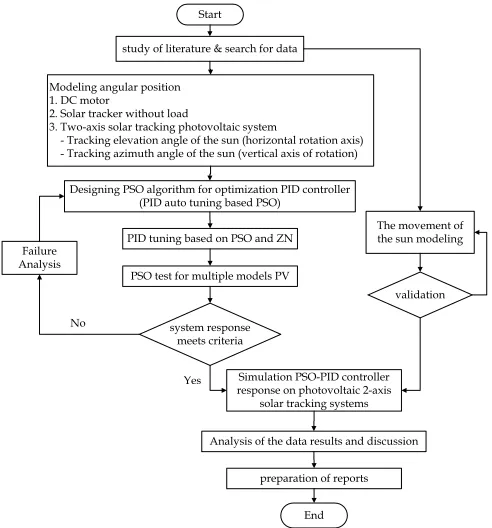
Fig. 3. Flow diagram of the design of PID-PSO
The design phase auto tuning PID control system using the PSO on solar tracking photovoltaic system includes a two-axis sun tracking two axes, PID control, PID tuning with ZN, build algorithms PSO and PSO-PID control. Data used include DC motor parameters (moment of inertia, friction constant, constant emf, constant torque, resistance and inductance), gear parameters (mass and diameter), as well as parameters of some models of photovoltaic (mass and dimensions). Both behavioral modeling system that includes modeling of the angular position of DC motor, gear corner position farthest from the fusion of DC motor with gear transmission system (basic tracking the sun), and the modeling of the angular position tracking solar photovoltaic system two axes. solar tracker photovoltaic system consists of a two-axis vertical rotary axis (vertical rotating-axis) and horizontal swivel axis [11].
Phase three is the PSO algorithm design for the optimization of PID parameters or PSO-PID controller design that is capable of controlling the angular position of the system. Stage four PID tuning parameters (Kp, Ki, Kd) using PSO algorithm design and two Ziegler Nichols methods for each model system obtained from the second step with Matlab. The fifth test or algorithm design application in solar tracking photovoltaic system with a two-axis PV different loads. If the response does not meet the system performance criteria of the control system, then back to the third step to reevaluate the steps that have been made. Reveres , if the response performance of the system as expected, then go to the next step. Sixth analysis and discussion as well as the final preparation of the report. Stage six model the movement of the sun, the seventh step response simulation PSO-PID control on the 2-axis solar tracking photovoltaic. System Design PSO-PID Control in Photovoltaic Systems Solar Tracker, the two axes are designed to follow the design shown in Figure 4[12].
DC motor 1 Gears1
DC motor 2 Gears2
Solar panel Position sensor 1
Elevation angle
Azimuth angle
D
ri
v
e1
D
ri
v
e2
Controler1
Controler2
Position sensor 2 Error 1
Error 2 the sun position
Elevation input
Azimuth input
Fig 4. Design of the control system at the PV system of two- axis solar tracking [13].
DC motor modeling, shown in the electrical equivalent circuit of the armature and the rotor of a DC motor is shown in Figure 5
.
Fig. 5. System of DC-motor
DC motor parameters: the moment of inertia (J), the constant shear viscosity of the motor (b), a constant
electromotive force (Kb), the motor torque constant (Kt), resistance (R), and inductance (L). The input of this system is the source voltage (V), while the output is the position of the shaft (theta). The rotor and shaft are assumed rigid. Friction torque is proportional to the angular velocity of the shaft. The data used in the DC motor parameters from experimental results Carnegie Mellon's undergraduate controls laboratory.
where , ,
, , , and
. [16].
Gear transmission system is a spur gear comprising two gear namely M1B12 models (number of teeth 12, mass 10 g) and the model M1A20 (number of teeth 120, a mass of 1.32 kg) (source: http // md. Electric.com/prod/ PTIC / 375_PTI_CATALOG.pdf, page 376). The angular position sought by integrating the speed, then the system transfer function in the s.
𝜃 𝑠 𝑉 𝑠 =
𝐾
𝑠 𝐽𝑠 + 𝑏 𝐿𝑠 + 𝑅 + 𝐾2
𝑟𝑎𝑑 𝑉
(20)
𝜃 𝑠
𝑉 𝑠 =
0.0274
8.878 × 10⁻¹² 𝑠3 + 1.291 × 10⁻⁵ 𝑠2 + 0.0007648 𝑠
(21)
Solar Photovoltaic System Modeling two-axis trackers with Load, System photovoltaic solar tracker is a two-axis sun tracking solar cell panel with load and driven in two rotary axes are rotary axes vertical and horizontal swivel axis. useful vertical rotary axis to follow the direction of the sun's annual angles (azimuth), while the horizontal swivel axis is intended to follow the direction angle of the sun daily (elevation) from east to west.
Modeling Photovoltaic Solar Tracker Rotate Axis Horizontal, in the mechanical system of horizontal rotary axis solar tracker. Photovoltaic rotated along the axis x-x right down the length dimension L. load torque value is obtained from the moment of inertia of photovoltaic solar cell panels swivel multiplied by the angular acceleration. Rotary angular acceleration is derived from the angular acceleration gear-1.Momen inertial solar cell panel horizontal rotary axis [4].
𝐽1=
1 12𝑚𝑝𝑣𝐿2.
𝑁2
𝑁1 2
𝑘𝑔.𝑚2
(22) Moment of inertia of rotary horizontal axis solar tracker
𝐽
𝑇1= 𝐽
𝑠𝑡+𝐽
1𝑘𝑔.𝑚
2(23)
𝐽
𝑇1= 2.71684×10
−5+𝐽
1
𝑘𝑔.𝑚
2(24) III. RESULTS AND DISCUSSION
Detailed calculation of the value of the moment of inertia rotary axis horizontal cell panel J1dan total moment of inertia horizontal rotary axis solar tracker JT1 for the fifth model of the solar cell panels used are shown in Table 1. Here is a sample calculation step for determining the position of the sun and other information related to the sun with the data as follows; Gresik location (latitude south: 6.99465 ° = -6 ° 59' 41'') east longitude: 112 5-62 ° = 112 ° 33' 43'', time: 10:00:00 hrs, dated December 28, 2015 d = 362 days, the time difference GMT: 7 hours.
TABLE I
TOTAL OF INERTIA MOMENT IN HORIZONTAL ROTATION AXIS
Solar tracking system transfer function of the horizontal rotary axis is obtained from the equation (25) with a value of J = JT1 and multiplied by the ratio of angular velocity wR
𝐹𝑇𝑖𝑛𝑐=
𝜃 𝑠 𝑉 𝑠 = 𝑤𝑅.
𝐾
𝑠 𝐽𝑇1𝑠 + 𝑏 𝐿𝑠 + 𝑅 + 𝐾2
𝑟𝑎𝑑 𝑉
(25) The transfer function of the horizontal rotary axis solar tracker for each model of the solar cell panel shown in equation 26.
FT =
3.289×10
−10𝑠
3+0.0004783 𝑠
0.00274
2+ 0.0007648 𝑠
(26)
Modeling Photovoltaic Solar Tracker Play Vertical Axis (Vertical Rotating Axis), photovoltaic Burden played right in the long dimension LxW. Load torque value is obtained from the moment of inertia of photovoltaic solar cell panels swivel multiplied by the angular acceleration. Rotary angular acceleration is derived from the angular acceleration inertia gear. Momen solar cell panel vertical-axis rotating.
𝐽2=
1
2𝑚𝑝𝑣 𝐿2+ 𝑊2 .
𝑁2
𝑁1 2
𝑘𝑔. 𝑚2
(27)
Moment of inertia of a rotating vertical-axis tracker solar PV,
𝐽
𝑇2= 𝐽
𝑠𝑡+ 𝐽
2𝑘𝑔.𝑚
2(28)
𝐽𝑇2= 2.71684 × 10⁻⁵+ 𝐽2 𝑘𝑔.𝑚2
(29)
Detailed calculation of the value of the moment of inertia vertical-axis rotating panel J1 cells and moment of inertia vertical-axis rotating JT1 total to five models of solar cell panels used are shown in Table II.TABLE II
THE MOMENT OF INERTIA VERTICAL-AXIS ROTATING TOTAL
The system transfer function rotating vertical-axis tracker solar PV is obtained from the equation (30) with the value and multiplied by the ratio of angular velocity wR
𝐹𝑇𝑣𝑒𝑟𝑡=
𝜃 𝑠 𝑉 𝑠 =𝑤𝑅.
𝐾
𝑠 𝐽𝑇2𝑠 + 𝑏 𝐿𝑠 + 𝑅 + 𝐾2
𝑟𝑎𝑑
𝑉 (30) The transfer function rotating vertical-axis tracker solar PV for each model of the solar cell panel can be calculated following the transfer function of rotating vertical-axis tracker solar PV each model is represent.
FT = 0.00274
2.384×10⁻⁹ 𝑠3 +00.003467 𝑠2 + 0.0007648 𝑠
(31)
Determining the fitness function to determine the performance criteria of the time integral absolute error (ITAE). Determine the limit function limits the function of optimization criteria such as settling time systems based on the design of the controller Ziegler Nichols [14].
Further developing the algorithm PSO-PID, determine the parameters of PSO. The parameters used in the design PSO is .Dimension, d = 3 (Kp, Ti and Td); The number of particles, N = 40; Maximum iteration, I = 100; The upper limit Kp, Ti, Td = 100, 5, 5; Lower limit Kp, Ti, Td = 0, 0, 0; Constant acceleration, C1 = 1.2; Constant acceleration, C2 = 0.9; Weighting factor, w: w max = 0.9; w min = 0.4. Tuning the system control is done by giving step input to the system. Figure 6-10 and Table as overview PID parameter tuning process with PSO algorithm in a DC motor.
(a)
(b)
(c)
Fig. 6. The position of (a) particles initialization and G best in 3D, (b) particles and G best the 10th iteration and (c) the position of the
particle and G best the 20th iteration
Best PSO algorithm generates value Kp = 83.036; Ti = 0.045268 or Ki = 1834.3; and Td = 0.016728 or Kd = 1.389. In the transfer function of PSO-PID controller can be written as follows.
𝑃𝐼𝐷 𝑠 =
0.0006977 𝑠
2+ 8.245 𝑠 + 2.436 × 10
40.0003385 𝑠
(32)
Response test DC motors, DC motors from the model in equation (35), tested the response of the open loop, closed loop, ZN-PID, and the PID PSO. Each response is shown in Figure 7-10.
(a) (b)
Fig. 7. Response open-loop DC motor with input step (a), Closed loop DC motor with input step (b)
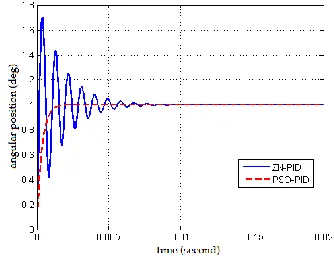
The performance comparison ZN-PID and PSO-PID on DC motors :
Fig 8. The performance comparison ZN-PID and PSO-PID on DC motors
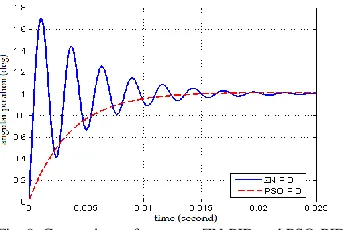
Test Response System Photovoltaic solar two axis tracking PV STM40-50 to load, test with load Horizontal axis response. Model horizontal axis solar tracking PV load STM40-50 in equation (62), close loop response test, ZN-PID, and the PID PSO. Each response is shown in Table 3.
TABLE III
COMPARATION OF THE PERFORMANCEOT THE SOLAR TRACKER WIT ZN-PID CONTROL AND PID-PSO CONTROL
Fig. 9.Comparison of response ZN-PID and PSO-PID on the PV load tracking STM40-50 horizontal axis
TABLE IV
COMPARATION OF THE PERFORMANCE ON THE SOLAR TRACKER PV LOAD HORISONTAL AXIS STM40-50
Test Response System Photovoltaic solar two axis tracking PV STM40-50 to load, test with load Horizontal axis response. Model horizontal axis solar tracking PV load STM40-50 in equation (62), close loop response test, ZN-PID, and the PID PSO. Each response is shown in Table 3. Comparison of ZN-PID response and PSO-PID on solar tracking PV load STM40-50 horizontal axis is shown on Figure 10.
Fig. 10. Comparison of response ZN-PID and PSO-PID on the PV load tracking STM40-50 vertical axis
TABLE V
THE COMPARISON OF THE PERFORMANCE OF THE SOLAR TRACKING PV LOAD AXIS STM40-50 VERTCAL
Test results of tracking the movement of the sun tracking solar photovoltaic system is a two-axis PV load STM40-50, PID auto tuning based PSO subsequently simulated by the movement of the sun that is represented in the angle of elevation and azimuth angles. Location is done in Gresik- East
Java(southern latitudes = -6 ° 59' 41'' and longitude = 112 ° 33' 43'') in December28,2015. Tracking the results shown in Fig. 11 . While the Fig.12 is the result of tracking for one day on 28 December. Here are shown the results of PSO-PID control Tracking the solar tracking photovoltaic system two axes at sunrise in Figure 11-12, and the simulation results PSO-PID control systems at two solar tracking photovoltaic system axis within 24 hours. Control system is able to follow the movement of the sun carefully.
Fig. 11. Tracking PSO-PID control on solar tracking photovoltaic system two axes at sunrise
Fig. 12. Simulation PSO-PID control system on the two solar tracking photovoltaic system axis within 24 hours
IV. CONCLUSION
Based on the evaluation of the result and discussion that has been done, In this study, PID auto tuning using PSO on solar tracking photovoltaic systems for two-axis photovoltaic load STM40-50 models can be concluded that the PID parameter tuning results with PSO algorithm for horizontal rotary axis is Kp = 212.38, Ki = 27.08, and Kd = 151.65 obtained in 3 iterations with minimum fitness function end = 1.33. While the PID parameter tuning results with PSO algorithm for the vertical spin axis is KP = 487.21, Ki = 21:40, and KD = 732.03 obtained in 8 iterations with at least the end of the fitness function 8.68
Performance PSO-PID control system for rotary axes horizontal and vertical axis sun tracking better than ZN-PID control system. In the ZN-PID control horizontal swivel axis has a maximum overshot = 69.76%, settling time = 0.1392 seconds. PSO-PID control for horizontal swivel axis has a maximum overshot = 1.69%, and settling time = 0.05 sec. ZN- PID performance control systems for rotary axis vertical, i.e the maximum overshot = 69.77%, settling time = 0.45 sec. PSO-PID control for vertical swivel axis has a maximum overshot = 1.83%, and settling time = 0.10 sec. With the elevation angle of the sun changes slowly (average of 4o per minute) and settling time control of the PSO-PID = 0.05 sec, the control system is designed capable of tracking the position of the sun at any time
REFERENCES
[1] Fitriana,Ira, (2013), “Potensial Sumber Daya Energi Terbarukan” dalam Indonesia Energy Outlook 2013, eds, Sugiyono, A., Permana, A.D., Boedoyo, M.S.,Adiarso, BPPT, Jakarta, hal. 18.
Nasional Dalam Rangka Mengantisipasi Pemanfaatan PLTU Batubara
Skala Kecil, PLTN,Dan Energi Terbarukan, Jakarta, 2006, hal. 43-52.
[3] Xin, Z., Jianwu, D., Min, Lee., (2013), “Parameter Optimization of PID Controller Based on PSO for Multi-leaf Collimator”, in TELKOMNIKA, Vol. 11, No. 10, October 2013, pp. 6127 – 6134
[4] Catarius, A., Christiner,M., (2010), Azimuth-Altitude Dual Axis Solar Tracker, A Master Qualifying Project, Worcester Polytechnic Institute, Worcester
[5] Alrijaldjiz, Astrowulan, K., (2010),““Optimasi Parameter kontroler PID Berbasis Algoritma Particle Swarm Optimization (PSO) Untuk Sistem dengan Waktu Tunda”, Tesis, Program S2 Teknik Elektro FTI-ITS, Surabaya.
[6] Ashraf B, Ahmad A. M, Farhan A. Salem, (2013),”Design and Performance of Solar Tracking Photo-Voltaic System; Research and Education”, in International Journal Of Control, Automation And
Systems, pp 49-55
[7] Koussa, M., Haddadi, M., Saheb, D., Hadji, S., (2012b), “Sun tracker systems effects on flat plate photovoltaic PV systems performance for different sky states: A case of an arid and hot climate”, in Energy
Procedia 18 (2012 ) hal 839 – 850.
[8] Sadyrbayev, S. A., Bekbayev, A. B.,Orynbayev, S., and Kaliyev, Z., (2013), “Design and Research of Dual-Axis Solar Tracking System in Condition of Town Almaty” in Middle-East Journal of Scientific
Research 17 (12), pp 1747-1751
[9] Sholihin, M., Tack, L., Kean, M., (2011), “Tuning of PID Controller Using Particle Swarm Optimization (PSO)”, in Proceeding of
International Conference on Advanced Science, January 2011, pp
458-461.
[10] Kennedy, J. and Eberhart, C., “Particle Swarm Optimization,”
Proceedings of the 1995 IEEE International Conference on Neural
Networks, Australia, pp. 1942-1948, 1995
[11] Gharghory, S., Kamal, H., (2013),”Modified PSO for Optimal Tuning of Fuzzy PID Controller”, in IJCSI International Journal of Computer Science Issues, vol. 10, pp 462 – 471.
[12] Koussa, M., Haddadi, M., Saheb, D., Hadji, S., (2012a), “Sun tracking mechanism effects on flat plate photovoltaic system performances for different step time and main parameters affecting the obtained gains: case of North Africa and Mediterranean site”, in Energy Procedia 18 ( 2012 ) 817 – 838.
[13] Mousazadeh, H., Keyhani, A., Javadi, A., Mobli, H, (2009), “A review of principle and sun-tracking methods for maximizing solar systems output” in Renewable and Sustainable Energy Reviews, Tehran pp 1800–1818
[14] Taeib, A., Lateif, A., Chaari, A., (2013), “A PSO Approach for Optimum Design of Multivariable PID Controller for nonlinear systems”, in
Proceedings Engineering & Technology - Vol.2, pp. 206-210
[15] Taeib, A., Chaari, A., (2013), “PID-PSO Control of MIMO Nonlinear System”, in Int. J. Emerg. Sci., 3(3), pp 257-267.
[16] source :http://ctms.engin.umich.edu/CTMS/index.php?example = Motor Position §ion = System Modeling), Desember 10,2015. [17] Imam Abadi, et.al.2014, “Extreme Learning Machine Approach to
Estimate Hourly Solar Radiation On Horizontal Surface (PV) in Surabaya –East Java “ 2014 1st International Conference on Information Technology, Computer and Electrical Engineering (ICITACEE).
[18] Imam Abadi, et.al. 2015, “Type-2 Furzry Logrc Controller Based PV Passive Two-Axis Solar Tracking “International Review of Electrical Engineering (I.RE.E.), Vol. 10, N. 3ISSN 1827- 6660 Mty-June. [19] A Musyafa, B Cholifah, A Dharma, I Robandi - 2009 “Local Short-Term
Wind Speed Prediction in the region Nganjuk City (East Java) Using Neural Network” Proceedings the 6th International conference on
![Fig 1. The two-axis solar trackers [7]](https://thumb-us.123doks.com/thumbv2/123dok_us/1358088.1644804/2.612.81.237.280.423/fig-the-two-axis-solar-trackers.webp)
![Fig 2. Diagram Block of PID-PSO Controller [6]](https://thumb-us.123doks.com/thumbv2/123dok_us/1358088.1644804/3.612.322.553.371.509/fig-diagram-block-pid-pso-controller.webp)