C A S E R E P O R T
Open Access
Primary synovial sarcoma of the kidney:
a case report of complete pathological
response at a Lebanese tertiary care center
Alissar El Chediak
1, Deborah Mukherji
1, Sally Temraz
1, Samer Nassif
2, Sara Sinno
2, Rami Mahfouz
2and Ali Shamseddine
1*Abstract
Background:Primary synovial sarcoma of the kidney is a rare type of soft tissue sarcoma. Its presenting features can resemble those of other renal tumors; rendering its early diagnosis, a dilemma. Several cases of renal synovial sarcoma have been reported in the literature with varying treatment options and outcomes. This article describes a rare case of primary renal synovial sarcoma and reviews all cases in the literature.
Case presentation:A 26-year-old male presented with flank pain and hematuria. Initially diagnosed with Wilm’s tumor, revision of pathology and histology, along with the immunohistochemical profile, confirmed, nevertheless, the diagnosis of primary monophasic synovial sarcoma of the kidney with the SYT-SSX2 fusion transcript. Follow-up, post nephrectomy, revealed recurrence within the lungs and at the surgical bed. Surgical resection followed by adjuvant chemotherapy regimen constituting of Doxorubicin and Ifosfamide, achieved complete pathological response. Conclusion:In this case report, we emphasize the need for accurate diagnosis and prompt treatment. We propose multimodality treatment approach including surgery along with anthracycline-based chemotherapy to induce complete remission.
Keywords:Synovial sarcoma, SYT-SSX, Doxorubicin, Ifosfamide, Pathological response, Survival
Background
Soft tissue sarcoma (STS) is a rare malignant tumor of mesenchymal origin having an incidence of 2–3 cases per 100,000, thus contributing to less than 1% of all adult ma-lignancies [1,2]. Synovial sarcoma (SS), or sarcoma of tis-sues adjacent to joints, is a rare type of STS, and represent 5 to10% of all STSs [1]. SS is commonly found in the proximal limb of young adults and has a male predomin-ance [3]. Other unusual sites of occurrence include the head and neck, heart, lungs, and kidneys [4]. Very few re-ports have tackled this tumor due to its rarity and diffi-culty to distinguish from other renal pathologies. The first case of primary SS of the kidney has been reported by Faria et al. in 1999 [5]. We present a case of primary syn-ovial sarcoma of the kidney, initially thought to be a
Wilm’s tumor, along with patient follow-up, showing complete pathological response to treatment, followed by a literature review of this disease entity.
Case presentation
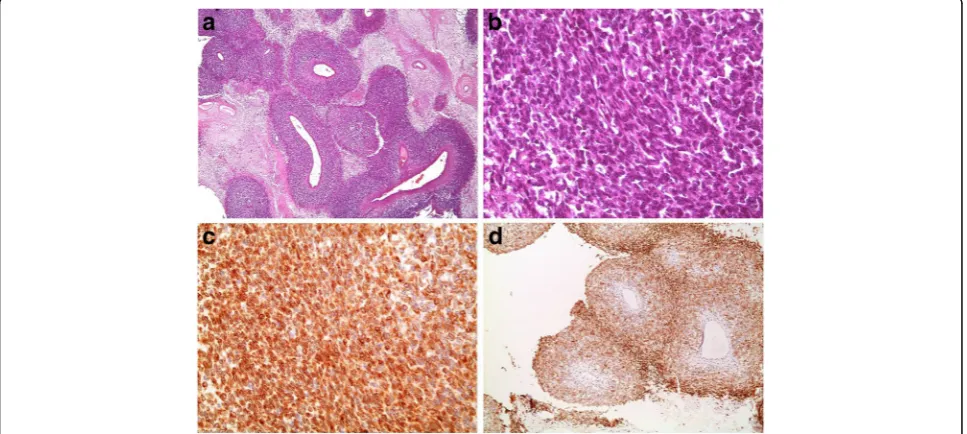
A 26-year-old male experienced recurrent flank pain and gross hematuria over several months duration. Kidney ultrasound showed a lower pole mass concerning for renal cell carcinoma. After confirmation of a right kid-ney tumor, measuring 6 cm, by an enhanced CT scan, he underwent right radical nephrectomy with para-caval lymph node dissection, at another institute, with path-ology there, read initially as adult type Wilm’s tumor. After referral to our institute for rereading of the patho-logical slides, the morphopatho-logical and immunostaining profiles were analyzed, and results came out to be con-sistent with synovial sarcoma of the right kidney. The tumor was monophasic and showed a cellular spindle cell proliferation with a prominent perivascular growth
* Correspondence:[email protected]
1Department of Internal Medicine, Division of Hematology/Oncology,
American University of Beirut - Medical Center, P.o.Box: 11-0236, Riad El Solh, Beirut 110 72020, Lebanon
Full list of author information is available at the end of the article
pattern and partial necrosis. It was positive for vimentin, BCL-2, CD56, MCK (partial), and negative for CD10, 31, 34, 99, 117, CK7, Desmin, SMA, MyoD1, EMA, WT-1, S100, RCC, PAX8, GATA-3, and Synaptophysin (Fig.1).
Molecular studies on the paraffin-embedded blocks were performed to test for the t(X; 18) SYT/SSX fusion transcript, using RT-PCR, at the University of Michigan Health System. RT-PCR amplification was performed using fluorescent dye-labeled primers, specific for the SYT-SS18 and SYT-SSX genes. The PCR products were then detected and sized by capillary electrophoresis to identify the presence of chimeric transcripts. A concur-rent internal control was run to ensure the integrity of the mRNA. FISH analysis was also performed using a break-apart style probe. The results were unfortunately negative due to the low quality samples.
According to these findings, a diagnosis of primary monophasic SS of the kidney was made. It was elected for serial follow up and no adjuvant treatment, there-after. Six months later, a follow up CT scan detected a 1. 5cmx1.7 cm left lower lobe lung nodule suggestive of metastasis. Consequently, he underwent a smooth left lower lobe wedge resection. Fusion gene product ana-lysis on the resected lung tissue, via FISH, revealed SYT-SSX 2 gene rearrangement confirming the SS diagnosis. Three months afterwards, CT scan of the chest, abdo-men, and pelvis revealed another disease recurrence in the nephrectomy surgical bed, with tumor invasion of the inferior vena cava and the presence of conglomerate suspicious aorto-iliac lymph nodes. A multidisciplinary team approach decided to start the patient on Doxorubi-cin 50 g/m2 and Ifosfamide 5 g/m2 chemotherapeutic
regimen. Following the third cycle, CT scan and MRI showed a 30 to 50% interval decrease in size of tumor masses in the right nephrectomy bed and adjacent retroperitoneum, IVC tumor, and distal aortocaval lymph nodes, indicating partial treatment response. The patient were received a total of 5 cycles, with no adjunct side effects.
A follow-up MRI, several months later, showed contin-ued decrease in the size of 3 masses at the previous sur-gical site, IVC tumor invasion, and aortocaval lymph nodes, indicating continued response to treatment. One of the small masses in the nephrectomy bed almost completely resolved, on imaging, with no new progres-sion. It was then decided to have the patient undergo surgical resection of the residual masses at the previous surgical bed with removal of the aorto-caval lymph nodes, thrombectomy with vena caval repair. All surgical margins were negative. Final pathology came out to be necrosis, with no viable tumor identified. Thus, a complete pathological response was achieved using the Adriamycin/Ifosfamide regimen, a year after the initial nephrectomy. A sample of the kidney lysate was again tested for the (X; 18) SYT/SSX fusion transcript via RT-PCR and FISH, and results were negative, suggestive of complete treatment response.
Discussion
Synovial sarcoma is a mesenchymal spindle cell tumor which displays variable epithelial differentiation and has a specific chromosomal translocation t(X; 18) (p11; q11), which results from the fusion of the SYT gene on chromosome 18 to exon 5 of either SSX1 or SSX2 genes
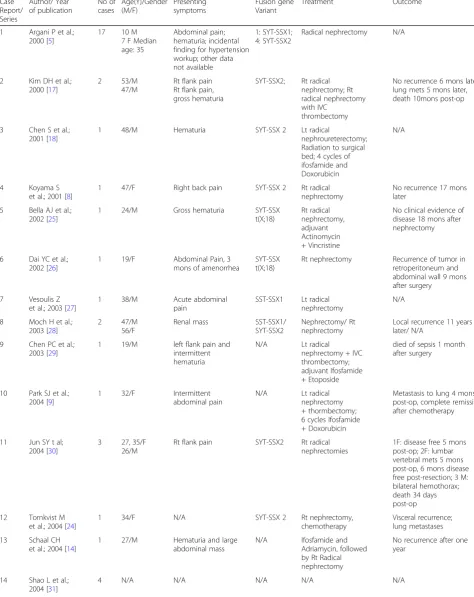
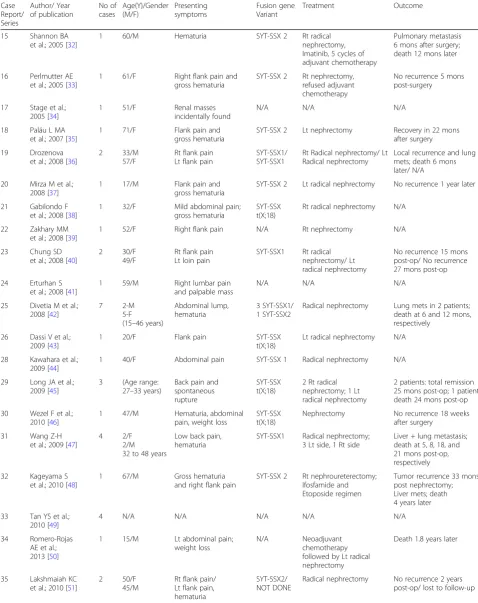
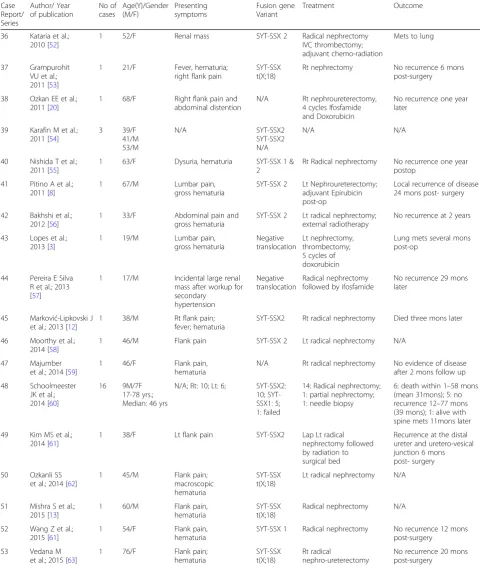
on chromosome X [6]. It was recently reported that the SSX4 gene is also involved in such a translocation [6,7]. Nonetheless, SS of the kidney can be first misdiagnosed as a renal cell carcinoma due to similar clinical presenta-tion [3]. The identification of the monophasic type of renal SS is also controversial as it has similar micro-scopic features to other spindle cell tumors, such as fibrosarcoma, leiomyosarcoma, malignant peripheral nerve sheath tumors, adult Wilm’s tumor, spindle cell carcinoma and spindle cell melanoma [3]. While phasic SS of the kidney is made up exclusively of mono-morphic spindle cells, the biphasic type is a mixture of both spindle-shaped cells and epithelial cells. SS of the kidney is a rare disease such as 64 cases have been re-ported since the Faria et al. cases up to 2012 [6]. We conducted a literature review using Embase and PubMed databases and included all cases (even those published in languages other than English) till the year 2016. This yielded a total of 114 cases (Table1) constituting the lar-gest series of renal SS cases to be reported. Noteworthy, our case is the first to be reported from the Middle East. The median age of patients with renal SS was 40.5 (15–78) years, which is half the median age for diagnosis of renal cell carcinoma [7]. The female to male ratio was 1:1. Regarding the predominant presentation symptoms, data was only available for 82 cases. The most frequently reported symptom on presentation was isolated flank/ lumbar pain which was found in 20 patients (24.4%).This is in concordance with a review conducted on older data where this same predominant symptom occurred in 55. 5% of cases [8]. Hematuria was present in 37 patients (44%) upon presentation. Kohle et al. reported similar data, albeit smaller sample size, where 98% of their pa-tients were symptomatic at the time of presentation, with 67% having pain and 38% having hematuria [6]. These figures are in concordance with our analysis of the world literature.
According to our analysis, the leading fusion variant was the SYT-SSX 2, detected in 42 (36.8%) patients, as op-posed to the SYT-SSX 1 variant, detected in 23 (20.2%) patients, in total (Table1).
Data on metastasis and disease recurrence was avail-able for 70 and 57 patients, respectively. 19 (27.1%) pa-tients had metastasis, whereas 14 (24.6%) papa-tients had tumor recurrence on follow-up. These numbers are similar to what was published in previous series [9].
A 30 to 50% of the patients who underwent surgical resection of their primary tumor were reported to wit-ness metastasis to the lungs or liver [10]. Our patient is of no exception. In terms of median survival for patients with localized disease, size represents an important prognostic factor [10]. A retrospective analysis was done on 135 consecutive patients with extremity and truncal variant of synovial sarcomas, seen at three institutions in
Boston, between years 1961 and 1996. Patients with lo-calized synovial sarcomas, less than 5 cm in longest diameter, had a survival at 10 years equivalent to 88%, compared with a 10-year survival of 38 and 8% for 5 to 10 cm and greater than 10 cm sarcomas, respectively [10]. Similar results were reported by Singer et al. on 48 consecutive patients with extremity and truncal synovial sarcomas, seen between years 1966 and 1994 [11].
SS of the kidneys presents a diagnostic dilemma, as it resembles renal cell carcinoma amongst other tumors. Diagnosis can be based on morphological (spindle cell) and immunological tumor profile. It can also be established by genetic analysis via FISH and RT-PCR, demonstrating the SYT18-SSX gene translocation. Dem-onstrating which translocation, the tumor possesses, has been a delicate matter. For instance, a SS case that was previously shown to be negative for SYT/SSX1 and SYT/SSX2 gene expression by conventional RT-PCR, was instead found to be SYT/SSX4 positive, as the sole fusion transcript expressed in this tumor sample, when the RT-PCR was redesigned [6]. This might have ex-plained our negative results, when trying to identify the translocations, since our RT-PCR was only designed to detect SYT/SSX1 and SYT/SSX2 fusion gene variants.
Moreover, the value of TLE1 antibody in the diagnosis of SS has also been examined. TLE1 was found to be an excellent discriminator of SS from other sarcomas, in a study by Terry et al. [12]. They reported that TLE1 monoclonal and polyclonal antibodies gave intense and/ or diffuse nuclear staining in 91 out of 94 molecularly confirmed synovial sarcoma patients. In contrast, TLE1 staining has been detected much less frequently and at lower levels, if et al.l, in 40 other mesenchymal tumors; thereby making this a robust immunohisto-chemical marker for SS. Jagdis et al. also supported this view as their findings confirmed that TLE1 was more sensitive and specific for synovial sarcoma, than any other currently available immunohistochemical kits [13]. Kosemehmetoglu et al. confirmed the sensi-tivity, but not the specificity, of TLE1 antibodies in diagnosing synovial sarcomas [14].
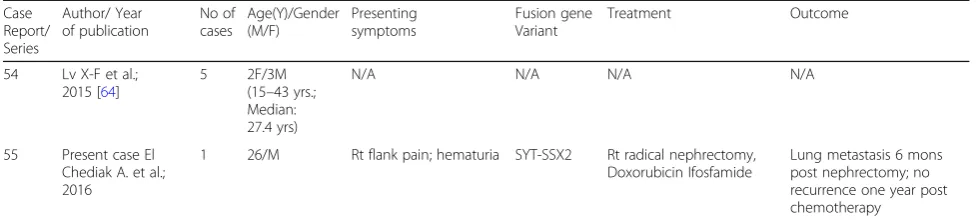
Table 1List of 114 cases of renal SS published in the literature
Case Report/ Series
Author/ Year of publication
No of cases
Age(Y)/Gender (M/F)
Presenting symptoms
Fusion gene Variant
Treatment Outcome
1 Argani P et al.; 2000 [5]
17 10 M 7 F Median age: 35
Abdominal pain; hematuria; incidental finding for hypertension workup; other data not available
1: SYT-SSX1; 4: SYT-SSX2
Radical nephrectomy N/A
2 Kim DH et al.; 2000 [17]
2 53/M 47/M
Rt flank pain Rt flank pain, gross hematuria
SYT-SSX2; Rt radical nephrectomy; Rt radical nephrectomy with IVC
thrombectomy
No recurrence 6 mons later; lung mets 5 mons later, death 10mons post-op
3 Chen S et al.; 2001 [18]
1 48/M Hematuria SYT-SSX 2 Lt radical
nephroureterectomy; Radiation to surgical bed; 4 cycles of ifosfamide and Doxorubicin
N/A
4 Koyama S et al.; 2001 [8]
1 47/F Right back pain SYT-SSX 2 Rt radical nephrectomy
No recurrence 17 mons later
5 Bella AJ et al.; 2002 [25]
1 24/M Gross hematuria SYT-SSX t(X;18)
Rt radical nephrectomy, adjuvant Actinomycin + Vincristine
No clinical evidence of disease 18 mons after nephrectomy
6 Dai YC et al.; 2002 [26]
1 19/F Abdominal Pain, 3 mons of amenorrhea
SYT-SSX t(X;18)
Rt nephrectomy Recurrence of tumor in retroperitoneum and abdominal wall 9 mons after surgery
7 Vesoulis Z et al.; 2003 [27]
1 38/M Acute abdominal pain
SST-SSX1 Lt radical nephrectomy
N/A 8 Moch H et al.;
2003 [28]
2 47/M 56/F
Renal mass SST-SSX1/ SYT-SSX2
Nephrectomy/ Rt nephrectomy
Local recurrence 11 years later/ N/A
9 Chen PC et al.; 2003 [29]
1 19/M left flank pain and intermittent hematuria
N/A Lt radical nephrectomy + IVC thrombectomy; adjuvant Ifosfamide + Etoposide
died of sepsis 1 month after surgery
10 Park SJ et al.; 2004 [9]
1 32/F Intermittent abdominal pain
N/A Lt radical nephrectomy + thormbectomy; 6 cycles Ifosfamide + Doxorubicin
Metastasis to lung 4 mons post-op, complete remission after chemotherapy
11 Jun SY t al; 2004 [30]
3 27, 35/F 26/M
Rt flank pain SYT-SSX2 Rt radical nephrectomies
1F: disease free 5 mons post-op; 2F: lumbar vertebral mets 5 mons post-op, 6 mons disease free post-resection; 3 M: bilateral hemothorax; death 34 days post-op 12 Tornkvist M
et al.; 2004 [24]
1 34/F N/A SYT-SSX 2 Rt nephrectomy, chemotherapy
Visceral recurrence; lung metastases 13 Schaal CH
et al.; 2004 [14]
1 27/M Hematuria and large abdominal mass
N/A Ifosfamide and Adriamycin, followed by Rt Radical nephrectomy
No recurrence after one year
14 Shao L et al.; 2004 [31]
Table 1List of 114 cases of renal SS published in the literature(Continued) Case Report/ Series Author/ Year of publication No of cases Age(Y)/Gender (M/F) Presenting symptoms Fusion gene Variant Treatment Outcome
15 Shannon BA et al.; 2005 [32]
1 60/M Hematuria SYT-SSX 2 Rt radical nephrectomy, Imatinib, 5 cycles of adjuvant chemotherapy
Pulmonary metastasis 6 mons after surgery; death 12 mons later 16 Perlmutter AE
et al.; 2005 [33]
1 61/F Right flank pain and gross hematuria
SYT-SSX 2 Rt nephrectomy, refused adjuvant chemotherapy
No recurrence 5 mons post-surgery 17 Stage et al.;
2005 [34]
1 51/F Renal masses incidentally found
N/A N/A N/A 18 Paláu L MA
et al.; 2007 [35]
1 71/F Flank pain and gross hematuria
SYT-SSX 2 Lt nephrectomy Recovery in 22 mons after surgery 19 Drozenova
et al.; 2008 [36]
2 33/M 57/F
Rt flank pain Lt flank pain
SYT-SSX1/ SYT-SSX1
Rt Radical nephrectomy/ Lt Radical nephrectomy
Local recurrence and lung mets; death 6 mons later/ N/A 20 Mirza M et al.;
2008 [37]
1 17/M Flank pain and gross hematuria
SYT-SSX 2 Lt radical nephrectomy No recurrence 1 year later 21 Gabilondo F
et al.; 2008 [38]
1 32/F Mild abdominal pain; gross hematuria
SYT-SSX t(X;18)
Rt radical nephrectomy N/A 22 Zakhary MM
et al.; 2008 [39]
1 52/F Right flank pain N/A Rt nephrectomy N/A 23 Chung SD
et al.; 2008 [40]
2 30/F 49/F
Rt flank pain Lt loin pain
SYT-SSX1 Rt radical nephrectomy/ Lt radical nephrectomy
No recurrence 15 mons post-op/ No recurrence 27 mons post-op 24 Erturhan S
et al.; 2008 [41]
1 59/M Right lumbar pain and palpable mass
N/A N/A N/A 25 Divetia M et al.;
2008 [42]
7 2-M 5-F (15–46 years)
Abdominal lump, hematuria
3 SYT-SSX1/ 1 SYT-SSX2
Radical nephrectomy Lung mets in 2 patients; death at 6 and 12 mons, respectively
26 Dassi V et al.; 2009 [43]
1 20/F Flank pain SYT-SSX t(X;18)
Lt radical nephrectomy N/A 28 Kawahara et al.;
2009 [44]
1 40/F Abdominal pain SYT-SSX 1 Radical nephrectomy N/A 29 Long JA et al.;
2009 [45]
3 (Age range: 27–33 years)
Back pain and spontaneous rupture
SYT-SSX t(X;18)
2 Rt radical nephrectomy; 1 Lt radical nephrectomy
2 patients: total remission 25 mons post-op; 1 patient: death 24 mons post-op 30 Wezel F et al.;
2010 [46]
1 47/M Hematuria, abdominal pain, weight loss
SYT-SSX t(X;18)
Nephrectomy No recurrence 18 weeks after surgery
31 Wang Z-H et al.; 2009 [47]
4 2/F 2/M 32 to 48 years
Low back pain, hematuria
SYT-SSX1 Radical nephrectomy; 3 Lt side, 1 Rt side
Liver + lung metastasis; death at 5, 8, 18, and 21 mons post-op, respectively 32 Kageyama S
et al.; 2010 [48]
1 67/M Gross hematuria and right flank pain
SYT-SSX 2 Rt nephroureterectomy; Ifosfamide and Etoposide regimen
Tumor recurrence 33 mons post nephrectomy; Liver mets; death 4 years later 33 Tan YS et al.;
2010 [49]
4 N/A N/A N/A N/A N/A 34 Romero-Rojas
AE et al.; 2013 [50]
1 15/M Lt abdominal pain; weight loss
N/A Neoadjuvant chemotherapy followed by Lt radical nephrectomy
Death 1.8 years later
35 Lakshmaiah KC et al.; 2010 [51]
2 50/F 45/M
Rt flank pain/ Lt flank pain, hematuria
SYT-SSX2/ NOT DONE
Table 1List of 114 cases of renal SS published in the literature(Continued)
Case Report/ Series
Author/ Year of publication
No of cases
Age(Y)/Gender (M/F)
Presenting symptoms
Fusion gene Variant
Treatment Outcome
36 Kataria et al.; 2010 [52]
1 52/F Renal mass SYT-SSX 2 Radical nephrectomy IVC thrombectomy; adjuvant chemo-radiation
Mets to lung
37 Grampurohit VU et al.; 2011 [53]
1 21/F Fever, hematuria; right flank pain
SYT-SSX t(X;18)
Rt nephrectomy No recurrence 6 mons post-surgery 38 Ozkan EE et al.;
2011 [20]
1 68/F Right flank pain and abdominal distention
N/A Rt nephroureterectomy, 4 cycles Ifosfamide and Doxorubicin
No recurrence one year later
39 Karafin M et al.; 2011 [54]
3 39/F 41/M 53/M
N/A SYT-SSX2 SYT-SSX2 N/A
N/A N/A
40 Nishida T et al.; 2011 [55]
1 63/F Dysuria, hematuria SYT-SSX 1 & 2
Rt Radical nephrectomy No recurrence one year postop
41 Pitino A et al.; 2011 [8]
1 67/M Lumbar pain, gross hematuria
SYT-SSX 2 Lt Nephroureterectomy; adjuvant Epirubicin post-op
Local recurrence of disease 24 mons post- surgery 42 Bakhshi et al.;
2012 [56]
1 33/F Abdominal pain and gross hematuria
SYT-SSX 2 Lt radical nephrectomy; external radiotherapy
No recurrence at 2 years 43 Lopes et al.;
2013 [3]
1 19/M Lumbar pain, gross hematuria
Negative translocation
Lt nephrectomy, thrombectomy; 5 cycles of doxorubicin
Lung mets several mons post-op
44 Pereira E Silva R et al.; 2013 [57]
1 17/M Incidental large renal mass after workup for secondary
hypertension
Negative translocation
Radical nephrectomy followed by ifosfamide
No recurrence 29 mons later
45 Marković-Lipkovski J et al.; 2013 [12]
1 38/M Rt flank pain; fever; hematuria
SYT-SSX2 Rt radical nephrectomy Died three mons later 46 Moorthy et al.;
2014 [58]
1 46/M Flank pain SYT-SSX 2 Lt radical nephrectomy N/A 47 Majumber
et al.; 2014 [59]
1 46/F Flank pain, hematuria
N/A Rt radical nephrectomy No evidence of disease after 2 mons follow up 48 Schoolmeester
JK et al.; 2014 [60]
16 9M/7F 17-78 yrs.; Median: 46 yrs
N/A; Rt: 10; Lt: 6; SYT-SSX2: 10; SYT-SSX1: 5; 1: failed
14: Radical nephrectomy; 1: partial nephrectomy; 1: needle biopsy
6: death within 1–58 mons (mean 31mons); 5: no recurrence 12–77 mons (39 mons); 1: alive with spine mets 11mons later 49 Kim MS et al.;
2014 [61]
1 38/F Lt flank pain SYT-SSX2 Lap Lt radical nephrectomy followed by radiation to surgical bed
Recurrence at the distal ureter and uretero-vesical junction 6 mons post- surgery 50 Ozkanli SS
et al.; 2014 [62]
1 45/M Flank pain; macroscopic hematuria
SYT-SSX t(X;18)
Lt radical nephrectomy N/A
51 Mishra S et al.; 2015 [13]
1 60/M Flank pain, hematuria
SYT-SSX t(X;18)
Radical nephrectomy N/A 52 Wang Z et al.;
2015 [61]
1 54/F Flank pain, hematuria
SYT-SSX 1 Radical nephrectomy No recurrence 12 mons post-surgery
53 Vedana M et al.; 2015 [63]
1 76/F Flank pain; hematuria
SYT-SSX t(X;18)
Rt radical
nephro-ureterectomy
transcript had a significantly longer metastasis-free sur-vival [15]. On the contrary, Japanese patients, with syn-ovial sarcoma, having positive SYT-SSX fusion transcript, were retrospectively analyzed [17]. They con-cluded that SYT-SSXfusion type was not found to be a significant prognostic factor, unlike tumor size and histological grading, for patients with localized synovial sarcoma [17]. Another study by Guillou et al. also con-firmed that histologic grading, and not SYT-SSX fusion type, was a stronger predictor of survival, by collecting retrospective data on 165 SS patients [18].
In our sample, staging information was available for 46 patients, based on the 7th edition TNM staging for soft tis-sue sarcomas. Among the patients having the SYT-SSX2 fu-sion protein. 53.8% were stage II and 34.6% were of stage III. 33 and 25% of patients with SYT-SSX1 transcript were stage II and III, respectively. 25% of patients with SYT-SSX1 were of stage IV, versus only 7.7% for SYT-SSX2 patients.
Lungs were the most common metastatic site, regardless of the fusion type. However, 50% of patients with SYT-SSX2 fusion type had metastasis to the liver. Although lungs and liver are common sites for metastasis for renal SS [19,20], it was not reported before whether there is a relation between the site of metastasis and the type of fu-sion transcript. From the above, it appears that SYT-SSX 1 behaves more aggressively. However, studies with a larger number of patients and longer follow-up periods are needed to verify these observations, especially in the light of the contradicting data, presenting on the prognostic value of the SYT-SSX fusion protein.
Although SS is considered an aggressive form of STS where metastasis can occur in 50% of the cases, it was found to be sensitive to Anthracycline based chemo-therapy [21]. However, due to the rarity of the tumor, a standard therapy has not been established. Treatment mo-dalities include surgical resection and chemotherapy. A combination of chemotherapy (Ifosfamide and Doxorubi-cin) and surgery has yielded positive results [6,9,12, 13]. Based on our review of the literature, 10 patients took Ifosfamide and Doxorubicin, either together or in combin-ation with other chemotherapeutic agents. 5 out of 10 cases were reported to have complete remission. This
further corroborates the effectiveness of giving Ifosfamide and Doxorubicin as a regimen to treat primary renal SS. The basis for chemotherapy was tumor volume reduction, mainly attributed to Ifosfamide. In one case report, the combination of Ifosfamide and Doxorubicin lead to a 50% reduction of the tumor before consequent resection [14]. The controversy of the impact of adjuvant chemotherapy on overall survival, in SS patients, is limited by random-ized clinical trials’(RCTs) sample size and varied chemo-therapy regimens with discrepant results [22]. The Sarcoma Meta-analysis Collaboration (SMAC) group per-formed a meta-analysis of all known randomized clinical trials in 1997. Their results indicated that doxorubicin-based chemotherapy served to significantly improve time to local and distant recurrence, as well as overall recurrence-free survival in comparison to patients who were just observed [23]. An increase in overall survival was not statistically significant [23]. Another meta-Analysis of RCTs of adjuvant chemotherapy for localized resectable STS was conducted by Pervais et al. where they built on the results of the SMAC study and narrowed the confidence intervals [24]. This meta-analysis demon-strated marginal efficacy of doxorubicin based chemother-apy with respect to local recurrence, distant recurrence, overall recurrence, and overall survival, in comparison to those who did not receive adjuvant chemotherapy [22].
Conclusion
In conclusion, primary SS of the kidney is an aggressive rare disease that can be mistaken for other types of renal cell carcinomas. Its diagnosis is based on morphological and molecular studies demonstrating spindle cells and the SYT-SSX translocation. However, establishing a correct diagnosis may be difficult. Prognosis can be enhanced by use of anthracycline based chemotherapy. Moreover, the combination of surgery and chemotherapy has shown positive results. Particularly, we propose the use of Ifosfa-mide and Doxorubicin as a standard chemotherapy to in-duce complete remission. Since the disease may have rapid course with unfavorable outcomes, clinicians need to be aware of the existence of this rare entity, so that timely and appropriate therapy can be initiated.
Table 1List of 114 cases of renal SS published in the literature(Continued)
Case Report/ Series
Author/ Year of publication
No of cases
Age(Y)/Gender (M/F)
Presenting symptoms
Fusion gene Variant
Treatment Outcome
54 Lv X-F et al.; 2015 [64]
5 2F/3M (15–43 yrs.; Median: 27.4 yrs)
N/A N/A N/A N/A
55 Present case El Chediak A. et al.; 2016
1 26/M Rt flank pain; hematuria SYT-SSX2 Rt radical nephrectomy, Doxorubicin Ifosfamide
Lung metastasis 6 mons post nephrectomy; no recurrence one year post chemotherapy
Abbreviations
CT:Computer tomography; FISH: fluorescence in situ hybridization; IVC: Inferior vena cava; MRI: Magnetic resonance imaging; N/A: Not available; RCT: Randomized clinical trials; RT-PCR: reverse transcriptase-polymerase chain reaction; SS: Synovial sarcoma; STS: Soft tissue sarcoma
Funding
No funding from an external party was received. Genetic testing was conducted using the corresponding author’s research fund.
Availability of data and materials
All data generated and analyzed during this study are included in this published article.
Authors’contributions
EA was involved in acquisition, analysis, and interpretation of data (literature), and manuscript writing. SN and SS performed histological examination of the resected tumor and provided the pathological images in our manuscript. MR performed molecular analysis of the tumor sample. Both MD and TS were involved in manuscript writing and editing. SA was involved in data analysis, interpretation of data (literature), and revising the manuscript. He also gave final approval of the version prior to submission. All authors read and approved the final manuscript.
Ethics approval and consent to participate
As this is a case report, the Institutional Review Board at the American University of Beirut waivers any approval.
Consent for publication
A written informed consent has been obtained from the patient, and is available to the Editor-in-chief upon request.
Competing interests
The authors declare that they have no competing interests.
Publisher’s Note
Springer Nature remains neutral with regard to jurisdictional claims in published maps and institutional affiliations.
Author details 1
Department of Internal Medicine, Division of Hematology/Oncology, American University of Beirut - Medical Center, P.o.Box: 11-0236, Riad El Solh, Beirut 110 72020, Lebanon.2Department of Pathology and Laboratory Medicine, American University of Beirut - Medical Center, Beirut, Lebanon.
Received: 14 November 2016 Accepted: 3 May 2018
References
1. Fletcher CD. The evolving classification of soft tissue tumours - an update based on the new 2013 WHO classification. Histopathology. 2014;64(1):2–11. 2. Goldblum JR, Weiss SW, Andrew L. Folpe Enzinger and Weiss's soft tissue
tumors. sixth ed. St Louis, Missouri: Saunders; 2001. 1176.
3. Lopes H, et al. Primary monophasic synovial sarcoma of the kidney: a case report and review of literature. Clin Med Insights Oncol. 2013;7:257–62. 4. Spillane AJ, et al. Synovial sarcoma: a clinicopathologic, staging, and
prognostic assessment. J Clin Oncol. 2000;18(22):3794–803.
5. Argani P, et al. Primary renal synovial sarcoma: molecular and morphologic delineation of an entity previously included among embryonal sarcomas of the kidney. Am J Surg Pathol. 2000;24(8):1087–96.
6. Kohle O, et al. Soft tissue sarcomas of the kidney. Rare Tumors. 2015;7(1):5635. 7. Namita Chittoria, B.I.R. Renal Cell Carcinoma. 2013 [cited 2016; Available from:
http://www.clevelandclinicmeded.com/medicalpubs/diseasemanagement/ nephrology/renal-cell-carcinoma/#top. Accessed 25 May 2017.
8. Pitino A, et al. Primary synovial sarcoma of the kidney. A case report with pathologic appraisal investigation and literature review. Pathologica. 2011; 103(5):271–8.
9. Park SJ, et al. A case of renal synovial sarcoma: complete remission was induced by chemotherapy with doxorubicin and ifosfamide. Korean J Intern Med. 2004;19(1):62–5.
10. Deshmukh R, Mankin HJ, Singer S. Synovial sarcoma: the importance of size and location for survival. Clin Orthop Relat Res. 2004;419:155–61. 11. Singer S, et al. Synovial sarcoma: prognostic significance of tumor size,
margin of resection, and mitotic activity for survival. J Clin Oncol. 1996;14(4): 1201–8.
12. Markovic-Lipkovski J, et al. Rapidly progressive course of primary renal synovial sarcoma–case report. Srp Arh Celok Lek. 2013;141(11–12):814–8. 13. Mishra S, et al. Primary synovial sarcoma of the kidney. Saudi J Kidney Dis
Transpl. 2015;26(5):996–9.
14. Schaal CH, Navarro FC, Moraes Neto FA. Primary renal sarcoma with morphologic and immunohistochemical aspects compatible with synovial sarcoma. Int Braz J Urol. 2004;30(3):210–3.
15. Ladanyi M. Fusions of the SYT and SSX genes in synovial sarcoma. Oncogene. 2001;20(40):5755–62.
16. Kawai A, et al. SYT-SSX gene fusion as a determinant of morphology and prognosis in synovial sarcoma. N Engl J Med. 1998;338(3):153–60. 17. Kim DH, et al. Primary synovial sarcoma of the kidney. Am J Surg Pathol.
2000;24(8):1097–104.
18. Chen S, et al. Primary synovial sarcoma of the kidney: a case report with literature review. Int J Surg Pathol. 2001;9(4):335–9.
19. Iacovelli R, et al. Clinical and pathological features of primary renal synovial sarcoma: analysis of 64 cases from 11 years of medical literature. BJU Int. 2012;110(10):1449–54.
20. Ozkan EE, Mertsoylu H, Ozardali HI. A case of renal synovial sarcoma treated with adjuvant ifosfamide and doxorubicin. Intern Med. 2011;50(15):1575–80. 21. Karavasilis V, Seddon BM, Ashley S, Al-Muderis O, Fisher C, Judson I.
Significant clinical benefit of first-line palliative chemotherapy in advanced soft-tissue sarcoma: retrospective analysis and identification of prognostic factors in 488 patients. Cancer. 2008;112(7):1585–91.https://www.ncbi.nlm. nih.gov/pubmed/18278813.
22. Pervaiz N, et al. A systematic meta-analysis of randomized controlled trials of adjuvant chemotherapy for localized resectable soft-tissue sarcoma. Cancer. 2008;113(3):573–81.
23. Adjuvant chemotherapy for localised resectable soft tissue sarcoma in adults. Cochrane Database Syst Rev, 2000(4): p. Cd001419.
24. Tornkvist M, et al. A novel case of synovial sarcoma of the kidney: impact of SS18/SSX analysis of renal hemangiopericytoma-like tumors. Diagn Mol Pathol. 2004;13(1):47–51.
25. Bella AJ, Winquist EW, Perlman EJ. Primary synovial sarcoma of the kidney diagnosed by molecular detection of SYT-SSX fusion transcripts. J Urol. 2002;168(3):1092–3.
26. Dai YC, et al. A rare synovial sarcoma of the kidney exhibiting translocation (X;18) and SYT-SSX2 fusion gene. Zhonghua Yi Xue Za Zhi (Taipei). 2002; 65(6):293–7.
27. Vesoulis Z, et al. Fine needle aspiration biopsy of primary renal synovial sarcoma. A case report. Acta Cytol. 2003;47(4):668–72.
28. Moch H, et al. Primary renal synovial sarcoma. A new entity in the morphological spectrum of spindle cell renal tumors. Pathologe. 2003;24(6): 466–72.
29. Chen PC, et al. Primary renal synovial sarcoma with inferior vena cava and right atrium invasion. Int J Urol. 2003;10(12):657–60.
30. Jun SY, et al. Synovial sarcoma of the kidney with rhabdoid features: report of three cases. Am J Surg Pathol. 2004;28(5):634–7.
31. Shao L, Hill DA, Perlman EJ. Expression of WT-1, Bcl-2, and CD34 by primary renal spindle cell tumors in children. Pediatr Dev Pathol. 2004;7(6):577–82. 32. Shannon BA, Murch A, Cohen RJ. Primary renal synovial sarcoma confirmed
by cytogenetic analysis: a lesion distinct from sarcomatoid renal cell carcinoma. Arch Pathol Lab Med. 2005;129(2):238–40.
33. Perlmutter AE, et al. Primary synovial sarcoma of the kidney. Int J Urol. 2005; 12(8):760–2.
34. Stage AC, Pollock RE, Matin SF. Bilateral metastatic renal synovial sarcoma. Urology. 2005;65(2):389.
35. Palau LM, et al. Primary synovial sarcoma of the kidney with rhabdoid features. Int J Surg Pathol. 2007;15(4):421–8.
36. Drozenova J, et al. Primary synovial sarcoma of the kidney. Cesk Patol. 2008; 44(1):20–2.
37. Mirza M, Zamilpa I, Bunning J. Primary renal synovial sarcoma. Urology. 2008;72(3):716. e11-2
38. Gabilondo F, et al. Primary synovial sarcoma of the kidney:
39. Zakhary MM, et al. Magnetic resonance imaging features of renal synovial sarcoma: a case report. Cancer Imaging. 2008;8:45–7.
40. Chung, S.D., et al., Primary synovial sarcoma of the kidney. J Formos Med Assoc, 2008. 107(4): 344–347.
41. Erturhan S, et al. Primary synovial sarcoma of the kidney: use of PET/CT in diagnosis and follow-up. Ann Nucl Med. 2008;22(3):225–9.
42. Divetia M, et al. Synovial sarcoma of the kidney. Ann Diagn Pathol. 2008; 12(5):333–9.
43. Dassi V, et al. Primary synovial sarcoma of kidney: a rare tumor with an atypical presentation. Indian J Urol. 2009;25(2):269–71.
44. Kawahara T, et al. Primary synovial sarcoma of the kidney. Case Rep Oncol. 2009;2(3):189–93.
45. Long JA, et al. Primitive renal synovial sarcoma: a cystic tumor in young patients. Prog Urol. 2009;19(7):474–8.
46. Wezel F, et al. Primary biphasic synovial sarcoma of the kidney. Urologe A. 2010;49(3):411–4.
47. Wang ZH, Wang XC, Xue M. Clinicopathologic analysis of 4 cases of primary renal synovial sarcoma. Chin J Cancer. 2010;29(2):212–6.
48. Kageyama S, et al. Primary synovial sarcoma arising from a crossed ectopic kidney with fusion. Int J Urol. 2010;17(1):96–8.
49. Tan YS, et al. Synovial sarcoma of the kidney: a report of 4 cases with pathologic appraisal and differential diagnostic review. Anal Quant Cytol Histol. 2010;32(4):239–45.
50. Romero-Rojas AE, et al. Early age renal synovial sarcoma. Arch Esp Urol. 2010;63(6):464–71.
51. Lakshmaiah KC, et al. Primary synovial sarcoma of kidney-a report of 2 cases and review of literature. J Egypt Natl Canc Inst. 2010;22(3):149–53. 52. Kataria T, et al. Pulmonary metastasis from renal synovial sarcoma treated by
stereotactic body radiotherapy: a case report and review of the literature. J Cancer Res Ther. 2010;6(1):75–9.
53. Grampurohit VU, Myageri A, Rao RV. Primary renal synovial sarcoma. Urol Ann. 2011;3(2):110–3.
54. Karafin M, et al. Diffuse expression of PAX2 and PAX8 in the cystic epithelium of mixed epithelial stromal tumor, angiomyolipoma with epithelial cysts, and primary renal synovial sarcoma: evidence supporting renal tubular differentiation. Am J Surg Pathol. 2011;35(9):1264–73. 55. Nishida T, et al. Monophasic primary renal synovial sarcoma accompanied
with a hemorrhagic cyst. Urol J. 2011;8(3):244–7.
56. Bakhshi GD, et al. Primary renal synovial sarcoma. Clin Pract. 2012;2(2):e44. 57. Pereira ESR, et al. Primary synovial sarcoma of the kidney with unusual
follow up findings. Can J Urol. 2013;20(2):6734–6.
58. Moorthy HK, Pillai BS, Varghese J. Primary renal synovial sarcoma: an oncologic surprise. Urol Case Rep. 2014;2(5):152–3.
59. Majumder A, et al. Primary renal synovial sarcoma: a rare tumor with an atypical presentation. Arch Iran Med. 2014;17(10):726–8.
60. Schoolmeester JK, Cheville JC, Folpe AL. Synovial sarcoma of the kidney: a clinicopathologic, immunohistochemical, and molecular genetic study of 16 cases. Am J Surg Pathol. 2014;38(1):60–5.
61. Wang Z, et al. Primary synovial sarcoma of the kidney: a case report. Oncol Lett. 2015;10(6):3542–4.
62. Ozkanli SS, et al. Primary synovial sarcoma of the kidney. Urol Int. 2014;92(3): 369–72.
63. Vedana M, et al. Primary synovial cell sarcoma of the kidney: case report and review of the literature. Case Reports in Oncology. 2015;8(1):128–32. 64. Lv XF, et al. Primary renal synovial sarcoma: computed tomography imaging