R E S E A R C H
Open Access
Cost of behavior change communication
channels of
Manoshi
-a maternal, neonatal and
child health (MNCH) program in urban slums of
Dhaka, Bangladesh
Bidhan Krishna Sarker
1*, Sayem Ahmed
2, Noushin Islam
1and Jahangir AM Khan
2,3Abstract
Background:The cost of behavior change communication (BCC) interventions has not been rigorously studied in Bangladesh. This study was conducted to assess the implementation costs of a BCC intervention in a maternal, neonatal and child health program (Manoshi) run by BRAC, which has been operating in the urban slums of Dhaka since 2007. The study estimates the costs of BCC tools per exposure among the different types of BCC channels: face-to-face, group counseling, and mass media.
Methods:The study was conducted from November 2010 to April 2011 in the Dhaka urban slum area. A micro-costing approach was applied using primary and secondary data sources to estimate the cost of BCC tools. Primary data were collected through interviews with service-providers and managers from theManoshiprogram, observations of group counseling, and mass media events.
Results:Per exposure, the cost of face-to-face counseling was found to be 3.08 BDT during pregnancy detection, 3.11 BDT during pregnancy confirmation, 12.42 BDT during antenatal care, 18.96 BDT during delivery care and 22.65 BDT during post-natal care. The cost per exposure of group counseling was 22.71 BDT (95% CI 21.30-24.87) for Expected Date of Delivery (EDD) meetings, 14.25 BDT (95% CI 12.37-16.12) for Women Support Group meetings, 17.83 BDT (95% CI 14.90-20.77) for MNCH committee meetings and 6.62 BDT (95% CI 5.99-7.26) for spouse forum meetings. We found the cost per exposure for mass media interventions was 9.54 BDT (95% CI 7.30-12.53) for folk songs, 26.39 BDT (95% CI 23.26-32.56) for street dramas, 0.39 BDT for TV-broadcasting and 7.87 BDT for billboards. Considering all components reaching the target audience under each broader type of channel, the total cost per exposure was found to be 60.22 BDT (0.82 USD) for face-to-face counseling, 61.40 BDT (0.82 USD) for group counseling and 44.19 BDT (0.61 USD) for mass media.
Conclusions:The total cost for group counseling was the highest per exposure, followed by face-to-face counseling and mass media. The cost per exposure varied substantially across BCC channels due to differences in cost drivers such as personnel, materials and refreshments. The cost per exposure can be valuable for planning and resource allocation related to the implementation of BCC interventions in low resource settings.
Keywords:Cost, BCC, MNCH-intervention, Micro-costing, Urban-Slum, Dhaka-Bangladesh
* Correspondence:[email protected]
1
Centre for Reproductive Health, icddr,b, GPO Box 128, Dhaka 1000, Bangladesh
Full list of author information is available at the end of the article
Background
Maternal, neonatal and child health (MNCH) services are of high importance in Bangladesh for meeting mil-lennium development goals (MDG) 4 and 5. Services under the MNCH banner include antenatal care (ANC), delivery care, post-natal care (PNC), newborn care, and child health care. Behavior change communication (BCC) refers to the delivery of communication strategies that aim to promote positive behaviors appropriate to the local set-tings, and are therefore considered an integral part of MNCH services. Costing is a major activity used to define future service packages and determine the funding of ac-tivities in the healthcare system [1]. The costs of selected services for several MNCH programs have previously been calculated [2-4]. However, costing of BCC interven-tions have not been rigorously conducted in Bangladesh, and the cost of individual components of BCC during ANC, PNC, delivery, and counseling have not been con-sidered separately [5].
Over the last few decades, a large number of MNCH programs have been initiated in Bangladesh targeting the rural and urban poor population. Manoshi, a MNCH program run by BRAC (formerly Bangladesh Rural Advancement Committee), has been implemented since 2007 within urban slums in Bangladesh. BCC interven-tions have been an important component of this pro-gram. The services of Manoshi are free to consumers, meaning that sustainability is a potential challenge. In-formation about the cost of providing specific services of
Manoshi, such as BCCs, medical care, etc. is thus im-portant for designing future programs as well as making refinements to the current program. Furthermore, sev-eral previous studies lack the costing of services at a low level of disaggregation, such as the cost of individual and group counseling [6,7]. This current study aimed to ad-dress this gap in the evidence by calculating the cost of BCC interventions for specific components of the
Man-oshiprogram in Bangladesh to a cost-per-exposure level.
BCC intervention in Manoshi program
BRAC, a leading NGO of Bangladesh, had been deliver-ing MNCH services through a community-based health intervention, under the Manoshi program, in selected urban slums of all city-corporation areas in Bangladesh. This program aims to reduce maternal and child mortal-ity in urban slums. BCC interventions are a key compo-nent ofManoshi,with the goal of developing awareness about MNCH in the target audience. The development of BCC messages and identification of message delivery channels was undertaken by BCC experts within BRAC, who work closely with the urban slum community. The effectiveness of Manoshi’s BCC messages was demon-strated in recent study, which found that several BCC tools were associated with significant increases in MNCH
knowledge: specifically, group counseling, TV spots, leaf-lets, sticker increased knowledge among exposed women by 2.3, 2.8, 3.8 and 2.3 times respectively in comparison with non-exposed women [8]. In a cost-effectiveness study in Bangladesh, Hutchinsonet al. found similar BCC tools (TV spot, billboards, a drama serial, IEC print material, press and other media campaigns) were effective family planning interventions [6]. Infant and young child feeding practice programs in Bangladesh have applied similar BCC tools for improving mother’s knowledge of exclusive breastfeeding and nutrition [9]. A randomized-control study in the Philippines found that a 6.4% increase in contraceptive use could be attributed to national mass media campaign [7].
The target audiences of BCC interventions are new couples (newly married women and their husbands), eli-gible couples (married women of reproductive aged 15– 49 years having at least one pregnancy experience, and their husbands), pregnant women and their husband, lactating mothers and their family members, and the broader community. The community health volunteers
Shasthya Sebika(SS), community health workersShasthya
Karmi(SK) and Program Organizers (PO) are directly in-volved with delivering BCC interventions. The dissemi-nated key BCC messages are as follows:
At least 3 antenatal check-ups are needed during pregnancy;
Eat more food and drink more water and liquids during pregnancy;
Keep a sound mind and take proper rest during pregnancy;
Ensure that deliveries take place at a delivery centre (birthing hut);
Use proper family planning methods after 42 days of delivery of the baby;
Use clean pad after delivery and keep the birth passage dry and clean;
Family members should take care of pregnant and lactating mothers;
Inform BRAC health workers immediately if any danger signs develop with the mother;
Wrap the whole body of the baby with clean cloths and always keep the baby warm;
Initiate colostrums feeding;
Keep the umbilical stump dry and bathe the newborn at least after seven days from birth;
Inform BRAC health workers immediately if there are any danger signs of the neonate;
Ensure exclusive breast feeding for up to six months;
Start complementary feeding from the age of 7 months;
Immunize the baby against seven infectious diseases;
If the baby has rapid breathing, chest in-drawing, re-spiratory problem or any other danger signs, inform a BRAC health worker immediately;
Additionally, messages outlining maternal and child health danger signs were also disseminated to increase awareness in the community. These included signs of excessive bleeding and convulsions during pregnancy, and rapid breathing, lethargy, convulsion for children.
BCC messages were delivered through 13 different mediums, which can be categorized into three broader channels, namely, face-to-face counseling (FFC), group counseling (GC) and mass media (MM). The following section explains how those three broader channels and their sub-channels functioned for message dissemination.
Face-to-face counseling (FFC)
This channel included five sub-channels for the delivery of BCC messages, including: pregnancy identification; pregnancy confirmation; antenatal care visits; delivery care at birthing huts; and post-natal care visits. Commu-nity Health Workers provided FFC to the target audi-ences with selected BCC messages during their regular field visits and when providing MNCH services. Mes-sages focused on pregnancy, safe delivery, and neonatal and child health issues.
Group counseling (GC)
This channel included four sub-channels, including: EDD (expected date of delivery) meetings for women who were close to their expected delivery; women’s sup-port group meetings (WSG); maternal, neonatal and child health meeting (MNCH); and spouse forum meet-ings. The program formed these groups with different target groups within the community, i.e. 7–9 month pregnant women for EDD meetings; prominent commu-nity women for WSG meetings, influential members of the community for MNCH meetings, and pregnant women together with their husbands for spouse forum meetings. Through these joint efforts, the program aimed to build awareness of safe delivery, birth pre-paredness, and birthing huts (safe delivery centres) to the community.
Mass media (MM)
This channel included four sub-channels: folk song per-formance; street dramas, TV spots; and billboards. The program hired staff with expertise in developing and de-livering cultural tools, such as folk singing and street dramas, to oversee this area of the intervention. The BCC messages were provided through artists singing folk songs and performing dramas in public places. These events were usually organized between October and April to avoid the rainy season, and took place at least
once per year in each BRAC delivery centre (birthing hut). A one minute TV spot was broadcast to the com-munity through the video channels of a local cable net-work. Usually, it was shown 10–12 times each day during the broadcasting of movies. The billboards for the program were set up in highly visible areas beside major streets in the city, and featured informational messages relating to maternal and child health.
We accounted for the variation between BCC channels by listing and defining the different inputs required for their operation. For instance, FFC involves community health workers and volunteers, while TV spots require the involvement of cable television service providers. Moreover, different channels might reach audiences on different scales. For example, while FFC reached a smaller audience, MM covered a larger population. The cost per exposure therefore needs to take into account the audience reached by each BCC channel or sub-channel.
Methods
The methods that were used to calculate the cost of BCC channels and sub-channels of the Manoshi inter-vention are outlined in the following section.
Costing approach
For estimating costs of BCC channels used in theManoshi project, the following assumptions have been made:
1) The BCC channels are effective; 2) Implementation costs are included;
3) The cost of BCC channels is calculated from the provider’s perspective
Micro-costing
The study used a‘micro-costing’ method for calculating the cost of inputs for the Manoshi BCC interventions. Micro-costing is a meticulous, bottom-up and highly de-tailed approach [2]. It is used when the accuracy of re-source measurement is crucial and data collection to the required detail is feasible and affordable [10]. Informa-tion on the inputs and costs were available from the implementing organization (BRAC) and the market values were used whenever applicable. The following equation was applied for calculating the cost of each sub-channel of the BCC intervention [11].
Cost of BCC intervention¼XðQuantity of any input
staff time was then calculated by multiplying the number of hours devoted by staff to running FFC sessions with the per hour salary.
Calculation of cost per BCC exposure
To calculate the cost per exposure for each BCC sub-channel, the total cost of each BCC sub-channel was di-vided by the estimated number of participants or people targeted by that specific channel. Number of participants with direct contact (or for mass media, the people tar-geted) of each sub-channel was estimated by direct ob-servation undertaken by the research team members and available secondary data. Cost per exposed person for each channel was thus calculated by adding up the costs per exposed for all sub-channels within one category.
Cost components of the program
The cost items were classified into“recurrent cost items” and “capital cost items”. Discounting was used to in-corporate time differentials. These concepts are de-scribed further in the following section.
Recurrent cost
Regular costs incurred repeatedly for any BCC service within one year was considered a “recurrent cost”. BCC materials, refreshments, salary of BRAC personnel, etc. are examples of recurrent cost items. Unit costs of re-current items were collected by interviewing BRAC personnel who were involved in supplying those items. The prices were then cross-checked with field staff. For example, refreshments provided during GC cost 15 BDT for each participant. A portion of salary was assigned to BCC activities for personnel who were actively partici-pating in arrangement of BCC counseling sessions. Fur-thermore the cost of training staff in delivering the intervention was included in calculations. However, the training cost of supervisors who generally give a negli-gible portion of his/her time to these activities was not included in the total cost.
Capital cost
According to Drummondet al. [11], capital costs or as-sets are usually invested in a bulk amount and used over time. Capital items such as fans, clocks, cabinets, mats, boards, curtains, register books and sign boards had been used to equip the venue for counseling interven-tions. Different life times were assumed for different capital items. For instance, a five year life time was con-sidered for ceiling fans, cabinets, etc. Life times for clocks and sign boards were considered to be two years and one year respectively.
Discounting and annuitization
Costs should be discounted to their present value to ad-just for any time differentials [11,12]. Capital items were annualized for their respective functional lifetime. In ab-sence of any official guidelines on discount rates applic-able in Bangladesh, this study has used 3% discount rate for annuitizing as suggested by a number of guidelines [13,14]. Using this discounting rate, cost per year of every capital items was calculated using the following equation:
E¼K 1þ 1
1þr
ð Þþ
1 1þr
ð Þ2þ⋯
!−1
Where, K = Purchasing price, r = Discounting rate and E = Equivalent yearly cost.
When calculating the costs of staff training, a 54-month project period was applied since the BCC intervention started in July 2007 (6 months later than the start of Manoshi program period) and continued until the end of 2011. Inflation and discounting had been applied whenever applicable.
Fixed and variable costs
The cost components of the program can be separated into fixed and variable costs. The costs that did not change with an increase in the number of persons ex-posed by BCC were considered to be fixed costs, while costs that increased with exposure to more individuals were considered to be variable costs.
Information on all recurrent costs were collected dur-ing study period (November, 2010 to April, 2011). The items which were purchased in earlier years, we made adjustments for those to the value of year 2011 and then summed up with other recurrent/capital costs. All costs are reported for 2011’s value.
Inputs in BCC interventions
banners, leaflets, badge, rope); the street drama team (contracted out) and supplies for the street drama activ-ities (e.g. leaflets, communication for street drama); pro-duction of the TV spot, CD, broadcasting fees, and communication with the TV station; and billboard pro-duction and set up (contracted out).
Ten minutes were allocated to BCC message delivery during all sub-channels in FFC except pregnancy identi-fication, which was allocated five minutes. However, the total time for these events ranged from five to 24 mi-nutes. The staff time was transformed into costs using the average salary of the relevant staff.
Time allocated to BCC message delivery was generally higher in GC sub-channels. The duration of EDD meet-ings was 90 minutes, and half of this time period was de-voted to BCC message delivery. Duration of each of WSG and MNCH meetings was 45 minutes, of which 15 minutes were allocated for BCC message delivery. A Spouse Forum meeting lasted for 45 minutes, where 10 minutes went to BCC message delivery. Staffs were also involved in communicating to prospective mothers, their husbands or relatives and community people so that they could attend the meeting.
Most of the activities in MM were contracted out to external organizations. However, some of the activities, such as communication with external organizations and event coordination activities, required time from BRAC staff and thus were included in the cost calculations. BRAC hired both folksong and street drama team for conducting the sessions. Additional supplies not pro-vided by the contracted teams, such as leaflets distrib-uted to audiences during performances, and props (like banners, badge and rope) for performances, were also included in calculations. An average of 150 and 200 people attended the folksong and street drama sessions respectively.
The TV spot (one minute advertisement) was pro-duced by an advertising firm and broadcasted through the video channels of a local satellite cable connection. The production cost was a one-off payment directly to the advertising firm, while the broadcasting fees were paid monthly to the cable connection providers for a period of 54 months. The size of the exposed audience was estimated using data from the Manoshiregional of-fice, available demographic data [15], and estimates of the proportion expected to be exposed based on previ-ous research into the Manoshi program. Based on the national demographic structure, the total population within the study area was estimated to be 3,250,592, of which 68 percent were considered to be adults (2,210,403), and half of them were female [15]. Sixty nine percent of adult females (762,589) and 30 percent of adult males (331,560) were assumed to be exposed to the TV spot over the course of one year, based on the
findings from another study done by Sarker et al., [8]. Therefore, in total 182,358 adults were estimated to be exposed to the TV spot in six month period. The total cost of the TV spot was divided by the exposed audience when calculating the cost per exposure.
Billboard production and setup was contracted to an external agency for an annual fee. Twelve billboards were set up in different areas of Dhaka. The total popu-lation of those areas was 112,920, of which 68 percent were expected to be adults. Previous research into bill-board exposure for anti-smoking program found that 12.3 percent of women and 20.8 percent of men were exposed to billboards during a one month period [16]. Applying the same exposure rate in this current study, in total 12,708 adults were estimated to be exposed to the billboard in one month period.
Data collection
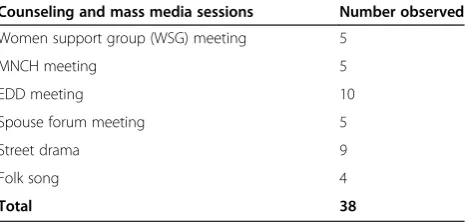
The study was conducted from November 2010 to April 2011, with all cost information collected during this period. Data on inputs and prices were collected from both primary and secondary sources. Primary data were obtained by interviewing BRAC staffs who were involved in implementing BCC tools. Data on contractual agree-ments, training costs, salaries, capital items and related costs were collected from the primary source. We ob-served different types of group counseling sessions and Mass Media sessions to document the duration of ses-sions and the time allocated for BCC message delivery, use of BCC materials, time commitment for various types of staff, number of participants, and the capital items used. To document the group counseling sessions, we carried out five observations for each of the WSG meetings, spouse forum meetings, and MNCH meetings, and 10 observations of the EDD meetings. In addition, we observed four folksong and nine street drama ses-sions in the field. A total of 38 observations were made to document the GC and MM sessions. Details about the data collection observation activities are presented in Table 1. These sessions were undertaken in all five broad intervention areas of Manoshi, namely the Dhanmondi,
Table 1 Number of BCC sessions observed for cost data collection
Counseling and mass media sessions Number observed
Women support group (WSG) meeting 5
MNCH meeting 5
EDD meeting 10
Spouse forum meeting 5
Street drama 9
Folk song 4
Gulshan, Uttara, Mohammadpur and Jatrabari regions in Dhaka city. Secondary data collection included reviewing documentation of SS training costs and their perform-ance records (such as the number of pregnant cases identified, ANC sessions, PNC sessions, and deliveries) that had been recorded in earlier studies of theManoshi project [17,18]. For validation, information was verified with the head-office as well as staff at local project sites.
Results
This section presents the total cost per exposure through BCC channels under the three broad categories, as well as their sub-categories.
Cost of face-to-face counseling (FFC)
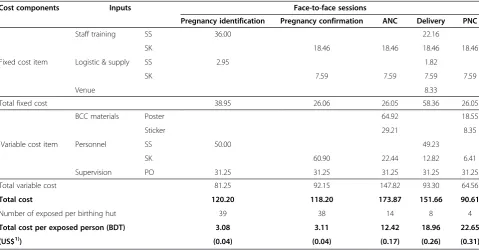
The cost per exposed through the FFC category is pre-sented in Table 2. The cost per exposure for a pregnancy identification event was 3.08 BDT. Monthly fixed and variable costs per birthing hut were calculated to be 38.95 BDT and 81.25 BDT. SinceSS staffs were respon-sible for pregnancy identification, the cost ofSS training (36.00 BDT) and salary (50.00 BDT) were included, as was logistics and supplies (2.95 BDT). Furthermore, the cost (31.25 BDT) for time allocated by the PO who su-pervised FFC services once a month was incorporated into the total cost.
Cost per BCC exposure during a pregnancy confirm-ation was estimated to be 3.11 BDT, and exposure for BCC during each antenatal and postnatal visit was esti-mated to be 12.42 BDT and 22.65 BDT respectively.
During delivery of a pregnant woman, asSSandSKboth were expected to be present, thus their associated costs were incorporated into calculations. The BCC cost per exposure during delivery was calculated to be 18.96 BDT. If a mother was exposed to all recommended ser-vices (including 3 ANC and 2 PNC visits), the estimated total cost per exposed was 87.54 BDT (US$ 1.20). It should be noted that the BCC materials were distributed only once per exposed during ANC and PNC periods.
Cost of group counseling (GC)
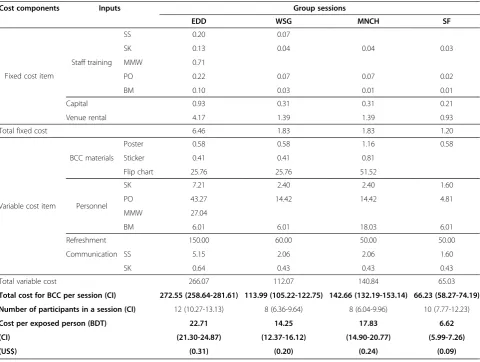
The total cost for EDD, WSG, MNCH and spouse forum meeting were calculated at 272.55 BDT (95% CI 258.64-281.61), 113.99 BDT (95% CI 105.22-122.75), 142.66 BDT (95% CI 132.19-153.14) and 66.23 BDT (95% CI 58.27-74.19) respectively (Table 3). The number of par-ticipants was 12, 8, 8 and 10 at each meeting respect-ively. The cost per person exposed was thus calculated to be 22.71 BDT (95% CI 21.30-24.87), 14.25 BDT (95% CI 12.37-16.12), 17.83 BDT (95% CI 14.90-20.77) and 6.62 BDT (95% CI 5.99-7.26) for EDD meeting, WSG meeting, MNCH meeting and spouse forum meeting re-spectively. Among all GC sessions, the highest cost per session was observed for the EDD meeting, while the lowest was the spouse forum meeting.
Cost for mass media (MM) campaigning
The total cost for folksong performances and street drama presentations was calculated at 1,431 BDT (95% CI 1402.72-1459.33) and 5,277 BDT (95% CI 5251.01-5303.29)
Table 2 Cost per exposed person of sub-channels in face-to-face counseling
Cost components Inputs Face-to-face sessions
Pregnancy identification Pregnancy confirmation ANC Delivery PNC
Fixed cost item
Staff training SS 36.00 22.16
SK 18.46 18.46 18.46 18.46
Logistic & supply SS 2.95 1.82
SK 7.59 7.59 7.59 7.59
Venue 8.33
Total fixed cost 38.95 26.06 26.05 58.36 26.05
Variable cost item
BCC materials Poster 64.92 18.55
Sticker 29.21 8.35
Personnel SS 50.00 49.23
SK 60.90 22.44 12.82 6.41
Supervision PO 31.25 31.25 31.25 31.25 31.25
Total variable cost 81.25 92.15 147.82 93.30 64.56
Total cost 120.20 118.20 173.87 151.66 90.61
Number of exposed per birthing hut 39 38 14 8 4
Total cost per exposed person (BDT) 3.08 3.11 12.42 18.96 22.65 (US$1)) (0.04) (0.04) (0.17) (0.26) (0.31) Note.1)
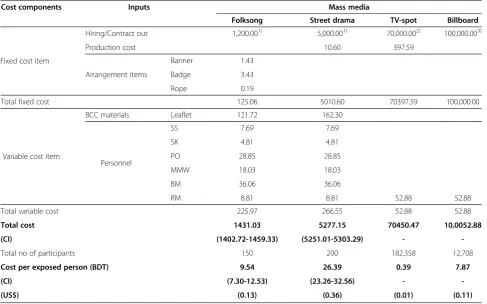
respectively (Table 4). The audience size was 150 and 200 attendees at each session respectively. The cost per person exposed was thus calculated to be 9.54 BDT (95% CI 7.30-12.53) and 26.39 BDT (95% CI 23.26-32.56) for folksong performances and street drama performances respectively. The TV spot was estimated to cost 70,450 BDT in total, and given 182,358 individuals were expected to be ex-posed to this channel, the cost per exex-posed was calculated at 0.39 BDT. The cost of billboards was found to be 100,053 BDT in total, and given the exposed population was expected to be 12,708 individuals, cost per exposed person was 7.87 BDT. A summary of the cost per expos-ure of different Mass Media channels is presented in the Table 4.
In summary, the total cost per exposed was the sum of sub-channels within each of the three broader categories of BCC channels. The highest cost per exposed was ob-served in GC, followed by FFC and MM (Table 5). These costs were applicable if an individual was exposed to each and every sub-channel within the respective broad category of channels.
Discussion
Among the three broader channels, FFC was considered the primary type of intervention, through which most of the target audience (pregnant women and mothers) in
the Manoshi program were exposed. All five
sub-channels within FFC were essential for exposure to the target audience, and any single sub-channel within FFC was not considered to be a complete BCC intervention on its own. It is, therefore, important to notice that FFC was considered to be a complete set and the total cost of FFC should be considered in economic planning of an MNCH program. The total average cost per exposure was estimated to be 87.54 BDT (US$ 1.20), which in-cluded one event of pregnancy identification (3.08 BDT) and confirmation (3.11 BDT), three ANC visits (23.81 BDT each), one delivery care at Manoshi birthing hut (18.96 BDT) and two PNC visits (38.58 BDT each). The BCC materials were distributed only once per exposed during ANC and PNC visits. Considering the total FFC cost per exposure, personnel costs were the highest (30.83%), followed by supervision (23.87%), staff training
Table 3 Cost per exposed person of sub-channels in group counseling
Cost components Inputs Group sessions
EDD WSG MNCH SF
Fixed cost item
Staff training
SS 0.20 0.07
SK 0.13 0.04 0.04 0.03
MMW 0.71
PO 0.22 0.07 0.07 0.02
BM 0.10 0.03 0.01 0.01
Capital 0.93 0.31 0.31 0.21
Venue rental 4.17 1.39 1.39 0.93
Total fixed cost 6.46 1.83 1.83 1.20
Variable cost item
BCC materials
Poster 0.58 0.58 1.16 0.58
Sticker 0.41 0.41 0.81
Flip chart 25.76 25.76 51.52
Personnel
SK 7.21 2.40 2.40 1.60
PO 43.27 14.42 14.42 4.81
MMW 27.04
BM 6.01 6.01 18.03 6.01
Refreshment 150.00 60.00 50.00 50.00
Communication SS 5.15 2.06 2.06 1.60
SK 0.64 0.43 0.43 0.43
Total variable cost 266.07 112.07 140.84 65.03
Total cost for BCC per session (CI) 272.55 (258.64-281.61) 113.99 (105.22-122.75) 142.66 (132.19-153.14) 66.23 (58.27-74.19) Number of participants in a session (CI) 12 (10.27-13.13) 8 (6.36-9.64) 8 (6.04-9.96) 10 (7.77-12.23)
(20.17%), BCC materials (18.49%) logistics and supplies (5.37%) and venue rent (1.27%). It’s worth noting that low-cost personnel were involved in delivering FFC ses-sions, which kept the overall cost relatively low.
Among the FFC sub-channels, we found PNC visits had the highest cost per exposure. PNC was generally received by a fewer number of mothers compared to other intervention, which made the cost relatively high. Next, BCC during delivery was found to be next most ex-pensive FFC session, which was attributed to the longer involvement of SS personnel during delivery, as BCC mes-sages are given (along with other services) during this time. The cost of BCC during ANC was predominantly at-tributed to materials, such as posters and stickers. Finally, the cost for BCC messages during pregnancy identification
was low since the time devoted to delivering BCC mes-sages was very short in this sub-channel.
In the group counseling sessions, almost identical messages were given to prospective mothers, their hus-bands and the community as during the FFC sessions. Group counseling was thus considered a complementary intervention in the sense that it reminded the prospect-ive mothers about the BCC information delprospect-ivered during pregnancy identification, confirmation, ANCs and PNCs. In addition, husbands and relatives received BCC mes-sages which would have increased awareness in the people immediately surrounding the pregnant women. The highest cost per exposed was observed in EDD meet-ings (22.71 BDT), followed by MNCH (17.83 BDT), WSG (14.25 BDT) and spouse forum meetings (6.62BDT).
The highest cost of GC was for EDD meetings, ex-plained by the involvement of relatively higher salaried personnel for a 90 minute session, of which half was spent delivering BCC information. WSG and MNCH meetings were similar a number of ways, including num-ber of participants, staff involvement and duration of the BCC message delivery. The difference in cost between WSG and MNCH meetings can be explained by the dif-ferential involvement of higher salaried personnel and a lower frequency of meetings for the later type, with
Table 4 Cost per exposed person for sub-channels in mass Media sessions
Cost components Inputs Mass media
Folksong Street drama TV-spot Billboard
Fixed cost item
Hiring/Contract out 1,200.001) 5,000.001) 70,000.002) 100,000.003)
Production cost 10.60 397.59
Arrangement items
Banner 1.43
Badge 3.43
Rope 0.19
Total fixed cost 125.06 5010.60 70397.59 100,000.00
Variable cost item
BCC materials Leaflet 121.72 162.30
Personnel
SS 7.69 7.69
SK 4.81 4.81
PO 28.85 28.85
MMW 18.03 18.03
BM 36.06 36.06
RM 8.81 8.81 52.88 52.88
Total variable cost 225.97 266.55 52.88 52.88
Total cost 1431.03 5277.15 70450.47 10,0052.88 (CI) (1402.72-1459.33) (5251.01-5303.29) -
-Total no of participants 150 200 182,358 12,708
Cost per exposed person (BDT) 9.54 26.39 0.39 7.87 (CI) (7.30-12.53) (23.26-32.56) - -(US$) (0.13) (0.36) (0.01) (0.11)
1)
Per show,2)
Broad casting through cable TV,3)
Display per year.
Table 5 Total cost per exposed person in different BCC channels (in BDT and US$)
BCC channel Total cost per exposed BDT US$
Face-to-face counseling 60.22 0.82
Group counseling 61.40 0.85
WSG meetings held every month while MNCH meet-ings were held every two months. The cost of spouse forum meetings was smallest among all GC sessions be-cause of fewer materials were used and the events were shorter in duration.
Among the four types of Mass Media sub-channels, the highest cost was street drama presentations (26.39 BDT), followed by folksong performances (9.54 BDT), billboards (7.87 BDT) and TV spots (0.39 BDT). Folk-song performances and street drama presentations were by nature targeting a specific group, while TV spots and billboards reached a broader audience. While the former two sub-channels’cost was higher due to the lower pos-sibility of exposure, the latter two cost far less due to ex-posure to larger population. Folksong performances were less expensive than the street dramas due to differ-ences in the price of hiring the external teams (1,200 BDT vs 5,000 BDT respectively).
This study intended to consider costs at the imple-mentation level, which means the cost of overseeing the project at higher levels (such as central management, planning) was not included. However, the implementa-tion personnel gave the greatest proporimplementa-tion of time to the BCC intervention. Therefore, the cost of upper-level staff time was not expected to contribute greatly to over-all BCC costs.
We have presented the total costs of the BCC inter-vention separated into fixed and variable costs, since a low variable cost means that a higher number of ex-posures results in a lower total variable cost. In addition, with higher number of exposures, the fixed cost will be divided by a higher number of exposed individuals, which correspondingly reduces the total cost per exposure.
A limitation of this study is that it is not an analysis of costs from the societal perspective. It instead focused on the costs of providing BCC services through different channels. For instance, no costs for households or indi-viduals receiving BCC (such as time spent attending group counseling) is not included in this analysis. Fur-ther, because of the nature of data collection, we are un-able to calculate confidence intervals (CI) or uncertainly for other channels (FFC and MM). For FFC, we took data from program staffs on the basis of consensus among themselves through a qualitative manner. It means that the BRAC staffs reported only one figure about any inputs used in FFC. For MM, we observed several events only for 2 sub-channels (street drama and Folk songs) and we therefore, are able to report CI on these items only.
An impact evaluation study of Manoshi project was conducted in 2007, 2009 and 2011 [19]. These studies assessed the impact of BCC channels on women’s know-ledge of services required during pregnancy, during
delivery, after delivery and when caring for children, in a project area and a comparison area. An overall improve-ment in knowledge about services (ANC, PNC and de-livery), and possible complications during pregnancy and for newborn, was found. Specifically, over a four year period, knowledge about the importance of attending four ANC visits increased from 44.7% to 58.7%, while awareness of danger signs during pregnancy (such as high fever) increased from 16.0% to 32.2%. Improvement in knowledge was also observed for PNC services, new-born, and child health care. However, this study could not determine what delivery channels were responsible for the changes. , the person exposed that we used as de-nominator of cost calculation is not homogeneous in its effects.
Conclusions
The cost per exposure varied substantially across the dif-ferent BCC intervention channels. The inputs contribut-ing the highest proportion of costs were personnel, BCC materials and refreshments. However, the major cost drivers differed across channels and sub-channels. The BCC costs of sub-channels can be useful for planning and predicting the total cost of BCC interventions in current and future projects. In future, this information might be used to plan resource allocation between sub-channels by comparing the cost in relation to the impact (measured by increased knowledge and better practice of MNCH program). In that case, cost-effectiveness ana-lysis needs to be performed. It is important to note that sub-channels may be substitutive and complementary which should be assessed by analyzing the content of each sub-channel.
Abbreviations
BRAC:Bangladesh rural advancement committee; MDG: Millennium development goals; MNCH: Maternal neonatal and child health; BCC: Behavior change communication; EDD: Expected date of delivery; ANC: Antenatal care; PNC: Post-natal care; SS: Shasthya Sebika (community health worker); SK: Shasthya Karmi (community health worker); PO: Program organizers; MMW: Manoshi mid-wife; BM: Branch manager; FFC: Face-to-face counseling; GC: Group counseling; MM: Mass media; WSG: Women support group.
Competing interests
The authors declare that they have no competing interests.
Authors’contributions
BKS and JAMK conceptualize the research idea and study design as well as contributed to data analysis, literature review, writing and revision of the manuscript. SA contributed to literature review data analysis, writing, revising and finalizing the manuscript. NI contributed to literature review, data analysis, writing and critically revised the manuscript. All authors read and approved the manuscript before submission.
Acknowledgements
This research protocol was funded by Bill and Melinda Gates Foundation through BRAC. icddr,b acknowledges with gratitude the commitment of Bill and Melinda Gates Foundation to its research efforts. We are grateful to all the researchers and program team members for their unabated diligence and efforts. We want to extend our appreciation to all the respondents for their willful contributions and sincere commitment towards fulfilling this research endeavor. The authors especially would like to acknowledge support from the focal points of program and research team, Dr. Kaosar Afsana, Dr. Abbas Uddin Bhuiya and Dr. Laura Reichenbach. We acknowledge the contribution of the program personnel Md. Solaiman Sarker, Shyamol Kumar Roy and their team members. We are very grateful to Md. Khurshid Alam, Abdur Razzaque Sarker, Dr. Nazmul Alam, Elizabeth Hetterly, Tessa Hillgrove, Mary McLennan and Andrew Mirelman for their valuable comments on this writing.
Author details
1
Centre for Reproductive Health, icddr,b, GPO Box 128, Dhaka 1000, Bangladesh.2Health Economics & Financing Research Group, Centre for Equity and Health System; icddr,b, GPO Box 128, Dhaka 1000, Bangladesh. 3Health Economics Unit, Department of Learning, Informatics, Management and Ethics, Karolinska Institute, Stockholm, Sweden.
Received: 26 June 2012 Accepted: 13 November 2013 Published: 14 November 2013
References
1. Hsiao WC, Shaw RP:Social health insurance for developing nations. In Lessons learned and Policy implications.Washington, DC: World Bank; 2007. 2. Sarowar MG, Medin E, Gazi R, Koehlmoos TP, Rehnberg C, Saifi R, Bhuiya A,
Khan J:Calculation of costs of pregnancy- and puerperium- related care: experience from a hospital in a low-income country.J Health Popul Nutr 2010,28(3):264–272.
3. Borghi J, Sabina N, Blum LS, Hoque ME, Ronsmans C:Household Costs of Healthcare during Pregnancy, Delivery, and the Postpartum Period: A Case Study from Matlab, Bangladesh.J Health Popul Nutr2006,
24(4):446–455.
4. Levin A, Amin A, Rahman A, Saifi R, Khuda BE, Mozumder K: Cost-Effectiveness of Family Planning and Maternal Health Service Delivery Strategies in Rural Bangladesh.Int J Health Plann Manag1999,
14(3):219–233.
5. Hoque ME, Khan JA, Hossain SS, Gazi R, Rashid HA, Koehlmoos TP, Walker DG:A systematic review of economic evaluations of health and health-related interventions in Bangladesh.Cost Eff Resour Alloc2011,
9:1478–7547.
6. Hutchinson P, Lance P, Guilkey DK, Shahjahan M, Haque S:Measuring the Cost-Effectiveness of a National Health Communication Program in Rural Bangladesh.J Health Commun2006,11(1):91–121.
7. Kincaid DL, Do MP:Multivariate Causal Attribution and Cost-Effectiveness of a National Mass Media Campaign in the Philippines.J Health Commun 2006,11(Suppl 2):69–90.
8. Sarker BK, Mridha MK, Dasgupta SK, Islam N, Reichenbach L:The effect of Behavior Change Communication (BCC) interventions on maternal neonatal and child health (MNCH) knowledge in urban slums of Bangladesh [working paper].Dhaka: icddr,b & brac; 2012. Manoshi working paper, No-17. 9. Saha KK, Bamezai A, Khaled A, Subandoro A, Rawat R, Menon P:Alive & Thrive
Baseline Survey Report: Bangladesh.Alive & Thrive: Washington, D.C; 2011. 10. Khan AMJ, Sarowar MG, Medin E, Gazi R, Koehlmoos TP, Rehnberg C, Saifi R,
Bhuiya A:Production cost of medical care in Bangladesh–a price setting approach.Stockholm: Karolinska Institutet; 2008.
11. Drummond MF, O’Brien BJ, Stoddart GL, Torrance GW:Methods for the economic evaluation of health care.3rd edition. Oxford: Oxford University Press; 2008.
12. Lipscomb J, Torrance GW, Gold MR, Siegel JE, Russell LB, Weinstein MC:Time preference. Cost-effectiveness in health and medicine. 214–264.New York: Oxford University Press; 1996.
13. Gold MR, Siegel JE, Russell LB:Weinstein MC (Ed.): Cost-effectiveness in Health and Medicine. 1st edition.New York: Oxford University Press; 1996. 14. World Health Organization:WHO Guide to cost-effectiveness analysis.Geneva;
2003.
15. Word Bank:World Development Indicators.Washington DC; 2010. 16. World Health Organization:Global adult tobacco survey.Dhaka; 2009. 17. Alam K, Khan J, Walker DG:Impact of dropout of female volunteer community
health workers in Dhaka urban slums [working paper].Dhaka: icddr,b & brac; 2012. Manoshi working paper, No-15.
18. Alam B, Sarker BK, Shafi S, Banu M, Ahmed A, Mridha MK:Assessment of performance of community health workers of Manoshi [working paper]. Dhaka: icddr,b & brac; 2012. Manoshi working paper, No-16.
19. Alam N, Begum D, Ahmed SM, Streadfield PK:MANOSHI Impact evaluation survey in Dhaka urban slums 2007, 2009 and 2011[Scientific Report].Dhaka: icddr,b; 2011.Scientific report,No-118.
doi:10.1186/1478-7547-11-28