http://www.ijcmph.com pISSN 2394-6032 | eISSN 2394-6040
Original Research Article
Stunting on children under five years on family of beneficiary family
hope program in Wonogiri district, Central Java
Titus Priyo Harjatmo*, Maria Poppy Herlianty, Antonius Sri Hartono
INTRODUCTION
The nutritional status of infants and toddlers is one indicator of public nutrition, and even has developed into one of the indicators of health and welfare. This is because infant and children under five years is a group that is very vulnerable to a variety of factors that can lead to infant malnutrition. Basic Health Research in 2013 showed that 18.0% children under five suffering from nutritional status is very severe stunting and stunting 19.2%. The cumulative numbers of nutritional problems
are very severe stunting and stunting higher or increased compared to 2010. While the index is based on weight for age, as much as 5.7% children suffer from severe under nutrition status and 13.9% under nutrition.1 Under nutrition based on MDG targets of 15.5%.
One of the efforts that have been made by the Indonesian government to reduce malnutrition in infants and toddlers is through a program that is integrated with the health sector include the Conditional Cash Transfer Program (PKH) which has been conducted since 2005. Conditional
ABSTRACT
Background: The nutritional status of infants and toddlers is one indicator of public nutrition, and even has developed into one of the indicators of health and welfare. Basic Health Research (Riskesdas) in 2013 showed that 37,2% children under five suffering from nutritional status is stunting. One of the efforts that have been made by the Indonesian government to reduce malnutrition in infants and toddlers is through a program that is integrated with the health sector namely Conditional Cash Transfer Program (Program Keluarga Harapan). The specific objectives were to identify the characteristics of families recieve Conditional Cash Transfer Program and analysis stunting children under five years in families receiving Conditional Cash Transfer Program in Baturetno subdistric, Wonogiri district.
Methods: The study was conducted in the subdistrict of Baturetno, Wonogiri district and has collected a total of 112 infants of families Conditional Cash Transfer Program participants. Sampling of children under five years was done purposively. This study was conducted from July to August 2017.
Results: The proportion of children who stunting quite high at 33.0% higher than the results of the Nutritional Status Monitoring in 2016 amounted to 27.5%. If stunting is associated with the age group of stunting problems occur in all age groups in the amount of 31.3% in under 23 months and 34.3% at 23 months upwards of 31.3% children under five short, as much as 25.0% children under five are overweight according to height (weight for height) is normal and thus potentially becoming obese.
Conclusions: The implementation of weight monitoring should be monitored the height of children under five in the hope family program.
Keywords: Conditional cash transfer program, Stunting, Children under five years Department of Nutrition, Politeknik Kesehatan Jakarta II, Ministry of Health, Indonesia
Received: 26 April 2018
Revised: 24 May 2018
Accepted: 25 May 2018
*Correspondence:
Dr. Titus Priyo Harjatmo, E-mail: [email protected]
Copyright: © the author(s), publisher and licensee Medip Academy. This is an open-access article distributed under the terms of the Creative Commons Attribution Non-Commercial License, which permits unrestricted non-commercial use, distribution, and reproduction in any medium, provided the original work is properly cited.
Cash Transfer Program is a poverty reduction program which is internationally known as Conditional Cash Transfers (CCT) and is intended as an attempt to build a system of social protection to the poor.2 PKH has been conducted since 2005 to target the poor and that there is on the borderline of poverty based on poverty criteria BPS, i.e. revenue of Rs. 100,000/ household/ month. The number of program objectives since 2005, 2008 and 2009, respectively amounted to 19.1 million households, 19.2 million households and 18.5 million households. The World Bank reported that the CCT program showed a significant impact on the health and nutrition of which is the increase in food consumption and the improvement of food consumption patterns.3
Baturetno sub-district is one of the districts in Wonogiri. Based on the annual report of the District Health Office in 2013 showed that the prevalence of nutritional status of the District Baturetno, still found malnutrition as much as 27.6%.4 Based on the Central Bureau of Statistics show that the percentage of poor in 2015 is still high at 12.9%. The number of families that follow PKH many as 527 families, while families with toddlers as many as 152 families. PKH has been performed in the District since 2010. Therefore it is necessary to study CCT program on nutritional status of children. From the data point to the fact that in Wonogiri, the percentage of poor people as much as 12.9%. While the prevalence of malnutrition in children under five is still high at 27.6%. PKH has been launched which aims to improve the nutritional status of the family has long proclaimed. However, the current research has not been done PKH on nutritional status.
METHODS
This study was a cross sectional study that measured variables at one time conducted in the subdistrict of Baturetno, Wonogiri district in July to August 2017. This study to identify nutritional status of children in families receiving PKH. The population in this study are all household or family who receives PKH who have children under five in Baturetno Subdistrict, Wonogiri District. While the sample is partially households with children under five. From the report data Profile Subdistrict shows that as many as 527 families receiving PKH of the total number, 127 families with children under five. Samples childre under five years who have collected a total of 112 infants were selected purposively to remember that not all families receiving PKH has a childrean under five years. Inclusion criteria include the PKH recipient family and have a children under five years, the children under five years’s parents live in District Baturetno, chilren under five years were not during nginap hospital care. While the exclusion criteria are under five suffering from physical abnormalities, Family toddler drop out of PKH recipient.
Data processing based on an height for age is done using software Anthro 2006 (WHO, Geneva, Switzerland). Cut
off are used, when z-score height for age <-2.0 categorized as stunting and height for age ≥- 2.0 normal.
RESULTS
Sample and parents characteristics
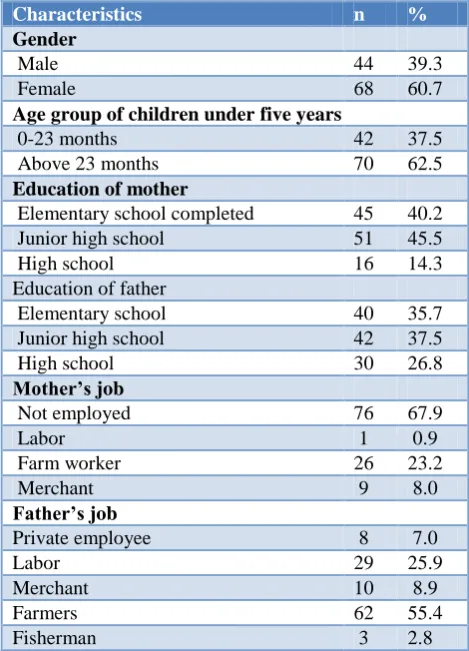
Results of the study, the following characteristics of the sample of children under five years and parents can be seen in Table 1.
Table 1: Distribution characteristics of children under five years and parents of conditional cash transfer
program (n=112).
Characteristics n %
Gender
Male 44 39.3
Female 68 60.7
Age group of children under five years
0-23 months 42 37.5 Above 23 months 70 62.5
Education of mother
Elementary school completed 45 40.2 Junior high school 51 45.5 High school 16 14.3 Education of father
Elementary school 40 35.7 Junior high school 42 37.5 High school 30 26.8
Mother’s job
Not employed 76 67.9
Labor 1 0.9
Farm worker 26 23.2
Merchant 9 8.0
Father’s job
Private employee 8 7.0
Labor 29 25.9
Merchant 10 8.9
Farmers 62 55.4
Fisherman 3 2.8
The analysis of the gender of children under five years, participants of Conditional Cash Transfer Program have more female infants as much as 60.7% and 39.3% have a male. When is categorized by age group showed that samples aged 0-23 months are 37.5% and those aged over 23 months at 62.5%.
Based on the work of parents, found as many as 67.9% of women who do not have jobs or as housewives. Likewise, most of the father had a job as a farmer.
Anthropometry children under five years
demonstrated standard deviation is 559.2 grams. Average weight children under five years minimum 2.5 kg and maximum 27.2 kg, while minimum of height of birth 46.0 cm and a maximum of 112.0 cm. Infant anthropometric
data samples vary enormously according to variations in the sample aged under five. The following statistical data anthropometry children u under five years.
Table 2: Statistics value of anthropometri children under five years of PKH participants in the subdistrict of Baturetno, Wonogiri District.
Variable n Min Max Mean SD 95% CI
Age (month) 112 1 59 33.3 17.8 29.9-36.6
Birth weight (grams) 112 1300 4300 2966.5 559.2 2861.8 - 3071.2
Weight (kg) 112 2.5 27.2 12.0 3.4 11.4-12.6
Height (cm) 112 46.0 112, 0 85.5 14.4 82.7 - 88.2
Nutritional status
The following shows the nutritional status of children of conditional cash transfer participants.
It appears from the Table 3 that the children under five years had been carried out measurements of weight, height or body length and age of a children under five
years. From these data have been presented based on the index W/H, H/A, W/A and BMI/A. Based on the index W/H then the proportion of very thin and emaciated by 4.5%. Even children under five years found that obese by 8.0%. Stunting of the children under five years (measurement of the z-score with indicators of H/A) indicates that there have been problems of nutrition in the long term. Total children under five years suffering undernourish is still quite high.
Table 3: Distribution of nutritional status children under five years participants of conditional cash transfer in subdistrict of Baturetno Wonogiri district.
Nutritional status n Nnn%% % Basic Health Survey, 2013
Index weight for height
Severe wasting 2 1.8
37,2%
Wasting 3 2.7
Normal 98 87.5
Obese 9 8.0
Index height for age
Severe Stunted 15 13.4
36.8%
Stunted 22 19.6
Normal 75 77.0
Index weight for age
Severe under weight 3 2.7
35.6%
Underweight 15 13.4
Normal 90 80.4
obese 4 3.6
BMI for age
Severe wasting 1 0.9
Wasting 3 2.7
Normal 98 87.5
Obese 10 8.9
Nutritional status based on H/A index associated with the age group of stunting problems occur in all age groups in the amount of 31.3% in under 23 months and 34.3% at 23 months above. Below is a graph of distribution of stunting by age group (Figure 1).
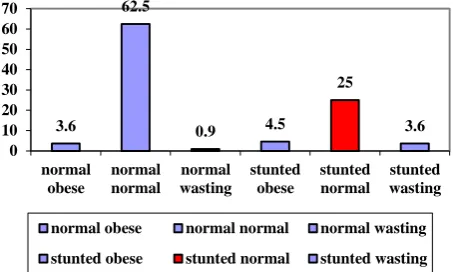
When analyzed composites into 6 categories nutritional status of participants of Conditional Cash Transfer
Program (PKH) by index H/A and W/H then the result can be seen in the following Figures 2 and 3.
Figure 1: Distribution nutritional statua (H/A) at the age of 0-23 months.
Figure 2: Distribution of nutritional status (H/A) at the age above 23 months.
Figure 3: Composite nutritional status based H/A and W/H.
Infection of children under five
Scrimshaw et al states that there is a very close relationship between infection (bacterial, viral and parasitic) and undernourishment. They emphasize the synergistic interaction between malnutrition and infectious diseases, and also the infection will affect the nutritional status and accelerates malnutrition.
The results show that in the last 3 months children under five as much as 59.8% have suffered. Some types of infectious diseases suffered by infants in the form of cough and colds, while only a small fraction children under five who have had diarrhea. Here is an infectious disease that affects children under five years under five years.
Table 4: Distribution of frequency of infection children under five years of conditional cash transfer program in Wonogiri district (n=112).
Infections Yes No Number
n % n % n %
Fever 51 45.5 61 54.5 112 100
Colds 56 50 56 50 112 100
Cough 49 43.8 63 56.2 112 100
Cough Long 1 0.9 111 99.1 112 100
Shortness of Breath 2 1.8 110 98.2 112 100
Diarrhea 3 2.7 109 97.3 112 100
Knowledge of mothers about nutrition
The analysis showed the distribution of mother's knowledge level based on the scores the answers of questions. Limitation of use is good when a score of 80% and above answered correctly and <80% score categorized less. Here is the distribution of the level of knowledge of mother:
A total of 64.3% of knowledge of mothers in the less category while 35.7% is good. Topics question that has still not understood to include targets of vitamin A, the
benefits of the use of iodized salt, the benefits of weight monitoring and cards used to monitor weight.
Table 5: Distribution of knowledge level of mothers of children under five years for conditional cash transfer program participants in Wonogiri district (n=112).
Knowledge category n %
Less 72 64.3
Good 40 35.7
21.4
9.5
69.2
0 10 20 30 40 50 60 70 80
severe stunted stunted Normal
severe stunted stunted Normal
8.6
25.7
65.7
0 10 20 30 40 50 60 70
severe stunted stunted Normal
severe stunted stunted Normal
3.6
62.5
0.9 4.5
25
3.6
0 10 20 30 40 50 60 70
normal obese
normal normal
normal wasting
stunted obese
stunted normal
stunted wasting
normal obese normal normal normal wasting
DISCUSSION
Conditional cash transfer program have a positive and meaningful goal in the achievement of indicators and outcome. However, the purpose of the program at the end is not solely due to the Cash Conditional Transfer Program. This is due to multifactorial causes. Participation of children aged 3 to 5 years was also significantly increased. The results showed an increase in enrollment and poverty reduction. In the end, the variation in feed consumption at the household level and increased use of health services for children under five has benefits on improving the nutritional status of children. Conditional cash transfer program (PKH) is a poverty reduction program and the position of conditional cash transfer (CCT) is part of poverty reduction programs more. CCT provides cash assistance to very poor households, if they meet the requirements associated with efforts to improve the quality of life in the areas of education and health. In traditional society usually mothers do not work outside the home but only as a housewife. a mother who does not work outside the home will have more time in nurturing and caring for children than mothers who work outside the home. The main purpose of the CCT is to reduce poverty and improve the quality of human resources, especially in poor communities. These objectives as well as efforts to accelerate achievement of the MDGs. In the implementation of CCT has a general purpose and special purpose. The general objective is to reduce morbidity and break the chains of poverty, improving the quality of human resources, as well as behavioral change very poor household relatively less improvement of well-being.5
Education is one of the important factors in the growth process of children. Mothers with high levels of education will more easily receive messages and information about nutrition and health. Parents who have the knowledge and higher education will be more understanding about the selection of food processing and how they should eat a healthy and nutritious for children because the mother's education level affects the level of understanding of the health care, hygiene, and awareness of the health of children and families. From the results of studies that characteristics maternal education are relatively low compared with the father's education, but still met some parents who do not have education/no school. Jobs linked to education and income as well as play an important role in social and economic life and has associated with other factors such as health. These results are consistent with the targets or beneficiaries of Conditional Cash Transfer Program is Very Poor Households who have family members that consists of children aged 0-15 years old and/or pregnant/postpartum and are on the Conditional Cash Transfer Program . The proportion of children under five years who stunting quite high at 33.0% higher than the results of the Nutritional Status Monitoring in 2016 amounted to 27.5%. This shows that children under five years of Conditional Cash Transfer Program participants did not experience acute
malnutrition (today), but children under five years of conditional cash transfer program participants experiencing chronic malnutrition problem means that in a long time. This is possible given the participants of conditional cash transfer program a poor family so it will affect the child's growth, especially height or body length ranging from birth until now. The incidence of stunting and severe stunting higher increasingly shows that nutritional problems that occurred in the area of research not only for the cause of a moment so the handling effort also must use the combined efforts of the areas of food, nutrition, health, education, social, and economic. Several studies show a finding consistent with other international studies. The results of anthropometric and use of health services by families enrolled in the conditional cash transfer programs have been evaluated. Effects on anthropometric outcome is usually positive, but only in certain subgroups. In Colombia, the average increase in body weight were noted among neonates and exposure to the cash transfer program is associated with increased infant age Z scores less than 2 years. Those exposed to the cash transfer, the probability of malnutrition was reduced by 6.9%.
Three analysis cash transfer program in Mexico (which offer food supplements other than cash) showed a positive effect on the high-participants. The study, which included children under 12 months old at the start, showed the greatest benefit among children under the age of 6 months in the poorest category. Exposure 2 years into the program at the age of 21-23 resulted in growth of 1.1 cm than that seen among children of older (12-18 months old) were exposed during the one-year program. Another study the same result: Children aged 12-36 months high gain of about 1 cm after one year of exposure to the program, while children aged 24-36 months at baseline experienced a high increase of 1.22 cm. In a third study of children aged 12-36 months are children Ethan 0.96 cm higher than the control area after one exposure to the program. However, these studies did not show an association between exposure to the program and stunting. In Nicaragua, cash transfer program was associated with a decline of 6 percentage points in the prevalence of underweight in children less than 5 years old. 6
the study at 12:13 SD (W/A). This is likely due to the concerns of the family that if the children showed an increase in the nutritional status of their participation as the target of the conditional cash transfer will be terminated. Despite the possibility of their similarity to the participants of conditional cash transfer reasons in Indonesia, but the program planners should start thinking of ways to show that if there is no improvement on the nutritional status and health of a toddler, then the family will be given a bonus or certain benefits that the program's objectives will be more easily achieved. The nutritional status especially stunting as a linear growth retardation caused by many factors including the lack of access to food consumption (1), inadequate feeding practitioners (2), recurrent disease (3). All these factors are associated with poverty, with the result that, in the country, consistently stunting affects children from poor families more than those who are better.4 Significantly improved levels of living conditions such as trigger food supplementation improved growth in children younger that have a higher risk of stunting.5 Therefore, it seems reasonable to assume that the cash transfer program directly into a very poor family will lead to an increase in the growth of their children, at least on the age at which children are especially vulnerable to environmental changes in their household. 7 Data stunting and severe stunting of toddler and overweight in this study also indicated that there had been cases of double nutritional burden. Based on the analysis that has been made known that despite the CCT but there are still 24.5% of severe underweight and underweight and 44.1% of severe stunting and stunting and 1.2% the toddler began experiencing more nutrition /overweight. This is necessary because the research results Duran, Caballero, and de Onis (2006) in Latin America shows that there is a relationship between the incidence of stunting with over nutrition.8
In chart 1 and 2 above shows the problems stunting in infants is relatively the same sample. In under 23 months of age in the proportion of stunting of 30.9% while the proportion of stunting by the age of 23 months up 34.3% spread. Severe stunting proportion was higher in children aged under 23 months. This needs serious attention given the impact of stunting for health in adulthood. In accordance with WHO standards, an area said to be a good category if the prevalence of stunting less than 20% and the prevalence of underweight children under five is less than 5%. A region is said to be experiencing an acute nutritional problems when the prevalence of stunting less than 20% and the prevalence of underweight children under five 5% or more. Thus, nutritional problems occur in children under five years participants CCT is a chronic malnutrition problem. The study found that after six months of receiving the cash transfer program began receiving benefit families associated with the health of children of beneficiary families is lower z-score of 0.13 (W/A) of the family who do not receive the benefit.9 From studies that have been conducted have the effect of a 5.5% decrease in stunting. This decline was faster by
1.7%. Despite improvements in the distribution of iron supplements at the same children have, however, no increase in levels of hemoglobin.9
The purpose of conditional cash transfer program among others is to increase access and quality of education and health services. One of the requirements that must be met by the target is willing to take advantage of excellent health services that for both mother and toddler. So it is quite appropriate if the existence of conditional cash transfer program associated with improved average z-scores for indicators of H/A. When compared with the results of the Nutritional Status Monitoring 2016 from 27.5% children stunting (H/A), as much as 23.4% children are overweight for height (W/H) normal, children under five has the potential to be obese.10 Various reports World Bank also noted that the condotional cash transfer program otherwise associated with marked increases in height. Stunting rates in Mexico, Nicaragua and Colombia fell, respectively, 10%, 5.5%, and 7%.
Results were similar to the results reported by other studies which suggested that the incidence of fever OR value in the last month i.e. 1:14 (CI 95%: 1:02 to 1:28) which means that the toddler had a fever in the last month are likely to experience less and poor nutrition 1:14 times higher than those without.11
World Bank reported that knowledge influenced by level of parental education has the potential to be important factors that shape children's behavior and coveted. PKH impact may be limited by household situation where the level of parental education on average low: the rate of average school attainment (mode) for the mother and father in the household receiver is a primary school level. However, at the same time, participation in this program can improve parental knowledge in areas such as health practices recommended.
CONCLUSION
From the analysis of gender children under five years turned out to participating of Conditional Cash Transfer Program has more women as much as 60.7% and 30.9% had a male toddler. When viewed by age group children under five years participants showed that samples of infants aged 0-23 months are 37.5% and those aged over 23 months at 62.5%. Based on the work of parents, found as many as 65.2% of women who do not have jobs or as housewives. Likewise father mempunyaa mostly work as farmers.
much as 25.0% children are overweight for height (W/H) normal potentially overweight.
ACKNOWLEDGEMENTS
Thanks conveyed to the respondents who participated in this study and coordinator of Conditional Cash Transfer Program in Wonogiri Distirct which has facilitated this research.
Funding: No funding sources Conflict of interest: None declared
Ethical approval: The study was approved by the Institutional Ethics Committee
REFERENCES
1. Ministry of Health. Basic Health Research 2013. Jakarta; 2013.
2. Simanjuntak M, Puspitawati H, Abubakar MD. Demographic Characteristics, Social and Family Economics Receiver Conditional Cash Transfer Program (PKH). J Science and Konsum IPB Ex. 2010;3(2):101-13.
3. World Bank. Main Findings from the Impact Evaluation of Indonesia’s Pilot Household Conditional Cash Transfer Program. Jakarta; 2011. 4. Dinas Kesehatan Kabupaten. Laporan Kesehatan
Tahunan. Wonogiri; 2013.
5. Purwoasri K, K Kediri, Utomo D, Hakim A, Ribawanto H. Implementation of the Conditional Cash Transfer Program in Enhancing Quality of Life of Poor Households P (Studies on the
Conditional Cash Transfer Program Implementation Unit. 1996;2(1):29-34.
6. Paes-sousa R, Pacheco M, Shisue É. Effects of a conditional cash transfer program on child nutrition in Brazil. Bull World Health Organ. 2011;89(7):496-503.
7. Morris SS, Olinto P, Flores R, Nilson EAF, Figueiro AC. Community and International Nutrition Conditional Cash Transfers Are Associated with a Small Reduction in the Rate of Weight Gain of Preschool Children in Northeast Brazil. J Nutr. 2004:134(9):2336-41.
8. Aries M, Hardinsyah. Determinants of Nutritional Status and Stunting Children Age 0-36 months Prohram Family Data (PKH) 2007. 2012;7(1):19-26.
9. Food International Policy Reasearch Institute. Impact Evaluation of a Conditional Cash transfer Program: The Nicaraguan Red de protection Social. 2005.
10. Direktorat Gizi Masyarakat. Pemantauan Status Gizi. Jakarta; 2016.
11. Palupi IR, Rahmanti AR. Association of household food security with toddler stunting in the Sleman Regency Indonesia. Int J Community Med Public Health. 2017;4(5):1424–8.
Cite this article as: Harjatmo TP, Herlianty MP, Hartono AS.Stunting on children under five years on family of beneficiary family hope program in