Original Research Article
Breastfeeding practices among currently married women of selected
tribes of Jharkhand, India
Shalini Kumari*, Gautam Kumar Kshatriya
INTRODUCTION
Breastfeeding has been conclusively demonstrated as one of the most important determinants for comprehensive growth and survival of infants, child and lactating mothers. It contains high levels of antibody rich proteins, especially secretory immunoglobulin A and lactoferrin, which offers protection to the new born from infection. The antibodies found in human breast milk protects the baby against respiratory infections.1-3 Apart from its various nutritional and immunological effects, it plays an
important role in controlling fertility by reducing the women’s fecundability (physiological ability to become pregnant).4 Demographic analyses have demonstrated that in populations without access to modern forms of contraception birth intervals are determined principally by the duration of breast feeding.5-6 Recent studies have shown association of breastfeeding practices with ovarian and breast cancer. For instance, a 12 month increase in breastfeeding reduced the incidence of invasive breast cancer by 4.3 percent while 30 percentage reduction in ovarian cancer can be seen associated with longer periods of breastfeeding.7 World Health Organisation (WHO)
ABSTRACT
Background: An exclusive breastfeeding for 6 months and an extended breastfeeding for 24 months protects the infant from infectious disease and promotes child spacing. Therefore, the knowledge, attitude and practice about infant and child feeding is important to overcome morbid conditions prevailing among mothers and her child. The present study aimed at investigating the factors influencing an exclusive breastfeeding among currently married tribal women in Jharkhand, India.
Methods: A cross sectional study was conducted among the 919 currently married Santal, Oraon, Mahli and Ho women in the age group of 15-29 years from forty villages of Purbi Singhbhum district of Jharkhand using interview schedule method.
Results: The mean duration of exclusive breastfeeding and breastfeeding up to 24 months was found to be 4.1 and 12.9 months respectively. Also, not much difference in the average duration of exclusive breast feeding was found between working and non-working women. The results of multinomial regression showed maternal age (OR=1.92, p<0.05), place of delivery (OR=2.3, p<0.05), distance from health facility (OR=4, p<0.01) and sex of last child born (OR=2.5, p<0.01) among the significant determinants for exclusive Breastfeeding.
Conclusions: The duration and initiation of breastfeeding in a marginalised society depends to a great extent on how family members participate and decide on the type of feeding for new-borns. Also, several public health education campaigns should be launched aiming at increasing the familiarity of family relations on exclusive breastfeeding.
Keywords: Exclusive breastfeeding, Pre-lacteal feeding, Colostrum Department ofAnthropology, University of Delhi, New Delhi, India
Received: 06 April 2018
Revised: 11 May 2018
Accepted: 15 May 2018
*Correspondence:
Shalini Kumari,
E-mail: [email protected]
Copyright: © the author(s), publisher and licensee Medip Academy. This is an open-access article distributed under the terms of the Creative Commons Attribution Non-Commercial License, which permits unrestricted non-commercial use, distribution, and reproduction in any medium, provided the original work is properly cited.
recommends early initiation of breastfeeding (proportion of children born in past 24 months who were put to the breast within an hour of birth), exclusive breastfeeding (EBF) for 6 months, continued breastfeeding at 1 year (proportion of children aged 12-15 months who are breastfed); and continued breastfeeding at 2 years (proportion of children aged 20-23 months who are breastmilk).8 EBF being a global public health recommendation serves as the most effective way to ensure child health and survival. It is can be noted that children breastfed for less than 1 year are at great risk of being underweight and wasting as the breast milk supplements Vitamin A.9 However, an extended breastfeeding without the introduction of appropriate complementary foods after 6 months can lead to malnutrition.10 Globally, only 40 percent of infants under six months of age are exclusively breastfed.3 Breastfeeding in India is universal where 56 percent of infants in India and 54.9 percent of infants up to 6 months in rural areas are exclusively breastfed respectively.11 However, the reasons for existing child malnutrition and mortality may be attributed to poor and incorrect feeding practice. Furthermore, the conditions of low rate of exclusive breastfeeding have often lead to morbid conditions in tribal areas of Madhya Pradesh, West Bengal, Gujarat, Tamil Nadu, Jharkhand, Assam, Karnataka and Odisha.12-20 Remarkably there is a variation in the patterns and practices of breastfeeding across different populations of India. One such traditional practice inhabiting the rural and tribal community of India is pre- lacteal feeding (PLF) involving artificial
feed to a new born before breastfeeding is
established.11,16-17,21 The feeding practice appears to be shaped by the health beliefs of communities, which are further influenced by various social and cultural attributes.22,23 The choice of PFL may be specific to family and usually include honey (also referred to as liquid gold), jaggery, ghutti and sugar water.24,25 Administration of these feeds interferes with suckling and pro lactin production. The guidelines of Infants and Young Child Feeding Guidelines (IYCF) along with major organisations like WHO and United Nations Children’s Fund (UNICEF) strongly recommends no PLF to be given to new born 26. Exploring the factors that have determined the breastfeeding initiation and duration is considered as an important issue for implementation of preventive strategy in tribal areas. Many recent studies have highlighted the role of sex of last child born, mother’s educational years presence of mother in law,
occupational statusand monthly per capita income of the household in determining the duration of exclusive breastfeeding.27-33 In recent decades, global movements have been undertaken to protect, promote and support breast milk as a part of optimal feeding practices among the neonates in both developed as well as developing countries. For instance, recently the Government of India
launched MAA- Mother’s Absolute Affection
programme in the year 2016. The breastfeeding programme attempts to revitalizes the efforts towards promotion, protection and support of breastfeeding
practices through health systems to enhance breastfeeding rates. Despite the various government initiatives and recommendations underlaid by WHO and UNICEF, there is a gap in knowledge of the current situation regarding initiation and duration of breastfeeding among tribes. Therefore, it is essential for a researcher to explore the factors hindering the breastfeeding practices among lactating women in marginalised area. Thus, the paper highlights the various traditional infant and child breastfeeding patterns among the women of Santal, Oraon, Mahli and Ho tribe. It also attempts to examine the effects of different covariates such as maternal education, maternal occupation, current age, socio economic status of the household, sex of the last child, monthly per capita income and household size on optimal breastfeeding in infants (0-5 months).
METHODS
The data for the present study was collected in a cross-sectional survey during April, 2014 to June, 2016 through interview schedule method from 919 currently married Santal, Oraon, Mahli and Ho women in the age group of 15-29 years. At the time of the first stage of sampling all the villages were arranged according to their size of population out of which forty villages of Golmuri and Potka Block of Purbi Singhbhum district, Jharkhand were selected on the basis of PPS sampling (Probability Proportional to the size of the population). The data on the current and past breastfeeding practices was taken only for women’s most recent birth occurring during the three years period preceding the data collection. Data pertaining to present age of women, waiting time to conception, sex of the last born, education of women, working status of women, monthly per capita income, place of delivery, distance from health facility and household size was collected. The term currently married women in the present study is referred to those women who had been married for last three years and had at least one live birth.34 Although this selection criterion might underrepresent the most fertile women but focuses on the recent breastfeeding decisions eliminating recall.
Construction of variables
Defining outcome variable
Information on exclusive breastfeeding (breastfeeding up to 6 months) for all infants (0-5 months) born during the last three years prior to the survey was collected. Further information on women’s breastfeeding initiation was also collected.
Defining of predictor variables
included as the predictor variables for exclusive breastfeeding and extended breastfeeding among infant and child respectively. Maternal age was categorized into 15-19 years, 20-25 years and >25 years. The educational attainment of the women was defined using years of schooling and were grouped into categories of currently married women with 1-5, 6-11, 12 and 0 years of schooling. The variable waiting time to conception is categorized into ≤3 months, 4 months-1 year and ≥1 year. On the basis of monthly per capita of the household, three economic groups were formulated into <Rupees 500, Rupees 500-1500 and >Rupees 1500. The variable distance from health facility were grouped into three categories (within 1 kilometer, between 1-5 kilometers and >5 kilometers).
Statistical analysis
Data was entered, edited, sorted and analysed using SPSS version 20 software. To identify the best predictor of exclusive breastfeeding among currently married tribal women, multinomial regression analysis was performed.
RESULTS
Table 1 shows the various infant and child feeding practices among tribal women. 62 percent of currently married women were currently breastfeeding whereas 38
percent of currently married women stopped
breastfeeding their child. Pre-lacteal feeding (PLF) involving administration of artificial feed to a new born was believed to resist hunger and help in proper suckling of breast milk. Traditionally, the PLF was done by father or elder members of the family. Other reasons for PLF were insufficiency of breast milk and the belief of pre-lacteal feed considered as substitute for colostrum. Among 29 percent and 42 percent of currently married women, the breastfeeding was initiated within 1 hour and within 6 hours of birth respectively. Only 9 percent of currently married women-initiated breastfeeding to their new born within 24 hours. It could be noted from the case studies that women giving birth in their home and in the presence of her family member administered pre-lacteal feed. Also, a gap in the knowledge of harmful effects of pre-lacteal feeds were unknown. 64 percent of currently married women fed colostrum to their new born while among 36 percent of currently married women colostrum was discarded while breastfeeding new born. However, few women did not actually know how colostrum looked like or felt like which resulted them in feeding their child with plain water or honey. Most of the times, it was only in the presence of a traditional birth attendant (TBA) or an anganwadi worker, colostrum was fed to the new born. It was believed that a delay in breastfeeding will make mother’s milk unhealthy for consumption by their new born. Also, the initiation in the breastfeeding within 1 hour of birth was less common due to many possible reasons. For instance, tribal women complained of great pain after delivery while some faced problems in secreting milk. Few women did not know the correct way
of feeding the new born. As a result, all the above listed reasons often led to a late initiation in breastfeeding.
Table 1: Infant and child feeding practices among the tribal women.
Sl. No.
Parameters of infant and child feeding
Number of respondents %
1
Ever breastfed
Currently breastfeeding 574 62
Stopped breastfeeding 345 38
Total 919 100
2
Pre-lacteal feed given
Yes 187 20
No 387 42
Total 574 62
3
Type of pre-lacteal feed given
Cow's milk 23 4
Honey 68 12
Jaggery water 59 10
Ghutti and cow's milk 20 3
Others 17 3
Total 187 32
4
Reason for giving pre-lacteal feed
Insufficient milk 70 12
Good for health 43 7
Substitute for colostrum 26 5
Advised by mother in law/ other members of family
48 8
Total 187 32
5
Colostrum fed/discarded
Fed 589 64
Discarded 330 36
Total 919 100
6
Initiation of breastfeeding
Within 1 hour 270 29
Within 6 hours 383 42
Within 24 hours 187 20
After 24 hours 79 9
Total 919 100
Santal, Mahli and Ho women respectively. 47 percent of infants in the present study were exclusively breastfed for 6 months. Only 10 percent of infants of Oraon women were exclusively breastfed in comparison to 16 percent, 16 percent and 13 percent of infants born to Santal, Mahli and Ho women respectively. 9 percent and 18 percent of children were breast fed for 1 year and 2 years respectively. Figure 1 shows a comparison of initiation of
breastfeeding and exclusive breastfeeding between the studied tribes, Purbi Singhbhum district, the State of Jharkhand and India. It can be seen that the exclusive breastfeeding rates is comparable to that of the National, State and district figures. While the percentage of tribal women in the present study having an early initiation of breastfeeding is much higher when compared to that National, State and district figures.
Table 2: Optimal breastfeeding practices among Santal, Oraon, Mahli and Ho women.
Tribe
Initiation of breastfeeding
within 1 hour Exclusive breastfeeding Breastfeeding at 1 year Breastfeeding at 2 years
Number Percentage (%) Number Percentage (%) Number Percentage (%) Number Percentage (%)
Santal 61 7 124 13 15 3 46 8
Oraon 33 4 88 10 10 2 21 4
Mahli 127 14 113 12 12 2 20 3
Ho 49 5 106 12 13 2 14 2
Total 270 29 431 47 50 9 101 18
Figure 1: Exclusive breastfeeding and breastfeeding initiation among tribal women.
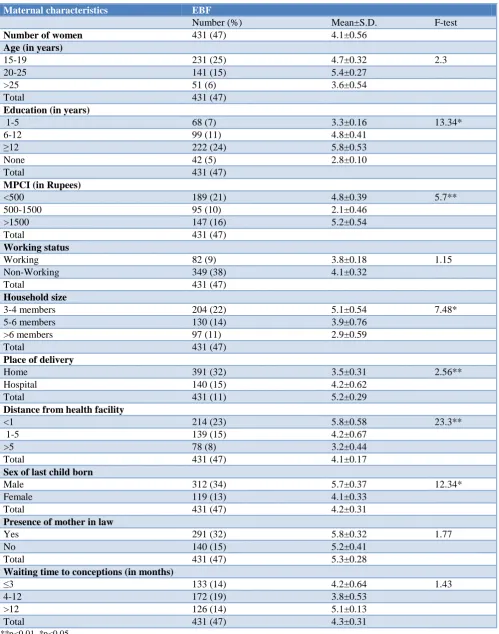
Distribution of exclusive breastfeeding and total breastfeeding (up to 24 months) of currently married with respect to current age, education, monthly per capita income, working status, household size, place of delivery, distance from health facility, sex of last born, presence of mother-in-law and waiting time to conception of currently married women are presented in Table 3. The table also shows results of one-way ANOVA applied for studying variation among currently married with optimal
breastfeeding. The mean duration of exclusive
breastfeeding and breastfeeding up to 24 months in currently married women is 4.1 and 12.9 months respectively. 25 percent and 28 percent of women in the age group of 15-19 years breastfed their new born for six months (exclusively) and up to 24 months. The mean duration of exclusive breastfeeding for women in the age group of 15-19, 20-25 and >25 years was 4.7, 5.4 and 3.6 months respectively. The mean duration of breastfeeding up to 24 months for women in the age group of 15-19, 20-25 and >25 years was 5.7, 6.4 and 8.6 respectively. 24 percent of women having more than 12 years of
education exclusively breastfed their child. It can be noted from the table that the median duration of both exclusive breastfeeding and total breastfeeding increased with an increase in the number of educational years and was least for women with no education. 21 percent, 10 percent and 23 percent of women had an average duration of exclusive breastfeeding of 4.8, 2.1 and 5.2 months respectively. 34 percent, 43 percent and 23 percent of women had average breastfeeding duration of 9.2, 5.6 and 10.7 months respectively.
Figure 2: Relationship between MPCI and breastfeeding duration of currently married women.
Figure 3: Comparison between working status and breastfeeding duration of currently married women.
7% 4%
14% 5%
29% 25%
34% 41%
13% 10%
12% 12%
47% 56%
65% 55%
-20% 0% 20% 40% 60% 80%
Santal Oraon Mahli Ho Total Purbi Singhbhum district Jharkhand India
Exclusive breastfeeding
Initiation of breastfeeding within 1 hour
0 2 4 6 8 10 12 14
₹ 0 ₹ 2,000 ₹ 4,000 ₹ 6,000 ₹ 8,000 ₹ 10,000
B
re
a
st
fe
ed
in
g
d
u
ra
ti
o
n
i
n
m
o
n
th
s
Monthly per capita income (MPCI)
18 20 21 16
6 9
7
16 28
22 20
7 0
10 20 30 40
≤2 3-5 6-8 9-11 12-23 ≥24
Pe
rc
en
ta
g
e
Breastfeeding duration in months
Table 3: Distribution of exclusive breastfeeding (EBF) with respect to background characteristics.
Maternal characteristics EBF
Number (%) Mean±S.D. F-test
Number of women 431 (47) 4.1±0.56
Age (in years)
15-19 231 (25) 4.7±0.32 2.3
20-25 141 (15) 5.4±0.27
>25 51 (6) 3.6±0.54
Total 431 (47)
Education (in years)
1-5 68 (7) 3.3±0.16 13.34*
6-12 99 (11) 4.8±0.41
≥12 222 (24) 5.8±0.53
None 42 (5) 2.8±0.10
Total 431 (47)
MPCI (in Rupees)
<500 189 (21) 4.8±0.39 5.7**
500-1500 95 (10) 2.1±0.46
>1500 147 (16) 5.2±0.54
Total 431 (47)
Working status
Working 82 (9) 3.8±0.18 1.15
Non-Working 349 (38) 4.1±0.32
Total 431 (47)
Household size
3-4 members 204 (22) 5.1±0.54 7.48*
5-6 members 130 (14) 3.9±0.76
>6 members 97 (11) 2.9±0.59
Total 431 (47)
Place of delivery
Home 391 (32) 3.5±0.31 2.56**
Hospital 140 (15) 4.2±0.62
Total 431 (11) 5.2±0.29
Distance from health facility
<1 214 (23) 5.8±0.58 23.3**
1-5 139 (15) 4.2±0.67
>5 78 (8) 3.2±0.44
Total 431 (47) 4.1±0.17
Sex of last child born
Male 312 (34) 5.7±0.37 12.34*
Female 119 (13) 4.1±0.33
Total 431 (47) 4.2±0.31
Presence of mother in law
Yes 291 (32) 5.8±0.32 1.77
No 140 (15) 5.2±0.41
Total 431 (47) 5.3±0.28
Waiting time to conceptions (in months)
≤3 133 (14) 4.2±0.64 1.43
4-12 172 (19) 3.8±0.53
>12 126 (14) 5.1±0.13
Total 431 (47) 4.3±0.31
Table 4: Predictors of exclusive breastfeeding (EBF) among tribal women,
S.no. Maternal characteristics EBF
1
Age (in years) Odds 95% C.I.
15-19®
20-25 1.78** 1.33-1.91
>25 2.21** 2.12-2.54
2
Education (in years)
1-5 0.891 0.53-1.12
6-11 1.12 0.91-1.32
≥12 1.92* 1.73-2.12
None®
3
MPCI (in Rupees)
<500 1.98** 1.71-2.43
500-1500®
>1500 2.1** 1.891-2.344
4
Working status Working®
Non-working 1.18 1.02-2.31
5
Household Size 3-4 members®
5-6 members 2.1* 1.7-2.4
>6 members 2.8** 2.2-3.6
6
Place of delivery Home®
Hospital 2.3* 2.1-2.7
7
Distance from health facility
Within village 4** 2.33-3.21
1-5 2.19* 1.99-2.99
>5®
8
Sex of last child born
Male 2.77** 2.13-3.11
Female®
9
Presence of mother in law
Yes 0.77 0.53-91
No®
10
Waiting time to conceptions (in months)
≤3 0.989 0.77-1.23
4-12 1.12 0.87-1.65
>12®
®
Reference category; **p<0.01, *p<0.05.
Figure 2 shows the relationship between monthly per capita income and breastfeeding duration among currently married women. It is quite relevant from the figure that the average duration of breastfeeding is same for the low and high categories of monthly per capita income. A U-shaped relationship between MPCI and breastfeeding duration where the lowest and the highest quartile were similar. The effect of work status can be seen quite complicated and quite interesting at the same time. In contrast to the expectation, there was not much difference in the average duration of exclusive breast feeding between working and non-working women. For instance, the average duration of exclusive breastfeeding between working and non-working women was 3.8 and
statistically significant F values for EBF is found for education (F=13.34, p<0.01) household size (F=7.48 p<0.05), monthly per capita income (F=5.7, p<0.01) place of delivery (F=2.56, p<0.01) distance from health facility (F=23.3, p<0.01) and sex of last child born (F=12.34, p<0.05). A statistically significant F values for breastfeeding duration is found for education (F=19.4, p<0.01), monthly per capita income (F=6.8, p<0.01), distance from health facility (F=28.45, p<0.01) and sex of last child born (F=9.8, p<0.05).
Determinants for exclusive breastfeeding among tribal women
The results of multinomial regression for determinants of EBF and breastfeeding duration are presented in Table 4. The results show that maternal age, educational years, monthly per capita income, place of delivery, distance from health facility, sex of last child born and household size are among the significant determinants of the EBF. Women of 25 years and above were twice (OR=1.92, p<0.05) as likely to exclusively breastfeed their child than women in the age group of 15-19 years. Women with more than 12 years of education were more likely to exclusively breastfeed their child than women with no education. Women with monthly per capita income of less than rupees 500 (OR=1.98, p<0.01) and more than rupees 1500 (OR=2.1, p<0.01) were more likely to breastfeed their child for 6 months than women with monthly per capita between rupees 500 and rupees 1500. Women with a male child is twice (OR=2.5, p<0.01) as likely to breastfeed for 6 months as women with girl child as last born. Non-working women were twice (OR=2.5, p<0.01) as likely to exclusively breastfeed their new born than working women. Women having delivery at hospital are twice (OR=2.3, p<0.01) as likely to exclusively breastfed than women giving birth in home. Women with less distance from health facility were four times (OR=4, p<0.01) more likely to exclusively breastfeed their child than women staying away from health facility.
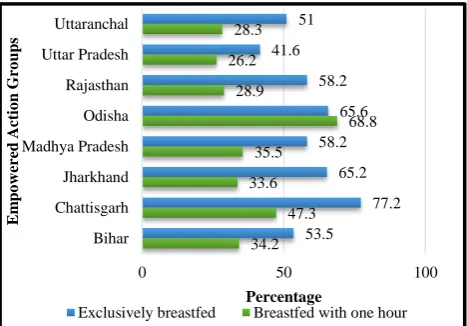
Figure 4: Exclusively breastfeeding and initiation of breastfeeding among empowered action groups
(EAG).
DISCUSSION
The present study examined the various infant and child feeding practices among tribal women. It also studied the best predictors of early initiation of breastfeeding and exclusive breastfeeding (breastfeeding of infant 0-5 months up to 6 months exclusively) among currently married women WHO and UNICEF highly recommend exclusive breastfeeding as well continued breastfeeding until the baby is 2 years old. It can be revealed from our analysis that despite breastfeeding programs, EBF in India continues to be low (47 percent). A marginal improvement in the proportion of infants <6 months was observed from 46.3 percent in NFHS-1 (1992-93)to 54.9 percent in NFHS-IV (2015-16).26,35 The EBF rates in India were similar to that reported by countries from neighbouring region with Bangladesh (42.5 percent) and Nepal (53.1 percent).30,34,36 Among the south Indian States, 71.1 percent of infants in Andhra Pradesh percent and 56.8 percent of infants in Telangana. Among the empowered action groups (EAG), percentage of children under age five who were ever breastfed is almost universal in every state (Figure 4).26 Among the eight EAG states, three states (Uttaranchal, Bihar and Uttar Pradesh) were having lower prevalence of exclusive breastfeeding in comparison to the National average. Early results from NFHS-4 (2015-16), 65 percent of infants were exclusively breastfed in Jharkhand.26 The present study assessed the effect of ten socio economic indicators of exclusive breastfeeding for infants and the predictors for extended breastfeeding. Among which, maternal characteristics including present age, economic status, place of delivery, distance from a health facility and sex of last child born had significant effect on the duration of exclusive breastfeeding. In earlier studies, mother’s age has been found to have a positive influence on the duration of exclusive breastfeeding. In fact, mothers older than 25 years were more likely to succeed with EBF than mothers who were younger than 18 years of age.15,37,38 Women with extremely high and low monthly per capita income were reported to have less breastfeeding duration.16,20 A study by Malhotra and colleagues in 2008 found that female children were breastfed for a shorter duration than male children. Many studies revealed about the difference in the initiation of breastfeeding between male and female child.30,34,39 Gender disparity in terms of exclusive breastfeeding reported in the present study can be seen in similar studies done in states of Madhya Pradesh, Odisha and West Bengal.30,36 Low monthly per capita income was one of the key factors in prolonging breastfeeding in the
society. However due to many unavoidable
circumstances women with low and high monthly per capita income weaned their child at an early age. Similar trend was observed in the analysis from the nationally representative data from the 2011-12 Indian Human Development Survey II.10,16
34.2 47.3 33.6
35.5
68.8 28.9
26.2 28.3
53.5
77.2 65.2 58.2
65.6 58.2 41.6
51
0 50 100
Bihar Chattisgarh Jharkhand Madhya Pradesh Odisha Rajasthan Uttar Pradesh Uttaranchal
Percentage
E
m
p
o
w
er
ed
A
ct
io
n
Gro
u
p
s
CONCLUSION
The study identified the factors associated with exclusive breastfeeding among currently married women (15-29 years) in Purbi Singhbhum district of Jharkhand, India. Given that there is limited research in the areas of exclusive and extended breastfeeding, present study aimed to understand the factors that determine the practice of optimal breastfeeding in selected tribes of Jharkhand. Variables like present age, economic status, place of delivery, distance from a health facility and sex of last child born had a significant effect on the breastfeeding pattern among the studied tribes. Programs and interventions to improve breastfeeding duration and rates need to focussed more on women living in tribal areas in India. Further several researches should be conducted to understand why women in India are not breastfeeding as long as they did in the past. Several public health education campaigns should be launched aiming at increasing the familiarity of family relations on EBF by increased access to information on breastfeeding and reproductive health in general.
ACKNOWLEDGEMENTS
The authors express there sincere thanks to University Grants Commission for providing funds as a UGC- SRF Grant. The first author also acknowledges the support of the other author and is also thankful to ASHA workers & tribal women for their constant support in the fieldwork.
Funding: UGC-SRF Grant Conflict of interest: None declared
Ethical approval: The study was approved by the
Institutional Ethics Committee, Department of
Anthropology, University of Delhi.
REFERENCES
1. Feachem RG, Koblinsky MA. Interventions for the control of diarrhoeal diseases among young children: Promotion of breast-feeding. Bulletin World Health Organization. 1984;62(2):271. 2. Jason JM, Nieburg P, Marks JS. Mortality and
infectious disease associated with infant-feeding practices in developing countries. Pediatrics. 1984;1;74(4):702-27.
3. Victora CG, Bahl R, Barros AJ, França GV, Horton S, Krasevec J, et al. Breastfeeding in the 21st century: epidemiology, mechanisms, and lifelong effect. Lancet. 2016;5;387(10017):475-90.
4. Blackburn ST. Postpartum period and lactation
physiology. Maternal, Fetal, and Neonatal
Physiology: A Clinical Perspective. Elsevier Health Sciences; 2007.
5. Bongaarts J, Potter RE. Fertility, biology, and
behavior: An analysis of the proximate
determinants. Academic Press; 2013: 22.
6. Nath DC, Goswami G. Determinants of breast-feeding patterns in an urban society of India. Human Biol. 1997;1:557-73.
7. Chowdhury R, Sinha B, Sankar MJ, Taneja S, Bhandari N, Rollins N, Bahl R, Martines J. Breastfeeding and maternal health outcomes: a
systematic review and meta‐analysis. Acta
Paediatrica. 2015;1;104(467):96-113.
8. World Health Organisation. Infant and young child nutrition: Global Strategy for Infant and Young Child Feeding. Geneva: World Health Organisation. 2003.
9. Sharma U, Yadav N, Mishra S, Tiwari P.
Demographic and socio-economic correlates of acute under-nutrition in the pre-school children of Allahabad, North India. Int J Current Res Rev. 2015;1;7(1):9.
10. Mehta AR, Panneer S, Ghosh-Jerath S, Racine EF. Factors Associated with Extended Breastfeeding in India. J Human Lactation. 2017;33(1):140-8. 11. Kakati R, Barua R, Borah M. Complementary
feeding practices and its determinants in rural areas of Kamrup district, Assam, India. Indian J Appl Res. 2016;6(8):49-53
12. Medhi GK, Mahanta J. Breastfeeding weaning practices and nutritional status of infants of tea garden workers of Assam. Indian Pediatrics. 2004;41:1277-9.
13. Kshatriya GK, Ghosh A. Undernutrition among the tribal children in India: tribes of Coastal, Himalayan and Desert ecology. Anthropologischer Anzeiger. 2008;1:355-63.
14. Chudasama RK, Patel PC, Kavishwar AB.
Determinants of exclusive breastfeeding in south Gujarat region of India. J Clinical Med Res. 2009;1(2):102-8.
15. Bisai S, Mallick C. Prevalence of undernutrition among Kora-Mudi children aged 2–13 years in Paschim Medinipur District, West Bengal, India. World J Pediatr. 2011;1;7(1):31-6.
16. Shah BD, Dwivedi LK. New born care practices: A case study of tribal women, Gujarat. Health. 2013 19;5(08):29-40.
17. Nisha C, Suguna A, Surekha A, Suleka T. Infant and child feeding practices among tribal population in Bangalore district, Karnataka. National J Res Comm Medic. 2015;4(4):370-3.
18. Singh SK. Breastfeeding practices among the Gond tribe of Mandla District of Madhya Pradesh. Asian J Multidisciplinary Studies. 2016;31;4.
19. Chavan S, Jadhao A, Narlwar U, Ughade S, Adikane H. Cross sectional study of knowledge and practices regarding breast feeding amongst mothers belonging to tribal community in Melghat area, Amravati, Maharashtra, India. Int J Res Med Sci. 2017;20;5(3):990-5.
21. Patro S, Nanda S, Sahu R. Infant feeding practices of Paroja: A tribal community of Orissa. Studies on Home Community Sci. 2012;1;6(1):21-5.
22. Das N, Chattopadhyay D, Chakraborty S, Dasgupta A. Infant and young child feeding perceptions and practices among mothers in a rural area of West Bengal, India. Ann Med Health Sci Res. 2013;3(3):370-5.
23. Singh J, Vishakantamurthy DG, Charan PM.
Breastfeeding practices among lactating mothers: Problems and prospects in a cross-sectional study. Int J Health Allied Sci. 2012;1;1(2):54.
24. Gogoi P, Choudhury B. Breast Feeding Practices in A Tribal And Non-Tribal Community Of Kamrup District Of Assam, India. Asian J Multidisciplinary Studies. 2016;4(8):75-8.
25. Shwetal B, Pooja P, Neha K, Amit D, Rahul P. Knowledge, attitude and practice of postnatal mothers for early initiation of breast feeding in the obstetric wards of a tertiary care hospital of Vadodara city. National J Community Med. 2012;3(2):305-9.
26. International Institute for Population Sciences (IIPS) and Macro International. National Family Health Survey (NFHS-4), 2015-16. Government of India, Volume I. Mumbai: IIPS; 2017.
27. Basu D, DeJong R. Son targeting fertility behavior: some consequences and determinants. Demography. 2010;47(2):521-36.
28. Ssenyonga R, Muwonge R, Nankya I. Towards a better understanding of exclusive breastfeeding in the era of HIV/AIDS: a study of prevalence and factors associated with exclusive breastfeeding from birth, in Rakai, Uganda. J Tropical Pediatr, 2004;50(6):348-53.
29. Malhotra R, Noheria A, Amir O, Ackerson LK, Subramanian SV. Determinants of termination of breastfeeding within the first 2 years of life in India: evidence from the National Family Health Survey‐2. Maternal Child Nutrition. 2008;4(3):181-93. 30. Pal I, Chaudhuri RN. Gender inequalities while
rearing of children under five years in a rural area of
West Bengal. Indian J Community Med.
2007;32(3):215-6.