Original Research Article
Perceived stress and source of stress among undergraduate medical
students of Government Medical College, Mysore
Bhavani Nivetha M., Mansoor Ahmed*, Prashantha B.
INTRODUCTION
Stress is defined as a condition or feeling experienced when a person perceives that demands exceed the personal and social resources the individual is able to mobilize.1 Hans Selye one of the original pioneers in modern stress research initially defined stress as essentially the rate of all the wear and tear caused by life, later he defined stress as the non-specific (common) result of the demand on the body be the effect mental or somatic.2 Medical school is recognized as a stressful environment that may have a negative effect on students’
academic performance, physical health, and psychosocial well-being.3 According to previous studies medical students around the world are considered to be experiencing more stress. Stress is an inevitable and important part of being a student: it motivates and stimulates learning. However, chronic, intense stress can arouse feelings of fear, uselessness, anger, incompetence and guilt. If it is not managed correctly, stress can lead to high levels of depression, substance abuse, relationship problems, anxiety, and suicide.4 Worldwide 10-20% of children and adolescents experience mental disorder. Depression is the leading cause of DALY in young
ABSTRACT
Background: Stress is defined as a condition or feeling experienced when a person perceives that demands exceed the personal and social resources the individual is able to mobilize. Medical school is recognized as a stressful environment that may have a negative effect on students’ academic performance, physical health, and psychosocial well-being. This stress when it exceeds the limit of tolerability causes various physical and mental health problems. Identifying this root cause will help us to put a barrier to many future mental health problems in a student’s life. Methods: It was a cross-sectional study done in Mysore Medical College among undergraduate students. Perceived stress scale was used to assess the level of stress and Medical student’s Stressor questionnaire was used to assess the source of stress.
Results: A total of 303 students were included in the final analysis. Among them 51.5% were male and 48.5% were females. The age group of the students ranged between 18 and 24 with a mean age of 20.48 and standard deviation (SD) of 0.4. The mean and SD of PSS score is 17.7 and 5.5. The prevalence of mild, moderate and severe stress was 20%, 74% and 6% respectively. Majority of the students (40.9%) considered academic related stressors to be the source of high stress.
Conclusions: In our study though majority of the students were stressed (80%), only 6% were severely stressed. The coping strategies adopted by the students like resorting to sleep and music/dance appeared to be appropriate methods of handling stress.
Keywords: Medical students, Stress, Stressors, Coping of stress
Department ofCommunity Medicine, Mysore Medical College and Research Institute, Mysore, Karnataka, India
Received: 16 May 2018 Revised: 27 June 2018 Accepted: 28 June 2018
*Correspondence: Dr. Mansoor Ahmed,
E-mail: [email protected]
Copyright: © the author(s), publisher and licensee Medip Academy. This is an open-access article distributed under the terms of the Creative Commons Attribution Non-Commercial License, which permits unrestricted non-commercial use, distribution, and reproduction in any medium, provided the original work is properly cited.
people.5 When subject to stress there can also be a compromise in the levels of skill and knowledge the medical students acquire. During medical school, students utilize various coping strategies to manage stress. These coping strategies determine the influence that stress has on psychological and physical well-being.6 Source of stress can be varied, in medical college some stressors have been identified as source like academic, personal related etc. Studies done in India also had shown a high level of stress in medical students. Knowing in detail about the stress levels in medical students will help to prevent future mental ill-health like depression. There is a gap in identifying the reasons for stress in medical students. This study will help us to identify the stressors and hence appropriate measures can be taken in tackling them at the earliest stage.
Objectives
To estimate the prevalence of stress among undergraduate medical students.
To determine the sources of stress and socio-demographic factors associated with stress.
METHODS
It was a cross-sectional study done in Mysore Medical College and Research Institute which is the only government run medical college in Mysore. The study population consisted of undergraduate medical students. The study was carried out during July to September 2017. Sample size was calculated to be 303, using 14.2% as prevalence of stress at 95% confidence interval.7 Simple random sampling was done to select the individuals using attendance list as sampling frame. Ethical clearance was obtained from institutional ethical committee.
Inclusion criteria
Students from all the semesters who had completed at least 6 months in medical college and all selected individuals who gave consent were included in the study.
Exclusion criteria
Students who were absent on the day of data collection were excluded
Study tools
Perceived stress scale (PSS-10) was used to evaluate levels of stress. It is a brief and easy-to- administer tool. It measures the degree to which situations in one's life are appraised as stressful. It has been proven to possess substantial reliability and validity. The questions in this scale ask about the feelings and thoughts of the participants during the last one month. In each case, they will be asked to indicate how often they felt or thought a certain way. It is a 10 item questionnaire with responses in the form of how often they experienced certain situations from 0-never to 4-very often.8
Medical student stressor questionnaire (MSSQ) was used to evaluate associated stressors. The MSSQ consists of 40 items representing the six stressor domains. The validation found that the MSSQ has good psychometric properties; it is a valid and reliable instrument that can be used to identify students’ stressors as well as measure the intensity of the stressors. Factor analysis showed that all the items were well distributed according to the six groups. Reliability analysis showed that the MSSQ had a high internal consistency as Cronbach’s alpha coefficient value was 0.95 which was more than the acceptable cut-off point of 0.6. The questions describe any situation or activity and the students are asked to grade the level of stress they will experience if they are engaged in that particular activity in Likert’s scale (0- no stress to 4 – very high stress).9 Socio-demographic details were collected using a semi structured questionnaire.
RESULTS
Figure 1: Prevalence of levels of stress.
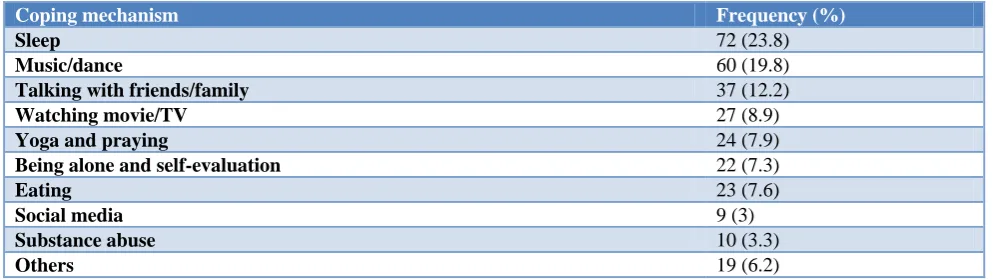
A total of 303 students were included in the final analysis. Among them 51.5% were male and 48.5% were females. The age group of the students ranged between 18 and 24 with a mean age of 20.48 and standard deviation of 0.4. The mean and standard deviation (SD) of PSS score is 17.7 and 5.5. Majority of the students 267 (88.1%) belonged to Hindu religion. 47(15.5%) students were from outside the state. The prevalence of mild, moderate and severe stress was 20%, 74% and 6% respectively (Figure 1). Stress was more among the students aged above 20 years (84.6%) and the association was statistically significant (p=0.049). Stress was less among students who had doctor parent(s) (65.4%) as compared to others (81.2%) and the association was statistically significant (p=0.044). Stress was more among students of 1st and 4th year (84% and 87.3% respectively) but it was not statistically significant (Table 1).Majority of the students (40.9%) considered academic related stressors to be the source of high stress which was followed by inter and intra-personal related stressors (33.3%), teaching and learning related stressors (27.7%), group activity related stressors (23.8%), social related stressors (18.5%) and drive and desire related stressors (16.2%) (Table 2). The leading coping strategy used by the students was sleep (23.8%) followed by music/dance (19.8%). Internet use and substance abuse was adopted by only 3% and 3.3% students as a coping mechanism (Table 3).
20%
74% 6%
Table 1: Factors associated with stress in Undergraduate medical students.
Characteristics Proportion of stress P value
Mild stress (%) Moderate/high stress (%) Age
18-20 39 (24.4) 121 (75.6)
0.049
>20 22 (15.4) 121 (84.6)
Sex
Male 32 (20.5) 124 (79.5)
0.865
Female 29 (19.7) 118 (80.3)
Religion
Hindu 52 (19.5) 215 (80.5)
0.603
Muslim 5 (27.8) 13 (72.2)
Christian 3 (18.8) 13 (81.2)
Category
GM 36 (23.7) 116 (76.3)
0.246
OBC 19 (18) 87 (82)
SC/ST 6 (13.3) 39 (86.7)
State
Karnataka 55 (21.5) 201 (78.5)
0.171
Outside Karnataka 6 (12.8) 41 (87.2)
Residence
Rural 8 (17.4) 38 (82.6)
0.615
Urban 53 (20.6) 204 (79.4)
Fathers education
Diploma and above 56 (20.4) 219 (79.6)
0.490
Below diploma 4 (14.8) 23 (85.2)
Mothers education
Diploma and above 43 (19.5) 178 (80.5)
0.630
Below diploma 18 (22) 64 (78)
Socioeconomic status
I 14 (25) 42 (75)
0.591
II 40 (19.6) 164 (80.4)
III 6 (19.4) 25 (80.6)
IV 1 (8.3) 11 (91.7)
Year of study
I 8 (16) 42 (84)
0.134
II 24 (29) 59 (71)
III 15 (21) 57 (79)
IV 9 (12.7) 62 (87.3)
V 5 (18.5) 22 (81.5)
Living status
Parents 14 (21) 53 (79)
0.811
Hostel 44 (19.6) 181 (80.4)
Paying guest 3 (27.3) 8 (72.7)
Choice of medicine
Own interest 46 (21.2) 171 (78.8)
0.354
Parental influence 4 (10.3) 35 (89.7)
Random choice 9 (22) 32 (78)
Peer influence 2 (33.3) 4 (66.7)
Medium of education
Kannada 4 (16) 21 (84)
0.728
English 57 (20.5) 221 (79.5)
Doctor parents
Yes 9 (34.6) 17 (65.4)
0.044
Table 2: Distribution of different stressors in causing stress.
Stressors Mild stress (%) Moderate stress (%) Severe stress (%)
Academic related stressor 25 (8.3) 154 (50.8) 124 (40.9)
Inter and intra-personal related stressor 53 (17.5) 149 (49.2) 101 (33.3) Teaching and learning related stressor 66 (21.6) 153 (50.5) 84 (27.7)
Social related stressor 80 (26.4) 167 (55.1) 56 (18.5)
Drive and desire related stressor 136 (44.9) 118 (38.9) 49 (16.2) Group activity related stressor 102 (33.7) 129 (42.6) 72 (23.8)
Table 3: Coping strategies adopted by the students.
Coping mechanism Frequency (%)
Sleep 72 (23.8)
Music/dance 60 (19.8)
Talking with friends/family 37 (12.2)
Watching movie/TV 27 (8.9)
Yoga and praying 24 (7.9)
Being alone and self-evaluation 22 (7.3)
Eating 23 (7.6)
Social media 9 (3)
Substance abuse 10 (3.3)
Others 19 (6.2)
DISCUSSION
In this study majority of the students (70%) experienced moderate stress and only 6% experienced severe stress. This finding was comparable to a study done in Tamil Nadu by Shakthivel et alin which 80% of the boys and 75% of the girls reported a moderate or higher stress level.10 In a study done in Kolkatta by Gupta et alshowed prevalence of moderate and high stress among the participants to be 55.7% and 35.4% respectively and the overall prevalence of stress was estimated as 91.1%.11 Another study done among medical students in Mysore by Kumar et alshowed the prevalence of stress as 33.7% in which only 52.9% experience moderate and above level of stress.7 The use of different scale in the above study can be the reason why the stress is different from our study populations. A study done in Kolkata by Chowdhury et al showed 46.3% of students had high stress.12 This is very high compared to the result in our study where only 6% experienced severe stress. Another study done in Mangalore by Brahmbhatt et alshowed prevalence of stress among study participants to be 42.5%.13 Different geographical area, college environment and regional socio-cultural factors might have been the reasons for this difference. Various studies done across the world had consistently shown that there is high prevalence of stress in medical students.14-17 The mean and SD of PSS score in our study was 17.7 and 5.5 respectively which was comparable to a study done in Tamil Nadu by Sakthivel et alwith mean score as 17 and SD as 6.5.10 However it was less than that found in a study done in Kolkatta by Chowdhury et alwhere the mean and SD were 29.58 and 6.6 respectively.12 Another
study done in by Brahmbhatt et alalso showed a higher mean score of 27.53.13 The topography and easy pace of life in Mysore, which is considered as the cultural capital of Karnataka with relatively good quality of life can be some of the reasons for the lesser stress experienced by the students of this college because another study on stress in Mysore by Kumar et al also showed a less prevalence of Stress.7
Satheesh et al which showed higher prevalence of stress in first and final years (53.3% and 84.6%) respectively as compared to other years.17 Other factors like gender, socio economic status, living status, medium of education were not significantly associated with stress in our study and it was comparable with studies done by Shakthivel et al, Yusoff et al, Supe et at and Nandi et al.10,18-20 Another study by Gade et al in their study in Nagpur showed a contrasting result with significant association between stress and gender, females being more stressed and students from rural background being significantly more stressed as opposed to our results.21
In our study majority of the students 40.9% stated academic related stressors to be the source of high stress which is followed by inter and intra-personal related stressors 33.3%. This was comparable to a study done by Gupta et alin Kolkatta where 94% had academic related stressor and 78% had Inter personal stressors.11 The other studies done by Chowdhury et al, Panchu et al, Melaku et al all showed a similar result with academic related stressor being the major contributor of stress.12,22,23 The vastness of the medical syllabus and lack of proper time management lessons for the students are the main reason for academic causes being the major stressor.
The leading coping strategy found in our study was sleep followed by music/dancing and sharing with friends so this shows that students are resorting to healthier coping mechanisms with only 3% resorting to internet use and 3.3% engaging in substance abuse. This can be the reason for less (6%) prevalence of severe stress in our study.
CONCLUSION
In our study though majority of the students were stressed (80%), only 6% were severely stressed. The factors of increasing age and parents being in the medical profession were found to be significantly associated with stress. The academic related stressors followed by interpersonal and teaching and learning related stressors were considered to be the major reasons for high level of stress. The coping strategies adopted by the students like resorting to sleep and music/dance appeared to be appropriate methods of handling stress.
Recommendations
Since majority of the students were stressed and academic causes were identified as the major stressor the students should be equipped with better life skills like appropriate time management, study planning, and relaxation techniques like yoga, meditation and extracurricular activities. There is also a need to look into the medical curriculum and incorporate a few changes keeping in mind the mental health of the students. Future studies need to be carried out in-order to have an in-depth analysis of the different medical college environments so as to improve the overall mental health status of the students all over the country.
ACKNOWLEDGEMENTS
We would like to thank the undergraduate students of Mysore medical college for their enthusiastic participation in the study.
Funding: No funding sources Conflict of interest: None declared
Ethical approval: The study was approved by the Institutional Ethics Committee
REFERENCES
1. American Institute of Stress. What is Stress?. Available at: https://www.stress.org/what-is-stress/. Accessed on 26 August 2016.
2. Hubbard R J, Workmann E A. Handbook of Stress Medicine: An Organ System Approach. New York: CRC press LLc; 1998: 6.
3. Saravanan C, Wilks R. Medical Students’ Experience of and Reaction to Stress: The Role of Depression and Anxiety. The Scientific World Journal. 2014: 1-8.
4. Finkelstein C, Brownstein A, Scott C, Lan Y. Anxiety and stress reduction in medical education: an intervention. 2007.
5. Child and Adolescent Mental Health. WHO 2014. Available at: http://www.who.int/mental_health/ maternal-child/child_adolescent/en/ Accessed on 26 August 2016.
6. Dyrbye L. N, Thomas, M. R and Shanafelt, T. D. Medical student distress: Causes, consequences, and proposed solutions. Mayo Clinic Proceedings. 2005;80(12):1613-22.
7. Kumar SD, Kavitha HS, Kulkarni P, Siddalingappa H, Manjunath R. Depression, anxiety and stress levels among medical students in Mysore, Karnataka, India. Int J Community Med Public Health. 2016;3:359-62.
8. Cohen S, Kamarck T, Mermelstein R. A global measure of perceived stress. J Health Soc Behav. 1983;24:385-96.
9. The Development and Validity of the Medical Student Stressor Questionnaire (MSSQ). Asean J Psychiatry. 2010;11(1).
10. Shakthivel N, Amarnath AM, Ahamed F, Rath RS, Sethuraman AR. Rizwan AS. Level of perceived stress and coping strategies prevailing among 1st year medical undergraduate students: A cross-sectional study from south India. Int J Med Public Health. 2017;7(2):111-5.
11. Gupta S, Choudhury S, Das M, Mondol A, Pradhan R. Factors causing stress among students of a Medical College in Kolkata, India. Educ Health. 2015;28:92-5.
13. Brahmbhatt K, Nadeera V P, Prasanna K S, Jayram S. Perceived stress and sources of stress among medical undergraduates in a private medical college in Mangalore, India. Int J Biomed Adv Res. 2013;4(2):133-5.
14. Bassols AMS, Carneiro BB, Siqueira AM, Guimarães GC, Okabayashi LMS, Carvalho FG, Silva ABD. Stress and coping in a sample of medical students in Brazil. Arch Clin Psychiatry. 2015;42(1):1-5
15. Sreeramareddy C, Shankar P, Binu V, Mukhopadhyay C, Ray B, Menezes R. Psychological morbidity, sources of stress and coping strategies among undergraduate medical students of Nepal. BMC Medical Education. 2007;7(1):26.
16. Shahida Shaikh, Abdul hameed shaikh, Inayatullah magsi; Stress among medical students of university of Interior Sindh; Medical Channel. 2010;16(4):538-40.
17. Satheesh BC, Prithviraj R, Prakasam PS. A study of perceived stress among undergraduate medical students of a private medical college in Tamil Nadu. Int J Sci Res. 2015;4:994‑7.
18. Yusoff MSB, Abdul Rahim AF, Yaacob MJ. Prevalence and sources of stress among Universiti
Sains Malaysia medical students. Malaysian J Med Sci. 2010;17(1):30–7.
19. Supe AN. A study of stress in medical students at Seth GS Medical College. J Postgrad Med. 1998;44:1-6.
20. Nandi M, Hazra A, Sarkar S. Stress and its risk factors in medical stu¬dents: an observational study from a medical college in India. Indian J Med Sci. 2012;66(1-2):1–12.
21. Gade S, Chari S, Gupta M. Perceived stress among medical students: To identify its sources and coping strategies. Arch Med Health Sci. 2014;2:80-6. 22. Panchu P, Bahuleyan B, Vijayan V. An analysis of
the factors leading to stress in Indian medical students. Int J Clin Exp Physiol. 2017;4:48-50. 23. Melaku L, Mossie A, Negash A. Stress among
Medical Students and Its Association with Substance Use and Academic Performance. J Biomed Education. 2015;1-9.
Cite this article as: Bhavani Nivetha M, Ahmed M, Prashantha B. Perceived stress and source of stress among undergraduate medical students of