Review Article
Rib fracture treatment and management
Yasser Alzahrani
1*, Mohammad Alhazmi
2, Mohammed Al Ibrahim
3, Hani Alzahrani
4,
Abdullah Calacattawi
5, Amirah Alosaimi
6, Abdullah Alkahtani
7, Mohammad Aljumah
8,
Abdulmalik Surrati
5, Ibrahim Saan
9INTRODUCTION
Severe blunt injury to the chest continues to be one of the leading causes of morbidity and mortality in both young and old trauma victims.1 Flail chest is one of the worst subset of these injuries and is likely the most common serious injury to the thorax seen by clinicians. Flail chest
is the most serious complication that may occur after thoracic trauma and refers to a segment of the chest wall resulting from at least two fractures of more than two consecutive ribs and moving in an asynchronous manner with the robust rib cage.2 The trauma that results in a flail chest can also lead to lung contusion and pneumothorax, which worsens blood oxygenation.3,4 Between flail chest
ABSTRACT
Simple rib fractures are the most common injury sustained following blunt chest trauma, accounting for more than half of thoracic injuries from non-penetrating trauma. Severe blunt injury to the chest continues to be one of the leading causes of morbidity and mortality in both young and old trauma victims. We conducted the current meta-analysis using a comprehensive search of EMBASE, MEDLINE, PubMed, Cochrane Database of Systematic Reviews, and Cochrane Central Register of Controlled Trials till 01 February 2018 for randomized controlled trials that compared operative-to-non-operative administration in flail chest patients. We identified 6 studies that could be included in the meta-analysis. In total, there were 129 patients receiving operative management compared to 152 patients in the non-operative management group. A positive effect of surgical rib fracture fixation was observed for pneumonia rate [ES 0.43, 95% CI 0.29, 0.72], duration of ICU stay [ES −4.54 days 95% CI (−6.02, −1.89) p>0.0001]. No significant difference was noted in mortality rate [ES 0.55, 95% CI (0.14, 2.44)] between the two treatment strategies. Operative management of flail chest might, therefore, be a promising treatment strategy that could not only improve patient’s outcome, but also lower treatment costs. These observations might be of value for surgeons treating patients with flail chest.
Keywords: Rib fractures, Flail chest, Mortality, Pneumonia
1
Imam Abdulrahman Bin Faisal University, Dammam, KSA
2
Royal College of Surgeons in Ireland, Dublin
3
Medical University Of Lublin, Poland
4
Batterjee Medical College, Jeddah, KSA
5
King Abdulaziz University, Jeddah, KSA
6
Almaarefa colleges, Riyadh, KSA
7
King khalid university, Abha, KSA
8
Western Sydney University, Campbelltown, Australia
9
Sabya General Hospital, Jizan, KSA
Received: 13 June 2018
Accepted: 05 July 2018
*Correspondence:
Dr. Yasser Alzahrani,
E-mail: [email protected]
Copyright: © the author(s), publisher and licensee Medip Academy. This is an open-access article distributed under the terms of the Creative Commons Attribution Non-Commercial License, which permits unrestricted non-commercial use, distribution, and reproduction in any medium, provided the original work is properly cited.
patients, 40% acquire pneumonia making it the most common non-acute complication.5
Internal pneumatic stabilization for flail chest was popularized in the 1950s, however, this management has afterward been presented to be avoidable in most patients without respiratory compromise. In a mid-1970s report, some evidence was delivered convincing that many patients managed better with sufficient pain control and pulmonary toilet (including medical management of their pulmonary injury) than those placed on mechanical ventilation.6 This remains the standard today. Mechanical ventilation is reserved for patients with persistent respiratory insufficiency or failure after adequate pain control or when complications related to excessive narcotic use occur. Patient-controlled analgesia machines, oral pain medications, and indwelling epidural catheters form the mainstay of present management.
A recent clinical report showed that continuous positive airway pressure by mask may decrease mortality and nosocomial pneumonia in the ICU, but CPAP by mask does not appear to change the length of ICU stay.7 Studies and reviews recommend operative fixation of flail chest could be an alternative treatment to decrease period of Intensive Care Unit stay, treatment costs, days on mechanical ventilation (DMV), and mortality rate.8,9 The purpose of the present analysis was to evaluate operative management of flail chest to current treatment methods.
METHODS
Data sources and searches
We conducted the current meta-analysis using a comprehensive search of EMBASE, MEDLINE, PubMed, Cochrane Database of Systematic Reviews, and Cochrane Central Register of Controlled Trials till 01 February 2018 for randomized controlled trials and Case-controls that compared operative-to-non-operative administration in flail chest patients. Both semiparametric and parametric methods were used.
Selection criteria
Studies were included in this meta-analysis if they satisfied the following criteria: RCTs which has mortality and pneumonia rate as primary outcomes, only English studies, and the investigators reported relative risks (RRs) with 95% CI.
Data extraction
The final data were abstracted from each study using standardized form: the first author’s name, year of publication, number of patients, age, study location, smoking rate, number of patients, pulmonary infection rate, duration of ICU stay, and duration of illness. These
factors were chosen because they represent the most important variables for assessing patient risk and treatment of patients. Flow diagram showing the selection criteria of assessed studies.10
Statistical analysis
The present meta-analysis utilized Stata version 12.0 software for statistical analysis. Mean difference (MD) were calculated for continuous variables. Pooled odds ratios (OR) were calculated for discrete variables. Heterogeneity amongst the trials was determined by means of the Cochran Q value and quantified using the I2 inconsistency test with a significance set at the p<0.10 or I2 score >50%.11 DerSimonian-Laird random-effect meta-analysis was adopted when obvious heterogeneity existed.12
RESULTS
We recognized 845 citations using the search strategy. Of these, we excluded 263 after examining the title and abstract including removal of duplicates. We retrieved and evaluated 14 articles in more detail, of which 8 articles were excluded, leaving 6 studies that were eligible for inclusion (Figure 1). In total, there were 129 patients receiving operative management compared to 152 patients in the non-operative management group. Main characteristics of included studies have been summarized in Table 1.
Figure 1: Flow diagram showing the selection criteria of assessed studies.
Table 1: Main characteristics of included studies.
Author Year Study design Location Operative
management N
Non-operative
management N Outcomes reported
Marasco3 2013 RCT Australia 23 23
Mortality, pneumonia, DMV, ICU stay, DHS, TRCH, FVC, FEV1
Tanaka4 2002 RCT Japan 18 19 Pneumonia, DMV, ICU
stay, TRCH, FVC
Granetzny13 2005 RCT Egypt 20 20 Mortality, DMV, ICU stay,
DHS, FVC, FEV1
Nirula14 2006 Case-control USA 30 30 DMV, ICULOS, HLOS
Althausen15 2011 Case-control USA 22 28 DMV, ICULOS, HLOS,
PNA, TRCH
de Moya16 2011 Case-control USA 16 32 DMV, ICULOS, HLOS,
PNA
RCT, randomized control trial; DMV, duration of mechanical ventilation; ICULOS, intensive care unit length of stay; HLOS, hospital length of stay; PNA, pneumonia; TRCH, tracheostomy
Table 2: Pneumonia in patients with flail chest.
Study ES 95% CI
Marasco3 0.65 (0.40–1.06)
Tanaka4 0.25 (0.11–0.60)
Althausen15 0.18 (0.02–1.37)
de Moya16 0.83 (0.35–1.96)
Overall 0.43 (0.29–0.72)
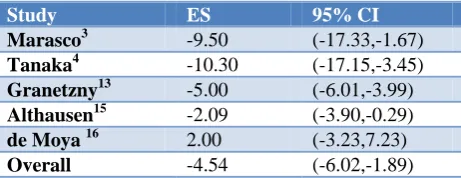
No significant difference in risk ratio (RR) for mortality between the operative and non-operative management groups was seen [ES 0.55, 95% CI 0.14, 2.44], duration of ICU stay [ES −4.54 days 95% CI (−6.02, −1.89) p>0.0001].
Table 3: mortality in patients with flail chest.
Study ES 95% CI
Marasco 3 0.33 (0.01–7.77)
Granetzny13 0.67 (0.12–3.56)
Overall 0.55 (0.14–2.44)
Table 4: Intensive Care Unit stay.
Study ES 95% CI
Marasco3 -9.50 (-17.33,-1.67)
Tanaka4 -10.30 (-17.15,-3.45)
Granetzny13 -5.00 (-6.01,-3.99)
Althausen15 -2.09 (-3.90,-0.29)
de Moya 16 2.00 (-3.23,7.23)
Overall -4.54 (-6.02,-1.89)
DISCUSSION
The present study displays that operative management of flail chest improves the outcome of patients concerning pneumonia, ICU stay, days in hospital, and treatment costs. There were more chest wall irregularities such as
stove-in chest, stated in the non-operative management group by Granetzny et al at 45% for non-operative compared to 5% of patients in the operative management groups.13 Tanaka et al similarly recommended that non-operative management is not constantly effective in preventing chest wall deformities and thus, supports the outcomes defined in the publication by Granetzny et al.13 There are several important factors that our study was not designed to address, principal among these is timing of the intervention. In theory, ‘early’ surgical intervention-within 24-72 hours of injury-would provide the most benefit to patients with FC in terms of avoidance of prolonged mechanical ventilation and associated complications. When looking at management costs, operative management appeared to be $10.000 to $14.443 less expensive according to Tanaka et al and Marasco et al, respectively.3,4
Our findings suggest that operative management in this context has beneficial effects on morbidity, mortality, and resource expenditure. We found that operative management was associated with 4.54 fewer days in the ICU, and almost 4 fewer days in the hospital relative to patients managed non-operatively. Furthermore, operative stabilization was associated with >50% reductions in mortality, incidence of pneumonia. Conversely, utilization of surgical intercession later in the time course of malady may bring about negligible advantage while presenting patients to procedural dangers. Time to surgical stabilization changed in the investigations incorporated our examination from ≤24 hours to >8 days after affirmation. Deciding ideal timing of interference will be a serious component in outline of a stage III investigation.
showed a comprehensive report of all complications in the operative management group, however, they did not include pneumonia, while two of their fatal cases were due to pneumonia.13 A recent study showed that patients treated with surgical rib fracture fixation were matched two-to-one to non-operative patients with similar injuries. There were some differences between both treatment groups, which made it difficult to compare both treatment groups such as flail chest was present in 79% of patients in the operative management group compared to 23% of patients in the non-operative management group.17
We were unable to determine the optimal approach for rib fracture fixation. Multiple techniques have been described, including use of metal plates, absorbable plates, intramedullary fixation, Judet struts, U-plates.4,13,15,16,18-23 The studies included in the present analyses exemplify a wide range of surgical approaches, and individual studies often employed more than one surgical technique. These surgical approaches may differ greatly in terms of their efficacy and safety. By way of any surgical procedure, operative fixation of rib fractures is related with the risk of complications for example, hardware failure or migration, wound infection, and malunion/ nonunion of the fracture site.
CONCLUSION
Operative management of flail chest might, therefore, be a promising treatment strategy that could not only improve patient’s outcome, but also lower treatment costs. These observations might be of value for surgeons treating patients with flail chest. Nevertheless, further studies should be made to make a better understanding of the potential biological mechanisms. Large-scale and long-term randomized controlled trials in various populations must be carried out in future studies to deliver more significant evidence.
Funding: No funding sources Conflict of interest: None declared Ethical approval: Not required
REFERENCES
1. Kilic D, Findikcioglu A, Akin S, Akay TH, Kupeli E, Aribogan A, et al. Factors affecting morbidity and mortality in flail chest: comparison of anterior and lateral location. Thorac Cardiovasc Surg. 2011;59(1):45-8.
2. Ahmed Z, Mohyuddin Z. Management of flail chest injury: internal fixation versus endotracheal intubation and ventilation. J Thorac Cardiovasc Surg. 1995;110(6):1676-80.
3. Marasco SF, Davies AR, Cooper J, Varma D, Bennett V, Nevill R, et al. Prospective randomized controlled trial of operative rib fixation in traumatic flail chest. J Am Coll Surg. 2013;216(5):924–32. 4. Tanaka H, Yukioka T, Yamaguti Y, Shimizu S,
Goto H, Matsuda H, et al. Surgical stabilization of
internal pneumatic stabilization? A prospective randomized study of management of severe flail chest patients. J Trauma. 2002;52(4):727–32. 5. Segers P, Van Schil P, Jorens P, Van Den Brande F.
Thoracic trauma: an analysis of 187 patients. Acta Chir Belg. 2001;101(6):277–82.
6. Trinkle JK, Richardson JD, Franz JL, Grover FL, Arom KV, Holmstrom FM. Management of flail chest without mechanical ventilation. Ann Thorac Surg. 1975;19(4):355-63.
7. Tanaka H, Tajimi K, Endoh Y, Kobayashi K. Pneumatic stabilization for flail chest injury: an 11-year study. Surg Today. 2001;31(1):12-7.
8. Leinicke JA, Elmore L, Freeman BD, Colditz GA. Operative management of rib fractures in the setting of flail chest: a systematic review and meta-analysis. Ann Surg. 2013;258(6):914–21.
9. Bhatnagar A, Mayberry J, Nirula R. Rib fracture fixation for flail chest: what is the benefit? J Am Coll Surg. 2012;215(2):201–5.
10. Moher D, Liberati A, Tetzlaff J, Altman DG. Preferred reporting items for systematic reviews and meta-analyses: the PRISMA statement 2007. 11. Higgins JP, Thompson SG, Deeks JJ. Altman DG.
Measuring inconsistency in meta-analyses 2008. 12. DerSimonian R, Laird N. Meta-analysis in clinical
trials. Control Clin Trials. 1986;7(3):177-88. 13. Granetzny A, Abd El-Aal M, Emam E, Shalaby A,
Boseila A. Surgical versus conservative treatment of flail chest. Evaluation of the pulmonary status. Interact Cardiovasc Thorac Surg. 2005;4(6):583–7. 14. Nirula R, Allen B, Layman R, Falimirski ME,
Somberg LB. Rib fracture stabilization in patients sustaining blunt chest injury. Am Surg. 2006;72:307–9.
15. Althausen PL, Shannon S, Watts C, Thomas K, Bain MA, Coll D. Early surgical stabilization of flail chest with locked plate fixation. J Orthop Trauma. 2011;25:641–7.
16. de Moya M, Bramos T, Agarwal S, Fikry K, Janjua S, King DR. Pain as an indication for rib fixation: a bi-institutional pilot study. J Trauma. 2011;71:1750–4.
17. Sarah M, Emily W, Scott G, Steven G, VanBoerum Don H, White Thomas W. In-hospital outcomes and costs of surgical stabilization versus nonoperative management of severe rib fractures. J Trauma Acute Care Surg. 2015;79(4):533–8.
18. Beelen R, Rumbaut J, De Geest R. Surgical Stabilization of a rib fracture using an angle stable plate. J Trauma. 2007;63:1159–60.
19. Vu KC, Skourtis ME, Gong X, Zhou M, Ozaki W, Winn SR. Reduction of rib fractures with a bioresorbable plating system: preliminary observations. J Trauma. 2008;64:1264–9.
21. Moore BP. Operative stabilization of non-penetrating chest injuries. J Thorac Cardiovasc Surg. 1975;70:619–30.
22. Landreneau RJ, Hinson JM, Jr, Hazelrigg SR. Strut fixation of an extensive flail chest. Ann Thorac Surg. 1991;51:473–5.
23. Sales JR, Ellis TJ, Gillard J, Liu Q, Chen JC, Ham B, et al. Biomechanical testing of a novel,
minimally invasive rib fracture plating system. J Trauma. 2008;64:1270–4.