Pedagogical sciences
79
tion of the RF fellowships of the RF leading scientific schools research governmental support many a time and oft. In 1982 the student body of the Department as part of the Perm Polytechnical Institute got the prize in the name of Leninist Komsomol for the research works. Annually not less then 15 best students of the Department are awarded with medals, diplomas and certificates of merit of the RF Ministry of Education on the results of the graduation papers contest, and also the diplomas for the reports at conferences. The Department students were granted individual scholar-ships of the RF President, titles of “Soros student, within the framework of the European Community “Commet” and “Erasmus” on the collaboration in the area of teaching and research the students, post-graduates and teachers of the Department completed their training and practical study at the Technical Uni-versity of Vienna. Among the graduates of the De-partment there are leaders of enterprises and regional Administration.
The results of the accumulated practical ex-perience, pedagogical and scientific activities of the Department’s body are published in textbooks, 43 monographs, 27 learning guides. More than 50 new courses have been developed at the Department, 78 ti-tles of study aids have been published.
Since 1970 a postgraduate study has been opened at the Department, and in 1991 – the doctoral studies on scientific specialties 05.16.06 "Powder metallurgy and composite materials" and 05.02.01 "Materials Science (industry)" were opened. Under the direction of the academician of the Russian Academy of Science V.N.Antsiferov 22 doctor's and 68 master's theses have been protected.
Thus, the academic process organization sys-tem at the Powder Materials Science Department, es-pecially in senior courses, when the graduate performs research and developments under the leadership of highly qualified experts and teachers independently, working in the collective and realizing the responsibil-ity for his work to it, together with the material remu-neration and motivation to publishing his results allow forming not only the professional, but also learning-and-cognitive, informative and communicative com-petences in the graduate.
Since 2008 a new professional educational program of specialists training on the specialty 210605.65 “Nanomaterials” has been working at the Department. The accumulated experience of students’ training will be a pledge of training highly qualified experts in the area of nanotechnologies and nanomate-rials.
The work is submitted to the Scientific International Conference «Innovative Technology in Higher and Vocational Education», August, 2-9, 2008, Spain, came to the editorial office on 23.07.2008.
ROLE WHICH IS GIVEN TO THE STUDENT IN EDUCATIONAL SYSTEM
Pavlenko V.V.
SSUI Novokuznetsk, Russia
CONTENTS
Pedagogical sciences
80
to receive scientific degrees. As it is impossible to garble level of readiness of students in subjects of each separately taken teacher, scientific activity of al-ready concrete teacher will be in direct dependence on indicators (not simply progress which can be manipu-lated) activity of students in scientific activity.
The work was submitted to international scientific conference «Prospects for the development of univer-sity science», Dagomys (Sochi), 20-23 September 2008, came to the editorial office on 21.07.2008.
POLITICAL SOCIALIZATION IN THE HIGHER MEDICAL EDUCATION
Parakhonsky A.P., Venglinskaya .
Medical institute of the supreme sisterly education Krasnodar, Russia
The central concept of our researches is politi-cal socialization which is understood as a way of the person to finding civil outlook, comparison of the sys-tem of values to the certain vision of the state interest, influence on such identification of purposeful factors. Political socialization in high school as the party of a vital way of the developing person is space of a meet-ing (interaction, connection) official pedagogics (edu-cational system), a policy (political traditions), con-crete conditions of the biography of the separate per-son or the whole generation. Studying of so multi-plane subject as political socialization various genera-tions, first of all, youth, demands the interdisciplinary approach. It presumes to answer the following basic questions: conducting approaches to of political so-cialization in a history and the modernity in various scientific directions; Historical experience of interac-tion of pedagogics, medicine and authority in practice of political socialization representatives of various ethnoses, faiths, regions, generations, floors in condi-tions of educational system of the higher school; op-timum ways of studying political of socialization in a modern, polycultural society and development of rec-ommendations on its perfection, including through in-teraction of pedagogical system of the higher school with the government.
The answer to the first item gives a panorama of various approaches to a problem, necessary for its three-dimensional consideration owing to integrated approach of an object of research. The answer to the second item can give representation about historical dynamics of pedagogical mechanisms of political so-cialization inside various educational levels and on their crossing. The answer to the third item will allow
to offer new approaches to studying modern lines in of political socialization, those conditions and factors which define procedures of political socialization peo-ple from different generations at their meeting with the state. It is necessary for high school system to pro-vide graduates, except for a professional knowledge and skills, skills to be guided in an escalating stream of the information, readiness for constant updating and updating of knowledge, and also ability to dialogue to interaction in collective, to the decision of disputed situations.
From these positions it is possible to believe, that - the manager in system of higher education it is necessary to include the following aspects in process of preparation of the medical sister: historical - a his-tory of development of medicine and the general pa-thology; ethical - basic principles and concepts "is an-gry", "kindly", "validity", "conscience", "honesty"; le-gal - realization of key rules standard - lele-gal certifi-cates; medical - scientific validity, an estimation of a degree of risk, utility or uselessness, danger or safety for health and lives of the patient; psychological -models of interaction, psychological features of the medical worker and the patient; social - conformity to system of knowledge of norms and the values formu-lated in a society; religious - an admissibility of ac-tions of the medical sister from posiac-tions of existing religious faiths; Educational - formation of valuable orientations in relation to the person of the examinee, to the own person, formation of the concept " I am a manager ".
Thus, the given approach allows to form the competent spiritual - moral person of the future medi-cal the sister - manager, thus, to reduce negative con-sequences of use of new technologies both for sepa-rately taken person, and for a society as a whole. The work was submitted to international scientific conference «Modern science education», China, Bei-jing, November, 26 – December, 4, 2007, came to the editorial office 08.08.2008
COMBINED METHODS OF NUMERICAL SOLUTION FOR ALGEBRA DIFFERENTIAL
EQUATIONS Vas henko G.V.
Sibirian State Technological University Krasnoyarsk, Russia
We consider algebra - differential equations of the normal form and Cauchy problem [1] as follows:
,
,
) , ( , 0 0 0 0
(
0
)
)
0
(
))
(
),
(
(
)
(
),
)
(
),
(
(
z
x
z
z
x
x
t
z
t
x
t
z
t
z
t
x
x
(1) wheret [0, T], :G Rn Rm, :G Rn Rn - m,x(t) Rm,z(t) Rn - m .
Combined numerical methods for solution (1): implicit Euiler’s scheme with simple iterations and
itera-Pedagogical sciences
81
tions are presented. It is shown convergence and exact numerical solutions.
Asymptotic properties of the both combined methods are discussed. We also give examples in which the numerical and the exact solutions are com-pared.
References:
1. Chistyakov V.F. Algebra - differential opera-tors with finite dimension kernel. Novosibirsk, Hauka, 1996. - 279 p.
2. Schropp J. Geometric properties of Runge-Kutta discretizations for index 2 differential-algebraic equations // SIAM J. Numer. Anal. - 2002. - vol. 40, N 3. - pp. 872 - 890.
The work is submitted to the IV Scientific Interna-tional Conference "Basic research", Italy, October, 11-18, 2008, came to the editorial office on 19.08.2008.
LIFEWARE REALIZATION AS SITUATION OF SUCCESS IN EDUCATION
Yurtayeva N.I.
Nizhnekamsk Chemical-Engineering Institute (Branch of Kazan State Technological University)
Nizhnekamsk, Republic of Tatarstan, Russia
The Russian society has been performing its life changes complex process focused on democratic transformations for the last years. Humanitarization of education is becoming an integral part of higher school renovation, is the means of students’ panhuman culture formation. Most likely the new type of educa-tion will appear as a projective one called up to con-vert the culture in accord with those changes, which take place in the social development. The higher edu-cation quality is the key element, when creating the European Higher Education Zone. More than ever a further development of methods, approaches and crite-ria of quality assurance at all the levels (institutional, national, European) is necessary now. The quality
as-surance is the prime responsibility of higher educa-tional institutions and it provides the basis for the aca-demic community real responsibility. The training of specialists should be assured not only by the teacher’s professional competency high level, but also by the conditions for the development of new educational technologies oriented to personality growth, the learner’s peculiarities revelation, the acknowledge-ment of his subjective experience as originality and inherent worth, the composition of pedagogical effects with the agreement of individual and social experi-ence. The entry of the human into the new develop-ment epoch, the change for the interaction with the help of global communications is attended by the re-alization of the fact that the outside world possesses simultaneously both the properties of integrity and multiplicity. In the constantly changing society the human is offered a wide range of choice, when solving professional and personal problems, that increases the degree of individual responsibility. Due to this the axiological, and it means – humanitarian, aspect of life grows.
The requirements made for the future special-ists in conditions of the changes taking place in the society are, first of all, a high level of abilities to real-ize their intellectual possibilities, to use all their crea-tive potential for displaying initiacrea-tive and entrepreneu-rial spirit, solving problems in conditions of market economy harsh mechanisms. That is why the learner-centered education having the humanitarian aspect as the leading one, can create conditions for sound mani-festation and development of personal functions of the educational process subjects, create the situation of learners’ success.
CONTENTS
Pedagogical sciences
82
Short Report
CONDITION CHANGE DYNAMICS AND COMPETENCE STRUCTURE DIAGNOSTICS
OF FUTURE PHYSICAL EDUCATION TEACHERS
Ivanov B.M., Kuznetsova Z.M., Imashev A.M.
The Kama state academy of physical training, sports and tourism
Naberezhnye Chelny, Russia
Functional competence of future physical edu-cation teachers is considered as a part of their profes-sional competence, characterized by mastering their main pedagogical functions (knowledge – ability – skills).
The problem is increasing future physical edu-cation teachers functional competence.
Actuality of the problem is the future physical education teachers professional physical education quality increasing process.
The object of the research is condition and functional competence of the future physical educa-tion teacher dynamics.
The subject of the research is condition and functional structure competence dynamics of the fu-ture physical education teachers (knowledge – ability – skills).
The purpose of the research is experimental study of the Kama state academy of physical culture, sports and tourism future physical education teachers condition and functional competence structure dynam-ics.
The task of the research is:
1. To analyze peculiarities of the future physi-cal education teacher functional competence according to courses of study;
2. To conduct systematic – structural analysis of the Kama state academy of physical culture, sports and tourism future physical education teachers func-tional competence characters.
3. To reveal directions of the future physical education teachers functional competence formation process correction.
4. The methods used in research are: a) Questionnaire
b) mathematics-statistical processing of the re-sult.
The diagnostic instrument is a questionnaire «Portabe function diagnostics card of the physical education teachers» (Imashev, 1998) comprising 100 knowledge – ability – skills as functional elements of the 10 main physical education teachers pedagogical functions.
Organization of the research. 170 extra-mural fifth course students of the Kama state academy of physical culture, sports and tourism were offered to give information about their functional competence level according to the following rules:
– «zero» – no knowledge about the given func-tional element;
– «one» – there is knowledge about the given functional element;
– «two» – there is ability (the given functional element is used at least once);
– «three» – there is skill (the given functional element is used automatically.
The research is done from September 2004 up to June 2005.
The results of the research show that changing dynamics of the future physical education teachers functional competence is progressive: differences be-tween future physical education teachers functional competence meanings are valid.
For revealing the system of structurally inter-connected groups of functional competence influenc-ing upon future physical education teachers general functional competence forming correlation factors be-tween all functional competence meanings were found. They were formed into mutually connected ma-trixes, between main pedagogical functions and corre-lation pleiades were built.
Students of the first course have projecting pedagogical function with the most correlation factors meanings.
Students of the second course as system form-ing factor have constructive, projectform-ing and mobiliza-tion pedagogical funcmobiliza-tion.
Students of the third course don't have vivid system forming factor but a tendency of communica-tive, developing and mobilization pedagogical func-tions.
Students of the fourth course as system form-ing factors have the orientation – educative pedagogi-cal function which correlates close to the constructive and projecting pedagogical functions.
Students of the fifth course have the tendency to the developing and mobilization pedagogical func-tions.
So , the hypothesis in completely confirmed: 1) dynamics of the Kama state academy of physical culture, sports and tourism extra-mural fac-ulty future physical education teachers functional competence changing is progressive;
2) the basic of future physical education teacher functional competence forming process is pro-jecting (1 course), constructive (2 course), mobiliza-tion (3 course), orientamobiliza-tion (4 course) and developing (5 course) pedagogical functions which harmoniously coexist with other pedagogical functions in the corre-lation pleiad.
References:
Pedagogical sciences
83
2. Bobyrev N.D., Merlinkin V.P. Functional structuring components peculiarities in the physical education teacher activity // Kazan, 1989. – 130 p.
3. Polovnikova N.A. Intensification of higher qualification specialist training // Sov.ped. – 3. – 1986. – P. 72-78.
CONTENTS
Technical sciences
84
Materials of Conferences
CORRELATION ENERGY OF DOUBLY EXCITED STATES OF HELIUM-LIKE ATOMS
Kav V.V.
Krasnodar, Russia
1. Selection and description of used approach
Main problem at calculation of multielectron atoms, which elementary case are helium-like atoms, eventually is the necessity to take into account of in-teraction between electrons. The review of approxi-mate methods of the solution of this problem (as of 2000 year) it is possible to find in [1].
In the present work we use the one-configuration first approximation of a variational method (further VM1), in which one parameter
-charge of the nucleus varies only, and all interaction of electrons is with each other reduced only to mutual shielding by them of this charge. Thus VM1 is most
simple from all possible methods, which use approxi-mation of independent parti les. The description VM1
can be found in many sources (for example - in [2]) and there is no necessity to consider it here in full de-tails.
We note, that we not take into account in this approach exchange effects. The wave function of two-electron atom in this approximation is look as
= 1 2 , (1)
where 1 and 2 - wave functions of separate
elec-trons, which differ from hydrogen-like functions only by replacement in them of a real charge of the nucleus Z on effective charges Ze1 and Ze2, which are
varia-tional parameters.
Eventually formula of energy (hereinafter eve-rywhere in the text as units of energy is used Rydberg -Ry) two-electron atom calculated by the method VM1
is noted as
He1 = 1 ·(Ze1/n1 )2 + 2· (Z e2/n2 )2 , (2)
where n1 and n2 - general quantum numbers of appropriate electrons, and 1and 2- factors, which take into
ac-count relativistic effects and influence of the nucleus. In the present work we have taken their value from ex-periment under the formula
= H exp · ( n/Z)2 , (3)
where H exp - experimental value of energy of
hydro-gen-like atom for given Z and given n. 2. Correlation energy
The residual between precision energy of atom and energy calculated by one from methods of ap-proximation of independent parti les is named as cor-relation energy.
We can estimate accuracy of approach VM1
with the help of correlation energy. In the present work we have analyzed of correlation energy of a method VM1 for nl 1nl 2states of helium-like atoms,
where n - main quantum number, common for both electrons, and l 1and l 2 - orbital quantum numbers of
appropriate electrons. The similar analysis for a ground state of two-electron atoms can be found in various sources (for example in [2]), but we could not find any publication of similar investigation for dou-bly excited states (DES) and we claim for superiority in this problem. We have analyzed of correlation en-ergy for all nl 1nl2states of He-like atoms, for which it
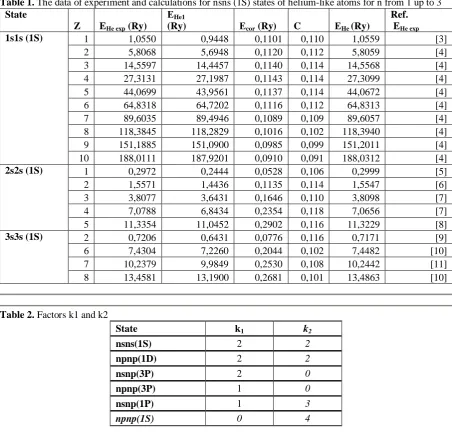
was possible to find the experimental data now, but because of limitation of the size of the article we shall present here as an example only data obtained for nsns(1S) states. The values He1, calculated by a
method VM1, values of energy E exp, taken from
ex-periment, and also value of correlation energy cor=
E exp – He1, for nsns (1S) states are given in a
ta-ble 1.
We have analyzed relation of correlation en-ergy from Z and n, and have detected, that the nl 1nl2
states are divided into two groups. The first group in-volves lowest states for the given configuration, i.e. states with least possible n. It is states, in which at least one electron is on the such orbit, for which n = l + 1. In the old quantum theory this condition corre-sponds to the special case of circular orbits. Second group involves all remaining states of configurations, i.e. states with n > l + 1 for everyone from two elec-trons. We obtained the formulas
cor = (1/2)·C·(1/n)·Z·[ k1 - k2 ·(Z-1)/Z ] (4)
and
Technical sciences
85
accordingly for the first and second group of states, where k1 and k2 - integer factors, which values are
given in a table 2, and C - numerical factor. The val-ues C, at which formula (4) and (5) give precision
co-incidence with experiment, are given in a table 1 for nsns (1S) states. It is easy to see, that C with a large degree of probability is a constant and is in range 0,110-0,116, i.e. is close to 1/9.
Table 1.The data of experiment and calculations for nsns (1S) states of helium-like atoms for n from 1 up to 3 State
Z E exp (Ry)
He1
(Ry) cor (Ry) C He(Ry)
Ref. E exp 1s1s (1S) 1 1,0550 0,9448 0,1101 0,110 1,0559 [3]
2 5,8068 5,6948 0,1120 0,112 5,8059 [4] 3 14,5597 14,4457 0,1140 0,114 14,5568 [4] 4 27,3131 27,1987 0,1143 0,114 27,3099 [4] 5 44,0699 43,9561 0,1137 0,114 44,0672 [4] 6 64,8318 64,7202 0,1116 0,112 64,8313 [4] 7 89,6035 89,4946 0,1089 0,109 89,6057 [4] 8 118,3845 118,2829 0,1016 0,102 118,3940 [4] 9 151,1885 151,0900 0,0985 0,099 151,2011 [4] 10 188,0111 187,9201 0,0910 0,091 188,0312 [4] 2s2s (1S) 1 0,2972 0,2444 0,0528 0,106 0,2999 [5] 2 1,5571 1,4436 0,1135 0,114 1,5547 [6] 3 3,8077 3,6431 0,1646 0,110 3,8098 [7] 4 7,0788 6,8434 0,2354 0,118 7,0656 [7] 5 11,3354 11,0452 0,2902 0,116 11,3229 [8] 3s3s (1S) 2 0,7206 0,6431 0,0776 0,116 0,7171 [9] 6 7,4304 7,2260 0,2044 0,102 7,4482 [10] 7 10,2379 9,9849 0,2530 0,108 10,2442 [11] 8 13,4581 13,1900 0,2681 0,101 13,4863 [10]
Table 2.Factors k1 and k2
State k1 k2
nsns(1S) 2 2
npnp(1D) 2 2
nsnp(3P) 2 0
npnp(3P) 1 0
nsnp(1P) 1 3
npnp(1S) 0 4
Finally we have following semi-empirical formula for calculation of full energy of helium-like atom for nl 1nl2states
He = He1+ cor, (6)
where He1 is calculated by a method VM1 and follows from the formula (2), and cor follows from the formulas
(4) and (5) and is entered because of analysis of the experimental data.
In that specific case of states nsns (1S), npnp (1D), ndnd (1G) etc., when both electrons are on same or-bit, or, as speak, occupy the same quantum cell, the formulas (4) and (5) receive especially simple kind
cor = C·(1/n) (7)
for n = l + 1 and
cor = C·(1/n)· Z (8)
CONTENTS
Technical sciences
86
The particular case of the formula (7) for n = 1 corresponds to a ground state of helium-like atoms (1s1s) and results to cor = C, i.e. the correlation
en-ergy in this case does not depend from Z and it was marked by Bethe as the curious fact in [2]. The Har-tree-Fock method also results in independence of cor-relation energy of a nuclear charge in case of a ground state 1s1s , but the constant obtained at it, has average value 0,085 unlike 0,111 for case of a method VM1.
The correlation energy of a Hartree-Fock method was a theme of many works at the end of 1950s and at the beginning of 1960s, however after appearance of the first experimental data on DES of atoms in a middle of 1960s the point of view has prevailed, that the Har-tree-Fock method and generally approximation of in-dependent parti les is inapplicable for the description of a similar class of states because of large increase for them of correlation energy. The obtained above formulas show, that at least in case of a method VM1
the approximation of independent parti les can be ap-plied successful for DES if to consider correlation en-ergy not as an annoying error, but as the simply taken
into account correction with interesting physical prop-erties which will be discussed below. Moreover, sim-plicity of obtained expressions results that the correla-tion energy is transformed from a problem into a proof of effectiveness of approximation of independent par-ti les. Already now it is possible to use algorithm of calculation , offered us, as the simple and at the same time rather precision semi-empirical approximation to describe known lines of spectra of helium-like atoms and to predict or to help to identify until now un-knowns lines.
The data of calculation of energy He under the
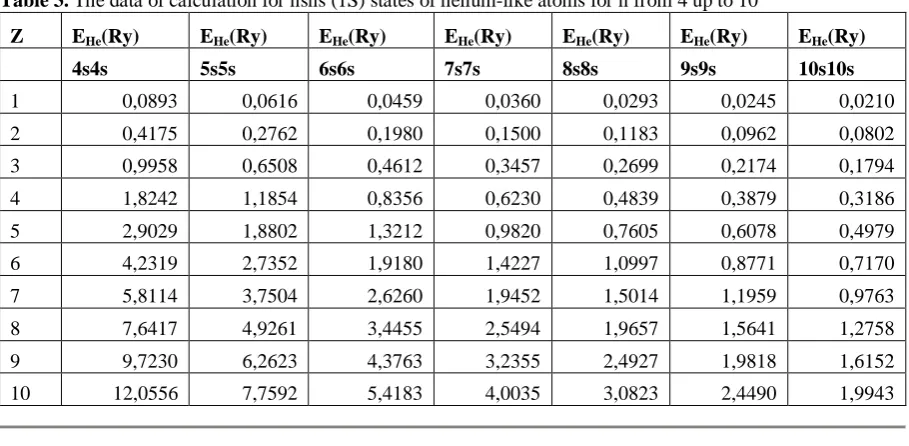
formula (6), in the supposition, that C = 1/9, are given in table1 for those of nsns (1S) states, for which the experimental data are known . Goodness of fit of cal-culations with experiment quite satisfactory, taking into account errors of measurements and approxima-tions at calculaapproxima-tions. The data of the same calculation for a unknown for today nsns (1S) states at n from 4 up to 10 and Z from 1 up to 10 are given as an exam-ple in a table 3.
Table 3.The data of calculation for nsns (1S) states of helium-like atoms for n from 4 up to 10
Z EHe(Ry) EHe(Ry) EHe(Ry) EHe(Ry) EHe(Ry) EHe(Ry) EHe(Ry) 4s4s 5s5s 6s6s 7s7s 8s8s 9s9s 10s10s 1 0,0893 0,0616 0,0459 0,0360 0,0293 0,0245 0,0210 2 0,4175 0,2762 0,1980 0,1500 0,1183 0,0962 0,0802 3 0,9958 0,6508 0,4612 0,3457 0,2699 0,2174 0,1794
4 1,8242 1,1854 0,8356 0,6230 0,4839 0,3879 0,3186 5 2,9029 1,8802 1,3212 0,9820 0,7605 0,6078 0,4979 6 4,2319 2,7352 1,9180 1,4227 1,0997 0,8771 0,7170
7 5,8114 3,7504 2,6260 1,9452 1,5014 1,1959 0,9763 8 7,6417 4,9261 3,4455 2,5494 1,9657 1,5641 1,2758
9 9,7230 6,2623 4,3763 3,2355 2,4927 1,9818 1,6152 10 12,0556 7,7592 5,4183 4,0035 3,0823 2,4490 1,9943
3. Results
3.1. From a point of view of physics of the formula (4) and (5) result to exotic, i.e. in nonclassical relation of energy of interaction of charged parti les to a distance between them.
If in the formulas, obtained by us, to present n as a radius of atom r (remembering, that in hydrogen-like atoms r ~ n2), we shall receive for different parts of full energy of atom of relation
~ 1/rk ,
where for terms, calculated by the method VM1, k = 1,
that completely corresponds to the classical law of the Coulomb, and for correlation energy, k = 1/2. Thus here there is an additional interaction decreasing on a distance slower, than Coulomb force.
The additional calculations, carried out by us, have shown, that the relation ~ 1/r1/2, or accordingly ~ 1/n, occurs only in that case, when both electrons have identical general quantum numbers n. We found proofs of existence of similar relation of correlation energy from a general quantum number of external electrons not only in helium-like atoms, but also in at-oms with large number of electrons, and in molecules and crystals.
Technical sciences
87
interaction, but similar to interaction, which exist be-tween protons in the nucleus.
3.2. From a mathematical point of view it is obvious, that if in two-electron atom there were no nonclassical interactions, the method VM1 would give
precisiouly analytical solution of a three-body prob-lem. The simplicity of the formulas (4-8) allows to hope, that the analytical solution is possible and with taking into account of nonclassical interactions. It would become possible after an evaluation of correla-tion energy cor and constant C from certain general
principles.
3.3. From a practical point of view it is inter-esting, that since some value n usual Coulomb repul-sion electrons (decreasing as 1/n2) will become less additional not - Coulomb attractions (decreasing as 1/n). It can result in macroscopic case to join of elec-trons in certain stable or metastable structures - quasi-neutral (if number of electrons equally to number of positive ions) or charged, just as the protons are inte-grated in the charged nucleus. The similar processes could spontaneously happen in strong rarefied plasma of intersidereal space, in high layers of an ionosphere of the Sun, Earth and other cases, in which the large distances between charged parti les ( appropriate to the large values n ) are realized. It is possible, that the similar effects could explain at least some from anomalous plasma-like effects observed in atmosphere and an ionosphere, such as a ball lightning etc.
To receive a similar new states of substance in experiment, it is necessary, that the electrons of sub-stance were excited synchronously, i.e. had identical energy and identical values n in each instant . To the present moment not much of similar (doubly exited) states is obtained even for two-electron atoms . For molecules them it is known even less. Moreover both in case of atoms, and in case of molecules the values n are not reached yet value, at which the attraction be-tween electrons exceeds a repulsion bebe-tween them. In case of macroscopic skew fields the problem of syn-chronous excitation of electrons up to maximum large n till now not to pose, though technically it is not unat-tainable, since the similar problems are decided at creation of quantum generators of coherent electro-magnetic radiation.
Let's remind also, that the explanation of a su-perconductivity involves appearance of additional electron-electron attraction , which exceeds Coulomb repulsion under certain conditions.
Moreover there are the direct analogies be-tween additional correlation energy of electrons in su-perconductors and additional correlation energy of electrons in separate atoms in the literature (see for example [3]), and the Cooper pair sometimes is repre-sented as two electrons moving round an induced positive charge, and is compared to atom of a helium.
All of this makes probablis bose-einstein con-densation of synchronously excited electrons both in atoms, and in macroscopic skew fields from that
mo-ment, when not - Coulomb attraction of electrons will begin to exceed Coulomb repulsion. The similar su-perconductivity already could be named super-high-temperature.
Conclusion
The approach based on separation of full en-ergy of multielectron systems on classical Coulomb and nonclassical not - Coulomb parts, allows on the one hand to simplify calculations, and with another -to see interesting regularities, which were not visible at use of more complex methods. Most interesting is the discovery of that fact, that under certain conditions electron-electron attraction exceeds electron-electron repulsion. The most important practical consequence it is the capability of existence of ordered structures of a new type in the special way exited substance.
References:
1. G. Tanner et al., Reviews of Modern Physics April 2000 (Volume 72, Issue 2) p.497
2. Bethe H.A., SalpeterE.E., Quantum Mechanics of One- and Two- Electron Atoms, New York, 1957, 562p.
3. Emsley J. The Elements, Oxford, Clarendon press, 1991, 256p.
4. NIST Standard Reference Database
http://www.physics.nist.gov/PhysRefData/ASD/index. html
5. S.Buckman and C.Clark, Reviews of Modern Physics 1994 (Volume 66, Issue 2) p. 539
6. P. J. Hicks and J. Comer, J. Phys. B: At. Mol. Phys. 1975,Volume 8,Number 11, p.1866
7. M. Rodbro et al., J. Phys. B: At. Mol. Phys.
1979, Volume 12, Number 15, p.2413
8. H.A.Sakaue et al., J. Phys. B: At. Mol. Opt. Phys.1991, Volume 24, Number 17, p.3787
9. K. Iemura et al., Physical Review A – Decem-ber 2001 (Volume 64, Issue 6) p.062709
10. M. Mack et al., Physical Review A – 15 April 1989 (Volume 39, Issue 8) p. 3846
11. D. H. Oza et al., J. Phys. B: At. Mol. Opt. Phys.1988, Volume 21, Number 6, p.L131
The work was submitted to international scientific conference «Prospects for the development of univer-sity science», Dagomys (Sochi), 20-23 September 2008, came to the editorial office on 01.09.2008.
POLYMER-IMPREGNATED CONCRETE BASED ON WATER DISPERSION OF VINYL
CHLORIDE Kondrashov G.M.
Non-State Educational Establishment of continuing professional education “Academy of business and
property management” Volgograd, Russia
con-CONTENTS
Technical sciences
88
tent of the polymer the kinetics of polymer concrete decomposition in acid media has been investigated.
The data got at the investigation of the air con-tent dependence on the polymer-cement ratio in the mortar modified by -65 (Fig.1) tes-tify that in the area conforming to 7-10% content of the polymer from the cement mass the decrease of air entrainments and increase of the forming closed pores number, the result of which is receiving the polymer-cement frame possessing maximal chemical durabil-ity.
The possibility of cement systems lifetime in-crease in aggressive media owing to their modification by chemically resistant water dispersion has been es-tablished in principle.
For the purpose of establishing modified con-cretes’ corrosion resistance the tests in various aggres-sive media: nitric, sulfuric and hydrochloric acids and also solutions of sodium chloride and sulfate, were carried out. The corrosion resistance was estimated on the modified materials’ strength properties loss, when cured in 10% aggressive medium.
Due to the carried out experiments it is estab-lished that on the intensity degree of the effect on the modified mortars’ physical and mechanical properties the investigated aggressive media represent the fol-lowing comparative range: hydrochloric acid > sulfu-ric acid > nitsulfu-ric acid > sodium sulfate > sodium chlo-ride > benzine. In salt solutions the modified materi-als’ durability increases considerably compared to the non-modified ones.
The mathematical treatment of the experimen-tal data inclusive of the works performed by the re-search workers of A.F. Polak’s school, Ivanov F.M., Rozental N.K. and others allowed the author to sug-gest a calculation formula for the modified concretes’ and mortars’ durability definition depending on the aggressive agents in the exploitation medium:
2
0 0
1
L
L
, (1)
where - is the aggressive substance concentration in the exploitation medium; L – the thickness of the con-struction being subjected to the exploitation medium’s aggressive effect, (cm); L0 – the laboratory sample
thickness (4 cm);A0 – the constant defined
experimen-tally by the errors sum-of-squares minimization on the formula ( 0 <0):
2 2
1
1 0
0
)
ln(
i i M
i i
i i i
t
S
S
t
A
, (2) whereSi– is the sample strength [kg/cm2] after being
cured in the aggressive medium for the time ti; m – the
number of measurements carried out for every sample;
S0 – the sample strength initial value [kg/cm2]; – the
mortar concentration (0< <1).
The established functional dependence and corrosion resistance of the modified mortars and con-cretes in acidic and salt aggressive media allow fore-casting a material’s lifetime and, consequently, struc-tural units’ durability as a whole at the anticorrosion protection design stage already.
The work was submitted to international scientific conference «Prospects for the development of univer-sity science», Dagomys (Sochi), 20-23 September 2008, came to the editorial office on 11.08.2008.
TECHNICAL SILICON REFINING Nemchinova N.V.
Irkutsk State Technical University Irkutsk, Russia
Silicon is widely used in various branches of industry. So, due to its ability to create valuable alloys with unique properties Si is used for making rust-resistant pipes when obtaining silicon steel for electri-cal industry, in transformer, instrumental, corrosion-resistant, heat-proof, spring, constructive and other steels. Silumins (silicon and aluminum alloys) applied in space and aviation, automobile, instrument-building and other industries; corrosion-resistant silicon bronzes, silicon and magnesium alloys, abrasive mate-rials based on silicon carbide are widely known. Sili-con is used for the production of a wide range of or-ganic silicon compounds. The ultrapure Si – is the main semi-conducting material for transistors, current rectifiers, radio waves enhancers, controllers, elec-tronic chips for computing devices. Silicon serves as the basic material for making photoelectric converters (PEC) as well [1].
The technical (metallurgical) silicon (Sitech) is
obtained by the carbo-thermal method out of silica-containing raw material in electric arc furnaces on the general reaction: SiO2+2C=Si+2CO [2,3]. The Sitech
obtained at the melting process dissatisfy the con-sumer requirements on the ultimate product chemical purity. That is why refining is practiced nowadays.
A complex operation of refining should reduce the content ofAl, Ca, Fe,Ti and other admixtures in the silica and also fully remove small and big slag pockets. The silicon refining methods (those not intro-duced into production as well) at the national and overseas plants are based on the following physical and physico-chemical phenomena:
- the slag separation by settling the liquid for coagulation and separation of small inclusions into a single phase;
- the slag separation by the silicon remelting and settling an additive agent of the degassing flux;
Technical sciences
89
the same with an additive oxidative agent
-O2 and transfer of the admixtures (Ca, Al and others,
for example) into oxides passing into slag;
- the purification of powdery silicon in solid by halogens, chlorhydric or sulphuric acids, etc.; the ul-timate product being the refined silicon powder;
- the silicon treatment in plasma.
The main method ofSitech commercial refining
at the CJSC “Kremny” (Shelekhov, Irkutsk Region) – is the oxidizing-flux one performed in scoops by air blowing (with adding siliceous sand as the flux) [4]. We carried out the pilot plant tests on the operating equipment of the enterprise by two refining methods. 1. The refining ofSitech by the oxidating method with
the following crystallization was performed at the fol-lowing parameters: the compressed air flow = 29-34 m3/h; the melt temperature = 1550-15700 ; the gas-and air mixture supply increase up to 0,6 ; the blowing time = 16 hours; the silicon crystallization pe-riod = 48 hours.
2. The refining of Sitech by the oxidating
method by blowing the melt with oxygen-rich air was performed (without adding fluxes) at the following process variables: the pressure in the oxygen and com-pressed air supply lines 0,5 ; the melt tempera-ture = 1472-14810 ; the refining time (average) = 1,5 hours; the consumption indices of oxygen, com-pressed air, m3/h, accordingly: 4; 19,5. After the car-ried out tests the degree ofSitech refining from
princi-pal impurities made, %, accordingly: on the first method -Fe - 97,27;Al - 95,5;Ca - 99,64; on the sec-ond method –Fe - 6,7-8,2;Al- 70; - 94,95.
Thus, the silicon refining procedures suggested allow obtaining refined silicon of high chemical purity without significant changes of the process flow sheet existing at the plant.
The work was supported by the program of the Ministry of Education and Science of the Russian Federation «Development of Science Potential in Higher Education (2006-2008)», project no. RNP 2.1.2.2382.
References:
1. Nemchinova N.V., Klyots V.E., Ne-pomnyashchikh A.I. Silicon in XXI century // Basic research – M.: Academy of Natural History, 2006 – N12 – pp. 13-17.
2. Technical silicon melting technology / under the editorship of Katkov O.M. – Irkutsk: CJSC “Kremny”, 1999 – p. 245.
3. Popov S.I. Silicon metallurgy in three-phase ore-smelting furnaces – Irkutsk, 2004 – p. 237.
4. Borisov, N. Nemchinova, S. Popov. The sili-con production technology improving for its applica-tion extending // Proceedings of the Internaapplica-tional Sci-entific Conference «Silicon for the Chemical nd So-lar Industry IX», Oslo (Norway), June 23-26, 2008. – Trondheim: NTNU, 2008. – P. 37-50.
The work was submitted to international scientific conference «Manufacturing Technology», Italy
(Rome, Florence), September, 9-16, 2008, came to the editorial office on 23.07.2008
ADVANCED FEATURES OF OIL-BEARING STRATA VERTICAL AND LATERAL HETEROGENEITY MAPPING AND STUDYING
USING INFORMATION MEASURES Ozhgibesov V.P., Belyayeva O.V.
Perm State University Perm, Russia
As a rock characteristics heterogeneity meas-ure in a vertical geological cross section the coeffi-cient of relative entropy (Pelto, 1954; Yaglom, Yag-lom, 1960; Dementyev, Khitrov, 1966; Ozhgibesov, 1975) was used.
N
p
ilog
log
p
n
1 i
i
(1), where – is the coefficient of relative probability entropy (coefficient of facial heterogeneity); n – the number of group intervals of the measured parameter; pi – the probability of the observation result fall within
the i-th group interval; N – the number of group inter-vals of the measured parameter (here N=10, that is why the denominator represented as a common loga-rithm is equal to 1).
The first extremal case. The petrophysical rock properties parameters’ amplitudes have been studied on the bore well logs.
It goes from the formula (1) that at n = 10 and pi = 0,1 the value is equal to 1. In the calculations
we used the logarithm to base 10. The considered case conforms to themaximal heterogeneity of the vertical section of the isochronal stratigraphic range chosen. The number of facial rock types is equal to 10.
The second extremal case. If the vertical sec-tion is homogeneous, all the values of amplitudes in the well log fall within the same grouping class. In this case pi = 1, and the value is equal to zero, as
log 1 = 0. The number of facial rock types in the verti-cal section is equal to 1.
Present-day computer technologies allow get-ting in the shortest time such vertical section hetero-geneity complementary information, which is impos-sible to get in other ways. This heterogeneity can also be mapped.
For the geological section heterogeneity prob-lem solution on the GC, OGC, SP and RC diagrams we applied the computer programs, which allow ana-lyzing and interpreting the well information quickly using standard petrophysical algorithms and also mak-ing the relative section entropy map.
re-CONTENTS
Technical sciences
90
flecting the geological system heterogeneity. This ad-vantage consists in the fact that the number of facial rock types, which are taken into consideration, when lateral variability of the facies evaluated by informa-tion measures theoretically unlimitedly (as distinct from the traditional method of drawing facial maps on the basis of lithological triangles).
The value allows coming to the conclusion about facial heterogeneity of the vertical geological section in every well, and also studying the heteroge-neity index variability in the studied area on the pa-rameter value, which changes from 0 to 1. When using this extremely formalized information parameter, the lithology on the direct core sample observations should be taken into account, as = 1 forany homo-geneous stratum. For example, for homohomo-geneous po-rous sandstone and homogeneous dense argillite the value will be the same. Rocks are indistinguishable on this formalized characteristic.
With the appearance of special computer pro-grams allowing representing a well log automatically in the form of a discrete series of points and compos-ing a histogram on the basis of these data in the preset number of grouping classes the possibilities of study-ing vertical and lateral heterogeneity of a geological section by information measures have increased.
The source material presentation and its further computer treatment procedure described here allow solving the problems, which couldn’t be solved earlier because of the labour intensity and duration of meas-uring and computation operations (Ozhgibesov, 1975). However, it should be borne in mind that the beginning of the problem solution and the problem definition itself consist in the substantiation and choice of a concrete stratigraphic interval with iso-chronal (or relative isoiso-chronal) boundaries of its bot-tom and roof. The analysis and final conclusions about the multivariable lithologic-petrophysical heterogene-ity of the vertical section and its lateral variabilheterogene-ity should be made only with due account for (probably, simplified) the three-dimensional lithlogic-petrophysical model of the studied territory.
Gratitude. The authors thank the Geological Department of the Perm University for the support of the participation of creative collective of students and teachers in the projects of the Russian and European Academies of natural History.
The work is submitted to the International scientific conference "Modern science technology", Tenerife, Spain, November, 20-27, 2008, came to the editorial office on 06.09.2008.
BASIC RESULTS OF WORKING OUT AND INTRODUCTION OF TECHNOLOGIES OF DESTRUCTION OF FRAGILE MATERIALS
WITH APPLICATION OF PLASTIC SUBSTANCES IN MINING AND BUILDING
Tsygankov D.A.
Institute of Mining of Siberian Branch of Russian Academy of Sciences
Novosibirsk, Russia
Plastic substances for the purpose of destruc-tion of natural or artificial brittle materials came into use comparatively not long ago. Despite of this fact there are concrete results briefly expressed in the fol-lowing in this area.
The working out and realization of the brittle materials destruction technologies using plastic sub-stances in industry should be connected with the initial definition and subsequent regard for a complex of fac-tors reflecting the specificity of objective and subjec-tive operasubjec-tive conditions.
The projecting of technologies of crushing firm formation lumps with drop-weight using plastic substances in conditions of mineral deposits exploita-tion open-cut mining method will be connected with: the necessity to use mining engineering able to pro-duce high impact energies; the provision of destruc-tion directivity elements absence by means of using smooth wading rods, the lack of the necessity to use estuarine parts and shot hole walls sealing; the use of maximally possible hole depth filled up with a plastic substance. Thereat, because of weight dropping height limitations there will be restrictions on maximum di-mensions of the lump, the destruction of which takes place along the whole length of the hole drilled in it and filled up with a plastic substance practically si-multaneously.
The projecting of technologies of crushing av-erage and low strength formation lumps with a hy-draulically and pneumatically operated hammer using plastic substances in conditions of mineral deposits exploitation open-cut mining method will be con-nected with: the possibility to use mining engineering producing lesser impact energies; the provision of de-struction directivity elements absence by means of us-ing smooth wadus-ing rods; the lack of the necessity to use estuarine parts and shot hole walls sealing; the use of maximally possible hole depth filled up with a plas-tic substance. Thereat, because of the tractor chasses-mounted hydraulically and pneumatically operated hammer raising possibilities limitations there will be restrictions on maximum dimensions of the lump, the destruction of which will take place in the contact point of the hydraulically and pneumatically operated hammer rod (lance) and plastic substance in the shot hole at its gradual moving from the estuarine part to the face one.