Original Research Article
Knowledge of basic life support among health care professionals in a
tertiary care hospital in Chitradurga
Somarouthu Rajashekar
1*, Nagendra Gowda M. R.
2, Ajith Anthony
3INTRODUCTION
Cardiovascular diseases are the major public health concern worldwide. Sudden cardiac death (SCD) which is often the first manifestation of cardiovascular disease, is also the most common cause of death worldwide.1 Survival after cardiopulmonary arrest is usually low and depends on early intervention, quality of cardio-pulmonary resuscitation (CPR) and time of initiation of defibrillation post cardiac arrest. Basic life support (BLS)
is a key component of chain of survival. It decreases the chance of mortality.2 Invented in 1960, CPR is a simple but effective procedure that allows almost anyone to sustain life in the early critical minutes after cardiac and respiratory arrest. BLS includes both prompt recognition, immediate support of ventilation and circulation in case of respiratory or cardiac arrest.3
A 70% of out-of-hospital cardiac arrests (OHCAs) occur in the home and approximately 50% are un-witnessed. Outcome from OHCA remains poor. Only 10.8% of adult
ABSTRACT
Background: Cardiovascular diseases are the major public health concern worldwide.Survival after cardiopulmonary
arrest is usually low and depends on early intervention, quality of cardiopulmonary resuscitation (CPR) and time of initiation of defibrillation post cardiac arrest. Basic life support (BLS) is a key component of chain of survival. The aim of the study was to assess the knowledge of medical students, doctors, nursing students, nursing staff in Basic Life Support.
Methods: A cross sectional study was conducted in Basaveshwara Medical College and Hospital. Those who were
willing to participate in the study and who gave informed consent, were administered a self-filling written questionnaire. A total of 400 people were administered the questionnaire, out of which 388 filled the Performa completely.
Results: This study was conducted to evaluate knowledge of basic life support among 388 health care professionals
took part in the study of which 64.5% were medical students, 8.7% were doctors, 10.3% were nursing staff and 16.5% were nursing students. The study revealed that there is poor knowledge of basic life support among the respondents and 76% of them wanted basic life support to be included in the curriculum.
Conclusions: Awareness and knowledge about basic life support is mandatory among health care professionals as they encounter such situation on a daily basis and will help them a long way in saving lives, thus knowledge in basic life support is very essential as health care professionals will get exposed to such situation more often.
Keywords: Basic life support, Health care professional, Newborn care
Department of Community Medicine, 1Kanachur Institute of Medical Sciences, Mangalore, 2Basaveshwara Medical College and Hospital, Chitradurga, Karnataka, India
3
Basaveshwara Medical College and Hospital, Chitradurga, Karnataka, India
Received: 05 June 2018
Revised: 20 July 2018
Accepted: 21 July 2018
*Correspondence:
Dr. Somarouthu Rajashekar, E-mail: [email protected]
Copyright: © the author(s), publisher and licensee Medip Academy. This is an open-access article distributed under
the terms of the Creative Commons Attribution Non-Commercial License, which permits unrestricted non-commercial use, distribution, and reproduction in any medium, provided the original work is properly cited.
patients with non-traumatic cardiac arrest who have received resuscitative efforts from emergency medical services (EMS) survive to hospital discharge. In-hospital cardiac arrest (IHCA) has a better outcome, with 22.3-25.5% of adults surviving to discharge.4
BLS is the foundation for saving lives after cardiac arrest. Fundamental aspects of adult BLS include immediate recognition of sudden cardiac arrest and activation of the emergency response system, early CPR, and rapid defibrillation with an automated external defibrillator (AED). Initial recognition and response to heart attack and stroke are also considered part of BLS.4
It is important that at least the health care professionals should know about the basic life support as they encounter such situation often.2 Such emergency situation can occur almost on daily basis in a hospital setting. Various studies have been carried out to assess the level of knowledge and attitude towards BLS among health care providers, which reflects its importance in the emergency care of the patients.5,6 The knowledge of BLS (CPR) is a major determinant in the success of resuscitation and plays a vital role in the final outcome of acute emergency situation.5 Hence the current study was conducted with the aim to assess the knowledge of medical students, doctors, nursing students, nursing staff in basic life support and objectives to assess the knowledge of medical students, doctors, nursing staff and students in BLSand to understand the ways in which the current knowledge can be expanded.
METHODS
A cross sectional study was conducted in Basaveshwara Medical College and Hospital after obtaining the ethical clearance from the institutional ethical committee for period of 2 months from June 2016 to July 2016, using convenient sampling technique. All the doctors, medical students, nursing staff of Basaveshwara medical college
and of nursing college students studying in S.J.M. Institute of Nursing Science, Chitradurga, were included in the study after obtaining permission from the concerned head of the institutions. Those who were willing to participate in the study and who gave informed consent, were administered a pretested and predetermined self-filling written questionnaire in local language. There were 21 questions in the study questionnaire, which included information regarding the levels of knowledge and skills involved in basic life support (BLS). Questions including abbreviation of BLS, AED (automated external defibrillator) and EMS (emergency medical service), sequential steps in BLS, assessment and resuscitation techniques with regard to airway, breathing, circulation in unresponsive victims of different age groups, techniques regarding removal of foreign body obstruction, recognition of early signs of stroke and acute coronary syndrome were present in questionnaire. The information regarding the ways by which the current knowledge of BLS could be improved (whether by including BLS in curriculum, attending workshops, watching videos or by reading books) was also obtained. A total of 400 people were administered the questionnaire, out of which 388 filled the proforma completely. The data thus obtained is analysed using SPSS software version 22 and results were given in percentages.
Statistical analysis
The data was compiled and analysed using Microsoft (MS) Excel work sheet. For categorical data, the number and percentage were used in the data summarized. Data is presented in tables and graphs.
RESULTS
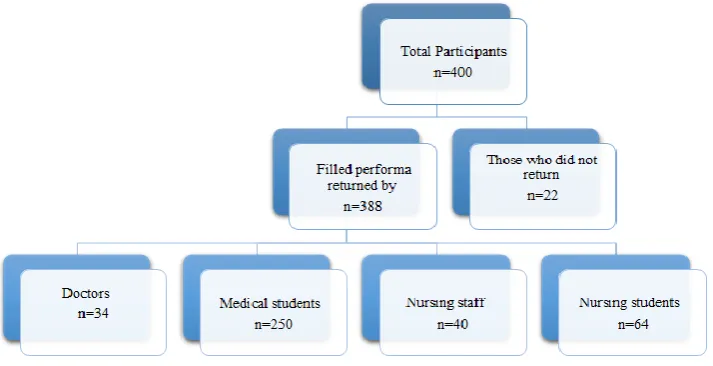
Of the 388 who gave completed questionnaire, 250 (64.5%) were medical students, 64 (16.5%) were nursing staff, 40 (10.3%) were nursing staff and 34 (8.8%) were doctors (Figure 1).
Table 1: Knowledge regarding abbreviations associated with basic life support.
Question
Percentage of correct answers from the respondents
Doctors (n=34) (%)
Nursing staff (n=40) (%)
Medical students (n=250) (%)
Nursing students (n=64) (%)
1.Who knew the abbreviation of BLS 31 (91.7) 29 (72.5) 187 (74.8) 56 (87.5)
2.Who knew the correct abbreviation of AED 27 (79.41) 8 (20) 28 (11.20) 11 (17.18)
3.Who knew the abbreviation of EMS 26 (76.47) 27 (67.50) 108 (43.2) 46 (71.87)
Table 2: Knowledge regarding basic steps of BLS.
Question
Percentage of correct answers from the respondents
Doctors (n=34) (%)
Nursing staff (n=40) (%)
Medical students (n=250) (%)
Nursing students (n=64) (%)
1.Who knew the 1st step of BLS 10 (29.4) 10 (25) 90 (36) 17 (26.6)
2.Who knew the correct steps of BLS 11 (32.35) 6 (15) 84 (33) 9 (14.06)
Table 3: Information about correct location of chest compression in BLS and CPR and rescue breathing.
Question
Percentage of correct answers from the respondents
Doctors (n=34) (%)
Nursing staff (n =40) (%)
Medical students (n =250) (%)
Nursing students (n=64) (%)
1.Who knew the correct location of chest
compress in adults 13 (38.28) 8 (22.5) 120 (48) 13 (20.31)
2.Who knew the correct location Of chest
compression in neonates 11 (29.4) 11 (27.5) 60 (24) 18 (28.12)
3.Who knew that they should not stop CPR 25 (73.5) 9 (22.5) 53 (21.2) 11 (17.18)
4.Who knew the correct information about
rescue breathing in infants 12 (35.3) 9 (22.5) 57 (22.8) 11 (17.18)
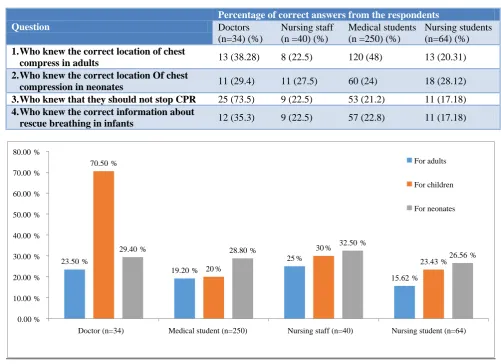
Figure 2: Information about correct depth of chest compression in CPR for adults, children and neonates.
A 91.17% of doctors knew the abbreviation of BLS whereas 74.80% of medical students knew the abbreviation of BLS. A 87.50% of nursing students and 72.50% of nursing staff knew the abbreviation of BLS. When asked for abbreviation of AED, 79.41% of doctors,11.20% medical students, 20% of nursing staffs
and 17.18% of nursing students answered it correctly ie, Automated External Defibrillator. Similarly when asked regarding correct full form of EMS (emergency medical service) 76.47% of doctors,71.87% of nursing students, 67.5% of nursing staff and only 43.2% of the students knew it (Table 1).
%
23.50
19.20 %
% 25
15.62 % 70.50 %
% 20
% 30
% 23.43 %
29.40 28.80 %
% 32.50
% 26.56
0.00 % 10.00 % 20.00 % 30.00 % % 40.00
% 50.00 60.00 %
% 70.00
% 80.00
Doctor (n=34) Medical student (n=250) Nursing staff (n=40) Nursing student (n=64) For adults
For children
In the study conducted, 29.40% of doctors, 36% of medical students, 25% of nursing staff and 26.56% of nursing students reportedly knew that scene safety was the first step of basic life support. Regarding the steps of BLS only 32.35% of doctors and 33% of medical students knew that when a patient is unresponsive even after shaking and shouting, they are supposed to activate EMS immediately before they start CPR. Only 15% of nursing staff and 14.06% of nursing students knew they had information about this (Table 2).
Information about correct location of chest compression in BLS and CPR and rescue breathing
In the present study, it was found out that 38.28% of doctors reported that they knew the exact location of chest compression in adults, whereas 48% of medical students reportedly knew the correct location of chest compression in adults. The percentage of nursing staff and nursing student who knew this is 22.50% and 20.31% respectively. A 70.60% of doctors did not know the correct location of chest compression in neonates. A 76% of medical students, 73.50% of nursing staffs and 71.88% of nursing students also did not know the exact location of chest compression of neonates (Table 3).
Present study revealed that, 73.50% of doctors knew that they are not supposed to stop giving CPR even though they do not want to give mouth to mouth respiration. Only 21.20% of medical students knew about this information, whereas 22.50% of nursing staff and 17.18% nursing students knew that they are not supposed to stop CPR. Only 35.30% doctors knew that they are supposed to give mouth to mouth and nose rescue breathing for infants whereas only 22.80% medical students, A 22.50% nursing staffs, 17.18% nursing students know that they supposed to give mouth to mouth and nose rescue breaths (Table 3).
Information about depth of chest compression in CPR for adults, children and neonates
Through our study we found out that, only 23.50% doctors, 19.20% medical students, 25% nursing staff, 15.62% nursing students knew the correct depth of compression to be given in CPR to an adult. 70.5% of doctors, 20% of medical students, 30% of nursing staff and 23.43% of nursing students knew the correct depth of compression to be given in CPR to a child. 29.40% of doctors, 28.8% of medical students, 32% of nursing staff and 26.56% of nursing students knew about the correct depth of compression to be given in CPR to a neonate (Figure 2).
Information about rate of chest compression and ventilation compression ratio
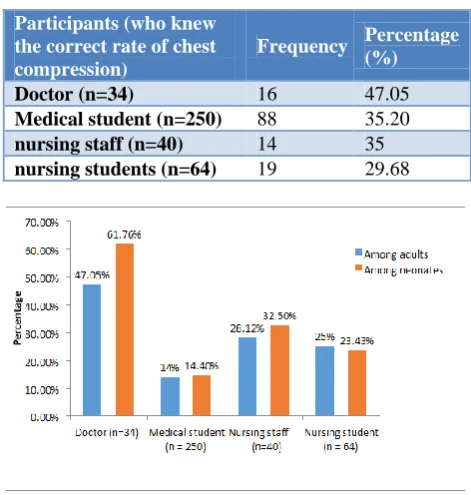
Total of 52.95% of doctors did not know the rate of chest compression during CPR. 64.80% of medical students did not know the rate of compression, 65% nursing staff and
70.32% of nursing students also did not know the rate of chest compression during CPR (Table 4).
Table 4: Information about rate of chest compression.
Participants (who knew the correct rate of chest compression)
Frequency Percentage
(%)
Doctor (n=34) 16 47.05
Medical student (n=250) 88 35.20
nursing staff (n=40) 14 35
nursing students (n=64) 19 29.68
Figure 3: Information about ventilation compression ratio by single rescuer in BLS.
Only 47.05% of doctors knew that the ventilation perfusion ratio in case of single rescuer for an adult victim is 30:2. Only 14% of medical students, 28.12% nursing staffs and 25% of nursing students had knowledge regarding this question. in new born the chest compression: ventilation ratio is 3:1 which only 61.76% doctors, 14.40% medical students, 32.50% of nursing staff and 15.62% of nursing students knew that the in new born the chest compression: ventilation ratio is 3:1 (Figure 3).
Information about choking and drowning and cardio vascular emergencies
Table 5: Information about choking and drowning and cardiovascular emergencies.
Question
Percentage of correct answers from the respondents
Doctors (n=34) (%)
Nursing staff (n=40) (%)
Medical students (n=250) (%)
Nursing students (n=64) (%)
1.Who knew the correct initial step to be
taken in case of choking 18 (52.29) 12 (30) 39 (15.6) 11 (7.18)
2.Who knew the correct steps to be taken
when an infant starts choking suddenly 25 (73.52) 10 (25) 111 (44.4) 12 (18.75)
3.Who knew about keeping in recovery
position post drowning 10 (29.4) 4 (10) 11 (4.4) 5 (7.81)
4.Who knew about the symptoms of stroke
and measures to be taken 28 (82.35) 15 (37.5) 84 (33.6) 15 (23.43)
5.Who knew the symptoms of myocardial
infarction 32 (94.11) 17 (42.5) 92 (36.8) 14 (21.87)
A majority of 82.35% of doctors, a 33.60% of medical students, 37.50% of nursing staff and 23.43% of nursing students indentified that when a person develops sudden slurring of speech and weakness of upper limbs, it is a possibility of stroke and that person might require thrombolysis and hence activation of emergency medical services is required. A majority of 94.1% of doctors identified the symptoms of myocardial infarction (retrosternal chest discomfort, profuse sweating and vomiting in a 50 year old patient). A 36.8% of medical students, 42.5% of nursing staff and 21.87% of nursing students identified the symptoms of myocardial infarction (Table 5).
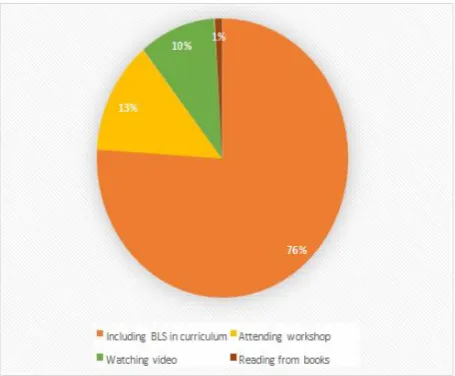
Figure 4: Participants’ response to the ways in which the current knowledge of BLS can be improved.
Feedback from the study population
A 76.03% participants wanted BLS to be included in the curriculum, 13.14% wanted to improve their knowledge by attending workshops, 9.79% wanted to improve by watching videos related to the information of BLS and 1.03% wanted to improve by reading about BLS from books.
DISCUSSION
It is essential that every individual in the community should be aware of Basic Life Support to save lives as well as improve the quality of community health. It is all the more important for the health care professionals to know about basic life support as the encounter such situation on daily basis. Performing chest compressions at the correct location increases the likelihood of enhancing coronary circulation and lessens the risks of accompanying complications such as rib fractures. Also the depth, rate and interruption duration of the compressions directly influence the outcome of cardiac arrest.1
The present study was conducted to assess the knowledge about basic life support, 388 participants participated in the study. 250 participants were medical students, 34 were doctors, 40 were nursing staff and 64 were nursing students who took part.
The study used a standard questionnaire6 for assessing the knowledge contained questions about the abbreviation of BLS, AED and EMS, sequential steps in BLS, assessment and resuscitation techniques with regard to airway, breathing and circulation in unresponsive patients of different age groups, techniques regarding removal of foreign body obstruction.
found to have better knowledge of BLS when compared to other groups, but still there is scope for betterment. In some of the questions, nurses fared better than medical students. This may be due to more practical exposure. The present study showed that majority of the participants prefers to include basic life support in curriculum to increase the knowledge about basic life support (Figure 4).
The review of literature showed that, the observations in our study were consistent with already existing literature. In the study conducted by Almesned et al the scores of the respondents were very poor with 49.6% of the respondents scored less than 50%.1 In our study we found better results with respondents scoring 60% in majority of the questions.
Alsayil et al in their study found that 59.6% of the respondents were not having sufficient knowledge regarding basic life support and how to attend the emergencies.5 These findings are consistent with our results.
Chandrasekaran et al in their study found that awareness of basic life support (BLS) among students, doctors and nurses of medical, dental, homeopathy and nursing colleges is very poor with 84.82% of the respondents scoring less than 50% which is huge void and our studies substantiate the findings.6
A study was conducted by Sharma Rand Attar, regarding adult basic life support awareness and knowledge among medical and dental interns passing out from K.S. Hegde Medical College, Mangalore. It showed that even though almost all interns had heard about BLS, the correct knowledge regarding BLS was lacking among them.7 Similar to the findings of the current study.
Zaheer et al conducted a study in Karachi, Pakistan among under graduate medical students in Karachi, Pakistan, regarding their awareness of BLS. It was found that around 60% of them had no knowledge of BLS. The authors concluded that inclusion of BLS course would increase awareness and application of this valuable lifesaving maneuver.8 Which reinstates the results we found in our study.
Raghavan and group from resuscitation council of southern Africa, analyzed the level of knowledge and skill in basic resuscitation among medical practitioners and tried to determine the differences in characteristics between those with and without knowledge and skills. In this cross sectional study they also found poor knowledge and skills of basic resuscitation among medical practitioners as less than 25% of them scored more than 50% marks.9 Our results were also on the similar lines.
CONCLUSION
Awareness and knowledge about basic life support is mandatory among health care professionals as they encounter such situation on a daily basis, and will help them a long way in saving lives. Such situations not only occur at hospital settings but can also occur at outdoor settings (Anywhere), thus knowledge in basic life support is very essential as health care professionals will get exposed to such situation more often. This study focused on the evaluation of knowledge of basic life support among health care professionals.
This study showed that there is a lack of knowledge about basic life support among health care professionals (doctors, nursing staffs, medical student, nursing students), which is also reflected in studies conducted elsewhere. A 76% of the participants opined that by including the topic basic life support in the curriculum would improve the knowledge of BLS among the medical and paramedical professionals.
Recommendations
The study highlights the importance of conducting workshops and seminars on Basic Life support and including Basic life support in the routine academic curriculum wherein the students can be trained in the essential and life-saving component in the chain of survival.
Funding: No funding sources Conflict of interest: None declared
Ethical approval: The study was approved by the Institutional Ethics Committee
REFERENCES
1. Almesned A, Almeman A, Alakhtar AM, AlAboudi AA, Alotaibi AZ, Aldamegh MS. Basic life support knowledge of healthcare students and professionals in the Qassim University. Int J Health Sci, Qassim University. 2014;8(2):142-6.
2. Roshana S, Batajoo KH, Piryani RM, Sharma MW. Basic life support: knowledge and attitude of medical/paramedical professionals. World J Emerg Med. 2012;3(2):141-5.
3. Aroor AR, Saya RP, Attar NR, Saya GK, Ravinanthanan M. Awareness about basic life support and emergency medical services and its associated factors among students in a tertiary care hospital in South India. J Emerg Trauma Shock. 2014;7(3):166–9.
5. Alsayil SN, Alzahran SM, Alhawiti WM. Awareness of basic life support among medical and nursing students at Tabuk University. Basic Res J Med Clin Sci. 2016;5(3):53-7.
6. Chandrasekaran S, Kumar S, Bhat SA. Awareness of basic life support among medical, dental, nursing students and doctors. Indian J Anaesthesia. 2010;54(2):121.
7. Sharma R, Attar NR. Adult basic life support (BLS) awareness and knowledge among medical and dental interns completing internship from deemed university. NUJHS. 2012;2:6-13.
8. Hassan Zaheer H, ZebaHaque Z. Awareness about BLS(CPR) among medical students status and requirements. JPMA. 2009;59:57-9
9. Raghavan S, Schneider H, Kloeck WGJ. Basic resuscitation-knowledge& skills of full time medical practitioners at public hospitals in northern province. SAMJ. 2000;90(5):50-8.
Cite this article as: Rajashekar S, Nagendra Gowda