© 2016 IJSRSET | Volume 2 | Issue 2 | Print ISSN : 2395-1990 | Online ISSN : 2394-4099 Themed Section: Science and Technology
Computational Techniques for the Functional Annotation of
Hypothetical ORFS in Human Chromosome 3
Sivashankari Selvarajan
1, Piramanayagam Shanmughavel
21Assistant Professor in UGC, Innovative Programme, Department of Bioinformatics, Nirmala College for Women, Coimbatore,
Tamil Nadu, India
2Associate Professor, Department of Bioinformatics, Bharathiar University, Coimbatore, Tamil Nadu, India
ABSTRACT
In biochemistry, a hypothetical protein encoded by a hypothetical gene is a protein whose existence has been predicted, for which there is no experimental evidence for expression in vivo. As a result, the function of such genes is not known. Despite several efforts, only 50-60 % of genes have been annotated in most completely sequenced genomes and their functions are known. The rest 40% of the genes in any genome is totally unknown in terms of its functions. As of September 2010, there are around 637 genes encoded as Hypothetical in NCBI. So, the present investigation focused on functional annotation of hypothetical genes in the Chromosome 3 of the Human Genome.
Keywords: Annotation, Chromosome3, Function, Hypothetical Genes
I.
INTRODUCTION
The human genome project revealed the three billion base pairs encrypted within the twenty three pairs of chromosomes in the human genome. Also, the Human Genome contains 30,000 genes, constituting just 1% of the ~3 billion base pairs of the total human DNA.
Among these, there are genes (called Hypothetical ORFs) which code for the so-called “hypothetical proteins” whose existence is either validated experimentally or predicted computationally but its function is not yet reported. Hence, after the completion of the genome sequences, the challenge ahead for all biologists is to use the data to interpret the function of the protein, the cell, and the organism. This can be achieved by a process called annotation which involves identification of genes within the chromosome, its fine structure, determination of protein products encodes by the gene and understanding the function (Venter et al., 2001). A group of these genes may be involved in many pathological disorders and hence are of pharmaceutical significance. Thus, annotation is an essential process of understanding the entire mechanism behind the cellular processes and molecular functions of a genome.
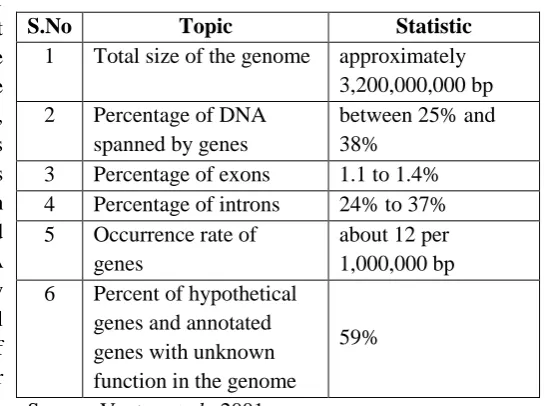
However, there were inconsistencies in the accuracy of genome annotation in the initial stages which are now gone due to advancements in computational algorithms and potentiality of bioinformatics. After annotation of the Human Genome a number of genes (59%) reported by the project were hypothetical and annotated genes with unknown function (Venter et al 2001) (Table 1).
Table 1.1 The Human Genome Statistics
S.No Topic Statistic
1 Total size of the genome approximately 3,200,000,000 bp 2 Percentage of DNA
spanned by genes
between 25% and 38%
3 Percentage of exons 1.1 to 1.4% 4 Percentage of introns 24% to 37% 5 Occurrence rate of
genes
about 12 per 1,000,000 bp 6 Percent of hypothetical
genes and annotated genes with unknown function in the genome
59%
As of September 2010, there are around 637 genes encoded as Hypothetical in NCBI. These hypothetical ORFs may be functionally important and play very important roles in growth, development and maintenance of Homo sapiens. Research is needed to unravel the function of these conserved hypothetical genes in Human to understand more about molecular mechanisms and biological significance of the entire Human Genome.
Among the 23 pairs of chromosomes in the human genome, Chromosome 3 spans almost 200 million base pairs and represents about 6.5 percent of the total DNA in cells. Identifying genes on each chromosome is an active area of genetic research. Because researchers use different approaches to predict the number of genes on each chromosome, the estimated number of genes varies. Chromosome 3 likely contains between 1,100 and 1,500 genes. Hence, the present work aims to investigate and predict the function of the Hypothetical genes in the chromosome 3 of the Human Genome using Computational approaches which will be a guide for experimental analysis. So, the present investigation focused on functional annotation of hypothetical genes in the Human Genome with the following Objectives:
1. To identify the uncharacterized hypothetical Genes in chromosome3 of the Human Genome.
2. To annotate the function of the uncharacterized hypothetical genes in the human Genome both at gene and Protein level.
3. To assign functional categories for the annotated hypothetical genes.
4. To assign transmembrane Topology and Sub-Cellular Localization for the unannotated Hypothetical Genes.
II.
METHODS AND MATERIAL
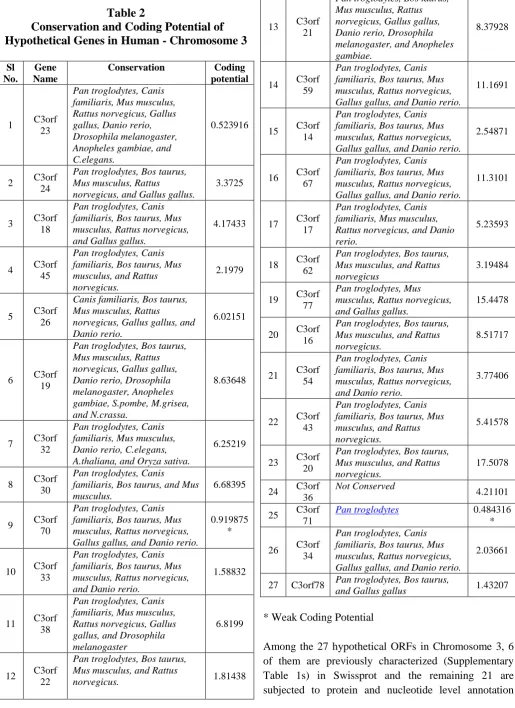
The Hypothetical ORFs in chromosome 3 of the Human Genome was retrieved from NCBI [Geer et al., 2010]. To identify whether the ORFs can actually be genes two strategies were followed. Initially, conservation of the ORF in other organisms was determined using Homologene [Geer et al., 2010] and then its coding potential was calculated using Coding Potential Calculator (CPC) [Lei Kong et al., 2007]. Conservation and coding potential were determined, because the ORFs
have a high probability to be functional if they are conserved and having a higher coding potential score.
Next, the annotation of the hypothetical genes which are conserved and with coding potential at the nucleotide level was done using BLAST2GO [Ana et al., 2005] with the following algorithm: Initially, the sequence was queried against BLAST to find homologs followed by mapping of the sequence with GO terms including running Interproscan. At the protein level, pfam [Robert et al., 2013] and supfam database[Pandit et al., 2002] were used to assign domains and superfamily to the hypothetical proteins. Finally, COG[Geer et al., 2010] and SCOP[Murzin et al., 2002] were used to assign functional category to the hypothetical genes. The transmembrane topology and subcellular localization were predicted for the unannotated hypothetical genes using TMHMM[Krogh et al., 2001] and PSort[Nakai and Horton, 1999 ]
III.
RESULTS AND DISCUSSION
CHROMOSOME 3
Table 2
Conservation and Coding Potential of
Hypothetical Genes in Human - Chromosome 3
Sl No. Gene Name Conservation Coding potential
1 C3orf 23
Pan troglodytes, Canis familiaris, Mus musculus, Rattus norvegicus, Gallus gallus, Danio rerio, Drosophila melanogaster, Anopheles gambiae, and C.elegans.
0.523916
2 C3orf 24
Pan troglodytes, Bos taurus, Mus musculus, Rattus
norvegicus, and Gallus gallus.
3.3725
3 C3orf 18
Pan troglodytes, Canis familiaris, Bos taurus, Mus musculus, Rattus norvegicus, and Gallus gallus.
4.17433
4 C3orf 45
Pan troglodytes, Canis familiaris, Bos taurus, Mus musculus, and Rattus norvegicus.
2.1979
5 C3orf 26
Canis familiaris, Bos taurus, Mus musculus, Rattus
norvegicus, Gallus gallus, and Danio rerio.
6.02151
6 C3orf 19
Pan troglodytes, Bos taurus, Mus musculus, Rattus norvegicus, Gallus gallus, Danio rerio, Drosophila melanogaster, Anopheles gambiae, S.pombe, M.grisea, and N.crassa.
8.63648
7 C3orf 32
Pan troglodytes, Canis familiaris, Mus musculus, Danio rerio, C.elegans, A.thaliana, and Oryza sativa.
6.25219
8 C3orf 30
Pan troglodytes, Canis
familiaris, Bos taurus, and Mus musculus.
6.68395
9 C3orf 70
Pan troglodytes, Canis familiaris, Bos taurus, Mus musculus, Rattus norvegicus, Gallus gallus, and Danio rerio.
0.919875 *
10 C3orf 33
Pan troglodytes, Canis familiaris, Bos taurus, Mus musculus, Rattus norvegicus, and Danio rerio.
1.58832
11 C3orf 38
Pan troglodytes, Canis familiaris, Mus musculus, Rattus norvegicus, Gallus gallus, and Drosophila melanogaster
6.8199
12 C3orf 22
Pan troglodytes, Bos taurus, Mus musculus, and Rattus
norvegicus. 1.81438
13 C3orf 21
Pan troglodytes, Bos taurus, Mus musculus, Rattus norvegicus, Gallus gallus, Danio rerio, Drosophila melanogaster, and Anopheles gambiae.
8.37928
14 C3orf 59
Pan troglodytes, Canis familiaris, Bos taurus, Mus musculus, Rattus norvegicus, Gallus gallus, and Danio rerio.
11.1691
15 C3orf 14
Pan troglodytes, Canis familiaris, Bos taurus, Mus musculus, Rattus norvegicus, Gallus gallus, and Danio rerio.
2.54871
16 C3orf 67
Pan troglodytes, Canis familiaris, Bos taurus, Mus musculus, Rattus norvegicus, Gallus gallus, and Danio rerio.
11.3101
17 C3orf 17
Pan troglodytes, Canis familiaris, Mus musculus, Rattus norvegicus, and Danio rerio.
5.23593
18 C3orf 62
Pan troglodytes, Bos taurus, Mus musculus, and Rattus norvegicus
3.19484
19 C3orf 77
Pan troglodytes, Mus musculus, Rattus norvegicus, and Gallus gallus.
15.4478
20 C3orf 16
Pan troglodytes, Bos taurus, Mus musculus, and Rattus norvegicus.
8.51717
21 C3orf 54
Pan troglodytes, Canis familiaris, Bos taurus, Mus musculus, Rattus norvegicus, and Danio rerio.
3.77406
22 C3orf 43
Pan troglodytes, Canis familiaris, Bos taurus, Mus musculus, and Rattus norvegicus.
5.41578
23 C3orf 20
Pan troglodytes, Bos taurus, Mus musculus, and Rattus norvegicus.
17.5078
24 C3orf 36
Not Conserved
4.21101
25 C3orf 71
Pan troglodytes 0.484316
*
26 C3orf 34
Pan troglodytes, Canis familiaris, Bos taurus, Mus musculus, Rattus norvegicus, Gallus gallus, and Danio rerio.
2.03661
27 C3orf78 Pan troglodytes, Bos taurus,
and Gallus gallus 1.43207
* Weak Coding Potential
using Superfamily database and BLAST2GO respectively. The results are tabulated in Supplementary Table 2.
From the table, it is evident that all the 6 super families within the hypothetical genes of the Chromosome 3 were identified with reasonable confidence using Superfamily database. Further, „C-type lectin domain‟ is identified with C3orf45 hypothetical gene in Chromosome 3.
The hypothetical genes C3orf33 and C3orf71 were found to contain nucleic acid binding sites with hydrolase activity and isomerase activity respectively. Similarly, C3orf43 was found to contain an ATP domain with hydrolase activity by BLAST2GO. Another type of ATP synthase was identified in C3orf77 by SUPFAM database. Among the 16 annotated hypothetical genes, majority of them are involved in Chromosome 3. It can be evident from the functional category assignment in Table 3. However, five hypothetical genes could not be assigned any functional information using this approach. Hence, transmembrane prediction and sub-cellular localization were identified for these seven hypothetical genes and presented in Table 4.
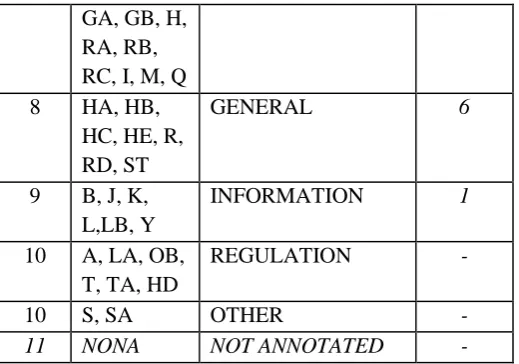
Table 3: Functional Categories for the Hypothetical Genes in Chromosome 3
S.No Group Code
Description Number a
COG category
1 J, A, K, L, B
Information storage and processing
1
2 D, Y, V, T, M, N, Z, W, U, O
Cellular processes and signaling
-
3 C, G, E, F, H, I, P, Q
Metabolism 2
4 R, S Poorly characterized -
SCOP Category
5 RF, RE, P, MA, RG, SB, D, IA, N, NA, O, OA
PROCESSES 3
7 CA, C, CB, E, EA,F, G,
METABOLISM 6
GA, GB, H, RA, RB, RC, I, M, Q 8 HA, HB,
HC, HE, R, RD, ST
GENERAL 6
9 B, J, K, L,LB, Y
INFORMATION 1
10 A, LA, OB, T, TA, HD
REGULATION -
10 S, SA OTHER -
11 NONA NOT ANNOTATED -
a
„–‟indicates there is no newly annotated gene in this COG or SCOP functional category.
On perusal of Table 3, it is evident that many of the hypothetical genes in Chromosome 3 are involved in metabolism and only meager number of genes performs process, information and regulation activities. Similarly, COG functional assignment reveals nearly equal number of hypothetical genes is involved in metabolism and information storage. This validates that Chromosome 3 is a store house of many metabolically important proteins and enzymes.
Table 4: Topology and Localization of Un-annotated Hypothetical Genes in
Chromosome 3
S.No. Gene Subcellular Localization
TM Topology
1 C3orf 30 Nucleus No
2 C3orf 22 Extracellular No 3 C3orf 67 Extracellular No
4 C3orf 36 Nucleus No
5 C3orf 23 mitochondrion No
It is evident from Table 4 that, majority of the un-annotated hypothetical genes in the human chromosome 3 are localized in nucleus, Extracellular region and none of them has trans membrane topology.
IV.
CONCLUSION
annotated functionally. But their membrane
topology and sub cellular localization are predicted
to aid in experimental expression studies. Two of
the
un-annotated
hypothetical
genes
in
Chromosome 3 are localized in Nucleus and
another two in extracellular region, and only one is
localized in Mitochondria. There is no membrane
topology seen among the un-annotated hypothetical
genes in Chromosome 3 of the Human Genome.
The present work has resulted in the identification
of function for majority of the hypothetical proteins
in the Human Chromosome 3 which has to be
validated experimentally.
V.
REFERENCES
[1] Ana Conesa,Stefan Götz, Juan Miguel García-Gómez, Javier Terol, Manuel Talón1and Montserrat Robles, Blast2GO: a universal tool for annotation, visualization and analysis in functional genomics research, Bioinformatics, 2005, Volume 21, Issue 18 Pp. 3674-3676.
[2] Geer LY, Marchler-Bauer A, Geer RC, Han L, He J, He S, Liu C, Shi W, Bryant SH. The NCBI BioSystems database. Nucleic Acids Res. 2010 Jan; 38(Database issue):D492-6.
[3] Krogh A, Larsson B, von Heijne G, Sonnhammer EL Predicting transmembrane protein topology with a hidden Markov model: application to complete genomes. J Mol Biol. 2001 Jan 19;305(3):567-80. [4] Lei Kong, Yong Zhang, Zhi-Qiang Ye, Xiao-Qiao
Liu, Shu-Qi Zhao, Liping Wei and Ge Gao, CPC:
assess the protein-coding potential of transcripts using sequence features and support vector machine, Nucleic Acids Research, 2007, Volume 35, Issue suppl 2 Pp. W345-W349
[5] Murzin A. G., Brenner S. E., Hubbard T., Chothia C. (1995). SCOP: a structural classification of proteins database for the investigation of sequences and structures. J. Mol. Biol. 247, 536-540.
[6] Nakai K and Horton P. PSORT: a program for detecting sorting signals in proteins and predicting their subcellular localization, Trends Biochem Sci. 1999 Jan;24(1):34-6.
[7] Pandit SB, Gosar D, Abhiman S, Sujatha S, Dixit SS, Mhatre NS, Sowdhamini R, Srinivasan N,
SUPFAM--a database of potential protein
superfamily relationships derived by comparing sequence-based and structure-based families: implications for structural genomics and function annotation in genomes. Nucleic Acids Res. 2002 Jan 1;30(1):289-93.
[8] Robert D. Finn, Alex Bateman, Jody Clements, Penelope Coggill ,Ruth Y. Eberhardt, Sean R. Eddy, Andreas Heger, Kirstie Hetherington, Liisa Holm, Jaina Mistry, Erik L. L. Sonnhammer, John Tate and Marco Punta, Pfam: the protein families database, Nucleic Acids Research, 2013, Volume 42, Issue D1, Pp. D222-D230.
[9] Venter,J.C., Adams,M.D., Myers,E.W. et al. (2001) The sequence of the human genome. Science, 291, 1304–1351.
Supplementary Table 1: Characterized Hypothetical ORFs in Chromosome 3 of Human
S. N o
Gene Name
Component, Process, Function
Domain/Superf amily
Function COG SCOP
1 C3orf 26
F: ATP Binding F: ATP-Dependent helicase activity F: Nucleic acid binding
Helicases superfamily
Information storage and processing: DNA replication, recombination and repair
L
--2 C3orf 32
- DnaJ-class molecular chaperone with C-terminal
Cellular processes: Posttranslational modification,
--protein turnover, chaperones 3 C3orf
21
C: Integral to membrane C: Membrane
F: Transferase activity, Transferring Glycosyl Groups
Glycosyltransfe rase family A Nucleotide- diphospho-sugar transferases
Cell envelop biogenesis
M -
4 C3orf 59
- Mab-21 protein Unknown function
S -
5 C3orf 16
- Ankyrin repeats General - R
6 C3orf 34
- Phosphoenolpyr uvate
carboxylase
Metabolism: Energy production and conversion
C
--Supplementary Table 2: Functional annotation of Hypothetical Genes in Chromosome 3
Sl No.
GENE NAME
COMPONENT, PROCESS, FUNCTION
DOMAIN / SUPERFAMILY
FUNCTION CO G
SCOP
1 C3ORF18 C: Integral to Membrane - General - R
2 C3ORF45 C: Integral to Membrane C-Type Lectin Processes_EC: Cell Adhesion
- MA
3 C3ORF70 P: Biological Process; C: Cellular Component; F: Molecular Function
- General - R
4 C3ORF33 C: Integral to Membrane F: Hydrolase Activity, Acting on Ester Bonds F: Nucleic Acid Binding
Staphylococcal Nuclease
Metabolism: Nucleotide Transport and Metabolism
- F
5 C3ORF38 P: Apoptosis NTF2-LIKE Processes_IC: Transport
- RF
6 C3ORF14 - Tetrahydrobiopterin
Biosynthesis Enzymes-Like
Metabolism: Nucleotide Transport and Metabolism
- F
7 C3ORF17 C: Integral to Membrane GFP-Like Metabolism: Energy Production and Conversion
- C
8 C3ORF77 - V-Type ATP
Synthase Subunit C; Fuma C-Terminal Domain-Like
Metabolism: Electron
Transfer/Transport
- CA;E
9 C3ORF54 - Acyl-CoA
Dehydrogenase NM Domain-Like
Metabolism: Coenzyme Metabolism and transport
10 C3ORF43 C: Integral to Membrane C: Proton-Transporting Two-Sector ATPase Complex, Catalytic Domain; C: Integral to Membrane;
F: Hydrolase Activity, Acting on Acid
Anhydrides, Catalyzing Transmembrane Movement of Substances
- Cellular Processes: Inorganic Ion Transport And Metabolism
P -
11 C3ORF20 C: Cytoplasm C: Integral to Membrane
- General - R
12 C3ORF71 C: Integral to
Membrane F: Cholestenol Delta-Isomerase Activity; F: Nucleic Acid Binding; F: Endonuclease Activity; C:Integral To Membrane; F: Metal Ion Binding; P: RNA Catabolic Process; P: Sterol Metabolic
Process; C: Extracellular Region; C: Endoplasmic Reticulum Membrane; P: Transcription; F: Ribonuclease Activity
- Metabolism : Lipid Metabolism; Information Storage and Processing: Transcription
I;K -
13 C3ORF78 C: Integral to Membrane, Mitochondria
- General - R
14 C3ORF62 C: Centrosome; C: Microtubule; F: Protein Binding
- General - R
15 C3ORF19 - Tropomyosin;
XRCC4, C-Terminal Oligomerization Domain
Processes_IC: Cell Motility,
Cytoskeleton; Information: DNA Replication, Recombination, Repair
- N;L