The Effect of Intellectual Property Rights and Information and Communication
Technology on Human Development Index in Developing Countries During 2005-2010
Abdolali Monsef: Corresponding author [email protected]
Assistant Professor; Payam-Noor University, Department of Economics, IRAN
Majid Sameti [email protected]
Assistant Professor; Isfahan University, Department of Economics, IRAN
Mahsa Mojahednia [email protected]
Master Student of Economics; Payam-Noor University, Department of Economics, IRAN
ABSTRACT
Recently the effect of Intellectual Property Rights (IPR) and Information and Communication Technology (ICT) on human development index (HDI) is a new subject which has been considered in economics. Most of the economists believe that not paying enough attention to IPR would prevent the economical growth and development. On the other hand, different nations will have developed human resources when in addition to institutions and certain rules, the people of the society invent new things and the development in ICT can be the reason. The main purpose of this article is to study the effects of IPR and ICT on HDI in developing countries during 2005-2010. In this study we use panel data and the indicators from United Nations Human Development Report (UNDP) and World Bank.
Keywords:Intellectual Property Rights, Information and Communication Technology, Gross National Income per capita, Human Development Index.
JEL: O15, 034
1. INTRODUCTION
Recent economical literature named human development as one of the main goals of economic development and the economists has been interested in finding the mechanism of the development of this index in developed countries and using the new methods for the developing countries. The foundation of human development is in the definition of Sen,” The ability of one person in having different functional vectors and the joy of gaining great progress”. Adam Smith, one of the most famous economists wrote in his venerable book1”You can compare a person who spends a lot of time and work on his education with expensive machinery “. He used to believe that with education and proper training, people would have more abilities and skills. The increase in human abilities would help them make more money and the society would benefit from this investment. Property rights and the protection of these rights will augment the motivation of working and a better usage of the sources, and cause the economy grow and develop.
In general, there are two types of property rights: a) Intellectual Property Rights (IPR), b) Physical Property Rights (PPR). The focus of this article is on IPR. Property right is a concept in which a group of rights are organized in an institutional way and is a branch of law. Property is used after right because in modern economy, the economists do not only talk about physical property but they consider intellectual property rights as well. In some cases, IPR is similar to PPR, but protecting it, is much harder than protecting PPR. Some countries are searching for vast investments to protect these rights, meanwhile, some other think such investments are not necessary for long term development. From 1995 most of developing countries reform IPR governmental laws. IPR can affect economics in different ways. Based on Lewer and Saenz(2005), IPR would increase entrepreneurship activities, technology and finally economic growth which leads into economic development. On the other hand, ICT will affect human development through the increase in labor force efficiency because in economic growth equation, it is obvious that GDP growth rate depends on human resource
1
growth rate, physical capital and technology development. For these reasons, developing countries are looking for expediting growth in these fields to gain economic growth and human development. Technology development through the impact on infrastructure and related indicators by strong and direct relationship that has human resource, can increase labor productivity and cause the development of human resources. It is hard to find a suitable index and data for IPR and it is not easy to include all the effective factors in ICT but this article tries to use the possible and available data on the subject.
2. LITERATURE RERVIEW
2.1. Experimental and theoretical literature on the subject 1.2.1. Human Development
Human development is a general concept that shows the efforts of politicians to increase the standards of living and economic health. These efforts are about human development, health care, safety, vital foundation, regional competition, sustainable environment, social security and literacy. Human development is something more than an increase or decrease in national income. It is about making an environment in which people can reach their maximum potential and have a better and more creative life according to their needs and interests. People are the main wealth of a nation and development is about expansion of their choices to get a kind of life that is worth to live. So it is more than just economic growth which is only a quantitative concept. Expansion of these choices would make them more capable and raise their capacity, so they can have a longer and healthier life to gain knowledge, get the needed resources for standards of life and the ability to participate in the social life. Without many of these factors, lots of choices would be out of reach and the majority of opportunities remain untouchable.
A number of economists valued the concept of economic development, and the framework was placed beyond the quantitative concepts and they knew the development, social structures and cultural phenomena and believed that further development is a qualitative change rather than a quantitative one. In 70s, there were certain doubts about quantitative index and some started to introduce qualitative index such as: health, nutrition, education and mortality rates. On the other hand individuals need three basic resources: income, health care and education. Income can buy basic and necessary goods for living, meanwhile good health care, increases the physical abilities to achieve and enjoy the results of products and life. Education increases opportunities and choices with the opportunity to increase efficiency. Increased income is one of the main ways to increase choices and the welfare.
Countries with higher income rate have higher human development level. So there is a cause and effect relationship between income and human development. With more income, individuals can pay more attention on education, health care and communication. In this case, productivity increases and with more human abilities, gross national income increases (Todaro, Smith, 2002). Gross national income (GNI) is often used to raise the economic welfare of a nation or managing the resources. In human development topics, income is the only main reason to increase the life welfare.
It is not that easy to say when income increases a person would have more welfare and a better life. In modern economy, UNDP publishes an annual report which is called Human Development Report. This report is about the situation of all human beings worldwide. First it is important to talk about living situations. Income can increase the capability and when a person has more abilities, he can also have more income, so there is a cause-effect relationship between income and capability. In other words, it is not enough to say more basic trainings and better health care increase the value of life, it is also necessary to increase the capability of individuals to earn more money. When there are better education and health care, it is possible for the poor to have a chance to overcome their poverty (Sen, 2000)
Institutions have been one of the primary aspects of development in the last twenty years. In the early 90s institutions were the center of attention. Douglass North, the Nobel Prize winner and one of the most famous institutional economists has variety of definitions for institutions. He says:” the main role of institutions in the society is to build a permanent structure (not necessarily an efficient one) to reduce uncertainty in human interactions”. One of the most important purposes in economics is optimal and efficient allocation of resources. Institutions control the usage of resources. Property right system defines the market (Acemoglu, 2005).
Institutions are divided into two categories: 1.Official 2.Unofficial
benefits of what he is doing, he will have enough motivation to work more, be more efficient and use the resources in an optimal way and there will be economic growth and development.
IPR has different meanings. It can be called value and not a physical object, because property is not the relationship between individuals and objects, it is the relationship of individuals to things, so individuals own the value of objects not the object itself. Property right is an institutional option to determine how the resources are available, whether they are owned by the government or the private sector. All economic goods have the character of property rights, including the use of income and education and the right to transfer it to others (Isaac, Park, 2004).
In this study property can be classified in two characteristic: 1. Intellectual Property Rights (IPR)
2. Physical Property Rights (PPR)
IPR includes copyright, trademarks, industrial designs, geographical indicators, trade secrets and patent to name a few. Intellectual property rights are intended to encourage innovation. This principle has been highlighted by the economic analysis, that intellectual property rights are intended to encourage innovation and mind work absorbs the information. It also shows the allocation of resources (Arrow, 1962). Sir Hugh Laddie (2002) wrote in his foreword to the seminal report of the Commission on Intellectual Property Rights (CIPR) on Integrating Intellectual Property Rights and Development Policy:
“On the one side, the developed world side, there exists a powerful lobby of those who believe that all IPRs are good for business, benefit the public at large and act as catalysts for technical progress. They believe and argue that, if IPRs are good, more IPRs must be better. On the other side, the developing world side, there exists a vociferous lobby of those who believe that IPRs are likely to cripple the development of local industry and technology, will harm the local population and benefit none but the developed world. They believe and argue that, if IPRs are bad, the fewer the better. The process of implementing TRIPS2 has not resulted in a shrinking of the gap that divides these two sides, rather it has helped to reinforce the views already held…So firmly and sincerely held are these views that at times it has appeared that neither side has been prepared to listen to the other. Persuasion is out, compulsion is in. Within an „economic growth‟ model for development, IPRs are often assumed to play a crucial role as an engine of growth and innovation in a country as well as a conduit for foreign investment and technology transfer”
It is not uncommon to encounter descriptions of IP or forms of IP (e.g. patents or copyright) as the “engine of growth‟ (Idris 2003) or the “engine of development‟ (Oman, 2000). Such literature suggests IPR protection as an essential driver or even pre-condition of economic growth and development in a country. These viewpoints remain powerful in shaping IPR policies at many national and international forums, even though the empirical evidence connecting IPR protection and economic development is mixed and inadequate.
Accordingly IPR protection depends on the development of a country, it increases the motivation to work and invent more, because the rights of individuals are safe and they can earn what they deserve-as much as they tried- so it can improve the human development.
2.2.1 Information and Communication Technology
The world is divided between rich and poor, healthy and sick, literate and ignorant, democratic and authoritarian, and between empowered and deprived. All the technologies that were developed in the past centuries and all the policies for enhancing human development have not wiped out these glaring disparities. The numbers are depressing: more than 2 million people die of tuberculosis annually, for which medical treatments exist. We can extract such dismal statistics in many areas of human development, infrastructure availability, economic well-being, environment and empowerment. While many categorizations of countries have been proffered (such as developing, emerging economies, economies in transition, etc), a new label-a sign of the times-is the “digital divide”, which describes the development of countries in terms of their capacity to harness the power of Information and Communication Technology( ICT).
The most important feature of the Information and Communication Technology is about information processing and information storage devices and transfer devices and access to information. Information infrastructure as information and technology communication, has raised the possibility of offering quality service and provides information services. Human development and economic development have a direct and close relationship
together and technology shows its effect on economic development and growth through human development. Information and Communication Technology cause the production and distribution of agricultural products and makes it possible to offer basic health care services to the poor. On the other hand it gives the possibility to the teachers and instructors to improve their knowledge in all over the world. Availability to information and technology communication makes it easier for small firms to be built worldwide and helps to connect global and regional markets. Information and Communication Technology provide mutation so that the poor infrastructure is not the cause of lost in markets and inefficient distribution channels, and the other belongs to the past. Accepting the power of information and communication technologies to improve the economic, social and culture of people, it must be driven as all the strategies of development.
Lucas (1998) suggested the definition of labor force should change in a way that the benefits of investment in human development be noticed in it. Neoclassical models of endogenous growth models did not assume the strictly constant returns to scale. Endogenous growth approach considered a developmental framework in which implicitly the economy area is affected by the benefits of investments in new technologies. Based on endogenous growth, some of the countries invest more in research and development and human resources, so they have faster growth. Such investments lead to inventing pioneer technologies. In most cases, in developing countries utilizations of new technologies have limited or non-significant effects on economic growth because human resources do not have enough capacity to absorb these new technologies. In general, Information and Communication Technology affect the economy on demand and supply sides. In demand side it affects the economy by economical behavior of consumers and in supply side, it affects the economy by economical behavior of producers (Pohjola, 2003).
Information and Communication Technology in supply side are inputs along with other factors which include: Organization and management experience, organization of the legislative, economic structure, government policies and investment in human capital. They cause production process, capital deepening, technological progress and quality of labor to improve and their results cause an increase in added-value in firms and countries which leads in economic growth, efficiency and consumer welfare (Dedrick, 2003).
Over the last 15 years, there have been multiple global meetings on issues of development, there are four major UN sponsored meetings and resolutions: Agenda 21, Millennium Development Goals, Johannesburg Summit, and the World Summit on the Information Society (WSIS). The most important one was Millennium Development Goals (MDGs).
Its goals were:
1. Eradicating extreme poverty and hunger
2. Achieving universal primary education
3. Promoting gender equality and empower women
4. Reducing child mortality
5. Improving maternal health
6. Combating HIV/AIDS, malaria, and other diseases
7. Ensuring environmental sustainability
8. Developing a global partnership for development
In long term when the countries reach these goals through ICT, they will develop, accordingly Information and Communication Technology that affects human development, the more investments in Information and Communication Technology, the more growth and development in economics and human development.
3.2.1. Empirical studies
Park and Ginarte (1997) created an index for 60 countries from 1960 till 1990 and they estimated a system of equation which showed the effect of IPR on growth. They studied the effect of research and development, investment and education. Their article is different from the past studies because they used these factors:
a) Development of patent
b) Membership in international summits
c) Rules for not protecting the rights
d) Enforcement mechanisms
e) Time of the protection of intellectual property rights
of this variable in developed countries is positive and significant and in developing countries is positive but not significant.
Heitger (2004) used Freiser institute index and found out that by doubling property rights, gross national income will be more than doubled. He concluded that the countries which respect protecting the rights more have better physical and human resources and they would have a better human development index.
Lewer and Saenz (2005) used a regression for 101 countries (25 OECD countries, 76 developing countries) during 1990-2002:
Where is the growth of real Gross Domestic Product for country i at time t, is the growth of the labor force for country i at time t, is the growth of real capital for country i at time t,
is the growth of real international trade (i.e. the sum of imports and exports) for country i at time t,
, a proxy for human capital, is the fraction of country i’s population aged 25 or above with secondary educational attainment, is Gwartney and Lawson’s (2004) property rights index, and is the error term. They concluded the traditional factors of production, labor and capital, are positive and significantly associated with economic growth at the 95 percent level.
3. HYPOTHESES
For studying the effect of IPR and ICT on HDI we test the following hypotheses: H1: IPR has a positive and significant effect on HDI
H2: ICT has a positive and significant effect on HDI
5. RESEARCH METHODOLOGY
Many linear econometric studies have analyzed the “sources of growth,”, see for example Barro (1991), Levin and Renelt (1992), Keefer and Knack (1997), Sala-i-Martin (1997), and Hall and Jones (1999). Most have drawn their regression foundation from the neoclassical Cobb-Douglas function, Y = AK L-1 . Taking the natural log of the level values gives us ln(Y) = ln(A) + ln(K) + (1- )ln(L), and differentiating with respect to time, T, ln(Y)/ T yields:
GY = GA + GK + (1- )GL, (2)
In this paper by using this equation we estimate the relationship between the variables:
( ) ( ) ( )
HDI is the human development index which is calculated as below:
a) Life Expectancy Index : LEI= 3
b) Education Index : EI =√ √
c) Mean Years of Schooling Index: MYSI =
d) Expected Years of Schooling Index: EYSI =
f) Income Index: II = ( ) ( ) ( ) ( )
Finally, the HDI is the geometric mean of the previous three normalized indices:
√
3
IPR is Intellectual Property Rights index which is calculated by Kyle Jackson(2011), ICT is the average of internet users in 100 people, cellular phones users in 100 people and GNI is the gross national income per capita from World Bank.
5.1.Panel Data
In econometrics, the term panel data refers to multi-dimensional data. Panel data contains observations on multiple phenomena observed over multiple time periods for the same firms or individuals (Wooldridge,2002).
Hsiao (2003) lists several benefits from using panel data. These include the following:
1) Controlling for individual heterogeneity
2) Panel data give more informative data, more variability, less collinearity among the variables, more degrees of freedom and more efficeincy.
3) Panel data are better able to study the dynamics of adjustment
4) Panel data are better able to identify and measure effects that are simply not detectable in pure cross-section or more pure time-series data
5) Panel data models allow us to construct and test more complicated behavioral models than purely cross-section or time-series data.
1.5.1. Fixed Effects Model:
A fixed effects model is a statistical model that represents the observed quantities in terms of explanatory variables that are treated as if the quantities were non-random. This is in contrast to random effects models and mixed models in which either all or some of the explanatory variables are treated as if they arise from the random causes. Often the same structure of model, which is usually a linear regression model, can be treated as any of the three types depending on the analyst`s viewpoint, although there may be a natural choice in any given situation. In panel data analysis, the term fixed effects estimator (also known as the within estimator) is used to refer to an estimator for the coefficients in the regression model. If we assume fixed effects, we impose time independent effects for each entity that are possibly correlated with the regressors.
2.5.1. Random Effects Model:
A random effect(s) model, also called a variance components model is a kind of hierarchical linear model. It assumes that the dataset being analysed consists of a hierarchy of different populations whose differences relate to that hierarchy. In econometrics, random effects models are used in the analysis of hierarchical or panel data when one assumes no fixed effects (i.e. no individual effects). The fixed effects model is a special case of the random effects model. Note that this is not the case in biostatistics, where the econometric definition of the fixed effects model encompasses what biostatisticians call both the "fixed" and "random" effects.
3.5.1. Tests of Fixed Effects, Random Effects and Pooled OLS model
Panel data can be divided into the three types of model, the Pooled OLS, Fixed Effects and Random Effects models. Pooled OLS model has constant coefficients; referring to both intercepts and slopes therefore we could pool all of the data and run an ordinary least squares regression model (in this model there are neither significant country nor significant temporal effects). The Fixed Effects regression models allows the unobserved explanatory variables (either cross-section fixed effects or time fixed effects) to be correlated with the observed explanatory variables. If the unobserved explanatory variables are strictly uncorrelated with the observed explanatory variables, then it might be appropriate to treat the regression model as a random effect model, where cross-section specific constant terms (a different constant term for each cross-section unit) are randomly distributed across cross sectional units (Greene, 2003, p. 293, 299). In modern econometrics “Random Effect” is considered synonymous with zero correlation between the observed explanatory variables and unobserved explanatory variables (Wooldridge, 2002, p. 252).
We have used F-test in order to select the Fixed Effects or Pooled OLS model. The null hypothesis of the fixed effect model is that all time dummy parameters are zero:
This hypothesis is tested by the F-test. We can estimate the F-test with the following formula:
( ) ( )
( ) ( )
The results obtained from F-tests (for Fixed Effects) are presented in Table 2. . These results indicate that the null hypotheses that we have to use Pooled OLS methods are rejected for that groups of countries at significance levels of at most % 5. Therefore, as it is shown by the results, we cannot estimate the model by using Pooled Ordinary Least Squares method; hence Fixed Effects or the Random Effects must be applied. In order to select Fixed Effects or Random Effects, and also to make sure reliable results are obtained, the Hausman test has been used. Hausman Test for Random Effects is based on comparing the slope estimates of Random Effects regression model and Fixed Effects regression model (Greene, 2003, p. 302; Wooldridge, 2002, p. 288).
4.5.1. Selected Countries:
In this study we use 16 developing countries from different parts of the world: Iran, South Africa, Russia, China, India, Brazil, Mexico, Cameroon, Egypt, Indonesia, Thailand, Argentina, Bahrain, Ecuador, Algeria, Tunisia during 2005-2010.
6. RESULTS WITH TABLES
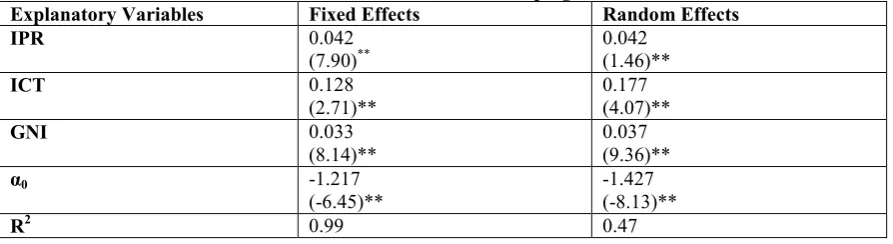
In this section, the method that is presented in section 3, the equation is estimated by Eviews and the following results were obtained :
Table 1: HDI Determinants: Developing Countries
Explanatory Variables Fixed Effects Random Effects
IPR 0.042
(7.90)** 0.042 (1.46)**
ICT 0.128
(2.71)** 0.177 (4.07)**
GNI 0.033
(8.14)** 0.037 (9.36)**
α0 -1.217
(-6.45)**
-1.427 (-8.13)**
R2 0.99 0.47
Source: Author`s own calculation
Notes: Figures in parentheses are t-statistics. **Significant at the 95% level
Table 2: The Result F-Test and Hausman Test
F-Test 187.80
Hausman-Test 42.30
Source: Author`s own calculation
F(15,77)= 1.794
Regarding F, calculated F is greater than critical value of F, so fixed effect method is accepted, to choose between fixed effects of random effects models we use Hausman test.
χ2(3)=7.81
Calculated χ2 is smaller than critical value of χ2, so random effect method is not accepted.
7. FINDINGS As expected,
a) The coefficient on intellectual property rights is positive and significant at the 95 percent level for the developing countries. 1 percent change in IPR would increase HDI about 0.04 percent.
b) The coefficient on Information and Communication Technology is positive and significant at the 95 percent level for the developing countries. 1 percent change in ICT would increase HDI about 0.12 percent.
c) The coefficient on gross national income per capita is positive and significant at the 95 percent level. 1 percent change in GNI increase HDI about 0.03 percent.
8. CONCLUSION
The purpose of this paper is to test the effect of intellectual property rights and Information and communication technology on human development index. Using fixed-effects panel data for 16 countries from 2005-2010, support for a positive and significant relationship between intellectual property rights, Information and communication Technology and human development is found. The findings of this paper offer several economic insights. First, as economic theory suggests, countries with secure intellectual property rights are able to grow faster partially because of more rapid technology growth and entrepreneurial activity and human development index increases as well. The empirical evidence also supports the idea that developing countries gain lots of benefits from positive changes to their legal structures and property rights.
Lastly, intellectual property rights and the lack thereof may be a significant convergence variable.
REFERENCES
1. Acemoglu, D. (2005). Politics and Economics in Weak and Strong States. Journal of Monetary Economics, 52, 1199-1226.
2. Arrow, K. J. (1962). Economic Welfare and the Allocation of Resources for Inventions, Prinston University Press.
3. Dedrick, J. Gurbarani, Kraemer. (2003).Information Technology and Economic Performance: A
Critical Review of the Technology and Organizations. University of California, Irvine.
4. Greene, William H. (2003). Econometric Analysis. 5th Edition, New Jersey; Prentice Hall, Inc. 5. Heitger, B. (2004). Property Rights and The Wealth of Nations.Cato Journal, 23(3), 381-402. 6. Hsiao, C. (2003). Analysis of Panel Data,2nd Edition, Cambridge University Press, New York.
7. Idris, K. (2003). Intellectual Property: A Power Tool for Economic Growth. World Intellectual Property Organization (WIPO), Publication, No.888.
8. Isaac, A.G. Park, W.G. (2004). On Intellectual Property Rights: Patent Versus Free and Open Development, In Colombatto, E, (ed), The Elgar Companion to the Economic of Property Rights, Edward Elgar Publishing.
9. Laddie, H. (2002). Forward, Integrating Intellectual Property Rights and Development Policy, CIPR, London.
10. Lewer, J.,Saenz,M. (2005). Property Rights and Economic Growth: Panel Data Evidence. Journal of Southwestern Economic Review, 32, West Texas University.
11. Lucas,R. (1998). On the Mechanism of Economic Development.Journal of Monetary Economics,
3-42.
12. North, D.C. (2005). Understanding the Process of Institutional Change,Princeton University Press. 13. Oman, R. (2000). Copyright-Engine of Development: An Analysis of the Role of Copyright in
Economic Development and Cultural Vitality, UNESCO.
14. Park, W.G., Ginarte, J.C. (1997). Intellectual Property Rights and Economic Growth. Oxford, Contemporary Economic Policy, 3, 51-61.
15. Pohjola, M. (2001). Information Technology and Economic Growth: A Cross-Country Analysis, in Pohjola, Matti (ed) Information Technology and Economic Development, Oxford University Press, 242-256.
16. Pohjola, M. (2002). The New Economy: Facts, Impact and Politics, Information Economic and Policy, (14), 133-144.
17. Sen, A. (2000). A Decade of Human Development. Journal of Human Development, 1(1), 2000. 18. Smith, A. (1904). Wealth of Nations, London, Methuen & Co Ltd.
19. Todaro, M., Smith, S. (2002). Economic Development,(ISBN: 978-1-4058-7424-3).