http://www.ijcmph.com pISSN 2394-6032 | eISSN 2394-6040
Original Research Article
Assessment of nutritional status in adolescent girls residing in social
welfare hostels in Tirupati town: a cross sectional study
Ravi Sankar Deekala, Meghana Reddy Kokku*
INTRODUCTION
World health organization (WHO) defines adolescence as the segment of life between the ages of 10-19 years.1 Adolescence is a transition phase through which a child becomes adult.2 India has the largest population of adolescents in the world being home to 243 million individuals aged 10-19 years.3 The country’s adolescents constituted 20% of world’s 1.2 billion adolescents. Investing in the world’s 1.2 billion adolescents aged 10-19 years now can break entrenched cycles of poverty and
inequity, said UNICEF in its 2011 state of the world’s children report entitled “Adolescence: an age of opportunity".4
Adolescence is a crucial part of life. During this period, adolescents gain up to 50% of their adult weight, 20% or more than that of their adult height and 50% of their adult skeletal mass.5 To attain healthy reproductive outcome and efficient physical activity nutritional status of adolescent girl is valuable. One way to break the intergenerational cycle of malnutrition is to improve the
ABSTRACT
Background: One way to break the intergenerational cycle of malnutrition is to improve the nutrition of adolescent
girls prior to conception. Adolescent health and nutrition are important issues which have not received the attention it deserves in our country, especially in the context of a girl child. The objectives of the study were to assess the nutritional status of the adolescent girls residing in the social welfare hostels of Tirupati town, Andhra Pradesh.
Methods: The Nutritional status will be assessed by anthropometric measurements (i.e., height, weight, BMI) and questionnaire.
Results: 54.1% of the adolescent girls were underweight.61.4% of them studying 1st and 2nd years of their
graduation. 52.2% of them belonged to upper lower class according to modified Kuppuswamy classification 2016.76% of adolescent girls belonged to the family size of less than or equal to five. 44.1% has one sibling. 33% of the adolescent girls use nutritional supplements.59.7% of adolescent girls has junk food once a week. 56.1% of them routinely involve in moderate physical activity. 4.1% of them who attained menarche do not practice menstrual hygiene. 62.3% of them visited health center for 1-5 times in the past one year.71.5% of them does not practice deworming. 5.9% observed worms in their fecal matter. 19.7% of the adolescent girls have vision problems. 67.3% of adolescent girls have awareness regarding nutritional health. Only 28.2% of adolescent girls get cosmetic charges from government.
Conclusions: There is relation between nutritional status and educational level (better among graduates).
Keywords: Nutritional status, Adolescent girls, Social welfare hostels, Morbidity pattern
Department of Community Medicine, SVIMS, Sri Padmavathi Medical College for Women, Tirupati, Andhra Pradesh, India
Received: 17 October 2018
Revised: 02 November 2018
Accepted: 03 November 2018
*Correspondence:
Meghana Reddy Kokku,
E-mail: [email protected]
Copyright: © the author(s), publisher and licensee Medip Academy. This is an open-access article distributed under
the terms of the Creative Commons Attribution Non-Commercial License, which permits unrestricted non-commercial use, distribution, and reproduction in any medium, provided the original work is properly cited.
nutrition of adolescent girls prior to conception. The vicious cycle of malnutrition, if not broken, will goes on resulting in more and more severe consequences. 6
Objective
To assess the nutritional status of the adolescent girls residing in the social welfare hostels of Tirupati town, Andhra Pradesh.
METHODS
A cross sectional study is conducted to assess the nutritional status of the adolescent girls residing in all 6 social welfare hostels for scheduled caste girls in Tirupati town, Andhra Pradesh. The study period was for four months from June 2017 - September 2017.
The hostel wardens are interviewed and hostel registers were looked into to secure information regarding the number of residential girls. Prior permission has been taken from the respective hostel wardens to conduct the study and informed consent is taken from the students before collecting the data.
Inclusion criteria
Adolescent girls in social welfare hostels, who are present and are willing to participate voluntarily on the day of data collection
Exclusion criteria
Those girls who are not willing to participate and those who are absent on the day of data collection. Those girls aged less than 10 years and more than 19 years.
Sample size calculation
Previous studies from various parts of the world shown the range of Prevalence of under nutrition between 56.4% to 78.4%. According to the formula: n=4pq/d2,
p=78.4/100 =0.784, q=1-p=0.216, d=5/100=0.05
[Allowable error=5%] the minimum required sample size was found to be 270 members. The present study included 355 students.
The nutritional status is assessed by anthropometric measurements i.e., height, weight, BMI.
Height: A measuring tape capable of measuring to an accuracy of 1cm is used to assess height of the subjects. The subjects are made to stand without footwear with the feet parallel and with heels, buttocks, shoulders and occiput in a straight line position and the head in upright position.7
Weight: A portable weighing machine with an accuracy of 100gm is used to record the weight of girls. The girls are instructed to stand on weighing machine with light
clothing and without footwear and with feet apart and looking straight and then the weight is recorded.7
Body mass index (BMI)
It is calculated using the Quetelet index and the subjects are categorized into various grades based on BMI according to Indian national standards as approved by WHO.8 i.e.,
Underweight: BMI <18.5 kg/m2
Normal: BMI 18.5-22.9 kg/m2
Overweight: BMI 23-24.9 kg/m2
Obese: BMI >and= 25 kg/m2
Study instruments
Self-assessed questionnaire, weighing machine,
measuring tape.
Data analysis
Data was analyzed by using SPSS Software version 21 (copyright IBM corporation and others 1989, 2012).
RESULTS
A total of 355 adolescent girls were studied in Social welfare hostels of Tirupati town. Majority (64%) belonged to the age group of 17-19 years. Majority of them are graduates (61.4%) and belonged to Hindu (96.7%) religion. It was found that majority (54.1%) of the girls were undernourished. Most of them belonged to low socioeconomic status (52.2%) and 76% of them belonged to a family size of less than or equal to five, about 44.1% of them had only one sibiling, 59.7% of the subjects have junk food at least once in a week.67% of them do not use any nutritional supplements. Majority of the subjects have moderate physical activity (56.1%) and have exercise during their usual daily activities (49%). There is only a slight difference (0.8%) between the percentages in number of girls who routinely practice relaxation and those who never practice it. Majority of them are practicing hand hygiene before food intake (96.9%) and after defecation (95.8%). 95.9% of them practice menstrual hygiene. Majority of them have awareness regarding general health (74.4%), regarding nutritional health (67.3), regarding personal hygiene (70.1%), regarding importance of physical exercise (69.9%).
There is high prevalence of morbidity [eye problems (19.7%), reproductive problems like dysmenorrhoea (16.5%), communicable diseases (19.4%), bleeding of gums (22.8%), worms in stools (5.9%)] among adolescent girls residing in social welfare hostels. This will affect their health and school performance. Majority of them do not get cosmetic charges (71.8%).
1. Association between nutrition status versus participant parameters (Table 1):
There is a relation between the nutritional status and hostel address. There is also a relation between nutritional status and educational level, that is, the nutritional status is better among graduates followed by intermediate and secondary education levels. The above results are also significant statistically.
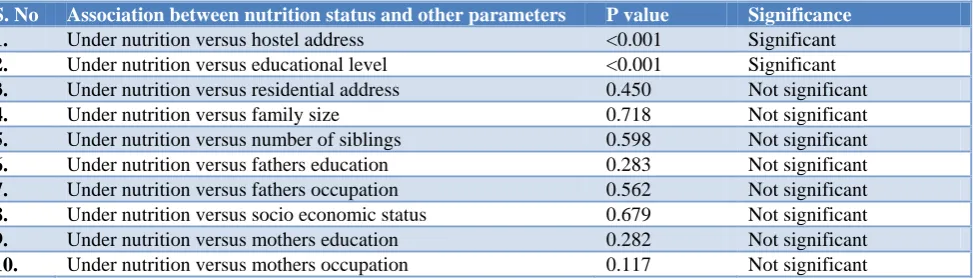
2. Association between under nutrition versus participant parameters (Table 2):
There is a relation between the under nutrition status and hostel address. There is also a relation between under nutrition status and educational level, that is, the under nutrition percentage is more among school going adolescents followed by intermediate and graduate education levels. The above results are also significant statistically.
Table 1: Association between nutrition status versus participant parameters.
S.No. Association between nutrition status and other parameters P value Significance
1. Nutrition versus hostel address <0.001 Significant
2. Nutrition versus educational level <0.001 Significant
3. Nutrition versus religion 0.022 Significant
4. Nutrition versus family size 0.999 Not significant
5. Nutrition versus number of siblings 0.981 Not significant
6. Nutrition versus fathers education 0.743 Not significant
7. Nutrition versus fathers occupation 0.988 Not significant
8. Nutrition versus socioeconomic status 0.911 Not significant
9. Nutrition versus mothers education 0.319 Not significant
10. Nutrition versus mothers occupation 0.006 Significant
Table 2: Association between under nutrition versus participant parameters.
S. No Association between nutrition status and other parameters P value Significance
1. Under nutrition versus hostel address <0.001 Significant
2. Under nutrition versus educational level <0.001 Significant
3. Under nutrition versus residential address 0.450 Not significant
4. Under nutrition versus family size 0.718 Not significant
5. Under nutrition versus number of siblings 0.598 Not significant
6. Under nutrition versus fathers education 0.283 Not significant
7. Under nutrition versus fathers occupation 0.562 Not significant
8. Under nutrition versus socio economic status 0.679 Not significant
9. Under nutrition versus mothers education 0.282 Not significant
10. Under nutrition versus mothers occupation 0.117 Not significant
DISCUSSION
In the present study it was observed that prevalence of underweight, normal weight, overweight & obesity was 54.1%, 40.24%, 2.28%, 3.38% respectively according to Indian national standards as approved by WHO. Similar results were obtained in other studies conducted by Hossain et al. In their study 41.33% of adolescent girls were underweight, 35.00% normal, 8.33% overweight and 6.67% obese.9 In another study by Susmitha et al 64.6% were underweight, 0.4% were overweight and 0.4% were obese.10 In the study conducted by Ganga Bhavani et al 74.5% were underweight, 24.5% were normal weight, 0.98% were overweight and none were obese.11
In the present study 17.3% subjects suffered from chronic energy deficiency (CED) grade III (BMI <16). Results
from other studies are as follows: In a study conducted by Sheloj et al 33.5% subjects suffered from chronic energy deficiency (CED) grade III.12 In a study by Wasnik et al 16% subjects suffered from chronic energy deficiency (CED) grade III.13 In other study by Chaturvedi et al. 78.8% were CED grade III.14 In a study by Deshmukh was found to be 75.3%.15 In a study conducted by Shivaramakrishna 22.2% were CED grade III.16
In present study 24% of girls belonged to large family size i.e., family size of more than 5 members in contrast more than 67.7% belonged to large family size in other study made by Prashant et al.17
problems.18 In a study conducted by Srinivasan et al the prevalence of defective vision was 4.7%.19
In present study 16.5% of subjects had menstrual irregularities (dysmenorrhoea). In a study conducted by wasnik et al dysmenorrhoea was present in 16% of study subjects.20 In a study conducted by Srinivasan et al dysmenorrhoea was noted in 3.5%.21 In a study by Geetha et al in rural south India, dysmenorrhoea was noted in 21%.22
In present study 5.9% of subjects observed worms in their stools. In a study conducted by Srinivasan et al 18.3% of girls had history of passing worms in the stool.21
CONCLUSION
The present study done among adolescent girls residing in social welfare hostels, Tiruapti town, shown that more than half of them are suffering with under nutrition. Majority of them belonged to low socioeconomic status, large family size with more than 5 family members. There is a considerable amount of morbidity which will affect their nutritional status, general health and school performance. Defective vision and refractive errors,
menstrual irregularities like dysmenorrhoea,
communicable diseases, bleeding of gums, diarrhoea and worms in the stool. Majority students does not practice deworming. There is a significant relation between the under nutrition and hostel address, some of the hostels performing fairly good and some performing bad. There is a significant relation between nutritional status and educational level, the under nutrition problem is more
among school going adolescents followed by
intermediate and graduate education levels. In spite of providing nutritional support by government to the economically backward group of adolescent girls, majority are still suffering with under nutrition which will affect their nutritional status, general health and school performance. These type of studies will help to ministry of social welfare, government of India to evaluate the nutritional welfare programmes like this and identify the gaps in nutrition provision and nutritional status which in turn will help to make some policy changes for the effective implementation of nutritional support. Intervention strategies such as extension of the mid-day meal programme even for higher classes like high school, intermediate and graduation level and improvement in quality and quantity of the food provided are needed to improve the nutritional status.
Recommendations
Having a system of team of health workers like ANM or multipurpose health worker and officers for observing the quality and quantity of food being served and food preparation practices, giving health education as per required conditions prevailing in those hostels and timely action is a major step that can solve many issues present in relation to nutritional status of adolescent girls.
General Health checkup by medical officer level -at least once in 6 months. Compulsory deworming for all students once in 6 months.
To address vision problems measures should include checkup with ophthalmologist at least once in 6 months for correction of refractive errors with provision of spectacles, vit-A solution therapy and food rich in vit-A should include in the daily menu of the hostels.
Provision and effective supervision of sanitary measures which will affect nutritional status in these hostels by the concerned wardens eg: regular bath room and toilet cleaning, provision for hand wash and dish wash soaps or solutions and provision for washing of clothes.
ACKNOWLEDGEMENTS
We acknowledge ICMR STS-2017 program, our management SVIMS, Sri Padmavathi Medical College for Women and also the members of social welfare hostels of Tirupati for supporting the study.
Funding: Stipend released from ICMR for research done under STS-2017 program
Conflict of interest: None declared
Ethical approval: The study was approved by the
Institutional Ethics Committee, Sri Venkateswara
Institute of Medical Sciences (SVIMS), Tirupati, Andhra Pradesh, India
REFERENCES
1. Definition of adolescence by WHO:
http://www.who.int/maternal_child_adolescent/topic s/adolescence/dev/en/. Accessed on 3 January 2018. 2. Ratnam TR, Hallad JS. Nutritional status of
adolescents in Northern Karnataka, India. The J Family Med. 2012;58(1):55-67.
3. India has largest adolescent population in the world- http://www.hindustantimes.com/india. Accessed on 3 January 2018.
4. Adolesence is the age of opportunity--
http://unicef.in/PressReleases/87. Accessed on 3 January 2018.
5. Akhter N, Sondhya FY. Nutritional status of adolescents in Bangladesh: Comparison of severe thinness status of a low-income family's adolescents between urban and rural Bangladesh. J Edu Health Promot 2013;2:27.
6. Mulugeta A. Nutritional Status of Adolescent Girls from Rural Communities of Tigray, Northern Ethiopia. Ethiop J Health Dev. 2009;23(1):5-11. 7. International Journal of Collaborative Research on
Internal Medicine & Public Health Vol. 4,No. 1 (January 2012)
9. Hossain GMM, Sarwar MT, Rahman MH, Rouf SMA, Raza S, Ud- Daula A, et al. A Study on Nutritional Status of the Adolescent Girls at Khagrachhari District in Chittagong Hill Tracts, Bangladesh. Am J Life Sci. 2013;1:278-82.
10. Susmitha KM, Jyothi C, Prabakaran J, Ananthaiah Chetty N. Nutritional Status of Adolescent Girls in Social Welfare Hostels: A Cross-Sectional Study, National Journal of Research in Community Medicine. 2015;4(1):106-13.
11. Guduri GB, Avvaru K, Naidu SA, Assessment of Nutritional Status among Early Adolescent Girls (11-14 years) Attending Government Schools of Visakhapatnam City, IOSR J Dental Med Sci. 2014;13(4):31-3.
12. Joshi SM, Likhar S, Agarwal SS, Mishra MK, Shukla U. A Study of Nutritional Status of Adolescent Girls in Rural Area of Bhopal District. Natl J Community Med. 2014;5(2):191-4.
13. Wasnik V, Rao BS, Rao D. A Study of the Health Status of Early adolescent Girls residing in Social Welfare Hostels in Vizianagaram district of Andhra Pradesh State, India. Int J Collaborative Res on Internal Med Public Health. 2012;4(1):72-83. 14. Chaturvedi S, Kapil U, Gnanasekaran N, Sachdev
HP, Pandey RM, Bhanti T. Nutrient intake amongst adolescent girls belonging to poor socioeconomic group of rural area of Rajasthan. Indian Pediatrics. 1996;33(3):197-201.
15. Deshmukh PR. Nutritional Status of Adolescents in Rural Wardha. Indian J Pediatr. 2006: 73.
16. Shivramakrishna HR, Deepa AV, Sarthareddy M. Nutritional status of Adolescent Girls in Rural Area
of Kolar District- A Cross sectional study. Al Ameen J Med Sci. 2011;4(3):243-6.
17. Prashant K, Shaw C. Nutritional Status of Adolescent Girls from an Urban Slum Area in South India, Indian J Pediatr. 2009;76:501.
18. Wasnik V, Rao BS, Rao D. A Study of the Health Status of Early adolescent Girls residing in Social Welfare Hostels in Vizianagaram district of Andhra Pradesh State, India. International J Collaborative Res Internal Med Public Health. 2012;4(1):72-83. 19. Srinivasan K, Prabhu GR. A Study of the Morbidity
Status of Children in Social Welfare Hostels in Tirupati Town. Indian J Community Med. 2006;31(3):1.
20. Wasnik V, Rao BS, Rao D. A Study of the Health Status of Early adolescent Girls residing in Social Welfare Hostels in Vizianagaram district of Andhra Pradesh State, India. Int J Collaborative Res Internal Med Public Health. 2012;4(1):72-83.
21. Srinivasan K, Prabhu GR. A Study of the Morbidity Status of Children in Social Welfare Hostels in Tirupati Town. Indian J Community Med. 2006;31(3):1.
22. Joseph GA, Bhattacharji S, Joseph A, Rao PS. General and reproductive health of adolescent girls
in rural south India. Indian J Pediatr.
1997;34(3):242-5.
Cite this article as: Deekala RS, Kokku MR.