Artificial intelligence & self-consistent sonification method for converting DNA sequence to
music
Majid Monajjemi
1, *1
Department of chemical engineering, Central Tehran Branch, Islamic Azad University, Tehran, Iran
*corresponding author e-mail address: [email protected] |Scopus ID 6701810683
ABSTRACT
One of the most favorable directions in data sonification is time-series-sonification data (TSSD), due to auditory imagination is very sensitive to changes in time. Biological sonification contains total steps of ways that convert the bio-macromolecules data derived from biology systems into acousmatic music. NMR data of the 13C are particularly well suited data sources for DNA &mRNA sonification. Although, their resonant frequencies are typically in the MHz range, the resonant frequencies span around kHz. The E. coli is consisting of several genes which one of them can be divided into eight series of codons for eight octaves of notes. During NMR calculation with AB-initio methods, these signals are routinely mixed down into the audible frequencies ranges, rendering the need for any additional frequencies transpositions unnecessary. By this study, E .coli’s gene sequences into musical notes for a revealing auditory algorithm has been converted. Estimations of their calculation and optimization of those codons have been done and the total frequencies of each nucleotide have been converted to several music notes and distinguishing those using variations of chemical shifts including pitch, time duration length of notes and even rhythm have been accomplished.
Keywords: DNA; mRNA; E .coli; artificial intelligence; sonification, classical music notes.
1. INTRODUCTION
Time-series-sonification data (TSSD) offer successful methods that intuitively display transitions based on time, inspiring sonification of other types of dynamic. [1].By inter-disciplines such as genetics, microbiology and biophysics researchers observe organisms through visualization or quantitative measurements, and sonification has seldom been applied as a data-observation method. Parallel to the classical methods of science, the sonification might be providing a means to comprehend biological phenomena from a new angle.
McMillan (1992) [2] applied an artificial intelligence network for the conversion of IR spectrum to music based on acoustic foundation. Non-scientist musicians might not feel that biological molecules oscillate and play imaginary music under various conditions. In other words because of a very fast vibrate of the atoms in macro-molecules that are orders of a large magnitude faster than acoustic vibrations cannot be possible to hear these frequencies physically. These kinds of perspectives become more amazing via the fact which each molecule even each chemical reaction has a specific spectrum in a wide region of music. In any modeling of molecular properties towards musical sonification any vibrations may be matched to the melodies, rhythms, pitch or duration of acoustic which is a “Sonification” from bio-macro-molecules to music. There is a long and distinguished history, within the field of music, of composers using non-musical data as a source for composition. As instance some items can be mentioned, (1): Brazilian composer “Heitor Villa-Lobos” compositions his “Symphony No. 6: On the Profiles of the Mountains of Brazil” (1944) for orchestra;(2): American composer John Cage’s Atlas Eclipticalis (1961-62) for orchestra; Etudes Borealis (1978) for cello and/or piano, which made via tracing star maps onto score paper; (3) Charles Dodge’s an American
composer “The Earth’s Magnetic Field” (1970) for computer, which mapped magnetic field measurements onto the notes of a diatonic musical scale; (4) Clark and Dunn’s work, especially their paper “Life Music: The Sonification of Proteins” and their several collaborative CDs of DNA music is a paradigm for the sonification. In each of the compositions, a non-music source is converted to music which often has quite unfamiliar aspects to it [2-5]. The approach proposed by the "DNA sonification" is that the translation of DNA sequence representations into music not only permits to create a musical instrument but also allows exploiting deep neural network models for representing and designing in the audio spaces. Thereby we take advantage of longer-range structure that is important in music and which is equivalently important in DNA designing (in connecting nucleotide sequence to helical structure) [5, 6].This paradigm goes beyond music, but rather enables us to connect life and music in a reversible way, providing an approach to design anti disease, aging and DNA, proteins and behavior, or other molecular architectures from the Nano-scale upward. Sonification, generally aim to create a spectrum of overlapping waves either to mimic the sounds of concepts that do not naturally exist. Therefore, hereby this work it has been considered sonification of spider webs and whole DNA structures, and it also has presented mathematical modeling approaches using category theoretic representations for describing hierarchical systems and their translations between different manifestations. By this work, It has been supposed a formulation of sonification and generate a method by which the nucleotide sequence of DNA, is used to generate audible sound through consideration of the elementary chemical and physical properties of guanine (G), cytosine( C) adenine(A), thymine (T) and uracil (U). The supposed sound-based generative algorithm is
Volume 9, Issue 6, 2019, 4494 - 4501
ISSN 2069-5837
Open Access Journal
Received: 20.07.2019 / Revised: 10.10.2019 / Accepted: 15.10.2019 / Published on-line: 21.10.2019
Original Research Article
Biointerface Research in Applied Chemistry
www.BiointerfaceResearch.com
based on the natural vibrational frequencies of nucleotides. Commonly, the vibrational spectra of those nucleotides can be computed via computational chemistry methods such as abinitio methods, molecular dynamics (MD) and especially QM/MM. A computer algorithm for converting these inaudible sounds into a range that the human ear can detect has been used. Through making these natural vibrations of the DNA, they can then be applied to express sound and generate music which is based on the complex vibrational spectrum offered by DNA structures. The importance of considering vibrations as a means to translate among chemical specification and sounds has broader ranging implications. It is notable that DNA plays a role in information processing, mutation and memory in the brain. The use of artificial intelligence in recognizing and classifying DNA and predicting nucleotides sequences and genome structures have been used in this research and also presents an opportunity for any further research investigations. Hereby via artificial intelligence, the structures of DNA sequences in musical space have been designed through the translational approach and then translation back to DNA. The plan of this work is as follows. Firstly, an analysis of the translation of the vibrational spectra of each of nucleotides into audio signals has been done using the concept of trans-positional equivalency. Then several known gene structures into musical scores will introduce by sonification. The goal of this study is to find a mode of converting 13C-NMR data of nucleotides, di-nucleotide (Bas pairs) and three di-nucleotides (codons) sequences to classic notes which are reasonable sounds to a musician’s ear. And also to present a model for overcoming the jump between consecutive notes as a consequence of the DNA related to any range of genes with NMR data. The broad scope of the musical notes in many melodies has problem, such as large range, stochastic jumps and unknown frequencies to make them difficult musically. A second matter is the question of how to incorporate rhythm into the sequence of notes. Based on NMR data, various innovations can be presented in coding assignments that generate a decreased musical note ranges and consequently introduce rhythm into the sequence of notes.
1.1. Codes for DNA interpretation.
The DNA sonification can be linearly converted to music sounds, in a way that has an implied biological context.
Interpretations of genetic information as music, which clearly cross the divide between science and art, are so much interesting [7]. Moreover it can be supposed, DNA to be a nonrandom sequence and takes into account fundamental chemical or biological characteristics during sonification. For achieving this, they should connect the DNA sequence data to the perceptual specification of sound [8]. The sonification method and its auditory, help for analyzing the concept of DNA sequences via the musical sounds. It might be useful for understanding of this approach as the codes for DNA sequence interpretation and not music, despite the fact that musical notes can be used during sonification.
The algorithm permits users to inputting their own DNA sequences to produce an auditory display in real time. The major action is the reading frame codons (algorithm) that are extracted from the genetic code, whereby the codons are mapped to musical notes on a scale and also there is no optional handling work for reducing the number of notes to make the auditory display more
musical. The DNA bases can be specified as codons in each of three possible reading frames leading to three interlaced streams of notes.
1.2. Convert NMR Spectroscopy to Music.
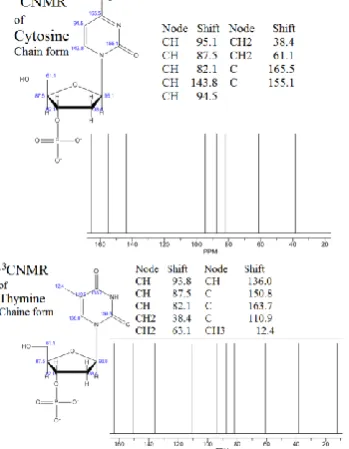
DNA and codons specification can be turned via sonification of molecular spectroscopy directly into sound, including Infra-red spectroscopy "IR" or nuclear magnetic resonance "NMR". Via IR spectroscopy, it can be measured the vibrational behavior of molecules and it has been applied for a sound source of spectroscopy’s sonification in theoretical musical backgrounds [9-11]. Basically, this kind approach has to be made during the sonification mechanism including musical’s notes, pitches, melodies, Rythms and Chords to be designed for different chemicals images. In this work, 13C-NMR spectroscopies are applied as the novel sources for DNA specifications as sonification. In contrast to IR, 13C-NMR spectroscopies experiment the frequencies of the nuclear signals which can be converted straightly into the audible described the sonification strategies which used NMR data in acoustic music composition [12]. Nuclear magnetic resonance is usually used in structure illumination and confirmation that are strongly sensitive for conformational changes in molecules. The data of NMR calculation data based on B3LYP/6-31G* for guanine, cytosine, adenine, and thymine are shown in Figs 1&2.
The human genes is a combination (A,T,G,C) of various codons such as group (1) including; ATG,TGC,GCA,CAT, AGC, TCA, GAT,CTG , group (2) including; ATG,ATC,TGC,GCA,CAT, AGC, TCA,CTG, group (3) including; AAT,TTG,GGC,CCA, AAG,TTC, GGA,CCT, group(4) including; ATT,TGG,GCC, CAA, AGG, ,GAA,CTT, group(5) including; AGT,TCG,GAC, CTA,AGC,TCA, GAT,CTG, group (6) including, ATA, TGT, GCG, CAC, TAT,GTG,CGC,ACA , AND group (7) including; AAA,TTT,GGG,CCC,ATG,TGC,GCA,CAT which are shown in Figures 3-5 .
Figure 1. NMR calculation data based on B3LYP/6-31G* for guanine and adenine.
Figure 2. NMR calculation data, based on B3LYP/6-31G* for Cytosine and thymine.
Figure 3. Optimized Guanine-Cytosine base pairs with B3LYP/6-31G*, including three hydrogen bonds.
Figure 4. Optimized Guanine-Cytosine base pairs with B3LYP/6-31G*, including three hydrogen bonds.
In abinitio methods, the optimized energies are related to particular methods and basis sets which are applied in a model. In other words results during optimization of nucleotides, bas pairs and codons with any kind of methods or basis set are not equal. Therefore, the conversion of frequencies music notes for each codons may be different from data in table 1. Pitch, is one of the important components of the music’s notes that pivotal section of acoustics is related to it. In abinitio quantum chemistry each basis sets and methods including DFT, MPn, RHF,UHF, ROHF and even semi empirical methods are related to a type of pitches.
Figure 5. Optimized of mRNA codon including; Adenine, Thymine and cytosine with B3LYP/6-31G*.
Treble clef symbol indicates that the second line from the bottom is "G". On any staff, the notes are always arranged so that the next letter is always on the next higher line or space. The last note letter, G, is always followed by another A (Fig.6).
Figure 6. Treble Clef Symbol of 8 codons from group (1). 1.3. Basic music theory.
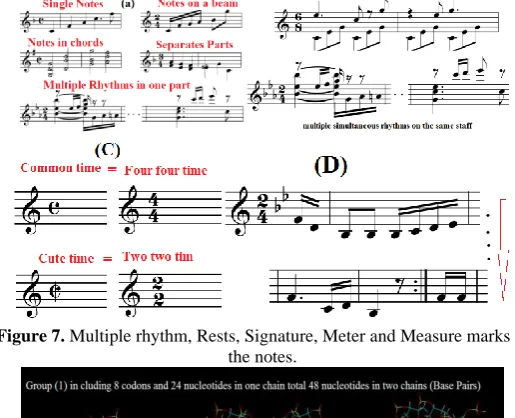
In a standard and usual notation, a single musical sound is written as a note. The most important item in a piece of music, needs to explain about a note in a pitch, which means, how high or low it is and also what is its duration (time) or how long it lasts. For finding out the pitch of a written note, it must be looked at the clef and the key signature, and then look to the line which the notes are on. In NMR map the distances between chemical shift picks indicate the time scale between notes (Fig .7). The dots which are some places other than next to the head of the note do not affect the rhythm. Other dots are articulation marks. They may affect the actual length of the note (the amount of time it sounds), but do not affect the amount of time it must be given (Figs 6&7). In table 1 chemical reaction and consequently musical reaction as follows are listed
Chemical reaction: Adenine +Thymine → Adenine- Thymine (Bas pairs)
Musical reaction: (A#7/Bb7) + (A7) → (A#8/Bb8)
Table 1. Calculations of Normal modes (B3LYP/6-31G*) and related Music’s note [13].
Base Maximum
frequency (HZ) of Normal modes
Intensity degeneracy Music’s
note
Adenine 3701 556 1 A#7/Bb7
Cytosine 1899 1531 1 A#6/B
b 6
Guanine 2826 491 1 F7
Thymine 3494 438 1 A7
Bas Pairs
G-C 6005 6501 1 G#8/A
b 8
A-T 7400 2333 1 A#8/Bb8
The head of the note can be filled in black, or not and the notes may also have the stem, one or more flags, beams connecting it to other notes, and one or more dots. The note length is defined based on how long they last compared to the whole notes. A note that lasts half as long as a whole note is a half note. A note that lasts a quarter as long as a whole note is a quarter notes. The pattern continues with eighth notes, sixteenth notes, thirty-second notes, sixty-fourth notes, and so on, each type of note is half the length of the previous type (Fig.7-a). A rest stands for a silence in music. For each kind of note (Section 1.2.1), there is a written rest of the same length. Rest doesn’t necessarily means that there is a silence situation in music at that point; only that part is silent. often, on a staff with multiple parts, rest must be used as a placeholder for one of the parts, even if a single person is playing both parts. When the rhythms are complex, this is necessary to make the rhythm in each part clear (Fig.7-b). The time signature is a mark that is written at the beginning of a piece of music, but the meter of a piece is the sequence of its rhythms in a repetitive pattern of strong and weak beats.
Meters can be categorized via counting the number of beats from one strong beat to the next one. The meter of the pieces of music is
their basic rhythm; the time signatures are the symbol that tells you the meter of each pieces and also how it can be written (Fig.7-c). At the ends of the music, a measure might be interrupted via a double bar were places the pickup notes in the correct place and assures that repeats have the correct number of the beats. When this occurs, the bar lines will still appear at the end of the completed measure (Fig.7-d).
Figure 7. Multiple rhythm, Rests, Signature, Meter and Measure marks in the notes.
Figure 8. Optimized of group (1) , Helix form is B form and sugar form is 2`and Caps are from 3` to 5`.
2. MATERIALS AND METHODS
The start codon on mRNA inside ribosome is AUG, so natural of all gene might produce methionine as starting amino acid in related proteins, which means AUG codon acts as same as Sol’s key in musical notes. Based on frequency calculations via DFT and AB-Initio methods, the conversion of optimized energy of each codons to musical notes for group (1); (Figure 8) are listed in table 2
Table 2. Convert of 8 codons to 8 notes based on Their normal modes.
Codons Note Codons Note
ATG E CAT B
ATC F AGC C
TGC G TCA D
GCA A CTG E
Additional items are needed for the ‘Reading frame codons’ algorithm for sonification of start or stop By default, ATG of DNA or AUG of mRNA is the first codons in each reading due to methionine which is starting amino acid in
related proteins. And also due to the alanine related codon (GCU) can be used as the stop codon. This default behavior can be circumvented by the ‘Silent until AUG’ option whereby each frame is silent until the occurrence of an in-frame start codon. Moreover the start or stop codons can be produced an uninterrupted audio stream representing three reading frames. Start or stop codons can also be applied to triggering distinct audio sounds to highlight their occurrence irrespective of whether the reading frame is silent or not. Sonification of these motifs can be
implemented with the ‘Reading frame codons’, ‘Protein sequence’ or ‘Tri-nucleotides’ algorithms. By this work, codon usage in E. coli has been selected as a sample for test (Table 3). Each codons of the E. coli has been optimized using abinitio with DFT calculations (B3LYP/6-31G*). The whole of E. coli (Table 3) has been calculated and simulated with ONIOM approach through semi empirical methods. The final molecular structures were computed using SCF calculations in order to find the optimal starting geometries, as well as the difference energies for those vibrational spectrums. The DFT with the van der Waals densities functional theory was investigated for modeling of exchange-correlation calculation. The ONIOM methods including 3 levels of high (H), medium (M) and low (L) calculations have been done. B3LYP /6-31G* was used for the high (H) layer and pm6 and AM1were used for the medium and low layers, respectively. In this work, differences of force fields of OPLS and AMBER are applied. In addition, The Hyper-Chem professional programs have been applied for some additional keywords all calculation and estimation both modeling and simulation have been done based on my previous works [14-41].
half note. A note which lasts a quarter as long as a whole note is equal to a quarter notes. The pattern continues with eighth notes, sixteenth notes, thirty-second notes, sixty-fourth notes, and so on, each type of note is half the length of the previous type. Note lengths work same fractions in arithmetic: two half notes or four quarter notes last the same amount of time as one whole note. Flags are often replaced by beams that connect the notes into easy-to-read groups. A question is; how long does each of these notes actually last, that depends on a couple of things. A written note lasts for a certain amount of time measured in beats.
Figure 9. Time scale and note Lengths of AUG codon based on distances between chemical shifts, each 10 ppm is one unite.
Table 3. An expanded codon table showing the relative codons which are used in E. coli genes.
Codon Amino
Acid
Codon Amino
Acid
Codon Amino
Acid
Codon Amino
Acid
UUU Phe UAU Tyr UCU Ser UGU Cys
UUC Phe UAC Tyr UCC Ser UGC Cys
UUA Leu UAA Stop UCA Ser UGA Stop
UUG Leu UAG Stop UCG Ser UGG Trp
CUU Leu CAU His CCU Pro CGU Arg
CUC Leu CAC His CCC Pro CGC Arg
CUA Leu CAA Gln CCA Pro CGA Arg
CUG Leu CAG Gln CCG Pro CGG Arg
AUU Ile AAU Asn ACU Thr AGU Ser
AUC Ile AAC Asn ACC Thr AGC Ser
AUA Ile AAA Lys ACA Thr AGA Arg
AUG Met AAG Lys ACG Thr AGG Arg
GUU Val GAU Asp GCU Ala GGU Gly
GUC Val GAC Asp GCC Ala GGC Gly
GUA Val GAA Gly GCA Ala GGA Gly
GUG Val GAG Gly GCG Ala GGG Gly
3. RESULTS
During hearing the auditory display of a sonified DNA sequence, it appears like an unfamiliar language. By this work, the sonification methods apply for vibrations of various codons for computing an audible representation of each natural nucleotide in gene structure. The NMR chemical shift is converted to the audible spectrum following the musical concept (Fig 9). 13C NMR chemical shifts have been calculated for eight groups of DNA’s sequences based on E. coli structure. Generally, 13C NMR peaks might be occupied higher frequencies than 1H NMR. Via 13C NMR a combination of sounds created using chemical shifts data that might be occupied the whole audible spectrum. The applying sounds through sonification of NMR data in musical combination are almost unexplored. These trans-positions enable us to find a relative value of the vibrational frequencies within each nucleotide for writing musical notes. The specific frequencies spectrum and sounds associated with the codons create a type of musical scale which includes 8 tones. For making a playable music, each tone associated with the codons is assigned to a special key on a musical piano, which enables us for drawing the sequences of nucleotides in E. coli or any other genes into a musical format [42-64]. As it explained, this manuscript describes the sonification of
4. CONCLUSIONS
The structure of the E .coli being analyzed related to the features present by the NMR analysis. Moreover, it is able to select proteins based on structural features in order to create acoustic music notes. By this study, using the sonification methodology presented to create an acoustic music combination based exclusively on publicly accessible NMR data. In the future years, it might be useful to apply the sonification of other important DNA motifs such as mutation, transcription, restriction and duplication to unique sounds for highlighting their occurrence. While mapping codons to a note is instructive and might also be useful for mapping the output of more complex approaches of
sequence analyses to an auditory display. Moreover, it might be useful using an auditory displaying for highlighting variation in multiple sequences In summary, this work presents a proof-of-concept for showing that properties of the DNA sequences might be identified via sonification to provides an impetus for the inclusion of an auditory displays within the toolkit of DNA sequences, as an adjunct to existing visual and analytical tools. Certainly, NMR sonification based on physical and chemical data is the strong tools for any further controlling human diseases such as Cancer, Alzheimer, Parkinson and diabetes.
5. REFERENCES
1. Dombois, F. Auditory Seismology on Free Oscillations, Focal Mechanisms, Explosions and Synthetic Seismograms.
Proceedings of the International Conference on Auditory Display, Kyoto 2002, 1-4.
2. McMillan, R. Auditory Analysis of Infrared Spectra Using Artificial Neural Networks for Data Pretreatment. International Conference on Auditory Display 1992.
3. Ohno, S.; Ohno, M. The All Pervasive Principle of Repetitious Recurrence Governs not only Coding Sequence Construction but also Human Endeavor in Musical Composition.
Immunogenetics 1986, 24, 71-78,
https://doi.org/10.1007/bf00373112.
4. Albers, M.C. The Varèse System, Hybrid auditory Interfaces, and Satellite Ground Control: Using Auditory Icons and Sonification in a Complex, Supervisory Control System.
Proceedings of the International Conference on Auditory Display, 1994, 3, 13.
5. Walker, B.N.; Kramer, G. Mappings and Metaphors in Auditory Displays: An Experimental Assessment. Proceedings of the 1996 International Conference on Auditory Display 1996,
https://doi.org/10.1145/1101530.1101534.
6. Giesa, T.; Spivak, D.I.; Buehler, M.J. Reoccurring Patterns in Hierarchical Protein Materials and Music: The Power of Analogies. Bionanoscience 2011, 1, 153-161.
7. Mossinger, J. Science in culture: The music of life. Nature
2005, 435, 280, https://doi.org/10.1038/435280a.
8. Barrass, S. A perceptual framework for the auditory display of scientific data. ACM Trans Appl Percept. 2005, 2, 389–402, https://doi.org/10.1145/1101530.1101532.
9. Delatour, T. Molecular Music, The Acoustic Conversion of Molecular Vibrational Spectra. Computer Music Journal 2000,
24, 48-68.
10. Delatour, T. Molecular Songs. Molecular Aesthetics, 2013,
1, 293–311
11. Alexjander, S.; Deamer, D. The Infrared Frequency of DNA bases: Science and Art. IEEE Engineering in Medicine and Biology Magazine. 1999, 18, 74-79.
12. Truax, B. Sound, Listening and Place: The aesthetic dilemma. Organised Sound 2012, 17, 193– 201, https://doi.org/10.1017/S1355771811000380.
13. Monajjemi, M. Molecular vibration of dopamine neurotransmitter: a relation between its normal modes and harmonic notes. Biointerface Research in Applied Chemistry, 2019, 9, 3956-3962, https://doi.org/10.33263/BRIAC93.956962. 14. Mollaamin, F.; Monajjemi, M. DFT outlook of solvent effect
on function of nano bioorganic drugs. Physics and Chemistry of Liquids 2012, 50, 596-604,
https://doi.org/10.1080/00319104.2011.646444.
15. Mollaamin, F.; Gharibe, S.; Monajjemi, M. Synthesis of various nano and micro ZnSe morphologies by using hydrothermal method. International Journal of Physical Sciences 2011, 6, 1496-1500.
16. Monajjemi M. Graphene/(h-BN)n/X-doped raphene as anode material in lithium ion batteries (X = Li, Be, B AND N).
Macedonian Journal of Chemistry and Chemical Engineering 2017, 36, 101–118,
http://dx.doi.org/10.20450/mjcce.2017.1134.
17. Monajjemi, M. Cell membrane causes the lipid bilayers to behave as variable capacitors: A resonance with self-induction of helical proteins. Biophysical Chemistry 2015, 207, 114-127,
https://doi.org/10.1016/j.bpc.2015.10.003.
18. Monajjemi, M. Study of CD5+ Ions and Deuterated Variants (CHxD(5-x)+): An Artefactual Rotation. Russian Journal of Physical Chemistry A, 2018, 92, 2215-2226.
19. Monajjemi, M. Liquid-phase exfoliation (LPE) of graphite towards graphene: An ab initio study. Journal of Molecular Liquids, 2017, 230, 461–472,
https://doi.org/10.1016/j.molliq.2017.01.044.
20. Jalilian, H.; Monajjemi, M. Capacitor simulation including of X-doped graphene (X = Li, Be, B) as two electrodes and
(h-BN)m (m = 1–4) as the insulator.Japanese Journal of Applied Physics 2015, 54, 085101-7.
21. Ardalan, T.; Ardalan, P.; Monajjemi, M. Nano theoretical study of a C 16 cluster as a novel material for vitamin C carrier.
Fullerenes Nanotubes and Carbon Nanostructures 2014, 22, 687-708.
22. Mahdavian, L.; Monajjemi, M.; Mangkorntong, N. Sensor response to alcohol and chemical mechanism of carbon nanotube gas sensors Fullerenes Nanotubes and Carbon Nanostructures
2009, 17, 484-495, https://doi.org/10.1080/15363830903130044. 23. Monajjemi, M.; Najafpour, J. Charge density discrepancy between NBO and QTAIM in single-wall armchair carbon
nanotubes. Fullerenes Nanotubes and Carbon Nano structures 2014, 22, 575-594,
https://doi.org/10.1080/1536383X.2012.702161.
24. Monajjemi, M.; Hosseini, M.S. Non bonded interaction of B16 N16 nano ring with copper cations in point of crystal fields.
Journal of Computational and Theoretical Nanoscience 2013,
10, 2473- 2477
25. Monajjemi, M.; Mahdavian, L.; Mollaamin, F. Characterization of nanocrystalline silicon germanium film and nanotube in adsorption gas by Monte Carlo and Langevin dynamic simulation. Bulletin of the Chemical Society of Ethiopia 2008, 22, 277-286,
https://doi.org/10.4314/bcse.v22i2.61299.
wall carbon nanotubes electrical properties and normal mode analysis: Dielectric effects. Russian Journal of Physical Chemistry A, 2009, 83, 2288-2296,
https://doi.org/10.1134/S0036024409130184.
27. Mollaamin, F.; Najafpour, J.; Ghadami, S.; Akrami, M.S.; Monajjemi, M. The electromagnetic feature of B N H (x = 0, 4, 8, 12, 16, and 20) nano rings:Quantum theory of atoms in molecules/NMR approach. Journal of Computational and Theoretical Nanoscience,2014, 11, 1290-1298.
28. Monajjemi, M.; Mahdavian, L.; Mollaamin, F.; Honarparvar, B. Thermodynamic investigation of enolketo tautomerism for alcohol sensors based on carbon nanotubes as chemical sensors.
Fullerenes Nanotubes and Carbon Nanostructures 2010, 18, 45-55, https://doi.org/10.1080/15363830903291564.
29. Monajjemi, M.; Ghiasi, R.; Seyed, S.M.A. Metal-stabilized rare tautomers: N4 metalated cytosine (M = Li , Na , K , Rb and Cs ), theoretical views. Applied Organometallic Chemistry 2003,
17, 635-640, https://doi.org/10.1002/aoc.469.
30. Ilkhani, A.R.; Monajjemi, M. The pseudo Jahn-Teller effect of puckering in pentatomic unsaturated rings C AE , A=N, P, As, E=H, F, Cl.Computational and Theoretical Chemistry 2015,
1074,19-25, http://dx.doi.org/10.1016%2Fj.comptc.2015.10.006. 31. Monajjemi, M. Non-covalent attraction of B N and repulsion of B N in the B N ring: a quantum rotatory due to an external field. Theoretical Chemistry Accounts 2015, 134, 1-22,
https://doi.org/10.1007/s00214-015-1668-9.
32. Monajjemi, M.; Naderi, F.; Mollaamin, F.; Khaleghian, M. Drug design outlook by calculation of second virial coefficient as a nano study. Journal of the Mexican Chemical Society 2012,
56, 207-211, https://doi.org/10.1007/s00214-015-1668-9. 33. Monajjemi, M.; Bagheri, S.; Moosavi, M.S. Symmetry breaking of B2N(-,0,+): An aspect of the electric potential and atomic charges. Molecules 2015, 20, 21636-21657,
https://doi.org/10.3390/molecules201219769.
34. Monajjemi, M.; Mohammadian, N.T. S-NICS: An aromaticity criterion for nano molecules. Journal of Computational and Theoretical Nanoscience 2015, 12, 4895-4914, https://doi.org/10.1166/jctn.2015.4458.
35. Monajjemi, M.; Ketabi, S.; Hashemian, Z.M.; Amiri, A. Simulation of DNA bases in water: Comparison of the Monte Carlo algorithm with molecular mechanics force fields.
Biochemistry (Moscow) 2006, 71, 1-8,
https://doi.org/10.1134/s0006297906130013.
36. Monajjemi, M.; Lee, V.S.; Khaleghian, M.; Honarparvar, B.; Mollaamin, F. Theoretical Description of Electromagnetic Nonbonded Interactions of Radical, Cationic, and Anionic NH2BHNBHNH2 Inside of the B18N18 Nanoring. J. Phys. Chem C 2010, 114, 15315.
37. Monajjemi, M.; Boggs, J.E. A New Generation of BnNn
Rings as a Supplement to Boron Nitride Tubes and Cages.
J. Phys. Chem. A 2013, 117, 1670-1684,
http://dx.doi.org/10.1021/jp312073q.
38. Monajjemi, M. Non bonded interaction between BnNn (stator) and BN B (rotor) systems: A quantum rotation in IR region. Chemical Physics 2013, 425, 29-45,
https://doi.org/10.1016/j.chemphys.2013.07.014.
39. Monajjemi, M.; Robert, W.J.; Boggs, J.E. NMR contour maps as a new parameter of carboxyl’s OH groups in amino
acids recognition: A reason of tRNA–amino acid conjugation. Chemical Physics 2014, 433, 1-11,
https://doi.org/10.1016/j.chemphys.2014.01.017.
40. Monajjemi, M. Quantum investigation of non-bonded interaction between the B15N15 ring and BH2NBH2 (radical, cation, and anion) systems: a nano molecularmotor. Struct Chem
2012, 23, 551–580, http://dx.doi.org/10.1007/s11224-011-9895-8.
41. Monajjemi, M. Metal-doped graphene layers composed with boron nitride–graphene as an insulator: a nano-capacitor.
Journal of Molecular Modeling 2014, 20, 2507,
https://doi.org/10.1007/s00894-014-2507-y.
42. Kadkhodaie, A.; Rezaee, R. Have you ever head the sound of well logs or reservoir data. Journal of Petroleum Science and Engineering 2017, 156, 340–347,
https://doi.org/10.1016/j.petrol.2017.06.014.
43. Supper, A. Lobbying for the ear, listening with the whole body: the (anti-)visual culture of sonification, Sound Studies
2016, 2,69-80, https://doi.org/10.1080/20551940.2016.1214446. 44. Vickers, P.; Holdrich, R. Direct Segmented Sonification of the data domain. arxiv. org 2017, 1711.11368
45. Rosen, A. An introduction to cognitive aging and dementia: a clinical neuropsychologist’s perspective. Proceedings of the 2016 CHI Conference Extended Abstracts on Human Factors in Computing Systems San Jose: 2016, 948–951,
https://doi.org/10.1145/2851581.2856690.
46. Rice, S.L.; Kent, F.P. Clinical pet-mr imaging in breast cancer and lung cancer. PET Clin 2016, 11, 387–402,
https://doi.org/10.1016/j.cpet.2016.05.008.
47. Rungta, A.; Schissler, C.; Rewkowski, N.; Mehra, R.; Manocha, D. Diffraction Kernels for Interactive Sound Propagation in Dynamic Environments. IEEE Trans. Vis. Comput. Graph. 2018, 24, 1613–1622.
48. Yu, T.; Behm, H.; Bill, R.; Kang, J. Validity of VR Technology on the Smartphone for the Study of Wind Park Soundscapes. ISPRS Int. J. Geo-Inf. 2018, 7, 152,
https://doi.org/10.3390/ijgi7040152.
49. Mysore, A.; Velten, A.; Eliceiri K.W. Sonifcation of Arabidopsis Mitochondria and Cell Membrane. Figshare. 2016. 50. Paterson, E.; Sanderson, P.M.; Paterson, N.A.B.; Liu, D.; Loeb, R.G. The effectiveness of pulse oximetry sonification enhanced with tremolo and brightness for distinguishing clinically important oxygen saturation ranges: a laboratory study. Anaesthesia 2016,
51. Connor, M.O.; Deeks, H.M.; Dawn, E.; Metatla, O.; Roudaut, A.; Sutton, M.; Thomas, L.M.; Glowacki, B.R.; Tew, P.; Wonnacott, M.; Bates, P.; Mulholland, A.J.; GLowacki, D.R. Sampling molecular conformations and dynamics in a multi-user virtual reality framework. ArXiv e-prints 2018, 4,
https://doi.org/10.1126/sciadv.aat2731.
52. Rau, B.; Frieb, F.; Krone, M.; Muller, C.; Ertl, T. Enhancing visualization of molecular simulations using sonification. In 1er workshop international Virtual and Augmented Reality for Molecular Science (VARMS@IEEEVR), 2015; pp. 25–30. 53. Commère, L.; Florian, G.; Côté, F.; Rouat, J. Sonification of 3D point clouds for substitution of vision by audition for blind users. In 24ème conference international Auditory Display (ICAD 2018), Michigan Technological University, USA, 2018. 54. Larsen P.E. More of an Art than a Science: Using Microbial DNA Sequences to Compose Music. J Microbiol Biol Educ. 2016, 17, 129–32.
55. Bywater, R.P.; Middleton, J.N. Melody discrimination and protein fold classification. Heliyon. 2016, 2, e00175.
https://doi.org/10.1016/j.heliyon.2016.e00175.
56. Valery, B.; Scannella, S.; Peysakhovich, V.; Barone, P.; Causse, M. Can an aircraft be piloted via sonification with an acceptable attentional cost? A comparison of blind and sighted pilots. Applied Ergonomics, 2017, 62, 227-236,
https://doi.org/10.1016/j.apergo.2017.03.001
International Conference on Auditory Display. ICAD, Canberra, Australia 2016, https://doi.org/10.21785/icad2016.027.
58. Kather, J.K.; Hermann, T.; Bukschat, Y. ;Kramer T.; Schad, L.; Zãűllner, F.G. Polyphonic sonification of electrocardiography signals for diagnosis of cardiac pathologies.
Scientific Reports 2017, 7, 44549,
https://doi.org/10.1038/srep44549.
59. Kadkhodaie, A.; Rezaee, R. Have you ever head the sound of well logs or reservoir data. Journal of Petroleum Science and Engineering 2017, 156, 340–347,
https://doi.org/10.1016/j.petrol.2017.06.014.
60. Supper, A. Lobbying for the ear, listening with the whole body: the (anti-)visual culture of sonification, Sound Studies, 2016, 2, 69-80, https://doi.org/10.1080/20551940.2016.1214446.
61. Vickers, P.; Holdrich, R. Direct Segmented Sonification of the data domain. arxiv.org 2017, 1711, 11368.
62. Rosen, A. An introduction to cognitive aging and dementia: a clinical neuropsychologist’s perspective. Proceedings of the 2016 CHI Conference Extended Abstracts on Human Factors in Computing Systems. San Jose, ACM, 2016, 948–951,
https://doi.org/10.1145/2851581.2856690.
63. Rice, S.L.; Kent, F.P. Clinical pet-mr imaging in breast cancer and lung cancer. PET Clin 2016, 11, 387–402,
https://dx.doi.org/10.1016%2Fj.cpet.2016.05.008.
64. Miller-Thomas, M.M.; Sipe, A.L.; Benzinger, T.L.S.;McConathy, J.; Connolly, S.; Schwetye, K.E. Multimodality review of amyloid-related diseases of the central nervous system. Radiographics 2016, 36, 147–63,
https://doi.org/10.1148/rg.2016150172.
6. ACKNOWLEDGEMENTS
Thanks of the Central Tehran Branch, Islamic Azad University for supporting computational software and all necessary equipment.
© 2019 by the authors. This article is an open access article distributed under the terms and conditions of the