RESEARCH ARTICLE
FORWARD REASONING: AN INFERENCE METHOD OF EXPERT SYSTEM FOR THE BOMBAY STOCK
EXCHANGE OF INDIA PREDICTION AND KNOWLEDGE REPRESENTATION
*1
Kamley
Sachin,
2Jaloree Shailesh,
3Thakur
R.S.
and
4Gour Sanjeev
1
Department of Computer Applications, S.A.T.I., Vidisha, (M.P.), India
2
Department of Appl. Math’s and CS., S.A.T.I., Vidisha, (M.P.), India
3
Department of Computer Applications, M.A.N.I.T., Bhopal, (M.P.), India
4
Department of Computer Science and Applications, Career College, Bhopal, (M.P.), India
ARTICLE INFO
ABSTRACT
Stock market has emerged as one of the well-known powerful areas due to economic globalization as well as representing the overall economic growth of the country. In the past two decades, there were many research efforts have been put by various researchers and academicians in the field. The major problem of the stock market is that it embodies the vast amount of knowledge of different sectors at one place and representation of this knowledge is very chaotic. In this direction, an expert system is a powerful concept which supports an intelligent decision making process as well as knowledge representation techniques. This study mainly highlights the expert system design and development in the stock market field based on forward reasoning approach.However, the inference engine is tested for nine different shares of Bombay Stock Exchange (BSE) index of India like Infosys, TCS, ONGC LTD., Reliance Industry, Wipro LTD., Asian Paints, Ambuja Cement, HCL LTD., and HDFC LTD. The Common Lisp 3.0 editors are used in the expert system design task. Finally, experimental results showed that system could have the capability to predict the stock price pattern accurately.
Copyright©2016, Mario R. Delfino et al.This is an open access article distributed under the Creative Commons Attribution License, which permits unrestricted use, distribution, and reproduction in any medium, provided the original work is properly cited.
INTRODUCTION
For many years, Artificial Intelligence (AI) has been one of broad research areas that focus on “making machines in such a manner so that exhibit’s intelligence as like a human being” (Nils Nilsson, 1998 and Elaine Rich, 2009). So there are many disciplines of AI like Neural Networks, Genetic Algorithms, Frame Systems, and Expert Systems, etc. Knowledge representation is that the area of AI involved with however, knowledge is depicted and manipulated. An expert system is basically a computer program which uses knowledge to solve problems in the specialized domain as such human experts do (Michie,, 1982; Davis, 1977 and Erdani Yuliadi, 2011). In an expert system, knowledge can be collected from human experts and secondary knowledge sources such as books, journals, newspapers, etc. after acquiring the knowledge some training and experience are required in some fields like medicine, engineering, geology, agriculture, financial, etc. once the stored knowledge in the database is completed, then it must be encoded in some form that must be tested and verified throughout the life of the system (Mathkour, 1992; Alauddin Alomary, 2006 and Beauvieux, 1990).
*Corresponding author: KamleySachin
Department of Computer Applications, S.A.T.I., Vidisha, (M.P.), India
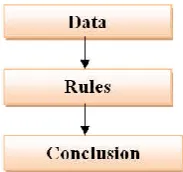
It is also called knowledge-based expert system and also considered as ‘applied artificial intelligence’ where several techniques or methods may be utilized. Forward reasoning is additionally one amongst the well-known inference strategy of expert system, that starts as a group of known facts and applies rules to get new facts, whose premises match the known facts and therefore the method continues till it reaches a preset goal or till no any facts are often derived whose premises match known (Pushpa Kesarwani, 2013). It checks the respective facts against the user’s query or predetermined goal and indicates that the inference process moves in the forward direction, i.e. facts to the goal (Pushpa Kesarwani, 2013 and Okafor, 2007). However, it is also called data-driven inference procedure. The forward reasoning is one of the most used methods in expert system design and also used for modeling the human brain in AI. Fig. 1 shows a conceptual representation of forward reasoning approach.
This study is also important because
Various rules can be constructed from the stock market data set.
Very few researchers have attempted formalized logic methods for representation of the stock market expert system
ISSN: 0976-3376
Vol. 07, Issue, 11, pp.3896-3902, November,Asian Journal of Science and Technology 2016Available Online at http://www.journalajst.com
ASIAN JOURNAL OF
SCIENCE AND TECHNOLOGY
Article History:
Received 17th August, 2016
Received in revised form
24th September, 2016
Accepted 02nd October, 2016
Published online 30th November, 2016
Key words:
Selecting reasonable strategy paradigm for stock market problem and also improving decision making quality of a stock market expert system.
This research study will be contributed to already ongoing research on stock market expert system.
This research study will be laid down a good foundation for novice users and researchers intending to work on this area by providing a clear picture of expert system, methods, and their components and most important stock market related issues.
The nine different shares of Bombay Stock Exchange (BSE) of India are considered. Therefore, the various experiments are conducted on input variables as well as no. of iterations and their effect upon the inference engine is noticed.
Fig. 1. Conceptual Representation of Forward Reasoning approach
The organization of this paper is as follows: The section 2 describes brief literature of significant researchers; section 3 describes an overview of system architecture; section 4 describes the knowledge base design; section 5 describes proposed methodology in detail; section 6 describes experimental results, and at last section 7 describes conclusion and future scopes of study.
Literature Review
Over the couple of decades, stock market field has greatly shown the need of an expert system due to increasing economic loss or even fatal loss of life in some domain applications. Here we have presented some significant researchers work. Niderlinski (2010) (Niederlinski, 2001), has proposed a model based expert system shell. He used the two most important techniques forward and backward reasoning for the design and development of the shell. The most important property of the system is that it may be used to reason with any knowledge base, and it consists approximately 24 rules with an uncertainty factor ranging from -1 to +1. He used the modified standard certainty factor algebra for modeling the uncertainty factor. Finally, the system has the capability to automatically rule checking and drawing conclusions from the given facts. The system is also used to generate a diagnosis report, which may be used as record keeping or for further analysis. Zarandi et al. (2012) have suggested fuzzy rule based expert system model for evaluating intellectual capital. They applied fuzzy linguistic variables to determine the level of qualitative evaluation and criteria of experts. The various samples of company are considered for measuring the intellectual capital. Their knowledge base consists of various rules based on capital structure, market share rate, employee’s knowledge, customer capital, etc. The experimental results showed that system gave a lot of correct
judgments in terms of linguistic variables and system conjointly extending the capability for future studies for various sorts of membership functions in terms of linguistic terms.
Mohamed et al. (2014) have proposed multiple-imputation type framework for the estimation of time series data using forward and backward forecasting methods. However, the model relies on iterative successive backward and forward forecasting of the missing values. The experimental results showed that proposed model has been tested on numerous linear and non liner times’ data and has been succeeded to achieve better prediction accuracy. Ajlan (2015) has presented a comparative study of forward and backward reasoning methods for academic field. He used various academic performance indicators like grade point, attendance to draw Graduate Admission Expert system (GAES). The knowledge base consists of 12 rules, and experimental results showed that forward reasoning is a better strategy than backward reasoning in terms of deriving goals. Stephen (2015) has presented an artificial intelligence approach to investing in corporate bankruptcy. He designed expert system prototype for corporate bankruptcy analysis. His system consists of various production rules based on indebtedness ratios (i.e. financial leverage ratio, general indebtedness ratio, global financial autonomy ratio etc.). The exsys corvid @R tool is used to draw expert system prototype. The experimental results showed lower training time, prescription to refine performance. Kamley et al. (2015) have proposed rule based expert system approach for share prices selection. The last ten years Bombay Stock Exchange (BSE) of India’s data is considered to draw expert system knowledge base. Their expert system used to draw with twelve most promising rules of the stock market and rules contains of open price, close price, high price, low price, earning per share, dividend, interest rates, oil prices and the most important US dollar prices of shares. Kamley et al. (2016) have proposed a comparative study between forward and backward reasoning strategy over global stock exchanges such as India, US, Japan and China. Their studies consist of several fundamental, macroeconomic and technical factors. The expert system consists of 50 production rules. Finally, experimental results showed that backward reasoning strategy has performed better over forward reasoning strategy. In this study, forward reasoning approach is considered for the stock market expert system design and development.
Overview of System Architecture
The proposed system has five major components which are:
User Interface
Inference Engine (IE)
Knowledge base (KB)
Database (DB)
Explanation Facility
Working Memory
User Interface
A dialogue between user and system is conducted by the User Interface. The user provides information on the problem to be solved and then system attempts to derive insight information
(i.e. inferred information) by the inference engine after examining the knowledge base.
Fig. 2. System Architecture of Expert System
Inference Engine
An inference engine is the key component of expert systems. It interacts with the database component with providing data, and then it searches for applicable rules in the Knowledge Base (KB) carries out the reasoning and storing the useful results in the database for further processing (Nils Nilsson, 1998 and Elaine Rich, 2009).
Knowledge Base
The Knowledge Base component contains the domain knowledge useful for problem solving. The knowledge in a rule- based expert system is represented by a set of IF-THEN rules (Nils Nilsson, 1998 and Elaine Rich, 2009).
Database
The Database component includes a set of facts used to match against the IF (condition) parts of rules stored in the knowledge base.
Explanation Facility
The explanation component would be helped to know the validity to the conclusion before applying it to the particular domain. It is not acceptable for an expert system to take decisions without being able to provide an explanation, for it has to take decisions.
Working Memory
Working Memory is an important part of an expert system that contains the problem facts that are discovered during the session. It contains two types of information that are:
Supplied by the user and
Inference by the system.
Knowledge base design
A good quality of expert system depends on experts who feed the knowledge about the system as well as how much knowledge posses by the system (Nils Nilsson, 1998). However, the stock market is considered as a proposed application area and LISP programming language is used to create a knowledge base and functioning as a shell (Davis, 1977). Therefore, the knowledge base is designed with twenty- seven stock variables, which is shown in Table 1 (http://www.bseindia.com, http://www.rbiindia.org).
Table 1. Vocabulary of Stock Market
S.No. Variable Name Description
1 OP Open Price
2 LP Low Price
3 CP Close Price
4 HP High Price
5 PE Ratio Price Earnings Ratio
6 DIVD Dividend
7 EPS Earnings Per Share
8 USDP US Dollar Prices
9 OILP Oil Prices
10 INFLR Inflation Rates
11 INTR Interest Rates
12 GDP Gross Domestic Product
13 FDI Foreign Direct Investment
14 UNEMPR Unemployment Rate
15 IMP Imports
16 EXP Exports
17 Vole Volume
18 USNE United State Nation Economy
19 CNE China Nation Economy
20 MA21d Moving Average of 21 days
21 MA52d Moving Average of 52 days
23 RSI14d Relative Strength Index of 14 days
24 MC Market Capitalization
25 SMN Stock Market News
26 RBGS Reserve Bank Governor Statement
27 BSE Sensex Bombay Stock Exchange
Stock market consists of so many technical rules. So therefore, the mapping of these rules with all stock variables is impossible. In this study, knowledge base consists of maximum hundred production rules, but Table 2 shows only
sample of the stock market knowledge base
(http://www.bseindia.com, http://www.rbiindia.org).
Table 2. Sample of the Stock Market Knowledge Base
R.No. Rule Description
1 IF OP and LP are rising THEN HP is also rising
2 IF LP is rising THEN CP is rising
3 IF CP is falling THEN OP is rising
4 IF USDP are falling then BSE index rising
5 IF IMP fall Then BSE Sensex rise
6 IF Vole and OP are falling THEN all shares are falling
7 IF EPS and DIVD rises THEN BSE Sensex rises
8 IF INFL fall THEN BSE Sensex go down
9 IF IMP rise THEN BSE Sensex fall
10 IF OILP are rising then BSE Sensex fall
11 IF RBGS is negative THEN stock prices are falling
12 IF INTR and INFLE are rising THEN BSE Sensex is falling
13 IF IMP and EXP fall THEN BSE Sensex go down
14 IF INFLR and USDP are falling THEN BSE Sensex go down
15 IF CNE are falling THEN BSE Sensex is falling
16 IF EPS and DIVD are falling THEN all share prices are falling
17 IF CP and LP are rising THEN VOLE. Is also falling
18 IF PE ratio is rising THEN all shares of BSE Sensex is rising
19 IF FDI is rising THEN BSE Sensex is rising
20 IF GDP is rising THEN BSE Sensex is rising
Proposed Methodology
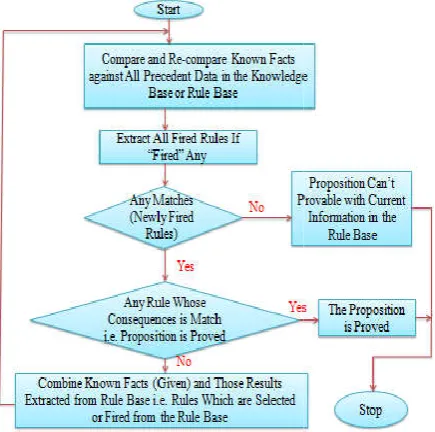
Stock market domain is vast, thus there is a need of such a kind of inference mechanism, which might be search through the database and deduce the results in an effective manner. Forward reasoning is a strategy of an inference process which starts from the initial facts (given) and would be terminated with the goal. It’s a way of drawing inferences
knowledge base and often called data-driven methodology. This can be more generally used inference method in expert system (Nils Nilsson, 1998). Fig. 3 shows a flowchart of the forward reasoning process (Elaine Rich, 2009;
Davis, 1977 and Erdani Yuliadi, 2011).
Fig. 3. Flowchart of Forward Reasoning Process
Fig. 3 clearly states that the proposed approach starts with a known (given) facts and going towards in the forward direction until rule fire procedure doesn’t stop.
described the forward reasoning approach in a more detailed manner (Nils Nilsson, 1998; Elaine Rich, 2009;
Davis, 1977 and Erdani Yuliadi, 2011).
Algorithm 1: Forward Reasoning
Step 1: Start
Step 2: Compare the premises of each rule against the fact base to discover the new applicable rule.
Step 3: Conflict Resolution arises if more than one rule is applicable at the same time, then choose one rule based upon some criteria:
3.1: ignore those rules whose conclusion is already known and choose first of the remaining rules.
3.2: don’t fire rules twice on the same data element. 3.3: rules must be fired on most
memory elements.
Step 4: Apply the selected rule and added the facts which are specified in THEN part of a conclusion.
Step 5: Terminate a procedure if no more rules are applicable.
Example 1: let the overall procedure can be understood by
following example.
Initially knowledge base contains the following rules.
3899 Asian Journal of Science and Technology
Stock market domain is vast, thus there is a need of such a kind of inference mechanism, which might be search through database and deduce the results in an effective manner. Forward reasoning is a strategy of an inference process which starts from the initial facts (given) and would be terminated with the goal. It’s a way of drawing inferences from the driven methodology. This can be more generally used inference method in expert Fig. 3 shows a flowchart of the , 2009; Michie, 1982;
Flowchart of Forward Reasoning Process
Fig. 3 clearly states that the proposed approach starts with a known (given) facts and going towards in the forward direction until rule fire procedure doesn’t stop. Algorithm 1 reasoning approach in a more detailed , 2009; Michie, 1982;
Compare the premises of each rule against the fact base to discover the new applicable rule.
Conflict Resolution arises if more than one rule is applicable at the same time, then choose one rule
ose conclusion is already known and choose first of the remaining rules. 3.2: don’t fire rules twice on the same data element. 3.3: rules must be fired on most- recent working
Apply the selected rule and added the facts which are specified in THEN part of a conclusion.
Terminate a procedure if no more rules are applicable.
let the overall procedure can be understood by
Initially knowledge base contains the following rules.
Rule 1: IF A &CF
Rule 2: IF A & EG
Rule 3: IF BE Rule 4: IF GD
Prove that: IF A & BD (True)
Initially, only inputs
A and B
Rule 1 and go forward until rule “fire” is found.
1st Iteration: Rule 3 matches, i.e. fires so now the conclusion
E
is true and added to the database. No other rules fired. Therefore, 1st iteration ends here goal2nd Iteration: Rule 2 fires so now the conclusion
added to the database. Finally, Rule 4 fires conclusion true and the goal is found. However, two iterations take to search the specified the goal.
EXPERIMENTAL RESULTS
In this study, last five years,
Reliance Industry, Wipro LTD., Asian Paints, Ambuja Cement, HCL LTD. and HDFC LTD.
BSE index are selected (http://www.bseindia.com
the expert system is modeled with various fundamental,
technical and macroeconomic factors
rbiindia.org). These factors play a vital role in share market performance and might be affected share performance dir or indirectly. The expert system functions are coded in common lisp 3.0, which is well suited for expert system programming (http://tutorialspoint.com
Initially, database consists of various facts, which are shown by Fig. 4.
Fig. 4 Sample of Fact Generation from LISP Environment
Therefore, after the fact base and rule base generation users might be able to ask various questions from the system such as “Will share prices fall for Infosys company in near future”, “Will share prices rise for ONGC company”, “what will be the impact of rising open price and close price shares of TCS company”, “what will be the impact of rising interest rates and inflation rates on shares of BSE Index”, “what will be the
Asian Journal of Science and Technology Vol. 07, Issue, 11, pp. 3896-3902, November,2016
IF A & B D (True)
A and B
are true. So let’s now start with1 and go forward until rule “fire” is found.
Rule 3 matches, i.e. fires so now the conclusion is true and added to the database. No other rules fired.
iteration ends here goal
D
is not found here. Rule 2 fires so now the conclusionG
is true and added to the database. Finally, Rule 4 fires conclusionG
is true and the goal is found. However, two iterations take toEXPERIMENTAL RESULTS
In this study, last five years, Infosys, TCS, ONGC LTD, Reliance Industry, Wipro LTD., Asian Paints, Ambuja Cement, HCL LTD. and HDFC LTD. Company’s data on http://www.bseindia.com) However, the expert system is modeled with various fundamental,
technical and macroeconomic factors (http://www.
These factors play a vital role in share market performance and might be affected share performance directly or indirectly. The expert system functions are coded in common lisp 3.0, which is well suited for expert system http://tutorialspoint.com, http://google.com). Initially, database consists of various facts, which are shown
Fig. 4 Sample of Fact Generation from LISP Environment
Therefore, after the fact base and rule base generation users might be able to ask various questions from the system such as “Will share prices fall for Infosys company in near future”, ices rise for ONGC company”, “what will be the impact of rising open price and close price shares of TCS company”, “what will be the impact of rising interest rates and inflation rates on shares of BSE Index”, “what will be the
impact of falling economy of US and China on Indian stock market” and “what will be the impact of breaking news in the stock market”. Once system dialogue, the next subsequent section describes how an expert system reaches a explicit conclusion and what will be decision regarding us
Fig. 6 shows the execution of forward reasoning inference procedure.
Fig. 5. Sample of Rule Generation from LISP Environment
Fig. 6. Execution of Forward Reasoning Inference Procedure
Fig. 6 shows the execution of inference procedure. However, the initial procedure starts with information supplied
user and goes toward in the forward direction until the procedure could not be reached at predetermined goal. Fig. 7 shows the initial production system consultation for the stock market system. The specified goal will be searching through all the rules in the knowledge base. As a result eight rules fired after first iteration. There is conflict resolution occurs, but it resolved that priority wise, i.e. the rule first triggered that’s priority will be always high in the procedure. Fig. 8 shows production system environment after rule execution
3900 Asian Journal of Science and Technology
US and China on Indian stock market” and “what will be the impact of breaking news in the stock market”. Once system dialogue, the next subsequent section describes how an expert system reaches a explicit conclusion and what will be decision regarding user’s queries. Fig. 6 shows the execution of forward reasoning inference
Fig. 5. Sample of Rule Generation from LISP Environment
Execution of Forward Reasoning Inference Procedure
Fig. 6 shows the execution of inference procedure. However, the initial procedure starts with information supplied by the user and goes toward in the forward direction until the procedure could not be reached at predetermined goal. Fig. 7 shows the initial production system consultation for the stock The specified goal will be searching through rules in the knowledge base. As a result eight rules fired after first iteration. There is conflict resolution occurs, but it resolved that priority wise, i.e. the rule first triggered that’s priority will be always high in the procedure. Fig. 8 shows
duction system environment after rule execution.
Working Memory
Goal 1: What Will be Effect of Rising US Dollar
Prices Goal 2: What Will be Effect of Falling GDP
Rates .
. .
Fig. 7. Initial Production System Consultation for Stock Market System
Fig. 8. Production System Environment after Rule Execution
Working Memory
1stIteration
2ndIteration
.
25thIteration
.
87thIteration
BSE Index ->Rise Infosys Share Prices-> High Ambuja Cement Share Prices
fall
Sell Shares-> INFY, TCS, ONGC Buy Share -> Asian Paints, HCL
Fig. 9. Final Production System Environment after Execution of Successive Iterations
Table 3. Descriptive Statistics of Inference Procedure
S.No. No. of Fact No. of Rule
1 12 12
2 32 24
3 67 36
4 110 48
5 190 85
6 225 100
Asian Journal of Science and Technology Vol. 07, Issue, 11, pp. 3896-3902, November,
Knowledge Base
Rule 1 Rule 2 Rule 3
. Rule 15 Rule 16
. Rule 42 Rule 43
. Rule 82
. Rule 98 Rule 99 Rule 100
Initial Production System Consultation for Stock Market System
Production System Environment after Rule Execution
Knowledge Base
Working Memory
Rule 1Rule 2 Rule 3
. Rule 15 Rule 16
. Rule 42 Rule 43
. Rule 82
. Rule 98 Rule 99 Rule 100 > High
Ambuja Cement Share Prices->
> INFY, TCS, ONGC > Asian Paints, HCL
Final Production System Environment after Execution of Successive Iterations
Table 3. Descriptive Statistics of Inference Procedure
No. of Rule No. of Iteration
34 57 84 110 195
100 214
Fig. 10. A Bar Graph for No. of Rule against No. of Iteration
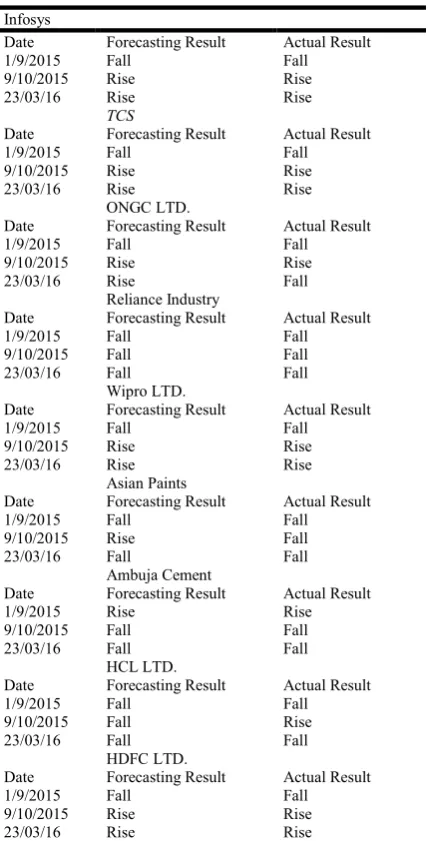
Table 4. Forecasted Performance of BSE Index
Infosys
Date Forecasting Result Actual Result
1/9/2015 Fall Fall
9/10/2015 Rise Rise
23/03/16 Rise Rise
TCS
Date Forecasting Result Actual Result
1/9/2015 Fall Fall
9/10/2015 Rise Rise
23/03/16 Rise Rise
ONGC LTD.
Date Forecasting Result Actual Result
1/9/2015 Fall Fall
9/10/2015 Rise Rise
23/03/16 Rise Fall
Reliance Industry
Date Forecasting Result Actual Result
1/9/2015 Fall Fall
9/10/2015 Fall Fall
23/03/16 Fall Fall
Wipro LTD.
Date Forecasting Result Actual Result
1/9/2015 Fall Fall
9/10/2015 Rise Rise
23/03/16 Rise Rise
Asian Paints
Date Forecasting Result Actual Result
1/9/2015 Fall Fall
9/10/2015 Rise Fall
23/03/16 Fall Fall
Ambuja Cement
Date Forecasting Result Actual Result
1/9/2015 Rise Rise
9/10/2015 Fall Fall
23/03/16 Fall Fall
HCL LTD.
Date Forecasting Result Actual Result
1/9/2015 Fall Fall
9/10/2015 Fall Rise
23/03/16 Fall Fall
HDFC LTD.
Date Forecasting Result Actual Result
1/9/2015 Fall Fall
9/10/2015 Rise Rise
23/03/16 Rise Rise
In Fig. 8, working memory shows resultant facts that have been added after the rules “fire” procedure. Fig. 9 shows final production system environment after execution of successive iterations. Fig. 9 shows that working memory consisted of various goals such as BSE Index rise, Infosys shares will be higher etc. so, proposed study shows great investment time for stock users in the near future i.e. users might earn a profit on individual share selection. Table 3 shows the descriptive
statistics of inference procedure. In Table 3, at the initial stage, only twelve facts are known, but the inference procedure each time adds new facts into the database whenever the certain conclusion is made to be true. At last, procedure consisted of 225 known facts and it will be very efficient to derive the goal after a minimum no. of iterations at most 214. Fig. 10 shows a bar graph for no. of rule against no. of iteration. Fig. 10 depicts that when no. of rule increases than no. of iteration also increases, but the algorithm considerably performs better on a maximum no. of rules. Table 4 shows forecasted performance of BSE Index.
Table 5. Testing Sample of Predicted Prices Pattern against Expert System
Infosys
Date Forecasting Result Actual Result
5/1/2016 Rise Rise
6/1/2016 Rise Rise
7/1/2016 Rise Rise
TCS
Date Forecasting Result Actual Result
5/1/2016 Rise Rise
6/1/2016 Rise Rise
7/1/2016 Rise Fall
ONGC LTD.
Date Forecasting Result Actual Result
5/1/2016 Rise Rise
6/1/2016 Fall Rise
7/1/2016 Rise Rise
Reliance Industry
Date Forecasting Result Actual Result
5/1/2016 Rise Rise
6/1/2016 Rise Fall
7/1/2016 Fall Fall
Wipro LTD.
Date Forecasting Result Actual Result
5/1/2016 Rise Fall
6/1/2016 Fall Fall
7/1/2016 Rise Rise
Asian Paints
Date Forecasting Result Actual Result
5/1/2016 Fall Fall
6/1/2016 Fall Fall
7/1/2016 Fall Fall
Ambuja Cement
Date Forecasting Result Actual Result
5/1/2016 Fall Rise
6/1/2016 Fall Fall
7/1/2016 Rise Fall
HCL LTD.
Date Forecasting Result Actual Result
5/1/2016 Fall Rise
6/1/2016 Rise Fall
7/1/2016 Fall Fall
HDFC LTD.
Date Forecasting Result Actual Result
5/1/2016 Fall Rise
6/1/2016 Rise Rise
7/1/2016 Rise Fall
Table 4 clearly states that the comparison of share performance with forecasted performance. However, the different shares of BSE Index may be performing outstanding in the future and also showing a great sign of boom of Indian economy. Table 5 shows testing samples of the predicted price pattern against expert system. The system could be able to predict accurately price pattern against testing samples which is shown by Table 5. Some shares like Infosys, TCS, Wipro, and Asian Paints etc. has outstanding performance. Stock users have a good opportunity to invest in these shares.
Conclusion and Future scopes
In this study forward Reasoning based inference engine adapted to stock market expert system. The proposed approach is well suited for such an environment and will be helpful for stock users to reach at the certain decision as well as knowing the stock market conditions’ time to time. The system is designed in the very straightforward way, and proposed systems is better than other systems in a number of ways like no. of variables, no. of facts, no. of rules, no. of iterations, and most important in terms of inference power. However, the system could be able to predict the stock price’s pattern accurately. In the near future, some other intelligent method like frame based expert system will be adopted for stock market knowledge representation.
Ethics
This article is original and contains unpublished materials. The corresponding author confirms that all the authors have read and approved the manuscript and no ethical issues involved.
REFERENCES
A1-Ajlan, 2015. The Comparison between Forward and Backward Chaining, International Journal of Machine Learning and Computing, Vol. 5, No.2, pp. 106-113. Alauddin Alomary, and Mohammad Jamil, 2006. An
Approach to Strengthen Expert System Shell with Knowledge Illustration Established on Peak of the Fuzzy Logic, The International Arab Journal of Information Technology, Vol. 3, No. 3, pp. 210-218.
Beauvieux, A. 1990. A General Consistency Checking and Restoring Engine for Knowledge Bases, In Proceedings of the 9th European Conference on Artificial Intelligence,
Stockholm, Sweden.
Common Lisp Compiler from http://google.com.,
Downloaded on date April 2015.
Davis, R. and King, J. 1977. An Overview of Production Systems, Machine Intelligence, Vol. 8, pp. 300-322. Elaine Rich, Kevin Knight and B Shivashankar Nair, 2009.
Artificial Intelligence, Tata McGraw-Hill Publishing
Company Limited, Third Edition, New Delhi.
Erdani Yuliadi, 2011. Developing Recursive Forward Chaining Method in Ternary Grid Expert System,
International Journal of Computer Science and Network Security, Vol. 11, No. 8, pp. 126-130.
Macro Economic Variables Data Available on
http://www.rbiindia.org.”, Accessed on April 2015.
Mathkour, H. 1992. Expert System Development Tools: A Case Study, In Proceedings of the 1st International Conference on AI Application, Cairo, Egypt.
Michie, D. 1982. The State of the Art in Machine Learning, Introductory Readings in Expert Systems, Gordon and Breach, New York, pp. 209-229.
Niederlinski, A. 2001. An Expert System Shell for Uncertain Rule and Model Based Reasoning”, Methods of Artificial Intelligence in Mechanics and Mechanical Engineering,
Vol. 8, pp. 1-10.
Nils Nilsson, J. 1998. Artificial Intelligence A New Synthesis,
Morgan Kaufmann Publishers, Inc., USA, 1998.
Okafor, E.C. and CC. Osuagwu, 2007. Issues in Structuring the Knowledge-base of Expert Systems, The Electronic
Journal of Knowledge Management, Vol. 5, pp. 313-322.
Online LISP Material Available at “http://tutorialspoint.com”.
Online Stock Market Dataset Available at
“http://www.bseindia.com”, Accessed on April 2015. Pushpa Kesarwani, and A.K. Mishra, 2013. Selected
Integrated Approach for Knowledge Representation by Comparative Study of Knowledge Scheme, International Journal of Scientific and Research Publications, Vol. 3, Issue (2), pp. 1-5.
Sachin Kamley, R.S Thakur, and Shailesh Jaloree, 2015. Rule Based Approach for Stock Selection: An Expert System,
International Journal of Computing Algorithm (IJCOA),
Special Issue, Vol. 4, Issue (1), pp. 15-18.
Sachin Kamley, R.S. Thakur, and Shailesh Jaloree, 2016. Performance Comparison between Forward and Backward Chaining Rule Based Expert System Approaches over Global Stock Exchanges, International Journal of
Computer Science and Information Security (IJCSIS), Vol.
14, No. 3, pp.74-81.
Stephen, C. G. 2015. An Artificial Intelligence Approach towards Investing Corporate Bankruptcy, Review of European Studies, Vol. 7, No. 7, pp. 5-22.
Tawfik Mohamed, N.E. Gayar, and A.F. Atiya, 2014. Forward and Backward Forecasting Ensembles for the Estimation of Time Series Missing Data, Artificial Neural Networks in Pattern Recognition (ANNPR), LNAI, Vol. 8774, pp. 93-104.
Zarandi, M. H., Hassan, N. M. and Bastani, S. 2012. A Fuzzy Rule Based Expert System for Evaluating Intellectual Capital, Advances in Fuzzy System, Vol. 12, pp. 1-11.