* To whom all correspondence should be addressed.
Modification of Argillous Raw Materials by
Additives Comprising Carbonates
Galeev Ruslan Razinovich1, Bogdanov Andrey Nikolaevich2,
Abdrakhmanova Layla Abdullovna2 and Khozin Vadim Grigorievich2
1Kazan Federal University–18 Kremlyovskaya St., Kazan 420008 Republic of Tatarstan, Russian Federation
2 Kazan State University of Architecture and Engeneering – 1 Zelenaya St., Kazan 420043 Republic of Tatarstan, Russian Federation.
doi: http://dx.doi.org/10.13005/bbra/1570 (Received: 30 October 2014; accepted: 05 December 2014)
In order to improve technological and drying properties of argillaceous raw materials and to produce face brick of light color shades from low-melt and red-burning clay, a modification of carbonate-containing additive, in a form of oil-slime utilization product, was carried out. An influence of a concentration of an additive on structure and properties of a modified mixture is discussed. Structure of ceramics and chemical composition of minerals formed during burning is studied, their influence and an influence of organic component of the additive on a change of color and properties of ceramic brick, manufactured by means of plastic molding method, are identified.
Key words: Argillous raw, drying, carbonates, plastic molding method.
In the presented paper an influence of modifier for ceramic mixtures in a form of petroleum oils utilization product (OUP) on main properties of ceramic bricks, depending on chemical and mineral composition of raw materials, was studied. Petroleum oil utilization product (“Poroshok mineral’ni PUN”) is a mineral powder, produced by means of processing of oil-slime, taken from lower (bottom) layer of sludge tanks, using burned lime.
Its external appearance is uniform in composition and color, friable, hydrophobic, partially clotted powdered mineral particles with an organic component, absorbed on a surface: microparticles consist of calcium hydroxide with
oil slime, which is uniformly absorbed on a surface and filling pore structure in an entire volume.
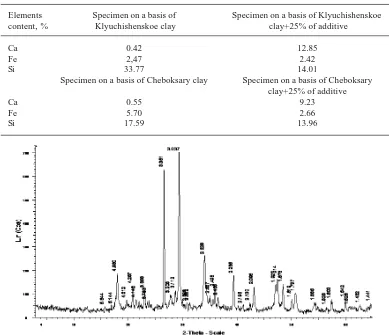
Mineral part of OUP (Fig.1) consists of quartz (16%), calcite (12%), portlandite Ca(OH)2 (approximately 22-25%), clay minerals (up to 20%), also, traces of dolomite (up to 1%) and feldspars (up to 4%) are detected. X-Ray amorphous phase constitutes, approximately, 10-16%
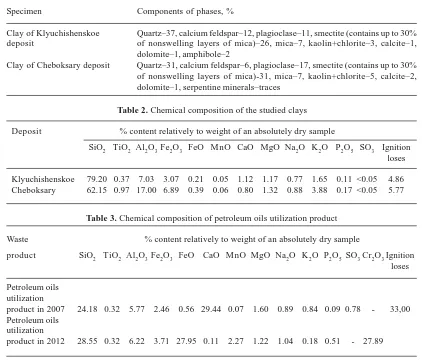
A comparative modification of clay raw materials was carried out on clays of two deposits, which have virtually the same clay minerals and impurities (table 1), but differ in chemical composition (table 2). Clay of Cheboksary deposit consists more clay-forming minerals as compared to clay of Klyuchishenskoe deposit, and contains 2 times bigge ramoun of iron oxide Fe2O3.
Despite of the fact, that the studied substance was produced by means of processing of waste product (oil-slime), comparative analysis of OUP, collected in 2007 and 2012, demonstrated a quite high stability of chemical composition, which follows from the data in table 3.
X-Ray diffraction quantitative analysis of OUP and clay raw materials was carried out using Bruker D8 Advance X-Ray diffraction analysis device. The study of chemical compositions of specimens was carried out with use of induction-bound plasma emission spectrometer OPTIMA 2000DV.
Characteristics of formed structures, obtained during burning at 11000!,were studied by scanning electron microscope REM-100U with x-ray energy dispersion analyzer EDAR, which allows to conduct quantitative element analysis.
RESULTS
OUP was selected as a multifunctional modifying additive, because of its mass-production, high content of CaO, presence of clay minerals in the mineral component and high specific surface area of mineral powder. In a process of testing OUP demonstrated properties of strong anti-shrinkage additive and whitening additive.
Organic component of the additive must have a positive influence on a formation of structure during burning. That’s why we conduct studies on organic component of OUP by means of extraction by kerosene, thermal analysis of the studied material before and after an extraction by kerosene of filler, which contains waste materials of oil production, as well as an obtained extracted material, was carried out.
Table 1.Phase composition of the studied clays
Specimen Components of phases, %
Clay of Klyuchishenskoe Quartz–37, calcium feldspar–12, plagioclase–11, smectite (contains up to 30%
deposit of nonswelling layers of mica)–26, mica–7, kaolin+chlorite–3, calcite–1,
dolomite–1, amphibole–2
Clay of Cheboksary deposit Quartz–31, calcium feldspar–6, plagioclase–17, smectite (contains up to 30% of nonswelling layers of mica)-31, mica–7, kaolin+chlorite–5, calcite–2, dolomite–1, serpentine minerals–traces
Table 2. Chemical composition of the studied clays
Deposit % content relatively to weight of an absolutely dry sample
SiO2 TiO2 Al2O3Fe2O3 FeO MnO CaO MgO Na2O K2O P2O5 SO3 Ignition loses
Klyuchishenskoe 79.20 0.37 7.03 3.07 0.21 0.05 1.12 1.17 0.77 1.65 0.11 <0.05 4.86
Cheboksary 62.15 0.97 17.00 6.89 0.39 0.06 0.80 1.32 0.88 3.88 0.17 <0.05 5.77
Table 3. Chemical composition of petroleum oils utilization product
Waste % content relatively to weight of an absolutely dry sample
product SiO2 TiO2 Al2O3Fe2O3 FeO CaO MnO MgO Na2O K2O P2O5 SO3Cr2O3Ignition loses
Petroleum oils utilization
product in 2007 24.18 0.32 5.77 2.46 0.56 29.44 0.07 1.60 0.89 0.84 0.09 0.78 - 33,00
Petroleum oils utilization
Table 4. OUP thermal data analysis
No. Specimen Water content,% OS, % FS
1 OUP 3.1 10 0.7
2 OUP after extraction by kerosene 2.3 5 0.5
3 extracted material - 100 0.6
Table 5. Phase composition of ceramic specimens
Number of sample Mineral content, %
Quartz Feldspar X-Ray amorphous pyrop ediopside helenite hematite
phase
Cheboksary clay 52 11 19 7 11
Cheboksary clay+25% OUP 20 32 7 4 20 11 2
Cheboksary clay+50% OUP 14 20 29 1 16 17 <2
Klyuchishenskoe clay 45 16 33 6
Klyuchishenskoe +25% OUP 23 32 8 20 12 3
Klyuchishenskoe +25% OUP 23 27 28 15 5 <2
Table 6. Results of energy dispersion analysis of ceramic specimen
Elements Specimen on a basis of Specimen on a basis of Klyuchishenskoe
content, % Klyuchishenskoe clay clay+25% of additive
Ca 0.42 12.85
Fe 2,47 2.42
Si 33.77 14.01
Specimen on a basis of Cheboksary clay Specimen on a basis of Cheboksary
clay+25% of additive
Ca 0.55 9.23
Fe 5.70 2.66
Si 17.59 13.96
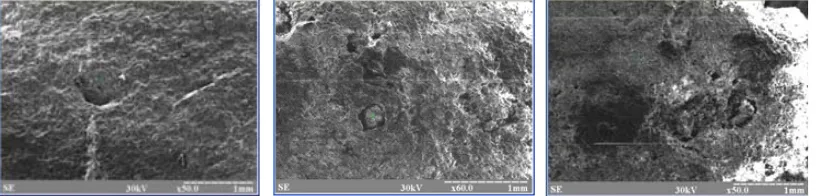
Fig. 2. Microphotograph of ceramic sample made from Cheboksary clay (withoutadditive, 25%, 50% OUP)
Fig. 2. Microphotograph of ceramic sample made from Klyuchishenskoe clay (withoutadditive, 25%, 50% OUP)
Results of the studies of the products (initial OUP, OUP after extraction, extracted material) obtained by means of thermal analysis method in temperature range of 20-10000! with heating speed of a furnace equal to 100!/min are presented. Data on water content, content of organic substance (OS) and factor of fractions of particle size distribution FS is presented in table 4. Phase structure of burned specimens is presented in table 5:
Elemental composition of burned specimens was obtained by means of energy dispersion analysis (table 6). Results are obtained at samples that were chipped off in a central part of burned specimens.
DISCUSSION
Analysis of structure’s microphotographs showed, that not modified specimens have relatively dense surface, which consists of melted uneven mass (Fig.1 and Fig.2). Glassy fragments of various shape are detected. Neoformations of granular shape and sizes of 10 ÷ 150 µm, which appeared as a result of burning, are distribute unevenly. Local inclusions with diameter from 100 to 800 µm and cracks are with 1000 µm length are detected. Elemental composition consists, mainly, ofsilicious phase (Si: 11-25% in a
specimen made from Cheboksary clay and 24-32% in a specimen made from Klyuchishenskoe clay), bakground elements are O, Mg, Al, Si, K, Ca, Fe, Ti.
25% of OUP additive facilitate a formation of system of pores (with diameter up to 50 µm), local cavities (with dieameter up to 400 µm) and rounded aggregates with a tendency for mechanical destruction and further formation of half-spherical elements of microrelief of «crater» or «caldera» type. In spectres, obtained by microprobe analysis of that inclusions, increased calcium content (6-21%) was detected.
A surface of specimens with 50% of an additive has loose, spongy structure, which is related with a large number of pores and caverns that are clearly visible in the chips. There is a tendency for an increase of Ca content (6-16%) relatively to Si (1-15%).
Previously, on an example of one type of raw materials, it was established, that a component, containing calcium, leads to a formation of various types of structures on a surface and in a volume of a sample16,17.
7% of helenite are detected. Hematite content, which is related with a presence of iron oxide, in all case of OUP introduction was decreasing, at that, it was detected, that in all specimens diopside had appeared and content of helenite had increased.
Results of energy dispersion analysis (tabel 6) allow to conclude, that structure formation for two types of clays occurs in a different manner. For Klyuchishenskoe clay based specimens it was established16, that burning of not modified clays, when red ceramics is formed, Fe content on a surface is dominating. Carbonate-containing additive makes Fe content on a surface minimal, which results in whitening of ceramics18. In a case of Cheboksary clay, iron content on a surface and in a whole volume of a specimen is of one order.
Table 6 data shows, that OUP modification of Cheboksary clay leads to a rapid decrease of Fe content, i.e., despite of a large amount of Fe in burned ceramics of an initial clay, OUP introduction results in virtually the same amounts of Fe in specimens, produced from two differnt types of clays. It indicates that Fe-containing minerals in a case of Cheboksary clay mainly concentrate in surface layers of specimens. It determines a lesser level of whitening in modified specimens based on Cheboksary clay.
A recalculation form an element composition to a content of oxide !0, SiO2 leads to a conclusion, that !0:SiO2 ratio is many times lower in the ceramics made from not modified clay as compared to clay, containing carbonates, which explains a detected decrease of mechanical strength in a case of modification. At the same time, it is detected, that surface structures are stronger, than internal ones, both in modified and not modified specimens. That fact can be explained by a partial pores’ formation in internal areas (visible decrease of specimens is detected) because of burning out of an organic component19. That data is supported by a comparative analysis of an organic component of OUP.
Values of organic composition factor of more than 0.5 can be explained by a predominant content in a composition of an organic substance of oils and resins as compared to asphaltenes. At the same time, in OUP powder after an extraction by kerosene there is almost a half of organic fraction, which more rich of asphaltenes, which are insoluble in kerosene. The obtained extracted
material has F=0.6. Basing on that data it can be said that the extracted material is a heavy organic substance with 0.9736 g/cm3 density and 644.1 cSt viscosity, at that, highly oxidized: non-soluble in kerosene organic part in OUP constitutes 5% (table 4), which correlates with the data of weight method for determining organic component. Heavy fractions burn out only at temperatures higher than 4000!, which, undoubtedly, will influence processes of structure’s formation during burning.
CONCLUSION
In the presented paper a positive influence of calcium-containing compounds of optimal concentration on burning processes and properties of burned facing brick of «light» shade from low-melt and red-burning widely spread types of clays. However, in order to achieve uniform volumetric coloration and avoid an increase of porosity and, as a consequence, an increase of water absorption and decrease of frost resistance of burned ceramic products, it is necessary to additional modify the mixture by additives, intensifying sintering. In addition, it is necessary to carry out an optimization of burning regimes in order to decompose calcite !0!3, portlandite !0(”)2, which is introduced together with calcium-containing additive, which will lead to a formation of anorthite with a low content of a ratio of !0:SiO2 in structure, instead of detected diopside and helenite. Anorthite has high mechanical strength and chemical stablity among all known calcium compounds with crystal lattice.
ACKNOWLEDGMENTS
The authors would like to express their gratitude to workers of «TZNIIGEOLNERUD» (Kazan) for their help during a conduction of the presented research
REFERENCES
1. Yatzenko, N., Vil’bickaya, N., Golovanova, S., Zubehin, A., &Rat’kova, V., Intensification of sintering of ceramic mixtures containing calcium. Glass and ceramics, 2000; 32-34.
47-49.
3. Balkevich, V.,&Kogos, A.m Siliceous limestone in a production of building ceramic.Glass and ceramics, 1986; 8: 23-24.
4. Abdrahimov, V., &Kolpakov, A., Innovative directions in use of nano-grade anthropogenic raw materials containing calcium: sediment waste materials of waste waters, dust waste material of asphalt plants, water purification sludge and galvanic sludge in manufacturing of bricks.News of Higher Educational Institutions. Construction, 2013; 8: 41-45.
5. Shukina, L., Lyubova, E., Bilan, I., &
Kartavenko, M., Implementation of anthropogenic raw materials for manufacturing of ceramic facing brick. Construction materials, 2010; 8: 28-30.
6. Chumachenko, N., Hlistov, A., Pastushkov, A., &Vlasov, A., Implementation of high-aluminous sludges in technological processes of manufacturing of roasting free refractory materials and clinker based ceramic materials. Refractory materials and engineering ceramics, 2011; 7-8: 47-50.
7. Dhanapandian, S., Gnanavel, B., &Ramkumar, T., Utilization of granite and marble sawing powder wastes as brick materials.Carpathian Journal of Earth and Environmental Sciences, 2009; 2(4): 147-160.
8. Kadir, A., Mohajerani, A., Roddick, F.,
&Buckeridge, J., Density, Strength, Thermal Conductivity and Leachate Characteristics of Light-Weight Fired Clay Bricks Incorporating Cigarette Butts. International Journal of Civil and Environmental Engineering, 2010; 2(4): 179-184.
9. Anderson, M., Factory-scale proving trials using combined mixtures of three by-product wastes (including incinerated sewage sludge ash) in clay building bricks. Journal of Chemical Technology & Biotechnology, 2002; 77(3): 345-351.
10. Abdrakhimova, E., Roshchupkina, I.,
Myshentseva, Y., & Abdrakhimov, V., Experimental study of physicochemical processes during firing of acid-resistant materials based on traditional natural materials and production wastes. Refractories and
Industrial Ceramics, 2012; 1(53): 40-45. 11. Menezes, R., Ferreira, H., Neves, G., Lira, H.,&
Ferreira, H., Use of granite sawing wastes in the production of ceramic bricks and tiles. Journal of the European Ceramic Society, 2005; 25: 1149-1158.
12. Turgut, P.,&Yesilata, B., Physico-mechanical and thermal performances of newly developed rubber-added bricks.Energy and Buildings, 2008;
40: 679-688.
13. Basegio, T., Berutti, F., Bernades, A., & Bergmann, C., Environmental and technical aspects of the utilization of tannery sludge as a raw material for clay products.Journal of the European Ceramic Society,2002; 22: 2251-2259. 14. Cultrone, G., & Sebastian, E., Fly ash addition in clayey materials to improve the quality of solid bricks. Constr. Build. Mater., 2009; 23(2): 1178-1184.
15. Erol, M., Kucukbayrak, S., Ersoy-Mericboyu, A., Comparison of the properties of glass, glass-ceramic and glass-ceramic materials produced from coal fly ash. J. Hazard. Mater. 2008; 53(1-2): 418-425.
16. Bogdanov, A., Abdrakhmanova, L., &Gordeev, A., Evaluation of effectiveness of carbonate-containing additive in clay raw materials for a production of facing ceramic materials.Bulletin of KazSUACE, 2013; 2(24), 215-220.
17. Bogdanov, A., &Abdrakhmanova, L.,
Multifunctional nanoadditivesforreceiving volume coloring facing bricks of light tones. Second International conference “Clays, Clay Minerals and Layered Materials” – GMLM 2013, Saint-Petersburg, 2013; 105.
18. Golovanova, S., Zubehin, A., &Lihota, O., Whitening and sintering intensification of ceramics in a case of an application of iron-containing clays. Glass and ceramics, 2004; 9-11.
19. Abdrahimov, V., &Kolpakov, A., Phase