Impact of Interest Rates on Foreign Direct
Investment: Case Study Sierra Leone Economy
Alie FAROH
Capital University of Economics and Business, Beijing, PR China
School of Economics
Hongliang SHEN
Associate Professor at Capital University of Economics and Business, Beijing, PR China
School of Economics
Abstract
Foreign Direct Investment (FDI) has been seeing as one of the engines that ignite economic growth in recent years in developing countries. This study aim to examine the impact of interest rate on FDI flow in Sierra Leone, as the government of Sierra Leone has made tremendous effort after the civil war ended in 2001 to attract more foreign investment through the implementation of favorable foreign investment policies. Using econometrics techniques to run multiple regression time series data for the period of 1985 to 2012 in which diagnostic test was carried out in order to make the model fit and free from all spuriousness and make result valuable. The main findings were; trade openness (TO) and exchange rates (ER) are the key determinants of FDI flow having positive significant signs in Sierra Leone. Others variables, such as inflation, gross domestic products (GDP) and interest rate (IR), were found to be insignificant factors causing the variability of FDI flows. Finally we accept the null hypothesis that; high interest rate has no effect on FDI flow in Sierra Leone. For policy recommendation, government should support the private sector to mobilize domestic resources for productive investment, increase openness to foreign trade, fight corruption, improve the energy and infrastructure to attract foreign investment, maintain single digit inflation figure, promote production through boosting employment to build up GDP and finally to limit exchange rate fluctuation. Keywords; Foreign Direct Investment, domestic economy, interest rate, Sierra Leone.
1. INTRODUCTION
Foreign Direct Investment (FDI), has been seeing as one of the engines that ignite economic growth in recent years in developing countries, as it promote host country economic growth indicators such as; labor training, market development, financial inflow, technology transfer and skills. Its ability to minimize the shortages of financial resources and technology as these key resources can contribute to human skill development that would lead to economic growth. It can impact the host economy through a variety of channels. Principally, it helps by adding to the resources available for investment and capital formation. The transfer of technology, skills, innovative capacity, organizational and managerial practices between countries is also enhanced through the activities of foreign direct investors.
The government of Sierra Leone has made tremendous effort after the civil war ended in 2001 to attract foreign investment through the implementation of favorable foreign investment policies. The investment Code of 2005 effectively addresses the treatment of foreign investors. There are no known economic or industrial policies or practices that have discriminatory effects on foreign investors. There are also no formal obstacles on foreign ownership or control, but there are restrictions in one business sector. The historical exploitation of the country’s vast mineral wealth has led to legislated restrictions to protect small scale local artisan miners. Investments in mining of less than $500,000 require a Sierra Leone holding of 25 percent. Sierra Leonean authorities do not screen investments.
There is no history of expropriations in Sierra Leone. World Bank indices indicate that Sierra Leone’s laws on investment protection are strong. Investors’ rights are covered across a range of areas such as:
Open access to all sectors of the economy to foreign investment Rights to 100 percent foreign ownership of companies
Freedom to use foreign managerial, technical and unskilled workers No exchange restrictions
Guarantees on capital repatriation, loan remittance, and against expropriation.
The most recent United Nations Conference on Trade and Development statistics for FDI for Sierra Leone in 2011; Inward FDI Flows reached $49 million, Inward FDI Stocks: $313 million and Outward FDI Stocks: $316 million.
In Sierra Leone, there has been a much more liberalized regime for FDI, addressing investor concerns, privatizing public enterprises and actively promoting investment, all of which are aimed at creating a good environment to boost investor confidence. Again, the government of Sierra Leone has expanded the scope for FDI by reducing the number of industries closed to foreign investors. Given the growing importance of FDI in Sierra Leone, it has been an area that has not been empirically research as in the Sierra Leone case; therefore it is vital to explore the impact of interest rate on FDI flows.
The paper is structured as follows: Section two present literatures review both theoretical and empirical literatures, section three the methodology employed in the study and the sources of data and variable specification, section four empirical results and analysis were done, while the conclusion, policy recommendations and limitations in section five.
Statement of the research problem
Foreign direct investment is very low in Sierra Leone and this is resulting in low levels of economic growth and standards of living and has hindered efforts to promote economic prosperity and sustainable development for the country. With the huge investment opportunity in the country which ranges from agriculture, mining, tourism, financial market, labor abundances etc, the foreign investment flow continue to be low. Therefore this paper is intending to identify some problems that might be the reason for this slow inflow of foreign capital, and to find solutions through policy recommendation to the government of Sierra Leone.
Objective
The main objective of this study is to examine the impact of interest rate on Foreign Direct Investment (FDI) in Sierra Leone, and to make some policy suggestion as to how the government could improve this investment area of the economy.
Research question
Do high interest rates determine the variability of foreign direct investment in Sierra Leone? Hypothesis
Ho: Interest rates have no effect on FDI.
H1: High interest rate has a positive impact on foreign direct investment.
Economic Outlook
Driven by the mining sector (particularly iron ore), real gross domestic product (GDP) growth accelerated from 6% in 2011 to 16.7% in 2012 as a consequence of iron ore production has placed the country as the second fastest growing economy in the world in 2012. It has also been supported by agriculture, services and an expansion in construction, which has been the major sector attracting FDI in recent years. GDP growth is projected to stabilize around 7.2% in 2013 before reaching 12.1% in 2014 as iron ore projects become fully operational. This robust economic growth has been accompanied by a tight monetary policy that has reduced inflationary pressures. As a result, inflation has dropped from 18.5% in 2011 to 11.6 % in 2012 and is projected to return to a single-digit 7.1% in 2013 and 6.9% in 2014 as agricultural production recovers and international food prices fall, aided of course, by the tight monetary policy. Indeed, the government implemented several reforms to contain inflation and has taken appropriate monetary policy measures. Policies to strengthen fiscal discipline in 2012 have helped to reduce the fiscal deficit from 4.5% of GDP in 2011 to 1.8% in 2012, and is projected around 2.3% in 2013, and 2% in 2014. The current account deficit as a percentage of GDP has also been reduced from 52.3% in 2011 to 44.0 % in 2012 as a consequence of an expansion in the minerals and cash crop exports. It is projected to shrink to 11.6% in 2013 but to slightly increase to 12 % in 2014.
The restrictive fiscal and monetary policies contributed to a reduction in the government expenditure and thus the domestic debt burden. This has been supported by strong reforms aiming at fighting corruption, improving the ease of doing business in Sierra Leone and reducing poverty. The Poverty Reduction Strategy Paper (PRSP) II is being succeeded by a new strategy called Agenda for Prosperity 2013-17, which aims to scale up inclusive green economic growth, employment and value addition in various sectors and to accelerating progress towards the Millennium Development Goals (MDGs).
activities that are now the main driver of GDP. However, labor transfer to these sectors is still low due to the fact that extractive activities and construction are capital intensive. Under its new development strategy, Agenda for Prosperity 2013-17, the government plans to improve its management of natural resources and to enhance revenue collection. With a population of about six million, mostly active youth which comprises of 56% of the total population, the country has huge labor that has attracted investors. As a result of the tight restrictive monetary policy followed by the Bank of Sierra Leone (BSL), inflation decelerated from 18.5% in 2011 to 11.6% and is anticipated to follow a downward trajectory, returning to single digits in 2013 and 2014 as a consequence of the decline in food prices and the continuous corrective actions taken by the Central Bank to achieve price stability on one hand and the relative stability in the value of the Leone, on the other hand. To ease inflation and achieve its liquidity target, the Central Bank continued its efforts in 2012 to contain the growth of monetary aggregates within limits consistent with the programmed inflation target. Reserve money has grown by 13.9% in 2012 with broad money growth of 20.4% in the same year and credit to the private sector increasing by 15.7%. BSL has also planned to use its money market instruments more actively and to strictly respect the new regulations on direct central bank financing of the Government budget adopted in late 2011, prevent its participation in the primary securities market and deepen secondary market operations, providing an opportunity for the BSL to increase its T-bills in the secondary market and in turn enhance its development. The Monetary Policy Committee (MPC) has maintained in 2012 the Bank’s Monetary Policy Rate (MPR) at 20%, the reserve repo rate at 21% and the standing facility rate at 30% from January to November before reducing it to 28% in December 2012. The BSL is planning to build international reserves but will maintain a careful balance between reserve accumulation and liquidity management. While maintaining a floating exchange regime, BSL's interventions in the exchange market will be limited to smoothing exchange rate volatility. As a result, the nominal exchange rate stability will be maintained and the real effective exchange rate will remain constant. To strengthen the
Central Bank’ autonomy, new legislation was enacted in 2012 providing security of tenure for the Governor of BSL which means more autonomy for BSL in exercising monetary policy and in supervising the financial sector. Additionally, the government of Sierra Leone received in 2012 support from the African Development Bank (AfDB) and the World Bank (WB) to finance the Financial Sector Development Plan Support Project (FSDPSP). The objective of this Project is to strengthen technical assistance and thus enhance the capacity of the Bank of Sierra Leone to take a leadership role in implementing financial sector reforms.
2. LITERATURE REVIEW Theoretical literature
Extant literature review reveals that there are effectively two ways of thinking about investment, namely the Hayekian and Keynesian perspectives. The Hayekian perspective conceives of investment as the adjustment to equilibrium and thus the optimal amount of investment is effectively a decision on the optimal speed of adjustment. A firm may decide it needs a factory (the capital stock decision), but its decision on how fast to build it, how much to spend each month building it, effectively is the investment decision.
The Keynesian approach places far less emphasis on the adjustment nature of investment. Instead, they have a more behavioral take on the investment decision. Namely, the Keynesian approach argues that investment is simply what capitalists’ do meaning businesses are more concerned as to what is the optimal amount of investment for some particular period. According to Keynesians, then, optimal investment is not about optimal adjustment but rather about optimal behaviour.
Much of the research on the determinants of investment is based on the neoclassical theory of optimal capital accumulation pioneered by Jorgenson (1963, 1971). In this framework, a firm's desired capital stock is determined by factor prices and technology, assuming profit maximization, perfect competition and neoclassical production functions. This theory was a deliberate alternative to views expressed initially by Keynes (1936) and Kalecki (1937) that fixed capital investment depends on firms' expectations of demand relative to existing capacity and on their ability to generate investment funds, Fazzari and Mott (1986). Several studies have challenged the neoclassical assumption that any desired investment project can be financed.
Asymmetric information about the quality of a loan could lead to credit rationing, implying that not all borrowers seeking loans at the prevailing cost of capital may be able to obtain financing (Greenwald, Stiglitz and Weiss, 1984).
Consequently, firms tend to rely on internal sources of funds to finance investment, and to prefer debt to equity if external financing is required.
Marginal efficiency of capital is the first and most crucial theory that has given light to economists to understand the determinants of private investment. The classical theory of investment states that investment depends on the rate of interest (marginal efficiency of capital) and it is a discount rate that will make the expected flow of income equal to supply. Furthermore, in his
various investment projects depending on their internal rate of return (or marginal efficiency of investment-MEI) and thereafter, faced with a given rate of interest (r), choose those projects whose internal rate of return exceeded the rate of interest. With an infinite number of projects available, this amounted to arguing that firms would invest until their marginal efficiency of investment was equal to the rate of interest, i.e. MEI = r. Keynes claimed that marginal efficiency of capital could be defined as being equal to the rate of discount which would make the present value of the series of annuities given by the returns expected from the capital asset during its life just equal its supply price (Keynes, 1936, page 135). Supply price of the capital asset is the price which would just induce a manufacturer to newly produce an additional unit of such assets, i.e. what is sometimes called its replacement cost (Keynes 1936, page135). He further said that the relationship between the prospective yield of a capital asset and its supply price or replacement cost, i.e. the relationship between the prospective yield of one more unit of that type of capital and the cost of producing that unit, furnishes us with the marginal efficiency of capital of that type, Keynes General theory (1936 page135). Marginal efficiency of capital can also be defined as an annual percentage yield earned by the last additional unit of capital. It is also known as marginal productivity of capital, natural interest rate, net capital productivity, and rate of return over cost. The significance of the concept to a business firm is that it represents the market rate of interest at which it begins to pay to undertake a capital investment. If the market rate is 10%, for example, it would not pay to undertake a project that has a return of 9.12%, but any return over 10% would be acceptable. In a larger economic sense, marginal efficiency of capital influences long-term interest rates. This occurs because of the law of diminishing returns as it applies to the yield on capital. As the highest yielding projects are exhausted, available capital moves into lower yielding projects and interest rates decline.
As market rates fall, investors are able to justify projects that were previously uneconomical. This process is called diminishing marginal productivity or declining marginal efficiency of capital. Irving Fisher (1930), in his theory of investment, stated that the optimum condition for the firm's investment decision is that marginal efficiency of investment is equated with rate of interest (MEI = r) and he added a condition that investment in any time period yields output only in the next period. When the rate of interest rises, then to equate r and MEI, it must be that investment declines, thus there is a negative relationship between investment and interest rate. Empirical literature review
Hooda (2009), conducted a research on FDI on the economy of India from 1991-2008 using simple and multiple regression techniques. Found out that the main determinants of FDI in developing countries are inflation, infrastructural facilities, exchange rates, stable political environment, interest rates, labour costs and corporate taxes. Bende-Nabende (2002) found that FDI liberalization is among the most dominant long-run determinants of FDI in Africa. The results from Asiedu (2003) also indicate that a good investment framework promotes FDI to Africa, i.e. investment restrictions deter investment flows to Africa, Asiedu, (2003).
According to Basu and Srinivasan (2002), excessive market regulations, i.e. domestic investment policies on profit repatriation and on entry into some sectors of the economy were not conducive to the attraction of FDI in Africa. Ghana, for example, has expanded the scope for foreign investment by reducing the sectors previously closed to foreign investment, Basu and Srinivasan, (2002). In general, from the 1980s to the 1990s, the pace of liberalization for African countries as measured by three types of indexes (capital controls; restrictions on trade and investment; FDI policy), was slow compared with other developing countries, Asiedu, (2004). Cheap labour and the quality of the labour force are other important determinants of FDI in Africa, Krugell, (2005). Lower labour cost reduces the cost of production; all other factors remaining unchanged, for example Schneider and Frey, (1985). However, rather than just low wages, it is important that wages reflect productivity Krugell, (2005). It is generally believed that highly educated personnel are able to learn and adopt new technologies faster, and the cost of retraining is also less, Pigato (2001).
3. METHODOLOGY
The study used time series data from 1985 to 2012. All the data were obtained from the International Financial Statistical year book, World Bank Development Indicator, Sierra Leone Statistics office and Bank of Sierra Leone. This study intends to examine the impact of interest rate on FDI flows in Sierra Leone using time series data. The variables were used to estimates the impact on FDI are; Gross Domestic Product (GDP) used as a proxy for market size, inflation (INF) used as a proxy for economic stability, exchange rate (ER) used as a proxy for financial market viability, interest rates (IR) used as a proxy for Central Bank monetary policy tool and the trade volume (TO) used as a proxy for openness to the outside world. In order to make the model and variables free from problems associated with time series data, the following diagnostic test were carried out; Correlation matrix testing for multicollinearity problem and stationarity test using Augmented Dickey-Fuller(ADF). Both Eview 5 and Stata softwares were used to analyzed the data.
Empirical Model
The Ordinary Least Squares (OLS) was used to determine the relationship between FDI, interest rates (IR) and other explanatory variables. The model was specified as follows:
FDI= β0 + β1 GDP +β2INF +β3IR +β4ER+β5TO+µ
Where FDI is foreign direct investment; are parameters to be estimated and they measure the slope of the regression equation. IR is the interest rate; GDP is the gross domestic product; INF is inflation; ER is the exchange rate, TO is the trade openness and μ is the error term or the random residual term, which capture other factors that may cause variation in dependent variable FDI but not included in the model.
Foreign Direct Investment (FDI) -For the purposes of this study the FDI net inflow will be used in Sierra Leone under period 1982 to 2012. In order to fully investigate the influence those independent variables selected for this study has on the dependent variable (FDI) individually.
Trade Openness (TO)-Studies have found a positive relationship between openness and FDI flows (Chakrabarti, 2001). Following Chakrabarti (2001), the trade volume is determined by the sum of exports and imports divided by nominal GDP as a proxy for trade openness and must be positively correlated with direct investment. The greater the degree of trade openness, the more it is directed towards external market that would be more open to foreign capital.
Gross domestic product (GDP) - As confirmed by various studies from Veugelers, (1991); Grosse and Trevino, (1996), there is a positive effect of host country’s economic growth on FDI. In fact growth rates are positively related to foreign capital stocks, FDI flows to countries with increasing GDP and it leads to an increase in economic activity in the recipient country. Therefore there is a positive sign between GDP and FDI.
Interest rates (IR) - The interest rate is the rate which is charged or paid for the use of money or more precisely the cost of borrowing. Also the real interest rate in the host economy which captures the host country’s return on investment as an attracting factor for FDI. Gross and Trevino (1996) a relatively high interest rate in a host country has a positive impact on inward FDI. However the direction of the impact could be in a reverse if the foreign investors depend on host countries capital market for raising FDI fund, the expected sign is positive relation to FDI inflow.
Exchange rates (ER) - capture and measure the international competitiveness of countries. Froot and Stein (1991) exchange rates can affect FDI through an imperfect capital market channel. In this case a real depreciation of the domestic currency raises the wealth of foreign investors relative to that of domestic investors and thereby increases FDI. Overvalued exchange rates are associated with shortages of foreign currency, rent seeking and corruption, unsustainably large current account deficits, Balance of Payment (BOP) crises, and stop and go macroeconomic cycles all of which are damaging FDI. In addition, high levels of exchange rate volatility can be disruptive to exports and investment. The expected sign of the exchange rates with respect to FDI is likely to be negative.
4. FINDINGS Diagnostic Tests
It is important to determine if the time series is stationary because time series data usually follow a particular trend and economic theory requires that they be subjected to differencing or de-trending procedures otherwise spurious results will be obtained (Gujarati, 1995).
Table 1: Stationarity test
VARIABLES Intercept and trend Orde of Integration Probability
(Prob*) Condition
FDI -3.563141** I(1) 0.0129 Stationary GDP -5.441089*** I(1) 0.0001 Stationary
ER -3.589174** I(1) 0.0124 Stationary INF -7.574970*** I(1) 0.0000 Stationary TO -7.425394*** I(1) 0.0000 Stationary IR -9.107743*** I(1) 0.0000 Stationary
Critical valve at 1%= -3.679, 5%= -2.9639 and 10%= -2.6210 ***, **,* are 1%, 5 % and 10% respectively
Using the Augmented Dickey Fuller (ADF) to test for unit root, all the variables were tested individually at first order integration with intercept and trend, except Foreign Direct Investment (FDI) and Exchange Rates (ER) passed the test at 5% level of significance, all the remaining variables passed at 1% level.
The theory stated that for a variable to be stationary, its ADF statistics should be greater than its critical valves of either at 1%, 5% or 10% level, as these variables fulfilled this criteria, they are all proved to be stationary. This means that all the mean, variance and auto covariance at various lags remain the same no matter at what point we measure them.
Table 2: Correlation matrix
FDI GDP ER INFL TO IR
FDI 1.000000 0.102323 0.606239 -0.238624 0.556831 0.308353
GDP 0.1022323 1000000 -0.122428 0.249915 0.067854 -0.377268
ER 0.606239 -0.122428 1000000 -0.561894 0.241226 0.569701 INF -0.238624 0.249915 -0.561894 1000000 0.163099 -0.908648
TO 0.556831 0.067854 0.241226 0.163099 1000000 0.074350
IR 0.308353 -0.377268 0.569701 -0.908648 0.074350 1000000 Source: E-views 5, software package.
According to econometrics theory multicollinearity is said to be present when the explanatory variables are highly correlated to each other. In this case only Exchange rates (ER) and Foreign Direct Investment (FDI) show the presence of multicollinearity with a positive valve closer to one 0.606239, all the other variables have values less below 0.606239 meaning that no strong relationship exists between the variables and that there is no multicollinearity. However, there are strong positive correlation between FDI and exchange rate (ER) and also trade openness (TO).
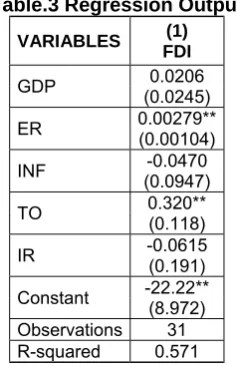
Table.3 Regression Output
VARIABLES (1) FDI
GDP (0.0245) 0.0206 ER 0.00279**(0.00104) INF (0.0947) -0.0470 TO 0.320** (0.118) IR -0.0615 (0.191) Constant -22.22** (8.972) Observations 31 R-squared 0.571
Standard errors in parentheses *** p<0.01, ** p<0.05, * p<0.1
The results of the Ordinary Least Squares (OLS) using Stata software presented in the table above shows that, an R2 of 0.571 means that 57% of the total variation in Foreign Direct Investment (FDI) is being explained by the independent variables used in the model, which is above 50% meaning that the variables used have a stronger explanatory power about the dependent variable. The test for autocorrelation was carried out using the Durbin Watson statistic showing a value of 2.335, which indicate that the model is free from spuriousness and no autocorrelation. This shows us that there is no autocorrelation. The F-statistic of Prob(F-statistic)= 0.000458 shows that the model is correctly specified and this means that the independent variables correctly explains the dependent variable.
RESULT ANALYSIS
Gross Domestic Product (GDP)
The coefficient on GDP is not significant at 1% level in explaining the variation in FDI flow, but it has its expected sign which is positive and the coefficient of 0.0206 means that for every one percentage point increase in GDP will cause a 0.027 point increase in FDI that is there is positive relationship between FDI and GDP. It has been argued in the literature that the benefits accruing from FDI are conditional upon higher levels of absorptive capabilities Borensztein et al.(1998) and are thus more likely to benefit from FDI liberalization country. GDP has been proven to be a key determinant of FDI inflow in Sierra Leone.
Trade openness (TO)
The coefficient on Trade openness (TO) is significant at 5% level with the expected sign being positive meaning it has a positive impact on FDI. Suggesting that the more the country opens to the world by providing an efficient environment is likely to attract foreign firms and more FDI flows, at an increasing point of 0.320 in Sierra Leone which is to supported by more trade liberalization . Our findings is consistence with Asiedu (2002) and Edwards (1990), their findings indicate that FDI responds significantly to increased openness. Therefore trade openness has been proven to be a key determinant of FDI flow in Sierra Leone.
Interest rate (IR)
The coefficient on interest rate is not significant at 1%level with unexpected sign negative. Therefore the impact of high interest rates in Sierra Leone has not found to be significant in explaining the variability of FDI flows. Which means that high interest rate is not a key factor to attract foreign firms and FDI in Sierra Leone. Hence our result accepts the null hypothesis that; high interest rate has not effect on FDI and the research question no. Inflation (INF)
The rate of inflation (INF) is used as a proxy for macroeconomic stability. The coefficient for inflation variable is insignificant at 1% level, with the expected sign.
The variability of inflation rate in Sierra Leone is insignificant that it is not affecting the variability in FDI. The results are in contrast with what Ehimare (2010) found in Nigeria, he found a positive impact of exchange rates to FDI. This finding implies that macroeconomic stability is not an important determinant of foreign direct investment inflows to Sierra Leone.
Exchange rate (ER)
The coefficient on exchange rate is significant at 5% level, with unexpected sign positive, meaning that higher exchange rate volatility will increase FDI flow by 0.00279 point, though it effect is very small. The exchange rate volatility is a key determinant of FDI in Sierra Leone. When the domestic currency depreciates, there can be negative or positive effects on FDI inflows. On the other hand, a real depreciation of the currency of the host country may reduce FDI inflows into the host country because a lower level of the exchange rate ‘measured in units of foreign currency per domestic currency’may be associated with lower expectations of future profitability in terms of the currency of the source country Campa (1993). In some instance, a depreciation of the currency of the host country increases the relative wealth of foreign entrepreneurs and therefore may increase the attractiveness of the host country for FDI (Benassy et al., 2000; Cleeve, 2004). It is true that foreign exchange appreciates with FDI inflow and resource outflow. Benassyet al. (2000) argue that a depreciation of the host currency makes, local assets and production cost comparatively cheaper and, on the hand, imports more expensive, therefore leading to higher inflows of FDI.
5. CONCLUSION AND RECOMMENDATION
CONCLUSION
POLICY RECOMMENDATIONS
For the host country to attracts FDI and benefits from foreign corporation and technology transfer, sound policies for foreign companies and firms should be adopted that has to do with protecting foreign investment.
Government should support the private sector to mobilize domestic resources for productive investment. An enabling domestic business environment that would empower the private sector to compete with foreign firms in service delivery, in order to increase efficiency.
The government should work toward increased openness to foreign trade so that the domestic enterprise sector can participate fully in the global economy. As trade openness has been proved to be a significant factor has influence FDI flow in the country. The government should implement more liberalization policies to attract foreign investment.
Moreover, the successful elimination of global and regional trade barriers makes participating countries more attractive for FDI; Sierra Leone should do more to easy the entering and opening of foreign businesses.
The government should try to promote transparency on all macroeconomic issues, fight corruption in all sectors of the economy and should increase outside world confidence to invest in the country.
Host country’s GDP performance is an important factor that boosts investor confidence, though is not found to be significant in our study, it may be due to smaller sample size, is should not be neglected , the government should find ways to promote local production, create more jobs as it would add to the GDP growth.
Energy and infrastructure are also identified as major determinants of FDI flow in developing country in which Sierra Leone is one by many authors, the government should try to improve both sectors as it can boost production of those companies and attracts more investors.
Inflation is another key factor that impedes most countries FDI flow decision by investors. Therefore the government through the central bank and ministry of finance should try to maintain the inflation around single digit, as is desirable to stimulate investment in an economy.
The monetary policy should be directed toward exchange rate regulation in the financial market, to avoid higher exchange rate volatility, since most economists believed that exchange volatility hurt FDI, Interest rate should be targeted to keep it under favorable level that would cause inflation.
LIMITATIONS
One of the limitations of this study was the problem of data availability for larger sample size was a serious constraint. Secondly, there are a great number of possible variables that could affect the variability of FDI flow either negatively or positively in Sierra Leone, but because of time and some other factors outside the control of the researcher, this study only considers a few of these variables in the light of data availability and ease of measurement procedures.
Although this study makes a number of contributions, there are need to expand in to further research from here by considering other variables that could best explained the variability of FDI flows in Sierra Leone or other emerging economies.
REFERENCES
Adinboade, 2006. “The Location of Foreign Direct Investment: An Empirical Analysis”. Applied Economics 31, 65-76. Asiedu, E., 2002. On the Determinants of Foreign Direct Investment to Developing Countries: Is Africa Different? World
Development Journal, Volume 30,107-119.
American Chamber of Commerce in Sierra Leone: Accessed October 24, 2014 from: http://usslcc.org.sl/
Billington, N. (1999). The location of foreign direct investment: An empirical analysis. Applied Economics 31 (1) 65-78. Borensztein, E., Gregorio, J. & LEE, J. W. (1998) How does foreign direct investment affect economic growth? Journal of
International Economics 45.
Blonigen, B. A. (2005) A review of the empirical literature on FDI determinants, Atlantic Economic Journal, 33(December), 383-403.
Benassy, A., Larche-Revil, A. & Fontague, L. (2000). MENA countries in the competition for FDI designing an exchange rate strategy. International Seminar GDR-EMMA, commissasriat du Plan, Paris.
Chakrabarti, A. (2001) The Determinants of foreign direct Investment: Sensitivity analyses of crosscountry regressions,
Kyklos, 54(1), 89-113.
Campa, J. (1993) Entry by Foreign Firms in the US under Exchange-Rate Uncertainty. Review of Economics and Statistics, vol 75, no. 4, pp. 614-622.
Cleeve, E. (2004). How effectiveness are fiscal incentives to attract FDI to sun-Saharan Africa. Paper Presented at the IAABD 5th International Conference Atlanta, April.
Ehimare, 2010. Foreign Direct Investment and its Impact on the Nigerian Economy., Covenant University, Ota, Ogun State, Nigeria.
Froot, K.A & Stein, J. C. (1991). Exchange rates and foreign direct investment: An imperfect capital markets approach.
Quarterly Journal of Economics. 105. 1191-1218.
Fezzarri., and Athey., 1987. Host Country Reforms and FDI inflows. How much Difference do they make? World Development, 26, 1299-1314.
Gross, and Trvino., 1996. Determinants of Foreign Direct Investment, Journal of International Economics, Volume 45, 115-135.
GabriBaldi, P., Mora, N., Sahay, R. & ZettelMeyer, J. (2001). What moves capital to transition Economies. IMF Staff Papers, vol 48, Special Issue, IMF.
Gujarati DN (1995). Basic Econometrics. Third edition, McGraw-Hill, Inc.
Government of Sierra Leone: Accessed October 29, 2014 from: http://www.sierra-leone.org/government.html Heritage Foundation, Index of Economic Freedom: http://www.heritage.org/index/country/sierraleone Human Development Indicator (HDI): http://hdr.undp.org/en/statistics/hdi/
Hooda., 2011., A study of FDI and Indian Economy., Department of Humanities and Social Sciences National Institute Of Technology (Deemed University).
Kalecki., 1937. “Economic and Political Determinants of Foreign Direct Investment”, World Development 13(2), 161-175. Keynes, J. M., 1936. General Theory, Cambridge University, London
Klein, M. & Roengren, E. (1994). The real exchange rate and foreign direct investment in the United States: Relative wealth vs. relative wages effects. Journal of International Economics. 373-389.
Loree, D. W., & e Guisinger, S. E. (1995). Policy and non-policy determinants of U. S. Equity Foreign Direct Investment.
Journal of International Business Studies, 26, (2): 281-299.
Naude and Krugell., 2004. Investigating the determinants of Foreign Direct Investment in Africa using panel data. NEPAD Council’s International Trade and Investment Conference, East London.
Regional Economic Outlook: Sub-Saharan Africa. IMF, October 2012
Schneider, F., and Frey, B.S., 1985. Economic and Political determinants of Foreign Direct Investment. World Development, 13, 161-175.
Stevens, G. (1997). Exchange rate and foreign direct investment: A note. Journal of Policy Modelling.
Sierra Leone Investment and Export Promotion Agency (SLIEPA): Accessed November 20th, 2014 from: http://www.sliepa.org/
United Nations Conference on Trade and Development (UNCTD).,1970-2005. Foreign Direct Investment Data- base. UNCTAD, Geneva. Accessed November 18, 2014 from: http://www.unctad.org.
UNCTAD (FDI): http://www.unctad.org/sections/dite_dir/docs/wir11_fs_sl_en.pdf
World Bank Country Guide: Accessed December 28, 2014 from: http://data.worldbank.org/country/sierra-leone
Wint., and Williams., 1994. International Investment Location Decisions. The case of US Firms. Journal of International Economics, Volume 33, 57-76.
World Bank, Governance Indicators: http://info.worldbank.org/governance/wgi/sc_country.asp World Bank, GDP: Retrieved December 30, 2014 from:
http://siteresources.worldbank.org/DATASTATISTICS/Resources/GDP.pdf World Trade Organization, Country Page: Accessed January 15th, 2015 from: