Original Research Article
Study on the adverse effects affecting treatment outcome in smear
positive tuberculosis patients under DOTS in Amritsar city
Manisha Nagpal
1*, Priyanka Devgun
1, Riya Kaur Kalra
2, Naresh Chawla
3INTRODUCTION
Tuberculosis, which is one of the oldest diseases known to affect humans and a major cause of illness and death worldwide, especially in Asia and Africa.1 Tuberculosis causes a great deal of ill health in the populations of most low-income countries; it is the single most common cause of death in individuals aged fifteen to forty-nine years. The world adopts DOTS strategy for TB control through the national TB control programs in different countries and is making good progress. The key component of
DOTS therapy is the standard anti-TB short course chemotherapy regimen, which requires continually taking drug combinations of isoniazid (INH), rifampicin (RFP),
pyrazinamide (PZA), ethambutol (EMB) and/or
streptomycin (SM) every other day for six to nine months.2
Despite the positive therapeutic effects, studies have shown that utilization of multidrug regimens can cause undesirable adverse drug reactions (ADRs) of varying
degrees of severity, such as hepatotoxicity,
ABSTRACT
Background: The world adopts DOTS strategy for TB control thought the national TB control programs in different countries and is making good progress. Despite the positive therapeutic effects, studies have shown that utilization of multidrug regimens can cause undesirable adverse drug reactions (ADRs) of varying degrees of severity, such as hepatotoxicity, gastrointestinal disorders, allergic reactions, arthralgia, neurological disorders and non-adherence to treatment as well.
Methods: The study was conducted on new smear positive patients registered under DOTS in two Treatment Units (TUs) present in Amritsar city. The prevalence of various adverse effects like gastro-intestinal, hepato-biliary, visual disturbances, musculoskeletal, skin and appendages, peripheral nervous system, etc was recorded and their effect on the outcome was observed. Data management and analysis was done by using Microsoft excel and SPSS version 17.00.
Results: Out of 250 patients, 149 (59.6%) were males and 101 (40.4%) were females. Out of the total 250 cases, adverse effects were present in 44.4% cases. Most common adverse effects observed were gastrointestinal in 63.9% followed by fever and chills in 28.8% of cases.
Conclusions: On statistical analysis, it was observed that the absence of adverse effects was significantly associated with the favourable outcome (p<0.001).
Keywords: Tuberculosis, Adverse drug reactions, Treatment outcome, DOTS
1Department of Community Medicine, Sri Guru Ram Das Institute of Medical Sciences and Research, Amritsar,
Punjab, India
2Government Medical College, Amritsar, Punjab, India 3Chest and TB, District TB Officer, Amritsar, Punjab, India
Received: 20 December 2017
Accepted: 11 January 2018
*Correspondence:
Dr. Manisha Nagpal,
E-mail: [email protected]
Copyright: © the author(s), publisher and licensee Medip Academy. This is an open-access article distributed under the terms of the Creative Commons Attribution Non-Commercial License, which permits unrestricted non-commercial use, distribution, and reproduction in any medium, provided the original work is properly cited.
gastrointestinal disorders, allergic reactions, arthralgia, neurological disorders and so on.3 ADRs increase patient suffering and incur substantial additional costs because of added outpatient visits, tests and in more serious instances hospitalizations.4 In addition, ADRs are regarded as one of the major causes of non-adherence to anti-TB treatment.5 Patient default from treatment is one of the most important problems in TB control, tuberculosis treatment defaulters, especially those who are smear positive, propagate ongoing community transmission and promote the development and acquisition of drug-resistant TB strains resulting in a higher number of TB cases.6
At the same time, alternative agents may have greater problems with toxicity, and are often less effective. As a result, ADRs may eventually contribute to the extension of treatment duration, final termination, drug resistance and treatment failure.7 It may also increase the number of TB cases, and more rarely the number of deaths, posing a challenge to the management of TB patients and TB control.
The overall incidence of ADRs caused by anti-TB therapy ranges from 5.1% to 83.5%.8 We aimed to get an overview of ADRs due to anti-TB therapy and evaluate their impact on anti-TB treatment in Amritsar district of Punjab.
METHODS
The study was conducted on new smear positive patients registered under DOTS in two Treatment Units (TUs) present in Amritsar city. One TU is located in the Chest and TB Hospital, Amritsar and the other is located in the Civil Hospital, Amritsar. A pre designed and pretested proforma was administered to the subject after taking his or her consent. Approval of college ethical committee was granted at the time of submission of the plan of the study.
Sampling technique
Based on the quarterly reports of both the TUs and by the expected incidence of new smear positive (NSP) cases in the northern zone of India which is 95/lac population/yr, a quota of 250 cases was affixed (As population covered under two TUs is approximately 11 lac, the expected NSP cases in a year comes around 1045 and expected cases in a quarterly cohort is around 250.
Study sample
The study sample consisted of 250 new smear positive (NSP) cases that were enrolled from December 1, 2009 to February 28, 2010. The study period was extended till the projected number achieved.
Inclusion criteria
New smear positive patients of >15 years of age were included in the study.
Exclusion criteria
Patients with extra pulmonary tuberculosis and smear negative tuberculosis patients were excluded.
House to house visits were done and socio-epidemiological parameters were studied by completing a pre designed proforma evolved for this purpose. The possible outcomes of the new smear positive patients under DOTS can be:
(a) Cured: If the patient was registered as pulmonary smear positive, completed treatment and had negative smear results on two occasions one of which is at the end of the treatment.
(b) Treatment completed: If the patient was registered as pulmonary smear positive, completed treatment with negative smear at the end of the intensive phase but none at the end of treatment.
(c) Died: If the patient died from any cause whatsoever while on treatment.
(d) Failure: was registered as pulmonary smear positive CAT-I, and was smear positive at 5 months or later.
(e) Defaulted: If the patient has not taken drugs for more than 2 months consecutively any time after starting treatment.
(f) Transferred out: If the patient was transferred to another district with Transfer Form sent and treatment outcome not available.9
Adverse drug reaction was defined as a response which is noxious and unintended and which occurs at doses normally used in humans for the therapy of tuberculosis. The prevalence of various adverse effects like gastro-intestinal, hepato-biliary, visual disturbances, musculoskeletal, skin and appendages, peripheral nervous system, etc was recorded and their effect on the outcome was observed. Data management and analysis was done by using Microsoft excel and SPSS version 17.00. Mantel Hanzel Odds Ratio (OR) and 95% CI were calculated for dichotomous variables and a two-tailed p<0.05 was considered significant.
RESULTS
Table 1: Distribution showing the treatment outcome of NSP cases under study.
Outcome* No. of cases
n=250
Percentage (%)
Cured 210 84.0
Treatment completed 1 0.4
Failure 13 5.2
Defaulted 12 4.8
Transferred out 4 1.6
Died 10 4.0
*For statistical analysis, outcomes were divided in two categories: Favourable Outcome (F.O.) - include cured and treatment completed. Unfavourable Outcome (U.O.) – include failure, defaulted, transferred out and died.
Table 1 illustrates that among the total 250 cases under study, 84% were cured and 0.4% completed treatment. 13 cases were sputum positive even 5 months after treatment i.e. failure rate was 5.2%. 4.8% cases defaulted, 1.6% transferred out and 4% died during the treatment.
Table 2: Distribution of cases having adverse effects with the treatment.
Side effects No. of cases
n= 111
Percentage (%)
Gastrointestinal 71 63.9
Yellow eyes or skin 0 0
Fever and chills 32 28.8
Pain and swelling of
joints 4 3.6
Visual difficulty 0 0
Imbalance 3 2.7
Skin rashes 1 1.0
It is evident from the above table that out of the total 250 cases, adverse effects were present in 44.4% cases. Most common adverse effects observed were gastrointestinal in 63.9% followed by fever and chills in 28.8% of cases. Few other adverse effects observed were pain and swelling of joints (3.6%), imbalance (2.7%) and skin rashes (1%).
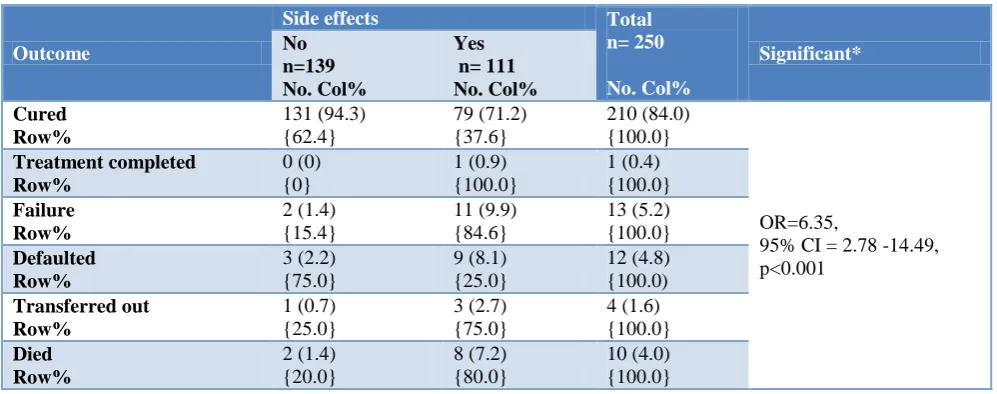
Table 3: Distribution of cases showing the relation of presence/absence of adverse effects with the outcome.
Outcome
Side effects Total
n= 250 No. Col% Significant* No n=139 No. Col% Yes n= 111 No. Col% Cured Row% 131 (94.3) {62.4} 79 (71.2) {37.6} 210 (84.0) {100.0} OR=6.35,
95% CI = 2.78 -14.49, p<0.001 Treatment completed Row% 0 (0) {0} 1 (0.9) {100.0} 1 (0.4) {100.0} Failure Row% 2 (1.4) {15.4} 11 (9.9) {84.6} 13 (5.2) {100.0} Defaulted Row% 3 (2.2) {75.0} 9 (8.1) {25.0} 12 (4.8) {100.0) Transferred out Row% 1 (0.7) {25.0} 3 (2.7) {75.0} 4 (1.6) {100.0} Died Row% 2 (1.4) {20.0} 8 (7.2) {80.0} 10 (4.0) {100.0}
*According to F.O. and U.O.
A perusal of Table 3 shows that cure rate was 71.2% in cases having adverse effects with the treatment while it was 94.3% in cases with no adverse effects. It was also observed that cases having adverse effects had higher failure rate (9.9%), default rate (8.1%), transferred out rate (2.7%) and death rate (7.2%) whereas cases with no adverse effects had lower failure rate (1.4%), default rate (2.2%), transferred out rate (0.7%) and death rate (1.4%). The absence of adverse effects was significantly associated with the favourable outcome (p<0.001).
DISCUSSION
Treatment outcomes of the NSP cases observed in the present study were: cured (84%), treatment completed (0.4%), failure (5.2%), defaulted (4.8%), transferred out (1.6%) and died (4%).
The outcome was categorized as favourable in cases of cure and treatment completed and as unfavourable in cases of failure, death, default and transfer out. Similar categorization (favourable, death and other unfavourable outcome) was done by Vasankari et al in their study on risk factors for poor treatment outcome in Finland and another study by Mukherjee et al on comparing outcomes in new pulmonary sputum positive and sputum negative cases under RNTCP in West Bengal, India.10,11
Similarly, a retrospective study Aggarwal et al in three tuberculosis units of Jamnagar district reported the cure rate of 87% and defaulter rate of 11% in sputum positive tuberculosis cases registered under DOTS.13
Another observational study of effectiveness of DOTS on tuberculosis patients treated under RNTCP by Mishra et al in Gwalior city showed the cure rate of 85.04% in Category I patients, which is almost concurrent to the cure rate in the present study.14
Verma et el in their study to determine the treatment outcome of 150 tuberculosis cases under DOTS presenting at chest and TB hospital, Amritsar reported the cure rate of 91% for Category I (NSP) patients.15
A five year follow up of Revised National Tuberculosis Control Programme of India at Lucknow showed the outcome results of 208 registered patients as: treatment success (cured + treatment completed) 89.9%, default 5.3%, death 4.3% and treatment failure 0.4%.16
According to RNTCP status report, treatment outcome of new smear positive cases for the year 2009 in Punjab was observed as: cure 85.7%, treatment completed 1.9%, died 4.5%, failure 2.2%, defaulted 4.0% and transfer out 1.7%.17
The findings in the present study are supported by the district-wise performance report of RNTCP which shows that treatment success rate (cure rate and treatment completion rate) of new smear positive patients in the year 2010 in district Amritsar is 84%.
Adverse effects with the treatment were present in 44.4% of the cases. Commonly observed were gastro-intestinal (63.9%) followed by fever with chills (28.8%).
As is evident from the Table 3 that favourable outcome was more in cases having no adverse effects with the treatment (p<0.001). Cure rate was 71.2% in the cases having adverse effects whereas it was 94.3% in cases with no adverse effects. Unfavourable outcomes were also higher in cases having the adverse effects with the anti-tubercular therapy.
The findings are consistent with the findings of a study in Agra conducted by Mittal and Gupta which showed that side effects due to medication were present in 43.2% of the cases and this was one of the main reasons of non-compliance resulting in poor outcome.18
Similarly, Pandit and Choudhary in their study reported that the toxicity of drugs was the major reason for defaulting for treatment.19
CONCLUSION
Treatment outcome among tuberculosis patients was satisfactory in the study area. The incidence of ADRs due
to DOTS therapy was 44.4%. Patients with ADRs were more susceptible to develop unfavorable results of anti-TB. This shows the importance of developing strategies to control ADRs both to improve the quality of life and to treat TB safely.
ACKNOWLEDGEMENTS
We are thankful to District TB Officer, Amritsar and staff at TB hospital and civil hospital for helping us during the study. Also we are grateful to all the patients, for their kind and affectionate attitude and cooperation.
Funding: No funding sources Conflict of interest: None declared
Ethical approval: The study was approved by the Institutional Ethics Committee
REFERENCES
1. World Health Organization. WHO Report. Global tuberculosis control: epidemiology, strategy, financing. WHO/HTM/ TB/2008.393. Geneva, Switzerland: WHO, 2008.
2. World Health Organization. An expanded DOTS framework for effective tuberculosis control. Stop TB Communicable Diseases. Geneva: WHO Press. 2002: 1–20.
3. Chhetri AK, Saha A, Verma SC, Palaian S, Mishra P, et al. Study of adverse drug reactions caused by first line anti-tubercular drugs used in directly observed treatment, short course (DOTS) therapy in Western Nepal, Pokhara. J Pak Med Assoc. 2008;58:531–6.
4. Schaberg T, Rebhan K, Lode H. Risk factors for side-effects of isoniazid, Damrifampin and pyrazinamide in patients hospitalized for pulmonary tuberculosis. Eur Respir J. 1996;9:2026–30. 5. Awofeso N. Anti-tuberculosis medication
side-effects constitute major factor for poor adherence to tuberculosis treatment. Bull World Health Organ. 2008;86:B–D.
6. Bronner LE, Podewils LJ, Peters A, Somnath P, Nshuti L, Van der Walt M, et al. Impact of community tracer teams on treatment outcomes among tuberculosis patients in South Africa. BMC Public Health. 2012;12:621.
7. Kaona FA, Tuba M, Siziya S, Sikaona L. An assessment of factors contributing to treatment adherence and knowledge of TB transmission among patients on TB treatment. BMC Public Health 2004;4:68.
8. Maciel EL, Guidoni LM, Favero JL, Hadad DJ, Molino LP, Jonhson JL, et al. Adverse effects of the new tuberculosis treatment regimen recommended by the Brazilian Ministry of Health. J Brasileiro de Pneumologia. 2010;36:232–8.
Division; Directorate General of Health Services, MOH&FW; 2005.
10. Vasankari T, Holmstrom P, Ollgren J, Lippo K, Kokki M, Ruutu P. Risk factors for poor tuberculosis treatment outcome in Finland: a cohort study. BMC Public Health. 2007;7:291.
11. Mukherjee A, Singla R, Saha I. Comparing outcomes in new pulmonary sputum positive and sputum negative cases under RNTCP in rural India. Indian J Tuberc. 2009;56:144-50.
12. Chennaveerappa PK, Siddharam SM, Halesha BR, Vittal BG, Jayashree N. Treatment outcome of tuberculosis patients registered at DOTS centre in a teaching hospital, South India. Int J Biol Med Res. 2011;2:487-9.
13. Aggarwal SS, Aggarwal NS, Makadia BK, Nagar SS. Assessment of one year of RNTCP. Indian J Comm Med. 2004;4:164-5.
14. Mishra A, Mishra S, Chouksey M, Gautam P, Verma P, Srivastava D, et al. A study of effectiveness of DOTS on tuberculosis patients treated under RNTCP programme. NTI Bulletin. 2007;43:47-50.
15. Verma V, Singh J, Chand N, Khalsa JS. Treatment outcome of tuberculosis under DOTS in patients presenting at Chest and TB Hospital, Amritsar. CHEST. 2005;128(4):403S.
16. Verma SK, Verma Sanjay K, Kant S, Kumar S, Prasad R. A five year follow up of Revised National Tuberculosis Control Programme of India at Lucknow. Indian J Chest Dis Allied Sci. 2008;50:195-8.
17. TB India. 2011. Revised National Tuberculosis Control Programme. Annual Status Report: TB India 2011. Central TB Division, Directorate General of Health Services, Ministry of Health and Family Welfare; 2010. Available at: http://www. tbcindia.org/pdfs/RNTCP%20TB%20India%20201 1.pdf. Accessed on 3 June 2011.
18. Mittal C, Gupta SC. Noncompliance to DOTS: How it can be decreased. Indian J Comm Med. 2011;36:27-30.
19. Pandit N, Choudhary SK. A study on treatment compliance in Directly Observed Therapy for tuberculosis. Indian J Comm Med. 2006;31(4):241-3.