Original Research Article
Knowledge and attitude study among the nursing staff working in a
tertiary care hospital in Southern India
Pavithra M. B.*, Amrita N. Shamanewadi, Suwarna Madhukumar
INTRODUCTION
An important discovery was made in 1847 by a Hungarian physician Ignaz Philipp Semmelweis, he was called the "saviour of mothers" for he proved statistically that the incidence of puerperal fever, also known as childbed fever could be drastically cut by use of hand washing standards for doctors and nurses in obstetrical clinics. Centuries later we are still battling hospital-acquired infections, otherwise known as the nosocomial infections which occur as the result of transmission of healthcare-associated pathogens via the contaminated
hands of healthcare workers. It affects 5-10% of hospitalized patients in developed countries and 20% of patients in developing countries.1
Hospital-acquired infections lead to consequences like prolonged stay in the hospital, increase in the cost of health care for the patient. Another complication is that hospital acquired infections are difficult to treat with antibiotics leading to drug resistance particularly among gram-negative bacteria.2,3
A simple measure to reduce hospital acquired infections is hand hygiene of the health care workers. It is known
ABSTRACT
Background: Hand hygiene is recognised as one of the leading measure to prevent cross transmission of micro-organisms. Inadequate hand hygiene practices are common cause of nosocomial infections. Nurses are considered as the “nucleus of health care system” Because of the time they spend with patients than any other health care workers. Hence their compliance with hand washing guidelines seems to be more vital in preventing the disease transmission among patients.
Methods: Despite the simplicity of the procedure, compliance with hand hygiene among health care providers in particular nurses is as low as 40%. This study aims at assessing knowledge, attitude and practice of hand hygiene of the nursing staff working in a tertiary care hospital.
Results: Among the 140 study participants 74% were female nurses. Majority of the study participants (78%) had average knowledge of hand hygiene in the pre-test session The health education and training session on correct hand hygiene methods significantly(p<0.001) improved the knowledge and attitude of the nursing staff, during the post-test session 87% of the nurses had good knowledge and 100% had positive attitude.
Conclusions: Our study shows the importance of improving the current training programmes targeting the hand hygiene practices among nursing staff. Hand hygiene training sessions need to be conducted more frequently with continuous monitoring and performance feedback to encourage them and their fellow nurses to follow correct hand hygiene practices.
Keywords: Hand hygiene, Nurses, Hospital infections
Department of Community Medicine, MVJ Medical College and Research Hospital, Bangalore, India
Received: 21 June 2019 Revised: 07 August 2019 Accepted: 08 August 2019
*Correspondence: Dr. Pavithra M. B.,
E-mail: [email protected]
Copyright: © the author(s), publisher and licensee Medip Academy. This is an open-access article distributed under the terms of the Creative Commons Attribution Non-Commercial License, which permits unrestricted non-commercial use, distribution, and reproduction in any medium, provided the original work is properly cited.
that proper hand hygiene practices among health-care workers will significantly reduce the transmission of bacterial organisms.4 Despite the simplicity of this preventive measure adherence to the hand hygiene guidelines and proper techniques is poor among the health care workers.5,6
The world health organisation (WHO) issued draft guidelines in 2006 to provide evidence and recommendations for improvement of hand hygiene.7 But lack of knowledge on proper hand hygiene among health care workers leads to poor compliance. Nursing staff are the “nucleus of health care system” because they spend more time with patients than any other health care workers. Their compliance with hand washing guidelines seems to be more vital in preventing the disease transmission among patients. With this background the present study was undertaken to assess the knowledge and attitude of hand hygiene practices of the nursing staff working in a tertiary care hospital setting and also to assess the changes in knowledge and attitude after a health education and training session on hand hygiene practices.
METHODS
A cross sectional study was conducted among the nursing staff working in MVJ Medical College Hospital which is a tertiary care hospital in rural Bengaluru to assess the knowledge and attitude regarding hand hygiene. Study was done after obtaining ethical clearance from the institutional ethical committee. All the nursing staffs working in the institution in various places like wards, operation theatre, emergency room, intensive care units were approached for the study. The study, purpose and procedures were explained and verbal consent was obtained from those who volunteered to participate. A total of 140 respondents were included in the study. The study was conducted over a period of 3 months from October 2018 to January 2019.
Questionnaire
The questionnaire was designed to assess knowledge and attitude related to hand hygiene. This pre-validated questionnaire was administered to nursing staff. Their level of knowledge was assessed based on the hand hygiene knowledge questionnaires for health-care workers designed by World health organisation, which was slightly modified for the study settings.
The first part of the questionnaire elicited demographic data like gender, profession, and years of experiences, college studied and qualification (GNM, BSC). The second part included 39 questions both multiple choice and „yes” or “no” questions in the knowledge section. Measurement of attitude was done on the basis of 13 questions. Here the respondents gave their opinion on a 1 to 5 point Likert scale ranging from strongly disagrees to strongly agree.
For scoring, 1 point was given for each correct response to good level of knowledge and positive attitude and 0 point was given for poor level of knowledge and negative attitude, good knowledge was when they scored 75% and above, a score between 50-74% was moderate/average/ fair and below 50% was considered poor.
Intervention
To address the problem of nosocomial infections the World health organisation makes continues efforts to identify effective and sustainable strategies. One of such effort is introduction of an evidence based concept of “my 5 moments for hand hygiene” by WHO and a “save lives: clean your hands” campaign May 5, 2014 to ask the world leaders to show their commitment towards hand hygiene and initiate appropriate action. These five moments that call for the use of hand hygiene include the moment before touching a patient, before performing aseptic and cleaning procedures, after being at risk of exposure to body fluids, after touching a patient, and after touching patient surroundings.7
A health education and training session based on the WHO concept of hand hygiene was conducted for the nursing staff in smaller batches of twenty five. Information on nosocomial infections, ways to prevent it, importance of hand hygiene were included in Health education. Proper technique of hand washing according to who guidelines was demonstrated and were encouraged to practice the same on daily basis. Interactive session concluded the training session. The same questionnaire was administered again at the end of the session to compare the results of pre-test with that of post-test.
Data analysis
Data analysis and management was done using Microsoft EXCEL and SPSS software Descriptive statistics including frequency distributions and central tendencies were conducted. Knowledge score was computed; each item was allotted 1 point, and then, the score was converted to a per cent out of 100. Chi-square test was applied to compare pre-test and post-test results. p value less than 0.05 were considered significant.
RESULTS
Our study sample consisted mostly of female nurses (74%) working in varies places in the hospital like wards (68%), operation theatre (6%), intensive care unit (22%) and very few from emergency room (2%) participated in the study. Majority of the study participants (80%) had experience of less than 5 years. Qualification of the nursing staff was GNM nursing for 54% of the participants where as 46% had a BSc nursing degree.
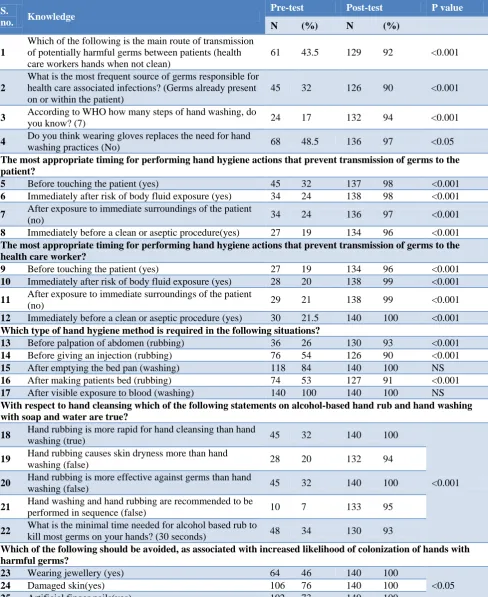
the nursing staff had well and 13 % had poor knowledge before the training intervention. The health education and training session on correct hand hygiene methods significantly (p<0.001) improved the knowledge of the
nursing staff, during the post-test session 87% of the nurses had good knowledge and 13% had average knowledge on hand hygiene (Table 1).
Table 1: Knowledge of hand hygiene among nurses (n=140).
S.
no. Knowledge
Pre-test Post-test P value
N (%) N (%)
1
Which of the following is the main route of transmission of potentially harmful germs between patients (health care workers hands when not clean)
61 43.5 129 92 <0.001
2
What is the most frequent source of germs responsible for health care associated infections? (Germs already present on or within the patient)
45 32 126 90 <0.001
3 According to WHO how many steps of hand washing, do
you know? (7) 24 17 132 94 <0.001
4 Do you think wearing gloves replaces the need for hand
washing practices (No) 68 48.5 136 97 <0.05
The most appropriate timing for performing hand hygiene actions that prevent transmission of germs to the patient?
5 Before touching the patient (yes) 45 32 137 98 <0.001
6 Immediately after risk of body fluid exposure (yes) 34 24 138 98 <0.001 7 After exposure to immediate surroundings of the patient
(no) 34 24 136 97 <0.001
8 Immediately before a clean or aseptic procedure(yes) 27 19 134 96 <0.001 The most appropriate timing for performing hand hygiene actions that prevent transmission of germs to the health care worker?
9 Before touching the patient (yes) 27 19 134 96 <0.001
10 Immediately after risk of body fluid exposure (yes) 28 20 138 99 <0.001 11 After exposure to immediate surroundings of the patient
(no) 29 21 138 99 <0.001
12 Immediately before a clean or aseptic procedure (yes) 30 21.5 140 100 <0.001 Which type of hand hygiene method is required in the following situations?
13 Before palpation of abdomen (rubbing) 36 26 130 93 <0.001
14 Before giving an injection (rubbing) 76 54 126 90 <0.001
15 After emptying the bed pan (washing) 118 84 140 100 NS
16 After making patients bed (rubbing) 74 53 127 91 <0.001
17 After visible exposure to blood (washing) 140 100 140 100 NS With respect to hand cleansing which of the following statements on alcohol-based hand rub and hand washing with soap and water are true?
18 Hand rubbing is more rapid for hand cleansing than hand
washing (true) 45 32 140 100
<0.001 19 Hand rubbing causes skin dryness more than hand
washing (false) 28 20 132 94
20 Hand rubbing is more effective against germs than hand
washing (false) 45 32 140 100
21 Hand washing and hand rubbing are recommended to be
performed in sequence (false) 10 7 133 95
22 What is the minimal time needed for alcohol based rub to
kill most germs on your hands? (30 seconds) 48 34 130 93
Which of the following should be avoided, as associated with increased likelihood of colonization of hands with harmful germs?
23 Wearing jewellery (yes) 64 46 140 100
<0.05
24 Damaged skin(yes) 106 76 140 100
25 Artificial finger nails(yes) 102 73 140 100
S.
no. Knowledge
Pre-test Post-test P value
N (%) N (%) What are the reasons for poor hand washing compliance?
26 Lack of knowledge of guidelines/protocol 94 67 125 89
NS 27 Lack of role models among the superiors/colleagues 15 11 42 30
28 Understaffing and over crowding 118 84 140 100
29 Poor access to hand washing facilities 64 46 87 62
30 Non availability of hand rub or soap or water 53 38 48 34 31 Hand washing causes irritation and dryness 24 17 13 9
32 Wearing gloves/gowns 3 2 0 0
What is the best approach to improve hand washing compliance
33 Motivation 106 76 99 71
NS 34 Availability of alcohol based hand rubs 120 86 112 80
35 Training and education of health care workers 83 59 137 98 36 Instructions demonstrating correct hand washing
technique to be displayed 64 46 97 69
Table 2: Attitude on hand hygiene among nurses (n=140).
S.
no. Attitude
Pre-test Post-test
P value
N (%) N (%)
1 Hand hygiene is essential part of my role (agree) 137 98 140 100
NS 2 Health care worker should have sufficient knowledge
and training on hand hygiene (agree) 105 75 140 100
3 Correct hand hygiene should be followed all times
(agree) 113 81 137 98
4 Feeling guilty on omitting hand hygiene (agree) 106 76 123 88 5 Reluctant to engage others in hand hygiene (disagree) 60 43 95 68
There were significantly (p<0.001) improvement in the knowledge regarding the main route of transmission of potentially harmful germs between patients, The most appropriate timing for performing Hand hygiene, actions that prevent transmission of germs to the patient and to health care workers. Knowledge on alcohol-based hand rub and hand washing with soap and water and type of hand hygiene method required for various situations increased after the training session (Table 1).
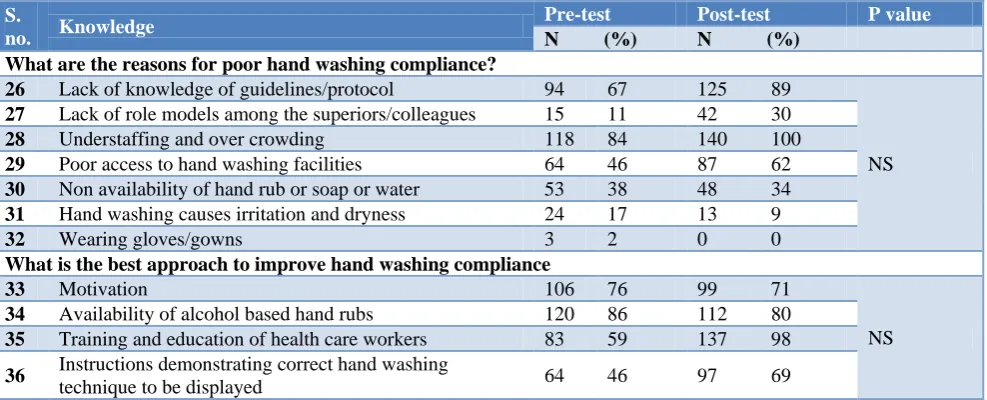
The major reasons for poor hand washing compliance as per the participants were overcrowding of the hospital and understaffing (84%) and lack of knowledge of guidelines and protocol (89%) and training of the health care workers (98%) was the best approach to improve hand washing compliance among the staff according to the participants.
The attitude regarding the hand hygiene practices was favourable among the nurses even before the training session (85%) (Table 2). Though majority of the participants (76%) agreed that hand washing facilities are conveniently located in their tertiary care institution, few reasons or barriers to practice hand hygiene all the time mentioned by the participants were not sure of its need (78%), not convenient (67%), out of product (39%) forgetting to wash hand (82%) causes irritation and dryness to the skin (46%).
DISCUSSION
The knowledge about hand hygiene is very important to reducing the burden of nosocomial infections. The main finding of our study was that the knowledge scores were low, among the nursing staff working in this tertiary health care hospital. Results indicating low knowledge level are in line with other studies in India as well as internationally.8-11
Forty three per cent of the respondents in pre-test and ninety eight per cent in the post test answered correctly when asked about the main route of transmission of potentially harmful germs between patients. Our pre-test results are low when compared with other studies which reported that 75% and 72% of participants knew that unhygienic hands of health care workers were the main route of transmission.9,12 However, only 45% of the participants knew the source of infection in the pre-test session.
In a study to see the impact of ring wearing on hand contamination Trick et al have shown that 40% of the nurses‟ harboured Acinetobacter under the finger rings.14 In our study only 46% had knowledge that wearing jewellery should be avoided to reduce colonization of hands with harmful microorganisms.
The knowledge on the type of hand hygiene method required before various procedures was average in our study. The knowledge of hand washing after visible exposure to blood and after emptying the bed pan was very high even in the pre-test sessions, whereas appropriate methods of hand hygiene before palpation of abdomen was only known to 26% of study participants. The reason could be due to non-availability of hand rub solutions at all points in the institute. In this study the participants (76%) agreed that hand washing facilities are conveniently located in their tertiary care institution. Previous studies showed increase in compliance and correlated it with the availability of hand rub solutions at the bedside of the patient.12
Another main finding of our study is that nursing staff have a positive attitude toward hand hygiene guidelines. They recognize their importance and they try to follow them all of the time. This finding is similar to the studies that have assessed attitudes toward hand hygiene in medical settings.10,13 Overall, the attitude towards of good hand hygiene is high even before the conduct of training session. In a study conducted by Suchitra in Mysore University it was also revealed that compliance for hand washing was maximum among nurses and nurses showed more positive attitudes towards hand hygiene.15
Barriers to practice hand hygiene all the time mentioned by the participants were not sure of its need, not convenient, out of product, forgetting to wash hand, causes irritation and dryness to the skin. As compared to the barriers mentioned in a study in Bhopal where the study population mentioned the following as barriers for practicing hand hygiene, lack of education, high work load, understaffing, working in critical care units, lack of encouragement, lack of role model among senior staff and lack of knowledge of guidelines set by the institution.9
Limitations
A limitation of our study was that it was performed only as a knowledge and attitude study on hand hygiene and actual practice of hand hygiene was not observed in the study population as done in various other studies. A study on observation on actual hand hygiene practices by the nurses working in various setting and correlating the findings with the incidence of nosocomial infections in the hospital is warranted.
CONCLUSION
Our study highlights the importance of improving the current training programmes targeting the hand hygiene
practices among nursing staff to prevent nosocomial infections. Hand hygiene training sessions need to be conducted more frequently with continuous monitoring and performance feedback to encourage them and their fellow nurses to follow correct hand hygiene practices. Increase in knowledge regarding hand hygiene would translate in to a behavioural change that would help in reducing the incidence of nosocomial infections.
ACKNOWLEDGEMENTS
We sincerely acknowledge the Management and the Principal of MVJ Medical College, Bangalore, for their support during this work. We sincerely acknowledge and thank the nursing staff and nursing superintendent for their participation and support for this study.
Funding: No funding sources Conflict of interest: None declared
Ethical approval: The study was approved by the Institutional Ethics Committee
REFERENCES
1. World Health Organization. Healthcare associated infections. Available at: http://www.who.int/gpsc /country_work/gpsc_ccisc_fact_sheet_en.pdf. Accessed on 31 December 2017.
2. Lindsay JA. Hospital-associated MRSA and antibiotic resistance-what have we learned from genomics? Int J Med Microbiol. 2013;303:318-23. 3. Knight GM, Budd EL, Whitney L, Thornley A,
Al-Ghusein H, Planche T, et al. Shift in dominant hospital-associated methicillin-resistant
Staphylococcus aureus (HA-MRSA) clones over time. J Antimicrob Chemother. 2012;67:2514-22. 4. Al-Tawfiq JA, Tambyah PA. Healthcare associated
infections (HAI) perspectives. J Infect Public Health. 2014;7:339-44.
5. Alsubaie S, Maither Ab, Alalmaei W, Al-Shammari AD, Tashkandi M, Somily AM, et al. Determinants of hand hygiene noncompliance in intensive care units. Am J Infect Control. 2013;41:131-5.
6. Basurrah MM, Madani TA. Handwashing and gloving practices among the health care workers in medical and surgical wards in a tertiary care centre in Riyadh, Saudi Arabia. Scand J Infect Dis. 2006;38:620-4.
7. WHO guidelines on hand hygiene in health care first global patient safety challenge clean care is safer care, 2009. Available at: http://whqlibdoc.who.int/ publications/2009/9789241597906_eng.pdf.
Accessed on 31 December 2017.
8. Nair SS, Hanumantappa R, Hiremath SG, Siraj MA, Raghunath P. Knowledge, attitude, and practice of hand hygiene among medical and nursing students at a tertiary health care centre in Raichur, India. ISRN Prev Med. 2014;2014:608927.
knowledge and attitude regarding hand hygiene amongst residents and nursing staff in a tertiary health care setting of Bhopal city. J Clin Diagn Res. 2014;8:4-7.
10. Hamadah R, Kharraz R, Alshanqity A, AlFawaz D, Eshaq AM, Abu- Zaid A, et al. Hand hygiene: knowledge and attitudes of fourth-year clerkship medical students at Alfaisal University, College of Medicine, Riyadh, Saudi Arabia. Cureus. 2015;7:310.
11. Herbert VG, Schlumm P, Kessler HH, Frings A. Knowledge of and adherence to hygiene guidelines among medical students in Austria. Interdiscip Perspect Infect Dis. 2013;2013:802930.
12. Ariyaratne MHJD, Gunasekara TDCP, Weerasekara MM, J Kottahachchi J, Kudavidanage BP, Fernando SSN. Knowledge, attitudes and practices of hand hygiene among final year medical and nursing students at the University of Sri Jayewardenepura. Sri Lank J Infect Dis. 2013;3(1):15-25.
13. Khaled M, Elaziz A, Bakr IM. Assessment of knowledge, attitude and practice of hand washing among health care workers in Ain Shams University hospitals in Cairo. Egypt J Commun Med. 2008;26(2):1-12.
14. Trick WE, Vernon MO, Hayes RO. Impact of ring wearing on hand contamination and comparison of hand hygiene agents in a hospital. Clin Infect Dis. 2003;36:1383-90.
15. Suchitra JB, Lakshmi Devi N. Impact of education on knowledge, attitudes and practices among various categories of health care workers on nosocomial infections. Indian J Med Microbiol. 2007;25(3):181-7.