Original Research Article
Knowledge, attitude and practice of emergency
medical care in Lima, Peru
David Aaron Adler
1,2*, Max Dean Goldstein
1,3, Anthony Phy Mai
4,5,
Miguel Rosales Tello
6, Ross Ireland Donaldson
7,8INTRODUCTION
Injuries pose a significant threat to individuals all over the world. They are historically responsible for 10% of mortality and 15% of disability-adjusted life years (DALYs) across the globe.1 The burden also weighs
heavily on youth in the 10–24 age range, accounting for 40% of total mortality and over half of all male deaths.2 Often overlooked by global health investments that favor endeavors targeting communicable diseases, injuries increasingly deserve greater public attention due to their widespread prevalence.3
ABSTRACT
Background: This study gauged public need and reception for a community-based first-aid and cardiopulmonary resuscitation (CPR) training program in Lima, Peru, to counteract predicted emergency medical service (EMS) deficits.
Methods: The study population consisted of Lima households that were selected with a two-staged 30x7 cluster sampling method. An EMS and first-aid focused knowledge-attitude-practice (KAP) survey was administered by a joint academic-community interview team.
Results: The study included 210 households from 30 districts within Lima. Among the participants, 61.4% were unable to provide an EMS number and only 24.8% would call an ambulance in case of a family emergency. Although 37.6% could provide first-aid, 99.5% would feel more comfortable if a neighbor were first-aid trained.
Conclusions: The results indicated a lack of confidence in Lima’s EMS systems and awareness of EMS contact numbers, which possibly led community members to trust each other over their local EMS. The creation of a community-based first-aid and CPR training program can potentially take advantage of strong intra-community trust, mitigate first-aid deficits, and alleviate Lima’s injury burden by providing a buffer against barriers to effective EMS responses.
Keywords: Emergency medical services, KAP survey, Lima, Peru
1
David Geffen School of Medicine, University of California, Los Angeles, California, United States
2
Department of Family Medicine, University of California, Irvine, California, United States
3
Ventura County Medical Center, Ventura, California, United States
4
Carver College of Medicine, University of Iowa, Iowa, United States
5
Department of Medicine Biostatistics Core, University of California, Los Angeles, California, United States
6
Asociación de Salvamento Y Socorrismo - Los Delfines, Lima, Perú
7
Department of Emergency Medicine, 8Department of Global Health, Harbor-UCLA, Torrance, California, United States
Received: 04 December 2018
Revised: 14 January 2019
Accepted: 15 January 2019
*Correspondence:
Dr. David Aaron Adler, E-mail: [email protected]
Copyright: © the author(s), publisher and licensee Medip Academy. This is an open-access article distributed under the terms of the Creative Commons Attribution Non-Commercial License, which permits unrestricted non-commercial use, distribution, and reproduction in any medium, provided the original work is properly cited.
Low and middle-income countries (LMIC) disproportionately hold 90% of the global burden for injury-related mortality and disability; poorer individuals from LMICs are six times more likely than those from high income countries to die or be disabled from injuries.4 Because Peru falls into the this bracket as an upper-middle income country, it is thus projected to also shoulder a significant injury burden.5 In the example of injuries from road traffic incidents in Peru, only 5% of victims were transported to health facilities by ambulance and only 66% of those transported received professional care during the golden hour after an accident.6,7 The lack of timely ambulance access point to large disparities in the Peruvian pre-hospital care system. The skyrocketing levels of injury-related mortality and disability in LMICs – as compared to those of high-income countries – reveal a desperate need for a shift in global health strategies.
Seventy percent of Peruvians – most of which are uninsured – are served by the Ministry of Health; other providers include the Ministry of Labour and the Ministry of Defence, which provide care for the social security system and armed forces, respectively. The three ministries and the national fire-fighter department all employ their own pre-hospital ambulance services, otherwise known as emergency medical services (EMS). Because these four EMS systems work independently of each other, they each maintain a different emergency telephone number. The lack of communication between the EMS systems has created ill-defined coverage zones that leave certain communities, inside and outside of metropolitan areas, without adequate EMS.8
While the Peruvian Society of Emergency Medicine and Disasters (SPMED) has attempted to improve Peruvian pre-hospital care by consolidating emergency numbers, endeavors targeting the communities themselves may yield significant results. The World Health Organization (WHO) recommends the provision of basic first-aid training to unofficial first responders in communities that lack adequate EMS, since bystanders knowledgeable in first-aid can greatly increase the survival rate of injured victims.9 Usage of first-aid training programs are effective in providing volunteers with life-saving knowledge, even in under-resourced LMICs.10,11 First-aid training programs may thus mitigate EMS disparities concerning bodily injuries. Our study assessed how the communities of Lima, Peru relate to first-aid and EMS to gauge public need and reception for a community-based first-aid and CPR training program.
Study objectives
This study aimed to evaluate the Limeños’ (people from Lima) EMS and first-aid related knowledge, attitudes, and practices and measure the demand for a first-aid and CPR training program. Impetus for this study came from a partnership developed among the University of California, Los Angeles (UCLA) researchers, the
Peruvian National Police Department, and the
Association Salvavidas Socorristas Del Peru (ASSP) as one researcher was developing a junior lifeguard curriculum for ASSP. It was through this relationship that conversations regarding EMS’s struggle to provide adequate care and coverage to the more destitute neighborhoods began to surface. Conversations with community members and police officers revealed that the Limeños were unaware and distrusting of their local EMS systems.
The study’s secondary objective was to build a basis of equal partnership and trust between researchers and communities to lay groundwork for future projects. Relying upon communication, shared responsibility, and common goals, this foundation takes time to develop; this pioneer study was an opportunity to potentially begin building relationships with target communities. Although this secondary objective was a key component to the study, it will be discussed in greater detail in a future manuscript.
METHODS
Study design
This two-staged cluster study was conducted at the household level with a sample size of 210 households recruited from Lima, Peru. Lima is divided into 5 zones (North, South, East, Central, and Callao), each of which is further subdivided into a total of 41 districts. A two-staged 30×7 sampling technique was used to select 7 households from each of 30 districts.12
The study was designed and analyzed as per the WHO Guidelines for Conducting Community Surveys on Injury and Violence.13 In the first stage, a single district was defined as the primary cluster. 30 districts were selected with a probability proportional to size (PPS) method, which ensured that the probability a district was chosen depended on its population size. 30 out of the 41 districts of Lima were randomly chosen after having been weighted proportionally to their population size. In the second stage, a single police station and 7 surrounding households were defined as a sub-cluster within its district. A single sub-cluster was randomly chosen for each of the 30 districts. The ultimate objective for the two-stage cluster sampling method was to give each household in Lima the same sampling probability. The 30×7 scheme of 7 households per 30 police station sub-divisions projected a total of 210 surveys and provided a confidence limit of 95% for survey results.12
Survey content and administration
Peruvian partners. The University of California Los Angeles South General Institutional Review Board approved the study design, research grant, and the KAP survey with accompanying consent forms (IRB#12-000676).
The KAP surveys were administered by a joint interview team – consisting of members from the Peruvian National Police, the ASSP lifeguard program, and UCLA researchers – after having obtained written consent from all study participants. Households that did not answer or that declined participation were excluded from the study. The joint interview team participated in a day-long conference that discussed project goals, the informed consent process, interview methods, and safety precautions before entering the data collection stage.
Data analysis
Data analysis was conducted by the UCLA Department of Medicine Statistics Core using SAS 9.2 software. Survey responses were tabulated according to their respective KAP section. Questions 7, 9, 21, and 31 were stratified for age and gender using chi-squared and Fisher exact tests with the null hypothesis that there were no differences between demographic characteristics (age and gender) and first-aid knowledge, attitudes, and practices.
RESULTS
Demographics
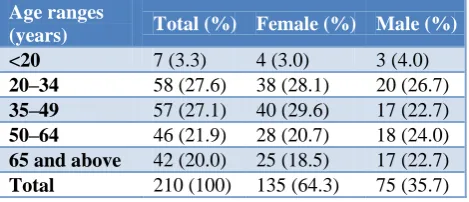
A total of 210 individuals from 30 districts in Lima, Peru participated in the study (Table 1). Participants ranged in age from 18 to 90 years old (mean: 46.6; SD: 18.3). Of the 210 people interviewed, 64.3% were females and 35.7% were males.
Table 1: Age and gender of the KAP survey.
Age ranges
(years) Total (%) Female (%) Male (%)
<20 7 (3.3) 4 (3.0) 3 (4.0)
20–34 58 (27.6) 38 (28.1) 20 (26.7)
35–49 57 (27.1) 40 (29.6) 17 (22.7)
50–64 46 (21.9) 28 (20.7) 18 (24.0)
65 and above 42 (20.0) 25 (18.5) 17 (22.7)
Total 210 (100) 135 (64.3) 75 (35.7)
Knowledge results
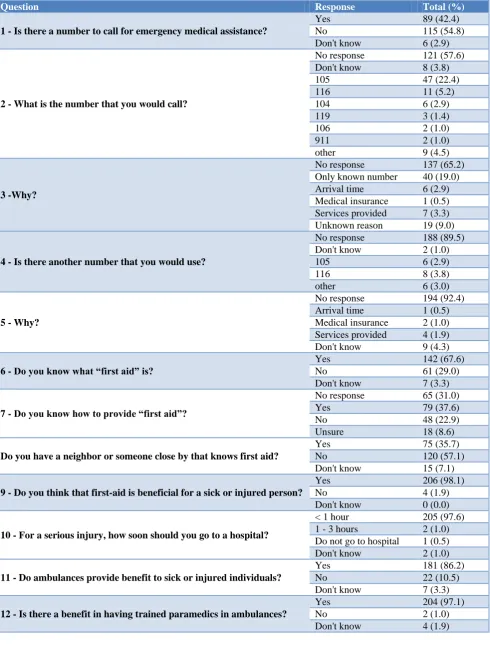
Table 2 shows data related to the public’s EMS and first-aid related knowledge. 61.4% of the participants could not provide a number to call in case of medical emergency. Of the 38.6% who could provide a number, 65.4% wrote #105 and 23.4% wrote #116, with the rest ranging from the el serenazgo municipal, other EMS numbers, to family members contacts. 97.6% were aware of a serious injury’s time-sensitive nature by reporting
that patients should arrive at the hospital less than an hour after an injury. 86.2% knew that ambulances provide benefit and even 97.1% agreed that trained paramedics are beneficial to Lima’s EMS. Although 98.1% confirmed that first-aid is beneficial, only 37.6% knew how to provide first-aid and 35% knew a neighbour who knew first aid.
Attitude results
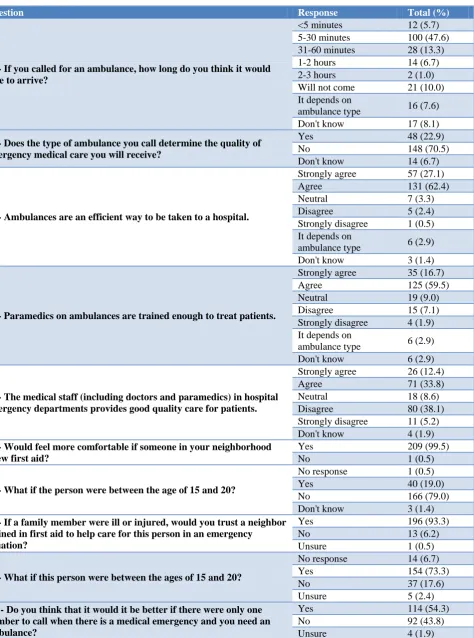
Table 3 demonstrates the Limeños’ perceptions towards EMS and first-aid. The disposition towards Lima’s EMS was generally positive as 80.5% agreed/strongly agreed that ambulances are an efficient transportation mode to the hospital and 76.2% agreed/strongly agreed that ambulance paramedics are adequately trained to treat patients. Although most respondents had agreed upon the efficiency of Lima’s ambulances, their predictions of an ambulance’s actual arrival time significantly varied: 66.7% thought it would come within an hour of calling, 7.7% said it would take longer than an hour, 7.7% assumed that it would depend on the ambulance type, and 10% did not think it would arrive at all. 70.5% did not believe that the type of ambulance called determined the pre-hospital care’s quality. Public opinion was split in regard to the care of hospital facilities: 46.6% agreed/strongly agreed while 43.3% disagreed/strongly disagreed that medical staff in hospital emergency departments provide good quality care for injured patients. Community attitudes towards the simultaneous existence of multiple EMS numbers revealed that 54.3% agreed that the consolidation of EMS telephone numbers into a single contact would be better, 43.8% did not agree, and 1.9% was unsure which would be better.
Attitudes toward first-aid were overwhelmingly positive: 99.5% felt more comfortable if a neighbour or someone close by knew first-aid and 93.3% trusted a first-aid trained neighbour to care for an injured family member. However, there was a discrepancy between question 19 and 21; although only 19.0% was comfortable with the youth having first-aid knowledge in general, 73.3% would still trust a young neighbour to perform first-aid on an injured family member in an emergent situation.
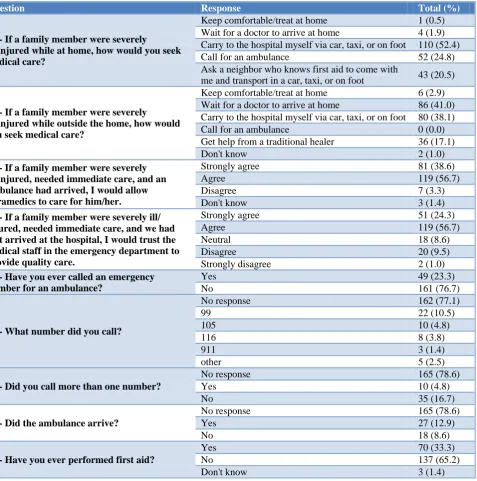
Practice results
ambulance had already arrived, 95.3% would allow paramedics to care for the ill/injured victim and if the victim had just arrived at the hospital, 81.0% would allow
the hospital staff to treat their loved one. In regard to practice of first-aid, 33.3% reported having provided first-aid in the past.
Table 2: Results of the KAP survey knowledge section.
Question Response Total (%)
1 - Is there a number to call for emergency medical assistance?
Yes 89 (42.4)
No 115 (54.8)
Don't know 6 (2.9)
2 - What is the number that you would call?
No response 121 (57.6)
Don't know 8 (3.8)
105 47 (22.4)
116 11 (5.2)
104 6 (2.9)
119 3 (1.4)
106 2 (1.0)
911 2 (1.0)
other 9 (4.5)
3 -Why?
No response 137 (65.2)
Only known number 40 (19.0)
Arrival time 6 (2.9)
Medical insurance 1 (0.5)
Services provided 7 (3.3)
Unknown reason 19 (9.0)
4 - Is there another number that you would use?
No response 188 (89.5)
Don't know 2 (1.0)
105 6 (2.9)
116 8 (3.8)
other 6 (3.0)
5 - Why?
No response 194 (92.4)
Arrival time 1 (0.5)
Medical insurance 2 (1.0)
Services provided 4 (1.9)
Don't know 9 (4.3)
6 - Do you know what “first aid” is?
Yes 142 (67.6)
No 61 (29.0)
Don't know 7 (3.3)
7 - Do you know how to provide “first aid”?
No response 65 (31.0)
Yes 79 (37.6)
No 48 (22.9)
Unsure 18 (8.6)
Do you have a neighbor or someone close by that knows first aid?
Yes 75 (35.7)
No 120 (57.1)
Don't know 15 (7.1)
9 - Do you think that first-aid is beneficial for a sick or injured person?
Yes 206 (98.1)
No 4 (1.9)
Don't know 0 (0.0)
10 - For a serious injury, how soon should you go to a hospital?
< 1 hour 205 (97.6)
1 - 3 hours 2 (1.0)
Do not go to hospital 1 (0.5)
Don't know 2 (1.0)
11 - Do ambulances provide benefit to sick or injured individuals?
Yes 181 (86.2)
No 22 (10.5)
Don't know 7 (3.3)
12 - Is there a benefit in having trained paramedics in ambulances?
Yes 204 (97.1)
No 2 (1.0)
Table 3: Results of the KAP survey attitude section.
Question Response Total (%)
13 - If you called for an ambulance, how long do you think it would take to arrive?
<5 minutes 12 (5.7)
5-30 minutes 100 (47.6)
31-60 minutes 28 (13.3)
1-2 hours 14 (6.7)
2-3 hours 2 (1.0)
Will not come 21 (10.0)
It depends on
ambulance type 16 (7.6)
Don't know 17 (8.1)
14 - Does the type of ambulance you call determine the quality of emergency medical care you will receive?
Yes 48 (22.9)
No 148 (70.5)
Don't know 14 (6.7)
15 - Ambulances are an efficient way to be taken to a hospital.
Strongly agree 57 (27.1)
Agree 131 (62.4)
Neutral 7 (3.3)
Disagree 5 (2.4)
Strongly disagree 1 (0.5)
It depends on
ambulance type 6 (2.9)
Don't know 3 (1.4)
16 - Paramedics on ambulances are trained enough to treat patients.
Strongly agree 35 (16.7)
Agree 125 (59.5)
Neutral 19 (9.0)
Disagree 15 (7.1)
Strongly disagree 4 (1.9)
It depends on
ambulance type 6 (2.9)
Don't know 6 (2.9)
17 - The medical staff (including doctors and paramedics) in hospital emergency departments provides good quality care for patients.
Strongly agree 26 (12.4)
Agree 71 (33.8)
Neutral 18 (8.6)
Disagree 80 (38.1)
Strongly disagree 11 (5.2)
Don't know 4 (1.9)
18 - Would feel more comfortable if someone in your neighborhood knew first aid?
Yes 209 (99.5)
No 1 (0.5)
19 - What if the person were between the age of 15 and 20?
No response 1 (0.5)
Yes 40 (19.0)
No 166 (79.0)
Don't know 3 (1.4)
20 - If a family member were ill or injured, would you trust a neighbor trained in first aid to help care for this person in an emergency
situation?
Yes 196 (93.3)
No 13 (6.2)
Unsure 1 (0.5)
21 - What if this person were between the ages of 15 and 20?
No response 14 (6.7)
Yes 154 (73.3)
No 37 (17.6)
Unsure 5 (2.4)
22 - Do you think that it would it be better if there were only one number to call when there is a medical emergency and you need an ambulance?
Yes 114 (54.3)
No 92 (43.8)
Table 4: Results of the KAP survey practice section.
Question Response Total (%)
23 - If a family member were severely
ill/injured while at home, how would you seek medical care?
Keep comfortable/treat at home 1 (0.5)
Wait for a doctor to arrive at home 4 (1.9)
Carry to the hospital myself via car, taxi, or on foot 110 (52.4)
Call for an ambulance 52 (24.8)
Ask a neighbor who knows first aid to come with
me and transport in a car, taxi, or on foot 43 (20.5)
24 - If a family member were severely ill/injured while outside the home, how would you seek medical care?
Keep comfortable/treat at home 6 (2.9)
Wait for a doctor to arrive at home 86 (41.0)
Carry to the hospital myself via car, taxi, or on foot 80 (38.1)
Call for an ambulance 0 (0.0)
Get help from a traditional healer 36 (17.1)
Don't know 2 (1.0)
25 - If a family member were severely ill/injured, needed immediate care, and an ambulance had arrived, I would allow paramedics to care for him/her.
Strongly agree 81 (38.6)
Agree 119 (56.7)
Disagree 7 (3.3)
Don't know 3 (1.4)
26 - If a family member were severely ill/ injured, needed immediate care, and we had just arrived at the hospital, I would trust the medical staff in the emergency department to provide quality care.
Strongly agree 51 (24.3)
Agree 119 (56.7)
Neutral 18 (8.6)
Disagree 20 (9.5)
Strongly disagree 2 (1.0)
27 - Have you ever called an emergency number for an ambulance?
Yes 49 (23.3)
No 161 (76.7)
28 - What number did you call?
No response 162 (77.1)
99 22 (10.5)
105 10 (4.8)
116 8 (3.8)
911 3 (1.4)
other 5 (2.5)
29 - Did you call more than one number?
No response 165 (78.6)
Yes 10 (4.8)
No 35 (16.7)
30 - Did the ambulance arrive?
No response 165 (78.6)
Yes 27 (12.9)
No 18 (8.6)
31 - Have you ever performed first aid?
Yes 70 (33.3)
No 137 (65.2)
Don't know 3 (1.4)
Table 5: Stratification of questions KAP survey 7, 9, 21 and 31 by gender.
Female (n=135) Male (n=75) Total (n=210) P value
N (%) N (%) N (%)
Question 7
Yes 50 (37.0) 29 (38.7) 79 (37.6) 0.4310**
No 27 (20.0) 21 (28.0) 48 (22.9)
Unsure / No response 58 (43.0) 25 (33.3) 83 (39.6)
Question 9
Yes 133 (98.5) 73 (97.3) 206 (98.1) 0.6810*
No 2 (1.5) 2 (2.7) 4 (1.9)
Question 21
Yes 100 (74.1) 54 (72) 154 (73.3) 0.3539**
No 21 (15.6) 16 (21.3) 37 (17.6)
Female (n=135) Male (n=75) Total (n=210) P value
N (%) N (%) N (%)
Question 31
Yes 39 (28.9) 31 (41.3) 70 (33.3) 0.0650*
No 95 (70.4) 42 (56) 137 (65.2)
Don’t know 1 (0.7) 2 (2.7) 3 (1.4)
*Fisher Exact Test, **Chi-squared test.
Table 6: Stratification of questions KAP survey 7, 9, 21, and 31 by age.
<=20 (n=14) >20 (n=196) Total (n=210) P value
Question 7
Yes 2 (14.3) 77 (39.3) 79 (37.6) 0.1983*
No 4 (28.6) 44 (22.4) 48 (22.9)
Unsure / No response 8 (57.1) 75 (38.3) 83 (39.5)
Question 9
Yes 14 (100) 192 (98) 206 (98.1) 1.0000*
No 0 (0) 4 (2) 4 (1.9)
Question 21
Yes 10 (71.4) 144 (73.5) 154 (73.3) 0.4790*
No 4 (28.6) 33 (16.8) 37 (17.6)
Unsure / No response 0 (0.00) 19 (9.7) 19 (9.0)
Question 31
Yes 1 (7.1) 69 (35.2) 70 (33.3) 0.0646*
No 12 (85.7) 125 (63.8) 137 (65.2)
Don’t know 1 (7.1) 2 (1.0) 3 (1.4)
*Fisher Exact Test, **Chi-squared test.
Stratification by gender and age
Tables 5 and 6 reveal demographic characteristics of people who knew and/or performed first-aid. There was no significant difference between genders for knowing how to provide first-aid (p=0.43), thinking that first-aid is beneficial for a sick or injured person (p=0.62), and trusting a 15–20-year-old neighbor trained in first-aid to help care for a sick or injured family member in an emergent situation (p=0.35). Although males were potentially more likely to have performed first-aid (OR=1.79, p=0.065), this difference did not reach statistical significance. There was no significant difference among ≤20 and >20 year olds for knowing how to provide first-aid (p=0.2), thinking that first-aid is beneficial for a sick or injured person (p=1), and trusting a 15–20 year old neighbor trained in first-aid to help care for a sick or injured family member in an emergent situation (p=0.48). Although >20-year olds were potentially more likely than ≤20 year olds to have performed first-aid before (OR=6.58, p=0.065), this difference did not reach statistical significance.
DISCUSSION
The KAP survey was administered to 210 participants in Lima, Peru to evaluate the relationship between the Limeños, Peruvian EMS, and first-aid. Regarding the EMS system, the results revealed that perceptions of EMS arrival times varied greatly, many were unable to
provide an EMS number, few would call an ambulance in case of family emergency, and nearly half of calls resulted in failure of the ambulance to arrive. Regarding first-aid, one third could provide first-aid, another third had provided first-aid before, and virtually everyone would feel more comfortable if a neighbor were first-aid trained.
Perceived EMS deficits
this answer, one possible hypothesis may be that different EMS systems accept different health insurances.8 The Limeños might have been referring to the logistical difficulty of a single number accounting for this variation in insurance coverage during emergent situations. Nevertheless, the public’s unawareness of emergency numbers might have undermined effective community-EMS relationships.
Even though a large majority of respondents thought that ambulance transport was an efficient means of travel, the great variation of answers regarding ambulance arrival times suggested an underlying uncertainty in the ambulance’s consistency (Table 2). Not surprisingly, some respondents did not trust an ambulance to arrive at all since a little less than half of the calls resulted in no-shows (Table 4). Although the quality of pre-hospital care was generally agreed upon to be good, there was a more ambivalent perception of the hospitals’ emergency departments. A possible explanation of the perceived
deficits lay not in the training of the paramedics, but in the EMS arrival time. This contradicted background literature findings that EMS response times to motor vehicle collisions were adequate at an average of 33 minutes.7 The results here did not yield a solid conclusion except for the fact that the Limeños did not have a consensus on perceptions of ambulance arrival times. The lack of trust and the perceived deficits in Lima EMS’s consistency might be reasons why respondents prefer to rely upon themselves or their neighbors over an ambulance when transporting an ill/injured relative to the hospital (Table 4). This potentially indicated a greater trust for community members as compared to more distant EMS systems that have already been deemed somewhat unreliable in their eyes. International research would support that community-based first-aid training could potentially take advantage of this trust imbalance and reduce pre-hospital care deficits by increasing bystander response capacity to emergent situations.9-11
Strengths and weaknesses
The study’s strength lay in its two-staged cluster design. This sampling methodology was chosen due to its ability to cover large areas without producing exhaustive data lists of every individual.13 Because respondents in a single cluster may share similar characteristics due to their close proximity, recruiting a high number of participants in a cluster may produce skewed data. The study targeted a high number of clusters that each contained a small number of participants in order to avoid this bias. Another strength was the usage of a previously validated EMS-focused KAP survey that successfully assessed the relationship between community members and their EMS system in Baghdad, Iraq.14,15 This Iraq-based study showcased the reproducibility of the previously outlined WHO study methodology, supporting its usage in our current study in Peru.
The study’s weakness was the lack of socioeconomic
stratification. Non-discrimination between
well-developed tourist areas and slum neighborhoods might have led to underestimation of EMS deficits in underserved communities. Because the results did indicate perceived EMS deficits and a need for first-aid education in Lima as a whole, the study concludes that such findings would only be stronger for the underserved areas.
Community-based health program – development strategies
Given prior evidence of the efficacy of community-partnered processes in resource-challenged communities, it seems logical that a community-partnered approach would be valuable in considering the development of a prospective community-based first-aid and CPR training program in Lima, Peru. In particular, studies have shown
that Community-Partnered Participatory Research
(CPPR) effectively translates research results into
tangible actions and policy changes, allowing
community-academic partnerships to cooperatively meet true community needs.16,17 CPPR centralizes around equal partnership within the community-academic partnership at all stages of the project (development, implementation, dissemination). Although the process often requires additional time and increased cooperation from all shareholders, the results have been shown to translate to improved outcomes and greater sustainability as a result of activating local leadership through community engagement and empowerment.16,17 For example, research shows that it is often difficult to recruit men to participate in community health programs. 18 Because our study suggests that men were more likely to have performed first-aid than women, utilizing CPPR to increase male engagement may help increase the human capital for a local emergency training program. Further studies would indicate that using CPPR would allow resource-poor communities in Lima to potentially self-activate in times of emergency using local solidarity, resilience, and grassroots-organized community health programs designed and implemented by the people.19,20
CONCLUSION
This study advances our knowledge of the challenges faced by communities in Lima, Peru with respect to access of emergency medical services. The survey results, along with other international studies, suggest that the development of basic first-aid and CPR training program using community-partnered methodologies may help improve access to care by leveraging strong intra-community trust and solidarity.
ACKNOWLEDGEMENTS
all those at the UCLA Center for Health Services and Society, as well as Ms. Loretta Jones and Healthy African American Families (HAAF), for guidance regarding the community-partnered participatory research (CPPR) process. Special thanks to Ning Li, Lewei Duan, and David Elashoff in the UCLA Department of Medicine Statistics Core for your statistical consultations. Thanks to Doc Renneker, Clay Everline, and the SMA for your inspiration. Thank you to the UC Irvine Department of Family Medicine and the Program in Medical Education for Latino Communities (PRIME-LC) for your inspiration and all the great work you do to serve marginalized communities in California. Lastly, we would like to thank Omprakash and Building Dignity for your consultations regarding Peruvian NGO’s and community partnerships in Lima, Peru.
Funding: UCLA Short Term Training Program Grant Conflict of interest: None declared
Ethical approval: The study was approved by the University of California Los Angeles South General Institutional Review Board (IRB#12-000676)
REFERENCES
1. Murray C, Lopez A. Global mortality, disability, and the contribution of risk factors: Global Burden of Disease Study. Lancet. 1997l;349(9063):1436-42. 2. Patton G. Global patterns of mortality in young people: a systematic analysis of population health data. The Lancet 2009;374:881-92.
3. Gore F, Bloem P, Patton G, Ferguson J, Joseph V, Coffey C, et al. Global burden of disease in young people aged 10-24 years: a systematic analysis. Lancet. 2011;377:2093-102.
4. LaGrone L, Riggle K, Joshipura M, Quansah R, Reynolds T, Sherr K, et al. Uptake of the World Health Organization’s trauma care guidelines: a systematic review. Bulletin of the World Health Organization. 2016;94:585-98.
5. The World Bank. World Bank Country and Lending
Groups. Available at https://datahelpdesk.world bank.org/knowledgebase/articles/906519-world-bank-country-and-lending-groups. Accessed on 3 June 2018.
6. Medina RY, Espitia-Hardeman V, Dellinger AM, Loayza M, Leiva R, Cisneros G. A road traffic injury surveillance system using combined data sources in Peru. Revista Panamericana de Salud Pública. 2011;29(3):191–7.
7. Miranda JJ, Lopez-Rivera LA, Quistberg DA,
Rosales-Mayor E, Gianella C, Paca-Palao A et al. Epidemiology of Road Traffic Incidents in Peru 1973–2008: Incidence, Mortality, and Fatality. PLoS ONE. 2014;9(6):e99662.
8. Swanson R, Morales Soto NR, Garcia Villafuerte A. Emergency Medicine in Peru. J Emergency Med. 2005;29(3):353-6.
9. Sasser S, Varghese M, Kellerman A, Lormand JD. Prehospital trauma care systems. Geneva, World Health Organization. 2005.
10. Mock CN, Tiska M, Adu-Ampofo M, Boakye G. Improvements in prehospital trauma care in an African country with no formal emergency medical services. J Trauma Acute Care Surg. 2002;53(1):90– 7.
11. Husum H, Gilbert M, Wisborg T, Van Heng Y, Murad M. Rural prehospital trauma systems improve trauma outcome in low-income countries: a prospective study from north Iraq and Cambodia. J Trauma Acute Care Surg. 2003;54(6):1188–96. 12. Henderson RH, Sundaresan T. Cluster sampling to
assess immunization coverage: a review of experience with a simplified sampling method. Bulletin of the World Health Organization 1982;60(2):253-60.
13. Sethi D, Habibula S, McGee K, Peden M, Bennett S, Hyder AA, et al. WHO Guidelines for Conducting Community Surveys on Injuries and Violence. Geneva, World Health Organization. 2004.
14. Shanovich PK, Donaldson RI, Hung YW, Hasoon T, Evans GE. Iraqi community member’s knowledge, attitude and practice of emergency medical care: assessing civilian medicine in an area of conflict. Med Conflict Survival. 2011;27(3):151-64.
15. Baghdassarian A, Donaldson R, DePiero A,
Chernett N, Sule H. Pediatric Emergency Medical Care in Yerevan, Armenia: A knowledge and attitudes survey of out-of-hospital Emergency Physicians. Int J Emergency Med. 2014;7(1):11.
16. Jones L. Community-Partnered Participatory
Research: How We Can Work Together to Improve Community Health. Ethnicity Dis. 2009;19(4 Suppl 6):S6-1-2.
17. Jones L, Wells K. Strategies for Academic and Clinician Engagement in Community-Participatory Partnered Research. J Am Med Association. 2007;297(4):407-10.
18. Lefkowich M, Richardson N, Robertson S. “If We Want to Get Men in, Then We Need to Ask Men What They Want”: Pathways to Effective Health Programming for Men. Am J Mens Health. 2017;11(5):1512-24.
19. Chandra A, Williams M, Plough A, Stayton A, Wells KB, Horta M et al. Getting Actionable About Community Resilience: The Los Angeles County Community Disaster Resilience Project. Am J Public Health. 2013;103(7):1181-9.
20. Wells KB, Tang J, Lizaola E, Jones F, Brown A, Stayton A, et al. Applying community engagement to disaster planning: developing the vision and design for the Los Angeles County Community Disaster Resilience initiative. Am J Public Health. 2013;103(7):1172-80.