Original Research Article
A study of risk factors for ischemic heart disease in a village of
Davanagere district: a case control study
Muhammed Muntazeem G., Rathnaprabha G. K.*, Varadaraja Rao B. A., Prakash Kengal
INTRODUCTION
Ischemic heart disease (IHD) has been defined as ―impairment of heart function due to inadequate blood flow to the heart compared to its needs which is caused by obstructive changes in the coronary circulation to the heart.1 Cardiovascular diseases (CVD) comprising coronary heart and cerebrovascular diseases are currently the leading cause of death globally, accounting for 21.9% of total deaths and are projected to increase to 26.3% by 2030.2
Ischemic heart disease is a multifactorial disease. Various behavioral risk factors like smoking, smokeless tobacco consumption, physical inactivity, unhealthy diet and alcohol consumption are known to be the important risk factors for IHD. Most of the behavioral risk factors are potentially modifiable one.3 This is due to rapid epidemiological transition, increased life expectancy,
lifestyle changes and genetic predisposition of Indians to atherosclerotic Ischemic heart disease (IHD).4 Seventy percent of the Indian population lives in rural areas5. The rural population of Karnataka is 61.32%.6 Most of the studies conducted on IHD in India are in urban population. Few studies were conducted in rural areas suggested that IHD was not a major problem in rural communities.7 This study was conducted to assess the risk factors associated with Ischemic Heart Disease and to determine the strength of association between the risk factor and Ischemic Heart Disease among people with IHD in Kerebilachi village of Davanagere district.
METHODS
Study design: Case control study.
Study population: People who are the residents of Kerebilachi village.
ABSTRACT
Background: Ischemic heart disease is a multifactorial disease. Various behavioural risk factors like smoking, physical inactivity, unhealthy diet and alcohol are known to be important risk factors for IHD.
Methods: A case control study was conducted at Kerebilachi village, Davanagere. 40 known cases of Ischemic heart diseases and 80 controls were studied. The association of various risk factors with IHD was assessed. Data was entered in the Microsoft excel and analysed using SPSS v20.
Results: Smoking, diabetes, hypertension, physical inactivity and obesity were important risk factors considered in this study. Significant association was observed with smoking (OR 6.15, CI: 2.646 -14.289.), diabetes (OR 5.28, CI: 1.80-18.54), hypertension (OR.35, CI: 0.12-1.01) and obesity (OR 0.74, CI: 1.06—8.23).
Conclusions: This study reinforces the importance of risk factors which are modifiable and preventable.
Keywords: Risk factors, IHD, Case-control study
Department of Community Medicine, S.S Institute of Medical Sciences and Research Centre, Davanagere, Karnataka, India
Received: 08 April 2019
Accepted: 07 May 2019
*Correspondence:
Dr. Rathnaprabha G. K., E-mail: [email protected]
Copyright: © the author(s), publisher and licensee Medip Academy. This is an open-access article distributed under the terms of the Creative Commons Attribution Non-Commercial License, which permits unrestricted non-commercial use, distribution, and reproduction in any medium, provided the original work is properly cited.
Inclusion criteria
Inclusion criteria were individuals whose age >18 years; people who are resident for more than 6 months in that village; Cases: Already diagnosed cases of IHD. Diseases which comes under IHD are angina pectoris, myocardial infarction, cerebrovascular disease (stroke), and congestive heart failure. Patients with known CAD included those who had documented evidence of acute coronary syndrome, treatment for CAD including history of angioplasty/Coronary Artery Bypass Graft Surgery (CABG) or documentation of CAD by coronary angiography; Controls: person not a known case of Ischemic heart disease in Kerebilachi village.
Exclusion criteria
Exclusion criteria were people with the organic and congenital heart disease.
Study period: 6 months (1st March to 31st August 2018).
Sampling technique:Convenient.
Sample size
Sample size was 40 cases, 80 controls.
List of patients with IHD was obtained from NCD register maintained at Community Health Centre, Kerebilachi. House to house visit was done with the help of health care workers.
For each case, 2 age- and sex-matched controls were selected and the neighbour was the source of control.
Informed consent was obtained from each respondent prior to the interview and physical Examinations. The questionnaire containing demographic characteristics such as age, sex, religion, education, history of alcohol consumption, cigarette smoking, hypertension, type 2 diabetes mellitus, sedentary lifestyle, dietary pattern and family history of IHD will be administered by interview technique. Time spend for moderate physical activity like brisk walking, cycling was calculated for each subject and they were classified as physically inactive if physical activity was <30 minutes/day.9 Body mass index (BMI) was used to classify the weight status of subjects. Classification of overweight and obesity was done according to Asian classification.10
Analysis
Data was entered in the Microsoft excel and analysed using SPSS v20, presented in the form of frequencies, Chi square test was applied. Strength of association was used by odds ratio.
RESULTS
In this study 40 cases and 80 controls were included. Majority of the cases and controls were >60 years of age groups, 90% of the participants were males and predominant religion was Islam (96%). Majority of cases (27.5%) and controls (37.5%) studied only up to high school and belonged to class 2 socioeconomic status. Most of the cases (52.5%) were residing in joint families and controls (55%) in nuclear families. The association of Ischemic heart disease with socio-demographic factors are explained in the Table 1.
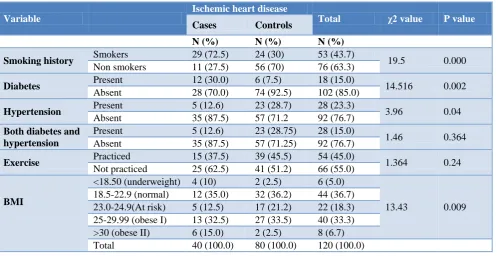
In this study 43.7% were smokers. It was also found that (72.5%) of the cases and (30%) of controls had history of smoking. Diabetes was found to be present in (30%) of the cases and (7.5%) in controls. Hypertension was found to be present in (12.6%) of cases and (28.7%) in controls. It was observed that (62.5%) of cases and (55%) of controls had sedentary lifestyle. Majority of the cases as well as controls had normal body mass index. Association of Ischemic heart disease with these risk factors is explained in Table 2.
In this study significant association was found between smoking, diabetes, hypertension and body mass index with Ischemic Heart Disease but no significant association was found between exercise with Ischemic Heart Disease.
In this study risk of IHD was 1.9 times more among 51-60 age group compare to > 51-60 years
(OR: 1.9, CI:0.38-8.432). The risk of IHD was 8.4 times among Muslims compared to Hindus( OR:8.4,CI: 0.827-8.56).The risk of IHD was 1.1 times more among illiterates compared to graduates(OR:1.1, CI:0.36-7.14) and 1.5 times more among class 1 socioeconomic group compared to class V( OR: 1.5,CI: 0.59-5.95) and risk of IHD was 2.9 times more among people residing in joint family compared to nuclear family(OR: 2.9, CI:0.458-18.37).
In this study the risk of Ischemic Heart Diseases was 6.15 times more among smokers compared to non- smokers and association was statistically significant with (OR: 6.15, CI: 2.648-14.298 and p<0.001). The risk of Ischemic Heart Disease was 5 times more among those with diabetes compare to non-diabetics (OR:5.28, CI:1.80-15.4 and p<0.001). The risk of Ischemic Heart Disease was 2.8 times was more among hypertensives compare to
Table 1: Sociodemographic features of study participants.
Variables Ischemic Heart disease Total
Cases Controls
N (%) N (%) N (%)
Age wise distribution (in years)
≤40 4 (10) 8 (10) 12 (10.0) 41-50 5 (12.5) 10 (12.5) 15 (12.5) 51-60 8 (20.0) 16 (20.0) 24 (20.0) >60 23 (57.5) 46 (57.5) 69 (57.5)
Sex wise distribution Female 4 (10) 8 (10) 12 (10.0)
Male 36 (90) 72 (90) 108 (90.0)
Religion Hindu 3 (7.5) 2 (2.5) 5 (4.0)
Islam 37 (92.5) 78 (80) 115 (96.0)
Education
Illiterate 7 (17.5) 9 (11.2) 16 (13.3) Primary 9 (22.5) 10 (12.5) 19 (15.8) Middle 4 (10.0) 11 (13.8) 15 (12.5) High school 11 (27.5) 30 (37.5) 41 (34.1) PUC/Diploma 1 (2.5) 6 (7.5) 7 (5.8) Undergraduate/ Postgraduate 8 (20.0) 14 (17.5) 22 (18.3)
Socioeconomic status
Class 1 10 (25.0) 17 (21.2) 27 (22.5) Class 2 11 (27.5) 30 (37.5) 41 (34.1) Class 3 9 (22.5) 19 (23.8) 28 (23.3) Class 4 7 (17.5) 12 (15.0) 19 (15.8) Class 5 3 (7.5) 2 (2.5) 5 (4.1)
Type of family
Joint 21 (52.5) 31 (38.7) 52 (43.4) Nuclear 17 (42.5) 44 (55.0) 61 (50.8) Three generation 2 (5.0) 5 (2.5) 7 (5.8)
Total 40 (100) 80 (100) 120 (100)
Table 2: Association of Ischemic heart diseases with risk factors.
Variable
Ischemic heart disease
Total χ2 value P value
Cases Controls
N (%) N (%) N (%)
Smoking history Smokers 29 (72.5) 24 (30) 53 (43.7) 19.5 0.000 Non smokers 11 (27.5) 56 (70) 76 (63.3)
Diabetes Present 12 (30.0) 6 (7.5) 18 (15.0) 14.516 0.002 Absent 28 (70.0) 74 (92.5) 102 (85.0)
Hypertension Present 5 (12.6) 23 (28.7) 28 (23.3) 3.96 0.04 Absent 35 (87.5) 57 (71.2 92 (76.7)
Both diabetes and hypertension
Present 5 (12.6) 23 (28.75) 28 (15.0)
1.46 0.364 Absent 35 (87.5) 57 (71.25) 92 (76.7)
Exercise Practiced 15 (37.5) 39 (45.5) 54 (45.0) 1.364 0.24 Not practiced 25 (62.5) 41 (51.2) 66 (55.0)
BMI
<18.50 (underweight) 4 (10) 2 (2.5) 6 (5.0)
13.43 0.009 18.5-22.9 (normal) 12 (35.0) 32 (36.2) 44 (36.7)
23.0-24.9(At risk) 5 (12.5) 17 (21.2) 22 (18.3) 25-29.99 (obese I) 13 (32.5) 27 (33.5) 40 (33.3) >30 (obese II) 6 (15.0) 2 (2.5) 8 (6.7)
Table 3: Strength of association of Ischemic heart disease with risk factors.
Risk factors OR 95% CI P value
Age (in years)
≤ 40 1.17 0.393-3.943 0.880
41-50 1.245 0.238-5.238 0.456 51-60 1.803 0.38-8.432 0.506
>60 1
Sex Female 1.958 0.462-9.29 0.362
Male 1
Religion Islam 8.415 0.827-8.56 0.072
Hindu 1
Education
Illiterate 1.16 0.36-7.14 0.881 Primary 1.12 0.85-4.10 0.908
Middle 0.47 0.25-2.94 0.387
High school 0.49 0.14-2.60 0.277 PUC/Diploma 0.25 0.02-1.75 0.274 Undergraduate/Postgraduate 1
Socioeconomic classification
Class 1 1.594 0.59-5.95 0.658 Class 2 0.514 0.49-5.39 0.347 Class 3 0.355 0.34-3.5 0.368 Class 4 0.344 0.40-3.1 0.579
Class 5 1 . .
Type of family
Joint 2.901 0.458-18.37 0.258 Three generation 1.479 0.231-9.45 0.679
Nuclear 1
Smoking Smokers 6.15 2.64- 14.28 0.000
Non smokers 1
Diabetes Diabetes 5.28 1.80-15.4 0.000
Non diabetics 1
Hypertension Hypertensives 2.82 0.98- 8.11 0.02 Normotensives 1
Body mass index (Kg/mt2)
<18.50(Underweight) 0.081 0.01-0.53 0.09 18.5-23(Normal) 0.064 0.00-0.50 0.07 23.0-24.9(At risk) 0.10 0.01-0.62 0.014 25-29.99(Obese I) 0.74 0.06-8.237 0.809
>30(Obese II) 1
DISCUSSION
The present study was designed as case-control study to assess risk factors among IHD patients in rural area of Davanagere district. It was found that smoking, type 2 diabetes, hypertension, sedentary life style, obesity were the important risk factors which were associated with IHD.
A total of 120 subjects (40 cases and 80 controls) were studied, 90% were males and 10% were females. Majority of the cases and controls belongs to age group >60 years. This is similar to other studies. In this study majority were belongs to Islam religion. Majority of the cases 11 (27.50%) and controls 30 (37.50%) studied up to high school and similar difference was also observed by Singh et al.17 In this study majority of the cases (27.5%) and controls (37.5%) belongs to class 2 socio economic state which is similar with the findings of Singh et al.17
Majority of cases residing at joint families 21 (52.50%) and controls 44 (55.0%) residing at nuclear families.
In this study majority of the cases were smokers and controls were non-smokers. Significant association was found between smoking and IHD (p=0.000) and similar results were found by the other studies4,7 but in contrast, a study done By Hussain M et al 14 showed that majority of the study participants were non - smokers. In our study smokers were 6.15 times increased the risk of developing IHD compared to non–smokers with (OR: 6.15, CI: 2.64814.289, p<0.000).
In this study, majority of the cases and controls do not practice exercise regularly but no significant association was found with development of IHD. This is similar to study conducted by Mendagudali et al,Oommen et al at rural block of Vellore, Krishnan et alat rural block of Kerala and Dhungana et al at Sitapaila Village in Nepal.7,11,13,18 In contrast, study done by Hussain et aland Sinha et al showed that majority of workers practiced exercise regularly and significant association was found between physical activity and IHD.14,16
In this study majority of the cases and controls had normal body mass index. Significant association was found between Obesity and IHD (chi square p value 0.009), similar to the previous literature.7,11 In contrast, studies done by others showed that majority of study participants had BMI >25 Kg/m2 and study done by Dhungana et al showed that majority of the study participants had BMI in the range of 25-30. 4,14,18 The limitations of the present study were the sample size was small. Cases who have died are generally not taken and these may be systematically very different from living case as regards the exposure status and leads to survivorship bias.
Chance of social desirability bias because many participants may under report the answers. Salt intake and oil intake was not assessed because of chance of recall bias.
CONCLUSION
Present study was a case-control study conducted in rural area of Davanagere district. Study showed that smoking, diabetes, hypertension, sedentary life style and obesity were the important risk factors of Ischemic heart disease. The risk factors are modifiable and preventable. Creating awareness about the non-communicable diseases among villagers, early diagnosis, treatment and proper glycemic control along with reduction of blood pressure, central obesity, regular physical exercise, reduction of excess salt, oil and fat consumption and cessation of smoking may be important in controlling coronary artery disease in the rural population. Life style interventions along with adherence to medicine for other co-morbidities will reduce the risk of Ischemic heart disease.
Funding: No funding sources Conflict of interest: None declared
Ethical approval: The study was approved by the Institutional Ethics Committee
REFERENCES
1. World health organization. World Health Report: Reducing risks, promoting healthy life, 2002. Available at: https://www.who.int/whr/2002/ en/whr02_en.pdf. Accessed on 1 February 2018.
2. Ali MK, Tandon N. Diabetes & coronary heart disease. Current perspectives. Indian J Med Res. 2010;132(5):584-97.
3. Park K. Park’s Text book of Preventive and Social medicine, 20th ed, M/S Banaridas Bhanot, Jabalpur India. 2009: 318-78.
4. Sriharibabu M, Himabindu Y, Kabir Z. Prevalence and associated risk factors of coronary artery disease in a rural South Indian population on a governmental health insurance scheme. J Indian Coll Cardiol. 2012: 150-155.
5. Chandramouli C. Rural Urban Distribution of Population (Provisional Population totals. Available at: http://censusindia.gov.in/2011provresults/ paper2/data_files/india/Rural_Urban_2011.pdf. Accessed on 12 November 2015.
6. Census info India, final population totals: Karnataka profile. Available at: http://censusindia.gov.in/ 2011census/censusinfodashboard/stock/profiles/en/I ND029_ Karnataka.pdf. Accessed on 12 November 2015.
7. Mendagudali RR, Akka KD, Manjula R, Swati IA, Dayalaxmi TS, Ghattargi VC. Prevalence of coronary heart disease in rural population of Bagalkot, Karnataka, India. Int J Community Med Public Health. 2015;2:581-6.
8. Pandey VK, Aggarwal P, Kakkar R. Modified BG Prasad’s Socio-economic Classification-2018: The need of an update in the present scenario. Indian J Comm Health. 2018;30(1):82-4.
9. Battly GD, Lee IM. Physical activity and coronary heart disease. BMJ. 2004;328:1089-90.
10. A training Manual for Height, Weight and BMI assessment. Developed by BMI task force [Internet]. Available at http://www.achi.net> BMI content>Document. Accessed on 4 February 2018. 11. Oommen AM, Abraham VJ, George K, Jose VJ.
Prevalence of coronary heart disease in rural and urban Vellore: A repeat cross-sectional survey. Indian Heart J. 2016;68:473-9.
12. Pradeep J, Idris MZ, Saran RK, Natu SM. A study of coronary heart disease and the associated risk factors in Lucknow district, India. Int J Biol Med Res. 2013;4(1):2966-72.
13. Krishnan MN, Zachariah G, Venugopal K, Mohanan P, Harikrishnan S, Sanjay GL, et al. Prevalence of coronary artery disease and its risk factors in Kerala, South India: a community-based cross-sectional study. BMC Cardiovascular Disorders. 2016;16:1-12.
14. Hassan MU, Awan ZA, Gul AM, Sahibzada WA, Hafeezullah M. Prevalence of coronary artery disease in rural areas of Peshawar. JPMI. 2005;19(1):14-22.
15. Goyal A, Kahlon P, Jain D, Soni RK, Gulati R, Chhabra ST, et al. Trend in prevalence of coronary artery disease and risk factors over two decades in rural Punjab. Heart Asia. 2017;9:1–6.
Risk Factors in Rural Area of Nagpur. Ntl J Community Med. 2016;7(8):703-7.
17. Singh RB, Sharma JP, Rastogi V, Niaz MA, Ghosh S, Beegom et al. Social class and coronary disease in a rural population of north India. Eur Heart J. 1997;18:588-95.
18. Dhunganaa RR, Thapac P, Devkotad S, Banike PC, Gurunga Y, Mumue SJ, et al. Prevalence of cardiovascular disease risk factors: A community-based cross-sectional study in a peri-urban
community of Kathmandu, Nepal. Indian Heart J. 2018: 1-8.