Feature Optimization of Whitefly Detection Algorithm
using Image Segmentation and Feature Analysis
Honse-Al-Walid
Associate Professor, Department of ComputerScience & Engineering Ahsanullah University of Science and Technology
Dhaka, Bangladesh
Md. Tanjim-Al-Akib
CSE Graduate, Department of ComputerScience & Engineering Ahsanullah University of Science and Technology
Dhaka, Bangladesh
Nusratul Islam
CSE Graduate, Department of ComputerScience & Engineering Ahsanullah University of Science and Technology
Dhaka, Bangladesh
ABSTRACT
With the increase of agricultural production worldwide, the economic importance of early detection of crop pests is more evident than ever before. The purpose of this study is to improve the performance of crop pest detection algorithm using image processing techniques. This study combines the object extraction, feature extraction and classification of a particular crop pest species using the SVM classifier. The end point of this study is to achieve optimal performance and accuracy.
Keywords
Image Processing, Image Segmentation, Feature Extraction, Pest Detection, Whitefly, Blob Extraction, SVM Classifier, Performance Analysis
1.
INTRODUCTION
About 75 percent of the world's poor people live in rural areas, and most of them are involved in farming. [1] But in order to attain the best production, people need to protect plants from various kinds of pests. In recent times, many researches have focused on detecting pests in agricultural crops. Crops infected by pests must be detected at an early stage in order to facilitate direct action for prevention of further infection. There are many existing manual methods to detect pests in crops but they all tend to be time consuming. With the help of latest technologies and rising advancement of image processing research field, a more efficient system for early detection of pests in crops can be developed.
Pesticides is one of the preventive measures taken against pest occurrence, but its long-term usage is not feasible in many ways because they can be very harmful for both the environment and the animals that come in contact to the plants. Usage of pesticides reduces nitrogen fixation and thus it decreases the production of crops. Therefore, early detection of crop pests can play a huge role to achieve better productivity in the field of agriculture. In this study, the primary focus is on studying the existing pest detection algorithms, optimizing them by applying different techniques and improving performance through analysis.
2.
IMPORTANCE OF EARLY PEST
DETECTION
Huge amount of crops are destroyed yearly around the world because of pests and diseases. The number is quite shocking and it ranges from 10%-16% of the total worldwide agricultural production [2]. Farmers tend to use pesticides to
prevent pests and diseases to attack the crops but as a matter of fact those pesticides sometimes become more harmful than the pests or the disease itself.
Whiteflies generally suck phloem sap and a large number of them can turn leaves into yellow, appear dry and sometimes to fall off the plants. When these whiteflies lay eggs or the time when nymphs grow bigger to an adult whitefly, they suck out a lot of phloem sap causing plant distortion, silvering of leaves and possibly serious losses in some vegetable crops. Some whiteflies even transmits viruses to some plants. Sometimes small group of them doesn’t affect much but it’s very important to notice issues that may cause infestation later on [3].
Heavy infestation of whiteflies can lead to the cause of death of plant. Even late detection of these pests can cause heavy loss for the farmers. After a certain delay in taking actions sometimes farmers panic and use a lot of pesticides which is also very harmful for the crops. The goal of this work is to develop a method which will be robust, easy to adopt and automate the identification process based on computer vision. Nowadays smartphone cameras are very sophisticated and they provide high resolution photos. Using image processing techniques it is possible to detect pests in their early stages of infestation. But in order to apply pest detection algorithms to portable devices like smartphones, the detection algorithm needs to have optimized performance and accuracy.
3.
LETARATURE OVERVIEW
Insect detection using static images method was first given by Paul Boissard, Sabine Moisan [4]. The actual algorithm computation took hours and the slow scanning process included risks of pests flying away from the crops, resulting in a faulty image database.
Another study conducted by Sandip P. Bhamare and Samadhan C. Kulkarni [5] used shape and texture extraction methods for detecting Black Sigatoka insect in banana trees. Their algorithm showed promise, but lacked a viable image database and a detection accuracy rate. In another study conducted by Goutham and Tejaswini, detects pests in tomato plants by extracting Region of Interest (ROI) from tomato plant images.
primarily focuses on [6] and seeks to optimize its performance and accuracy.
.
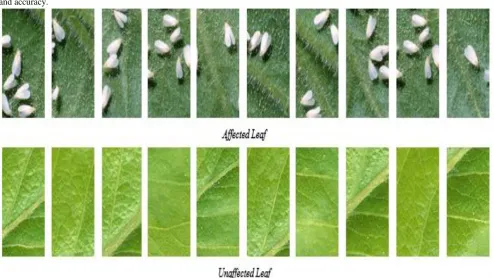
Fig 1: Image Database
4.
OVERVIEW OF EXISTING
ALGORITHM
The existing algorithm for detection and classification of pests in greenhouse is [6]. Their study focuses on whiteflies as early detection of this pest which is crucial for effective intervention.
Image database for their study was acquired through pan tilt camera with zoom within the boundaries of a greenhouse. For this study the same image database was chosen as the image quality is optimal. A portion of the acquired image database for is shown in Fig 1.
The algorithm [6] use several stages of image processing techniques. Their methodology, consists of three main working stages, namely: pre-processing, detection and classification. The elaborate steps of this algorithm are displayed in Fig. 2.
The images used in [6] were saved in common image formats (JPEG, PNG) and the image capture system was directly interfaced with the detection system. Pre-processing stage includes the following steps
● RGB to Grayscale Conversion ● Image Resizing
● Image Filtering.
A set of seven image properties are chosen as features. They are:
• Entropy [7] • Mean
• Standard Deviation [8] • Contrast [9]
• Correlation [10]
• Eccentricity [6] • Euler Number
Based on the feature set defined in the previous section, [6] uses the binary SVM classifier for detection of whiteflies. Using this classifier, [6] demonstrates a 100% success rate in detecting leaves affected with whitefly.
Fig 2: Steps of the Mundada-Gohokar Detection
Image acquisition
RGB to Grayscale Conversion
Image Resizing
Image Filtering
Feature Extraction
Disease Classification
& Grading
Detection
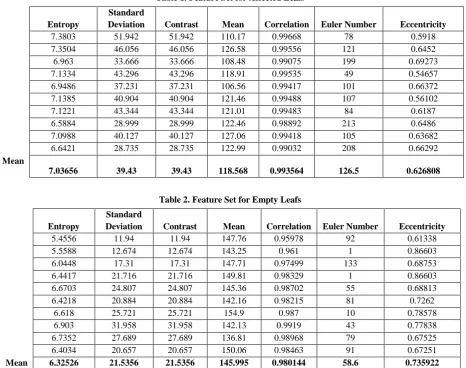
Table 1. Feature Set for Affected Leafs
Entropy
Standard
Deviation Contrast Mean Correlation Euler Number Eccentricity
7.3803 51.942 51.942 110.17 0.99668 78 0.5918
7.3504 46.056 46.056 126.58 0.99556 121 0.6452
6.963 33.666 33.666 108.48 0.99075 199 0.69273
7.1334 43.296 43.296 118.91 0.99535 49 0.54657
6.9486 37.231 37.231 106.56 0.99417 101 0.66372
7.1385 40.904 40.904 121.46 0.99488 107 0.56102
7.1221 43.344 43.344 121.01 0.99483 84 0.6187
6.5884 28.999 28.999 122.46 0.98892 213 0.6486
7.0988 40.127 40.127 127.06 0.99418 105 0.63682
6.6421 28.735 28.735 122.99 0.99032 208 0.66292
Mean
7.03656 39.43 39.43 118.568 0.993564 126.5 0.626808
Table 2. Feature Set for Empty Leafs
Entropy
Standard
Deviation Contrast Mean Correlation Euler Number Eccentricity
5.4556 11.94 11.94 147.76 0.95978 92 0.61338
5.5588 12.674 12.674 143.25 0.961 1 0.86603
6.0448 17.31 17.31 147.71 0.97499 133 0.68753
6.4417 21.716 21.716 149.81 0.98329 1 0.86603
6.6703 24.807 24.807 145.36 0.98702 55 0.68813
6.4218 20.884 20.884 142.16 0.98215 81 0.7262
6.618 25.721 25.721 154.9 0.987 10 0.78578
6.903 31.958 31.958 142.13 0.9919 43 0.77838
6.7352 27.689 27.689 136.81 0.98968 79 0.67525
6.4034 20.657 20.657 150.06 0.98463 91 0.67251
Mean 6.32526 21.5356 21.5356 145.995 0.980144 58.6 0.735922
5.
ANALYSIS OF EXISTING
ALGORITHMS
This study takes a more in-depth look at [6] determine the accuracy and aims make [6] more efficient by reducing the number of features used in the study.
5.1
Importance of Feature Reduction
According to a study made by Andreas G. K. Janecek and Wilfried N. Gansterer [11] in application fields where the search for the optimal feature set is still a topic of active research. It can be observed that the accuracy of classification achieved with a reduced feature set is often significantly better than using a full feature set. In an active field such as image processing and computer vision, the search for the perfect feature set is continually progressing. Reducing the size of the feature set can make classifier algorithms more accurate and reduce time needed for the full execution of the classification algorithm5.2
Percentage of Varience
For understanding detection algorithm [6], at first, the image database that was used in [6] is obtained. Then the images are converted to grayscale, resized and filtered according to the specifications mentioned in the previous study. Then the
seven features are extracted from the image and prepared into a simple feature vector. By repeating this process, a feature vector for each of the sample images which are shown in Fig.1 is obtained. A portion of the sample feature vector set obtained through this method is shown in Table 1. Note that since the current concern is with training images, it is already known which data are from images affected with whitefly and which are empty leaf data. The feature set for the whitefly affected leaves is given in Table 1 and the feature set for empty leaves is given in Table 2.
Now for each of the columns in Table 1 and Table 2, the mean of the features is calculated. After the mean is calculated their variation with respect to one another is obtained.
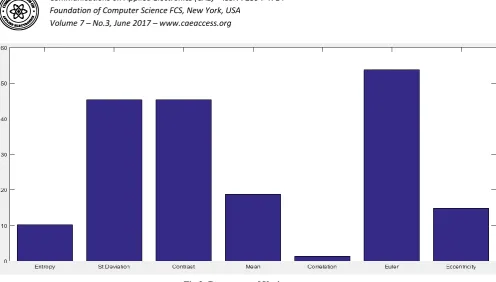
That is, the percentage of variation is defined by the ratio of the difference between two means and the highest value of mean among the two data. This percentage provides a basic idea about which feature varies more in an image for a leaf affected with whitefly versus an empty leaf. The higher the percentage of variation, the more viable that feature is in terms of significance to whitefly detection.
5.3
Result Analysis
The results obtained through the calculation of percentage of
Fig 3: Percentage of Varience
Note that the bar for standard deviation and contrast have the same exact percentage of variance. It is also noted that the percentage of variance is surprisingly low for the features correlation and entropy. With the percentage of variance being under 10% these two features can be eliminated from the feature set for their insignificance to pest detection. Fig 1.
So in conclusion to this analysis, it is noted that the features contrast, entropy and correlation do not vary much between affected and unaffected images, and as such, can be eliminated from the optimized feature vector. The goal of this study will now be to suggest new significant feature extraction methods and optimize the existing algorithm.
6.
PROPOSED ALGORITHM
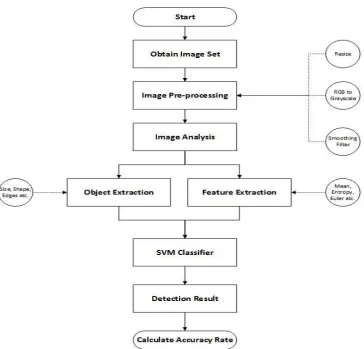
In image processing, there are two principal techniques for object detection in images. One of them is the aforementioned feature extraction method, the other method is known as image segmentation, or object extraction. While feature detection deals with extracting data points from an image based on some of its property, object extraction takes a more physical approach to the image with a view to focus on detecting actual edges and other visible characteristics in the image. The goal of segmentation is to simplify and/or change the representation of an image into something that is more meaningful and easier to analyze [12]. Unlike other greenhouse pests, whiteflies are visually significant. For this reason image segmentation and object extraction is a feasible technique for detecting whiteflies in leaf images. Therefore, with the aim of improving the existing [6], this study aims to combine the two principal image processing techniques of image segmentation and feature extraction. The proposed algorithm, as depicted in Fig 4, uses the blob extraction method of image segmentation, obtaining physical characteristics data from the image.
6.1
Image Acquisitions
This study uses the same image database as [6]. This image database, as depicted in Fig 1 is of .jpeg format and consists of two classes of images: a) Affected with whitefly, and b) Healthy, unaffected leaf.
6.2
Image Pre-processing
The images are converted to grayscale, resized and then smoothened to eliminate background noise. The pre-processing steps are discussed in detail here:
6.2.1
Resize
Different sample of different sizes needed to be brought uniformity to the images so that computation and image processing can be same for all images. For this purpose all the images are resized to 512x720px at the very beginning of processing.
6.2.2
RGB to Grayscale Conversion
Digital images are classified in four main types according to its format of pixel: binary images, grayscale images, indexed images, and true color images. [13]. In grayscale images the value of a pixel is a scalar who represents an intensity or gray level within some range. The value of a pixel in indexed images is a scalar who represents an index. It indicates the color of the pixel in a color map. In true color images the value of a pixel is a vector. This vector indicates the color of the pixel according to some color space (e.g. RGB, CMYK).
A true color image can be converted to a grayscale image by eliminating the hue and saturation information while retaining the luminance. The RGB image is 3 dimensional, while a grayscale image is 2 dimensional.
There is a formula to convert RGB to grayscale image used in this study is as follows:
Fig 1: Proposed Algorithm
6.2.3
Filtering
The image is filtered to get rid of the environmental noises, which helps to detect the objects. Low pass filters, high pass filters, median filters etc are some methods of noise reduction. The low pass filters are smoothening filters whereas the high pass filters are sharpening filters. The traditional median filters are used to reduce salt-paper noise. In this study smoothening filter is used to reduce noise and to improve the visual quality of the image. The simplest smoothening filter is average filter which consists of a 3x3 matrix of 1 and is divided by 9sample of different sizes needed to be brought uniformity to the images so that computation and image processing can be same for all images. For this purpose all the images are resized to 512x720px at the very beginning of processing.
6.3
Image Analysis
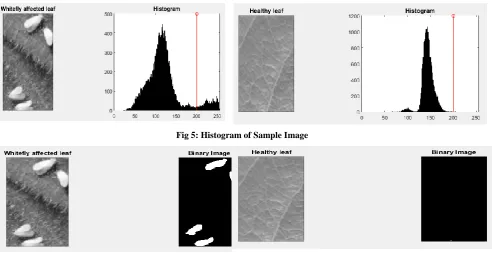
In this stage of the algorithm two different image processing techniques are followed to obtain a significant and optimized feature vector. For image segmentation, the blob detection method is applied for detecting the region containing whitefly in images.
6.3.1
Blob Detection
Informally, a blob is a region of an image in which some properties are constant or approximately constant; all the
Fig 5: Histogram of Sample Image
Fig 2: Conversion to Binary Image
6.3.2
Blob Property Extraction
Now that the outlines of the whiteflies have been detected, mathematical analysis to measure their diameter, centroid and area can be performed. These data provide insight to the measurement of the pests, as well as the total affected area. These data can be significant in application of a pest-detection program because it is important to know how much a crop leaf has been affected by a pest for consideration of possible treatment methods.
The data extracted from the sample images using image segmentation is displayed in Table 3 and Fig 7 demonstrates a demo application that can count the number of whiteflies affecting the crop and the total affected area using image segmentation. This application gives a measure of how much area is affected by the pest. If the pixel density of the captured image, the focal length and the camera distance is known then the real world affected area in mm^2 can be calculated.
Table 3. Features Obtained from Image Segmentation Probable Pest
Number
Mean Intensity
Affected Pixel Area
Pest Diameter
14 230.37 2437 40.518
12 231.27 2492 44.883
7 230.2 470 19.214
7 233.68 2296 44.796
3 236.12 1254 24.482
6 231.35 1390 32.495
7 234.63 2165 27.194
3 234.99 870 24.597
5 234.36 2026 36.984
1 234.03 785 31.615
a) For Affected Leaf
Probable Pest Number
Mean Intensity
Affected Pixel Area
Pest Diameter
1 228.5 2 1.5958
0 0 2 0
1 226 1 1.1284
1 227 1 1.1284
3 226.67 3 1.5595
2 230 2 1.3621
4 228.19 10 2.778
5 229.15 14 3.0668
3 229.92 12 3.119
1 228 4 2.2568
b) For Empty Leaf
6.4
Feature Optimization & Classification
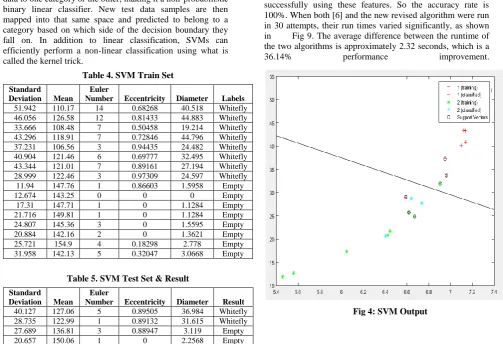
After elimination of features who had little to no effect on the classifier’s performance, the features that have been selected for the optimized feature set are: Mean, Standard Deviation, Euler number and Eccentricity. These are the features that are provided to a SVM classifier for classification and identification of whitefly in images. These features are interfaced with learning algorithms that are able to analyze data and detect known patterns [17]. If given a set of training examples, where each entry is labeled to belong to a particular class, an SVM classifier builds a model that assigns new test data to one category or the other, making it a non-probabilistic binary linear classifier. New test data samples are then mapped into that same space and predicted to belong to a category based on which side of the decision boundary they fall on. In addition to linear classification, SVMs can efficiently perform a non-linear classification using what is called the kernel trick.This trick consists of implicitly mapping training and test data into higher-dimensional feature spaces, when data is not linearly separable. This study makes use of a binary SVM classifier which takes as training input the reduced feature sets.
7.
RESULT ANALYSIS
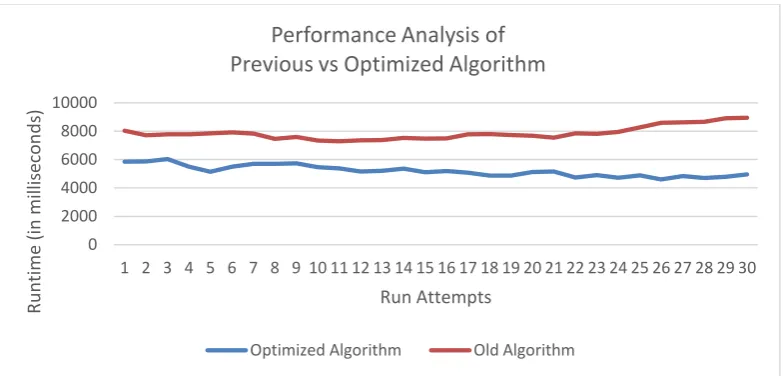
The training set for SVM classifier is shown in Fig.8 and Table 4 and Table 5 shows the test result and output of the SVM classifier using the reduced feature set. Note that the feature ‘Blob Diameter’ has been added to the feature set. It is found that the SVM has been able to classify all test datasets successfully using these features. So the accuracy rate is 100%. When both [6] and the new revised algorithm were run in 30 attempts, their run times varied significantly, as shown in Fig 9. The average difference between the runtime of the two algorithms is approximately 2.32 seconds, which is a
36.14% performance improvement.
Table 4. SVM Train Set
Standard Deviation Mean
Euler
Number Eccentricity Diameter Labels
51.942 110.17 14 0.68268 40.518 Whitefly
46.056 126.58 12 0.81433 44.883 Whitefly
33.666 108.48 7 0.50458 19.214 Whitefly
43.296 118.91 7 0.72846 44.796 Whitefly
37.231 106.56 3 0.94435 24.482 Whitefly
40.904 121.46 6 0.69777 32.495 Whitefly
43.344 121.01 7 0.89161 27.194 Whitefly
28.999 122.46 3 0.97309 24.597 Whitefly
11.94 147.76 1 0.86603 1.5958 Empty
12.674 143.25 0 0 0 Empty
17.31 147.71 1 0 1.1284 Empty
21.716 149.81 1 0 1.1284 Empty
24.807 145.36 3 0 1.5595 Empty
20.884 142.16 2 0 1.3621 Empty
25.721 154.9 4 0.18298 2.778 Empty
31.958 142.13 5 0.32047 3.0668 Empty
Table 5. SVM Test Set & Result
Standard Deviation Mean
Euler
Number Eccentricity Diameter Result
40.127 127.06 5 0.89505 36.984 Whitefly
28.735 122.99 1 0.89132 31.615 Whitefly
27.689 136.81 3 0.88947 3.119 Empty
20.657 150.06 1 0 2.2568 Empty
Fig 5: Performance Analysis Chart
8.
FUTURE SCOPE
The importance of a fast and reliable solution that can effectively detect crop pests is undeniable. With that in mind, the optimization of detection algorithms is crucial. In order to implement detection algorithms in feasible user applications, the algorithm needs to be runtime efficient. The goal of this study is to achieve such optimization that allows portable devices like cell phones with working camera implement these pest detection algorithms. So the future scope of this study will include further optimization using other non-linear classifiers, and to apply these algorithms into feasible mobile applications, so that the general user can benefit from modern day image processing researches.
9.
REFERENCES
[1] Kwadwo, Asenso-Okyere, K. Davis, and D. Aredo, “Advancing agriculture in developing countries through knowledge and innovation,” Synopsis of an international conference. International Food Policy Research Institute (with the German Agency for Technical Cooperation (GTZ) among others) in Addis Abeba. 2008.
[2] Chakraborty, Sukumar, and Adrian C. Newton, “Climate change, plant diseases and food security: an overview,” Plant Pathology 60.1 (2011): 2-14.
[3] Rasdi, Mohd Z., et al., “Population ecology of whitefly, Bemisia tabaci, (Homoptera: Aleyrodidae) on brinjal,” Journal of Agricultural Science 1.1 (2009): 27.
[4] Boissard, Paul, Vincent Martin, and Sabine Moisan, “A cognitive vision approach to early pest detection in greenhouse crops,” computers and electronics in agriculture 62.2 (2008): 81-93.
[5] S. P. Bhamare and S. C. Kulkarni, “Detection of Black Sigatoka on Banana Tree using Image Processing Techniques,” IOSR Journal of Electronics and Communication Engineering, pp. 60-65.
[6] Mundada, Rupesh G., and V. V. Gohokar, “Detection and classification of pests in greenhouse using image processing.” IOSR Journal of Electronics and Communication Engineering 5.6 (2013): 57-63.
[7] Shannon, Claude Elwood, “A mathematical theory of communication,” ACM SIGMOBILE Mobile Computing and Communications Review 5.1 (2001): 3-55
[8] Bland, J. Martin, and Douglas G. Altman, “ Statistics notes: measurement error, ” Bmj 313.7059 (1996): 744.
[9] Peli, Eli, “Contrast in complex images,” JOSA A 7.10 (1990): 2032- 2040.
[10]Pearson, Karl, “Note on regression and inheritance in the case of two parents,” Proceedings of the Royal Society of London 58 (1895): 240- 242.
[11]Janecek, Andreas, et al., “On the Relationship Between Feature Selection and Classification Accuracy,” FSDM. 2008.
[12]Peli, Eli, “Contrast in complex images,” JOSA A 7.10 (1990): 2032- 2040.
[13]Pearson, Karl, “Note on regression and inheritance in the case of two parents,” Proceedings of the Royal Society of London 58 (1895): 240- 242.
[14]Pham, Dzung L, Chenyang Xu, and Jerry L. Prince. “Current methods in medical image segmentation 1,” Annual review of biomedical engineering 2.1 (2000): 315-337.
[15]N. Ray, “Digital Image Basics: File Formats,” in CMPUT, 2010.
[16]Kumar, Tarun, and Karun Verma, “ A Theory Based on Conversion of RGB image to Gray image, ” International Journal of Computer Applications 7.2 (2010): 7-10.
[17]Bay, Herbert, Tinne Tuytelaars, and Luc Van Gool, “Surf: Speeded up robust features,” European conference on computer vision. Springer Berlin Heidelberg, 2006
[18]Pearson, Karl, “Contributions to the mathematical theory of evolution,” Philosophical Transactions of the Royal Society of London. A 185 (1894): 71-110.
[19]Burges, Christopher JC, “A tutorial on support vector machines for pattern recognition,” Data mining and knowledge discovery 2.2 (1998): 121-167
0 2000 4000 6000 8000 10000
1 2 3 4 5 6 7 8 9 10 11 12 13 14 15 16 17 18 19 20 21 22 23 24 25 26 27 28 29 30
Ru
n
time
(in
mil
lis
econ
d
s)
Run Attempts