IJSRSET1736196 | Received : 15 Oct 2017 | Accepted : 29 Oct 2017 | September-October-2017 [(3)6: 820-826]
© 2017 IJSRSET | Volume 3 | Issue 6 | Print ISSN: 2395-1990 | Online ISSN : 2394-4099 Themed Section: Engineering and Technology
820
Effect of modification structure on some properties and
corrosion behavior of Bi- Sn- Pb- Cd alloys for shielding blocks
A. B. El-Bediwi
1, M.D. Khalaf
2*, Kh.M. Omar
3, T.M. Meaz
41
Physics Department, Faculty of Science, Mansoura University, Egypt
2*,3,4
Physics Department, Faculty of Science, Tanta University, Egypt
ABSTRACT
The aim of our research was to decrease the toxic metals (cadmium and lead) from Bi- Sn- Pb- Cd alloy with improve properties\ or produce new friendly environmental alloy with superior properties and low coast. To verify these aims, microstructure, thermal behavior and electrochemical corrosion parameters of normal casting Bi- Sn- Pb- Cd alloys have been investigated. Cadmium decreased by 70% and lead by 60% from original alloy. The results show corrosion resistance of Bi- Pb- Sn- Cd alloys increased with decreased Pb and Cd contents. Thermal parameters and lattice micro-strain of Bi50Pb25Sn12.5Cd12.5 alloy decreased by decreasing Pb and Cd. Bi58Pb10Sn28Cd4
alloy has best properties and friendly environmental.
Keywords: Corrosion Parameters, Microstructure, Thermal Behavior, Density
I.
INTRODUCTION
Fusible alloys have great importance for medical and industrial applications. They contained bismuth, lead, tin, cadmium or indium as fusible elements in safety devices [1-3], alarms, radio-opaque contrast medium in x-ray, low temperature solder and nuclear medicine as a shielding block [4]. Shepelevich et al [5] reported the structure, mechanical properties and thermal stability of Sn-58 wt. % Bi alloys produced by melt cooling at rate above 10k/s. Also the solubility of Bi in Sn for binary Bi-Sn system was studied using SEM/EDS, DTA/DSC and RT-XRD [6] and the results show that, Sn dissolves approximately 10 wt. % of Bi at the eutectic temperature. El-Bediwi et al [7] reported that, thermal behavior and physical properties of Bi75Pb25, Bi87.5Sn12.5, Bi87.5Cd12.5
and Bi62.5Pb25Sn12.5, Bi75Sn12.5Cd12.5, Bi62.5Pb25Cd12.5
alloys changed correlated to the formation of hexagonal Pb7Bi3 intermetallic compound and solid solution. Also
microstructure, thermal, electrical and mechanical properties of Bi50Pb15Sn22In10X3, Bi50Pb15Sn28In4X3
(X=Cd or Zn), Bi45.5Sn42Pb3Zn3In4Ag2.5,
Bi25Sn62.5Pb3Zn3In4Ag2.5 and Bi
50-xPb15Sn22Cd3In10(TiO2)x(x= 0.5, 1, 1.5) alloys depend on
alloys compositions [8, 9]. El-Bediwi et al [10] studied microstructure and solder properties of tin- bismuth- X (X= Cu and Ag), tin- bismuth- X (X = Zn-In, Zn-Cu,
Cu-In, Sb-In and Ag- In) and tin- bismuth- X (X=Ag-In-TiO2) alloys. They studied the microstructure, some
physical properties of Bi
50-xPb15Sn22Cd3In10(TiO2)x[x=0.5-1.5],
Bi45.5Sn42Pb3Zn3In4Ag2.5 and Bi25Sn62.5Pb3Zn3In4Ag2.5
alloys [11]. The results show all measured properties dependent on alloy composition. Also they reported that there is a significant increase in bismuth-tin-zinc alloy strengthens after adding silver but a significant decrease in its melting point after adding indium [12]. El-Bediwi et al [13] studied the microstructure, electrochemical corrosion behavior, thermal parameters and wettability of Sn50Bi30Sb10Al5Zn3Cu2, Sn61Bi25Sb5Zn4Al3Ag2 and
Sn60Bi20Sb7Al5Zn3Cd3Cu2 alloys. Therefore, the
objective of this research was to understand the
correlation between thermal behavior and
electrochemical corrosion parameters with alloy
composition to produce friendly environmental shielding blocks alloy.
II.
METHODS AND MATERIAL
Bi
58Pb
10Sn
28Cd
4alloys. These alloys (mixed metals
with different ratio) were melted and then normal
casted on copper substrate in air. For all tests as
structure, thermal parameters and
corrosion
behavior, the samples were prepared in convenient
shape. Microstructure of used alloys was performed
using Shimadzu X–ray Diffractometer (Dx–30,
Japan) Cu–K
radiation with
=1.54056 Å at 45 kV
and 35 mA and Ni–filter, in the angular range 2
ranging from 0 to 100° in continuous mode with a
scan speed 5 deg./min and scanning electron
microscope (JEOL JSM-6510LV, Japan). The
polarization studies were performed using Gamry
Potentiostat/Galvanostat with a Gamry framework
system based on ESA 300. Gamry applications
include
software
DC105
for
corrosion
measurements, and Echem Analyst version 5.5
software packages for data fitting. The differential
scanning calorimeter (DSC) thermographs were
obtained by Universal V4. 5A TA Instrument with
heating rate 10 k/min in the temperature range
0-400
C
III.
RESULTS AND DISCUSSION
A. X-ray Analysis
X-ray diffraction patterns of Bi50Pb25Sn12.5Cd12.5,
Bi55Pb20Sn15Cd10, Bi55 Pb15Sn20Cd10, Bi57.5Pb10Sn25Cd7.5
and Bi58Pb10Sn28Cd4 alloys have lines corresponding to
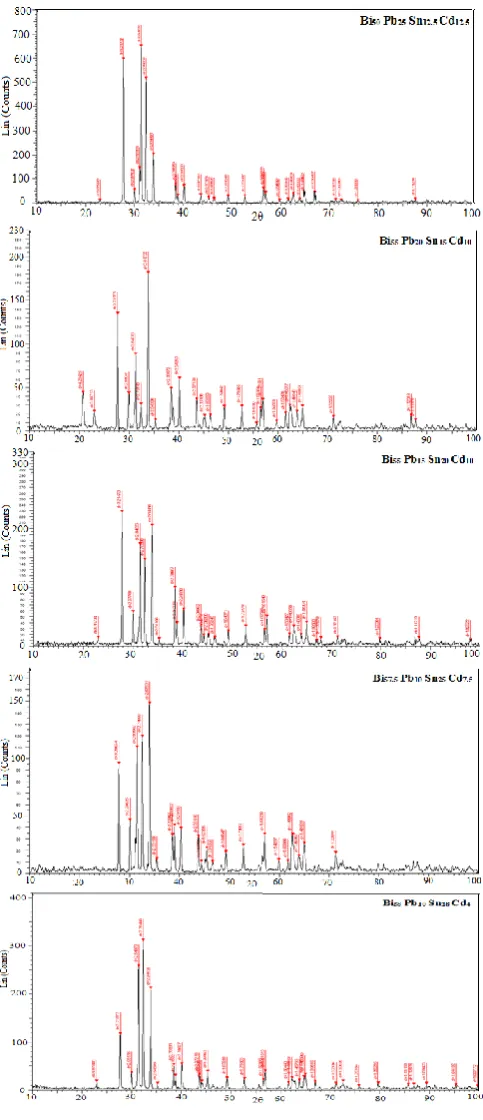
different phases as shown in Figure 1. Data from x-ray devise (2, d, FWHM and intensity) and cards (phase and hkl) are listed in Table 1. From x-ray analysis, the used alloys contained rhombohedral Bi phase, tetragonal Sn phase, face centered cubic Pb phase, hexagonal Cd
phase, Pb7Bi3 and SnBi intermetallic compounds with
different crystallinty (peak intensity), crystal size (peak broadness) and orientation (peak position) which dependent on alloy composition. Lattice microstain of Bi50Pb25Sn12.5Cd12.5, Bi55Pb20Sn15Cd10, Bi55 Pb15Sn20Cd10,
Bi57.5Pb10Sn25Cd7.5 and Bi58Pb10Sn28Cd4 alloys were
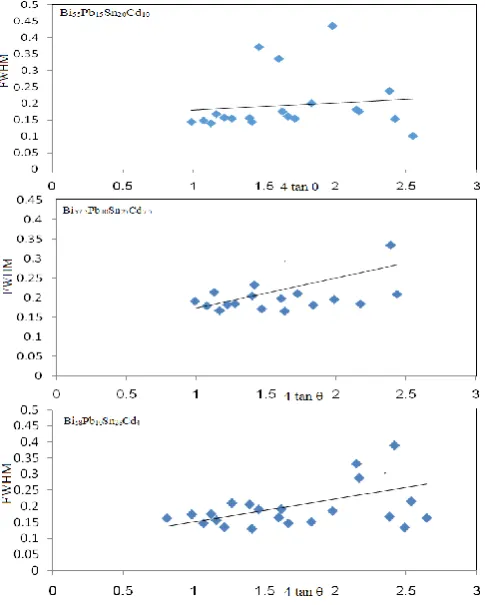
calculated from the relation between full half width maximum (FHWM) and 4tanθ [14] then presented in Figure 2. Lattice microstrain of Bi50Pb25Sn12.5Cd12.5 alloy
decreased by decreasing Pb and Cd as listed in Table 2.
Figure 1: x-ray diffraction patterns of Bi- Pb- Sn- Cd alloys
Table 1: x-ray diffraction analysis of Bi- Pb- Sn- Cd alloys
Bi50 Pb25 Sn12.5 Cd12.5
hkl phase Int. %
d Å 2
003 Bi
1.2 3.87228 22.948
012 Bi
91.6 3.21707
27.707
200 Sn
7.8 2.97802 29.981
002 Pb7Bi3
21.9 2.87688
31.061
200 Sn
100 2.84663 31.4
101 Sn
79.1 2.76005
101 Pb7Bi3
30.6 2.64401 33.876 101 Cd 11.6 2.33879 38.46 101 Cd 4.4 2.31218 38.92 110 Bi 10.7 2.24292 40.173 220 Sn 4.5 2.07124 43.666 006 Bi 2.9 2.00073 45.289 006 Bi 2.2 1.95695 46.36 202 Bi 3.8 1.84945 49.228 220 Pb 4.1 1.73497 52.717 024 Bi 8.7 1.62635 56.541 024 Bi 5.9 1.61581 56.944 107 Bi 1.3 1.54542 59.794 205 Bi 2.1 1.50442 61.597 311 Pb 5.3 1.48121 62.671 400 Sn 1.9 1.45383 63.99 321 Sn 5.3 1.43621 64.87 018 Bi 6.2 1.39427 67.074 009 Bi 1.6 1.32102 71.339 200 Cd 1.2 1.30316 72.47 303 Bi 1.1 1.25262 75.897 217 Bi 1.8 1.11234 87.657
Bi55Pb20Sn15Cd10
hkl phase Int. % d Å 2 Bi 23.6 4.28425 20.716 003 Bi 11.5 3.85713 23.04 012 Bi 74.1 3.21575 27.719 200 Sn 23.3 2.98041 29.957 111 Pb 48 2.8497 31.365 101 Sn 16.3 2.76143 32.395 101 Pb7Bi3
100 2.6472 33.834 100 Cd 6.3 2.54308 35.264 101 Cd 26.1 2.33872 38.461 110 Bi 32.7 2.2425 40.181 220 Sn 19.3 2.07153 43.66 211 Sn 8.9 2.003 45.234 006 Bi 9.3 1.9566 46.369 202 Bi 14.6 1.84942 49.229 301 SnBi 14.8 1.73505 52.714 024 Bi 4.1 1.6478 55.741 024 Bi 13.6 1.62559 56.57 024 Bi 19.1 1.61531 56.963 107 Bi 5.4 1.54579 59.778 205 Bi 10.7 1.5042 61.608 311 Pb 15.5 1.48677 62.41 400 Sn 11.6 1.45643 63.862 122 Bi 14.8 1.43351 65.007 009 Bi 8.2 1.32226 71.262 520 SnBi 9.1 1.12019 86.889 217 Bi 6.2 1.11176 87.714
Bi55Pb15Sn20Cd10
hkl phase Int. % d Å 2 003 Bi 5.7 3.86724 22.979 012 Bi 100 3.21473 27.728 200 Sn 24.7 2.97769 29.985 111 Pb 75.6 2.84666 31.4 101 Sn 64.1 2.7609 32.401 101 Pb7Bi3
89.7 2.64438 33.871 100 Cd 4.7 2.54166 35.284 101 Cd 43 2.33687 38.493 101 Cd 16.4 2.31218 38.92 110 Bi 26.8 2.2418 40.194 220 Sn 14.9 2.06992 43.695 015 Bi 7.5 2.04232 44.317 211 Sn 7.7 2.002 45.258 006 Bi 5.8 1.95245 46.473 202 Bi 10.3 1.84871 49.249 301 SnBi 14.1 1.73478 52.723 024 Bi 11.7 1.62599 56.555 024 Bi 21.5 1.6154 56.96 205 Bi 8.1 1.50427 61.604 311 Pb 13.9 1.4865 62.423 400 Sn 7.9 1.45581 63.892 321 Sn 16.9 1.43304 65.031 018 Bi 3.3 1.39506 67.031 018 Bi 5.2 1.37978 67.874 009 Bi 6 1.32162 71.302 400 Pb 4.7 1.20091 79.797 217 Bi 5.7 1.11219 87.672 134 Bi 3.2 1.02022 98.056
Bi57.5Pb10Sn25Cd7.5
hkl phase Int. % d Å 2 012 Bi 64.3 3.20094 27.85 100 Pb7Bi3
30.7 2.96625 30.103 111 Pb 73.9 2.83562 31.525 101 Sn 80.5 2.74938 32.541 101 Pb7Bi3
100 2.63531 33.991 100 Cd 7.9 2.53159 35.429 101 Cd 22 2.33052 38.602 110 Bi 27.8 2.30697 39.012 110 Bi 25.8 2.2345 40.331 220 Sn 21 2.0651 43.802 015 Bi 6.3 2.03708 44.437 113 Bi 14.3 1.99305 45.473 021 Bi 6 1.94509 46.66 202 Bi 12.1 1.84547 49.341 301 SnBi 16 1.73087 52.851 024 Bi 22.5 1.61239 57.076 205 Bi 7.2 1.54237 59.924 205 Bi 6.6 1.50098 61.754 311 Pb 22.2 1.48062 62.699 400 Sn 9.5 1.45367 63.997 122 Bi 17.1 1.43188 65.09 009 Bi 11.4 1.32044 71.375
Bi58Pb10Sn28Cd4
hkl phase Int. % d Å 2 003 Bi 5.3 3.8768 22.921 012 Bi 37.2 3.21872 27.693 100 Pb7Bi3
101 Pb7Bi3
67.6 2.64636
33.845
100 Cd
3.7 2.54599
35.222
101 Cd
16.5 2.33831
38.468
101 Cd
9 2.31562 38.86
110 Bi
16.9 2.24627
40.11
220 Sn
9.9 2.07218
43.645
220 Sn
5.1 2.05326
44.068
113 Bi
11.9 1.99993
45.308
202 Bi
7.5 1.85018
49.207
301 SnBi
6.8 1.73503
52.715
024 Bi
6.3 1.62695
56.519
024 Bi
12.1 1.61613
56.931
205 Bi
4.2 1.5044
61.598
311 Pb
7.4 1.48853
62.328
400 Sn
5.8 1.45735
63.817
321 Sn
8.1 1.4383
64.764
321 Sn
9.8 1.43349
65.008
018 Bi
4.9 1.39589
66.986
214 Bi
3.8 1.32336
71.194
300 Bi
5.3 1.30026
72.658
201 Cd
2 1.25334 75.845
400 Pb
4 1.20235 79.683
220 Bi
3 1.13188 85.773
217 Bi
3.2 1.12016
86.892
306 Bi
3.6 1.09423
89.492
134 Bi
2.8 1.04192
95.345
315 Bi
1.9 1.00772
99.706
Table 2:lattice microstrain of Bi- Pb- Sn- Cd alloys
Alloys
Bi50Pb25Sn12.5Cd12.5 0.293
Bi55Pb20Sn15Cd10 0.016
Bi55Pb15Sn20Cd10 0.021
Bi57.5Pb10Sn25Cd7.5 0.077
Bi58Pb10Sn28Cd4 0.072
Figure 2: FWHM versus 4 tan for Bi- Pb- Sn- Cd alloys
B. Scanning electron microscope analysis
Scanning electron microscope graphs of
Bi50Pb25Sn12.5Cd12.5, Bi55Pb20Sn15Cd10, Bi55 Pb15Sn20Cd10,
Bi57.5Pb10Sn25Cd7.5 and Bi58Pb10Sn28Cd4 alloys are shown
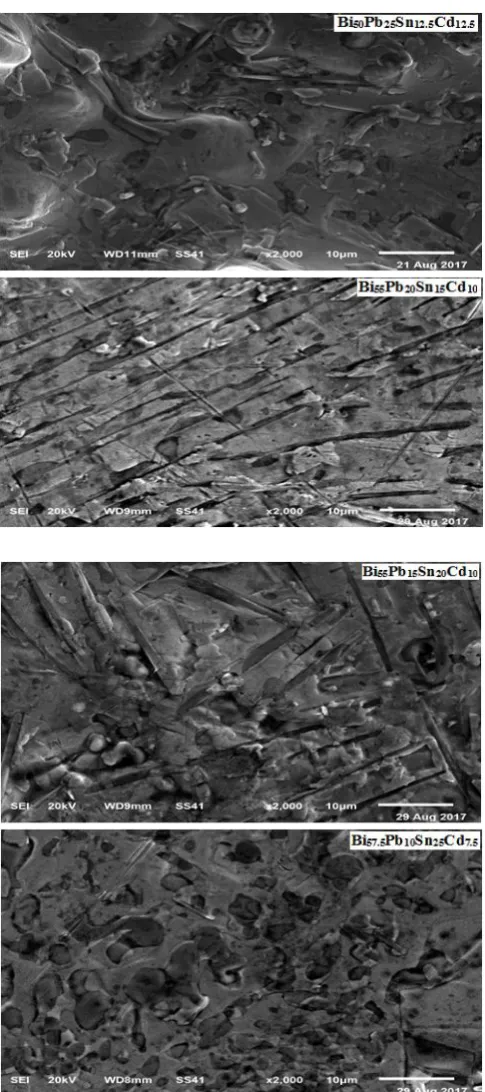
in Figure 3. Bi50Pb25Sn12.5Cd12.5 alloy has heterogeneous
structure, bismuth as a lamellar structure with different shape and orientation (gray color), tin as a separate or interference spherical shape (black color) and small spherical grains (lead or cadmium or intermetallic compound) around matrix grains or dispersed in it (white color). Bi55Pb20Sn15Cd10 alloy has a lamellar structure
(gray color), rods and spherical shapes (black color) and a little small rods (white color) disturbed in matrix. Bi55
Pb15Sn20Cd10 alloy has mixed from spherical and
cylindrical shape (gray color), rods shape with different length and orientation (black color) and a little rods
shape (white color) disturbed in matrix.
Bi57.5Pb10Sn25Cd7.5 alloy has heterogeneous structure
from gray color and black color which have a little cylindrical rods (white color). Bi58Pb10Sn28Cd4 alloy has
that, modified structure (by changed the ratio of elements) of Bi- Pb- Sn- Cd caused a change in microstructure like shape, size and orientation of formed phases.
Figure 3: SEM of Bi- Pb- Sn- Cd alloys
C. Density measurements
A material's density is defined as its mass per unit volume. It is, essentially, a measurement of how tightly matter is packed together. The change in density can also be useful in analyzing some situations, such as whenever a chemical conversion is taking place and energy is being released. Experimental and theoretical calculation of density for Bi50Pb25Sn12.5Cd12.5,
Bi55Pb20Sn15Cd10, Bi55 Pb15Sn20Cd10, Bi57.5Pb10Sn25Cd7.5
and Bi58Pb10Sn28Cd4 alloys are listed in Table 3. The
density value of Bi- Pb- Sn- Cd alloy decreased with lead and cadmium content decreased except at Bi58Pb10Sn28Cd4 alloy.
Table 3: experimental and theoretical calculation of density for used alloys
Alloys ρ gm/cm3
(Theatrical)
ρ gm/cm3 (Experimental) Bi50Pb25Sn12.5Cd12.5 9.76 10.22
Bi55Pb20Sn15Cd10 9.65 10.03
Bi55Pb15Sn20Cd10 9.45 9.63
Bi57.5Pb10Sn25Cd7.5 9.27 9.15
Bi58Pb10Sn28Cd4 9.24 9.39
D. Thermal properties
It is very important to study the response of a material to heat. The melting point is dissimilar for different materials and for each material it slightly varies when the superincumbent pressure varies. The alloys have a range of melting and not a fixed melting temperature but the eutectic alloys have fixed melting point. The melting temperature of a solid material depends on the interatomic and intermolecular bonds. Materials having stronger bonds exhibit higher melting points. The
differential scanning calorimeter, DSC, curve
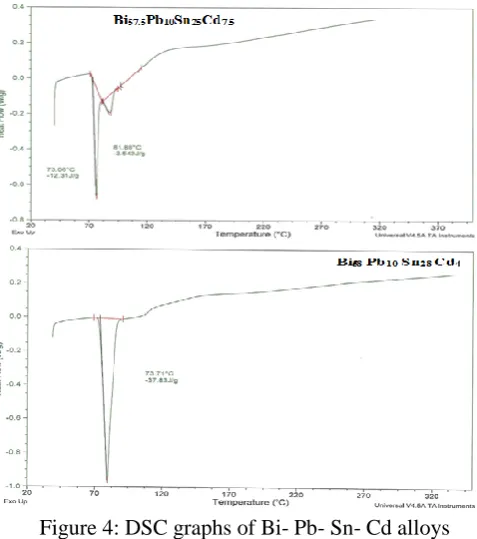
characterizing thermal processes qualitatively. Figure 4
shows differential scanning micrographs of
Bi50Pb25Sn12.5Cd12.5, Bi55Pb20Sn15Cd10, Bi55 Pb15Sn20Cd10,
Bi57.5Pb10Sn25Cd7.5 and Bi58Pb10Sn28Cd4 alloys. DSC
graphs show the thermal behavior, (Endothermic peaks shape, position and intensity), of Bi50Pb25Sn12.5Cd12.5
alloy changed. Entropy, enthalpy and specific heat capacity of Bi- Pb- Sn- Cd alloys decreased with the amount of Pb and Cd decreased as shown in Table 4. That is meant the atoms disorder and matrix defects in a system decreased and it's agreed with the lattice microstrain results.
Figure 4: DSC graphs of Bi- Pb- Sn- Cd alloys
Table 4: thermal parameters of Bi- Pb- Sn- Cd alloys
Alloys Melting
temperature oC
Cp J/g. C
Hc J/g S J/C
Bi50Pb25Sn12.5Cd12.5 75.75 2.22 42.1 0.55 Bi55Pb20Sn15Cd10 74.01 0.61 14.9 0.18
Bi55Pb15Sn20Cd10 73.02 0.295 15.4 0.11
Bi57.5Pb10Sn25Cd7.5 73.06 0.279 12.3 0.14 Bi58Pb10Sn28Cd4 73.71 1.182 37.8 0.34
E. Electrochemical corrosion behavior
Figure 5 shows electrochemical polarization curves of Bi50Pb25Sn12.5Cd12.5, Bi55Pb20Sn15Cd10, Bi55 Pb15Sn20Cd10,
Bi57.5Pb10Sn25Cd7.5 and Bi58Pb10Sn28Cd4 alloys. The
corrosion potential of Bi- Pb- Sn- Cd alloys showed a negative potential besides the cathodic and the anodic polarization curves exhibited similar corrosion trends. The corrosion current (ICorr), corrosion potential (ECorr)
and corrosion rate (Corrrate) of Bi- Pb- Sn- Cd alloys in
0.25 M HCl are obtainable in Table 5. Corrosion rate and corrosion current values of Bi- Pb- Sn- Cdalloys varied (decreased) by increasing Bi and Sn content and decreasing Pb and Cd content. That is because changing
alloy composition caused a heterogeneous
Figure 5: electrochemical polarization curves of Bi- Pb- Sn- Cd alloys
Table 5: corrosion parameters of Bi- Pb- Sn- Cd alloys Alloys Icorr µA Ecorr mv Corrrate mpy
Bi50 Pb25 Sn12.5Cd12.5 325 -778 340.1
Bi55 Pb20 Sn15 Cd10 141 -783 148
Bi55 Pb15 Sn20 Cd10 259 -766 298.9
Bi57.5 Pb10 Sn25 Cd7.5 162 -780 169.2
Bi58 Pb10 Sn28 Cd4 199 -788 208.5
IV.
Conclusions
Matrix microstructure, formed phases, of Bi- Pb-
Sn- Cd alloys dependent on their composition. A
little decreased occurred in Bi- Pb- Sn- Cd alloys
densities with decreased Pb and Cd contents.
Corrosion rate of Bi- Pb- Sn- Cd alloys decreased
by decreasing Pb and Cd contents. Entropy,
enthalpy, specific heat capacity and lattice
microstrain of Bi- Pb- Sn- Cd alloys decreased with
the amount of Pb and Cd decreased. Our concluded
that, it can produce new friendly environmental Bi-
Pb- Sn- Cd shielding blocks alloy.
V.
REFERENCES
[1]. M. T. McCormack, Y. Degani, H.S. Chen, W.R. Gesick, J. JOM, 48 (1996) 54
[2]. I. Manna and S.K. Pabi, Phys.Status Solidi A 123 (1991) 393
[3]. J. Perkins and G.R. Edwards, J. Mater. Sci. 10 (1975) 136
[4]. C.R. Blackwell and K.D.Andmunson, Med.
Dosimetry 15 (1990)127
[5]. Shepelevich, O.V. Gusakova and L.P. Shcherba chenko, Inorganic Mater. 1:49: 7 (2013) 663 [6]. M.H. Braga, G. Bizdal, A. Krouba, G. Ferreira, D.
Soares, L.F. Malheiros, (2007) 468
[7]. A.B. El-Bediwi, F. Dawood, M. Kamal, MSAIJ, 11: 5 (2014) 179
[8]. A.B. El-Bediwi, F. Dawood, M. Kamal, IJSEA. 4:2 (2015) 60
[9]. A.B. El-Bediwi, F. Dawood, M. Kamal, IJCR. 7: 5
(2015) 16433-16439
[10]. A.B. El-Bediwi, A. El-Shafei, M. Kamal, IJCR. 7: 6 (2015) 17305-17311
[11]. A.B. El-Bediwi, F. Dawood, M. Kamal, IJ CR. 7:
5 (2015) 16433-16439
[12]. A.B. El-Bediwi, F. Dawood, M. Kamal, J Advance
Phys. 7:3 (2015)
[13]. A.B. El-Bediwi, S. Bader, F. Khalifa, Global Journal of Physics, 4: 3 (2016) 480