Original Research Article
Knowledge and awareness of cervical cancer, its screening and HPV
vaccination among out patients in a tertiary care institute in India
Devi Balasubramaniam*, Kavitha Yogini Duraisamy, Sangeetha Karunanithi
INTRODUCTION
Cervical cancer is a leading cause of cancer death in Indian women. A majority of patients present in the locally advanced stage. India also has the highest (age standardized) incidence rate as 22 per 100,000 women per year of cervical cancer in South Asia (estimations for 2012), compared to 19.2 in Bangladesh, 13 in Sri Lanka, and 2.8 in Iran.1 More women in India die from cervical cancer than in any other country. New cases of cervical cancer detected in India: 96,922 every year. Deaths due to cervical cancer in India are 60,078/year.1 Nearly all cases
of cervical cancer can be attributable to Human Papilloma virus (HPV) infection. Human Papilloma virus (HPV), a sexually transmitted infection, is responsible for 99.7% of cases of cervical cancer and 530,000 new cases of cervical cancer globally every year. Based on Indian studies about 82.7% of invasive cervical cancers showed the presence of HPVs 16 or 18.1 Since, the approval of HPV vaccine by the Indian government, only limited data is available about the public awareness regarding HPV infection and vaccination.
The Pap test is a simple and cost effective technique for early diagnosis of cervical cancer. Cervical cancer can be
ABSTRACT
Background: Cervical cancer, despite being a preventable disease, its screening and vaccination still remains poor in
our country. The aim of our study was to assess the knowledge and awareness regarding cervical cancer, its risk factors, screening and HPV vaccination.
Methods: This cross sectional study was carried out among outpatients attending gynaecology OPD in GEM hospital
and Research Centre, a tertiary care centre in Tamil Nadu during the period of April 2019 to June 2019. A total of 500 women, aged 16 years and above were analyzed using a structured questionnaire with multiple choices regarding socio demographic profile, knowledge and awareness about the cervical cancer, its risk factors, screening method and HPV vaccination.
Results: Only 16.6% knew that cervical cancer is the most common cancer in Indian women. Majority (74.6%) of them were married, of which 36.2% were aware of Pap smear. Of those who were aware, only one third (12.6%) had their Pap smear done. The awareness of HPV vaccination was only 25% and 3.4% of them were vaccinated. 70.2% of the study participants were willing to be vaccinated after knowing about the vaccination.
Conclusions: This study serves to highlight that, the majority of women lack knowledge and awareness concerning
cervical cancer and its preventive aspects. This is a major hindrance among Indian women to undergo early screening and timely prevention. Hence creating public awareness of cervical cancer and its prevention is still a priority.
Keywords: Awareness, Human Papilloma virus vaccine, Cervical cancer, Pap smear
Department of Endogynaecology, GEM Hospital and Research Centre, Coimbatore, Tamil Nadu, India
Received: 03 August 2019
Revised: 08 September 2019
Accepted: 09 September 2019
*Correspondence:
Dr. Devi Balasubramaniam,
E-mail: [email protected]
Copyright: © the author(s), publisher and licensee Medip Academy. This is an open-access article distributed under
the terms of the Creative Commons Attribution Non-Commercial License, which permits unrestricted non-commercial use, distribution, and reproduction in any medium, provided the original work is properly cited.
prevented by vaccinating all young females against HPV and by screening and treating precancerous lesions in women. In addition if cervical cancer is detected early and treated in earlier stages it can be cured. Awareness regarding cervical cancer and its prevention is quite low amongst Indian women.
The purpose of the present study was to assess the knowledge and awareness regarding cervical cancer, its risk factors, screening and HPV vaccination.
METHODS
This is a descriptive cross sectional study conducted among women attending gynaecology OPD in GEM hospital and Research centre, a tertiary care centre in Tamil Nadu during the period of April 2019 to June 2019. The number of women attending gynaecology OPD per day was 30 to 40. The respondents were selected systematically each day to get final sample size of 500. Patients with history of cervical cancer were excluded from study. Written and informed consent was obtained from the participants after they were explained about the study. This study was approved by the Institutional Ethical Committee.
The questionnaire having 16 questions were designed based on the objectives. Most of them were closed ended questions with yes or no type (or) appropriate multiple choices were given for a quick response. First part of the questionnaire was to collect information on basics of socio demographic profile, knowledge of risk factors for cervical cancer. Remaining questions were about awareness about cervical cancer screening methods, Pap smear, HPV vaccine and their vaccination status.
The data was entered in Microsoft office excel version 2007 and statistical analysis was done using SPSS. Descriptive statistics were expressed as mean and percentages. Comparative variables were analysed using chi-square test and p value of less than 0.05 was considered significant. The relevant tables and graphs were charted appropriately.
RESULTS
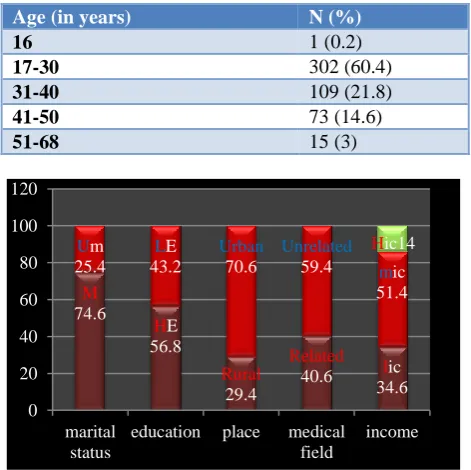
Total number of study participants was 500. Table 1 describes the age wise distribution, sociodemographic profile were shown in Figure 1. The mean age of the respondents was 30.91±9.48 years and age ranged from 16 years to 68 years. About 74.6% were married and about 30.6% were parous women. The education level of respondents ranged from primary to tertiary level. 56.8% were graduates and completed their higher education and 70% were from urban. 40% of them either themselves or their family members were related to medical or para medical field. 83.4% were Hindus. 35%, 51%, 14% were from low, middle and high income group respectively. Only 16% answered correctly for “what is the most common cancer in Indian females”. Almost half of the
respondents said that they “don’t know” (Figure 2). Almost 50% of the respondents have not recognized any of the major risk factors of cervical cancer. The risk posed by HPV infection was unfamiliar to majority (80%) of the respondents (Figure 3).
Table 1: Age wise distribution of study participants (n=500).
Age (in years) N (%)
16 1 (0.2)
17-30 302 (60.4)
31-40 109 (21.8)
41-50 73 (14.6)
51-68 15 (3)
Figure 1: Socio-demographic profile of the study participants.
M: Married; Um: Unmarried; HE: High economic; LE: Low economic; Lic: Low income; Mic: Middle income; Hic: High income.
Figure 2: Answer to the question “What is the most common cancer in Indian females?” by our study
participants.
76% of the study participants said detection of cervical cancer at an early stage is possible by easy screening methods. 43.8% were aware of Pap smear (Figure 4). Total number of unmarried women was 25% (127/500) in that 66% were aware of Pap smear. Awareness of Pap smear in married women was 36.19%, out of these women only 12.6% had done their Pap test (Figure 4).
M 74.6
HE 56.8
Rural 29.4
Related 40.6 lic
34.6 Um
25.4
LE 43.2
Urban 70.6
Unrelated 59.4 mic
51.4 Hic14
0 20 40 60 80 100 120
marital status
education place medical field
income
16.60%
34.80%
6.20% 0.20%
42%
0.00% 20.00% 40.00% 60.00% 80.00% 100.00%
Age wise distribution of awareness of Pap smear is depicted in (Figure 5). In 17-30 years many said that the reason for not doing Pap smear was that it was not recommended by their health care provider and they perceived themselves as not at risk of cervical cancer. In 51-70 years many said that they were healthy (Table 2).
Figure 3: Awareness of risk factors of cervical cancer.
Figure 4: Awareness of Pap smear screening among study participants.
Figure 5: Age wise distribution of awareness of Pap smear among the study population.
74% of the study participants had never heard about HPV vaccine. Only 3.4% were vaccinated in the study population. Among those who were aware of vaccination (128/500) 87% were not vaccinated. Table 3 describes the source of information about HPV vaccine. Out of 500 participants 17 were vaccinated and 351 were willing to get vaccinated (70%) if it was recommended by their health care provider.
Table 2: Reason for Pap smear refusal in married women (n=373) who were aware (n=135) of Pap
smear.
Reason N
I am healthy 54
Not recommended by doctors 22
I am afraid 7
Monogamous relationship 2
No family history 3
No. of women who refused Pap smear 88/135
Table 3: Source of information about HPV vaccine among study participants.
Information N
Gynaecologist 48
Nurses 27
Media 26
Paediatrician 14
Friends and neighbours 13
Total no. of women aware about HPV
vaccine 128
Majority (90%) of the study participants said, annual gynaecological examination is necessary. 74% replied that their healthcare provider was not discussing about cervical cancer and its preventive aspects.
The awareness of cervical cancer, Pap smear and HPV vaccine in the medically related group is statistically significant than in the general population group (P value<0.0001) (Table 4). The test of significance (chi-square) showed higher awareness with increasing educational standards (Table 5). With regard to awareness there is no statistical significance in the different socio economic groups and place of living.
Table 4: Comparison of awareness of cervical cancer, Pap smear and HPV vaccine in the medically related group versus non-medical group.
Cervical cancer Pap smear HPV
Aware Not aware Aware Not aware Aware Not aware
Medical field, n=203 62 (30.54%) 141 155 (76.4%) 48 92 (45.32%) 111
Non-medical field, n=297 21 (7.07%) 276 64 (21.5%) 233 36 (12.2%) 261
Total 83 417 219 281 128 372
p<0.0001 p<0.0001 p<0.0001
χ2=47.9 χ2=138 χ2=69.7
21.80% 14.80% 12.20%
0.00% 20.00% 40.00% 60.00% 80.00% 100.00%
HPV Early Marriage Not familial
Percentage
76%
43.80%
36.19%
66.14%
0% 10% 20% 30% 40% 50% 60% 70% 80%
Screening possible Heard of PAP smear Awareness of PAP among married
women
Awareness of PAP among unmarried
women
0.00% 20.00% 40.00% 60.00% 80.00% 100.00%
Table 5: Relationship between awareness of cervical cancer, Pap smear and HPV vaccine and education status in our study group.
Cervical cancer Pap smear HPV
Aware Not aware Aware Not aware Aware Not aware
>Higher secondary, n=284 71 213 108 176 101 183
≤Higher secondary, n=216 12 204 43 173 27 189
Total 83 417 151 349 128 372
p<0.0001 p<0.0001 p<0.0001
χ2
=32.116 χ2=19.11 χ2=33.064
DISCUSSION
Cervical cancer ranks as the most frequent cancer among women in India. Despite being a preventable disease, its early detection and screening makes it a major area of concern in countries like India because of poor education and awareness. This is reflected in our study. Most of the women were in the age group between 17-30 years and only 16% correctly answered that cervical cancer is the most common cancer among Indian women. Most of them were not aware of cervical cancer similar to the study by Ramavath et al, where 72% of them did not know about cervical cancer.2 This is concurred with findings of other studies done in Kolkata by Saha et al.3 On the contrary, a study done by Singh et al 85% of the females surveyed were aware of the cervical cancer.4 In our study, though more than half of them were graduates or did higher education and 40% of them were related to para medical field, the knowledge about the risk factors and mode of transmission about cervical cancer was poor. About half of the respondents have not recognized about the risk factors for cervical cancer like early age of marital life, multiple sexual partners and having multiple birth. Majority of them (80%) were not familiar with HPV infection similar to Ramavath study, where 77% were not aware that HPV virus causes cervical cancer.2 In a similar survey in Karnataka, almost half of the sample population were aware about mode of transmission of cervical cancer.5
Though nearly two third of (76%) the study participants told detection of cancer cervix at an early stage is possible by early screening methods, only 43% of them could name or have heard about Pap smear and only 12.6% had done their Pap smear. In Montgomery screening, only 7% of women were aware of Pap smear.5 In a study in Bangalore by Prakash Jothi the awareness about Pap smear was only 11.6%.6 There are several factors which may affect the women’s ability to participate in the screening programme. In our study total numbers of unmarried women were 127, in that 66% were aware about Pap smear. In countries like India unmarried women were unlikely to be screened and socially unacceptable because sexual relationships outside marriage are not culturally accepted. In this study women not getting their Pap smear test done in spite of awareness was mainly because they did not give importance to preventive health check up in the absence
of symptoms and they did not feel vulnerable to disease which is similar to Singh in 2012 and Kerala study.7,8 Despite saying that annual gynaecological examination is necessary, the existence of Pap smear and their understanding of the purpose of the test is poor in our study population. The other frequently reported obstacle to screening in our study was that it is not recommended by health care personnel and anxiety about the test and results.
Government of India has incorporated cost effective, alternate screening strategies such as VIA (visual inspection with acetic acid), VILI (visual inspection with Lugols iodine) in community and camp based screening programmes. Screening for cervical cancer can be done by Pap smear test, visual inspection or HPV test. The success and benefit of public health program to control and prevent cervical cancer depends upon the awareness and knowledge aspect of the disease. Almost two third of our respondents agreed that the cervical cancer will be easily identified by the screening methods. Married women are most likely to be screened is consistent with other studies in India.7,9 In our study most of them (75%) were married, in that only 1/3rd were aware of Pap smear and in that only12.6% had their Pap smear test out of 373 married women which is similar to study done in Kerala where 6.9% had done their Pap out of 809 women.8
Nurses constitute the group of health workers who can provide accurate information about the cervical cancer and they can educate and encourage the public regarding screening programme and HPV vaccine. Lack of knowledge about cancer screening among nurses can pose substantial barriers to cervical cancer control program in India and other developing countries. Among 38 married staff nurses, only 34.21% have done their Pap smear in our study. Even though awareness of Pap smear was high, their understanding of the purpose of the screening test was poor. The reasons for not performing Pap smear test were feeling embarrassed, forgetfulness and anxiety about the results which is similar with the results of Shanthilal et al study.11 In our study 41% of our study participants or their family member’s job was related to medical and paramedical field. The awareness of cervical cancer, Pap smear and HPV vaccine in the medically related group is statistically significant than in the general population group (p value<0.0001). High level of education and occupational status were positively associated with the awareness about cervical cancer, Pap smear and HPV vaccine in our study which was similar to a study in Kanchipuram by Mani and Balan Karnataka.12,13 This might be because, education influences the screening through its effects on income and its association with individual knowledge on cancer screening. The unmarried women were more aware of cervical cancer, Pap smear, HPV vaccine because of increasing educational standards. With regard to its awareness, there is no statistical significance in the different socio economic groups and place of living.
This study was conducted with a limited sample group in order to determine the level of knowledge about cervical cancer and its prevention. Another limitation is question type; most of them were closed ended questions with yes or no types for easy and quick answer. The disadvantage is that the respondents with no opinion also answer anyway. Thus findings of the present study could not be generalized to larger Indian population. However our results may provide important baseline information about the awareness about the cervical cancer, its risk factors and its prevention in general public.
CONCLUSION
These findings highlighted the poor dissemination of knowledge and awareness about cervical cancer, its risk factors and preventive aspects among the study population. The lack of information and communication by health care providers may have contributed to women's nonattendance to Pap smear screening and HPV vaccination. Education, information, communication and barrier specific counselling are required to overcome such resistance. Education program in prevention of cervical cancer should also be replicated for all female groups including unmarried working women or female adolescents. Health promotion campaigns and mass media play an important role in this context and its function should be optimized.
ACKNOWLEDGEMENTS
We thank profusely all study participants who took part in this survey.
Funding: No funding sources Conflict of interest: None declared
Ethical approval: The study was approved by the Institutional Ethics Committee
REFERENCES
1. Cervical Cancer. Available at: https://www.nhp.gov.in/disease/ reproductive- system/female-gynaecological-diseases-/cervical-cancer. Accessed on 25 July 2019.
2. Ramavath KK, Olyai R. Knowledge and Awareness of HPV Infection and Vaccination among Urban Adolescents in India: A Cross-Sectional Study. J Obstet Gynaecol India. 2013;63(6):399–404. 3. Saha A, Chaudhury AN, Bhowmik P, Chatterjee R.
Awareness of cervical cancer among female students of premier colleges in Kolkata, India. Asian Pac J Cancer Prev. 2010;11(4):1085-90.
4. Singh J, Roy B, Yadav A, Siddiqui S, Setia A, Ramesh R, et al. Cervical cancer awareness and HPV vaccine acceptability among females in Delhi: A cross-sectional study. Indian J Cancer. 2018;55:233-7.
5. Montgomery MP, Dune T, Shetty PK, Shetty AK. Knowledge and acceptability of human papillomavirus vaccination and cervical cancer screening among women in Karnataka, India. J Cancer Educ. 2015;30(1):130-7.
6. Prakash M, Jyothi GS, Murthy NS. Awareness of Pap test among women attending a tertiary center in Bangalore, India. Proc Obstet Gynecol. 2015;5(1):1. 7. Singh E, Seth S, Rani V, Srivastava DK. Awareness of cervical cancer screening among nursing staff in a tertiary institution of rural India. J Gynecol Oncol. 2012;23(3):141–6.
8. Aswathy S, Quereshi MA, Kurian B, Leelamoni K. Cervical cancer screening: Current knowledge & practice among women in a rural population of Kerala, India. Indian J Med Res. 2012;136(2):205-10.
9. Sankaranarayanan R, Rajkumar R, Arrossi S, Theresa R, Esmy PO, Mahe C, et al. Determinants of participation of women in a cervical cancer visual screening trial in rural south India. Cancer Detect Prev. 2003;27:457–65.
10. Madhivanan P, Krupp K, Yashodha MN, Marlow L, Klausner JD, Reingold AL. Attitudes toward HPV vaccination among parents of adolescent girls in Mysore, India. Vaccine. 2009;27:5203-8.
12. Mani G, Annadurai K, Danasekaran R. Awareness regarding cervical cancer and preventive practices among rural married women of Kancheepuram district, Tamil Nadu. J Comprehensive Health, 2014;7(1):42-8.
13. Thovarayi SB, Noronha JA, Nayak S. Knowledge of cervical cancer screening among rural Indian
women: a cross sectional study. J Nur Health Sci. 2014;3(3):51-5.
Cite this article as: Balasubramaniam D, Duraisamy