Original Research Article
A cross sectional study on health status and prevalence of risk factors of
non-communicable diseases among auto rickshaw drivers of
Hyderabad, Telangana
Asma, Vimala Thomas*, C. Jyothsna, Sri Manju,
C. Sowmya, C. Govardhana Devi,
D. Varun Kumar, D. Ravali, D. Yeshaswini, D. Ram Mohan
INTRODUCTION
Auto rickshaws are relatively cheaper and easily available mode of public transport in middle income countries. They form 10-20% of daily motorized urban transport and ensure connectivity and easy access throughout congested Indian cities.1
The environment in which drivers spend their majority of time is polluted, noisy and dangerous. Auto drivers are exposed to harmful gases, whole body vibration, harmful lifestyle and irregular meals.1
Further harmful lifestyle is practiced like irregularity of meals, no proper restrooms, bad posture while driving and stressful occupational conditions are found to be ABSTRACT
Background: Auto rickshaws form 10-20% of daily motorized urban transport and ensure connectivity and easy access throughout congested Indian cities. Harmful lifestyles practiced by auto rickshaw drivers like irregularity of meals, bad posture while driving, sedentary lifestyle predisposes them to many gastrointestinal, respiratory, musculoskeletal, cardiovascular diseases. This study was taken to assess the risk factors of non-communicable diseases among of auto rickshaw drivers. Objectives of the study were to estimate the proportion of various non-communicable diseases among study population and to assess various risk factors for non- non-communicable diseases among study population.
Methods: A cross sectional study was carried out among 100 auto rickshaw drivers, aged above 20 years commuting at bus terminus and railway station in Hyderabad, Telangana using a predesigned questionnaire from May to July 2018.
Results: The mean age of the study population was found to be 41.58±10.9 years. Around 14% of study subjects had history of diabetes mellitus and 15% hypertension. About 69% were overweight or obese, 41% had refractive errors and majority had musculoskeletal problems. The mean duration of physical activity was found to be 35±7 minutes/day.
Conclusions: The prevalence of cardio vascular disease risk factors i.e. tobacco smoking, sedentary lifestyle, obesity was found to be quite high among auto rickshaw drivers. Early precautionary measures, regular medical check-up and prompt interventions are necessary for managing risk factors.
Keywords: Auto rickshaw drivers, Non-communicable diseases
Department ofCommunity Medicine, Gandhi Medical College, Hyderabad, India
Received: 15 January 2019
Accepted: 13 February 2019
*Correspondence:
Dr. Vimala Thomas,
E-mail: [email protected]
Copyright: © the author(s), publisher and licensee Medip Academy. This is an open-access article distributed under the terms of the Creative Commons Attribution Non-Commercial License, which permits unrestricted non-commercial use, distribution, and reproduction in any medium, provided the original work is properly cited.
associated with many gastrointestinal, respiratory, musculoskeletal, cardiovascular and increase probability of disability or illness like hearing impairment and lowering efficacy of ocular system.2
Sitting in driving position exerts considerable force on spine and can cause number of problems with skeletal system, in particular, back pain, headache, stress and general stiffness. The incidence of smoking, drinking is also higher among auto rickshaw drivers which poses risk to non-communicable diseases.3
Lower literacy levels and lack of awareness among rickshaw drivers about the various health risks has led to lower periodic health examinations. Despite their long working hours and challenging occupational conditions, research on such occupational groups is sparse. This study aims to assess the prevalence of risk factors for non-communicable diseases among auto rickshaw drivers.
Objectives of the study were to estimate the proportion of various non-communicable diseases among study population and to assess various risk factors for non- communicable diseases among study population.
METHODS
Study design: Cross sectional study.
Study area: Bus terminus (Mahatma Gandhi bus station) and railway station (Secunderabad railway station), Hyderabad, Telangana.
Study population: Auto rickshaw drivers of Hyderabad, Telangana.
Study tools: Predesigned, pre tested questionnaire, weighing machine, measuring tape, stadiometer, sphygmomanometer, stethoscope.
Sample size: 100 (one hundred).
Inclusion criteria:Auto rickshaw drivers above 20 years of age, with more than 6 months of experience as auto driver.
Exclusion criteria: Drivers not willing to take part in the study.
Sampling technique: Simple random sampling.
Study duration: 2 months (May 2018 to July 2018).
Data collection and analysis: Data was collected and analyzed using MS Excel and open Epi. Descriptive statistics were calculated.
Ethical considerations: Ethical clearance certificate was obtained from institutional ethics committee prior to the
start of the study. Informed consent was taken from the study subjects.
RESULTS
A total of 100 auto rickshaw drivers were enrolled into the study. The study findings are as follows.
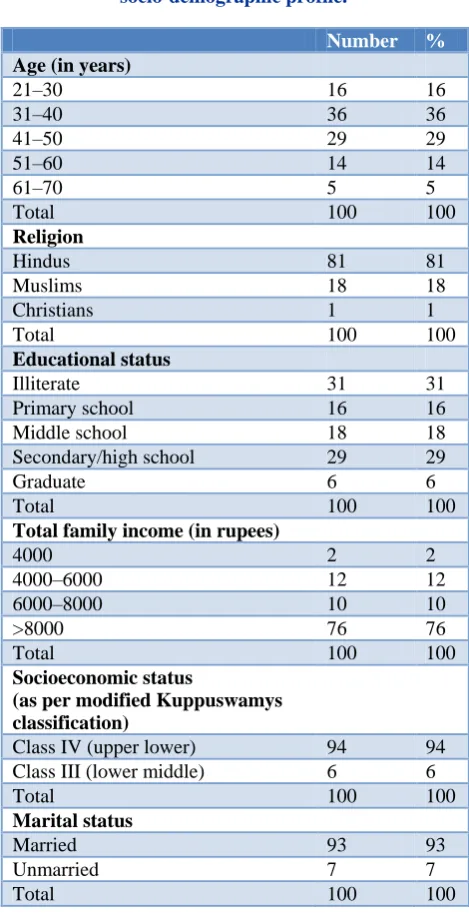
Table 1: Distribution of study population according to socio-demographic profile.
Number %
Age (in years)
21–30 16 16
31–40 36 36
41–50 29 29
51–60 14 14
61–70 5 5
Total 100 100
Religion
Hindus 81 81
Muslims 18 18
Christians 1 1
Total 100 100
Educational status
Illiterate 31 31
Primary school 16 16
Middle school 18 18
Secondary/high school 29 29
Graduate 6 6
Total 100 100
Total family income (in rupees)
4000 2 2
4000–6000 12 12
6000–8000 10 10
>8000 76 76
Total 100 100
Socioeconomic status
(as per modified Kuppuswamys classification)
Class IV (upper lower) 94 94 Class III (lower middle) 6 6
Total 100 100
Marital status
Married 93 93
Unmarried 7 7
Total 100 100
study subjects belonged to upper lower socio economic status (class IV) and 6% belonged to lower middle (class III) socio economic status as per modified Kuppuswamy’s classification. Ninety three percent of study subjects were married and 7% were unmarried.
In around 85% of study subjects driving auto was full time occupation while 15% of study participants did it as their part time occupation.
In this study it was observed that 44% of auto rickshaw drivers work for 8–10 hours a day, 39% work for 10-12 hours a day; 11% work for <8 hours a day and 6% work for >12 hours a day.
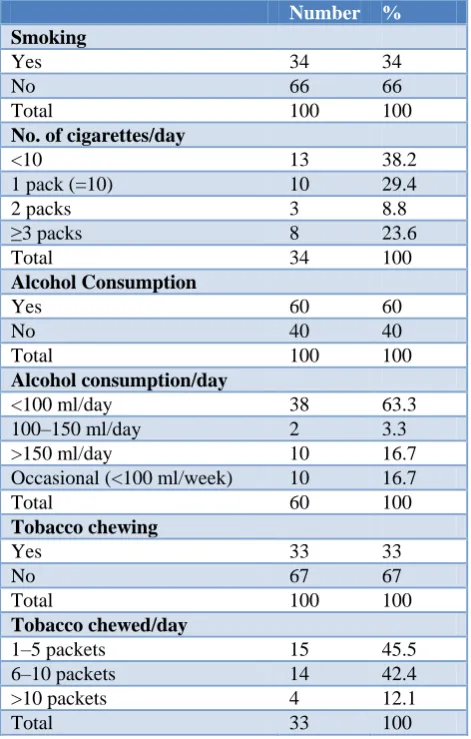
In the present study it was found that 34% of study subjects had habit of smoking cigarettes, 60% of them had habit of consuming alcohol and 33% of them had the habit of chewing tobacco/gutkha. Among those who were smokers, majority (38.2%) of them smoked less than 10 cigarettes per day; among those who consumed alcohol 63.3% of them consumed <100 ml/day. Around 45.5% of study subjects chewed around 1-5 gutkha packets per day and 42.4% of them consumed 6–10 packets/day.
Table 2: Distribution of study population according to history of addictions.
Number %
Smoking
Yes 34 34
No 66 66
Total 100 100
No. of cigarettes/day
<10 13 38.2
1 pack (=10) 10 29.4
2 packs 3 8.8
≥3 packs 8 23.6
Total 34 100
Alcohol Consumption
Yes 60 60
No 40 40
Total 100 100
Alcohol consumption/day
<100 ml/day 38 63.3
100–150 ml/day 2 3.3
>150 ml/day 10 16.7
Occasional (<100 ml/week) 10 16.7
Total 60 100
Tobacco chewing
Yes 33 33
No 67 67
Total 100 100
Tobacco chewed/day
1–5 packets 15 45.5
6–10 packets 14 42.4
>10 packets 4 12.1
Total 33 100
Figure 1: Distribution of study population according to work hours per day.
In this study it was found that 76% of study subjects had homemade food and 24% of them consumed food outside every day. Around 2% of study subjects skipped their lunch meals every day.
Figure 2: Distribution of study population according to the food consumed.
In this study, based upon their history, it was found that, 14% of study subjects diabetes mellitus, and 15% had hypertension. Around 34% of study subjects had frequent history of headaches (>3 times/week). Around 13% of the study subjects had history of cough, 4% had history of difficulty in breathing. Musculoskeletal problems were very common (65%) among the study population. Among the musculoskeletal problems, lower backache (51%) was most common followed by lower limb pains (32%). Around 16% of study subjects complained of indigestion and 4% complained of gastric burn.
Forty two percent of study population complained of pain in lower limbs due to vibrations arising from vehicular engine. Around 22% of study subjects complained of burning sensation/redness in eyes by evening every day and 12% complained of watering of eyes. Forty one percent of study population had refractive errors and only 18% of study subjects used glasses. Around 12% of study population had undergone major surgery in last 1 year.
0% 5% 10% 15% 20% 25% 30% 35% 40% 45% 50%
< 8 Hours 8 - 10 Hours 10 - 12 Hours > 12 Hours < 8 Hours 8 - 10 Hours 10 - 12 Hours > 12 Hours
76% 24%
2% Home made
Table 3: Distribution of study population according to health status/morbidities (multiple morbidities were
found in few study subjects).
Number %
History of chronic illness
Yes 27 27
No 73 73
Total 100 100
Chronic illnesses
Diabetes mellitus 14 14
Hypertension 15 15
Hypotension 1 1
Facial paralysis 1 1
Seizures 1 1
Polio 1 1
Frequent headaches (>3
times/week) 34 34 Respiratory problems
Dysopnea/ Difficulty in
breathing 4 4
Bronchial asthma 2 2
Cough 13 13
Chest pain 1 1
Musculoskeletal problems
Neck pain 22 22
Lower Backache 51 51
Lower limb pain 32 32
Upper limb pain 1 1
Gastro intestinal problems
Indigestion 16 16
Stomach pain 1 1
Gastric burn 4 4
Pain in the limbs due to
vibrations 42 42
Eye problems
Watering of eyes 12 12
Blurring of vision 9 9
Redness/burning sensation of
eyes 22 22
Difficulty in night vision 12 12 Refractive errors 41 41
Myopia 27 27
Hypermetropia 12 12
Myopia+hypermetropia 2 2
History of major surgery in last 1 year
CABG (coronary artery bypass
graft) 3 3
Stent 1 1
Plating for fracture of limb 1 1
Hernia 2 2
Vasectomy 1 1
Thrombectomy 1 1
Lithotripsy for renal stones 1 1
Cataract 2 2
Table 4: Distribution of study population according to body mass index.
Body mass index (kg/m2) Number %
Under weight (<18.5) 4 4
Normal (18.5–24.9) 27 27
Overweight (25–29.9) 34 34
Obese class I (30–34.9) 31 31
Obese class II (35–39.9) 2 2
Obese class III (>40) 2 2
Total 100 100
In this study, on examination it was found that, 34% of study subjects were overweight; 31% of them were obese class I and 27% of them were normal. The waist hip ratio was >0.9 in 95% of study subjects and <0.9 in only 5% of study subjects.
Table 5: Distribution of study population according to hypertensive state and physical activity.
Number %
Hypertension (>140/>90 mmHg)
Present 63 63
Absent 37 37
Total 100 100
Physical activity (>30 minutes/day)
Present 11 11
Absent 89 89
Total 100 100
In the present study, it was found that 63% were hypertensives (upon 3 readings taken 5 minutes apart) i.e. systolic blood pressure >140 mmHg and/or diastolic blood pressure >90 mmHg. The mean systolic blood pressure was found to be 137.7±18.5 mmHg and the mean diastolic blood pressure was found to be 91.7±12.9 mmHg. The mean duration of physical activity was found to be 35±7 minutes/day.
DISCUSSION
In this study the mean age of auto rickshaw drivers was found to be 41.58±10.9 years. This finding concurred with a study conducted by Chaudhary et al, the Mean age of ARDs was 41.70±9.05 years.4 This finding was also similar to a study conducted by Melwani et al where the mean age of study participants was 39.17±10.38 years.2
In this study 31% of study subjects were illiterates and 29% were educated till 10th standard. This finding was almost similar to a study by Melwani et al where 25% of study participants were educated till 10th standard while 22% participants were illiterate.2
In the present study, the average working hours was found to be 10.5 hours which was similar to a study by Chaudhary et al where the average work hours were 11.5 hours.4
In the present study it was found that 34% of study subjects had habit of smoking cigarettes, 60% of them had habit of consuming alcohol and 33% of them had the habit of chewing tobacco/gutkha. This findings were comparable to a study conducted by Girish et al wherein it was found that cardiovascular risk factors among auto rickshaw drivers were current smokers 35.45%, current alcohol consumption 43.6%.5
In this study it was found that, 14% of study subjects had history of diabetes mellitus and 15% were hypertensives. This finding was different to a study in North Kerala in which 21% of study subjects were found to be hypertensives.5 In this study it was found that around 13% of the study subjects had history of cough, 4% had history of difficulty in breathing. These findings were different when compared to a study in Delhi in which 77% of them had cough and the other major symptoms being breathlessness, mild to moderate obstructive pulmonary disease and passage of black sputum in the morning.6
In the present study Musculoskeletal problems were very common (65%) among the study population. Among the musculoskeletal problems, lower backache (51%) was most common followed by lower limb pains (32%). This finding concurred with a study in Agartala where musculo-skeletal pain that comprises of knee, back and shoulder pain were the most common in frequency occurring among all age groups of auto rickshaw service providers.3 Back pain was also found as the commonest health problem in a study conducted in Karachi.7
In this study it was found that around 22% of study subjects complained of burning sensation/redness in eyes by evening every day and 12% complained of watering of eyes. This finding was similar to a study conducted by Melwani et al where 12% participants complained of lacrimation while driving in day.2
In this study it was found that, 34% of study subjects were overweight; 31% of them were obese class I and 27% of them were normal. The waist hip ratio was >0.9 in 95% of study subjects and <0.9 in only 5% of study subjects. This finding was similar to a study conducted by Chaudhary et al in which 14.86% subjects were overweight and another 3.38% had obesity.4 This study findings were also similar to a study in North Kerala
where overweight and obesity was 40.6% and central obesity 32.1%.5
In the present study, it was found that 63% were hypertensives (upon 3 readings taken 5 minutes apart) i.e. systolic blood pressure >140 mmHg and/or diastolic blood pressure >90 mmHg. The mean systolic blood pressure was found to be 137.7±18.5 mmHg and the mean diastolic blood pressure was found to be 91.7±12.9 mmHg. The present study findings were different when compared to study by Chaudhary et al and a study in North Kerala and where 21.8% and 35.14% of study subjects were hypertensives respectively.4,5
With this study, we found that only 15% were known hypertensives but with our screening for hypertension we could find around additional 48% of hypertensives which were present in community as subclinical cases. This signifies the importance of periodic screening so as to identify people at risk at the earliest.
CONCLUSION
Our study throws some light on working condition and health status of auto-rickshaw drivers. Smoking and consumption of Alcohol was common among study participants. The prevalence of cardio vascular disease risk factors i.e. tobacco smoking, sedentary lifestyle, obesity was found to be quite high among auto rickshaw drivers. Health related issues like backache, neck pain and headache elucidates occupational health hazard in auto rickshaw drivers due to vibrations arising due to driving and sitting for prolonged hours while driving and waiting for customers.
Recommendations
Early precautionary measures, regular medical check-up and prompt interventions are necessary for managing risk factors.
There is need for creating awareness regarding health promotion and regular medical check-up.
Further studies on larger population are also recommended to quantify the impact of these risk factors for future occurrence of CVDs among auto-rickshaw drivers.
Limitations of study
The study was conducted on a very small sample size; hence all the findings cannot be generalized to the whole community.
ACKNOWLEDGEMENTS
The authors are grateful to the Principal of Gandhi medical college for providing an opportunity to carry out the study. The authors are thankful to the study subjects for their cooperation and support in carrying out this study.
Funding: No funding sources Conflict of interest: None declared
Ethical approval: The study was approved by the Institutional Ethics Committee
REFERENCES
1. Sonuparlak I. Sustainable Urban transport in India: Role of the Auto rickshaw sector. The City Fix, 2012. Available at: http://thecityfix.com/blog/ sustainable-urban-transport-in-india-role-of-the-auto-rickshaw-sector/. Accessed 28 December 2018. 2. Melwani V, Priya A, Toppo M, Sethia S, Khan A, Melwani S. Study to assess the socio-demographic profile, health status and working conditions of auto-rickshaw drivers in Bhopal. Int J Community Med Public Health. 2018;5:1323-6.
3. Debbarma D, Mitra S. Occupational health problems of auto rickshaw service provider in
Agartala city: A case study of Nagerjala motor stand. Int J of Current research and review. 2017;9(2):16-21.
4. Chaudhary SS, Nagarjole MM, Kubde SS, Gupta SC, Misra SK. Prevalence of Cardiovascular Diseases risk factors among auto-rickshaw drivers. Indian J Community Health. 2010;22(2):32-4. 5. Girish HO, Senan P, Koppad R, Venugopalan PP.
Risk factors of cardiovascular diseases among auto-rickshaw drivers of Kannur, North Kerala: a cross-sectional study. Int J Community Med Public Health. 2016;3:3395-8.
6. Rajkumar. Effect of air pollution on respiratory system of auto rickshaw drivers in Delhi. Indian J of occupational environmental med. 1999;3(4):171-3. 7. Omm-e-Hany, Menon S, Neelam A, Alamgir A,
Abid K. Epidemiological study of rickshaw driver’s health status and accident encounters in towns of Karachi. Bull Env Pharmacol Life Sci. 2015:4(12):55-9.