Original Research Article
Prevalence of non communicable disease risk factors among male to
female transgenders: a cross sectional study
Vaisnaavi Venkat Shenoy
1, P. Vaishnavi
1, Thulasi Rajan
1,
Cowshik Easwaran
2, Sudharshini Subramaniam
3*
INTRODUCTION
Non-communicable diseases (NCDs) are responsible for a high proportion of deaths and disabilities. WHO has estimated that worldwide nearly 28 million people die every year due to NCDs.1 In India specifically, NCDs account for approximately 60% of the total deaths.2 The
burden of non-communicable diseases (NCDs) and associated risk factors is evident worldwide. They are increasingly affecting developing countries such as India at a faster pace than the developed nations.3
Health damaging behaviours such as smoking, heavy alcohol drinking, inadequate fruit, and vegetable
ABSTRACT
Background: Non communicable diseases are responsible for a high proportion of deaths and disabilities. The major risk factors attributed to this are smoking, heavy alcohol drinking, inadequate fruit, and vegetable consumptions, and physical inactivity. While there are data available to understand the prevalence of non-communicable risk factors among men and women, there is no data among transgender community. Hence this study was conducted to assess the prevalence of NCD risk factors among the male-to-female transgender community.
Methods: This cross sectional study was conducted among 54 transwomen who had been registered with two social welfare organizations for transgender community in Chennai. The risk factor was assessed using WHO STEPS instrument.
Results: Among the transwomen, 16.7% were currently smoking tobacco, while 18.5% were using smokeless forms of tobacco. Alcohol consumption was observed in 44.4% of the population. 62.9% of them were not involved in any kind of exerting physical activity for recreation. 25.9% had undergone hormone supplementation for gender affirmation. Prevalence of obesity was 20.4% in the study population. The prevalence of hypertension, diabetes and hypercholesterolemia was 11.1%, 5.6% and 7.4% respectively.
Conclusions: High Prevalence of certain risk factors such as smokeless tobacco usage, alcohol consumption and hormone supplementation were seen among the male-to-female transgender community compared to the general population. Targeted interventions must be made so that specific attention is given to the transgender community in various NCD programs by the government. They must also be supported and accepted by every member of this society.
Keywords: NCD risk factors, Transgender, Transwomen
1
Madras Medical College, Chennai, Tamil Nadu, India
2NCD Coordinator, Thiruppur, Tamil Nadu, India
3Institute of Community Medicine, Madras Medical College, Chennai-03, Tamil Nadu, India
Received: 22 November 2018
Revised: 05 January 2019
Accepted: 07 January 2019
*Correspondence:
Dr. Sudharshini Subramaniam,
E-mail: [email protected]
Copyright: © the author(s), publisher and licensee Medip Academy. This is an open-access article distributed under the terms of the Creative Commons Attribution Non-Commercial License, which permits unrestricted non-commercial use, distribution, and reproduction in any medium, provided the original work is properly cited.
consumptions, and physical inactivity are leading risk factors that contribute to multiple health conditions and diseases. Although many lifestyle factors are considered to be modifiable, it is important that all individuals, across all strata of society must have sufficient and equal access and support to make healthy life style choices. There is a considerable amount of variability with regards to the NCD risk factor prevalence among various socioeconomic groups, and populations that are socioeconomically disadvantaged in terms of education or income tend to fare worse.4 Transgender community is one among the most disadvantaged strata of the world who needs special attention in regards to NCDs.
Transgender people are those who have a gender identity or gender expression that is incongruent with the gender identity accorded to them at birth.5 Male-to-female transgender (Trans women) are those who are assigned male gender at birth but identify themselves as female, while female-to-male transgender (Trans men) are assigned female gender at birth but identify themselves as male. Transgender individuals are at an increased risk for certain types of chronic diseases, cancers, and mental health problems due to the following reasons. They may avoid medical care for fear of being rejected. Many have been turned away by health care providers or had other negative experiences. Not all providers know how to deal with specialized transgender issues. Often, transgender health services are not covered by insurance.6 For these reasons, transgender persons may not be able to access the care they need.
Monitoring and surveillance of risk factors should be the top priority to tackle growing NCD epidemics in low resource settings, as stated by the WHO global status report on non-communicable diseases 2010.7 Identification of NCD risk factors among the transgender individuals is a primary prevention strategy towards analysing the disease susceptibility among their community. Once identified, NCD prevention programs can be formulated and focused specifically on them. It is important to assess the prevalence of risk factors for NCDs in transgender community and monitor their trend over a period of time so as to identify areas for intervention as well as evaluate the effectiveness of interventions. The study aimed at assessing the prevalence of non-communicable disease risk factors among the male-to-female transgender community (Trans women).
METHODS
A cross-sectional study using WHO STEPS instrument was done among 54 transgender women of Chennai from October – November 2017. The study participants were recruited through a non governmental organization which works for transgender community. Two study locations were adopted for data collection. Both were social welfare organizations working for the transgender and men having sex with men (MSM) community. The study
participants were invited to participate in the study and were informed about the purpose of the study. Trans women who were willing and gave informed written consent were included in the study.
The recruited individuals were interviewed using the STEPS questionnaire. Demographic information included income, education, relationship status and occupation in addition to basic information on sex, age, residential area and contact number. Information on tobacco consumption for smoking as well as smokeless tobacco was collected. Knowledge, attitude and practices regarding fruit, vegetable intake and dietary salt were assessed. For alcohol, information was collected to capture amount, frequency as well as patterns of drinking. Physical activity information was collected using GPAQ format (as part of STEPS tool) and information was asked in all the three domains i.e. work, transport and leisure.
Weight was measured to the nearest 10gms using an electronic scale, while height was measured to the nearest 0.1 cm using a portable stadiometer. Body Mass Index was calculated as weight in Kilograms/height in meters squared. Biochemical risk factor assessment was not done as blood and urine samples could not be obtained.
Ethics committee approval
The study was undertaken only after obtaining approval from the Institutional Ethics Committee.
Statistical analysis
The responses were verified, entered and analysed using IBM SPSS version 16.0. The descriptive statistics of the responses to the questions were calculated.
Definitions used
Cut off values recommended by STEPS were used for prevalence estimation. Current smoking (smoked in the past 30 days) and harmful alcohol use (i.e. 60 g of pure alcohol for men and 40 g of pure alcohol for women on an average day) was considered a NCD risk factor. Individuals who consumed less than five servings of fruits and vegetables per day were considered as ‘at risk’ group.8 NICE Guidelines for Asians was adopted for assessment of obesity based on Body Mass Index (BMI).9 BMI range of 18.5-22.9 kg/m2 was considered normal. Overweight was defined as BMI between 23–27.49 kg/m2 and obesity as BMI ≥27.5 kg/m2. Abdominal obesity was defined as a waist circumference ≥90 cm in men and ≥80 cm in women according to Asia Pacific guidelines.10
RESULTS
Demographic data
61 years respectively. Mean years of schooling was 10.83 years. In the relationship status, 43 were never married, 5 were separated, 3 were currently married and 3 were cohabitating. In occupation, the majority (61.11%) of them were self-employed. Their main source of income was begging and prostitution.
Table 1: Demographic characteristics of the study participants (n=54).
Characteristics Frequency %
Age (Mean±SD: 29.24±8.65 years)
18-29 32 59.3
30-44 18 33.3
45-59 3 5.6
60-69 1 1.9
Highest level of education
College/university completed 12 22.2 High school completed 10 18.5 Less than primary school 1 1.9 Post graduate completed 3 5.6 Primary school completed 9 16.7 Secondary school completed 19 35.2
Relationship status
Cohabitating 3 5.6 Currently married 3 5.6 Never married 43 79.6
Separated 5 9.3
Occupation
Homemaker 1 1.9
Non-government employee 13 24.1
Refused 1 1.9
Self-employed 33 61.1
Student 2 3.7
Unemployed (able to work) 4 7.4
Figure 1: Bar diagram of behavioural risk factors.
Behavioural risk factors
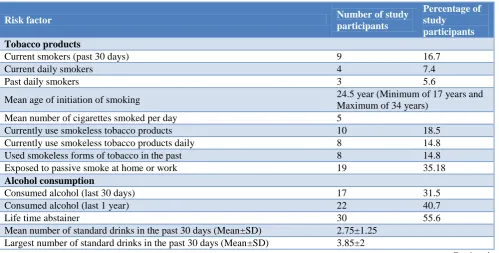
16.7% (n=9) were currently smoking tobacco. The mean number of cigarettes smoked was 5 per day. Out of the 9 who currently smoke, 4 of them smoke daily. 18.5% (n=10) use smokeless forms of tobacco like snuff, chewing tobacco, betel quid, pan and Hans. 16.7% of the 54 were exposed to passive smoking at home and closed work space. 44.4% (n=24) have consumed alcoholic beverages at some point of time in life. 40.7% (n=22) had consumed alcohol in the past 12 months of which 17 of them had it in the past 30 days. The mean number of drinking occasions was 10.1. On one drinking occasion, the mean number of standard drinks was 2.75±1.25. The mean of the largest number of standard drinks is 3.85±2 during one occasion.
Table 2: Behavioural risk factors among the study population.
Risk factor Number of study
participants
Percentage of study
participants
Tobacco products
Current smokers (past 30 days) 9 16.7
Current daily smokers 4 7.4
Past daily smokers 3 5.6
Mean age of initiation of smoking 24.5 year (Minimum of 17 years and Maximum of 34 years)
Mean number of cigarettes smoked per day 5
Currently use smokeless tobacco products 10 18.5 Currently use smokeless tobacco products daily 8 14.8 Used smokeless forms of tobacco in the past 8 14.8 Exposed to passive smoke at home or work 19 35.18
Alcohol consumption
Consumed alcohol (last 30 days) 17 31.5 Consumed alcohol (last 1 year) 22 40.7
Life time abstainer 30 55.6
Mean number of standard drinks in the past 30 days (Mean±SD) 2.75±1.25 Largest number of standard drinks in the past 30 days (Mean±SD) 3.85±2
85.2
40.7
25.9 24.1
16.7
0 10 20 30 40 50 60 70 80 90 100
Work does not involve vigorous intensity activity
Consumed alcohol within
past 12 months
Have been on hormone supplements
Often eat processed food high in
salt
Currently smoke tobacco products
P
re
v
a
le
nc
e
(%
)
Risk factors
Risk factor Number of study participants
Percentage of study
participants
Frequency of alcohol consumption (past 12 months)
Daily 3 5.6
5-6 days per week 2 3.7
3-4 days per week 3 5.6
1-2 days per week 6 11.1
1-3 days per month 1 1.9
Less than once a month 8 14.8
Dietary habit
Mean number of days in a week consumed fruits (Mean±SD) 4.6±2.4 Mean number of days in a week consumed vegetables (Mean±SD) 6.0±2.4
Consumption of less than 5 servings of fruits per week 22 40.7 Consumption of less than 5 servings of vegetables per week 8 14.8
Frequency of consumption of processed food high in salt
Always 7 13
Often 6 11.1
Sometimes 12 22.2
Rarely 13 24.1
Never 14 25.9
Don’t know 2 3.7
Physical activity
Work does not involve vigorous intensity activity 46 85.2 Work does not involve moderate intensity activity 36 66.7 Median time spent reclining on a typical day 120 minutes
Interquartile range 195 minutes
Hypertension
Known hypertensive 6 11.1
Currently on anti-hypertensive medication 3 5.6
Diabetes mellitus
Known diabetic 3 5.6
Currently on oral medication for diabetes 3 5.6
Currently taking insulin 1 1.9
Hypercholesterolemia
Have raised blood cholesterol level 4 7.4 Currently on oral medication for raised blood cholesterol 1 1.9
Cardiovascular diseases
Had an episode of heart attack, angina (chest pain) or stroke (CVA) in the past 2 3.7 Currently taking aspirin regularly for heart disease 5 9.3 Currently taken statins for heart disease 1 1.9
Hormone supplementation
Have been on hormones for gender affirmation in the past 14 25.9
Currently on hormones 1 1.9
In a typical week the mean number of days of fruits consumption was 4.6±2.4 days and the mean number of serving was 1.6±1.0. The mean number of days of vegetable consumption in a week was 6.0±2.4 days and the mean number of serving was 1.8±0.6. 35.2% (n=19) use salt, salty seasoning or salty sauce every day. 7 of them eat processed food every day. 14.8% (n=8) feel that they consume too much salt. The mean number of meals (breakfast/lunch/dinner) consumed outside home was 4.34±2.0. 51.9% of them do not perform activities that
are intense at work. 62.9% (n=24) were not involved in any kind of exerting physical activity for recreation. The mean of time spent sitting or reclining on a typical day was 110.4±90.3 minutes.
interval of 4.7±2.8 years. The current patterns of non-communicable diseases among the transgender women
was, 11.1% (n=6) were found to be hypertensive and 5.6% (n=3) were diabetic based on self-reporting.
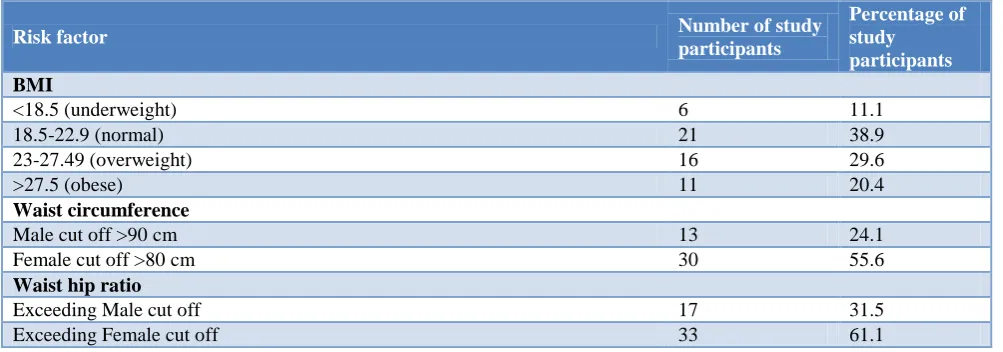
Table 3: Physical risk factors among the study population.
Risk factor Number of study
participants
Percentage of study
participants
BMI
<18.5 (underweight) 6 11.1
18.5-22.9 (normal) 21 38.9
23-27.49 (overweight) 16 29.6
>27.5 (obese) 11 20.4
Waist circumference
Male cut off >90 cm 13 24.1
Female cut off >80 cm 30 55.6
Waist hip ratio
Exceeding Male cut off 17 31.5
Exceeding Female cut off 33 61.1
Physical risk factors
Among 54 individuals, 11 were obese and 16 were overweight. Waist circumference of 24.1% (n=13) of the individuals exceeded the male cut off, while 55.6% (n=30) had their values greater than the female cut off.
DISCUSSION
This study which assessed the prevalence of multiple risk factors for NCDs among the transgender women is one of the first ever studies to be conducted targeting the trans women community for a health related issue other than sexually transmitted diseases (STDs) which is commonly studied.
In a recent study done in an urban locality of Andhra Pradesh, the prevalence of alcohol consumption was 4.93% where as, our current study had a high prevalence of 31.5%.11 In the NCD risk factor survey conducted by the Ministry of Health and Family Welfare of the Government of India,the percentage of current alcohol consumers (past 30 days) was 9.5% among the general population and 18.8% among men in Tamil Nadu state.12 The lifetime abstinence rate of alcohol among our study population was 55.6% which is quite low compared to 84.5% seen among the general population of Tamil Nadu.12 This shows that the alcohol consumption rate was very high among the transgender women.
The current tobacco smoking rate (past 30 days) among the transgender women was 16.7%, while it is 12.6% among the general population of Tamil Nadu.12 But the smoking rates among only the men of Tamil Nadu was 25%, which is higher than the value obtained among the Transgender community. In the current study, the prevalence of smokeless tobacco usage was 18.5% but 14.8% of them use smokeless tobacco daily. The current smokeless tobacco usage (past 30 days) and daily usage
among the general population was 11.0% and 10.2% respectively, while only among the men was 13.6% and 12.4% respectively.12 A study done in the state of Punjab revealed the percentage of current usage of tobacco products to be 11.3% which was still low compared to the values obtained in our study.13 Hence the usage of smokeless tobacco usage was grossly high compared to men and the general population of Tamil Nadu while tobacco smoking rate was also high compared to the general population. The mean number of cigarattes/bedis/cigars smoked was 5 per day which was almost similar to the result obtained in a study done among the fishermen community of Kancheepuram district of Tamil Nadu.14
The minimum recommended consumption of fruits and vegetables is 5 servings of each per week.12 59.3% of individuals consumed ≥5 servings of fruits per week and 85.2% of them consumed ≥5 servings of vegetables which was remarkably high compared to other studies done in different parts of the country. In a study done in Andhra Pradesh, 89.5% and 94.86% of individuals consumed <5 servings of vegetables and fruits respectively. 98.9% of individuals consumed <5 servings of fruits and vegetables per week in Tamil Nadu.12 The median time spent reclining on a typical a day was 120 minutes.
The transgender community was targeted for Non-communicable disease risk factor assessment because they are highly susceptible for acquiring NCDs at a higher rate compared to the general population due to the following reasons. Hormone therapy and anti-androgens are often used by them which have various adverse effects on the body. They have higher rates of depression and anxiety compared to others as a result of which many resort to alcohol consumption to cope up with the mental stress. They also smoke and use tobacco products at much higher rates than others. This can lead to a number of serious health problems, including heart disease, high blood pressure, lung disease, and lung cancer. These problems are often worse for those who do not have adequate social support or who are unable to express their gender identity.
It would be recommended that the transgender community must be targeted and given special attention in the various NCD programs by the government. Specific cut off for waist circumference must also be instituted in order to quantify abdominal obesity in them.
This study has few limitations. The study population were not selected randomly due to access to only limited number of transgender women, leading to selection bias. The study participants may also have difficulty in recalling certain facts during the interview which may have led to recall bias.
CONCLUSION
Transgender individuals are an isolated group of people who are in need of support and acceptance in the society. This study strongly brings out the fact that they are exposed to many NCD risk factors out of which the prominent ones were smokeless tobacco usage, alcohol consumption and hormone supplementation. Targeted interventions must be made so that specific attention is given to the transgender community in various NCD programs by the government. They must also be supported and accepted by every member of this society.
ACKNOWLEDGEMENTS
We acknowledge the support given by Sahodaran NGO for conducting this field research.
Funding: No funding sources Conflict of interest: None declared
Ethical approval: The study was approved by the Institutional Ethics Committee
REFERENCES
1. World Health Organization (WHO). Media Centre. Non communicable diseases Fact sheet. 2015. 2. World Health Organization. Non-communicable
diseases country profiles. India. Available at
http://www.who.int/nmh/countries/ind_en.pdf?ua=. Accessed on 3 October 2018.
3. Miranda JJ, Kinra S, Casas JP, Davey SG, Ebrahim S: Non-communicable diseases in low- and middle-income countries: context, determinants and health policy. Trop Med Int Health. 2008;13:1225-34. 4. Hosseinpoor AR, Bergen N, Kunst A, Harper S,
Guthold R, Rekve D, et al. Socioeconomic inequalities in risk factors for non-communicable diseases in low-income and middle-income countries: results from the World Health Survey. BMC Public Health. 2012;12:912.
5. Gupta A, Sivakami M. Health and Healthcare Seeking Behaviour among Transgender in Mumbai: Beyond the Paradigm of HIV/AIDS. Social Sci Spectrum. 2016;2(1):63-79.
6. Key Transgender Health Concerns | Program for LGBTQ Health. Available at: www.vumc.org/lgbtq/ key-transgender-health-concerns. Accessed on 3 October 2018.
7. World Health Organization: Global status report on non-communicable diseases. 2011, World Health Organization, Geneva. 2011.
8. World Health Organization. (2005).WHO STEPS Surveillance manual: The WHO STEPwise approach to chronic disease risk factor surveillance. Geneva: World Health Organisation; 2005.
9. Stegenga H, Haines A, Jones K, Wilding J. Identification, assessment, and management of overweight and obesity: summary of updated NICE guidance. BMJ. 2014;349.
10. WHO/IASO/IOTF: The Asia-Pacific perspective: redefining obesity and its treatment. Available from http://www.idi.org.au/home.htm. Accessed 21st August 2003.
11. Prabakaran J, Vijayalakshmi N, Ananthaiah Chetty N. Risk Factors of Non-Communicable Diseases in an Urban Locality of Andhra Pradesh. Nat J Res Com Med. 2013;2(1):1–78.
12. Ministry of Health & Family Welfare, Government of India, Integrated disease surveillance project (IDSP): Non-communicable disease risk factors survey 2007 – 2008.
13. Thakur JS, Jeet G, Pal A, Singh S, Singh A, Deepti SS, et al. Profile of Risk Factors for Non-Communicable Diseases in Punjab, Northern India: Results of a State-Wide STEPS Survey. 2016. 14. Annadurai K, Balan N, Ranaganathan K.
Non-communicable disease risk factor profile among Fishermen community of Kancheepuram district, Tamil Nadu: a cross sectional study. 2018;5(2):708-13.