Performance Analysis of Self-Scheduling Multi-channel
Cognitive MAC Protocols under Imperfect Sensing
Environment
Mingyu Lee
1, Seyoun Lim
2, Tae-Jin Lee
1*
1 College of Information and Communication Engineering, Sungkyunkwan University, Suwon, Korea.
2 DMC R&D Center, Samsung Electronics, Suwon, Korea.
* Corresponding author. Tel.: +82-31-290-7149; email: [email protected] Manuscript submitted October 10, 2014; accepted April 25, 2015. doi: 10.17706/ijcce.2015.4.5.327-335
Abstract: Cognitive radio MAC protocols have been proposed to efficiently utilize radio resources under the
assumption that radio spectrum can be perfectly sensed. However, due to dynamic and agile radio characteristics, secondary users may imperfectly detect whether the radio resources are occupied or not. In this paper, we study how the imperfect sensing environment affects cognitive radio systems. The sensing errors, i.e., misdetection and false alarm, result in interference to the primary users and decrease the transmission opportunities of secondary users. We formulate the number of sensed idle channels for different sensing mechanisms and the throughput of the multi-channel cognitive MAC protocol with the misdetection and the false alarm probabilities. Simulations are also conducted to verify the analysis. According to the results, the imperfect sensing should be considered as a critical factor when the cognitive MAC protocols are designed due to the influence on primary users’ and secondary users’ transmissions.
Key words: Cognitive radio, MAC protocols, ad-hoc networks, multi-channel, imperfect sensing.
1.
Introduction
There are some CR MAC protocols in [1]–[6], whose sensing methods are implicitly based on energy detection. Those protocols have been proposed emphasizing how SUs can efficiently utilize the licensed
spectrum without inference to PUs. Lim et al. in [1] propose a self-scheduling multi-channel cognitive radio
MAC (SMC-MAC) protocol, which allows multiple SUs to transmit data simultaneously through the sensed idle channels by two cooperative channel sensing algorithms, i.e., fixed channel sensing (FCS) and adaptive channel sensing (ACS), and by slotted contention mechanism to exchange channel request information
among SUs. Zhao et al. in [2] propose a decentralized cognitive radio MAC protocol based on the framework
of partially observable Markov decision processes (POMDPs) to reduce the complexity of the optimal channel sensing and access. They assume multiple antennas to detect the status of licensed channels
targeting the favorable sensing ability for the opportunistic frequency spectrum use. Su et al. in [3] and [4]
The authors in [6] propose a MAC protocol based on a game-theoretic approach. It considers selfish cognitive radio devices with multiple radios and the simultaneous transmissions at different frequencies (channels) to efficiently coordinate and use the available channels.
Aforementioned MAC protocols assume that SUs can perfectly sense the radio spectrum. There, however,
may be misdetection and the false alarm in sensing due to wireless radio characteristics. Wang et al. in [7]
propose channel assignment algorithms: a heuristic and a greedy centralized scheme, using the information that SUs report to the secondary base station, to increase the number of available channels for multi-channel cognitive radio networks since the sensing performance in terms of misdetection and false
alarm probabilities affects the overall system performance. Wong et al. in [8] design cognitive multi-channel
MAC protocols with perfect and imperfect sensing, which enable SUs to opportunistically access available idle channels that a dedicated device reports to them.
In this paper, we consider the impact of imperfect sensing in a multi-channel cognitive radio ad-hoc network. We study the cognitive radio multi-channel MAC protocol in ad-hoc networks when sensing errors, i.e., the misdetection and false alarm, happen. The MAC protocol in [1] is considered as the multi-channel cognitive radio MAC and we study how channel sensing results by two sensing algorithms, i.e., FCS and ACS, are affected by misdetection and false alarm. Then we formulate the analytical model for the throughput of the multi-channel cognitive radio MAC protocol under imperfect sensing.
2.
System Model and MAC Protocol Description
In this section, we describe the system model, imperfect sensing including both misdetection and false alarm and the CR multi-channel MAC protocol.
2.1.
System Model
We consider a multi-channel system where primary users and secondary users share radio
resources under the imperfect sensing environment with two probabilities: misdetection and false alarm. For a primary user traffic model [1], all licensed channels have the same utilization according to the PUs’
traffic load, and there are orthogonal channels. An SU network is a single hop cognitive radio network
with SUs under a primary user network. The SU network is an Ad-Hoc network which allows a node to
communicate directly with another node within the transmission coverage.
2.2.
Imperfect Sensing
We consider the imperfect sensing environment with the misdetection probability and the false
alarm probability . According to [8], the detection probability and the false alarm probability
are considered under the energy detection mechanism. is the probability that an occupied primary
channel is declared to be correctly occupied and is the probability that a vacant primary channel is
declared to be occupied. So the misdetection probability = 1− , the probability that an occupied
primary channel is declared to be vacant. The misdetection and false alarm cause the interference to PUs and the lost transmission opportunity of SUs, respectively. In [8], the relationship between the sensing
period of a channel, , with the probability of false alarm, , for a given detection probability,
1− , in the energy detector is given as follows.
1
( 2 1 (1 ) )
fa md cycle
p =Q
γ
+ ⋅Q− −p + T ⋅ ,γ
(1)where (⋅) is the complementary distribution function of the standard Gaussian distribution, is the
under the hypothesis that the primary user is active, and is a cycle time.
Fig. 1. A cycle structure of CR multi-channel MAC protocol.
2.3.
MAC Protocol Description
In the SMC-MAC protocol [1], SUs can use one common control channel and up to primary channels
for data transmission. A cycle time ( ) consists of four intervals: CR-Idle ( ), Sensing-Sharing (SS)
( ), Contention ( ) and Transmission ( ) as shown in Fig. 1. The CR-Idle interval is a constant time to
indicate the beginning of a new cycle. The Sensing-Sharing interval, during which SUs sense the primary channels and exchange the sensing results on whether primary channels are idle or busy, is composed of SS-slots each with three subslots. The first subslot is designed for sensing and the other two subslots
are for sharing of the sensing result by tone signals. The contention interval consists of contention-slots,
which enables SUs to compete with one another to reserve the sensed idle channels to be used to transmit their data frames during the transmission period. After contention, successful SUs can transmit data frames in parallel on self-scheduled idle channels during the transmission period. All SUs are assumed to be synchronized to cycle times, which is similar as in [5]. A new SU entering a secondary network listens to a
control channel for the (= contention slots) contention interval to overhear CR-RTS and CR-CTS
messages among other SUs in the network. The duration field in the messages indicates the data transmission time ( ). This allows a new SU to know the end of data transmission in the current cycle. After the transmission time in the current cycle, the SU can synchronize to the next cycle.
3.
Analysis
In this section, we analyze the performance of the multi-channel cognitive MAC protocol [1] under the imperfect sensing condition. The throughput of the MAC protocol under the imperfect sensing environment is formulated from the statistics of primary user channels [9], the number of sensed idle channels and the number of successful SUs.
We define the characteristics of the licensed channels as follows. The probability ( ) that the
number of idle channels is among licensed channels is
( ) (1 )i ch i 0
i
ch y N y
Y i i ch
i
N
p y y N
y
α
α
−
= − ⋅ , ≤ ≤ , (2)
where is the primary users’ traffic load. The probability ( ) that the number of busy channels is
among licensed channels.
( ) b (1 ) ch b 0
b
ch y N y
Y b b ch
b
N
p y y N
y
α
α
−
= ⋅ − , ≤ ≤ . (3)
sensing. There are four types of the probabilities, !,!#$%& ', (,!($ ), !,(#) ', (,(()%& ) which are the probabilities with $%& idle channels without false alarm, $ idle channels with miss detection, )
busy channels with false alarm and )%& busy channels without miss detection, respectively. Let and
be the probability of false alarm and that of miss detection, respectively. The probability that there are
$%& idle channels without false alarm among idle channels channels is
(
)
i(1
)
inofa yi inofa0
I I nofa i fa fa nofa i
nofa
y
p
i
y
p
p
i
y
i
−
,
|
=
−
⋅
, ≤
≤ .
(4)Then, the probability !,!($%& ) is given as follows,
0
( ) ( ) ( ) 0
ch
i i
N
I I nofa I I nofa i Y i nofa i
y
p, i p, i y p y i y
=
=
∑
| ⋅ , ≤ ≤ . (5)Let *%& be the number of idle channels without false alarm. Then the average number of idle channels without false alarm is
0 0
[ ] ( ) ( )
ch i
i i nofa
N y
nofa nofa I I nofa i Y i y i
E I i p, i y p y
= =
=
∑ ∑
⋅ | ⋅ . (6)Let * be the number of idle channels with misdetection. Then the probability that there are $ busy
channels but sensed as idle channels among busy channels by miss detection is
( ) b imd (1 )yb imd 0
B I md b md md md b
md
y
p i y p p i y
i
− ,
| = ⋅ − , ≤ ≤ .
(7)
From (7), (,!($ ) is given as
0
( ) ( ) ( )
ch
b b
N
B I md B I md b Y b y
p , i p , i y p y
=
=
∑
| ⋅ .(8)
Then the average number of idle channels with misdetection is
0 0
[ ] ( ) ( )
ch b
b
b md
N y
md md B I md b Y b
y i
E I i p , i y p y
= =
=
∑ ∑
⋅ | ⋅ .(9)
Under the imperfect sensing condition, we denote the channels that can be sensed as idle by *+. They
include *%& , idle channels without false alarm, and * , idle channels with misdetection. Then the
probability !,($+) that $+ channels sensed as idle is
0
( ) ( ) ( ) 0
nofa
i
I I I nofa B I nofa ch i
p i p i p i i i N
′
′ , ,
=
From (5) and (7), the average number of sensed idle channels is 0 0 0 [ ] ( ) ( ) ( ) ch ch nofa
N N i
I I nofa B I nofa I
i i i
E I i p ′ i i p i p i i
′
′
, ,
′= =
=
′ =
∑
′⋅ ′ =∑ ∑
′⋅ ⋅ ′− . (11)3.1.
Channel Sensing
We analyze the channel sensing mechanism in this section to formulate the average number of sensed idle channels under the imperfect sensing environment according to ACS [1]. According to the ACS
algorithm [1], each SU senses - channels (.ℎ ≤ - ≤ .ℎ 1) randomly until it finds 2+ idle channels
(0 ≤ 2+≤ .ℎ ). Let 4+ be the number of sensed idle channels by an SU. Then the conditional probability
5,(2+|$+) that the number of sensed idle channels 4+ = 2+ given $+ idle channels is as follows.
(
)
(
)
(
)
(
) (
)
(
)
1 1 0 0 1 0 1 1 0 0 1 0 ( ) 1 , 1, 0
max max max X
x r x
ch Ch i j idle r r x ch k Ch x x ch i j max idle Ch ch k
p x i
i i N i j
r
x Ch
x
N k
i
i
N
i
j
Ch
x
Ch
x
N
k
′ ′ ′ − − − = = − ′ = = ′ − − ′− = = − = ′ ′| = ′− − −′ − ′ = ′ − −′
−
− −
′
′
≤ <
′
−
∏
∏
∑
∏
∏
∏
∏
(12)
From (10) and (12), the average of 4+ sensed idle channels by an SU is
0 0 [ ] ( ) ( ) ch N i I X i x
E X x p ′ x i p i
′
′ ′= ′=
′ =
∑ ∑
′⋅ ′ ′| ⋅ ′.(13)
The probability that an idle channel is sensed by an SU among the total idle channels is found as
Average Number of Sensed Idle Channels by an SU [ ] Average Number of Idle Channels [ ]
E X
E I
γ = = ′ .
′ (14)
Since SUs independently select and sense the licensed channels, the probability 7,(8+) that an idle
channel is sensed by 8+ SUs among SUs is derived as
( ) su u (1 )Nsu u 0
U su
N
p u u N
u
γ
γ
′ ′ − ′ ′ = ⋅ − , ≤ ≤′ .
′
(15)
Then, the probability 9:;< that an idle channel is sensed by at least one SU is derived as
1 (1 )Nsu ACS
χ = − −γ .Let =+ be the number of sensed idle channels by SUs given total *+ idle channels.
Then the conditional probability >,(?+|$+) that ?+ idle channels are sensed by SUs given $+ idle channels following in (10) is derived as:
( ) w (1 )i w 0
W ACS ACS
i
p w i w i
w
χ
χ
′ ′− ′ ′ ′ ′ ′| = ⋅ − , ≤ ′ ′≤ . ′
So, the average number of sensed idle channels by SUs is derived from (10) and (16).
0 0
[ ] ( ) ( )
ch
N i
W I
i w
E W w p w i p i
′
′ ′
′= ′=
′ =
∑ ∑
′⋅ ′ ′| ⋅ ′ . (17)3.2.
Contention
Suppose that each SU randomly chooses a contention slot among slots in the contention interval. If a
slot is selected by a single SU among SUs, the slot is successful. Let @ be the number of successful slots and <(A) be the probability that A slots are successful, then
( ) ( ) (1s )M s 0
S succ succ
M
p s p p s M
s
−
=
⋅ − , ≤ ≤ ,
(18)
where pCDEE is the probability that a contention slot is selected by an SU and = ⋅ F ⋅ (1 − F)HIJKL,
F =ML [1]. From (18), the average number of successful contention slots is
0
[ ] ( )
M
S s
E S s p s
=
=
∑
⋅ .(19)
3.3.
Throughput
We, first, derive the transmission time per data channel denoted by (see Fig. 1) [1],
( )
tr cycle idle ss ct
T =T − T +T +T ,where is the cycle time, is the idle time, is the sensing-sharing
time, and is the contention time. The throughput of total sensed idle channels with the ACS mechanism
is denoted by ℎ:;<& as follows.
(
[min(
)]
)
/
ACS
total idle tr cycle
Th =
E
S Ch
⋅
,
W
′
⋅ ⋅
T
R
T
.(20)
Let N:;<+ be ZACS min(S Chidle W )
′ = ⋅ , ′ ,
and the pmf of N:;<+ is
( ) ( ) ( 1) 0
ACS ACS ACS ACS ACS ACS ACS ch
Z Z Z
p ′ z′ =F′ z′ −F′ z′ − , <z′ ≤N
(21)
where O
PQR, (0) = SOPQR, (0). The mean of T:;<
+ is
0
[ ] ( )
ch
ACS ACS
N
ACS ACS Z ACS z
E Z z p ′ z
′ =
′ =
∑
′ ⋅ ′ .(22)
We also need to find the throughput of sensed idle channels affected by misdetection. The probability that the number of idle channels affected by misdetection is N:;< among N:;<+ is
(
)
mdACS(1
)
ACS mdACS0
ACS md
z z z
ACS ACS ACS
md ACS md ACS
Z ACS
md
z
p
z
z
z
z
z
ν
ν
′ −
′
′
′
where F =U[!U[!WX]
Z,] from (9) and (11). The mean of N
:;< is as follows,
0 0
[ ] ( ) ( ).
ACS
ch ACS
ACS md ACS
ACS md
N z
ACS ACS ACS
md md Z md ACS Z ACS
z z
E Z z p z z p z
′
′ ′ = =
′ ′
=
∑ ∑
⋅ | ⋅(24)
Then, the throughput by misdetection is
( [
]
) /
ACS md
ACS
md tr cycle
Th =
E Z
⋅ ⋅
T
R
T
.(25)
Using (20) and (25), we can obtain the actual throughput of ACS without misdetection
ACS ACS ACS real total md
Th =Th −Th .
(26)
4.
Simulation
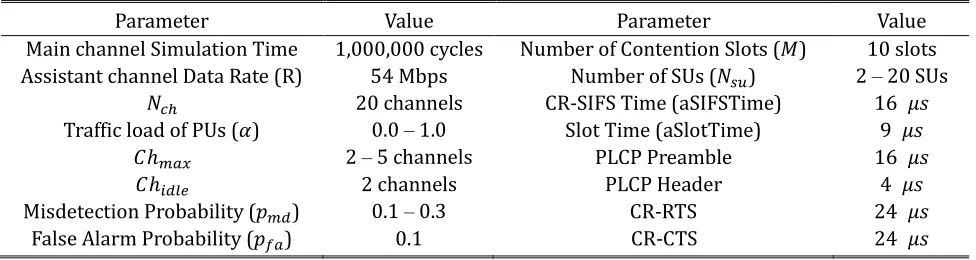
In this section, we present simulation results and the performance of the cognitive MAC protocol under the imperfect sensing environment. We also verify the analysis with the simulation. Table 1 summarizes the parameters for an SU network under the imperfect sensing environment to evaluate the performance of the cognitive multichannel MAC protocol. The basic parameters for an SU network are employed from IEEE
802.11a [10]. is given as aSIFSTime + 2 × aSlotTime and is × aSlotTime (= 3 ×
aSlotTime). is × aSlotTime. A contention slot time consists of CR-RTS transmission time, CR-SIFS
and CR-CTS transmission time. When the CR-RTS and CR-CTS are transmitted, they are converted to the physical layer convergence procedure (PLCP) protocol data units (PPDUs) including a PLCP preamble and a
PLCP header. So, the transmission time of CR-RTS/CR-CTS is 24A, and CR-SIFS is 16 \A (= aSIFSTime).
Table 1. Simulation Parameters
Parameter Value Parameter Value
Main channel Simulation Time 1,000,000 cycles Number of Contention Slots ( ) 10 slots
Assistant channel Data Rate (R) 54 Mbps Number of SUs ( ) 2 – 20 SUs
20 channels CR-SIFS Time (aSIFSTime) 16 \A
Traffic load of PUs ( ) 0.0 – 1.0 Slot Time (aSlotTime) 9 \A
.ℎ 1 2 – 5 channels PLCP Preamble 16 \A
.ℎ 2 channels PLCP Header 4 \A
Misdetection Probability ( ) 0.1 – 0.3 CR-RTS 24 \A
False Alarm Probability ( ) 0.1 CR-CTS 24 \A
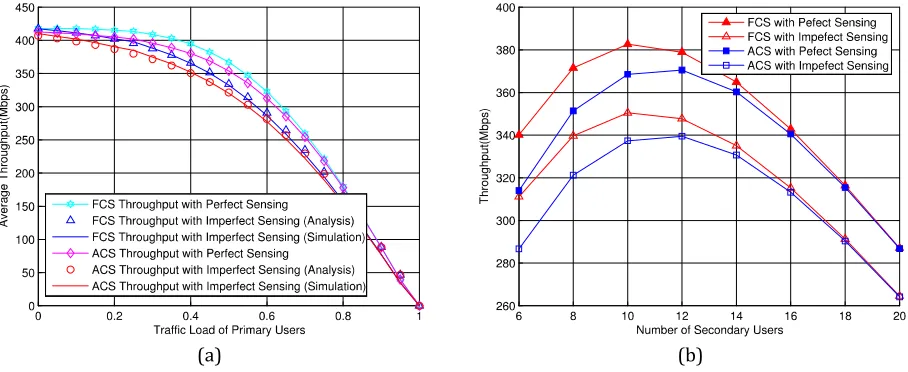
Fig. 2(a) shows the analysis and simulation results of the multi-channel cognitive MAC protocol under the
imperfect sensing environment when = 0.1, = 0.1, = 10, = 1A, .ℎ = 2 and
.ℎ 1= 5, and they are compared with those under the perfect sensing environment. The throughputs of
FCS are greater than those of ACS because an SU in FCS senses more channels. The throughputs under the imperfect sensing condition is lower than those under the perfect sensing condition since SUs lose the
transmission opportunities due to the affected idle channels by misdetection. For example, when = 0.4,
the real throughputs of FCS and ACS under the imperfect sensing condition are 365.39 Mbps and352.01
Mbps, respectively, and those of FCS and ACS under the perfect sensing condition are 394.83 Mbps and
(a) (b)
Fig. 2. Comparison of the average throughputs in the perfect sensing and the imperfect sensing environment.
The impact of the size of the contention slots on the throughputs is shown in Fig. 2(b) As the number
of SUs varies from 6 to 20, the average throughputs are presented with parameters: = 0.5, = 10,
= 1s, .ℎ = 2, .ℎ 1= 5, = 0.1 and = 0.1. The throughputs are shown to be maximized
when Nfg=M and then to start to decrease around <7= since the limited number of contention slots causes more collisions. For instance, the maximum throughputs of FCS and ACS with imperfect sensing are
350.5 Mbps and 339.52 Mbps at <7= 10, and then decrease to 291.29 Mbps and 290.38 Mbps, at <7= 18,
respectively. Besides, the throughputs with the imperfect sensing condition are compared with those with the perfect sensing case. The former is lower than the latter since imperfect sensing causes the interference to PUs and the loss of the SUs’ access opportunities to the available licensed channels.
5.
Conclusion
In this paper, we have considered the multi-channel cognitive MAC protocols under the imperfect sensing environment with misdetection and false alarm relaxing the tight assumption that channels are sensed perfectly without errors. The throughput of the MAC protocol with imperfect sensing is formulated in terms of the number of sensed idle channels considering the false alarm probability and the misdetection probability which may cause the interference to the PUs and decrease the transmission opportunities of SUs. We then have evaluated the performance of the protocol by extensive simulations. From the evaluation, the imperfect sensing conditions such as misdetection and false alarm need to be considered as a critical factor when CR MAC protocols are designed to reduce interference to PUs and to improve the performance of SUs.
Acknowledgment
This work was supported by the National Research Foundation of Korea (NRF) grant funded by the Korean government (MSIP) (2014R1A5A1011478).
References
[1] Lim, S., & Lee, T.-J. (2011). A self-scheduling multi-channel cognitive radio MAC protocol based on
cooperative communications. IEICE Trans. on Commun.,E94-B(6), 1657–1668.
[2] Zhao, Q., Tong, L., Swami, A., & Chen, Y. (2007). Decentralized cognitive MAC for opportunistic spectrum
access in Ad-Hoc networks: A POMDP framework. IEEE J. Select. Areas Commun.,25(3), 589–600.
Proceedings of CISS (pp. 363–368). Baltimore, Maryland, USA.
[4] Su, H., & Zhang, X. (2008). Cross-layer based opportunistic MAC protocols for QoS provisioning over
cognitive radio wireless networks. IEEE J. Select. Areas Commun.,26(1), 118–129.
[5] Jia, J., Zhang, Q., & Shen, X. (2008). HC-MAC: A hardware-constrained cognitive MAC for efficient
spectrum management. IEEE J. Select. Areas Commun.,26(1), 106–117.
[6] Felegyhazi, M., Cagalj, M., & Hubaux, J. (2009). Efficient MAC in cognitive radio systems: A
game-theoretic approach. IEEE Trans. Wireless Commun.,8(4), 1984–1995.
[7] Wang, W., Kasiri, B., Choi, J., & Alfa, A. S. (2011). Channel assignment of cooperative spectrum sensing in
multi-channel cognitive radio networks. Proceedings of IEEE ICC (pp. 1–5). Kyoto, Japan.
[8] Wong, D. T. C., Zheng, S., & Liang, Y. (2011). Cognitive multi-channel MAC protocols with perfect and
imperfect sensing. Proceedings of IEEE ICC (pp. 1–5). Kyoto, Japan.
[9] Willkomm, D., Machiraju, S., Bolot, J., & Wolisz, A. (2009). Primary user behavior in cellular networks
and implications for dynamic spectrum access. IEEE Commun. Mag.,47(3), 88–95.
[10]IEEE 802.11. (2007). Wireless LAN Medium Access Control (MAC) and Physical Layer (PHY)
Specifications.
Mingyu Lee received the B.S. degree in electronics engineering from Kwangwoon
University, Seoul, Korea in 2009 and the M.S. degree in mobile systems engineering from Sungkyunkwan University, Suwon, Korea in 2012. He is currently pursuing his Ph.D. degree in the Department of IT convergence at Sungkyunkwan University since March 2012. His research interests include cognitive networks, wireless LAN, and Ad-Hoc networks.
Seyoun Lim received the B.S and M.S. degrees in telecommunication & information
engineering from Korea Aerospace University, Goyang, Korea in 2000 and 2002, respectively and his Ph.D. degree in mobile systems engineering from Sungkyunkwan University, Suwon, Korea, in 2013. In 2002, he joined the Telecommunication R&D Center in Samsung Electronics. He is working as a senior engineer at DMC R&D Center in Samsung Electronics. His research interests include medium access control, resource allocation for cognitive radio networks.
Tae-Jin Leereceived his B.S. and M.S. degrees in electronics engineering from Yonsei