On the Performance of Different Simulation Models for
Rayleigh Fading Channels
Mohamed Ali Skima
1*, Amira Boulaaba
2, Hamadi Ghariani
11 Laboratory of Electronics and Information Technology (LETI), National School of Engineers of Sfax, University of Sfax, B.P. 1173, 3038 Sfax, Tunisia.
2 Department of Electrical Engineering, Higher Institute of Technological Studies of Rades, Tunis, Tunisia.
* Corresponding author. Email: [email protected] Manuscript submitted August 3, 2015; accepted October 25, 2015. doi: 10.17706/ijcce.2016.5.4.229-237
Abstract: In this paper, we analyze and compare seven of the most accepted and approved simulation models for Rayleigh fading channels. These models cover the three popular methods for generating time-correlated Rayleigh fading processes: the inverse discrete Fourier transform (IDFT) method, the filtering white Gaussian noise (FWGN) method and the sum-of-sinusoids (SOS) method. Three quantitative measures are used for judicious assessment of the quality of generated processes. The study addresses first- and second-order statistics of the fading process. The variance of the autocorrelation function (ACF) of the fading process is used to investigate the convergence of the stochastic SOS-based models. An evaluation of the computational effort is additionally presented. The simulation results suggest that the recently published Wang’s model is very attractive and it outperforms all SOS models. This study leads to several important conclusions about the accuracy, capability and efficiency of the different Rayleigh fading generators.
Key words: Radio propagation channels, Clarke’s model, Rayleigh fading channel simulators, performance analysis.
1.
Introduction
presented new models and have concluded that their models are efficient and accurate, but further studies are needed to confirm or deny these statements.
This paper compares and analyzes the performance of the most accepted Rayleigh fading channel simulators, and it is a continuation of our previous work [11] with substantial novel contributions. Some important outcomes of [11] are reported here, to be further studied and discussed. We will use three quantitative measures to investigate the accuracy of different Rayleigh fading generators in terms of both first- and second-order statistics. In [11], the quality of the second-order time-averaged autocorrelation function (ACF) is investigated using the power margin quality measures [12]. For the non-ergodic stochastic simulation models, this statistic varies from one simulation trial to another and a look into the convergence of these models is highly recommended which is missing in [11]. The convergence of two of the most successful stochastic SOS-based models is checked here using the variance of time-averaged ACF. In addition, the first-order statistic probability density function (PDF) of the envelope is assessed with a more convenient measure than used in previous studies [11], [13]. Moreover, the complexity of the different models is tested based on the time of execution. Compared to [11], the method with which the time of execution was computed has been refined for more accurate results.
The rest of this paper is organized as follows. Section 2 presents the statistical properties of the Clarke’s reference model and provides the Rayleigh fading models that were adopted in our comparative study. The simulation results and discussions are presented in section 3. Finally, section 4 concludes the paper.
2.
The Reference Model and Simulation Models
Under the frequency nonselective fading assumption and considering the Clarke’s two-dimensional (2-D) isotropic scattering model, the low-pass fading process 𝑔(𝑡) = 𝑔𝐼(𝑡) + 𝑗𝑔𝑄(𝑡), in densely built-up areas, has been shown to be approximated by a complex wide sense stationary (WSS) Gaussian random process [17]. The in-phase component 𝑔𝐼(𝑡) = ℜ*𝑔(𝑡)+, and the quadrature component 𝑔𝑄(𝑡) = ℑ*𝑔(𝑡)+ are independent, identically distributed zero-mean Gaussian processes with identical variances 𝜎2. Thereby, the envelope |𝑔(𝑡)| follows the well-known Rayleigh distribution with the corresponding PDF given by [2], [14]:
𝑓|𝑔|(𝑟) = (𝑟 𝜎⁄ )𝑒𝑥𝑝(−𝑟2 2⁄2𝜎2) (1)
Adopting the above assumptions and considering the Jakes power spectral density (PSD), the normalized
(𝜎2= 1) correlation properties of the fading process are [2], [14]:
𝑅𝑔𝐼𝑔𝐼(𝜏) = 𝐸,𝑔𝐼(𝑡)𝑔𝐼(𝑡 + 𝜏)- = 𝒥0(𝜔𝑑𝜏) (2a)
𝑅𝑔𝑄 𝑔𝑄(𝜏) = 𝒥0(𝜔𝑑𝜏) (2b)
𝑅𝑔𝐼 𝑔𝑄(𝜏) = 𝑅𝑔𝑄 𝑔𝐼(𝜏) = 0 (2c)
𝑅𝑔𝑔(𝜏) = 𝐸,𝑔(𝑡)𝑔∗(𝑡 + 𝜏)- = 2𝒥0(𝜔𝑑𝜏) (2d)
where 𝐸 is the statistical expectation operator, 𝒥0(∙) is the zeroth-order Bessel function of the first kind,
𝜏 is the time lag and 𝜔𝑑 = 2𝜋𝑓𝑑 is the maximum radian Doppler frequency due to the receiver motion.
𝑅𝑔𝐼 𝑔𝐼(𝜏) and 𝑅𝑔𝑄 𝑔𝑄(𝜏), are the ACFs of the in-phase and quadrature components of 𝑔(𝑡), respectively,
ACF of the low-pass complex fading process 𝑔(𝑡). These results characterize completely the reference model established by Clarke. Hence, any Rayleigh fading simulator aims to reproduce the aforementioned statistical properties as faithfully as possible.
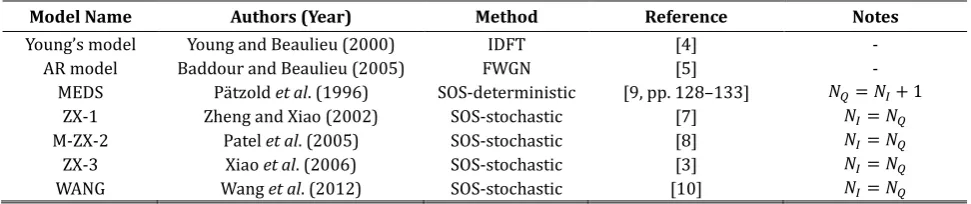
In the following, we provide the Rayleigh fading simulation models which will be used later in our study. Totally, seven of the most accepted and approved models were investigated and they are summarized in Table 1. These models are chosen carefully based on earlier works [8], [9], [11], [15] and they cover the three common methods for generating time-correlated Rayleigh fading. Details of these models are not provided here due to space constraints, but we refer the reader to the corresponding references. For the SOS method, the principle consists in approximating each of the Gaussian processes 𝑔𝐼(𝑡) and 𝑔𝑄(𝑡) forming 𝑔(𝑡) by a finite number of sinusoids with amplitudes, frequencies and phases that are properly selected to fit the desired statistical properties. Here, the number of sinusoids used in the in-phase and quadrature branches are denoted 𝑁𝐼 and 𝑁𝑄 respectively. Also, two classes of SOS-based model are distinguished: the Frequency-Amplitude (FA) deterministic and stochastic models [15]. In the FA-deterministic models, the sinusoids amplitudes and frequencies are deterministic. The corresponding process is ergodic, and then a single simulation trial is generally sufficient for convergence. For the stochastic models, the sinusoids amplitudes and / or frequencies are selected randomly. The statistical properties of such models vary from each simulation trial to another, and one has to compute these properties by averaging over several simulation trials which increases the complexity of the model, but helps to improve the quality. Further details about the SOS method can be found in [9].
Table 1. The Seven Rayleigh Fading Simulation Models Retained for the Comparative Study
Model Name Authors (Year) Method Reference Notes
Young’s model Young and Beaulieu (2000) IDFT [4] -
AR model Baddour and Beaulieu (2005) FWGN [5] -
MEDS Pätzold et al. (1996) SOS-deterministic [9, pp. 128–133] 𝑁𝑄= 𝑁𝐼+ 1
ZX-1 Zheng and Xiao (2002) SOS-stochastic [7] 𝑁𝐼= 𝑁𝑄
M-ZX-2 Patel et al. (2005) SOS-stochastic [8] 𝑁𝐼= 𝑁𝑄
ZX-3 Xiao et al. (2006) SOS-stochastic [3] 𝑁𝐼= 𝑁𝑄
WANG Wang et al. (2012) SOS-stochastic [10] 𝑁𝐼= 𝑁𝑄
3.
Comparative Study and Simulation Results
3.1.
Comparison Based on Power Margin Quality Measures
In our previous work [11], we have used two quantitative measures to analyze the quality of the ACF of the real part of the seven aforementioned models. The first measure, called the mean power margin, is given by [12]:
𝐺𝑚𝑒𝑎𝑛 = (1 𝜎⁄ 𝑥2𝐿)𝑡𝑟𝑎𝑐𝑒{𝐶𝑥𝐶𝑥̂−1𝐶𝑥} (3)
The second is the maximum power margin and is defined as [12]:
𝐺𝑚𝑎𝑥= (1 𝜎⁄ )𝑚𝑎𝑥 { 𝑑𝑖𝑎𝑔 {𝐶𝑥2 𝑥𝐶𝑥̂−1𝐶𝑥}} (4)
similarity of the theoretical and simulated ACFs. This second-order statistic is with high-importance because it reflects the time variability of the wireless fading channel. In all cases, the desired covariance matrix 𝐶𝑥 was obtained using the reference ACF of (2a), whereas the covariance matrix 𝐶𝑥̂ was estimated using the empirical technique presented in [16, p. 545-6]. An autocorrelation sequence length of 200 was considered, at a normalized maximum Doppler frequency 𝑓𝑚= 𝑓𝑑𝑇 of 0.05, where 𝑇 is the sampling interval. The time average correlations needed for estimating the matrix 𝐶𝑥̂ were calculated based on 220 generated samples and 𝜎𝑥2 was set to unity. The computed quality measures were then averaged over 50 independent simulation trials. Generally, these measures are expressed in dB and a perfect performance corresponds to 0 dB for both quantities. The result of this study is reported here in the Table 2 [11].
Table 2. Power Margin Quality Measures of the Different Models (Reprinted from [11], with Permission from Elsevier)
Method Model Name 𝑮𝐦𝐞𝐚𝐧(dB) 𝑮𝐦𝐚𝐱(dB)
IDFT Young’s model 0.003129 0,003330
FWGN AR model
Fi
lt
er
or
de
r 50 0.284074 0.414622
120 0.050733 0.143090
200 0.003376 0.003530
SOS
ZX-1 𝑁𝐼
8 34.86758 35.98688
16 4.931524 6.804558
64 0.005751 0.005914
128 0.001052 0.001092
M-ZX-2 𝑁𝐼
8 38.60137 40.34800
16 20.64050 24.36247
64 0.080284 0.141962
128 0.012520 0.021570
ZX-3 𝑁𝐼
8 39.95607 41.85942
16 28.13874 32.17058
64 0.299641 0.467291
128 0.039134 0.064304
WANG 𝑁𝐼
8 33.43456 34.30927
16 0.154066 0.490900
64 0.003151 0.003278
128 0.000838 0.000871
MEDS 𝑁𝐼
8 33.83460 34.66510
16 0.153808 1.903978
64 2.36 ∙ 10-5 2.86 ∙ 10-5
128 2.70 ∙ 10-5 3.21 ∙ 10-5
The results of Table 2 show that the accuracy of SOS-based models is strongly related to the number of sinusoids in use, 𝑁𝐼. Increasing 𝑁𝐼 leads to accurate results, but this improvement in the quality is done at the detriment of efficiency. Generally, 𝑁𝐼 = 16 is considered as a moderate choice for a good compromise between complexity and convergence. The major outcome of this study concerns the recently published WANG model. Compared with all SOS stochastic models, the WANG provides the best results in terms of
are used. Finally, the AR model of [5] has proven to be quite precise if high order model is chosen. For example, if a 200 order AR model (or higher) is taken, we can achieve a power margin quantities similar to those obtained with the IDFT method.
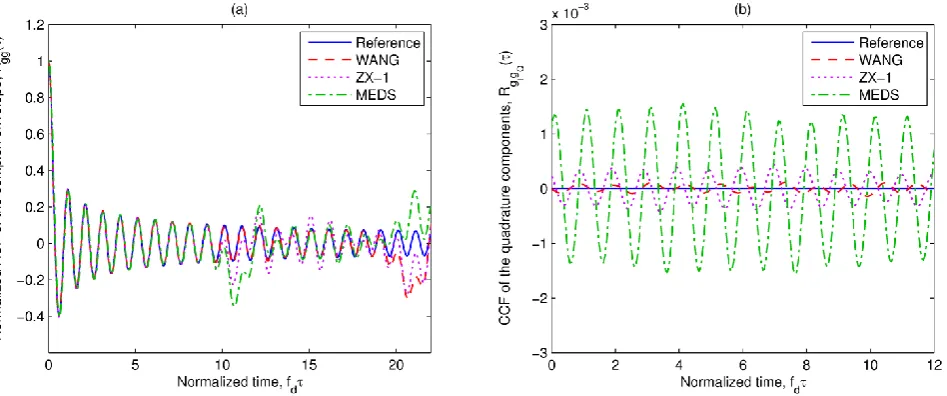
The results of Table 2 concern the performance evaluation of different models, in terms of the ACF of in-phase component 𝑅𝑔𝐼𝑔𝐼(𝜏) of the complex process 𝑔(𝜏). This is completely different from evaluating the accuracy of the ACF of complex process 𝑅𝑔𝑔(𝜏). This statement is confirmed by the results shown in Fig. 1(a), where we have plotted the ACF of the complex process of reference model in comparison with the ACFs of the complex process of ZX-1, WANG and MEDS models for 𝑁𝐼 = 16. Although MEDS and WANG are shown to perform similar results in terms of 𝑅𝑔𝐼𝑔𝐼(𝜏), the WANG model outperforms by far the MEDS regarding the ACF of the complex process 𝑅𝑔𝑔(𝜏). It can be seen that for WANG model, the range over which the simulated ACF, 𝑅𝑔𝑔(𝜏) closely matches the desired one, is roughly twice wider than that of MEDS. Approximately, similar results are found for MEDS and ZX-1 models. To better conclude on the correlation properties of ZX-1, WANG and MEDS models, we have plotted in Fig. 1(b) the CCFs of the quadrature components of these models in comparison with the CCF of the quadrature components of the reference model 𝑅𝑔𝐼𝑔𝑄(𝜏). We can see clearly that the WANG model outperforms other SOS models and the CCF of its quadrature components stills near zero as desired.
Fig. 1. (a) ACFs of the complex process 𝑅𝑔𝑔(𝜏) of reference, WANG, ZX-1 and MEDS models. (b) CCFs of the quadrature components of reference, WANG, ZX-1, and MEDS models (𝑓𝑚= 0 0 and 𝑁𝐼 = 16).
The above correlations were computed based on time-averaging, a technique that is often used in simulation practice instead of ensemble averaging [3]. For SOS stochastic models, the random frequencies makes the time-average correlation functions, denoted by 𝑅̂(∙), to change from one simulation trial to another. To characterize this variability, we generally use the variance of the time-average 𝑉𝑎𝑟,𝑅(∙)- = 𝐸 [|𝑅̂(∙) − lim𝑁𝐼→∞𝑅(∙)|
2
range of ZX-1 model. Therefore the WANG model converges faster than the ZX-1 model and its correlation properties vary little from one simulation trial to another.
Fig. 2. Variance of ACF of the complex process 𝑅𝑔𝑔(𝜏) of ZX-1 and WANG models for 𝑓𝑚= 0 0 and
𝑁𝐼 = 16.
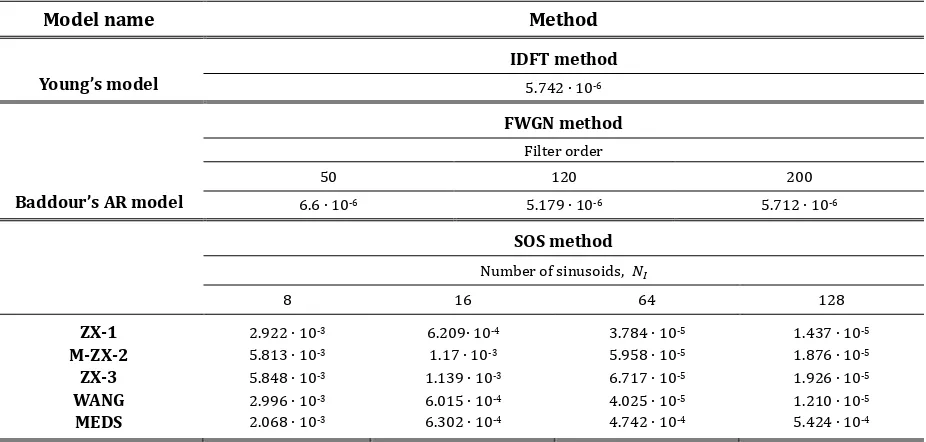
Table 3. Evaluation Based on the J-div of Various Models
Model name Method
Young’s model
IDFT method
5.742 ∙ 10-6
Baddour’s AR model
FWGN method
Filter order
50 120 200
6.6 ∙ 10-6 5.179 ∙ 10-6 5.712 ∙ 10-6
SOS method
Number of sinusoids, 𝑁𝐼
8 16 64 128
ZX-1 2.922 ∙ 10-3 6.209∙ 10-4 3.784 ∙ 10-5 1.437 ∙ 10-5
M-ZX-2 5.813 ∙ 10-3 1.17 ∙ 10-3 5.958 ∙ 10-5 1.876 ∙ 10-5
ZX-3 5.848 ∙ 10-3 1.139 ∙ 10-3 6.717 ∙ 10-5 1.926 ∙ 10-5
WANG 2.996 ∙ 10-3 6.015 ∙ 10-4 4.025 ∙ 10-5 1.210 ∙ 10-5
MEDS 2.068 ∙ 10-3 6.302 ∙ 10-4 4.742 ∙ 10-4 5.424 ∙ 10-4
3.2.
Comparison Based on Jeffrey's Divergence Criterion
Here, we evaluate the quality of the generated processes in terms of their envelope PDF. We use the Jeffrey's divergence (J-div) criterion commonly adopted in probability theory and statistics. This criterion measures the difference between a theoretical PDF and an empirical one. Some previous works (e.g., [11], [13]), have used the Kullback-Leibler Divergence (KL-div) criterion which is not symmetric. The J-div is the symmetric version of the KL-div criterion, and it is more convenient in this kind of studies. The J-div, denoted 𝐷𝐽, is defined as follows [17, p. 251]:
where 𝑃(𝑖) and 𝑄(𝑖) are the time-discrete versions of reference and the evaluated distributions respectively. The J-div is always non-negative and the closer 𝐷𝐽 is to 0, the better is the agreement of the empirical PDF with the theory. All the PDFs of the envelopes of the seven Rayleigh fading simulators are evaluated using this criterion and the results of simulation are shown in Table 3. The reference PDF is given by (1). The empirical (simulated) PDFs are computed under the same condition as for 𝐺𝑚𝑒𝑎𝑛 and 𝐺𝑚𝑎𝑥 (i.e., 220 samples and݂ 𝑓
𝑚= 0 0 ). For each Rayleigh generator, the envelope PDF was averaged over 100 independent simulation trials before to be used in the J-div criterion.
According to Table 3, the IDFT and FWGN methods give the best approximation of the desired envelope PDF. For the AR model, increasing the filter order above 50 don't bring a significant improvement in the quality of the envelope PDF. The simulation results suggest that the SOS models also provide good results if a large number of sinusoids is used (𝑁𝐼 ≥ 64). Overall speaking, we conclude that ZX-1, WANG and MEDS are best SOS-based models regarding the J-div criterion. For small 𝑁𝐼, the MEDS surpasses ZX-1 and WANG. While, for moderate to large 𝑁𝐼, the latter models performs better than MEDS. Also, we remark that in all cases, the WANG and ZX-1 models achieve approximately similar performances. Eventually, the worst case is observed for the M-ZX-2 and ZX-3 models with a slightly better performance for the M-ZX-2 model.
3.3.
Comparison Based on the Time of Execution
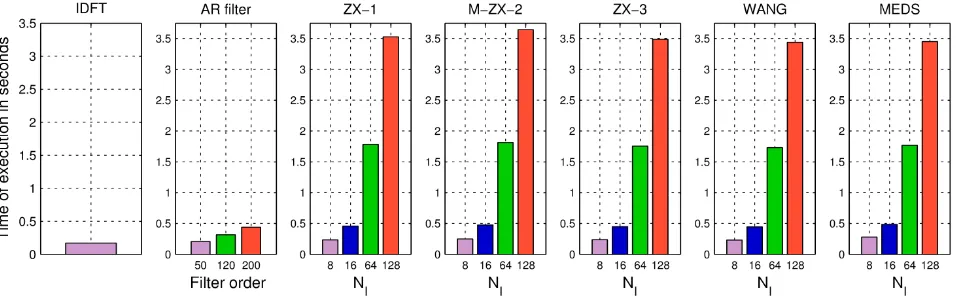
In this subsection, we evaluate the seven Rayleigh fading models in term of the computational effort. For each model, we have computed the time needed to generate 106 samples of the fading process 𝑔(𝑡) on an Intel® Core™ i5 machine using routines coded in MATLAB® . The normalized maximum Doppler frequency was set equal to 0.05. To obtain more precise results, the time of execution of each model has been averaged over 30 simulation trials. Also the outcome of the first simulation run was rejected. The results of this test are displayed in Fig. 3.
Fig. 3. Time to generate 106 complex samples using the various Rayleigh fading generators.
It can be seen clearly that the smallest run time was obtained with the IDFT method due to the inherent efficiency of the FFT operation. The AR model was also quite efficient even for a high filter order. On the other hand, the SOS method appears to be most time-consuming method. All SOS-based models achieved approximately similar results with slightly better performance observed for the WANG model. For moderate
𝑁𝐼 (𝑁𝐼 = 16), the WANG model has taken almost the same time as the AR model with 200th order filter, but with a loss of accuracy. The results presented in the previous section show that in terms of 𝐺𝑚𝑒𝑎𝑛, 64 sinusoids are needed for WANG model to reach the performances obtained with 200th order AR filter.
In this paper, extensive computations have been conducted to analyze and compare seven of the most approved Rayleigh fading channel models. The recently published WANG model has shown good performances. Its second order statistics outperform those of the first Zheng and Xiao model (ZX-1) which has been considered for long time the most accurate among the SOS models. Although the MEDS achieves the best results in terms of the ACF of the in-phase component, we have shown that the WANG model outperforms by far the MEDS regarding the ACF of the complex envelope. Furthermore, WANG provides the best approximation of the 𝑅𝑔𝐼𝑔𝑄(𝜏) and it is a superior choice when a zero CCF is required (e.g., in the case
of multiple uncorrelated fading waveforms). Moreover, the WANG model converges faster than the ZX-1 model and it needs a small number of simulation trials to achieve the desired statistical properties. For the Zheng and Xiao’s SOS models, we deduce that ZX-1 stands as the best model as expected in some previous works. The comparison study shows that the well-known Young’s IDFT method still has accurate statistical properties but due to its incapability to achieve sample-by-sample simulation, this method may be inappropriate for many applications. Finally, the simulation results demonstrate that the Badddour’s AR FWGN model realizes the best accuracy in terms of the quality of the envelope PDF.
References
[1] Rappaport, T. S. (2002). Wireless Communications: Principles & Practice (2nd ed.). Upper Saddle River, NJ: Prentice Hall PTR.
[2] Clarke, R. (1968). A statistical theory of mobile-radio reception. Bell System Technical Journal, 47(6), 957-1000.
[3] Xiao, C., Zheng, Y., & Beaulieu, N. (2006). Novel sum-of-sinusoids simulation models for Rayleigh and Rician fading channels. IEEE Transactions on Wireless Communications, 5(12), 3667-3679.
[4] Young, D., & Beaulieu, N. (2000). The generation of correlated Rayleigh random variates by inverse discrete Fourier transform. IEEE Transactions on Communications, 48(7), 1114-1127.
[5] Baddour, K., & Beaulieu, N. (2005). Autoregressive modeling for fading channel simulation. IEEE
Transactions on Wireless Communications, 4(4), 1650-1662.
[6] Jakes, W. (1974). Microwave Mobile Communications. New York: Wiley.
[7] Zheng, Y., & Xiao, C. S. (2002). Improved models for the generation of multiple uncorrelated Rayleigh fading waveforms. IEEE Communications Letters, 6(6), 256-258.
[8] Patel, C., Stuber, G., & Pratt, T. (2005). Comparative analysis of statistical models for the simulation of Rayleigh faded cellular channels. IEEE Transactions on Communications, 53(6), 1017-1026.
[9] Pätzold, M. (2012). Mobile Radio Channels (2nded.). Chichester, West Sussex, U.K.: Wiley.
[10]Wang, J., Ma, X., Teng, J., & Cui, Y. (2012). Efficient and accurate simulator for Rayleigh and Rician fading.
Transactions of Tianjin University, 18(4), 243-247.
[11]Skima, M. A., Ghariani, H., & Lahiani, M. (2014). A multi-criteria comparative analysis of different Rayleigh fading channel simulators. AEU — International Journal of Electronics and Communications,
68(6), 550-560.
[12]Young, D., & Beaulieu, N. (2003). Power margin quality measures for correlated random variates derived from the normal distribution. IEEE Transactions on Information Theory, 49(1), 241-252.
[13]Petrolino, A., Gomes, J., & Tavares, G. (2008). A mobile-to-mobile fading channel simulator based on an orthogonal expansion. Proceedings of the IEEE Vehicular Technology Conference (pp. 366-370). Singapore.
[14]Stüber, G. (2002). Principles of Mobile Communication (2nd ed.). Norwell, MA: Kluwer Academic Publishers.
sum-of-sinusoids models of Rayleigh-fading wireless channels. Proceedings of the IEEE Wireless
Communications and Networking Conference: (pp. 2027-2031). Kowloon, China.
[16]Press, W. H., Teukolsky, S. A., Vetterling, W. T., & Flannery, B. P. (1992). Numerical Recipes in C: The Art of
Scientific Computing. Cambridge, U.K.: Cambridge University Press.
[17]Deza, M., & Deza, E. (2009). Encyclopedia of Distances. Berlin: Springer-Verlag.
Mohamed Ali Skima was born in Tunis, Tunisia, in October 1979. He received the electrical engineering degree from the National Engineering school of Sfax (ENIS), Tunisia in 2003 and the electronic master diploma from the National Engineering School of Sfax (ENIS), Tunisia, in 2004. Currently, he is working toward the Ph.D. degree at Sfax University and he is a member of Laboratory of Electronics and Technology of Information (LETI). His research interests are modeling, characterization and sounding techniques of mobile radio channels.
Amira Boulaaba was born in Tunisia, in June 1978. She received the electrical engineering degree from the National Institute of Applied Sciences and Technology (INSAT), Tunisia in 2002. In 2003, she received the master degree in control engineering and industrial information technology from the INSAT, Tunisia. Crruntly, she is an associate professor at the Higher Institute of Technological Studies (ISET) of Rades, Tunisia. Her research interests are computer science, communication and wireless systems.
![Table 2. Power Margin Quality Measures of the Different Models (Reprinted from [11], with Permission from Elsevier)](https://thumb-us.123doks.com/thumbv2/123dok_us/1312533.1638909/4.595.74.521.251.548/margin-quality-measures-different-models-reprinted-permission-elsevier.webp)