Original Research Article
Awareness of risk of infections to health care professionals and its
preventive practices among medical students: a cross-sectional study
Aruna Marati Savanthe*, Cynthia Subhaprada Savolu
INTRODUCTION
Health care facility is not just any other workplace but a place for receiving and giving care to the sick. Health care facilities employ over 59 million workers globally. Health care professionals are exposed to intricate range of health and safety hazards in their day to day work which include biological hazards, such as HIV/AIDS, SARS, TB, hepatitis; chemical hazards, such as, xylene, glutaraldehyde; physical hazards, such as slippery floors,
electrical hazards, noise, radiation; ergonomic hazards, such as heavy lifting; psychosocial hazards, such as shiftwork, violence and stress; fire and explosion hazards. Exposure to these hazards are leading to a variety of air – borne, blood–borne infections, musculoskeletal disorders etc., Health-care workers (HCWs) slogging for the care of the sick and injured are always regarded as not vulnerable for injury or illness, though they are the one‟s who need utmost protection from these workplace hazards just as any other mining or construction workers.1
ABSTRACT
Background: Occupational health is a neglected public health issue among healthcare workers in developing countries leading to health care associated infections both to patients and medical students unless infection prevention and control (IPC) measures followed. This study was conducted with an aim to assess the degree of knowledge regarding infection in health care professionals and infection control measures among medical students.
Methods: A cross-sectional study was conducted from June 1 to July 31, 2017 on 95 students in the MBBS final year Part I at Kurnool Medical College Kurnool by simple random sampling technique after taking informed consent. A semi structured questionnaire with information regarding their knowledge on risk of infection and infection prevention practices was used. Using SPSS ver. 20, data analysed in proportions and means.
Results: Mean age of the study participants was 20.29±0.756 years, 83.2% (n=79) students expressed tuberculosis followed by Hepatitis B infection as the most common infection the medical students are exposed to. 97.9% definitely knew that they contact infections if standard precautions are not followed. Only 51.6% students were aware of all steps of hand wash. 83.2% were already vaccinated to hepatitis B and among vaccinated 73.4% had completed the course fully.
Conclusions: Effective infection prevention measures are pivotal in providing high quality health care for patients and a safe working environment for those that work in healthcare settings. Hence infection prevention and control guidelines particularly standard precautions should be incorporated into the curriculum before entering clinical postings.
Keywords: Infection control, Medical students, Knowledge
Department ofCommunity Medicine, Kurnool Medical College, Kurnool, Andhra Pradesh, India
Received: 08 February 2018
Revised: 10 March 2018
Accepted: 12 March 2018
*Correspondence:
Dr. Aruna Marati Savanthe,
E-mail: [email protected]
Copyright: © the author(s), publisher and licensee Medip Academy. This is an open-access article distributed under the terms of the Creative Commons Attribution Non-Commercial License, which permits unrestricted non-commercial use, distribution, and reproduction in any medium, provided the original work is properly cited.
A health care worker (HCW) contacts blood borne infection at work place on “occupational exposure” either through a percutaneous injury (e.g., needle stick or cut with a sharp instrument), or contact with the mucous membranes of the eye or mouth, non-intact or intact skin only when the duration of contact with blood or other potentially infectious body fluids is prolonged.2 Thus occupational exposure poses significant risk of transmission of blood borne pathogens such as human immunodeficiency virus (HIV), Hepatitis B virus and Hepatitis C virus among HCWs especially medical students. WHO global burden of disease from sharps injuries to health-care workers showed that 37% of the hepatitis B among health workers was the result of occupational exposure to blood and blody fluids. Though infection with the hepatitis B virus is 95% preventable with immunization, less than 20% of health worker in some regions of the world have received all three doses needed for immunity. Less than 10% of the HIV among health workers is the result of an exposure at work, mostly through needle stick injuries. The cause of 95% of the HIV occupational seroconversions, are preventable with practical, low-cost measures and have the co-benefit of preventing exposure to other blood borne viruses and bacteria.1
Risk of exposure to blood-borne pathogens to HCWs can be effectively reduced through adherence to standard precautions by applying the basic principles of infection control through hand washing, utilization of appropriate personal protective equipment (PPE) such as gloves, masks, gowns, and eyewear, appropriate use of safety devices and efficacious needle disposal system at the work place.3 Prior vaccination of HCWs is one of the revolutionary step to protect patients attending health care centres from becoming infected to certain diseases especially hepatitis B through exposure to infected health care workers.
In developing countries, including India, the knowledge and understanding of the infection prevention and control measures and compliance to these among health professionals has been found to be inadequate, inspite of detailed and strict guidelines. Scenario in developed countries was no better than any developing country.4-6 Occupational hazards and the occupational safety of healthcare workers was always overlooked. Even the few literatures we have now regarding awareness of risk of infections and its control measures were either performed on professional healthcare workers or undergraduate dental students. Medical students as the vulnerable group who are at risk of acquiring blood – borne infections is always a neglected issue. Hence forth very few studies involved undergraduate medical students as research subjects. The studies done have addressed only the psychological issues (anxiety, stress, depression) the medical students are facing in this profession and rarely focused on the perilled situations during the professional training especially infection exposure, safety and control measures. The medical students during the course would
be regularly attending the in-patient and out-patient clinics along with operation theatres where they come in contact with the infected patients and are exposed to a variety of pathogens. Thus to protect themselves, though not from all hazards atleast from these dreadful infections, assessment of their knowledge, attitudes and practices for health care associated infections (HAI) is of crucial importance.
Aims and objectives
This study was conducted with an aim,
1. To assess the degree of knowledge regarding
infection risk in health care professionals among medical students of Kurnool Medical College, Kurnool.
2. To evaluate the knowledge and practice of the
infection control measures.
METHODS
This cross-sectional study was conducted from June 1 to July 31, 2017. The study participants included students in the MBBS final year Part I at Kurnool Medical College (KMC), Kurnool. These students were included in the study because the clinical postings for the medical students start from the 2nd year onwards only according to MCI guidelines. The sampled population consisted of students in the final year part I MBBS, which at any point in time includes 200 students. A sample size of 95 was calculated considering a power of 80%, an absolute precision of 10% and a confidence level of 95%, assuming the awareness levels for infection prevention practices to be 55% among medical students. The simple random sampling technique was used to select students for the study after taking informed consent. A semi structured questionnaire was used to collect information regarding their knowledge on risk of infection to them and information in relation to the awareness of participants about various domains of infection prevention practices such as hand hygiene, needle stick injury prevention and standard precautions (SPs). WHO‟s concept of “My five moments for hand hygiene” has been utilized to evaluate hand hygiene practices.7 The questionnaire was pretested before the data collection, and necessary modifications were made in terms of content and language. The data obtained from the completely filled proformas was entered and analyzed using SPSS ver. 20. The analysis was performed in terms of descriptive statistics (proportions and means). Ethical clearance was obtained from the Institutional Ethics Committee (IEC) before the study was started.
RESULTS
for the most common infections the medical students are exposed to in wards, 83.2% (n=79) students expressed Tuberculosis followed by 78.9% (n=75) hepatitis B infection (Figure 1). On questioning medical students knowledge regarding the most common pathogens isolated in our hospital where the participants opined that
Mycobaterium tuberculosis and M. leprae together contribute 83.2%, Streptococcus pyogenes 71.6% and
Staphylococcus aureus 58.9%. Books, teachers, internet, mass media, friends and peers all together (91.6%) were source of the participants‟ information regarding infection risk in health care professionals and measures to be followed to protect from cross infections.
Figure 1: Knowledge of infectious diseases risk among medical students.
83.2% (n=79) students expressed Tuberculosis followed by Hepatitis B infection by 78.9% (75) as the most common infections the medical students are exposed to in wards.
Knowledge of infection exposure risk and its preventive measures of medical students
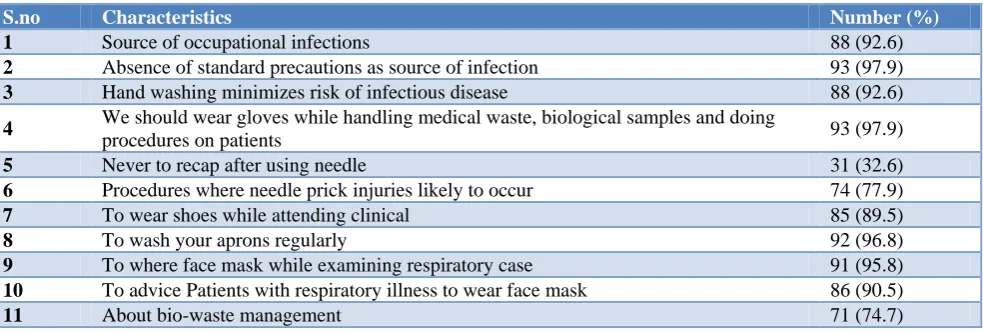
Majority, 92.6% of participants knew the probable source of infection, 97.9% definitely knew that health care professionals contact infections if standard precautions
were not followed. Under standard precautions majority of participants were knowledgeable regarding importance of hand washing with disinfectant, wearing shoes, face mask, gloves, and aprons while examining patients and respiratory patients should be advised to wear face mask. 77.9% of participants were aware of the procedures during which they were at risk of acquiring needle stick injury while only 32.6% knew that they should not recap after using needle. Majority of the participants, 74.7% knew about bio-medical waste management as shown in Table 1.
Hand hygiene knowledge
Table 2 shows that 96.8% of participants recommend hand hygiene to protect themselves from contacting infection. Only 51.6% students were aware of the correct and all steps of hand wash. More than ninety percent recommend hand wash with alcohol or other disinfectant before abdominal examination of patient and after attending clinical postings. 78.9% of positive indications for hand hygiene outlined in the questionnaire were correctly identified. All positive indications of hand hygiene were aware only to 38.9% (37) of students.
Knowledge and practice of blood borne infections and prevention
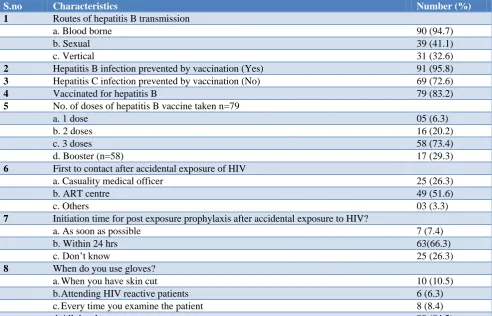
Parenteral route like blood transfusion, needle stick injury or other ways of infected blood contact as the route of transmission of hepatitis B infection was known by 94.7% of participants while sexual and vertical route by 41.1% and 32.6% respectively. All the routes of transmission was known only to 21 (22%) of participants. 95.8% knew that hepatitis B infection can be prevented by vaccination. 83.2% were already vaccinated to hepatitis B and among vaccinated 73.4% had completed the course fully. ART centre should be contacted after accidental exposure of HIV reactive body fluids according to 51.6% participants and that too within 24 hours by 66.3% (Table 3).
Table 1: Knowledge of risk of infections and its preventive measures among study participants.
S.no Characteristics Number (%)
1 Source of occupational infections 88 (92.6)
2 Absence of standard precautions as source of infection 93 (97.9)
3 Hand washing minimizes risk of infectious disease 88 (92.6)
4 We should wear gloves while handling medical waste, biological samples and doing
procedures on patients 93 (97.9)
5 Never to recap after using needle 31 (32.6)
6 Procedures where needle prick injuries likely to occur 74 (77.9)
7 To wear shoes while attending clinical 85 (89.5)
8 To wash your aprons regularly 92 (96.8)
9 To where face mask while examining respiratory case 91 (95.8)
10 To advice Patients with respiratory illness to wear face mask 86 (90.5)
11 About bio-waste management 71 (74.7)
97.9% definitely knew that health care professionals contact infections if standard precautions were not followed. Majority of participants were knowledgeable regarding standard precautions. Only 32.6% knew that they should not recap after using needle. Majority of the participants, 74.7% knew about bio-medical waste management.
83.2 78.9
46.7
36.8
23.2
15.8
Table 2: Hand hygiene knowledge.
S. no. Characteristics Number (%)
1 Is hand hygiene recommended to prevent infections 92 (96.8)
2 Is hand hygiene (washing with antiseptic soap/alcohol hand rub) recommended?
A Before abdominal examination 86 (90.5)
B Before blood sample extraction with gloved hands. 64 (67.4)
C After dressing the wound with gloved hands 70 (73.7)
D After shaking hands with patients at the end of detailed history taking session 83 (87.4)
E After touching apparently clean linen bedding or food package in the patient‟s room. 72 (75.8)
F After attending clinical postings 89 (93.7)
3 Steps of surgical hand wash 49 (51.6)
96.8% of participants recommend hand hygiene to protect themselves from contacting infection. Only 51.6% students were aware of the correct and all steps of hand wash.
Table 3: Knowledge and practice of blood borne infections and prevention.
S.no Characteristics Number (%)
1 Routes of hepatitis B transmission
a. Blood borne 90 (94.7)
b. Sexual 39 (41.1)
c. Vertical 31 (32.6)
2 Hepatitis B infection prevented by vaccination (Yes) 91 (95.8)
3 Hepatitis C infection prevented by vaccination (No) 69 (72.6)
4 Vaccinated for hepatitis B 79 (83.2)
5 No. of doses of hepatitis B vaccine taken n=79
a. 1 dose 05 (6.3)
b. 2 doses 16 (20.2)
c. 3 doses 58 (73.4)
d. Booster (n=58) 17 (29.3)
6 First to contact after accidental exposure of HIV
a. Casuality medical officer 25 (26.3)
b. ART centre 49 (51.6)
c. Others 03 (3.3)
7 Initiation time for post exposure prophylaxis after accidental exposure to HIV?
a. As soon as possible 7 (7.4)
b. Within 24 hrs 63(66.3)
c. Don‟t know 25 (26.3)
8 When do you use gloves?
a.When you have skin cut 10 (10.5)
b.Attending HIV reactive patients 6 (6.3)
c.Every time you examine the patient 8 (8.4)
d.All the above 80 (84.2)
Parenteral route like blood transfusion, needle stick injury or other ways of infected blood contact as the route of transmission of Hepatitis B infection was known by 94.7% of participants while sexual and vertical route by 41.1% and 32.6% respectively. 95.8% knew that Hepatitis B infection can be prevented by vaccination. 83.2% were already vaccinated to Hepatitis B and among vaccinated 73.4% had completed the course fully. ART centre should be contacted after accidental exposure of HIV reactive body fluids according to 51.6% participants and that too within 24 hours by 66.3%.
Overall scoring for knowledge on standard precautions, personal protective equipments, hand washing had been done. Mean scoring was 20.89±2.443. Poor knowledge scoring of <19 was seen in 17.9%, satisfactory knowledge in 53.7% and good knowledge in 28.4% of the medical students. Statistically significant association of knowledge levels was not seen with gender.
DISCUSSION
care professionals at risk of hepatitis B infection while 78.9% knew so in our study.8
Only 68-73% of the medical students from a college in Hyderabad knew bio–medical waste management rules which says that all infective materials should be discarded in yellow colour bags and waste sharps and needles in white color bags; similarly 74.7% knew about
bio-medical waste management in our study.8 Hand
washing reduces the incidence of health care associated infections was known to 71.3% of medical students in a study done by Tarek et al in Saudi Arabia while in our study most of the students (92%) were aware of it.9 Even 82.1% of the medical students knew that used needles should not be recapped which was far more than our study result where only 32.6% knew it.9 Patients with illnesses spread by droplets or spray must wear the facemask was known to 92% of medical interns in a study done in Saudi Arabia which was similar to our respondents knowledge.10
Cleaning the hands at the right time is the most crucial practice not only to save life but also to reduce the spread of antimicrobial resistance. Across all settings from advanced health care facilities to primary healthcare centers “Hand hygiene” is the single most cost-effective and practical measure to reduce the incidence of healthcare-associated infections.11-13 To address the problem of lack of compliance with hand hygiene, continuous efforts are being made to identify effective and sustainable strategies. One of such efforts is the introduction of an evidence-based concept of “My five moments for hand hygiene” by World Health Organization. These five moments that call for the use of hand hygiene include the moment before touching a patient, before performing aseptic and clean procedures, after being at risk of exposure to body fluids, after touching a patient, and after touching patient surroundings. This concept has been aptly used to improve understanding, training, monitoring, and reporting hand hygiene among healthcare workers.7 In our study all positive indications of hand hygiene were aware only to 38.9% (37) of students and near similar results were seen in other studies too.14,15 In a study done by Kumaril, only 58% of medical students had the knowledge of all the steps of hand washing techniques which was similar to our study result.16
Only very few, 22% of our medical students knew various modes of transmission of hepatitis B contrary to which 85.42% of the respondents were aware of it in other similar study.8 Blood transfusion, needle stick injury or other ways of infected blood contact as the route of transmission of hepatitis B infection was known by 94.7% of participants while sexual and vertical route by 41.1% and 32.6% respectively and similar results were seen in other studies. 8,17 Compared to ours, knowledge of sexual and vertical transmission was more than 70% in studies done by Singh at Ahmedabad and Al – Hazim.18,19
Knowledge about transmission of hepatitis B were well below expected levels in study done by Paul at Chennai.17 Though 93.5% of the students believed that hepatitis B is preventable, only 84 - 86% were aware of a vaccine for hepatitis B prevention in other studies which was similar to the response we noticed in our study wherein 95.8% respondents were aware of this preventive fact.8,17-19 However, only 73.4% of the participants were completely vaccinated against hepatitis B infection similar to other studies.16,17 But very poor vaccination coverage of 36.46% and 52.2% was observed in another studies done in similar setting.8,19 66.3% students expressed that anti-retroviral therapy should be started within 24 hours of accidental exposure to needle stick injury while attending HIV patient, similar to which 89% of third year students felt the same in another study.4 The World Health Organization (WHO) contributing to the patient safety program through “Clean Care is Safer Care” (CCiSC), launched in 2005 and Save lives: Clean your hands campaigns launched in 2009 dedicated to the prevention of HCAI. World Hand Hygiene Day is celebrated every year on 5th May with this year‟s theme being “It‟s in your hands to prevent sepsis in health care” with a forethought of a simple procedure of cleaning hands can save life from HCAI.16,20
Limitations
This study was conducted in only one institute setup. It was a cross-sectional survey done using self-reporting questionnaire for assessment of awareness and practice, on a limited sample size and thus, likely to be affected by bias. As the first and in regular contact of the patients are health workers, nurses, residents and doctors, we could have got more informative data on including them in the study regarding HCAI.
CONCLUSION
Knowledge of the medical students regarding infection source is adequate but infection prevention practices was relatively less particularly needle stick injury prevention, hand hygiene techniques, blood borne infection control. Inspite of this, majority of them were vaccinated against Hepatitis B infection which substantiates the awareness against infection protection. Insufficient and ineffective instructions to medical students through the curriculum pose them vulnerable to health facilities related infections. Proper curricular reform and training protects students and their patients. Finally to reinforce the
knowledge of universal precaution continually
ACKNOWLEDGEMENTS
The author would like to thank the medical students of Kurnool Medical College for their participation in the study. Also special thanks to Dr. G.S. Rama Prasad, Principal, Dr. A. Sreedevi, Professor and Head of Department of Community Medicine for supporting and guiding us in carrying out the study.
Funding: No funding sources Conflict of interest: None declared
Ethical approval: The study was approved by the Institutional Ethics Committee
REFERENCES
1. World health organization. Occupational health
Topics: Health worker occupational health.
Available at http://www.who.int/occupational_
health/topics/hcworkers/en/. Accessed on 12
October 2017.
2. Ministry of Health and family welfare, National AIDS Control organization. Guidelines on HIV
testing. 127, March 2007. Available at:
http://www.who.int/hiv/pub/guidelines/india_art.pd. Accessed on 08 March 2018.
3. Barikani A, Afaghi A. Knowledge, attitude and
practice towards standard isolation and precautions among Iranian medical students. Global J Health Sci. 2012;4(2):142-6.
4. Kulkarni V, Papannaa MK, Mohanty U, et al.
Awareness of medical students in a medicalcollege in Mangalore, Karnataka, India concerning infection prevention practices. J Infection Public Health. 2013;6:261-8.
5. Kotwal A, Taneja D. Health care workers and
universal precautions;perceptions and determinants of non-compliance. Indian J Community Med. 2010;35(4):526-8.
6. Kermode M, Jolley D, Langkham B, Thomas MS,
Holmes W, Gifford SM. Compliance with universal precautions among health care workers in rural north India. Am J Infection Control. 2005;33:27-33. 7. Sax H, Allegranzi B, Uckay I, Larson E, Boyce J,
Pittet D. „My five moments for hand hygiene‟: a user-centred design approach to understand, train, monitor and report hand hygiene. J Hospital Infection. 2007;67(1):9–21.
8. Pavani K, Srinivas Rao MS, Vinayaraj EV, Dass M.
A study on awareness, occupational risk perception & level of vaccination against hepatitis-B among medical & nursing students in tertiary care hospital, Hyderabad. Int J Res Med Sci. 2015;3:583-7.
9. Tarek Tawfik Amin etal.Standard Precautions and
Infection Control, Medical Students' Knowledge
and Behavior at a Saudi University: The Need for Change. Global J Health Sci. 2013;5(4):114-25. 10. Alraddadi W, Aljabri JN, Alghamdi SA, Alsulami
FH, Selim EHB, Alfallatah ZY, et al. Infection control knowledge and practices among medical and dental interns at Taibah university, Saudi Arabia. Int J Adv Res. 2017;5(1):2163-71.
11. Mathur P. Hand hygiene: back to the basics of
infection control. Indian J Med Res.
2011;134(11):611–20.
12. Kelc´ıkova S, Skodova Z, Straka S. Effectiveness of
hand hygiene education in a basic nursing school curricula. Public Health Nursing. 2012;29(2):152–9. 13. Jeer M, Shruthi U, Krishna S, Sagarika S. Role of Hand Hygiene in Reducing Transient Flora on the Hands of Health Care Workers (HCW) at a Tertiary Health Care Centre in Ballari, India. Int J Curr Microbiol App Sci. 2016;5(6):66-71.
14. Kadi A, Salati SA. Hand Hygiene Practices among Medical Students. Interdisciplinary Perspectives on Infect Dis. 2012;2012:1 -6.
15. Graf K, Chaberny IF, Vonberg RP. Beliefs about hand hygiene: a survey in medical students in their first clinical year. Am J Infection Control. 2011;39(10):885–8.
16. Kumaril G, Rupali B. Study to Assess Knowledge, Attitude and Practice of Hand Hygiene among Medical and Nursing Students at Gauhati Medical College & Hospital, Guwahati, Assam. Indian J Basic Applied Med Res. 2016;5(2):322-8.
17. Paul P, Arumugam B. Knowledge and awareness
regarding hepatitis B infection among medical and dental students: a comparative cross sectional study. Int J Res Med Sci. 2015;3:2352-6.
18. Singh A, Jain S. Prevention of Hepatitis
B-Knowledge and Practices Among Medical Students. Indian Medical Gazette. 2012;2:52-6.
19. Al-Hazmi A. Knowledge, Attitudes, and Practice of
Medical Students Regarding Occupational Risks of Hepatitis B Virus in College of Medicine, Aljouf University. Ann Med Health Sciences Res. 2015;5(1):13-9.
20. World Health Organisation. Infection Prevention
and control, Campaign. Save lives: clean your hands 5 May 2018. Available at http://www.who.int/ infection-prevention/campaigns/clean-hands/ 5may2018/en/. Accessed on 09 March 2018.