Physiological response of maize and soybean to partial
root-zone drying irrigation under N fertilization levels
Hang Liu1,3, Fengbin Song1*, Shengqun Liu1, Fulai Liu2, Xiancan Zhu1*1Northeast Institute of Geography and Agroecology, Chinese Academy of Sciences, Changchun, 130102, P.R. China, 2Department of Plant and Environmental Sciences, Faculty of Science, University of Copenhagen, Taastrup DK-2630, Denmark, 3University of Chinese Academy of Sciences, Beijing, 101408, P.R. China
INTRODUCTION
Maize and soybean are the main grain crops in Northeast China (NEC). The maize and soybean belt of NEC includes Heilongjiang, Jilin, and Liaoning Provinces, as well as Inner Mongolia, and accounts for ~34% and 43% of the total production and 31% and 43% of the growing area in China, respectively. Crop production in NEC is mainly rainfed, and droughts occur due to annual and seasonal fluctuations in precipitation. Within the areas where these crops grown, available water resources have become the most limiting factor. The Food and Agriculture Organization (FAO) has reported that practically 60% of total available water resources in the world are consumed by agriculture (Lin et al., 2012). To meet the demand of human consumption, the world’s irrigated area would need to be increased by more than 20% and the irrigated crop yield would need to be increased by 40% by 2025 (Kevin et al., 2007). Irrigation plays an important role in feeding the
world and provides opportunities for population expansion (Johan et al., 2007).
Partial root-zone drying (PRD) is a novel irrigation technique that has the potential to reduce water use significantly, while maintaining yields comparable to those of full irrigation (Kirda et al., 2004). This method requires that part of the root is exposed to drying soil while the remaining part is irrigated. The wet and dry sides of the roots are alternated according to the crop types, growing stages and soil water balance (Loveys et al., 2000; Davies et al., 2002; Ebrahimian et al., 2013).
PRD has been used to explore plant growth, nutrient uptake and water use efficiency (WUE) (Ashinie et al., 2016; Kusakabe et al., 2016; Liu et al., 2015). Plant dry biomass significantly decreased under fixed partial root-zone irrigation (FPRI) and deficit irrigation (DI) for maize (Wang et al., 2016). Compared to conventional irrigation (CI), PRD
Water stress induces physiological changes in plants, and partial root-zone drying irrigation (PRD) is a water-saving irrigation strategy that can regulate plant physiological responses. This study was to investigate the physiological responses of maize and soybean to PRD and
deficit irrigation (DI) under two N-fertilization levels. Plants were grown in a split-root pot culture and were exposed to three irrigation treatments, including full irrigation (FI), DI and PRD, at two fertilization levels (2 and 3 g Pot-1 N). We found that PRD and DI significantly
decreased the biomass of two plant species and PRD inhibited less dry mass than DI. Water stress resulted in a higher leaf malondialdehyde content in the leaves of maize and soybean at two fertilization levels, with a smaller increment of PRD than DI. PRD had higher proline content in maize at high N fertilization and in soybean at normal N level than DI. Soluble sugar and protein contents of maize and soybean were higher under PRD than DI at two N levels, except soluble protein content of soybean at normal N level. PRD reduced superoxide dismutase, peroxidase and ascorbate peroxidase (APX) activities of maize and soybean. Moreover, soluble sugar content and APX activity of maize and soybean and proline and protein contents of maize were significantly affected by N treatments. These results indicate that
PRD could alleviate the negative effects induced by water stress on maize and soybean through regulation of physiological parameters.
Keywords: Antioxidative enzymes;Deficit irrigation; Lipid peroxidation; Osmotic adjustment; Partial root-zone drying
A B S T R A C T
http://www.ejfa.me/
*Corresponding author:
Fengbin Song, Northeast Institute of Geography and Agroecology, Chinese Academy of Sciences, Changchun, 130102, P.R. China. E-mail: [email protected]; S Liu. Xiancan Zhu, 1Northeast Institute of Geography and Agroecology, Chinese Academy of Sciences, Changchun, 130102, P.R. China. E-mail: [email protected]
Received: 23 October 2017 ; Accepted: 23 April 2018
decreased plant biomass accumulation by 6.7% Under appropriate fertilization and watered conditions (Li et al., 2010b). Spatially variable water application with PRD causes change of soil moisture within the rhizosphere, influencing N availability and plant N uptake (Han, 2013). Some studies have reported that PRD significantly improved N uptake, with increases of 15 to 100% compared to FPRI, when N application was combined (Zhang et al., 2014; Li et al., 2017). Nitrogen use efficiency under PRD was significantly greater than under CI (Ebrahimian et al., 2013; Zhang et al., 2014).
There are numerous studies on plant physiological responses under PRD (Basile et al., 2016; Ennahli et al., 2015). Zhou et al. (2007) showed that PRD increased soluble sugar content and decreased malondialdehyde (MDA) content in the leaves of lily during the period of cut flower. Li et al. (2010a) found that PRD had a slight decreasing effect on the proline and MDA contents as well as the superoxide dismutase (SOD) and peroxidase (POD) activities of maize, but recovery to the levels of CI was rapid after full irrigation. FPRI significantly reduced SOD and POD activities and increased proline and MDA contents (Tan et al., 2006). Hu et al. (2010) reported that leaf SOD activity of maize plants was decreased under CI and PRD. By contrast, the high SOD activity in maize leaves under FPRI remained after rewatering. The leaf MDA content was higher during a water deficit and remained higher after rewatering under FPRI than those under CI and PRD. However, to the best of our knowledge, the effect of PRD under different N fertilizer treatments on physiological responses, such as osmotic substances, membrane lipid peroxidation, compatible solutes and antioxidant enzyme activity, are not well documented. We attempted to investigate the effect of PRD and N fertilizers on the growth, membrane lipid peroxidation, compatible solutes and activities of antioxidant enzymes in the leaves of maize and soybean as well as how this information contributes to further gains in the efficient production of maize and soybean.
MATERIALS AND METHODS
Experimental setupThe experiment was conducted in a rain-shelter of the Northeast Institute of Geography and Agroecology, Chinese Academy of Sciences from May to August in 2016. The soil field capacity was 25%. The experimental PVC pots (25 cm diameter and 40 cm depth) were evenly divided into two vertical compartments by plastic sheets such that water exchange between the two compartments was prevented. A section of plastic (5 cm in width and height) was removed from the middle of the sheets at the top of the pots where the seed tubers were planted. The pots were filled with 18.2 kg of naturally dried soil. At the third leaf stage, maize and soybean seedlings were
transplanted into the pots. Before the treatment, each side of the pots reached more than 90% of the field water capacity to ensure that seedling root growth was robust.
Water and N fertilizer treatments
The treatments were composed of three water irrigation techniques (full irrigation (FI), DI and PRD) and two N fertilizer treatments (normal N fertilizer treatment (2 g Pot-1 N) and high N fertilizer treatment (3 g Pot-1 N)).
Before filling the pots, the N fertilizer was mixed thoroughly and homogeneously with the soil. For all pots, 2 g pot-1 P and 2 g pot-1 K were mixed into the soil to meet the macronutrient requirements for plant growth.
Four weeks after transplanting, the plants were subjected to (1) FI and maintained at field capacity; (2) PRD, irrigated with 60-70% of the total water applied to only one side of the roots, alternating the sides every 7 days; and (3) DI, in which the same amount of water as PRD was evenly irrigated to the two soil compartments. The experiment was a complete randomized design with 6 replicates for each treatment, and this yielded 72 pots in total (36 pots for maize, 36 pots for soybean). The water treatments lasted for 36 days, during which period each soil compartment of the PRD plants had experienced three dry/wet cycles. The water used for irrigation was tap water with negligible concentrations of nutrients.
Parameter measurements
Plant samples were collected at the end of the water treatments. Plant dry biomass, including leaves, stem and roots, was recorded after oven-drying until constant weight. Fresh leaves were placed into separate bags, and frozen in liquid nitrogen, quickly stored at -80 ºC refrigerator, and measuring physiological properties.
MDA was measured according to the TBA reaction (Zhang and Zhang, 2006). The proline content was determined using sulfosalicylic acid (Zhang and Zhang, 2006). The soluble sugar content was determined by the anthrone method (Zhang and Zhang, 2006).
The soluble protein content was determined by Coomassie brilliant blue, G-250 (Zhang and Zhang, 2006). The SOD activity was measured according to nitroblue tetrazolium (NBT) (Zhang and Zhang, 2006). The POD activity was determined using guaiacol oxidation (Zhang and Zhang, 2006). The APX activity was determined by monitoring the decrease in absorbance at 290 nm as ascorbate was oxidized (Zhang and Zhang, 2006).
Data analysis
RESULTS
Plant growthAs shown in Table 1, plant biomass of maize and soybean were higher under FI than under PRD and DI. Under water stress, plant growth suffered inhibition. Compared to FI, PRD reduced the leaf, shoot and root dry mass of maize by 44, 105 and 160%, and DI by 51, 212 and 218%, respectively, with the normal N fertilizer treatment (2 g N Pot-1). With the high N fertilizer treatment (3 g N Pot-1), PRD reduced dry mass by 99, 122 and 98%, and
DI by 118, 152 and 218%, respectively. PRD inhibited less leaf, shoot, root and total dry mass than DI.
For soybean, compared to FI, under normal N fertilizer and high N fertilizer treatment, PRD decreased the dry leaf mass by 29 and 64% and DI by 43 and 68%, respectively. PRD decreased the dry shoot mass by 40 and 23% and DI by 30 and 20%, respectively. The magnitude of the change was less than that of maize.
Lipid peroxidation
Leaf MDA contents of maize and soybean were affected by water treatments (Table 2, Fig. 1). The leaf MDA content under PRD and DI was always higher than that under FI. Compared to FI, PRD and DI under normal and high N fertilization levels increased the MDA content of maize by 16, 18, 26 and 25%, respectively (Fig. 1a). For soybean, these markedly increased by 32, 21, 61 and 44%, respectively, with a greater increment than in maize (Fig. 1b). However, leaf MDA contents of maize and soybean were not affected by N treatments and interaction of N × water (Table 2).
Osmotic adjustment
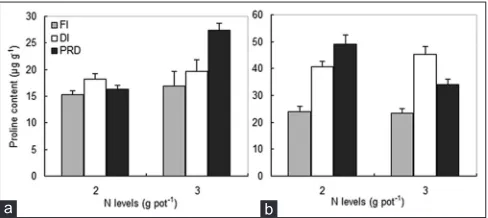
Significant effects of water, N and N × water treatments were found on the leaf proline content of maize (Fig. 2, Table 2). DI under normal and high N fertilization levels markedly enhanced he leaf proline content of maize by 19 and 16%, respectively. PRD enhanced the content
by 6.4 and 62%, respectively (Fig. 2a). PRD under the high N fertilization level more significantly increased the leaf proline content than under the normal N fertilization level. PRD and DI under the two N fertilization levels of soybean accumulated significantly more proline compared to FI. PRD dramatically enhanced proline by 104 and 47%, and DI enhanced it by 70 and 95% (Fig. 2b). A significant interactive effect of N × water on proline was observed.
PRD treatment of maize had the highest soluble sugar content of all of the water treatments, and compared with
Table 1: Plant biomass of maize and soybean at two N (2 and 3 g pot) and three water treatments. FI, full irrigation; DI, deficit irrigation; and PRD, partial root‑zone drying (unit, g)
N levels (g pot) Water treatments Leaf Shoot Root Total
Maize Soybean Maize Soybean Maize Soybean Maize Soybean
2 FI 39.35 16.57 41.40 20.84 92.10 7.55 172.86 44.96
DI 25.99 11.56 13.28 16.01 29.00 6.82 68.27 34.38
PRD 27.28 12.83 20.19 14.93 35.36 7.22 82.84 34.98
3 FI 51.46 18.67 47.37 19.64 75.10 7.3 173.93 45.62
DI 23.66 11.11 18.77 16.34 26.85 7.67 72.28 35.12
PRD 25.82 11.34 21.29 15.99 38.02 7.98 85.12 35.31
Source of variation
N ns ns ns ns * ns ns ns
Water ** ns ** ** ** ns ** *
N×Water ns ns ns ns ** ns ns ns
* P<0.05; ** P<0.01; ns, not significant by Duncan’s test.
Fig 1. Leaf malondialehyde (MDA) content of maize (a) and soybean
(b) plants at two N (2 and 3 g pot) and three water treatments. FI, full irrigation; DI, deficit irrigation; and PRD, partial root-zone drying. Bars represent the means±SE.
b a
Fig 2. Leaf proline content of maize (a) and soybean (b) plants at two
N (2 and 3 g pot) and three water treatments. FI, full irrigation; DI, deficit irrigation; and PRD, partial root-zone drying. Bars represent the means±SE.
FI, PRD under the two N fertilization levels increased the soluble sugar content by 8.78 and 44%, respectively. By contrast, DI decreased the content by 8.45 and 23%, respectively (Table 2; Fig. 3a). With an increase of the N fertilization level, soluble sugar content under PRD and DI decreased. Unlike maize, under the N fertilization levels, the leaf soluble sugar content in soybean under PRD and DI decreased compared to FI (Fig. 3b). With the increase in nitrogen content, the soluble sugar content under PRD and DI increased. There was a significant difference at the interaction of N × water (Table 2).
Compared to FI, the leaf soluble protein content of maize under the two N fertilization levels was found to increase under PRD, but declined under DI (Fig. 4a). The variation in the high N fertilizer treatments was more distinct than that of the normal N fertilization level. Water treatments and N fertilizers caused a significant difference in the leaf soluble protein content of maize (Table 2). However, the two N treatments provided the statistically same results for soybean.
Antioxidant enzyme activities
PRD caused a decrease in SOD activity, and DI triggered SOD activity intensely in the normal N fertilization level of maize (Fig. 5a). Increments in the high N fertilization level induced SOD activity and were more explicit than those for the normal N fertilization level. Therefore, this change was found to be significant (Table 2). The highest SOD activity was observed from DI of soybean under the normal N fertilization level; it increased SOD activity by 97% compared to FI, while PRD reduced SOD activity by 49% (Fig. 5b). The interaction of N × water caused a significant difference in SOD activity (Table 2).
POD activity exhibited a similar trend to that of SOD activity for maize; PRD caused a reduction in POD activity, and the highest POD activity was observed from DI at the normal N fertilization level of maize (Fig. 5c). Increased POD activity was observed under PRD and DI at the high N level. For soybean, PRD and FI at the high N level caused statistically similar results regarding the POD activity, while DI elevated the POD activity (Fig. 5d). The normal N fertilization level induced the same trend as maize. The interaction of N × water in maize was found to be significant, while in soybean, it was observed to be stable and statistically the same (Table 2).
APX activity in both PRD and DI presented a rising trend in maize and soybean, compared to FI; DI remarkably increased by 74% at the normal N fertilization level of maize, and PRD increased by 39% (Fig. 5e). With an increase in the N fertilization level, APX activity decreased. The increment in DI was more distinct than in PRD for soybean (Fig. 5f). APX activity at the normal N fertilization level for soybean was slightly lower than that for the high N fertilization level.
DISCUSSION
This study showed that PRD and DI affected the growth of maize and soybean. Plant biomass of maize and soybean
Table 2: Output of two‑way ANOVA for the effects of N and water treatments and their interaction on the physiological parameters of maize and soybean plants
N Water N×Water
Maize
MDA ns ** ns
Proline ** * *
Sugar ** ** ns
Protein ** ** **
SOD ns ** *
POD ns ** *
APX * ** ns
Soybean
MDA ns ** ns
Proline ns ** **
Sugar * ** *
Protein ns ns **
SOD ns ** **
POD ns ** ns
APX * ** ns
*P<0.05; **P<0.01; ns, not significant.
Fig 3. Leaf soluble sugar content of maize (a) and soybean (b) plants
at two N (2 and 3 g pot) and three water treatments. FI, full irrigation; DI, deficit irrigation; and PRD, partial root-zone drying. Bars represent the means±SE.
b a
Fig 4. Leaf soluble protein content of maize (a) and soybean (b) plants
at two N (2 and 3 g pot) and three water treatments. FI, full irrigation; DI, deficit irrigation; and PRD, partial root-zone drying. Bars represent the means±SE.
markedly decreased more under PRD and DI than under FI. This indicates that plant growth suffered inhibition under water stress. Importantly, the degree of inhibition under PRD was less than under DI. In addition, maize growth was inhibited much more than soybean under water stress. However, plant growth was not affected by N fertilizer treatments. It has been reported that plant growth is greatly restrained under water stress. A previous investigation indicated that drought treatments caused strong reductions of biomass (Rollins et al., 2013). Wang et al. (2008) demonstrated that the maximum biomass accumulation of maize was obtained under well-watered conditions, but a severe water deficit caused a 50% reduction under CI; such reduction was much smaller under APRI, similar to this study. Li et al. (2017) advocated that PRD improved biomass accumulation more compared to non-PRD treatments. A previous study demonstrated that total dry mass accumulation was high under higher fertilization than low fertilization treatment (Li et al., 2010a). The effect of APRI on plant biomass accumulation depended on the fertilization level as well as the duration and stage under which APRI was conducted (Liang et al., 2013).
Water stress leading to damage to plants can be determined by physiological methods, such as measuring lipid peroxidation, because membrane destruction is a
consequence of active oxygen (Mohammad et al., 2016). MDA is often considered to be the secondary product and an index to reflect the degree of membrane lipid peroxidation (Ali et al. 2005). This study showed that the MDA content in leaves increased under PRD less than under DI for maize and soybean and that soybean had a greater increment than maize. The increasing in MDA content might be a feedback mechanism responding to restraining the activities of antioxidant enzymes, thus inducing possible damage to membranes. However, the MDA content at the high N fertilization level remained lower than that at the normal N fertilization level, which indicated that the presence of N fertilizer could slightly alleviate the peroxidation of membrane lipids. More studies have found that the MDA content was increased with the drought intensity (Sofo et al., 2004; Zhang et al., 2015). Bai et al. (2006) showed that membrane lipid peroxidation significantly increased at all stages. Qi et al. (2008) indicated that FPRI significantly increased leaf MDA content, but APRI only had a slight effect. Li et al. (2010b) demonstrated that both APRI and FPRI increased leaf MDA content and FPRI increased more significantly than APRI.
Osmotic adjustment is considered to be an important mechanism of water stress for plants. When a plant is subjected to water stress, osmotic adjustment occurs to decrease its water potential to maintain a beneficial gradient of water flow. Leaf proline accumulation is a sensitive physiological indicator that is used to study the responses of plant to water stress (Rejeb et al., 2014). In this study, under PRD and DI, maize and soybean accumulated significantly more proline compared to FI. The proline content accumulated in leaves, and water stress was improved via osmotic adjustment. PRD under the normal N fertilization level increased the leaf proline content less than DI for maize. By contrast, PRD under the high N fertilization level enhanced the leaf proline content less than DI for soybean. The variation in leaf proline suggested that the effect of PRD on plants was weaker than DI, so there was no need to synthesize additional proline for osmotic protection. However, PRD under the high N fertilization level enhanced the leaf proline content more than DI for maize, and PRD under the normal N fertilization level increased the leaf proline content more than DI for soybean. The leaf proline content of soybean accumulated to a significantly greater degree than that of maize. This trend clearly indicated that maize had more positive physiology than soybean and could reduce the intensity of water stress. The leaf proline content was significantly different under the interaction of the water treatments and N fertilizers. It is probable that the leaf proline content leads to a trade-off between water stress and nitrogen fertilizers in plants. Lobato et al. (2008) demonstrated that the accumulation of proline in soybean
Fig 5. Activities of leaf superoxide dismutase (SOD) (a, maize and b,
soybean), peroxidase (POD) (c, maize and d, soybean) and ascorbate peroxidase (APX) (e, maize and f, soybean) at two N (2 and 3 g pot) and three water treatments. FI, full irrigation; DI, deficit irrigation; and PRD, partial root-zone drying. Bars represent the means±SE.
b
c d
f a
leaves was increased by 67% under water deficit. Teixeira and Pereira (2006) showed that the proline content was significantly increased in all organs of potato under water stress. These previous results are similar to our results.
Plants can actively accumulate soluble sugar when subjected to water stress, which regulate the osmotic potential of plants to enhance the plant water-holding capacity and alleviate osmotic stress (Song and Wang, 2002). After water stress, for maize, the leaf soluble sugar content and soluble protein content showed an upward trend under PRD. By contrast, DI showed a downward trend. Furthermore, with an increasing nitrogen content, the soluble sugar content under PRD decreased less compared to DI. The leaf soluble sugar content in PRD was decreased less compared to DI for soybean, and with an increasing nitrogen content, the soluble sugar content increased under PRD was similar to that of FI, but DI was still lower than FI. Some of the drought responsive leaf soluble sugar content constantly increases during water stress, and the soluble sugar content of maize increased with increasing drought stress (Wei et al., 2010). Under the normal N fertilization level, PRD resulted in a decrease compared to DI in the soluble protein content of soybean. In the high N fertilization level treatments, the soluble protein levels in PRD showed an upward trend. The total protein content in leaves was decreased under drought stress (Fazeli et al., 2007). By decreasing the water potential, the total soluble protein content first increased and then decreased in roots and leaves (Nayer and Reza, 2008).
The present results showed that PRD caused a decrease and DI triggered an increase in SOD activity for maize and soybean, except for the high N fertilization level in maize. POD activity exhibited a similar trend with SOD activity at the normal N fertilization level. By contrast, PRD enhanced POD activity at the high N fertilization level of maize and soybean. These results suggested that the decrease in SOD and POD activities is closely linked to the accumulation of MDA (Li et al., 2011). The decrease in these enzyme activities led to an accumulation of lipid peroxidation, thereby inducing damage to membranes. It was reported that water stress increased the activities of SOD POD (Bai et al., 2006; Pan et al., 2006; Fazeli et al., 2007). However, other literatures have reported no change or decrease in SOD and POD activities in response to water stress (Boo and Jung, 1999; Zhang and Kirham, 1996). Xue et al. (2016) indicated that in rice leaves, water stress not only increased the MDA content but also lowered the SOD and POD activities. Qi et al. (2008)reported that FPRI and APRI treatments enhanced leaf SOD activity. Moreover, the fertilization level may affected SOD activity, but unaffected POD activity. Sun et al. (2001) found that the SOD and POD activities were increased at a suitable nitrogen level
under water stress. SOD converts toxic O2- radicals to H 2O2, which must be scavenged to O2, and water by antioxidant enzymes, such as POD and APX (Ozkur et al., 2009). This study found that in DI, APX activity presented a rising trend for maize and soybean compared to PRD, which was in agreement with the results by Reddy et al. (2004). APX activity was not hampered by water stress, as high APX activity was present in DI. Along with the increase in N fertilizers, APX activity decreased in maize under DI, but in soybean, the activity increased. Mirzaee et al. (2013) indicated that water stress increased the APX activity in both shoots and roots of canola. A similar result was found in rice (Kunder et al., 2016). These results suggested that fertilization regulated increased tolerance to water stress.
CONCLUSIONS
PRD and DI significantly decreased the biomass of maize and soybean, but PRD decreased the biomass less than DI. PRD and DI increased the leaf MDA content and with a smaller increment of PRD than DI. PRD reduced SOD, POD and APX activities of maize and soybean. PRD elevated soluble sugar and proline content of maize and soybean at two N fertilization levels, Moreover, soluble sugar content, APX activity of maize and soybean and proline and protein contents of maize were significantly affected by N treatments. The present study revealed that PRD could mitigate damage caused by water stress in maize and soybean by regulating osmotic substances, membrane lipid peroxidation, compatible solutes and the activities of antioxidant enzymes.
ACKNOWLEDGEMENTS
The work is supported by the Youth Innovation Promotion Association of the Chinese Academy of Sciences (2018264) and the “One-Three-Five” Strategic Planning Program of Chinese Academy of Sciences (IGA-135-04).
Authors’ contributions
F.S. and X.Z. conceived designed the study; H.L., X.Z. and S.L. carried out the experiments; X.Z. and F.L. analysed the data; H.L., and X.Z. wrote the manuscript. All authors read and approved the final manuscript.
REFERENCES
Ali, M. B., E. Hahn and K. Paek. 2005. Effects of temperature on oxidative stress defense systems, lipid peroxidation and lipoxygenase activity in Phalaenopsis. Plant Physiol. Biochem. 43: 213-223.
Regulated deficit irrigation and partial root-zone drying irrigation impact bioactive compounds and antioxidant activity in two select tomato cultivars. Sci. Hortic. 213: 115-124.
Bai, L. P., F. G. Sui and T. D. Ge. 2006. Effect of soil drought stress on leaf water status, membrane permeability and enzymatic antioxidant system of maize. Pedosphere. 16: 326-32.
Basile, N., C. Antigoni, P Lamprini and P. Angelos. 2016. Pomegranate physiological responses to partial root drying under field conditions. Emir. J. Food Agric. 28: 410-414.
Boo, Y. C. and J. Jung. 1999. Water deficit-induced oxidative stress and antioxidative defenses in rice plants. J. Plant Physiol. 155: 255-261.
Davies, W. J., S. Wilkinson and B. Loveys. 2002. Stomatal control by chemical signaling and the exploitation of this mechanism to increase water use efficiency in agriculture. New Phytol. 153: 449-460.
Ebrahimian, H., A. Liaghat, M. Parsinejad, E. Playán, F. Abbasi, M. Navabian and B. Lattore. 2013. Optimum design of alternate and conventional furrow fertigation to minimize nitrate loss. J. Irrig. Drain. Eng. 139: 911-921.
Ennahli, S., S. Kadir, H. Khatamian, D. Scurlock and H. Hanine. 2015. Physiological and biochemical responses to partial root-zone drying of three grape cultivars. Theor. Exp. Plant Physiol. 27:141-156.
Fazeli, F., M. Ghorbanli and V. Niknam. 2007. Effect of drought on biomass, protein content, lipid peroxidation and antioxidant enzymes in two sesame cultivars. Biol. Plant 51: 98-103. Han, K., C. Zhou, N. Li, J. Schmidt, C. Dell and L. Wang. 2013.
Separating nitrogen fertilizer and irrigation water application in an alternating furrow irrigation system for maize production. Nutr. Cycl. Agroecosys. 96: 107-122.
Hu, T. T., L. N. Yuan, J. F. Wang, S. Z. Kang and F. S. Li. 2010. Antioxidation responses of maize roots and leaves to partial root-zone irrigation. Agric. Water Manage. 98: 164-171. Johan, R., L. Mats and F. Malin. 2007. Assessing the water challenge
of a new green revolution in developing countries. PNAS 104: 6253-6260.
Kevin, B. J., L. W. Blair and D. P. Michael. 2007. Irrigation of agricultural crops. Agron. Monograph. 30: 364-381.
Kirda, C., M. Cetin, Y. Dasgan, S. Topcu, H. Kaman, B. Ekici, M.R. Derici and A.I. Ozguven. 2004. Yield response of greenhouse grown tomato to partial root drying and conventional deficit irrigation. Agric. Water Manage. 69: 191-201.
Kundur, R., R. R. T. Papi and R. T. Manohar. 2016. Effect of PEG mediated water stress on solute accumulation, relative water content, biomass and antioxidant enzymes in rice. Indian J. Agric. Res. 50: 398-405.
Kusakabe, A., B. A. Contreras-Barragan, C. R. Simpson, J. M. Enciso, S. D. Nelson and J. C. Melgar. 2016. Application of partial root zone drying to improve irrigation water use efficiency in grapefruit trees. Agric. Water Manage. 178: 66-75.
Li, F. S., C. H. Wei, F. C. Zhang, J. H. Zhang, M. L. Nong and S. Z. Kang. 2010a. Water-use efficiency and physiological responses of maize under partial root-zone irrigation. Agric. Water Manage. 97: 1156-1164.
Li, F. S., J. M. Yu, M. L. Nong, S. Z. Kang and J. H. Zhang. 2010b. Partial root-zone irrigation enhanced soil enzyme activities and water use of maize under different ratios of inorganic to organic nitrogen fertilizers. Agric. Water Manage. 97: 231-239.
Li, J. T., Z. B. Qiu, X. W. Zhang and L. S. Wang. 2011. Exogenous hydrogen peroxide can enhance tolerance of wheat seedlings to salt stress. Acta Physiol. Plant 33: 835-842.
Li, W. R., L. G. Jia and L. Wang. 2017. Chemical signals and their regulations on the plant growth and water use efficiency of cotton seedlings under partial root-zone drying and different nitrogen applications. Saudi J. Biol. Sci. 24(3):477-487. Liang, H., F. Li and M. Nong. 2013. Effects of alternate partial
root-zone irrigation on yield and water use of sticky maize with fertilization. Agric. Water Manage. 116:242-247.
Lin, Y. C., Z. H. Zeng, C. Z. Ren and Y. G. Hu. 2012. Water use efficiency and physiological responses of oat under alternate partial root-zone irrigation in the semiarid areas of Northeast China. Procedia Engin. 28: 33-42.
Liu, C., G. H. Rubæk, F. Liu and M. N. Andersen. 2015. Effect of partial root zone drying and deficit irrigation on nitrogen and phosphorus uptake in potato. Agric. Water Manage. 159: 66-76. Lobato, A. K. S., N. C. F. Oliveira, R. C. L. Costa, F. G. Santos,
R. C. L. Cost, F. J. R. Cruz, H. K. B. Neves and M. J. S. Lopes. 2008. Physiological and biochemical behavior in soybean (Glycine max cv. Sambabia) plants under water deficit. Aust. J. Crop Sci. 2: 25-32.
Loveys, B.R., M. Stoll, P.R. Dry and M.G. McCarthy. 2000. Using plant physiology to improve the water use efficiency of horticultural crops. Acta Hortic. 537: 187-197.
Mirzaee, M., A. Moieni and F. Ghanati. 2013. Effects of Drought Stress on the Lipid Peroxidation and Antioxidant Enzyme Activities in Two Canola (Brassica napus L.) Cultivars. J. Agr. Sci. Tech. 15: 593-602.
Mohammad, B. Z., R. Hooman and S. M. Armin. 2016. Evaluation of antioxidant enzymes, lipid peroxidation and proline content as selection criteria for grain yield under water defcit stress in Barley. J. Appl. Biol. Sci. 10: 71-78.
Nayer, M. and H.Reza. 2008. Effects of Drought Stress on Soluble Proteins in two Maize Varieties. Turk J. Biol. 32: 23-30.
Ozkur, O., F. Ozdemir, M. Bor and I. Turkan. 2009. Physiochemical and Antioxidant Responses of the perennial Xerophyte Capparis ovata Desf to Drought. Environ. Exp. Bot. 66: 487-492. Pan, Y., J. W. Li and L.Y. Zeng. 2006. Effect of salt and drought
stress on antioxidant enzymes activities and SOD isoenzymes of liquorice (Glycyrrhiza uralensis Fisch). Plant Growth Regul. 49: 157-165.
Qi, W., E. Li, H. Zhai, X. Wang and Y. Du. 2008. Physiological and biochemical responses of different scion/rootstock combinations grapevine to partial root zone drought. Chin. J. Appl. Ecol. 19: 306-310.
Reddy, A. R., K. V. Chaitanya, P. P. Jutur and K. Sumithra. 2004. Differential antioxidative responses to water stress among five mulberry (Morus alba L.) cultivars. Environ. Exp. Bot. 52: 33-42. Rejeb, K. B., C. Abdelly and A. Savoure. 2014. How reactive oxygen
species and proline face stress together. Plant Physiol. Biochem. 80:278-284.
Rollins, J. A., E. Habte, S. E. Templer, T. Colby, J. Schmidt and M. V. Korff. 2013. Leaf proteome alterations in the context of physiological and morphological responses to drought and heat stress in barley (Hordeum vulgare L.). J. Exp. Bot. 64: 3201-3212.
Sofo, A., B. Dichio, C. Xiloyannis and A. Masia. 2004. Effects of different irradiance levels on some antioxidant enzymes and on malondialdehyde content during rewatering in olive tree. Plant Sci. 166: 293-302.
Song, S. and Y. Wang. 2002. Molecular response of plant to drought stress. Chin. J. Appl. Ecol. 13: 1037-1044.
on water stress under different nitrogen level in maize. Acta Agric. Boreal - Occident. Sin. 10: 7-10.
Tan, Y., Z. S. Liang, H. B. Shao and F. Du. 2006. Effect of water deficits on the activity of anti-oxidative enzymes and osmoregulation among three different genotypes of Radix astragali at seeding stage. Colloids Surf. B. 49: 60-65.
Teixeira, J. and S. Pereira… 2006. High salinity and drought act on an organ-dependent manner on potato glutamine synthetase expression and accumulation. Journal of Experimental Botany 60: 121-126.
Wang, J. F., S. Z. Kang, F. S. Li, F. C. Zhang, Z. J. Li and J. H. Zhang. 2008. Effects of alternate partial root-zone irrigation on soil microorganism and maize growth. Plant Soil. 302: 45-52. Wang, Y. S., B. Janz, T. Engedal and A. D. Neergaard. 2016. Effect
of irrigation regimes and nitrogen rates on water use efficiency and nitrogen uptake in maize. Agric. Water Manage. 4520: 1-6. Wei, C. H., F. S. Li, C. H. Xu, M. L. Nong, J. M. Yu and H. Luo. 2010.
Effect of regulated deficit irrigation and fertilization on dry matter accumulation and related physiological properties of maize.
Agric. Res. Arid Areas. 26: 76-83.
Xue, J. F. and S. Q. Chen. 2016. Effect of water stress on partial physiological characteristics of rice in cold region. Heilongjiang Agric. Sci. 2: 9-14.
Zhang, J. X. and M. B. Kirham. 1996. Enzymatic responses of the ascorbate-glutathione cycle to drought in sorghum and sunflower plants. Plant Sci. 113: 139-147.
Zhang, J., Y. Wang, H. Cai, J. Wan and Z. Li. 2014. Effects of different biogas slurry irrigation methods on maize physiological indices and soil nitrate-N. China Biogas. 32: 62-65.
Zhang, M., Z. Q. Jin, J. Zhao, G. Zhang and F. Wu. 2015. Physiological and biochemical responses to drought stress in cultivated and tibetan wild barley. Plant Growth Regul. 75: 567-574.
Zhang, Z. A. and M. S. Zhang. 2006. Experimental Guide for Plant Physiology. High Education Press, Beijing.