Published by Oriental Scientific Publishing Company © 2018
This is an Open Access article licensed under a Creative Commons license: Attribution 4.0 International (CC-BY).
Effect of Final Irrigation Protocol on Dentin Microhardness
Farah Salahalden Abbas, Nadeen Jamal Abdulredah and Amer Salman Hassan
Department of Conservative Dentistry, Al MustansiriyahDental College, Baghdad, Iraq. *Coressponding author E-mail: haneenmustafa292@ yahoo.com
http://dx.doi.org/10.13005/bpj/1596
(Received: 04 September 2018; accepted: 01 November 2018)
Endodontic therapy is essentially a debridement procedure that requires the removal of the irritants of the canal and periapical tissue if success is to be gained. The debridement may include instrumentation of the canal, placement of medicament and irrigants. Complete cleaning of the root-canal system requires the use of irrigants that dissolve organic and inorganic material. The study aimed to evaluate changes in dentin microhardness after canal irrigation with different solutions. Twenty four freshly extracted human mandibular molars (distal roots with single canals) were used. 10mm root length was taken as standard length. The roots were embedded into auto polymerizing acrylic resin using plastic molds before the canals preparation and micro hardness test. The distal roots were prepared with one shape rotary file. Before the preparation each root was irrigated with 1ml distilled water. Then the roots were divided into four groups according to the final irrigation protocol: Group A: NaOCl 2.5%, Group B: EDTA 17%, Group C: Citric Acid 40%, Group D: Distilled Water. For (Vickermicrohardness test) the same load and time 500 g test load for 20 seconds, will be conducted three times at distance 0.5mm from canal lumen ; thus there will be 9 indentations on each specimen surface. An average of the three readings for each test condition will be recorded as the VHN value of a specimen. Comparing all four groups statistically there was no significant difference among them. The mean values were found more reduced in EDTA group followed by NaOCL group, and then Control and Citric Acid groups. All the groups showed reduction in dentin microhardness. EDTA group showed the maximum reduction followed by NaOCL group, and least with Citric Acid group.
Keywords: Microhardness; irrigation; EDTA; Citric acid; Vicker test.
Endodontic therapy is essentially a debridement procedure that requires the removal of the irritants of the canal and periapical tissue if success is to be gained. The debridement may be carried out in various ways as the case demands and may include instrumentation of the canal, placement of medicament and irrigants1. The main goal of instrumentation is to facilitate effective irrigation, disinfection, and filling. Several studies using advanced techniques such as microcomputed
tomography (CT) scanning have demonstrated that proportionally large areas of the main root-canal wall remain untouched by the instruments,1 emphasizing the importance of chemical means of cleaning and disinfecting all areas of the root canal2.
of the root dentin may adversely affect sealing ability and adhesion of dental material such as resin cements and root canal sealers to dentin.
Microhardness tests are commonly used to study the physical properties of materials, and they are widely used to measure the hardness of teeth3,4,5. This method is easy, quick, and requires only a tiny area of specimen surface for testing. Using this technique, the specimen surfaces were impressed with a diamond indenter (a Knoop or a Vickers) at a certain load for a certain period of time. After load removal, diagonals of the indentation were measured with an optical microscope. The hardness number was defined by the ratio between the indentation load and the area of the residual impression, which depended on the indenter shape.
There is no single irrigating solution that alone sufficiently covers all of the functions required from an irrigant. Optimal irrigation is based on the combined use of 2 or several irrigating solutions. Complete cleaning of the root-canal system requires the use of irrigants that dissolve organic and inorganic material2.
Sodium hypochlorite is the most popular irrigating solution and is commonly used in concentrations between 0.5% and 6%. It is a potentantimicrobial agent, killing most bacteria instantly on direct contact. It also effectivelydissolves pulpal remnants and collagen, the main organic components of dentin.Although hypochlorite alone does not remove thesmear layer, it affects the organic part of the smear layer, making its complete removalpossible by subsequent irrigation with EDTA or citric acid.Thepresence ofinactivating substances such as exudate from the periapical area, pulp tissue, dentincollagen, and microbial biomass counteract the effectiveness of NaOCl6.
As hypochlorite is active only against the organic matter, other substances must be used to complete the removal of the smear layer and dentin debris. EDTA and Citric Acid effectively dissolve inorganic material, including hydroxyapatite7,8 they have little or no effect on organic tissue and alone they do not have antibacterial activity.
Aim of the study
The study aimed to evaluate changes in dentin microhardness after canal irrigation with different solutions.
MAteriAl And Methods
sample selection
Twenty four freshly extracted human mandibular molars (distal roots with single canals) were used.
selection criteria
1. Straight roots with single canals. 2. Free from caries and cracks. 3. Centered apical foramen. 4. Roots without resorption. 5. Roots length 11mm. sample preparation
The teeth were cleaned of all debris and stored in distilled water till the time of preparation. Teeth were sectioned transversely at cemento- enamel junction using diamond disc operated by low speed hand piece under continuous water coolant. Remnant of pulp tissue were removed by barbed broaches, thenthe patency of the canals were determined with S.S. k-file size 10,15 until it was visible at apical foramen and the working length were established 10mm.The roots were embedded intoauto polymerizing acrylic resin using plastic molds before the canals preparation and micro hardness test.
root canal preparation
The distal roots were prepared with one shape rotary file operated by x-smart micro motor at speed 350-450 r.p.m., torque 1.5 N/cm, gear ratio 16:1. Before the preparation each root was irrigated with 1ml distilled water and one shape rotary file was operated in the canal not more than 1 minute, then the specimens were irrigated with 5 ml of each test solution to receive the final irrigation according to the sample grouping.
sample grouping
The roots were divided into four groups according to the final irrigation protocol:
1. Group A: 6 roots were irrigated with 5ml NaOCl 2.5%.
2. Group B: 6 roots were irrigated with 5ml EDTA 17%.
3. Group C: 6 roots were irrigated with 5ml Citric Acid 40%.
4. Group D: 6 roots were irrigated with 5ml Distilled Water.
Microhardnesstest
table 1. Descriptive statistics
N Mean Std. Std. 95% Confidence Minimum Maximum
Deviation Error Interval for Mean
Lower Upper
Bound Bound
NaOCL 6 48.3 2.3281 0.9504 45.857 50.743 45.9 52.1
EDTA 6 43 3.2533 1.3282 39.586 46.414 40 47.3
Citric Acid 6 58.133 3.9343 1.6062 54.005 62.262 54.3 62.5
CONTROL 6 54.567 3.1379 1.2811 51.274 57.86 50.4 59.3
Total 24 51 6.6464 1.3567 48.193 53.807 40 62.5
Fig. 1. Cross section of the root show the area at which the microhardness of root canal dentin measured., L: Lumen of the root can , D: Dentin, H: area which the hardness measured(0.5mm from the lumen) , C:
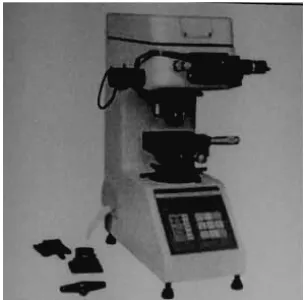
cementum Fig. 2. Vickers Micro hardness Machine
with ascending grades of SiC abrasive papers (400 and 1000 grit) under constant water irrigation on rotary felt disk.Then each test condition with the same load and time will be conducted three times at distance 0.5mm from canal lumen as shown in figure (1) using Vicker Micro hardness Machine as shown in figure (2); thus there will be 9 indentations on each specimen surface obtained from 500 g test load for 20 seconds. An average of the three readings for each test condition will be recorded as the VHN value of a specimen.
results
The results of Descriptive Statistics which include mean, standard deviation, standard of error, minimum and maximum for all groups are shown in Table (1).
It has shown that EDTA group has lowest mean values of dentin microhardness after final
irrigation protocol. And Citric Acid group has the highest mean values of dentin microhardness.
Analysis of variance ANOVA test was performed to identify the presence of any statistically significant difference among the means of microhardness reduction for all groups Table (2).
ANOVA test revealed that there was no statistically significant difference (P Ã 0.05) among the groups.
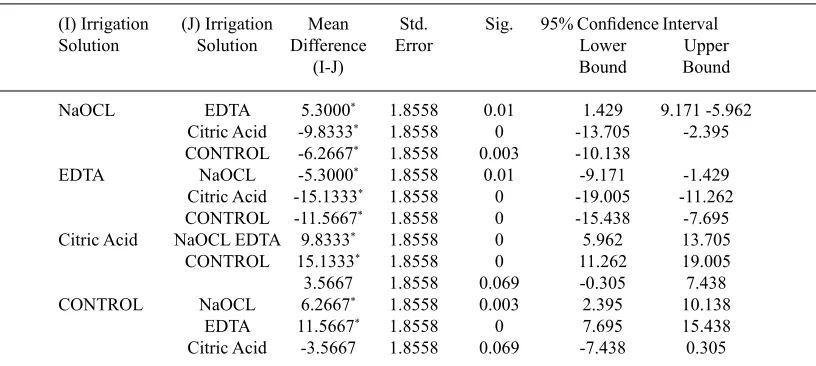
The Least signifigant different test (LSD) was performed for multiple comparisons between groups Table (3).
The results of (LSD) test showed that there was a significant difference between NaOCL and EDTA groups and there was a significant difference between NaOCL andand control groups.
discussion
table 2. Analysis of variancetest (ANOVA)
Sum of Squares df Mean Square F Sig.
Between Groups 809.373 3 269.791 26.111 0
Within Groups 206.647 20 10.332
Total 1016.02 23
table 3. Leastsignifigant different test (LSD)
(I) Irrigation (J) Irrigation Mean Std. Sig. 95% Confidence Interval
Solution Solution Difference Error Lower Upper
(I-J) Bound Bound
NaOCL EDTA 5.3000* 1.8558 0.01 1.429 9.171 -5.962
Citric Acid -9.8333* 1.8558 0 -13.705 -2.395
CONTROL -6.2667* 1.8558 0.003 -10.138
EDTA NaOCL -5.3000* 1.8558 0.01 -9.171 -1.429
Citric Acid -15.1333* 1.8558 0 -19.005 -11.262
CONTROL -11.5667* 1.8558 0 -15.438 -7.695
Citric Acid NaOCL EDTA 9.8333* 1.8558 0 5.962 13.705
CONTROL 15.1333* 1.8558 0 11.262 19.005
3.5667 1.8558 0.069 -0.305 7.438
CONTROL NaOCL 6.2667* 1.8558 0.003 2.395 10.138
EDTA 11.5667* 1.8558 0 7.695 15.438
Citric Acid -3.5667 1.8558 0.069 -7.438 0.305
have been recommended for use as root canal irrigants(1). The effect of mechanical washing, reduction of friction, and control of temperature are all important underlying reasons for irrigation; however, the most important tasks are dissolution of organic and inorganic tissue, and killing of the microbes.
The study aimed to evaluate changes in dentin microhardness after canal irrigation with different solutions; and in this study we use three of commercially available irrigating solutions. Research and clinical experiences have shown that NaOCl has several properties that contribute to effective chemomechanical debridement of a root canal system. The use of chelating agents (EDTA and Citric Acid) for final irrigation removes the smear layer and reduces dentin microhardness, which increases the access of the irrigant to dentinal tubules, allowing for proper disinfection9.
In the present study EDTA promoted the largest reduction in dentin microhardness at 0.5 mm from canal lumen. These results are in agreement with those of several previous studies9,10,11,12,13 in
which this solution also reduced microhardness. This effect is desirable in the layer next to the canal lumen and it has been associated with increasing calcium loss, resulting in dentin demineralization and softening.
The use of 2.5% Sodium Hypochlorite as a root canal irrigation significantly reduce the microhardness of root dentin this due to organic dissolving properties of Sodium Hypochlorite on collagen component of dentin14. In addition to that Sodium Hypochlorite extract the Calcium ion from the dentin and decrease the calcium/ phosphorus ratio15, 16,17. The current study agree with the study by Slutzky-Goldberg et al18, Ari et al19 and Oliveira et al20 who conclude that Sodium Hypochlorite significantly reduces the microhardness of root canal dentin.
have different initial physical characteristics10,21,22 and the initial microhardness of root dentin in this study not evaluated.
The primary factors that govern the action of an irrigant are the contact time and the concentration; and in the present study we used the root canal irritant for 5 minutes in our microhardness test and this is in agreement with studies Ulusoy & Görgül23 and Sayinet al16 who use the root canal irrigants in their microhardness tests for 5 minutes, stating that this duration is more realistic in terms of clinical practice. The solutions were taken to the canal with the help of a syringe coupled to the irrigation needle, thus simulating clinical practice.
Calt&Surper24, their study suggested that one minute application of 17% EDTA was effective to remove the smear layer. But previous studies evaluated the effect of root canal irrigants on the microhardness of the root canal dentin for five minutes23,25. Likewise, in the present study we use test solutions for 5 minutes.
Another determinant that has a profound effect on the post-treatment microhardness values of dentin is the concentration of the irrigating solution25. As the concentration of NaOCl increases, its bactericidal and smear layer removal efficacy also increases26, 27. Most studies showed that 17% EDTA was effective to remove the smear layer but a few reports have indicated that solutions with lower concentrations (eg, 10%, 5%, and even 1%) remove the smear layer equally well after NaOCl irrigation. Citric Acid is also marketed and used in various concentrations, ranging from 1% to 50%, with a 10% solution being the most common.
conclusions
All the groups showed reduction in dentin microhardness. EDTA group showed the maximum reduction followed by NaOCL group, and least with Citric Acid group.
reFerences
1. Weine FS. Endodontic therapy, Sixth Edition, Mosby; 4 (2004).
2. Peters OA, Scho¨nenberger K, Laib A. Effects
of four Ni-Ti preparation techniques on root canal geometry assessed by micro computed tomography. IntEndod J; 34:221–30 (2001).
3. Chunmuang S, Jitpukdeebodintra S, Chuenarrom C and Benjakul P. Effect of xylitol and fluoride on
enamel erosion in vitro. Journal of Oral Science;
49(4):293-297 (2007).
4. Faraoni-Romano JJ, Turssi CP and Serra MC.
Concentration-dependent effect of bleaching agents on microhardness and roughness of
enamel and dentin. American Journal of
Dentistry.20(1):31-34 (2007).
5. Attin T, Meyer K, Hellwig E, Buchalla W and
Lennon AM. Effect of mineral supplements to citric acid on enamel erosion.Archives of Oral Biology; 48(11):753-759 (2003).
6. Haapasalo HK, Siren EK, Waltimo TM.
Inactivation of local root canal medicaments by dentine: an in vitro study. IntEndod J;33:126–31 (2000).
7. Loel DA. Use of acid cleanser in endodontic
therapy. J Am Dent Assoc; 90: 148–51 (1975). 8. Haapasalo M, Ørstavik D. In vitro infection and
disinfection of dentinal tubules. J Dent Res;
66:1375–9 (1987).
9. Saghiri MA, Delvarani A, Mehrvarzfar P, Malganji G, Lotfi M, Dadresanfar B. A study of
the relation between erosion and microhardness of root canal dentin. Oral Surg Oral Med Oral Pathol Oral RadiolEndod;108 (6):e29-34 (2009).
10. Taneja S, Kumari M, Anand S. Effect of QMix,
peracetic acid and ethylenediaminetetraacetic acid on calcium loss and microhardness of root dentine. J Conserv Dent.; 17(2):155-8 (2014).
11. Tartari T, Souza PARS, Almeida BVN, Silva Junior JOCPessoa OF, Souza Junior MHS. A new
weak chelator in endodontics: effects of different irrigation regimens with etidronate on root dentin microhardness. Int J Dent. ; 2013:ID743018
(2013).
12. Aranda-Garcia AJ, Kuga MC, Chavéz-Andrade
GM, Kalatzis-Sousa NG, Hungaro Duarte MA, Faria G. Effect of final irrigation protocols on
microhardness and erosion of root canal dentin.
Microsc Res Tech; 76(10):1079-83 (2013).
13. Das A, Kottoor J, Mathew J, Kumar S, George S. Dentine microhardness changes following
conventional and alternate irrigation regimens: an in vitro study. J Conserv Dent.;17(6):546-9 (2014).
14. Farag A, Hassanien E. Effect of Chemical
irrigation and Intracanal CO2 Laser Irradi-ation on Hardness of Root Canal Dentin. Cairo Dent J;16: 135-139 (2000).
15. Dagan H, Calt S. Effect of Chelating Agents and Sodium Hypochlorite on Mineral Content
of Root Dentin. J Endod. 9: 578-580 (2001).
B, Dagli F, Gozukara H and Ka-layci S.
Time-dependent Decalcifying Effects of Endodontic
Irrigants with Anti-bacterial Properties. J Endod.;
35: 280-283 (2009).
17. Gurbuz T. Evaluation of Root Canal Dentin after ND:YAG Laser Irradiation and Treated with
Five Different Irrigation Solutions: A Preiminary Study. J Endod.34: 318-321 (2009).
18. Slutzky- Goldberg I, Maree M, Liberman R and Heling I. Effect of Sodium Hypochlorite on
Dentin Microhardness J Endod.;30: 880-882 (2004).
19. Ari H, Erdemir A and Belli S. Evaluation of the Effect of Endodontic Irrigation Solution on the
Microhardness and Roughness of Root Canal Dentin. J Endod.; 30: 792-797 (2004).
20. Oliveira L, Carvahlo C, Nunes W, Valera M,
Camargo C and Jorge A. Effect of Chlorhexidine and Sodium Hypochlorite of Root Canal
Dentin. Oral Surg Oral Med Oral Pathol Oral RadiolEndod.; 104: 125-133 (2007).
21. Cruz-FilhoAM, Sousa-Neto MD, Savioli RN, Silva RG, Vansan LP, Pécora JD. Effect of
chelating solutions on the microhardness of root canal lumen dentin. J Endod.;37(3):358-62 (2011).
22. Ghisi AC, Kopper PM, Baldasso FE, Stürmer CP, Rossi-Fedele G, Steier L et al. Effect of
super-oxidized water, sodium hypochlorite and
EDTA on dentin microhardness. Braz Dent J.;
25(5):420-4 (2014).
23. Ulusoy ÖÝ, Görgül G. Effects of different
irrigation solutions on root dentine microhardness, smear layer removal and erosion. AustEndod J.;
39:66–72 (2013).
24. Calt S, Serper A. Time-dependent effects of
EDTA on dentine structures. J Endod.; 28: 17–9 (2002).
25. Zhang K, Kim YK, Cadenaro M, Bryan TE, Sidow SJ, Loushine RJ. Effects of different exposure times and concentrations of sodium
hypochlorite /ethylenediaminetetraacetic acid on the structural integrity of mineralized dentin.
J Endod.; 36:105–9 (2010).
26. Zehnder M. Root canal irrigants. J Endod; 32: 389–98 (2006).
27. Marending M, Luder HU, Brunner TJ, et al.