RESEARCH ARTICLE
MA-LEACH: Energy Efficient Routing Protocol for
WSNs using Particle Swarm Optimization and
Mobile Aggregator
Alzahraa Elsayed
Computers and Systems Department, Faculty of Engineering, Al Azhar University, Egypt.
[email protected]
Mohamed Sharaf
Computers and Systems Department, Faculty of Engineering, Al Azhar University, Egypt.
[email protected]
Published online: 02 February 2018
Abstract – Routing protocols for wireless sensor networks pay a great attention to the limited resources of the nodes. As battery lifetime is a major concern, we consider our proposed model as an effort to prolong the network lifetime in harmony with WSNs’ constraints. In this paper, we study LEACH routing protocol and its performance and propose an extension to it, MA-LEACH. We introduce a mobile aggregator (MA) which is a gadget adopted to mitigate the overhead on the cluster heads (CHs). In addition, we optimize the trajectory using particle swarm optimization (PSO). Hence, we adapt the TSP problem to our protocol to determine the optimal trajectory that a mobile aggregator could travel to visit every cluster head in the network. We simulate the proposed protocol in MATLAB and the results reveal that it outperforms LEACH in network lifetime and energy consumption. Also, we compare our findings with a recent extension to the LEACH called LEACH with fuzzy descriptors and with clustered heterogeneous sensor networks (CHSNs) with a mobile sink. The simulation results show that MA-LEACH surpasses LEACH with fuzzy descriptor and CHSNs.
Index Terms – WSN, Clustering, LEACH, Modified LEACH, Cluster Head (CH), Particle Swarm Optimization (PSO), Mobile Aggregator, Base Station (BS), Sensor Node (SN).
1. INTRODUCTION
A Wireless Sensor Network (WSN) is a congregation of nodes of imited capabilities disseminated in bulk to observe a phenomenon of interest [1, 2, 3]. We apply WSNs in a variety of applications: agricultural, medical, environmental, etc. Major advantages of WSNs are the ability to cover harsh terrains, reliability, accuracy and nevertheless at a possibly lower cost. A great body of research has discussed the benefits of WSNs [4, 5, 6]. Our objective in this work is to modify the LEACH protocol to enhance the overall network lifetime. Therefore, we consider our protocol as a variation of the LEACH protocol. As the aim behind sensor nodes (SNs) deployment is to gather data form sites of interest, the nodes
need to have sensing and communicating capabilities. After the gathering process, the nodes eventually forward the collected data to the base station (BS), a mostly fixed capable device that can receive the data from the nodes and retransmit it to other stations, routing protocol. [2, 7, 8, 9, 10, 11, 12, 13] are examples of well-known WSNs routing protocols. A few of the existing routing protocols have taken power efficiency and network lifetime into consideration.
WSN’s routing protocols are classified into single-hop and multi-hop routing protocols [14]. In single-hop routing protocols, each node forwards its data directly to the BS. While in multi-hop routing protocols, nodes send data to intermediate/nearest nodes which similarly forward data to the nodes that can ultimately deliver the data to the BS. The clustering approach [15, 16] has been designed based on multi-hop technique. In clustering technique, a network is partitioned into sets of clusters. Each cluster comprises member nodes; such that one node is designated as a cluster head (CH). The CH gathers data from its cluster’s members. Then, the CHs forward the gathered data to the BS. Dividing the WSN into a huge number of clusters can adversely affect the network efficiency and decreases its lifetime [13, 17, 18]. In this work, we pay a great attention to LEACH which is an example of cluster-based routing protocols.
The paper is organized as follows: Section 2 related work, section 3 PSO and Optimal Trajectory, section 4 MA-LEACH Model, section 5 results and discussions, and section 6 Conclusion.
2. RELATED WORK
RESEARCH ARTICLE
adversely affected. We consider a premature death of the nodes a severe compromise for the routing protocols performance.
LEACH algorithm [2] is a cluster-based routing algorithm that improves WSNs lifetime. The partition of a WSN into clusters is accomplished by the network itself, since the network nature imposes a self-organizing discipline.
To improve the LEACH protocol, Hong et.al [19] present a variant version of LEACH protocol called Threshold- LEACH or TLEACH. “T-LEACH” limits the number of selected CHs by comparing a candidate CH residual energy with a threshold. Although they assume that decreasing the number of CHs increases the WSNs lifetime, the presence of a threshold sometimes obstructs the election of new CHs, reduces the energy levels at the nodes and adversely affects the network lifetime. Arumugam and Ponnuchamy [20] present an energy-efficient LEACH (EE-LEACH) protocol for energy-efficient data aggregation.
The energy-efficient routing is attained by nodes which have the most superior residual energy. These superior nodes work as source nodes to the CHs, i.e., assistant nodes. The source nodes are chosen to forward the data to the BS. The source nodes are chosen to direct the data to the BS. The assistance provided by source nodes ensures better packet delivery ratio with a minimum usage of energy.
Arumugam and Ponnuchamys experimental work shows that EE-LEACH outperforms the existing LEACH. In turn, we believe that the source nodes will be depleted at a higher rate for the sake of efficient gathering. Therefore, EE-LEACH may compromise a WSN’s lifetime. Agarwal, Kumar, and Prakash [21] introduce ACO-LEACH algorithm that optimizes the path of data transmission between the nodes and the CHs. ACO-LEACH improves the performance of ACO-LEACH and increases the network lifetime.
The idea of having deputies for cluster heads has been adopted by Ahlawat and Malik [22]. They introduce an improved version of LEACH protocol, VLEACH, which aims at prolonging the network lifetime. The vice cluster head (VCH) is a node that assume CHs responsibility when CH is absent (dead). The selection of VCH has three bases: minimum distance, maximum residual energy, and minimum energy. The shortcoming of the VLEACH approach lies in the overhead imposed by electing new VCHs. Mendis, Guru and Halgamuge [23] propose a mobility feature to the sink.
Though, they do not necessitate a topology to the WSN. The mobile sink job is to collect the data from nodes. The main problem of this technique is the difficulty to find a trajectory that enables the collection of data from all nodes as the model has no hierarchy approach. Nayak and Devullapalli [23] propose an enhancement to the LEACH protocol. They call it LEACH with Fuzzy Descriptors. The aim is to prolong the WSN lifetime. The proposed protocol depends on Fuzzy
inference engine (Mamdanis rule) which elect a super cluster head (SCH) from CHs to transmit the gathered data to the mobile BS. Selection of SCH utilizes fuzzy rules and depends on three parameters: the level of energy of each CH, mobility and the distance between the mobile BS and the CH. The proposed protocol employs fuzzy descriptors that results in a 20% overall enhancement to the WSN lifetime compared to LEACH.
Also, we compare our proposed protocol to that of Nayak and Devullapalli [23]. The simulation test results show that our proposed protocol surpasses Nayak and Devulapalli’s protocol. As MA-LEACH grants a 50% network lifetime extension compared to 20% for LEACH with fuzzy descriptors.
Sudarmani and Kumar [24] propose an approach to extend the network lifetime of CHSNs by mobilizing the sink. They optimize the path of mobile sink by using particle swarm optimization. The nodes in their settings are heterogeneous in terms of capabilities and energy. All clusters have equal number of nodes and hence balanced load.
In contrast to our proposed model, the sink is stationary, and a mobile aggregator introduced to collect the data and support the cluster heads. Also, we compare our proposed protocol to that of Sudarmani and Kumar [24]. The simulation results show that our model surpasses Sudarmani and Kumar’s protocol. MA-LEACH yields a significant enhancement in network lifetime compared with the enhancement introduced by Rudarmani and Kumar’s protocol.
Our work presents a model to enhance the performance of LEACH protocol. Therefore, we propose the use of MA which is a vehicle designed with unlimited energy to collect the data from the clusters during the sojourn time. The velocity of the MA ranges between (1-10 m/s). The MA trajectory is optimized using particle swarm optimization (PSO) [25, 26]. PSO is an optimization technique introduced to solve problems for which we do not have polynomial time algorithms [27], so far.
We have adapted a solution to the famous Travel Sales Person (TSP) [28] using PSO and constrained it to fit our model’s requirements. The model constraints fit the physical process as shown in next section. Though, the resulting path needs to meet our model’s constraints. In our model, the contributions are two folds: Firstly, we adopt a hierarchical protocol, LEACH in contrast to the work of Gu et al. [29] and we do not mobilize the sink as in [30]. Secondly, we limit the number of nodes a mobile aggregator needs to visit to a smaller set of CHs. A small number of nodes, CHs, makes it computationally feasible to find a trajectory for the mobile aggregator.
3. PSO AND OPTIMAL TRAJECTORY
RESEARCH ARTICLE
candidate solutions. The particles search the n-dimensional hyperspace looking for the global minimum (maximum) where n denotes the number of optimal parameters we need to determine. Let 𝑋𝑖𝑗 and 𝑉𝑖𝑗denote the position and velocity particle i may occupy in the 𝑗𝑡ℎ component of the n-dimensional hyperspace. While s denotes the total number of particles. Let f: ℝ𝑛 ℝ be an objective function used to evaluate the fitness of each particle.
In the global-best form of PSO, 𝑝𝑏𝑒𝑠𝑡𝑖𝑗 is used to store the position that reflects the lowest cost particle i has reached. Where the particle i has its lowest cost is stored as (𝑝𝑏𝑒𝑠𝑡𝑖𝑗). Also, we store 𝑔𝑏𝑒𝑠𝑡𝑗, which is best particle’s position. Specifically, we loop on (1) and (2) and keep updating V (velocity) and X (position) till we reach one of two of termination conditions: 1) attaining an acceptable 𝑔𝑏𝑒𝑠𝑡 or 2) reaching the maximum number of iterations, 𝑡𝑚𝑎𝑥 [23].
𝑣𝑖𝑗 (𝑡 + 1)= 𝑘1𝑣𝑖𝑗(𝑡) + 𝑘2(𝑝𝑏𝑒𝑠𝑡𝑖𝑗− 𝑥𝑖𝑗(𝑡))
+𝑘3 ( 𝑔𝑏𝑒𝑠𝑡𝑗− 𝑥𝑖𝑑 (𝑡) ) (1)
𝑥𝑖𝑗(𝑡 + 1) = 𝑥𝑖𝑗(𝑡) + 𝑣𝑖𝑗 (𝑡 + 1) (2)
𝑏𝑒𝑠𝑡𝑖𝑗(𝑡 + 1) = 𝑏𝑒𝑠𝑡𝑖𝑗(𝑡) + 𝑣𝑖𝑗(𝑡) (3)
Here, 𝑘1 and 𝑘2 are constants, we use the PSO to generate an optimized (near-optimal) path that meets the model’s constraints. The idea behind the application of PSO and the introduction of MA is to prevent the premature exhaustion of cluster-heads’ batteries. PSO has been used in WSN in different ways, i.e., to minimize localization error, clustering as PSO-Clustering proposed by Guru et al. [31], to name a few.
4. MA-LEACH MODEL
Our model targets WSNs with a BS at the midpoint of the field of the deployed nodes. We assume that the nodes are randomly deployed, immobile, and with non-rechargeable batteries. We consider our protocol as a variation of the LEACH protocol; therefore, we use it as a benchmark to our mode besides the performance of LEACH with Fuzzy Descriptors (Fuzzy-LEACH) by Nayak and Devulapalli [23] and clustered HSNs with mobile sink by using PSO proposed by Sudarmani and Kumar [24]. The simulation results show that our model outperforms both LEACH and Fuzzy-LEACH protocol and CHSN with mobile sink by using PSO.
In practice, the LEACH protocol enforces the partition of the network into clusters. It also requires the election of CHs to serve the nodes in the clusters for a specific time called a round time. After the elapse of the round time, the LEACH repeats the same procedure throughout the lifetime of the network. This causes the depletion of the energy of the CHs. If a CH is dead or cannot fulfill its mission, the whole cluster’s data is lost. We can circumvent this by introducing an aide to the CHs.
Therefore, we introduce a MA that works as an assistant to the CHs. The role of the MA is to reach the CHs vicinity to collect the gathered data and exempt the visited CH of duty during the MA visit. During the sojourn, all sensors in the cluster forward data directly to the MA. However, the MAs traveling path is constrained by the round time, trip time and sojourn time, see Equation 4. To consider MA’s work a success, it has to sustain a visit to every CH in the network within the limited round time. The proposed model solves the optimization problem to attain an optimized path with an overall trip time that is when added to the total sojourn time is at most equal to the round time as shown in Equation 4.
Definition 1. Given N cluster heads { 𝑐ℎ1, 𝑐ℎ2,…., 𝑐ℎ𝑛}, the distance between every two CHs 𝑐ℎ𝑖,𝑗denoted by d( 𝑐ℎ𝑖 , 𝑐ℎ𝑗), the MA has to find a permutation x = ( 𝑥1 , 𝑥2,…., 𝑥𝑛) such that 𝑥𝑖 ∈ {1,2,…., N} to minimize the tour length according to the constraints given in Equation 4.
Minimize L(x) =∑ d( 𝑐ℎ𝑥𝑖 𝑁−1
𝑖 , 𝑐ℎ𝑥𝑖+1) + d( 𝑐ℎ𝑥𝑛, 𝑐ℎ𝑥1)
S.t. ∀𝑖∈ {1, 2,….N}, ∃𝑗∈ {1, 2,….N} and 𝑥𝑖 = j,
d(𝑐ℎ𝑖, 𝑐ℎ𝑗) = d(𝑐ℎ𝑗, 𝑐ℎ𝑖) (Symmetric).
Subject to 𝑟𝑡≥ 𝑡𝑟𝑡+𝑠𝑡, (4)
where𝑟𝑡, 𝑡𝑟𝑡and 𝑠𝑡are the round time, trip time and sojourn time respectively, see Equation 5.
𝑡𝑟𝑡 = ∑
d( 𝑐ℎ𝑥𝑖 ,𝑐ℎ𝑥𝑖+1) 𝑣 𝑁−1
𝑖 +
d( 𝑐ℎ𝑥𝑛, 𝑐ℎ𝑥1)
𝑣 (5)
4.1 MA-LEACH Energy Model
MA-LEACH is an enhancement to the LEACH protocol. LEACH adapts the energy model of Heizelman, Chandrakasan and Balakrishnan [10], see Equation 6.
𝐸𝐶𝐻𝑖 = 𝑙𝐸𝑒𝑙𝑒𝑐(𝑁
𝐾− 1) + 𝑙𝐸𝐷𝐴 𝑁
𝐾+ 𝑙𝐸𝑒𝑙𝑒𝑐+ 𝑙𝜖𝑚𝑝𝑑𝑡𝑜 𝐵𝑆 4 (6)
Where 𝐸𝑅𝑋= 𝑙𝐸𝑒𝑙𝑒𝑐 , 𝑙 equals number of bits, (𝑙𝐸𝑒𝑙𝑒𝑐+ 𝑙𝜖𝑚𝑝𝑑𝑡𝑜 𝐵𝑆4 ) is the amount of energy dissipation due to transmission (per packet), and N denotes number of nodes.
RESEARCH ARTICLE
𝐸
𝐶ℎ𝑖(𝑟𝑡 − 𝑠𝑡𝑖 𝑛)= (1 − 𝑠𝑡𝑖
𝑛∗𝑟𝑡 ) ∗ 𝐸𝑐ℎ𝑖 (𝑟𝑡). (7)
Equation 8 shows that the save in energy, 𝐸𝑆(𝑐ℎ𝑖), is the difference between the consumption without MA and that with the MA.
𝐸𝑆(𝑐ℎ𝑖) = 𝐸𝐶ℎ𝑖(𝑟𝑡 ) - 𝐸𝐶ℎ
𝑖(𝑟𝑡 − 𝑠𝑡𝑖 𝑛 ). (8) Therefore, the total saved energy during the network lifetime, 𝐸𝑆, is computed by Equation 9
𝐸𝑆=
1
𝑛∑ ∑ 𝐸𝐶ℎ𝑖(𝑟𝑡 )∗ 𝑛
𝑖=1 𝑟
𝑗=1
𝑠𝑡𝑖. (9)
4.2 MA-LEACH Algorithm and Flow Chart
Next, we present the Algorithm 1 and Flowchart 1 of the proposed model.
Algorithm 1: MA-LEACH algorithm
1 function MA-LEACH (roundTime);
Input : nonnegative integer roundTime
Output : expectedNetworkLifeTime
2 i ← 1;
3 randomlyDeployNodes ();
4 while networkStillAlive do
5 time ← initializeTimer ();
6 doClustering ();
7 electClusterHeads ();
8 /* psoTrajectory (): optimize the best tour the
MA could use to travel among CHs */
9 psoTrajectory ();
10 while time ≤ roundTime do
11 /* maCollect (): The MA collects data from
each visited CH along the tour*/
12 maCollect ();
13 end
14 i++;
14 end
15 return expectedNetworkLifeTime;
RESEARCH ARTICLE
5. RESULTS AND DISCUSSIONS
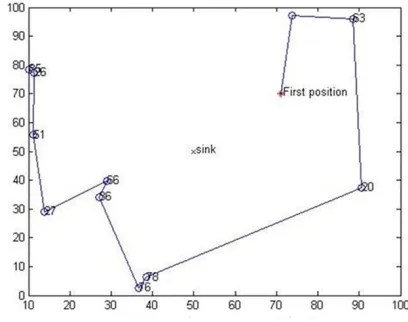
To assess the enhancement and performance of our proposed model, we build a software simulation. The simulation experiments are run on a MATLAB program. The network is composed of 100 SNs (homogeneous), each with non-rechargeable battery of 0.5 Joule. We deploy the nodes randomly within a field of dimension (length =100 m, width =100 m), see Figure 1. The BS is designated to be at midpoint of the network field, i.e., (50,50), see Table 1. In addition, we use the energy model [25] to compute the energy consumption due to communication among nodes. We presume that each SN creates one data packet per time unit and transmits it to its CH. In addition, clustering time per round is presented in Figure 2. Figure 3 illustrates the itinerary through which the MA travels to visit the CHs and collect the data.
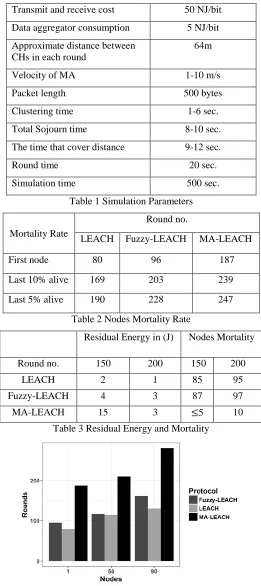
Figure 4 shows a sample run of the MA-LEACH protocol with the aforementioned network settings. In Figure 4 (a), one can observe the variation of dead nodes versus that of number of rounds. Figure 4 (a) also illustrates that the first depleted node dies at almost round number 80 and by the passage of 169 rounds almost more than 90 per cent of the nodes are dead (see Table 2). Figure 4 (b) gives a relation between the residual energy in nodes and the number of rounds. A sudden/sharp decline in the energy of the nodes takes place from the early beginning of the running of the model, i.e., round number 1 to round number 100, which causes the residual energy to fall to almost 5 (J) (see Table 3).
To test the enhancement provided by the MA-LEACH, we run our simulation against the same network settings. Figure 5 shows the result of a sample run of the MA-LEACH protocol. Figure 5 indicates number of rounds versus number of dead nodes. It also indicates that the first depleted node dies at almost round number 187 compared to 80 and 95 for LEACH and Fuzzy-LEACH, respectively. By the passage of 210 rounds almost 50 per cent of the nodes are alive compared with 115 rounds for the LEACH protocol and 117 for the Fuzzy-LEACH. Table 3 gives a relation between number of rounds the residual energy in the nodes. The decline rate of the residual energy in MA-LEACH protocol is less than that of the LEACH protocol and LEACH with fuzzy descriptor. In MA-LEACH, it takes 200 rounds to fall below 5 (J) residual energy compared with 110 rounds to the LEACH and 111 rounds to LEACH with fuzzy descriptors. Table 2 and 3 show comparisons among LEACH, LEACH with fuzzy descriptors and MA-LEACH.
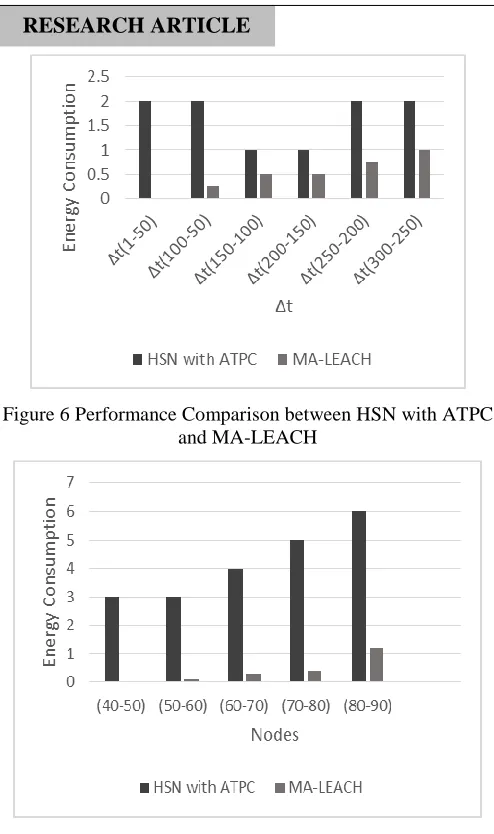
While Figure 6 indicates energy consumption versus ∆𝑡 (time interval) between HSN with ATPC and MA-LEACH. The decline rate of energy levels in MA-LEACH is so low compared with that of HSN with ATPC. Figure 7 shows a comparison between HSN with ATPC and MA-LEACH in terms of nodes versus energy consumption. Figure 7 illustrates that the nodes in HSN with ATPC consume more energy than MA-LEACH.
Figure 1 Random Deployment of SNs
Figure 2 MA-LEACH Clustering Time versus Round
RESEARCH ARTICLE
(a)
(b)
a) Loss in Nodes versus Rounds
b) Residual Energy versus Round
Figure 4 Output of a Sample Run of LEACH and Fuzzy-LEACH versus MA-Fuzzy-LEACH
Parameter Value
Network field dimension 100 × 100
Number of SNs 100
SNs deployment Random
Number of Rounds 300
BS Location Center
Initial battery level 0.5 J
Radio device dissipation 50 NJ/bit
Transmit and receive cost 50 NJ/bit
Data aggregator consumption 5 NJ/bit
Approximate distance between CHs in each round
64m
Velocity of MA 1-10 m/s
Packet length 500 bytes
Clustering time 1-6 sec.
Total Sojourn time 8-10 sec.
The time that cover distance 9-12 sec.
Round time 20 sec.
Simulation time 500 sec.
Table 1 Simulation Parameters
Mortality Rate
Round no.
LEACH Fuzzy-LEACH MA-LEACH
First node 80 96 187
Last 10% alive 169 203 239
Last 5% alive 190 228 247
Table 2 Nodes Mortality Rate
Residual Energy in (J) Nodes Mortality
Round no. 150 200 150 200
LEACH 2 1 85 95
Fuzzy-LEACH 4 3 87 97
MA-LEACH 15 3 ≤5 10
Table 3 Residual Energy and Mortality
RESEARCH ARTICLE
Figure 6 Performance Comparison between HSN with ATPC and MA-LEACH
Figure 7 A Performance Comparison between HSN with ATPC and MA-LEACH
6. CONCLUSION
In this work, we introduce an enhancement to the LEACH protocol. The proposed protocol surpasses the LEACH in energy utilization among the nodes and in network lifetime. The introduced MA alleviates the load on the CHs, and thus we attribute the improvement measured by the simulation to MA’s role. In addition, the MA’s trajectory is determined by utilizing swarm intelligence (PSO) and enforced to meet the constraints of the network. Further improvements could be conducted in future work, such as testing the effect of multiple MAs or adding assumption on CHs. For example, we may study the effect of using superior CHs with rechargeable capabilities, and test the WSN performance accordingly.
REFERENCES
[1] V. K. Arora, V. Sharma, and M. Sachdeva, “A survey on leach and others routing protocols in wireless sensor network,” Optik -
International Journal for Light and Electron Optics 2016, 127(16):6590 – 6600.
[2] W. R. Heinzelman, A. Chandrakasan, and H. Balakrishnan, “Energy-efficient communication protocol for wireless microsensor networks,” In Proceedings of the 33rd Annual Hawaii International Conference on System Sciences, Jan 2000, pages 10 pp. vol.2.
[3] Sukhkirandeep Kaur and Roohie Naaz Mir, “Energy efficiency optimization in wireless sensor network using proposed load balancing approach’” International Journal of Computer Networks and Applications (IJCNA), Volume 3, Issue 5, September – October (2016). [4] K. Begum and S. Dixit, “Industrial wsn using IoT: A survey,” In 2016 International Conference on Electrical, Electronics, and Optimization Techniques (ICEEOT), March 2016, pp. 499–504.
[5] M. Kavitha, B. Ramakrishnan and Resul Das, “A novel routing scheme to avoid link error and packet dropping in wireless sensor networks,” International Journal of Computer Networks and Applications (IJCNA), Volume 3, Issue 4, July – August (2016).
[6] F. J. Parrado-Garcia, J. Vales-Alonso, and J. Alcaraz, “Optimal planning of wsn deployments for in situ lunar surveys,” IEEE Transactions on Aerospace and Electronic Systems, PP (99):1–1, 2017.
[7] A. Somasundara, A. Ramamoorthy, and M. B. Srivastava, “Mobile element scheduling for efficient data collection in wireless sensor networks with dynamic deadlines,” In 25th IEEE International Real-Time Systems Symposium, Dec 2004, pp. 296–305.
[8] A. Chakrabarti, A. Sabharwal, and B. Aazhang, “Using predictable observer mobility for power efficient design of sensor networks,” In Proceedings of the 2Nd International Conference on Information Processing in Sensor Networks, IPSN’03, Berlin, Heidelberg, 2003. Springer-Verlag, pp. 129–145.
[9] C. Intanagonwiwat, R. Govindan, and D. Estrin, “Directed diffusion: a scalable and robust communication paradigm for sensor networks,” In Proceedings of the 6th Annual International Conference on Mobile Computing and Networking, MobiCom ’00, New York, NY, USA, 2000. ACM, pp. 56–67.
[10] N. Kumar, S.Yashwant, “Routing protocols in wireless sensor networks,” Handbook of Research on Advanced Wireless Sensor Network Applications, Protocols, and Architectures (2017), pp. 86-128. [11] R. Mohemed, A, Saleh, M. Abdelrazzak, A. Samra, “Energy-efficient routing protocols for solving energy hole problem in wireless sensor networks,” Computer Networks 114 (2017), pp. 51-66.
[12] C. Intanagonwiwat, R. Govindan, D. Estrin, J. Heidemann, and F. Silva, “Directed diffusion for wireless sensor networking,” IEEE/ACM Transactions on Networking, Feb 2003, 11(1), pp.2–16.
[13] H. Frey, S. Ruhrup, and I. Stojmenovic, “Guide to wireless sensor networks,” Routing in Wireless Sensor Networks. Springer, London, 2009.
[14] J. Luo and J. P. Hubaux, “Joint mobility and routing for lifetime elongation in wireless sensor networks,” In Proceedings IEEE 24th Annual Joint Conference of the IEEE Computer and Communications Societies., volume 3, March 2005, pp. 1735–1746.
[15] M. Ma and Y. Yang, “Clustering and load balancing in hybrid sensor networks with mobile cluster heads,” In Proceedings of the 3rd International Conference on Quality of Service in Heterogeneous Wired/Wireless Networks, QShine ’06, New York, NY, USA, 2006. ACM.
[16] P. Gupta, J. Sonu, “Integrated clustering and routing protocol for wireless sensor networks using Cuckoo and Harmony Search based metaheuristic techniques,” Engineering Applications of Artificial Intelligence 68 (2018), pp. 101-109.
[17] A. Boukerche, R. Araujo, and F. Silva, “A Context interpretation based wireless sensor network for the emergency preparedness class of applications,” Springer Berlin Heidelberg, Berlin, Heidelberg, 2006, pp. 25–34.
RESEARCH ARTICLE
[19] J. Hong, J. Kook, S. Lee, D. Kwon, and S.Yi. T-leach, “The method of threshold-based cluster head replacement for wireless sensor networks,” Information Systems Frontiers, 11(5):513, 2008.
[20] G. S. Arumugam and T. Ponnuchamy. “EE-LEACH development of energy-efficient leach protocol for data gathering in wsn,” EURASIP Journal on Wireless Communications and Networking, 2015(1): 76. [21] T. Agarwal, D. Kumar, and N. R. Prakash, “Prolonging network lifetime
using ant colony optimization algorithm on LEACH protocol for wireless sensor networks,” Springer Berlin Heidelberg, Berlin, Heidelberg, 2010, pp. 634–641.
[22] A. Ahlawat and V. Malik, “An extended vice-cluster selection approach to improve v leach protocol in wsn,” In 2013 Third International Conference on Advanced Computing and Communication Technologies (ACCT), April 2013, pp. 236–240.
[23] P. Nayak and A. Devulapalli, “A fuzzy logic-based clustering algorithm for wsn to extend the network lifetime,” IEEE Sensors Journal, 16(1), pp.137–144, Jan 2016.
[24] R Sudarmani, KRS Kumar, “Particle swarm optimization-based routing protocol for clustered heterogeneous sensor networks with mobile sink,” American Journal of Applied Sciences, 2013.
[25] C. Mendis, S. M. Guru, S. Halgamuge, and S. Fernando, “Optimized sink node path using particle swarm optimization,” In 20th International Conference on Advanced Information Networking and Applications - Volume 1 (AINA’06), April 2006.
[26] J. Kennedy and R. Eberhart, “Particle swarm optimization,” In Neural Networks, Proceedings., IEEE International Conference on, volume 4, Nov 1995, pp. 1942–1948.
[27] C. H. Papadimitriou and K. Steiglitz, “Combinatorial optimization: algorithms and complexity,” Prentice-Hall, Inc., Upper Saddle River, NJ, USA, 1982.
[28] KP Wang, L. Huang, CG. Zhou, and W. Pang, “Particle swarm optimization for traveling salesman problem,” In Proceedings of the 2003 International Conference on Machine Learning and Cybernetics (IEEE Cat.No.03EX693), Nov. 2003, pp. 1583–1585, Vol.3. [29] Y. Gu, D. Bozdag, E. Ekici, F. Ozguner, and CG. Lee, “Partitioning
based mobile element scheduling in wireless sensor networks,” In 2005 Second Annual IEEE Communications Society Conference on Sensor and Ad Hoc Communications and Networks, 2005. IEEE SECON 2005, Sept 2005, pp. 386–395.
[30] Y. Bi, L. Sun, J. Ma, N. Li, I. A. Khan, and C. Chen, “Hums: an autonomous moving strategy for mobile sinks in data-gathering sensor networks,” EURASIP Journal on Wireless Communications and Networking, 2007, 2007(1):064574.
[31] S. M. Guru, S. K. Halgamuge, and S. Fernando, “Particle swarm optimisers for cluster formation in wireless sensor networks,” In 2005 International Conference on Intelligent Sensors, Sensor Networks and Information Processing, Dec 2005, pp. 319–324.
Authors
Alzahraa Elsayed received the B.Sc. degree in Systems and Computers Engineering from the faculty of Engineering of Al Azhar University in 2014, where she is currently pursuing the Master degree in Communications engineering from 2015 to 2017, her research interests include system architecture of wireless mobile technologies.