pISSN 2394-6032 | eISSN 2394-6040
Original Research Article
Dietary practices in type 2 diabetes patients at Bhopal,
Madhya Pradesh: a cross-sectional study
Rama Singotiya Lodha,
Smriti Singh*, Dinesh Kumar Pal, Manju Toppo,
Shipra Verma, Arpita Jain, Akhil R. Nair
INTRODUCTION
According to a recent scenario, diabetes is a global public health problem in world, especially in India, it is the second most popular country in nation and more than 50 million people with diabetes type 2 live in India.
According to WHO report of 2018 diabetes prevalence has been rising more rapidly in middle and low-income countries. Diabetes is a major cause of blindness, kidney failure, heart attacks, stroke and lower limb amputation.
In 2016, an estimated 1.6 million deaths were directly caused by diabetes. Another 2.2 million deaths were attributable to high blood glucose in 2012. Almost half of all deaths attributable to high blood glucose occur before the age of 70 years.
WHO estimates that diabetes was the seventh leading cause of death in 2016.1Obesity, mostly central obesity and increased visceral fat due to lack of physical activity and consumption of high calorie diet, fat and high-sugar diets are most common factors for it.2 In India,
ABSTRACT
Background: Diabetes mellitus (DM) is a rapidly growing health problem in India. Diet and physical activity are important modifiable risk factors affecting the incidence, severity and management of DM. The aim of the study was to assess diet of diabetes mellitus patients. 87 adults from a cohort of diabetic patients attending the Medical Clinics at the Hamidia Hospital Bhopal were invited for the study.
Methods: Information about their nutritional status & food consumption pattern was taken by 24-hour dietary recall and food frequency questionnaire. Data was analysed using Epi Info and MS Excel. Frequency counts and percentages were used to describe the demographic characteristics of the participants while the significance difference in between male and female participants. The significance level was set at P <0.05 and 0.01. Statistical analysis used: MS Excel and Epi Info.
Results: The study sample was 87 out of which 56 were females and 31 were males; mean age of DM patients was 48.21±12.98.The mean energy intake was 1386.52 kcal and 1125.79 kcal among male and female. The mean protein intake was 68.71 g and 50.50 among male and female diabetics. There was significant difference between male and female age. There were no significant difference in body mass index and waist hip ratio between male and female. 30 (34.5%) & 16 (18.4%) were overweight and obese respectively.
Conclusions: Based on these findings, the dietary practices of diabetic patients are inadequate and require improvement. Education and counselling about diet of a diabetes patient is needed.
Keywords: Diabetes mellitus, 24 hr dietary recall, Food frequency, Energy, Protein
Department of Community Medicine, Gandhi Medical College, Bhopal, Madhya Pradesh, India
Received: 11 May 2019 Revised: 03 July 2019 Accepted: 05 July 2019 *Correspondence: Dr. Smriti Singh,
E-mail: [email protected]
Copyright: © the author(s), publisher and licensee Medip Academy. This is an open-access article distributed under the terms of the Creative Commons Attribution Non-Commercial License, which permits unrestricted non-commercial use, distribution, and reproduction in any medium, provided the original work is properly cited.
economic growth occur, there are major deviations in the dietary pattern and practices that are influenced by varied cultural and social customs. Most common factors are lifestyle changes and environmental changes occur resulting from industrialisation, urbanization and migration to a rural setting to urban environment may be responsible to a large extent in contributing to the epidemic of type-2 diabetes mellitus (T2DM) in Indians.3 The objective of the study was to assess dietary pattern and physical activity among type 2 diabetic patients attending special clinic at Gandhi Medical College, Bhopal.
METHODS
The study was a descriptive cross-sectional survey of male and female diabetic patients attending the special medical clinics at the Gandhi Medical College, Bhopal, a government tertiary care hospital in Madhya Pradesh state between August and November 2018. Ethical approval was obtained from the ethical committee of the hospital and college following which the verbal consent was taken, from the type 2 diabetic patients who had history of diabetes for more than 1 year. Total 87 patients were selected by using Purposive sample technique. Patients with severe medical and surgical complications were excluded.
The questionnaire was used to collect the information on the various factors likes socio-economic, disease history, family history, anthropometric measurements etc. Anthropometric measurements like height (cm), weight (kg) were recorded. The height was measured with the help of the anthropometric rod to the nearest 0.01 cm. The subjects were weighed on a portable platform weighing balance to nearest 0.5 kg with light clothes, without support footwear. Body mass index (BMI) was calculated as: body weight (kg)/ {height (m)}.2 The international classification of adult underweight, overweight and obesity was used to classify patient according to BMI.
Information about dietary pattern and consumption of various types of food groups were collected by using 24-hour dietary recall and food frequency questionnaire. The evaluation of the daily food intake was made by using Food Composition Tables from Hyderabad nutrition centre guide line. The collected data were tabulated and statistically analysed.
RESULTS
Table 1 shows socio-demographic characteristics of the respondent, according to the age group >50 years of age were 32 (36.8%) male and 56 (64.4%) were female. Most respondent were educated upto primary and intermediate (48.3%) and (54.0 %) respondents were house wife, because in this study the female respondent are more and (16.1%) were involved in business by occupation. None
of the patient has ever consulted dietician for their dietary requirement.
Table 1: Socio-economic characteristics and family history (n=87).
Variable N (%)
Age (years)
<40 27 (31.0)
41–50 28 (32.2)
>50 32 (36.8)
Sex
Male 31 (35.6)
Female 56 (64.4)
Occupation
House wife 47 (54.0) employees (Govt./Private) 8 (9.2) Business 14 (16.1) Labours / farmer 11 (12.6) Non-employed 7 (8.0) Education level
Illiterate 15 (17.2) Primary and intermediate 42 (48.3) Secondary 19 (21.8) Graduate and above 11 (12.6) Food habit
Vegetarian 42 (48.28) Non vegetarian / Mixed habit 45 (51.72) Duration of diabetes (years)
<2 21
2-5 40
>5 26
Family history of diabetes
Yes 15
No 72
Body mass index (kg/m2)
Underweight 5 (5.7)
Normal 36 (41.4)
Overweight 30 (34.5)
Obese 16 (18.4)
Table 2 showing mean±SD of age and anthropometric measurements of respondents according to the gender. There was significant difference between male and female age. There was no significant difference shows body mass index and waist hip ratio.
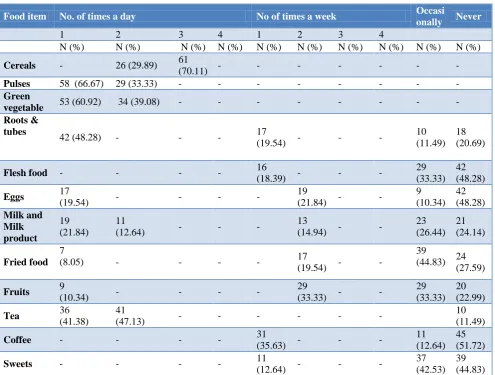
Table 3 shows the food consumption pattern of respondents majority consumed cereals 70.11% three times per day, pulses consumed once per day 66.67% and only 10.34% consumed fruits per day. 26.44% consumed milk and milk product occasionally, 47% drink tea twice per day and 42.53% eat sweets occasionally.
carbohydrate intake was 332.04 g and 293.56 g for male and female respectively. The table shows awareness about the care taking of wound shows cleaning with
water 79 (54.8%), cleaning with water and soap 64 (44.4%).
Table 2: Mean anthropometry of the respondents of type 2 diabetics patients.
Variable Male (n=31)
Mean±SD
Female (n=56)
Mean±SD Significance
Age 52.35±10.52 45.91±13.72 0.026*
Height (cm) 165.86±7.40 150.44±12.07 0.000**
Weight (kg) 70.15±12.32 59.55±13.08 0.000**
Hip (cm) 93.98±8.66 87.02±14.71 0.044*
Waist (cm) 97.17±10.53 90.88±15.22 0.018*
BMI 25.40±3.60 26.57±6.84 0.380
Waist Hip Ratio 1.03±0.05 1.04±0.06 0.364
*p<0.05, **p<0.01.
Table 3: Frequency of different type of food consumption (n=87).
Food item No. of times a day No of times a week Occasi
onally Never
1 2 3 4 1 2 3 4
N (%) N (%) N (%) N (%) N (%) N (%) N (%) N (%) N (%) N (%)
Cereals - 26 (29.89) 61
(70.11) - - - -
Pulses 58 (66.67) 29 (33.33) - - - -
Green
vegetable 53 (60.92) 34 (39.08) - - - -
Roots & tubes
42 (48.28) - - - 17
(19.54) - - -
10 (11.49)
18 (20.69)
Flesh food - - - - 16
(18.39) - - -
29 (33.33)
42 (48.28)
Eggs 17
(19.54) - - - -
19
(21.84) - -
9 (10.34)
42 (48.28) Milk and
Milk product
19 (21.84)
11
(12.64) - - -
13
(14.94) - -
23 (26.44)
21 (24.14)
Fried food 7
(8.05) - - - - 17
(19.54) - -
39
(44.83) 24 (27.59)
Fruits 9
(10.34) - - - -
29
(33.33) - -
29 (33.33)
20 (22.99)
Tea 36
(41.38)
41
(47.13) - - - -
10 (11.49)
Coffee - - - - 31
(35.63) - - -
11 (12.64)
45 (51.72)
Sweets - - - - 11
(12.64) - - -
37 (42.53)
39 (44.83)
Table 4: Mean macronutrients intake of the respondent.
Nutrients Male Female Total
Energy (kcal) 1386.52±318.72 1125.79±214.67 1218.70±284.04 Carbohydrate (g) 332.04±83.9 293.56±45.95 302.71±42.06
Proteins (g) 68.71±38.64 50.50±21.54 56.99±29.91
DISCUSSION
The aim of this study is to assess the nutritional status and food consumption pattern of type 2 diabetics. The study shows that majority of the respondents were 40 years and above, this is similar to the finding of Deepashree, Shrivastav, Adebisi et al.4-6 Anthropometry reveals that there was no significant difference in the mean waist hip ratio and BMI of male and female respondents, similar findings in a study by Oladapo et al showed the mean weight of the male (72.71 kg) and female (70.82 kg) and percentage of women (11.1%) that were obese was more than the male (8.3%) however, majority of the participants were either overweight or obese.7 Present study also reported similar finding, obesity and obese was observed in 21.66% and 55% subjects observed in Shrivastav et al.5 Kushwahaet et al in study the mean BMI was found in the survey of the study population was 25.55 kg/m2 with standard deviation of 4.2 kg/m2.8
Nutritional status and food consumption pattern of 87 diabetic’s respondents in Shrivastav et al, majority of responded consumed cereals and pulses twice a day, roots and tubes consumed less. Only 10% respondent consumed fruits once a day.5
Oladapo et al shows almost same as our finding of the food consumption pattern of the respondents. Majority of (70.0%) were consumed cereals once per day while few (16.7%) consumed fruits once per day. 51.7% of the respondents consumed non-starchy vegetable four times per week while majority (95%) consumed fish and sea products once per day. Fried foods were consumed by 33.3% twice per week while milk and milk products was consumed by 38.3% respondents once per day.7 The mean protein intake was 91.93 g and 89.29 g for male and female diabetics. Deepashree et al shows rice and ragi formed the staple cereal of most patients while wheat was used by lesser number of subjects.4 The intake of green leafy vegetables was less with 42 subjects consuming it once a week, 29 of them twice a week, 11 of them thrice a week and 23 subjects once in a fortnight. Most other vegetables were consumed on a weekly basis or fortnightly basis. In fruits, more than 50% of the subjects did not consume most fruits except for bananas. Milk and curds were used by majority of subjects everyday. Among other foods, coconut consumption was very high. Of the total population surveyed, 64 subjects were vegetarians and did not consume mutton, fish or chicken. Others mostly consumed these foods weekly, fortnightly and some of them occasionally. 27 subjects used sugar daily. 79 and 101 subjects did not use sugar and jaggery respectively.
Pomerleau and Knai also reported that diabetics were less devoted to the Mediterranean diet, which is rich in vegetables, fruits, fish, cereals and olive oil.9
This study shows that non-starchy vegetables consumption pattern of the respondents were below the minimum recommended consumption of five serving per day.10,11 While few of the respondents consumed fruits once per day and majority consumed fish and sea products during the cause of their disease, and they tend to eat other foods rich in carbohydrate and simple glucose. The low intake of fruit and vegetables among the diabetics could be because of low level of awareness on the importance of fruits and vegetables to diabetes management as vegetables contain fiber, which helps reducing cholesterol thereby controlling blood glucose. This is similar to a report from a cross-sectional study in Africa including Nigeria, which indicated low adherence to dietary recommendation for macronutrient intake on fruits and vegetables consumption among diabetics.12
CONCLUSION
In the present study dietary knowledge of diabetic patients was inadequate and needs improvement. Though the consumption pattern of the diabetics was encouraging, there is need to adhere fully to the dietary recommendation for diabetics. Non-starchy vegetables consumption pattern of the respondents were low and diabetes was poorly controlled. This could be attributed to low level of awareness on the importance and benefit of fruits and vegetables in the management of diabetes. So the diet is an important part in the treatment of a diabetic patient. Following a healthy lifestyle, managing the weight and eating a balanced diet will improve the patient’s health enormously. Education and counselling about all the aspects of diabetes are needed. We will do this study in future with the large scale and much large sample size.
ACKNOWLEDGEMENTS
I hereby acknowledge all the participants who helped in providing the information and all the students who helped in completion of the study.
Funding: No funding sources Conflict of interest: None declared
Ethical approval: The study was approved by the Institutional Ethics Committee
REFERENCES
1. WHO. Int. Diabetes, 2019. Available at https://www.who.int/en/news-room/fact-sheets/ detail/diabetes. Accessed 3 July 2019.
2. Mohan V. Why are Indians more prone to diabetes?. J Assoc Physicians India. 2004;52:468-74.
4. Deepashree BN, Prakash J. A study on the nutritional status of diabetics and associated risk factors. J Hum Ecol. 2007;21(4):269-74.
5. Shrivastava M, Gupta A, Shrivastava G. Assessment of dietary pattern and lifestyle of diabetic patients in Reva city, India. Int Res J Pharm. 2014;5(2):66-9. 6. Adebisi TT. Assessment of nutritional status of
diabetic patients in Ogun State, Nigeria. American J Hum Ecol. 2013;2(4):120-6.
7. Oladappo AA, Jude-Ojei BS, Koleosho AT, Roland-Ayodele MA. Nutritional status and food consumption patern of diabetics in Owo, Nigeria. 2013;17(2).
8. Kushwaha AS, Kumari S, Kushwaha N. Self care in diabetes: a study amongst diabetics in an urban community. Int J Community Med Public Health. 2017;3(1):293-8.
9. Pomerleau J, Lock K, Knai C, McKee M. Interventions designed to increase adult fruit and vegetable intake can be effective: a systematic
review of the literature. J Nutr. 2005;135(10):2486-95.
10. Blanck HM, Gillespie C, Kimmons JE, Seymour JD, Serdula MK. Trends in fruit and vegetable consumption among US men and women, 1994– 2005. Preventing Chronic Dis. 2008;5(2):A35. 11. World Health Organization. Diet, nutrition, and the
prevention of chronic diseases: report of a joint WHO/FAO expert consultation. World Health Organization. Geneva; 2003.
12. World Health Organization. Fruit and vegetables for health: report of the Joint FAO/WHO Workshop, Kobe, Japan; 2004.