Original Research Article
Mobile phone usage pattern and its health effects among medical
students in north Karnataka: an observational study
Sweta Sinha*, Manjula S. Patil
INTRODUCTION
The mobile phone is a modern-day communication invention, which has helped to reach the different parts of the world. Technological development in field of communication have made mobile phone smart enough to be able to make video calls, surf the internet, play games etc.
The usage of mobile internet has seen a more than threefold increase since 2010, which has reached 6.319 billion in April 2019.1 The rapid upheaval of technology
and storming fast internet has led to an enormous growth in the number of smart phone users in India. India ranks second in terms of telecommunication, subscription, internet subscribers and application downloads globally.2 Out of 830 million young people who are online, 320 million (39%) are in India and China.5
Today, the potential of smartphone as an educational tool has started to gain recognition Smartphones are used for various purposes by medical students viz., note taking, cloud storage, imaging, web browsing, clinical handbooks and text books, question banks, medical calculators, simulation apps etc.11
ABSTRACT
Background: The mobile phone is viewed as an important communication tool and is an integral part of the human society in the present era. Medical students use smart phones for note taking, imaging, web browsing, text books, question banks etc. Excessive mobile phone use has been found to be associated with health problems such as impaired concentration, headache, fatigue, thermal sensations in and around ear, stress, sleep disturbances and frustration. Objective was to explore the mobile phone usage pattern and its health effects among medical students. Methods: An observational study was conducted among medical students of Belagavi. The calculated sample size was 277 after taking the prevalence of mobile phone usage pattern of 76.4%. The questionnaire consists of socio-demographic characteristics, pattern of mobile phone usage like mode of use, time of maximum use etc. and the health effect variables like headache, restlessness, neck pain, painful fingers etc. Statistical analysis was done using MS-Excel 2007 and SPSS v 22, proportion and chi-square test was applied and p<0.05 was considered significant. Results: 98.19% were using smart phone and 85.56% were having single phone. Maximum were using for 2-4 years (42.60%). Internet was used for academic purpose in 89.89%. Majority of them experienced eyes symptoms (55.23%) followed by sleep deprivation (46.21%) and headache (42.60%).
Conclusions: Even though mobile phone has positive role in our daily lives, its overuse leads to negative impact on health, sleep, and academic performance of students.
Keywords: Mobile phone, Usage pattern, Health, Medical students
Department of Community Medicine, Belagavi Institute of Medical Sciences, Belagavi, Karnataka, India
Received: 07 July 2019 Accepted: 17 August 2019
*Correspondence: Dr. Sweta Sinha,
E-mail: [email protected]
Copyright: © the author(s), publisher and licensee Medip Academy. This is an open-access article distributed under the terms of the Creative Commons Attribution Non-Commercial License, which permits unrestricted non-commercial use, distribution, and reproduction in any medium, provided the original work is properly cited.
Mobile phone excessive use has been found to be associated with health problems such as impaired concentration, headache, dizziness, fatigue, thermal sensations in and around ear, facial dermatitis, stress, sleep disturbances owing to night time use, and frustration.6 Hence the study was conducted to know the usage pattern of mobile phones and the health effects among medical students.
METHODS
An observational study was conducted among the medical students of BIMS, Belagavi. The calculated sample size was 277 by taking 76.4% usage pattern of smart phone from a study conducted by Gupta et al with 95% confidence interval and 5% absolute error.9 It was two months study from August 2018 to September 2018. The study was conducted after the Ethical clearance from IEC of BIMS, Belagavi. All the medical students were included in the sampling frame except the first year as they were on post university exam leave and they were explained about the purpose of the research. The questionnaires were distributed to the respondents and were asked to fill it up after giving the informed consent. It was a self-administered, pre-designed, pre-tested semi-structured questionnaire. The questionnaire comprised of socio-demographic characteristics, pattern of mobile phone usage (mode of use, time of maximum use, etc.), behavioural pattern (midnight checking of mobile, early morning checking, restroom usage), their opinion on mobile phones and the health effect variables experienced like headache, restlessness, fatigue, neck pain, painful fingers etc.
Inclusion criteria
All the medical students were included to participate in the study.
Exclusion criteria
Students who did not give informed written consent.
Statistical analysis
Data was analysed using MS-Excel 2007 and SPSS v 22, proportion and Chi-square test was applied and p value <0.05 was considered significant. Results were presented in form of tables and figures.
RESULTS
Out of a total of 277 student participants, 62.09% were males and 37.91% were females. Majority of them were in the age group of 21-23 years (51.99%) as shown in the (Table 1).
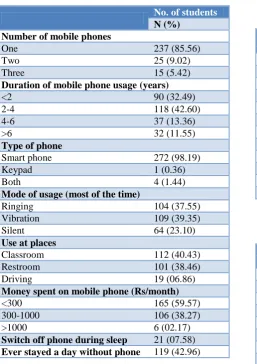
85.56% (237) had one mobile phone and only 5.42% (15) were having three mobile phones and 98.19% were having smart phones and both keypad and smartphone was owned by 1.44% of them. Among them 11.55% were
using mobile phone for more than six years and 42.60% were using since 2 to 4 years. As far as the behavioural pattern is concerned 23.83% of study participants kept the mobile under the pillow while sleeping, only 7.58% of them switched off their phone during sleep, 21.30% of them check the mobile for any missed calls or messages at midnight and 65.70% of them were checking the mobile as soon they get up from the bed. The usage of mobile phone among medical students in the classroom during the break time was 48.43%, 6.86% driving and 91.70% were using for study purpose (Table 2).
Table 1: Socio-demographic profile of medical students (n=277).
Number of students N (%)
Age (years)
18-20 162 (58.48)
21-23 144 (51.99)
>24 1 (0.36)
Gender
Male 172 (62.09)
Female 105 (37.91)
Religion
Hindu 261 (94.22)
Muslim 9 (3.25)
Christian 3 (1.08)
Others 4 (1.44)
Socio-economic status
I 172 (62.09)
II 59 (21.29)
III 31 (11.19)
IV 7 (2.53)
V 8 (2.89)
Students’ opinion on usage of mobile phone was as such- 47.65% thought it as academic hinderance and 66.06% as distractions but 93.14% of them had an opinion that mobile phones are beneficial for studies. 30.69% said that life without mobile phone is boring but normal. 46.25% said they have faced decline in study habits and grades (Table 3).
Internet used for academic purpose was 89.89%, entertainment 97.75% and for social networking 89.53% by the participants (Table 4).
46.21% faced sleep deprivation due to mobile use and 21.30% had been late for classes and 17.33% have missed classes. More than half of them (51.26%) experienced decrease in concentration.
Table 2: Pattern of mobile phone usage among medical students (n=277).
No. of students N (%)
Number of mobile phones
One 237 (85.56)
Two 25 (9.02)
Three 15 (5.42)
Duration of mobile phone usage (years)
<2 90 (32.49)
2-4 118 (42.60)
4-6 37 (13.36)
>6 32 (11.55)
Type of phone
Smart phone 272 (98.19)
Keypad 1 (0.36)
Both 4 (1.44)
Mode of usage (most of the time)
Ringing 104 (37.55)
Vibration 109 (39.35)
Silent 64 (23.10)
Use at places
Classroom 112 (40.43)
Restroom 101 (38.46)
Driving 19 (06.86)
Money spent on mobile phone (Rs/month)
<300 165 (59.57)
300-1000 106 (38.27)
>1000 6 (02.17)
Switch off phone during sleep 21 (07.58) Ever stayed a day without phone 119 (42.96)
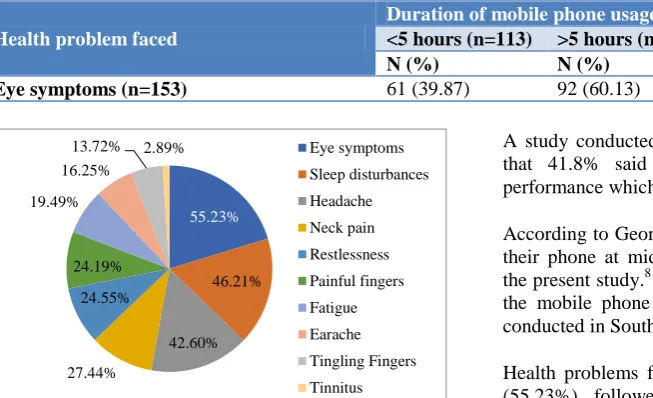
Majority of them have faced eye symptoms (55.23%) and headache 42.60%. one fourth of them had faced neck
pain (27.44%), restlessness (24.55%) and painful fingers (24.19%) (Figure 1).
Table 3: Opinion on usage of mobile phone.
Number of students N (%)
Opinion on usage
Academic hindrance 132 (47.65)
Distractions 183 (66.06)
Beneficial for study 258 (93.14) Life without phone
Bored and normal 85 (30.69) Bored and alone 34 (12.27)
Normal 56 (20.21)
Bored 35 (12.64)
Alone 21 (07.58)
Happy 19 (06.86)
Calm 27 (09.75)
Table 4: Usage of mobile phones other than communication among medical students
Number of students N (%)
*Other purpose
Hearing songs 267 (96.39)
Gaming 196 (70.76)
Internet 274 (98.92)
*Use of internet for
Academic 249 (89.89)
Entertainment 268 (96.75) Social networking 248 (89.53) *: multiple answers.
Table 5: Association of sleep and academic disturbance with duration of mobile phone usage (n=277).
Sleep and academic disturbances
Duration of mobile phone usage
<5 hours (n=113) >5 hours (n=164) Chi-square P value
N (%) N (%)
Sleep deprivation (n=129) 44 (34.11) 85 (65.89) 80.14 <0.001
Waking time tiredness (n=110) 42 (38.18) 68 (61.82) 61.98 <0.001
Difficulty in waking up (n=136) 52 (38.24) 84 (61.76) 74.88 <0.001
Decline in study habits and grades (n=128) 54 (42.19) 74 (57.81) 59.31 <0.001 Decrease in concentration (n=142) 59 (41.55) 83 (58.45) 65.67 <0.001 Increase in missed classes (n=48) 18 (37.50) 30 (62.50) 26.37 <0.001
Being late for classes (n=59) 16 (27.12) 43 (72.88) 46.51 <0.001
Table 6: Association of health problem faced with duration of mobile phone usage (n=277).
Health problem faced
Duration of mobile phone usage <5 hours (n=113) >5 hours (n=164)
Chi-square P value
N (%) N (%)
Headache (n=118) 44 (37.29) 74 (62.71) 62.31 <0.001
Earache (n=45) 12 (26.67) 33 (73.33) 35.73 <0.001
Neck pain (n=76) 27 (35.53) 49 (64.47) 43.61 <0.001
Health problem faced
Duration of mobile phone usage
<5 hours (n=113) >5 hours (n=164) Chi-square P value
N (%) N (%)
Eye symptoms (n=153) 61 (39.87) 92 (60.13) 69.29 <0.001
Figure 1: Health problems experienced due to mobile phone usage.
The association of health problems experienced with the duration of mobile phone was significant (p<0.005) (Table 6).
DISCUSSION
At present there are no much studies or information about the mobile phone usage pattern and its health impact. In our study 62.09% were male and 37.91% were female participants where as a study conducted by Unnikrishnan et al in Coastal South India 56% were male and 44% were female students.16 In South India, Subha et al found that 39.7% were keeping their phone in ringing mode and 60% were keeping in vibrating or silent mode which was almost similar to our study.15
The result of our study shows that 51.21% were using the mobile phone for more than five hours. A study conducted by Susila et al among medicals students of Chennai found that 29% spent more than three hours/day on mobile and 17.8% by Gupta et al in Punjab were using for more than three hours.6,9
The use of internet for entertainment, academics and social networking was higher in the present study. Internet usage for academic purpose in our study was 89.89% and 11.11%, 19.4%, 76.9% by different studies conducted among the medical students across India by Damor et al, Ghosh et al, Aggarwal et al, respectively.4,10,12 The usage of mobile phone for academic purpose may have increased the time duration spent on phone. Bagday et al study in Nagpur city showed 5.96% were using internet on mobile phones for chatting, 59.59% for shopping and 40.92% for games was less compared to our study.3 For playing games, mobile phone was used by 14.4%, 5.8% and for watching movies and songs 21.81%, 8.3% according to Damor et al and Ghosh et al was again less compared to our study.4,10
A study conducted by Damor et al in Gujarat indicated that 41.8% said mobile phones impaired academic performance which is almost similar to our study.4
According to George et al in Kerala, 34% were checking their phone at midnight which was higher compared to the present study.8 In the present study 6.86% were using the mobile phone while driving and 17.4% in a study conducted in South India.15
Health problems faced in our study was eye symptoms (55.23%), followed by headache (42.60%), neck pain (27.44%) which was almost similar to a study conducted by Arumugam et al where 64.3% had experienced health problems like headache, sleep disturbance, ear pain, irritability.14 Similar study was conducted by Paul et al among the medical students found that 35.4% of the students complained of headache and spasms of arm or neck muscles (31.0%) or loss of attention (24.7%).13 Among the medical students of Western Maharashtra, headache was 30.20% among girls, 15.60% in boys, eye symptoms 5.50%, sleep deprivation 21% by Yadav.7
The present study found that mobile phone was used for more than five hours by most of the students, and almost everyone was using for academic purpose, entertainment and social networking and they had experienced health problems. So, the students should be educated regarding the health problems owing to the over usage of mobile phones, prohibition of usage of mobile phones in the college campus should be implemented and strictly followed by the administrative authority.
ACKNOWLEDGEMENTS
We author gratefully acknowledge the participants, coordinators and Dr. R. G. Viveki, Head of the department of Community Medicine, BIMS, Belagavi for assistance and support.
Funding: No funding sources Conflict of interest: None declared
Ethical approval: The study was approved by the Institutional Ethics Committee of BIMS, Belagavi
REFERENCES
1. World Bank information and communication for development 2019. Accessed 2 July 2019.
2. India Brand Equity Foundation 2019. Available at: www.ibef.org. Accessed 3 July 2019.
3. Bagdey P, Adikane H, Narlawar U, Dhage D, Surwase K, Kaware A. Cross-Sectional Study of Prevalence of Internet Addiction and its association with mental health among college going students in 55.23%
46.21%
42.60% 27.44%
24.55% 24.19% 19.49%
16.25%
13.72% 2.89% Eye symptoms Sleep disturbances Headache Neck pain Restlessness Painful fingers Fatigue Earache Tingling Fingers Tinnitus
Nagpur city. Int J Community Med Public Health. 2018;5(4):1658-65.
4. Damor RB, Gamit SP, Modi A, Patel J, Kosambiya J. Pattern of smart phone and internet usage among medical students in Surat, Gujarat- A cross sectional study. National J Community Med. 2018;9(7):469-73.
5. ICT Facts and Figures 2017. Available at: http://www.itu. int/en/ITU-D. Accessed on 3 July 2019.
6. Susila T, Somasundaram A, Jenifer A, Kamalipriya S, SwarnaPriya M, Gayathri G, et al. A cross sectional study on electronic device addiction among youth in an urban area, Chennai. Stanley Med J. 2017;4:1-7.
7. Yadav JU, Yadav DJ. Study of mobile phone usage in medical students of deemed university of Western Maharashtra, India. Int J Community Med Public Health. 2017;4:1.
8. George S, Saif N, Joseph B, Joseph B. A study on mobile phone usage pattern and its dependence among medical students of a college in Kerala, India. Int J Res Med Sci. 2017;5:3615-9.
9. Gupta N, Garg S, Arora K. Pattern of mobile phone usage and its effects on psychological health, sleep and academic performance in students of a medical university. National J Physiol Pharmacy Pharmacol. 2016;6:132-9.
10. Ghosh A, Jha R, Malakar SK. Pattern of smart phone use among MBBS students in an Indian medical college. Int J Applied Res. 2016;2:5.
11. Mohapatra D, Mohapatra M, Chittoria R, Friji M, Kumar S. The scope of mobile devices in health care and medical education. Int J Advanced Med Health Res. 2015;2:469-73.
12. Aggarwal S, Ambalkar D, Kale K, Aswar N, Bhatule P. pattern of internet use among medical students. A cross sectional study. Asian J Sci Tech. 2015;6:4.
13. Paul B, Roy S, Saha I, Misra R, Chattopadhya S, Basu M. Mobile phone usage pattern among undergraduate medical students at a Medical College of Kolkata, West Bengal, India. Turk J Public Health. 2014;12(3):178-87.
14. Arumugam B, Sachi S, Nagalingam S. A descriptive study on behavior associated with mobile phone usage and its effect on health among medical students in Chennai. J Evol Med Dental Sci. 2014;3(7):1590-5.
15. Subba S H, Mandelia C, Pathak V, Reddy D, Goel A, Tayal A, et al. Ringxiety and mobile phone usage pattern among students of a medical college in South India. J Clin Diagnos Res. 2103;7(2):205-9. 16. Unnikrishnan B, Kulsshrestha V, Saraf A, Agrahari
AC, Prakash S, Samantary L, et al. Pattern of computer and internet use among medical students in coastal South India. South East Asian J Med Edu. 2008;2(2):18-25.