674 Emir. J. Food Agric ● Vol 31 ● Issue 9 ● 2019
Shoot nutrient contents and vegetative melon plants
growth at different pH levels of the nutrient solution
José Maria da Silva¹*, Bruno do Nascimento Silva², Gustavo Andrés Iglesias Barrera³,Rafaela da Silva Arruda², Paulo Cezar Rezende Fontes¹, Paulo Roberto Gomes Pereira¹
1Department of Crop Science, Federal University of Vicosa, Minas Gerais, Brazil,²Department of Plant Biology, Federal University of Vicosa, Minas Gerais, Brazil, ³Department of Microbiology, Federal University of Vicosa, Minas Gerais, Brazil
*Corresponding author:
José Maria da Silva, Department of Crop Science, Federal University of Vicosa, Minas Gerais, Brazil. [email protected]; [email protected]; [email protected]. E-mail: [email protected]
Received: 12 April 2019; Accepted: 22 August 2019
INTRODUCTION
The melon (Cucumis melo L.) is a vegetable belonging to the family of Cucurbitaceae with great acceptance by the national and international consumer market. Brazil is the third largest melon exporter, with Europe being the main destination of national production (Mulderij, 2018), and quality-demanding consumers (Nunes et al., 2005).
In 2016, worldwide melon harvest area was 1.2 M ha with 36 M t production (FAOSTAT, 2018). Melon plants
development and production can be influenced by several
factors mainly by adequate nutrients supply which is
markedly influenced by the pH, not only in soil conditions,
but mainly in nutrient solution due to its lower buffering capacity (Gorbe and Calatayud, 2010). Several factors
influencing plant grows in a hydroponic system including
light, water temperature, genotype, nutrient solution
composition, and pH.
Maintaining the pH of the nutrient solution in an adequate
value is crucial for the proper crop development because it is directly related to the nutrient availability to the plants
(Spinu et al., 1998). As a general rule, at pH between 5.5
and 6.5, nutrients are in available forms and ensures normal development of most crops (Islam et al., 1980; Sardare and Admane, 2013). Bugbees (2013) recommends the value of
5.8. The author mentioned when the pH is higher, nutrients
such as Mn, Cu, Zn, and Fe have a reduced availability and the availability of Mg, Ca, K, and P is slightly decreased.
Early marketable cucumber fruit yield was higher at pH 5.0 compared to pH 8.0 but total yield was unaffected by pH
treatment, in recirculating aquaponics (Tyson et al., 2008).
For Kane et al. (2006), maintained the pH at 6.5 increased onion biomass significantly in relation to pH of 5.8, indicating that small variations in the pH of the nutrient
solution directly impacted crop yield. Limited information is available for melon. Gomes et al. (2011) observed no differences in leaf number and melon plant height submitted
to pH levels in nutrient solution varying from 4.0 to 8.0.
Therefore, it is verified that the effect of nutrient solution pH on the plants depending on the specie and the
characteristic measured. The objective of this study was
to determine the effects of different nutrient solution pH
Melon plants development are determined by nutrient availability in the nutrient solution which is markedly influenced by the solution pH. The objective of this work was to evaluate the effects of hydroponic nutrient solution pH on growth and mineral content of melon plants. The plants were growth in nutrient solution at five pH levels (4, 5, 6, 7 and 8) in a completely randomized design with three replicates. At 40 days after transplanting were evaluated shoot and roots fresh and dry weight as well as the root volume. Leaf nutrients contents was also determined. It was concluded that it is essential to keep the nutrient solution pH at 6.0 in order to obtain plants with high leaf number, fresh and dry root mass, root volume and iron and zinc contents in the leaves.
Keywords: Cucumis melo L.; Hydroponic cultivation; Greenhouse; Hydrogen potential; Dry matter.
A B S T R A C T
http://www.ejfa.me/
levels on the shoot nutrient contents and growth of melon plants.
MATERIALS AND METHODS
The experiment was conducted in a 3-phase hydroponic system in a greenhouse of the Department of Crop Science of the Federal University of Vicosa (UFV), from April to June 2018. The experimental design was completely randomized, with three replications.
The treatments were constituted by five pH levels of the nutrient solution (4.0, 5.0, 6.0, 7.0, and 8.0). Each
experimental plot consisted of a vessel containing one plant. The nutrient solution was that recommended by
Benoit (1987) cited by Castellane and Araujo (1994) and Enshi cited by Hori (1966). The nutrient solution
contained, in mM L-1, 14.08 NO
3, 1.35 NH4, 1.35
H2PO4, 6.02 K, 4.03 Ca, 2.03 Mg, 2.03 S, 0.020 B, 0.05 Cu, 0.022 Fe, 0.0114 Mn, 0.0007 Mo and 0.0004 Zn.
The micronutrient iron was supplied as a chelate as ethylenediaminetetraacetic acid (EDTA).
Cantaloupe melon cultivar Pampa F1 (TPC-05814) seeds
were sown on April 11 in a tray containing washed sand. The acclimation of the seedlings was carried out by 21 days
after sowing, when they presented 2 definitive leaves.
The nutrient solution for acclimatization was the same
recommended for definitive cultivation, with 50% strength.
At 30 days after sowing, the seedlings were transferred
to pots filled with 8 L of nutrient solution. The vessels
were covered with styrofoam lids coated with foil where
the plants were fixed. The oxygenation of the nutritive
solutions was done by air compressor, using a porous capsule in each vessel.
Nutrient solution monitoring was performed daily through
the electrical conductivity (EC) and pH readings according to Furlani et al. (1999). The daily pH correction was done
according to the treatments, allowing variations up to ± 0.05 using 1 mol L-1 HCl or 1 mol L-1 NaOH. Whenever
the EC reached a value equal or inferior to 1.5 dS m-1, the
nutrient solution was reestablished. Deionized water was replaced whenever necessary.
At 8, 15, 22, 29 and 40 days after transplanting (DAT),
plants were evaluated for height, leaf number and SPAD (Soil Plant Analysis Development) index. The height (cm) of plants was measured from the base to the apex of the last leaf; leaf number was determined by direct counting of the fully expanded leaves. For the SPAD evaluation, reading was performed on three leaves of the middle third located on the main stem of the melon plant by Minolta Chlorophyll meter SPAD-502.
At 40 DAT plant were harvested and divided into shoot and
root which were weighted and the root volume evaluated. Shoot and root were conditioned in paper bags and dried at 65 ° C until reaching constant weight. After drying, shoot and root dry weight were obtained. Subsequently, foliar chemical analysis was performed.
For leaf chemical analysis, the samples were passed in a Wiley
type mill equipped with a 20-mesh sieve. Total nitrogen (N-total) was determined by the Kjeldahl method described by Bremner (1965). Phosphorus (P), potassium (K), calcium (Ca), magnesium (Mg), iron (Fe), manganese (Mn), zinc (Zn) and copper (Cu) were determined after
nitric-perchloric acid digestion. P was quantified calorimetrically
in a spectrophotometer following the methodology
proposed by Braga and Defelipo (1974). The K was determined in flame photometer and the Ca, Mg, Fe, Mn,
Zn and Cu by atomic absorption spectrophotometry.
Analysis of variance (F test P ≤ 0,05) was conducted using
the ExpDes.pt package (Ferreira et al., 2018) in software R and means were separated by Duncan’s Multiple Range
Test at the 5% level.
RESULTS AND DISCUSSION
Melon plant height (shoot length) as affected by different
nutrient solution pH, evaluated at 8, 15, 22, 29 and 40 days
after transplanting, are in Table 1. At any time, no pH effect
was observed on plant height which increased with time
from 5.72 to 176.62 cm as an average of nutrient solution pH treatments. Under nutrient solution, cucumber shoot length was similar in pH 5.0, 6.0, and 7.0 but reduced at
Table 1: Melon plant height and leaf number as affected by nutrient solution pH at 8, 15, 22, 29 and 40 days after transplanting (1)
pH Plant height (cm) Number of leaves
8ns 15ns 22ns 29ns 40ns 8ns 15ns 22ns 29ns 40ns
4.0 5.4 11.9 35.3 89.0 160.5 8.0 13.8 22.8 34.0b 42.3d
5.0 5.8 13.6 42.0 98.8 174.8 9.0 12.8 22.5 35.8b 50.3cd
6.0 6.6 17.1 51.3 115.3 195.0 9.0 14.3 29.0 49.0a 74.0a
7.0 5.0 12.5 42.5 106.5 179.0 8.0 14.3 24.5 42.3ab 62.8ab
8.0 5.8 14.5 44.3 102.0 173.8 8.0 15.5 24.0 40.5ab 56.5bc
CV (%) 26.2 29.2 24.7 13.1 10.4 20.9 15.5 15.6 15.8 13.4
(1)Different letters indicate significant differences between means within columns at the 5% probability level according to Duncan test. nsstands for no significant
SPAD is an effective instrument for the leaf greenness measurement being closely related to the chlorophyll content. SPAD could satisfactorily estimates N status of several species including melon (Azia and Stuart, 2001; Colla et al., 2010).
Concentrations of macronutrients N, P and K in the shoot
were not significantly affected by the applied treatments
(Table 3) and reached means values of 44.2, 8.0 and 43.4 g kg-1, respectively. However, significant pH effects
were observed for Ca and Mg concentrations (Table 3). Ca concentration was higher, 11.2 and 10.2 g kg-1, at pH 7.0 and 6.0, respectively. Mg concentration was higher, 13.7 and 12.4 g kg-1, at pH 8.0 and 7.0, respectively. Mills and
Jones (1996) suggest for Ca and Mg the normal values of 23 – 30 and 3 – 8 g kg-1, respectively. Similar values of 25 – 50; 3 – 7 and 25 – 40 for N, P and K, respectively
and 25 – 50 and 5 – 12 g kg-1 for Ca and Mg are cited as normal, respectively (Trani & Raij, 1997). It is verified that
shoot N, P, K and Mg concentrations were at adequate levels. More acidic or basic the nutrient solution lowers the Ca concentrations. This was true for Mg only under
more acidic pH treatments (Table 3). Independently of
pH treatments, the Ca concentration was below the lower limit of the sufficiency range (Table 3) but no visual Ca
deficiency symptoms was observed in the shoot. pH 8.0 (Tyson et al., 2008). Plant height obtained in the
present study was higher than reported by Gomes et al. (2011) and similar to values found for melon grown in soil, under greenhouse conditions (Lima et al., 2009).
Melon plant leaf number as affected by different nutrient
solution pH evaluated at 8, 15, 22, 29 and 40 days after
transplanting are in Table 1. Only at 29 and 40 DAT the pH of the nutrient solution significantly affected leaf number (LN). Lower pH (4.0 and 5.0) and higher pH (8.0) led to lower LN than pH 6.0, which were 49 and 74 leaves
plant-1. Gomes et al. (2011) did not find significant influence of the nutrient solution pH on melon leaf number.
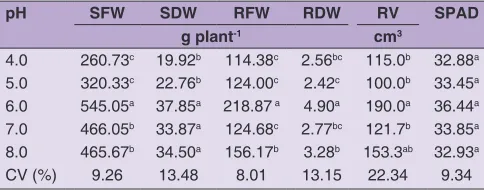
At 40 DAT, pH treatments significantly influenced shoot
and root fresh and dry weight as well root volume (Table 2).
The highest values were obtained at pH 6.0, although there was no significant difference for treatments at pH 7
and 8 in shoot dry weight and root volume (Table 2). The
highest SDW was 37.6 g plant-1 at pH 6.0. Comparing the
values of the dry weight of the roots, there was a growth
between the pH ranges 4 to 6, but a decrease in the ranges 7 and 8. At pH 6, there is a low availability of H+ in the solution, which allows higher efficiency of the ionic pump
bound to the ATPases of the plasma membrane and thus favors the absorption of essential ions for the growth and accumulation of dry matter (Marschner, 2012).
The pH of the nutrient solution significantly affected the root volume. The plants that grew up at pH 6 presented
higher individual mean between the treatments and better visual appearance of roots, with a clear coloration and higher volume (Fig. 1). Treatments with higher acidity resulted in
lower mean root volume. A reduction in the pH of the nutrient solution increases the competition of the H+ ion,
especially the K+, for the sites of the membrane carriers
(Marschner, 2012), which reduces the absorption of essential elements and, therefore, reduces the development of the roots. Plants grown under extreme pH ranges have lower
root development due to reduced hydraulic conductivity
(Kamaluddin et al. 2004). Long et al. (2017) showed that citrus plants showed reduced root growth at low pH, as a consequence of H+ accumulation toxicity, causing root
damage and reducing water absorption, which can induce water stress, causing a reduction in biomass accumulation. (Table 2). Qi et al. (1994) showed that the increase in bicarbonate concentration, as a consequence of pH increase,
led to lower root growth by inhibition of respiration. Damage
effects of pH 4 and 8 levels on the visual aspect of the roots
were observed. At these extreme levels, there were reduced growth, darker coloration and lower root distribution (Fig. 1).
The treatments did not differ in terms of green leaf color, measured by the SPAD index (Table 2). The
Table 2: Melon shoot fresh weight (SFW), shoot dry
weight (SDW), root fresh weight (RFW),root dry weight (MSR), root volume (RV) and SPAD index as affected by nutrient solution pH, at 40 days after plant emergence(1)
pH SFW SDW RFW RDW RV SPAD
g plant‑1 cm3
4.0 260.73c 19.92b 114.38c 2.56bc 115.0b 32.88a
5.0 320.33c 22.76b 124.00c 2.42c 100.0b 33.45a
6.0 545.05a 37.85a 218.87 a 4.90a 190.0a 36.44a
7.0 466.05b 33.87a 124.68c 2.77bc 121.7b 33.85a
8.0 465.67b 34.50a 156.17b 3.28b 153.3ab 32.93a
CV (%) 9.26 13.48 8.01 13.15 22.34 9.34
(1)Different letters indicate significant differences between means within
columns at the 5% probability level according to Duncan test.
Fig 1. Melon root growth at different pH levels of the nutrient solution,
The lower concentration of Ca at pH 4 may be caused by
the loss of this nutrient from the roots, due to the longer
exposure time. Arnon et al. (1941) reported a significant
reduction of Ca, Mg, NO3- and K levels in barley (Hordeum
vulgare) when it was exposed to pH 3. According to them,
the lower absorption of Ca may be linked to the reduction of plasma membrane permeability, ion absorption and retention, and to the role of Ca pectates formation as a structural component of the cell wall.
Concentrations of micronutrients Cu and Fe in the shoot
were not significantly affected by treatments (Table 3) and
reached means values of 8.6 and 142 mg kg-1, respectively.
Shoot Zn and Mn concentrations were lowered as the
solution pH increased (Table 3). For melon, Mills and
Jones (1996) sugest the sufficient ranges of 7-30;
50-300; 20-200; and 50-250 mg kg-1 for Cu, Fe, Zn, and Mn, respectively. According to Munson (1998), suficient
range concentration of Cu, Fe, Zn, and Mn are 5 – 30;
100 – 500; 27 – 100 and 20 – 300 mg kg-1, respectively. In
this study, the plants did not show visual symptoms of
micronutrients deficiency.
The reduction of Zn and Mn contents result from the
effect of carbonate formation (HCO3-) in the nutrient solution. The high concentration of HCO3- inhibits the uptake of Zn by roots (Dogar and Van Hai, 1980) and translocation to shoot (Forno et al., 1975). Similar results
were observed in the cultivation of lettuce (Roosta, 2011), lupine (Bertoni et al., 1992), rice (Yang et al., 1993), and
olive trees (De la Guardia and Alcantara, 2002) in regard to the concentration of Mn.
Accumulation of macronutrients (N, P, K, Ca, Mg) and micronutrients (Cu, Fe, Zn, and Mn) in the melon shoot
was significantly affected by pH treatments (Table 4).
The macronutrients N, P, K, and Ca accumulated more
at pH 7.0. Mg accumulated more at pH 8.0 but the
micronutrients Cu, Fe, Zn, and Mn besides P accumulated
more at pH 6.0.
In summary, the variables plant height, leaf number, shoot and root dry weight, root volume, leaf greenness and shoot
concentration of Cu and Fe were higher at pH 6.0 than in others pH treatments.
CONCLUSIONS
Based on our findings, pH 6 provided better conditions for plant growth. In this pH range, the shoot presented
higher levels of macro and micronutrients, which resulted in higher growth conditions.
ACKNOWLEDGMENTS
The authors thank the Conselho Nacional de Desenvolvimento Científico e Tecnológico (CNPq –
Process 303.448/2018), Fundação de Amparo à Pesquisa do Estado de Minas Gerais (FAPEMIG) and Coordenação
Table 3: Macro and micronutrient concentration in the shoot dry matter of melon as affected by nutrient solution pH, at 40 days after plant emergence (1)
pH Nns Pns Kns Ca Mg Cuns Fens Zn Mn
g kg‑1ns mg kg‑1
4.0 45.6 7.9 43.8 6.6c 7.9c 7 122 38a 220a
5.0 46.8 9.3 45.0 8.4bc 9.3c 8 138 34a 193a
6.0 40.9 7.8 39.4 9.4ab 10.2bc 10 185 24b 140b
7.0 46.5 8.2 48.6 11.2a 12.4ab 9 147 20b 122b
8.0 41.2 6.6 40.2 8.2bc 13.7 a 9 117 16b 105b
CV (%) 6.6 15.62 16.17 12.72 12.64 16.43 29.34 18.66 14.85
SR 25-50 3-7 25-40 25-50 5-12 5-30 100-500 27-100 20-300
(1)Different letters indicate significant differences between means within columns at the 5% probability level according to Duncan test. nsstands for no significant
difference at 0.05 level. SR stands for sufficiency range of the nutrient
Table 4: Macro and micronutrient accumulation in the shoot dry matter of melon as affected by nutrient solution pH, at 40 days after plant emergence (1)
pH N P K Ca Mg Cu Fe Zn Mn
g plant‑1 mg plant‑1
4.0 0.91b 0.16c 0.87c 0.13d 0.16c 0.14c 2.42b 0.76b 4.38a
5.0 1.06b 0.21c 1.04bc 0.19c 0.21c 0.17c 3.05b 0.76b 4.36a
6.0 1.55a 0.30a 1.48a 0.36a 0.38b 0.37a 7.03a 0.90a 5.30a
7.0 1.58a 0.28ab 1.64a 0.38a 0.42ab 0.32b 5.04ab 0.68b 4.13a
8.0 1.39a 0.22bc 1.35ab 0.27b 0.46a 0.31b 3.97b 0.54b 3.48a
CV (%) 9.92 14.60 16.03 9.95 10.95 9.35 32.24 9.69 15.72
de Aperfeiçoamento de Pessoal de Nível Superior - Brazil (CAPES) Finance Code 001, for financial support.
Author's contributions
Jose Maria, Bruno, Gustavo, Rafaela, and Paulo Fontes conceived and planned the experiment. Jose Maria, Bruno, Gustavo, Rafaela carried out the experiment and performed the analysis. Jose Maria wrote the manuscript with input from all authors. Paulo Roberto contributed to the interpretation of the results. All authors provided critical feedback and helped shape the research, analysis and manuscript.
REFERENCES
Arnon, D. I. and C. M. Johnson. 1941. Influence of hydrogen ion concentration on the growth of higher plants under controlled conditions. Plant Physiol. 17: 525-539.
Azia, F. and K. A. Stewart. 2001. Relationships between extractable chlorophyll and spad values in muskmelon leaves. J. Plant Nutr. 24: 961-966.
Bertoni, G. M., A. Pissaloux, P. Morad and D. R. Sayag. 1992. Bicarbonate-pH relationship with iron chlorosis in white lupine. J. Plant Nutr. 15: 1509-1528.
Braga, J. M. and B. Defelipo. 1974. Determinação espectrofotométrica de fósforo em exratos de solos e plantas. Rev. Ceres. 21: 73-85. Bremner, J. M. 1965. Total nitrogen. In: C. A. Black (Ed.), Methods of
Soil Analysis. American Society of Agronomy, Madison. Bugbee, B. 2004. Nutrient management in recirculating hydroponic
culture. Acta Hortic. 648: 99-112.
Castellane, P. D. and J. A. C. Araújo. 1994. Cultivo Sem Solo: Hidroponia. FUNEP/UNESP, Jaboticabal, SP.
Colla, G., C. M. Suárez, M. Cardarelli and Y. Rouphael. 2010. Improving nitrogen use efficiency in melon by grafting. HortScience. 45: 559-565.
Costa, C. C., A. B. Cecílio Filho, B. L. A. Rezende and J. C. Barbosa. 2006. Crescimento e partição de assimilados em melão cantaloupe em função de concentrações de fósforo em solução nutritiva. Cientifica. 34: 123-130.
De la Guardia, M. D. and E. Alcantara. 2002. Bicarbonate and low iron level increase root to total plant weight ration olive and peach rootstock. J. Plant Nutr. 25: 1021-1032.
Dogar, M. A. and T. Van Hai. 1980. Effect of N, P and HCO3- levels in the nutrient solution on rate of Zn absorption by rice roots and content. Z. Pflanzenphysiol. 98: 203-212.
Ferreira, E. B., P. P. Cavalcanti and D. A. Nogueira. 2018. ExpDes. pt: Pacote Experimental Designs (Portuguese). R Package Version 1.2.0. Available from: https://www.CRAN.Rproject.org/ package=ExpDes.pt.
FAOSTAT. 2018. Food and Agriculture Organization of the United Nations Statistics. Available from: http://www.fao.org/ faostat/en/#data/QC. [Last accessed on 2019 Oct 08].
Forno, D. A., S. Yoshida and C. J. Asher. 1975. Zinc deficiency in rice. II. Studies on two varieties differing in susceptibility to zinc deficiency. Plant Soil. 42: 551-563.
Furlani, P. R., L. C. P. Silveira, D. Bolonhesi and V. Faquin. 1999. Cultivo Hidropônico de Plantas. (Boletim Técnico 180). IAC, Campinas, p. 52.
Gomes, L. D. S., C. A. S. Martins, N. O. Nogueira, F. S. Lopes, T. M. T. Xavier and L. C. M. Cardoso. 2011. Efeito de diferentes valores de pH da solução nutritiva no desenvolvimento de variedades de melão. Rev. Bras. Cienc. Agrár. 6: 73-78.
Gorbe, E. and A. Calatayud. 2010. Optimization of nutrition in soilless systems: A review. Adv. Bot. Res. 53: 193-245.
Hori, H. 1966. Nutrient Solution (in Japanese) In: Yokendo. Gravel Culture of Vegetables and Ornamentals. Yokendo, Tokyo, Japan. Islam, A., D. Edwards, and C. Asher. 1980. pH optima for crop growth.
Plant Soil. 54: 439-448.
Kamaluddin, M. and J. J. Zwiazek. 2004. Effects of root medium pH on water transport in paper birch (Betula papyrifera) seedlings in relation to root temperature and abscisic acid treatments. Tree Physiol. 24: 1173-1180.
Kane, C. D., R. L. Jasoni, E. P. Peffley, L. D. Thompson, C. J. Green, P. Pare and D. Tissue. 2006. Nutrient solution and solution pH influences on onion growth and mineral content. J. Plant Nutr. 29: 375-390.
Lima, E. M. C., L. A. Faria, W. C. Siqueira, F. C. Rezende and L. A. Gomes. 2009. Crescimento e produção de melão cultivado em ambiente protegido e irrigado por gotejamento. Irriga. 14: 449-457.
Long, A., J. Zhang, L. T. Yang, X. Ye, N. W. Lai, L. L. Tan and L. S. Chen. 2017. Effects of low pH on photosynthesis, related physiological parameters, and nutrient profiles of citrus. Front. Plant Sci. 8: 1-22.
Marschner, H. 2012. Marschner’s Mineral Nutrition of Higher Plants. Academic Press Orlando, FL.
Mills, H. A. and J. B. Jr. Jones. 1996 Plant Analysis Handbook II: A Practical Sampling, Preparation, Analysis, and Interpretation Guide. Micromacro Publishing, Athens, GA.
Mulderij, R. 2018. Overview Global Melon Market. Available from: http://www.freshplaza.com/article/192066/overview-global-melon-market. [Last accessed on 2018 Jul 08].
Munson, R. D. 1998. Principles of plant analysis. In: Y. P. Kalra (Ed.), Handbook of Reference Methods for Plant Analysis. CRC Press, Boca Raton.
Nunes, G. H. S., J. J. S. Júnior, F. V. Andrade, F. B. Neto, J. B. Menezes and E. W. L. Pereira. 2005. Desempenho de híbridos do grupo inodorus em Mossoró. Hortic. Bras. 23: 90-94.
Roosta, H. R. 2011. Interaction between water alkalinity and nutrient solution pH on the vegetative growth, chlorophyll fluorescence and leaf magnesium, iron, manganese, and zinc concentrations in lettuce. J. Plant Nutr. 34: 717-731.
Sardare, M. D. and S.V. Admane. 2013. A review on plant without soil-hydroponics. Int. J. Res. Eng. Technol. 2: 299-304.
Spinu, V. C., R. W. Langhans and L. D. Albright. 1998. Electrochemical pH control in hydroponic systems. Acta Hortic. 456: 275-282. Trani, P. E. and B. V. Raij. 1997. Hortaliças. In: B. V. Raij, H. Cantarella,
J. A. Quaggio and A. M. C. Furlani (Eds.), Recomendações de Adubação e Calagem para o Estado de São Paulo. 2nd ed. Campinas, Instituto Agronômico and Fundação IAC, Boletim Técnico, p. 285.
Tyson, R. V., E. H. Simonne, D. D. Treadwell, M. Davis and J. M. White. 2008. Effect of water pH on yield and nutritional status of greenhouse cucumber grown in recirculating hydroponics. J. Plant Nutr. 31: 2018-2030.