Original Research Article
Time span from onset of oral cancer symptoms to treatment: a hospital
based cross sectional study in South India
Shivaraj Nallur Somanna
1*, Nandakumar Bidare Sastry
1, Ramesh Cheluvarayaswamy
2,
K. S. Sabitha
3, Murthy Nandagudi Srinivasa
1, Nea Malila
4INTRODUCTION
Oral cancer is one of the top ten leading cancers in the world and leading causes of mortality and morbidity in the South Asian countries such as India, Srilanka, Pakistan and Bangladesh.1 Age standardized incidence rate of oral cancer (lip and oral cavity) in India is 7.2 per 100,000 population.2 The disability adjusted life years (DALY) for the year 2016 for all cancers was estimated to be 6,904,358 years.3 The oral cancer burden is expected to double or triple over the next 20 years.2
In India 60–80% of patients with oral cancer seek medical advice at advanced stage as compared to 40% in
developed countries.4 Early diagnosis and timely initiation of treatment is required to achieve good results, high survival and good quality of life.5 Oral cancer signs and symptoms are amenable for early detection and the cancer is curable if detected early. The appropriate strategies have been initiated by National program for prevention and control of cancer, Diabetes, Cardiovascular Disease and Stroke (NPCDCS) to prevent Non-communicable diseases (NCDs) in an effective manner. Despite improved development of health care systems, delay in presentation of cancer patients for cancer specific primary treatment poses a great challenge.
Studies have shown that reduction in delay in cancer detection and treatment have improved survival and
ABSTRACT
Background: Oral cancer is one of the major health problems in India. Patient delay in seeking medical help usually contributes to late stage at diagnosis, high mortality and low survival. Our study aims to find the time span from first onset of oral cancer symptoms to cancer specific primary treatment.
Methods: A cross-sectional study was carried out from October 2015-September 2016 in one of the tertiary care cancer center in Bangalore. Histopathologically confirmed 212 incident oral cancer patients were interviewed using a pre-tested semi structured questionnaire.
Results: The median time span between onset of symptoms and seeking medical care was 60 [IQR 30, 104] days, the median time between seeking medical care and diagnosis was 30 [IQR 15, 90] days, and the median time between diagnosis and initiation of treatment was 20 [IQR 12, 33] days.
Conclusions: There is considerable delay in seeking cancer specific primary treatment among oral cancer patients. Efforts should be undertaken to increase awareness in the population and all stakeholders regarding symptoms and improve early diagnostics and access to care.
Keywords: Oral cancer, Time span, Oral cancer symptoms, Primary treatment, Median time
1
Department of Community Medicine, Ramaiah Medical College, Bangalore, Karnataka, India
2
Department of Epidemiology and Biostatistics, 3Department of Oral Surgery, KIDWAI, Bangalore, Karnataka, India
4
Finnish Cancer Registry, Finland
Received: 14 October 2018 Accepted: 31 October 2018 *Correspondence:
Mr. Shivaraj Nallur Somanna, E-mail: [email protected]
Copyright: © the author(s), publisher and licensee Medip Academy. This is an open-access article distributed under the terms of the Creative Commons Attribution Non-Commercial License, which permits unrestricted non-commercial use, distribution, and reproduction in any medium, provided the original work is properly cited.
decreased mortality to a large extent.6,7 Periodic screening programs on high risk groups have shown early detection of precursors, reduced incidence and mortality for oral cancer.8,9 Owing to resource constraints, screening programs in developing countries are largely not available. Oral cancer precursors are easily accessible and amenable for early detection owing to their overt manifestations and easy visibility.10 This requires patients to seek medical advice early and avail appropriate medical interventions to achieve improved survival.
The present study delineates the time span for oral cancer from the onset of symptoms to cancer specific primary treatment.
METHODS
This cross sectional study was undertaken from October 2015 to September 2016 at a tertiary care cancer center which is a population based cancer registry (PBCR) located in Bangalore, Karnataka, India. The center offers services to large populations in and around Karnataka state.
Patients with incident and histopathologically confirmed oral cancer of all stages registered at the center were invited to participate in the study. Patients with primary tumor of the lip upper/lower, oral tongue, floor of mouth, hard palate/maxilla and buccal mucosa as defined in the national cancer registry guidelines were included in the study. Patients referred to palliative care for end of life support were, excluded from the study. Data was
collected from both out patients as well as in-patients at different phases of treatment. Information pertaining to clinical and pathological details of the disease and socio-demographic details were extracted from the hospital records.
The sample size was calculated based on the study conducted by Joshi et al., where the proportion of patients who delayed to seek primary cancer care was 52%. Considering a 5% alpha error and a relative precision of 10%, the study required a minimum of 212 subjects.11
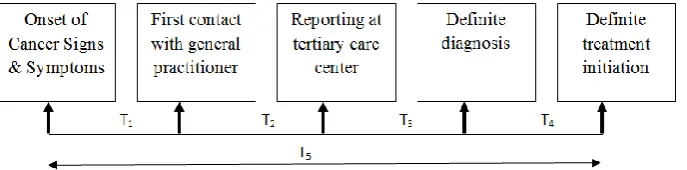
A semi-structured questionnaire was developed and administered to select respondents for assessing appropriateness and face validity. Additionally expert inputs from clinical oncologist and epidemiologist was obtained to refine the same. Base line information as well as time span for critical events from the onset of first symptom to definitive treatment was sought (Fig1). In order to improve recall among the respondents while collecting data on various time spans, local calendar of events was developed and used.
Time span in days was summarized with median and the inter quartile range since the data was skewed. For further analysis the time span was categorized into three month intervals. Chi square test of significance for proportions was used to assess the association between the time differences and various stages of oral cancer. P < 0.05 was considered for statistical significance. Data was analyzed using SPSS Inc. Released 2009. PASW Statistics for Windows, Version 18.0. Chicago.
Figure 1: Temporal Time span (Tx) of oral cancer care from 1stsymptoms to definitive treatment. T1: Onset of cancer symptoms until the first consultation with general practitioner
T2: Referral by the general practitioner or health center to tertiary care center T3: Consultation at tertiary care to definite diagnosis
T4: Time taken for initiation of cancer specific primary treatment from definitive diagnosis T5: Sum (T1:T4)
Ethical and administrative clearances were sought from PBCR ethical committee, Bangalore
RESULTS
We identified 212 patients diagnosed histopathologically with oral cancer and of these 192 (90.5%) were squamous cell carcinoma. Among the study subjects 109 (51.4%) were females and 103 (48.6%) males. Most of the patients 163(76.9%) were not literate and were from rural areas 173 (81.6%) and the majority 202 (95.3%) of
patients did not have any private health insurance (Table 1).
Table 1: Distribution of demographic variables of the study subjects.
Variable N (%)
Age (in yrs)
<45 66 (31.1)
45–59 91 (42.9)
≥60 55 (25.9)
Gender
Male 103 (48.6)
Female 109 (51.4)
Education
Not literate 163 (76.9)
Literate 49 (23.1)
Area of residence
Rural 173 (81.6)
Urban 39 (19.4)
Financially dependent for livelihood
Yes 127 (59.9)
No 85 (40.1)
Any health insurance
Yes 10 (4.7)
No 202 (95.3)
Tobacco use (any form)
Yes 168 (79.2)
No 44 (20.8)
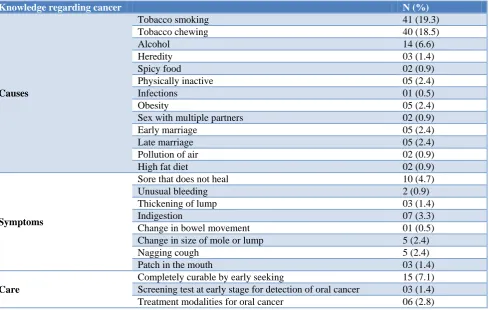
Table 2: Distribution of knowledge among study subjects regarding cancer causes, symptoms, screening and treatment.
Knowledge regarding cancer N (%)
Causes
Tobacco smoking 41 (19.3)
Tobacco chewing 40 (18.5)
Alcohol 14 (6.6)
Heredity 03 (1.4)
Spicy food 02 (0.9)
Physically inactive 05 (2.4)
Infections 01 (0.5)
Obesity 05 (2.4)
Sex with multiple partners 02 (0.9)
Early marriage 05 (2.4)
Late marriage 05 (2.4)
Pollution of air 02 (0.9)
High fat diet 02 (0.9)
Symptoms
Sore that does not heal 10 (4.7)
Unusual bleeding 2 (0.9)
Thickening of lump 03 (1.4)
Indigestion 07 (3.3)
Change in bowel movement 01 (0.5) Change in size of mole or lump 5 (2.4)
Nagging cough 5 (2.4)
Patch in the mouth 03 (1.4)
Care
Table 3: Distribution of Time interval between onset of cancer symptoms to cancer specific primary treatment.
Time Span between
N=212 Duration median [IQR] in days
Duration in months
< 1 N (%)
1 – 3 N (%)
3 -6 N (%)
≥ 6 N (%) Onset of symptoms to first
presentation for medical care 60 [30, 104] 48 (22.6) 88 (41.5) 45 (21.2) 31 (14.6) First contact to presentation at
tertiary care 30 [15, 90] 73 (34.4) 84 (39.6) 33 (15.6) 22 (10.4) Onset of symptom to seeking
diagnosis at tertiary care 117 [60, 180] 11 (5.2) 64 (30.2) 62 (29.2) 75 (35.4) First contact to initiation of primary
treatment. 81 [49, 151] 18 (8.5) 102 (48.1) 49 (23.1) 43 (20.3) Total time from onset of symptom to
initiation of primary treatment 154 [97, 252] 5 (2.4) 39 (18.4) 74 (34.9) 94 (44.3)
Table 4: Distribution of time interval between presentation at tertiary care to cancer specific primary treatment.
Time span between
N=212
Duration median [IQR] in days
Duration in days
1-15 N (%)
16-30 N (%)
>30 N (%) Initial presentation at tertiary care to definite
diagnosis 10 [7, 20] 139 (65.6) 38 (17.9) 35 (16.5)
Definite diagnosis to initiation of primary
treatment 20 [12, 33] 81 (38.2) 72(34.0) 59 (27.8)
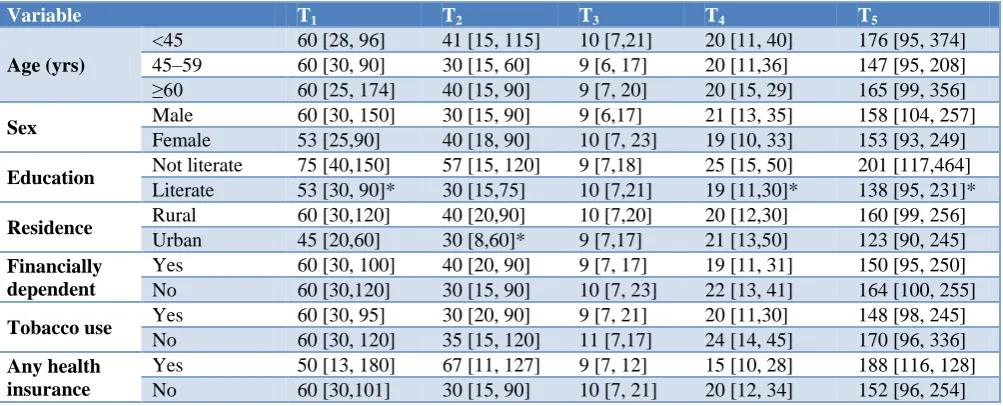
Table 5: Comparison of time span for baseline characters.
Variable T1 T2 T3 T4 T5
Age (yrs)
<45 60 [28, 96] 41 [15, 115] 10 [7,21] 20 [11, 40] 176 [95, 374] 45–59 60 [30, 90] 30 [15, 60] 9 [6, 17] 20 [11,36] 147 [95, 208] ≥60 60 [25, 174] 40 [15, 90] 9 [7, 20] 20 [15, 29] 165 [99, 356]
Sex Male 60 [30, 150] 30 [15, 90] 9 [6,17] 21 [13, 35] 158 [104, 257] Female 53 [25,90] 40 [18, 90] 10 [7, 23] 19 [10, 33] 153 [93, 249]
Education Not literate 75 [40,150] 57 [15, 120] 9 [7,18] 25 [15, 50] 201 [117,464] Literate 53 [30, 90]* 30 [15,75] 10 [7,21] 19 [11,30]* 138 [95, 231]*
Residence Rural 60 [30,120] 40 [20,90] 10 [7,20] 20 [12,30] 160 [99, 256] Urban 45 [20,60] 30 [8,60]* 9 [7,17] 21 [13,50] 123 [90, 245] Financially
dependent
Yes 60 [30, 100] 40 [20, 90] 9 [7, 17] 19 [11, 31] 150 [95, 250] No 60 [30,120] 30 [15, 90] 10 [7, 23] 22 [13, 41] 164 [100, 255]
Tobacco use Yes 60 [30, 95] 30 [20, 90] 9 [7, 21] 20 [11,30] 148 [98, 245] No 60 [30, 120] 35 [15, 120] 11 [7,17] 24 [14, 45] 170 [96, 336] Any health
insurance
Yes 50 [13, 180] 67 [11, 127] 9 [7, 12] 15 [10, 28] 188 [116, 128] No 60 [30,101] 30 [15, 90] 10 [7, 21] 20 [12, 34] 152 [96, 254]
T1: Onset of cancer symptoms until the first consultation with general practitioner; T2: Referral by the general practitioner or health center to tertiary care center; T3: Consultation at tertiary care to definite diagnosis; T4: Time taken for initiation of cancer specific primary treatment from definitive diagnosis; T5: Sum (T1:T4); *Indicates statistically significant.
Only 48 (22.6%) patients had sought medical advice within one month after the onset of cancer symptoms (T1) median being 60 [IQR 30, 104] days. Median time taken for cancer diagnosis after the first contact (T2) was 30 [IQR 15, 90] days, with 55 (26.0%) taking more than 90 days for the same (Table 3). The median time for definitive diagnosis (T3) after reporting at tertiary care center was 10 [IQR 7, 20] days. The median time taken for initiation of primary treatment (T4) for cancer after
diagnosis was 20 [IQR 12, 33] days, with 59 (27.8%) patients starting treatment after one month (Table 4). Overall median time taken from onset of cancer symptoms to primary treatment initiation was 154 [97, 252] days. It was noted that 94 (44.3%) patients had their primary treatment for cancer only after 180 days.
cancer symptoms to primary treatment among literate patients was paradoxically 201 [IQR 117, 464] days, as compared to not literate 138 days [IQR 95, 231] days. The difference was found to be statistically significant (p=0.006). It has been observed that the median time span
from first contact to presentation at tertiary care among urban patients was 30 [IQR8, 60] days which was found to be less as compared to rural patients 40 [IQR20, 90] days and was statistically significant (p=0.043).
Table 6: Association of time span between onset of cancer symptoms to primary treatment and stage of cancer.
Time interval (Months)
Stage I N (%)
Stage II N (%)
Stage III N (%)
Stage IV
N (%) Total
<3 5 (11.4) 9 (20.5) 18 (40.9) 12 (27.3) 44
3-6 3 (4.1) 15 (20.3) 20 (27.0) 36 (48.6) 74 ≥6 5 (5.3) 13 (13.8) 16 (17.0) 60 (63.8) 94 Total 13 (6.1) 37 (17.5) 54 (25.5) 108 (50.9) 212
Chi-square=18.6, df=3, p=0.005, Trend, p=0.001.
Table 7: Distribution of perceived reasons for delay in not seeking medical care at various stages.
Stage Perceived reasons N (%)
Onset of symptoms to first contact
(n=182)*
Lack of awareness of cancer symptoms 166 (91.2) Belief that symptom would go away 131 (72.0) Absence of pain 75 (41.2) Changes in the body attributed to common illness 53 (27.5) Vague and mild symptoms related to common
illness 50 (23.6)
Financial problems 34 (18.7) Nobody to accompany 32 (17.6) Co-morbidities like diabetes & hypertension 10 (5.5)
Others 13 (7.1)
Diagnosis after first contact (n=179)*
Visited multiple medical practitioner before
presenting at tertiary care 87 (48.6) Not suspected for cancer at first contact 71 (39.7) Distance of tertiary care center 61 (34.1)
Affordability 23 (12.8)
Treatment after diagnosis (n=131)#
Fear of treatment 67 (51.1) Dependent on the family 27 (20.6)
Stigma 16 (12.2)
Distance of hospital 11 (8.4) Not comfortable with treatment 11 (8.4)
I am aged 10 (7.6)
Treatment would cause disfigurement (6.1) Long treatment procedure 9 (6.9)
Affordability 5 (3.8)
Loss of wages 4 (3.1)
* Responses was elicited from those who had not sought specific care for more than one week; #Responses was elicited from those who had not sought treatment on specified time by doctor.
In our study, it was observed that predominantly 60 (63.8%) of the patients in stage IV had taken more than 6 months from onset of first symptom to initiation of cancer specific primary treatment. Few patients 5 (11.4%) in stage I had started their primary treatment within one month after the onset of symptoms. We observed a statistically significant association (p=0.001) between the time difference (T5) from the onset of first symptom to initiation of cancer specific primary treatment and stage of the disease (Table 6).
It was noted that delay for seeking diagnosis at tertiary care (T2) was due to visiting multiple general practitioners 87 (48.6%). It was noted among those with delayed treatment after diagnosis (T4 >15 days), 67 (51.1%) of the patients reported fear for treatment as one of the important reasons. Other common reasons for treatment avoidance included family dependence, advanced age, fear of stigma, perceived discomfort of treatment and distance from treating center (Table 7).
DISCUSSION
We observed that one third of the patients had prolonged time span in seeking for medical care (>90 days) and close to half of the patients (44%) had cancer specific primary treatment after more than 90 days from the onset of cancer symptoms.
Various studies in cancer treatment emphasizes the importance of early diagnosis and initiation of definitive treatment for improving patient clinical outcomes.12 However there are several reasons that contribute to inordinate delays in recognizing the onset of first symptoms and initiation of definitive treatment.
In a study by Jafari et al, it was noted that among oral squamous cell carcinoma patients, the time interval between first onset of symptoms to visiting of primary care physician was on average 270 days. The mean duration from contact with physician to definitive treatment was 90 days (range 0-270 days) which was similar to the present study 154 [IQR 97, 252] days.13 In our study, the median time span in visiting primary care physician was much less, only 60 days.
Joshi et al reported 50% of patient delayed for diagnosis by the primary care physician before being referred to tertiary care where as in the present study 65.6% were delayed for more than 30 days before reporting at tertiary care.11
Abdo et al concluded that for males and females the average evolution time (ET) was 169.4 and 215.4 days, time elapsed from referral to hospital and first appointment (RT) was 27.9 and 40.6 days, time elapsed from first appointment and treatment (TT) was 40.9 and 44.9 days, and total time elapsed from first noticing the lesion and starting treatment (TTE) was 207.9 and 263.8 days respectively. Most of these observations concur with current study.14
Majority of the oral cancer patients seeking for medical care at the late stage have complex treatment and reduced survival compared to early stage. Our study showed that only 23% of patients had sought medical advice from the medical practitioner within one month (T1) and 36% had delayed more than 3 months from the onset of cancer symptoms. On the other hand, a study from the UK, showed that 39% patients had presented within one month to the medical practitioner and only 29% had
taken more than 3 months.15 It is observed globally that despite several advances in diagnosis and increased accessibility to health care there are continued delays in reaching the right center for diagnosis as well as definitive care. In a study by Kumar et al 56 (70.9%) were in advanced stage at diagnosis which was similar to present study.16
Present study observed that urban patients get early diagnosis after the first contact with physicians as compared to rural patients. Observation from Akram et al showed urban patients 54.3% reported early compared to 31.7% among rural patients.17 In this study rural patients delay may be attributed to relatively greater distance of the tertiary care center, non-formal health care providers, financially constrains, older age and lack of awareness for cancer care.
Dwivedi et al have reported that common factors influencing the delay in the first contact were lack of awareness (54.6%), economical problems (12.4%) and lack of time (9.7%).18 In the present study we observed that ―lack of awareness of cancer symptoms‖ was common in 78% and ―belief that the symptom would go away‖ was 62%. The other factors such as distance, economical and family related problems were observed among 4.5%, 12.4% and 8.7% of the total patients respectively.
The above observations reiterate the fact that despite several advances in cancer diagnostics and treatment modalities, one of the important impediment to ensure successful patient outcomes is the time span for the patient to obtain cancer specific primary treatment from the onset of first symptom. This is an important aspect that needs to be factored in planning and implementing cancer control programs.
CONCLUSION
Considerable delay is noted at all phases of cancer care from the onset of symptom to cancer specific primary treatment. In this context cancer control programs should increase awareness in the population and all stakeholders (both first care physicians as well as patients and their relatives) regarding symptoms and improve early diagnostics and access to care.
ACKNOWLEDGEMENTS
Funding: No funding sources Conflict of interest: None declared
Ethical approval: The study was approved by the Population Based Cancer Registry Ethical Committee, Bangalore
REFERENCES
1. Gupta N, Gupta R, Acharya AK, Patthi B, Goud V, Reddy S, et al. Changing Trends in oral cancer - a global scenario. Nepal J Epidemiol. 2016;6(4):613– 9.
2. Ferlay J, Soerjomataram I. ErvikM. et al. GLOBOCAN 2012 cancer incidence and mortality worldwide: IARC cancerbase No. 11. Lyon, France: International Agency for Research on Cancer, 2013. 3. Murthy NS, Nandakumar BS, Pruthvish S, George PS, Mathew A. Disability adjusted life years for cancer patients in India. Asian Pac J Cancer Prev APJCP. 2010;11(3):633–40.
4. Coelho KR. Challenges of the oral cancer burden in India. J Cancer Epidemiol. 2012;2012.
5. Onizawa K, Nishihara K, Yamagata K, Yusa H, Yanagawa T, Yoshida H. Factors associated with diagnostic delay of oral squamous cell carcinoma. Oral Oncol. 2003;39(8):781–8.
6. WHO | Early detection of cancer. WHO. Available at: http://www.who.int/cancer/detection/en/. Accessed on 12 March 2018.
7. Ford PJ, Farah CS. Early detection and diagnosis of oral cancer: Strategies for improvement. J Cancer Policy. 2013;1(1):2–7.
8. Speight PM, Epstein J, Kujan O, Lingen MW, Nagao T, Ranganathan K, et al. Screening for oral cancer—a perspective from the Global Oral Cancer Forum. Oral Surg Oral Med Oral Pathol Oral Radiol. 2017;123(6):680–7.
9. Patton LL. The effectiveness of community-based visual screening and utility of adjunctive diagnostic aids in the early detection of oral cancer. Oral Oncol. 2003;39(7):708–23.
10. Murthy NS, Nandakumar BS, Shalini CN, Shivaraj NS, Gautham MS, Pruthvish S. Need for Cancer
Screening program - Pitfalls and solutions. Rajiv Gandhi University of Health Sciences, Karnataka, India; 2010. (CME).
11. Joshi P, Nair S, Chaturvedi P, Nair D, Agarwal JP, D’Cruz AK. Delay in seeking specialized care for oral cancers: Experience from a tertiary cancer center. Indian J Cancer. 2014;51(2):95.
12. Maybury C, Horowitz AM, Goodman HS. Outcomes of oral cancer early detection and prevention statewide model in Maryland. J Public Health Dent. 2012;72:34-8.
13. Jafari A, Najafi S, Moradi F, Kharazifard M, Khami M. Delay in the Diagnosis and Treatment of Oral Cancer. J Dent. 2013;14(3):146–50.
14. Abdo EN, Garrocho A de A, Barbosa AA, Oliveira EL de, França-Filho L, Negri SLC, et al. Time elapsed between the first symptoms, diagnosis and treatment of oral cancer patients in Belo Horizonte, Brazil. Med Oral Patol Oral Cir Bucal Internet. 2007;12(7):469–73.
15. Hollows P, McAndrew PG, Perini MG. Oral medicine: Delays in the referral and treatment of oral squamous cell carcinoma. Br Dent J. 2000;188(5):262–5.
16. Kumar S, Heller RF, Pandey U, Agarwal GG, Misra RP. Factors causing delay in reporting by oral cancer patients in India. J Clin Epidemiol. 50:S6. 17. Akram M, Siddiqui SA, Karimi AM. Patient Related
Factors Associated with Delayed Reporting in Oral Cavity and Oropharyngeal Cancer. Int J Prev Med. 2014;5(7):915–9.
18. Dwivedi AK, Dwivedi SN, Deo S, Shukla R, Pandey A, Dwivedi DK. An epidemiological study on delay in treatment initiation of cancer patients. Health (N Y). 2012;04(02):66.