ISSN: 2395-3519
www.ijatca.com 19
International Journal of Advanced Trends in
Computer Applications
www.ijatca.com
Multimedia Cloud Computing Security an Evolving Trend:
Rudimentary Essentials
1
Dhiraj Soni, 2Raman Kumar
Department of Computer Science and Engineering
DAV Institute of Engineering and Technology, Jalandhar, Punjab, India. [email protected]
Abstract:
Internet and digital technology is growing at fast pace. So, it is very important to secure the data transmission over clouds. Multimedia content has become very important in today’s era e.g. in online transferring, video conferencing. As for now multimedia cloud computing is one of the emerging trend over internet. But still to store the data with high security has become very crucial. So this paper will review multimedia cloud computing basic as well as some commonly used encryption/ decryption algorithms in the field of multimedia cloud computing.Keywords:
Multimedia Cloud Computing, Text, Audio, Video, Images, Security, Cloud.I. INTRODUCTION
Cloud computing is a new technology that is helpful both in academia as well as industry. Advancement in cloud computing leads to the various available services like Iaas, Paas, Saas etc [1]. As there are millions of users, cloud computing has potential in our society. The last decades have witnessed various popularity in multimedia content services i.e. image transferring, online conferencing etc. Furthermore, due to a growing amount of businesses/organizations rearranging in the direction of utilizing assets in the Cloud, there is inevitability for guarding the information of several clients [2]. Some most important trials which are being confronted through Cloud Computing are to safe and sound, defend and handle the information that is the assets of the client. The further down exemplified are the two foremost circumstances that we have concentrated in the direction of understanding the need of security of the information and data in the Cloud [3].
The Cloud supplier does not have any kind of privilege of retrieving the information physically that is in the particular local network. But then again in several circumstances, the Cloud necessitates in the direction of accessing some data that is in the specific local network, throughout that access; there happens to be a probability of unsanctioned access of those specific local network assets [4]. It refers to the distinctive challenge in network safety wherever the data could aspect active in addition to passive assaults. The active assaults take account of amendment of messages, impersonating, replay assault, in addition to denial of service. Passive assaults comprises of traffic investigation. These
assaults are to be expected to take place the minute the stream of data leaves the user network towards the Cloud network.
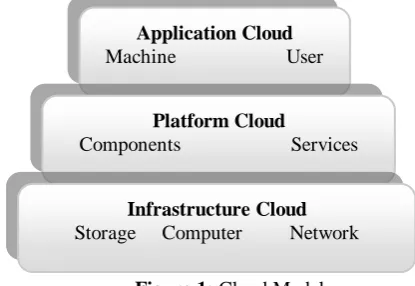
Figure 1: Cloud Model
Concerning this region of research and study, maximum research papers surveyed a standard old-style literature analysis process. A small number of papers gave a ground-breaking notion as well as anticipated a security prototypical. So, in this paper basic review on the multimedia cloud computing services with discussion on multimedia content will be done.
II. THREAT TO VARIOUS CLOUDS
IN CLOUD COMPUTING
Figure 2: Types of Clouds Application Cloud Machine User
Platform Cloud
Components Services
Infrastructure Cloud Storage Computer Network
Types of Clouds
Private Public Hybrid Comm
ISSN: 2395-3519
www.ijatca.com 20
Private cloud: This model is provisioned for exclusive use by a single organization comprising multiple consumers. It is equivalent to purchasing, building and dealing with your own base. Still, it acquires enormous quality from a security perspective. Amid their introductory adjustment to the cloud, numerous associations face challenges and have concerns identified with information security. These concerns are dealt with by this model, in which facilitating is constructed and kept up for a particular customer. The framework needed for facilitating can be on-premises or at an outsider location [5]. Security concerns are tended to through secure-access VPN or by the physical area inside of the customer's firewall system. Furthermore, for mission-basic applications we have to consider downtime as far as web accessibility, quality and execution [6]. In expansion to security reasons, this model is received by associations in situations where information or applications are obliged to adjust to different administrative models, for example, SOX, HIPAA, or SAS 70, which may oblige information to be overseen for protection and criticisms which manage any commercial corporation. Several SaaS applications, for example, Sugar CRM, give alternatives to their customers to keep up their information all alone premises to guarantee information security is kept up as per the necessities of the specific business. Amazon additionally gives the choice of a virtual private cloud [7].
Community cloud: In the community deployment model, the cloud foundation is imparted by a few associations to the same approach and consistence contemplations. This serves to further lessen costs when contrasted with a private cloud, as it is shared by bigger gathering. Different state-level government divisions obliging access to the same information identifying with the nearby population or data identified with foundation, for example, clinics, streets, electrical stations, and so on., can use a group cloud to oversee applications and information. Cloud computing is not a "silver–bullet" innovation; thus, interest in any sending model ought to be made in view of business necessities, the criticality of the application and the level of support required. It might be preserved, accomplished, and functioned by one or more of the administrations in the community, as a third party, or some sort of merger of those services, and it might occur on or off premises [8].
Public cloud: The public cloud deployment model speaks to genuine cloud facilitating. In this deployment model, administrations and framework are given to different customers. Google is a case of an open cloud. This administration can be given by a merchant gratis or on the premise of a pay-every client permit policy. This model is most appropriate for business pre-requisites
wherein it is obliged to oversee burden spikes, host SaaS applications, use interval base for creating and testing applications, and oversee applications which are devoured by numerous clients that would somehow or another oblige expansive interest in framework from businesses. This model serves to decrease capital consumption and cut down operational IT costs [9].
Hybrid cloud: This deployment helps organizations to exploit secured applications and information facilitating on a private cloud, while as yet appreciating money saving advantages by keeping shared information and applications on the general population cloud. This model is likewise utilized for taking care of cloud blasting, which alludes to a situation where the current private cloud base is not ready to handle burden spikes and obliges a fall back choice to bolster the heap. Consequently, the cloud moves workloads in the middle of open and private facilitating with no burden to the users. Many PaaS arrangements uncover their APIs, which can be further coordinated with inside applications or applications facilitated on a private cloud, while as yet keeping up the security perspectives. Microsoft Azure and Force.com are two samples of this model.
Table 1: Adapted from NIST Visual Model of Cloud Computing Definition
Essential Characteristics
Wide-ranging Network
Access
Rapid Flexibility
Measured Service
On-Request Self-Service
Resource-Pooling
Service-Models
Software-as-Service
Platform-as-a-Service
Infrastructure-as-a-Service
Deployment-Models
Public Private Hybrid Community
III. MULTIMEDIA STATISTICS FOR
SECURITY DETERMINATION
ISSN: 2395-3519
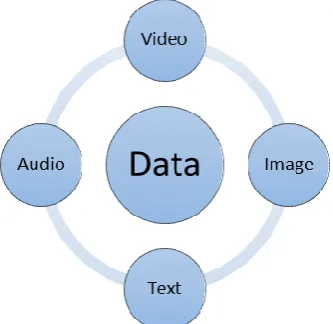
www.ijatca.com 21 Figure 3: Different Types of Multimedia Content
Text
The structure in which the content can be put away can shift incredibly. Notwithstanding ASCII based records, content is regularly put away in processor documents, spreadsheets, databases and annotations on more general interactive media objects. With accessibility and expansion of GUIs, text fonts the job of storing text is [4] becoming complex allowing enhancements (shading, shades).
Images
There is awesome difference in the quality and size of capacity for still pictures. Digitalized pictures are succession of pixels that speaks to a district in the client's graphical showcase. The space overhead for still pictures differs on the premise of determination, size, many-sided quality, and pressure plan used to store picture. The famous picture configurations are jpg, png, bmp, tiff etc.
Audio
An undeniably famous information sort being
coordinated in the vast majority of utilizations is Audio. It’s truly space concentrated. One minute of sound can take up to 2-3Mbs of space. Several techniques [5] are used to compress it in suitable format.
Video
One on the most space consuming multimedia data type is digitalized feature. The digitalized features are put away as succession of edges. Contingent on its determination and size a solitary casing can expend up to 1 MB. Likewise to have reasonable feature playback, pressure, the broadcast, as well as decompression of digitalized oblige nonstop exchange rate.
IV. QOS OF MULTIMEDIA CLOUD
COMPUTING
Availability: The objective of accessibility for Cloud Computing frameworks (counting applications and its
bases) is to guarantee its clients can utilize them whenever, at wherever. As its web-local nature, Cloud Computing framework empowers its clients to log in the framework (example, services, applications,) from somewhere [8].
Confidentiality: This means preserving consumer’s information secret inside the Cloud storage frameworks.
Cloud computing framework offerings (e.g.,
applications and its infrastructures) are essentially public networks hence, keeping all secret information of clients' mystery in the Cloud. Confidentiality loss happen when data can be read or viewed via any individuals that are un-authorized to access it.
Privacy: Security is an essential issue for distributed computing, both as far as legitimate consistence and client trust and this need to be considered at each period of configuration. The key test for programming designers to plan cloud benefits in such a way as to diminish security hazard and to guarantee lawful consistence.
Data Encryption & Integrity Problems: The information stored in the cloud storage is quite similar with the ones stored in several other places and also necessities to deliberate two key phases of security of data: privacy along with integrity of data. The communal explanation for confidentiality of data is data encryption. So as to make sure the effects of encryption, there is a necessity to deliberate the utilization of both key strength and encryption procedure. As the environment of cloud computing concerning huge amounts of transmission of data, handling and storage, there is a requirement to deliberate processing speed as well as computational proficiency of encrypting enormous amounts of information [9].
Identity and Access Management (IAM): The key critical success factor to managing individual identities at cloud providers is in the direction of having vigorous amalgamated identity administration architecture in addition to approach internal towards the organization. Utilizing cloud-reliant ―IaaS‖ providers the convenient means for outsourcing some individuality identity management capabilities and facilitating federated identity management with cloud providers [8].
ISSN: 2395-3519
www.ijatca.com 22
Audit: Review intends to watch what happened in the Cloud framework. Audit ability could be included as an extra layer over the virtualized operation framework (or virtualized application environment) facilitated on the virtual machine to give offices viewing what happened in the framework.
Compliance: An automatic way to deal with checking and consistence will help get ready CSPs (Cloud Administration Supplier) and their clients to address rising necessities and the development of cloud plans of action. To drive effectiveness, hazard administration, and consistence, CSPs need to execute a solid inside control observing capacity coupled with a vigorous outer review process [9].
Security-as-a [cloud] Service: Security-as-an administration is liable to see noteworthy future development for two reasons. To start with, a proceeding with shift in data security work from in-house to outsource will proceed. Second, a few other data security needs are available for associations presently, however author will quicken in necessity as well as complexity by means of the increasing implementation of cloud computing.
Leakage of Information: While transferring to a specific cloud there are two specific changes meant for client's information. Initially, the information will be stored away as of the consumer's local machine. Afterwards, the information is transferring from a single-tenant environment towards a multi-tenant environment. These alterations could increase a significant concern which is known as leakage of data. Because of this, leakage of data has turn out to be one of the highest organizational threats from security perspective [11].
Attacks in Cloud: Nowadays, there are numerous attacks in the world of IT. Internet is the communiqué infrastructure for the cloud providers which use well-acknowledged TCP/IP protocol that utilizes consumers IP addresses to recognize them in the Internet. Fundamentally, as the cloud could provide amenity to legal consumers it could also service to consumers which have malevolent purposes. A hacker could easily utilize a cloud towards hosting a malicious application meant for attaining their object that might be a type of Distributed Denial of Service attacks contrary to cloud
itself. Distributed Denial of Service attacks
characteristically attention high quantity of IP packages at particular network entry components. In cloud computing where infrastructure is shared by huge number of users, DDoS attacks might have the potential of having much greater effect [12].
V. VARIOUS APPROACHES FOR
PROVISION OF SECURITY
V.I RSA
RSA is generally utilized to encrypt your procedure key useful for secret key encryption (message integrity) or perhaps your message's hash value (digital signature).
The particular RSA algorithms entail the application of two keys:
V.II MD5
In cryptography MD5 has been used widely with 128-bit hash value. MD5 has been used mainly in security applications. MD5 has mainly 32-character hexadecimal number.
CONCLUSION AND FUTURE SCOPE:
Nowadays multimedia has turn out to be essential in every domain for its quality. On the other hand, due to the problems of handling peta-bytes of such kind of multimedia data in words of calculations, sharing, communications, as well as storage, there is a rising request of an substructure in the direction of having on-request admission towards a distributed group of configurable calculating assets (For instance, servers, linkages applications, stowage’s, as well as facilities). Cloud computing is the newest uprising in IT industry which is fundamentally connected to the budget. Increase amount of data sharing has led to various loads balancing. This results in demand of cloud computing. But, due to various security problems during sharing of data, some faults occur. So, this paper presented various techniques for security enhancement of various multimedia files (audio, text, image and video) in cloud computing using encryption algorithms using RSA and MD5.
REFERENCES
ISSN: 2395-3519
www.ijatca.com 23 GLOBECOM’ 11 Wksps., Houston, TX, Dec. 2011, pp.
45–50.
[2] B. Aggarwal, N. Spring, and A. Schulman, ―Stratus: Energy-Efficient Mobile Communication Using Cloud Support,‖ Proc. ACM SIGCOMM’10, New Delhi, India, Aug.-Sep. 2010, pp. 477–78.
[3] E. Cuervo et al., ―MAUI: Making Smartphones Last Longer with Code Offload,‖ Proc. AMC MobiSys’10, San Francisco, CA, June 2010, pp. 49–62.
[4] S. Wang and S. Dey, ―Modeling and Characterizing User Experience in A Cloud Server based Mobile Gaming Approach,‖ Proc. IEEE GLOBECOM’09, Honolulu, HI, Nov.-Dec. 2009, pp. 1–7.
[5] S. Wang and S. Dey, ―Rendering Adaptation to Address Communication and Computation Constraints in Cloud Mobile Gaming,‖ Proc. IEEE GLOBECOM’10, Miami, FL, Dec. 2010, pp. 1–7.
[6] S. Wang and S. Dey, ―Addressing Response Time and Video Quality in Remote Server based Internet Mobile Gaming,‖ Proc. IEEE WCNC’10, Sydney, Australia, Mar.2010, pp. 1–6.
[7] S.Wang, Y. Liu and S. Dey, ―Wireless Network Aware Cloud Scheduler for Scalable Cloud Mobile Gaming,‖ Proc. IEEE ICC’12, Ottawa, Canada, Jun. 2012, pp. 2081–86.
[8] L. Zhou, and H. Wang, ―Toward Blind Scheduling in Mobile Media Cloud: Fairness, Simplicity, and Asymptotic Optimality,‖ to appear in IEEE Trans. Multimedia.
[9] J. Oberheide et al., ―Virtualized in-Cloud Security Services for Mobile Devices,‖ 1st Wksp. Virtualization in Mobile Computing, Breckenridge, CO, June 2008, pp. 31–35.
[10]H. Li and X. Hua, ―Melog — Mobile Experience Sharing Through Automatic Multimedia Blogging,‖ Proc. ACM MCMC’10, Firenze, Italy, Oct. 2010, pp. 19–24.
[11]W. Yu et al., ―Muse: A Multimedia Streaming Enabled Remote Interactivity System for Mobile Devices,‖ Proc. ACM MUM’11, Beijing, China, Dec. 2011, pp. 216– 25.
[12]Min Chen, ―AMVSC: A Framework of Adaptive Mobile Video Streaming in the Cloud,‖ Proc. IEEE GLOBECOM, Anaheim, CA, Dec. 2012, pp. 1–6. [13]Raman Kumar and Harsh Kumar Verma, "A Channel
Analysis in Network Security - Using a Covert Approach", International Journal on Information Sciences and Computing, IJSAC, Vol. 2, Issue 1, 2008. [14]Raman Kumar, "A New Break-Flow Technique for
Encryption and Decryption of JPG/BMP/DIB Images", International Journal of Secure Digital Information Age, IJSDIA, Vol. I No. II, 2009.
[15]Harsh Kumar Verma, Abhishek Narain Singh and Raman Kumar, "Robustness of the Digital Watermarking Techniques against Brightness and Rotation Attack", International Journal of Computer Science and Information Security, IJCSIS, Vol. 5, No. 1, pp. 36-40, 2009.
[16]Harsh Kumar Verma, Ramanpreet Kaur and Raman Kumar, "Random of the Audio Watermarking Algorithm for Compressed Wave Files", International
Journal of Computer Science and Network Security, IJCSNS", Vol. 9, No. 11, pp. 283-287, 2009.
[17]Raman Kumar and Harsh Kumar Verma, "Secure Threshold Proxy Signature Scheme Based on RSA for Known Signers", Journal of Information Assurance and Security, JIAS, Vol. 5, Issue 1,pp. 319-326, 2010. [18]Raman Kumar, Asmita Puri, Vivek Gautam and
Saumya Singla, "An Image Based Authentication System - Using Needham Schroeder Protocol", International Journal of Computer Science and Network Security, IJCSNS, Vol. 10, No. 11, pp. 135-140, November 2010.
[19]Raman Kumar, Saumya Singla, Sagar Bhalla and Harshit Arora, "Optimization of work flow execution in ETL using Secure Genetic Algorithm", International Journal of Computer Science and Information Security, IJCSIS, Vol. 8, No. 8, pp. 213-222, November 2010.\ [20]Raman Kumar, Roma Jindal, Abhinav Gupta, Sagar
Bhalla and Harshit Arora, "A Secure Authentication System - Using Enhanced One Time Pad Technique", International Journal of Computer Science and Network Security, IJCSNS, Vol. 11, No. 2, pp. 11-17, February 2011.
[21]Raman Kumar, Naman Kumar and Neetika Vats, "Protecting the Content - Using Digest Authentication System and Other Techniques", International Journal of Computer Science and Information Security, IJCSIS, Vol. 9, No. 8, pp. 76-85, August 2011.
[22]Raman Kumar and Rajesh Kochher, "Information Technology Empowers by Women", International Journal of Science and Emerging Trends with latest Trends, IJSETT, Vol. 1, No. 1, pp. 1-5, June 2011. [23]Raman Kumar, Harsh Kumar Verma and Renu Dhir,
"Security Analysis and Performance Evaluation of Enhanced Threshold Proxy Signature Scheme Based on RSA for Known Signers", International Journal of Computer Network and Information Security, IJCNIS, Hong Kong, Vol. 4, No. 9, pp. 63-76, 2012.
[24]Jaskanwal Minhas and Raman Kumar, "An analysis on Blocking of SQL Injection Attacks by Comparing Static and Dynamic Queries", International Journal of Science and Emerging Trends with latest Trends, IJSETT, Vol. 3, No. 1, pp. 46-53, 2012.
[25]Jaskanwal Minhas and Raman Kumar, "Blocking of SQL Injection Attacks by Comparing Static and Dynamic Queries", International Journal of Computer Network and Information Security, IJCNIS, Hong Kong, Vol. 5, No. 2, pp. 1-9, 2013.
[26]Anil Gupta and Raman Kumar, "Design and Analysis of an algorithm for Image Deblurring using Bilateral Filer", International Journal of Science and Emerging Trends with latest Trends, IJSETT, Vol. 5, No. 1, pp. 28-34, 2013.
ISSN: 2395-3519
www.ijatca.com 24 [28]Ashwani Malhotra and Raman Kumar, "The
Comparison of Various Multi Proxy Multi Signature Schemes with Shared Verification", International Journal of Computer Science and Technology, IJCST, Vol. 4, Issue 1, Ver. 4, pp. 633-637, April 4, 2013. [29]Raman Kumar and Anil Gupta, "Comparative Study of
Various Image Restoration Techniques in the Basis of Image Quality Assessment Parameters", International Journal of Computer Science and Technology, IJCST, Vol. 4, Issue 2, Ver. 2, pp. 274-279, April - June, 2013. [30]Anshu Sharma and Raman Kumar, "The obligatory of
an Algorithm for Matching and Predicting Crime - Using Data Mining Techniques", International Journal of Computer Science and Technology, IJCST, Vol. 4, Issue 2, Ver. 2, pp. 289-292, April - June, 2013. [31]Ashwani Malhotra and Raman Kumar, "Performance
and Security Analysis of Improved Hsu et. al's Multi Proxy Multi Signature Scheme With Shared Verification", International Journal of Computer Science and Technology, IJCST, Vol. 4, Issue 2, Ver. 4, pp. 659-664, April - June, 2013.
[32]Anshu Sharma and Raman Kumar, "Analysis and Design of an Algorithm Using Data Mining Techniques for Matching and Predicting Crime", International Journal of Computer Science and Technology, IJCST, Vol. 4, Issue 2, Ver. 4, pp. 670-674, April-June, 2013. [33]Navneet Kaur and Raman Kumar, "Review of
Restorable Routing Algorithm in Optical Networks", International Journal of Computer Applications - IJCA (0975-8887), Vol. 83, No. 13, pp. 23-27, December 2013.
[34]Raman Kumar, "Security Analysis and Implementation of an Improved CCH2 Proxy Multi-Signature Scheme", International Journal of Computer Network and Information Security, IJCNIS, Hong Kong, Vol. 6, No. 4, pp. 46-54, March 2014.
[35]Raman Kumar and Nonika Singla, "Cryptanalytic Performance Appraisal of Improved CCH2 Proxy Multisignature Scheme", Mathematical Problems in Engineering, Vol. 2014, Article ID 429271, 13 pages, 2014.
[36]Navneet Kaur and Raman Kumar, "Design of Restorable Routing Algorithm in Optical Networks", International Journal of Computer Applications - IJCA (0975-8887), Vol. 91, No.2, pp. 39-45, April 2014. [37]Divya Jyoti and Raman Kumar, "Review of Security
Analysis and Performance Evaluation of an Enhanced Two-Factor Authenticated Scheme", International Journal of Electrical, Electronics and Computer Engineering, Vol. 3, No.1, pp. 218-222, June 2014. [38]Divya Jyoti and Raman Kumar, "Security Analysis and
Performance Evaluation of an Enhanced Two-Factor Authenticated Scheme", International Journal of Computer Applications - IJCA (0975-8887), Vol. 101, No.8, pp. 28-33, September 2014.
[39]Raman Kumar, Harsh Kumar Verma and Renu Dhir, "Analysis and Design of Protocol for Enhanced Threshold Proxy Signature Scheme Based on RSA for Known Signers", Wireless Personal Communications – An International Journal - Springer ISSN: 0929-6212 (Print) 1572-834X (Online), Volume 80, Issue 3 (2015), Page 1281-1345.
[40]Raman Kumar and Manjinder Singh Kahlon, "Power, Bandwidth and Distance Optimization in WMAN - Using Cross Layer Approach", International Journal of Computer Science and Technology, IJCST, Vol. 5, Issue 4, Ver. 4, pp. 144-147, Oct-Dec, 2014.
[41]Navneet Kaur, Manjinder Singh Kahlon and Raman Kumar, "AN IMPROVED DETERMINISTIC HEER PROTOCOL FOR HETEROGENEOUS REACTIVE WSNS – USING NETWORK LIFETIME AND STABILITY PERIOD", International Journal of Scientific & Engineering Research, IJSER, Vol. 5, Issue 9, pp. 650-655, September 2014.
[42]Raman Kumar, Arjun Sahni and Divanshu Marwah , "Real Time Big Data Analytics Dependence on Network Monitoring Solutions using Tensor Networks and its Decomposition", Network and Complex Systems International Institute for Science Technology and Education-International Knowledge Sharing Platform: ISSN (Paper)2224-610X ISSN (Online)2225-0603, Vol. 5, No. 2, pp. 30-38, 2015.
[43]Harsh Kumar Verma, Kamalpreet Kaur and Raman Kumar, "A Comparison of Threshold Proxy Signature Scheme", The 2008 International Conference on Security and Management, USA, 14-17 July, 2008. [44]Raman Kumar, "Electronic Information Security
Paradigm: Using Security Engineering Strategies and Cryptography Techniques", International Conference on Computing Updates and Trends, JIM, India, 6 February, 2009.
[45]Raman Kumar and Harsh Kumar Verma, "An Advanced Secure (t, n) Threshold Proxy Signature Scheme Based on RSA Cryptosystem for known Signers", IEEE 2nd International Advance Computing Conference, TU, India, 19-20 February 2010.
[46]Raman Kumar and Rajesh Kochher, "Motivational Aspects of Information Security Metrics in an Organization", International Conference on Industrial Competitiveness, GGI, India, 10 April, 2010.
[47]Raman Kumar, "Organization of CHORD Peer-To-Peer Overlay: Using Self Organizing Approach", International Conference on Industrial Competitiveness, GGI, India, 10 April, 2010.
[48]Raman Kumar, "Ethical Issues for Scientists and Engineers: Using Cyber Laws and Information Security Techniques", International Conference on Challenges of Globalization & Strategy for Competitiveness, ICCGC, India, ISBN 978-81-920451-2-2, 287-294, 14-15 January 2011.
[49]Raman Kumar, Manjinder Singh Kahlon and Amit Kalra, "A Secure Authentication System- Using Enhanced Serpent Technique", AICTE and DST Government of India sponsored International Conference on Advancements in Computing and Communication, ICACC, BBSBEC, Fatehgarh Sahib, India, 409-415, 23-25, February 2012.
ISSN: 2395-3519
www.ijatca.com 25 [51]Raman Kumar and Nonika Singla, "Cryptanalysis of
Improved CCH2 Proxy Multi-Signature Scheme", 7th International Conference on Advanced Computing and Communication Technologies, ICACCT 2013, APIITD SD, India, ISBN 978-93-83083-38-1, 267-275, 16 November, 2013.
[52]Raman Kumar and Navneet Kaur , "Restorable Routing Algorithm in Optical Networks by Reducing Blocking Probability", IEEE Recent Advances in Engineering and Computational Sciences, RAECS 2014, UIET, PU, Chandigarh, India, 6-8 March, 2014.
[53]Raman Kumar, Arjun Sahni and Divanshu Marwah , "Real Time Big Data Analytics Dependence on Network Monitoring Solution using Tensor Networks and its Decomposition", International Conference on Modelling, Simulation and Optimizing Techniques, ICMSOT-2015, DAV College, Jalandhar, India, 12-14 February, 2015
[54].Raman Kumar, "Power Conservation in Wireless Networks: Cross Layered Approach", Magazine, GNDU, India, 2007.
[55]Raman Kumar and Harsh Kumar Verma, "The Wireless Application Software Platform", AICTE sponsored National Seminar on ―Enterprise Information Systems‖, Apeejay, India, 24 May, 2008.
[56]Raman Kumar, "An improved Method of Generating a Threshold Proxy Signature Scheme on a Confidential Message", National Conference, 12th PSC, PAU Ludhiana, India, 7-9 February 2009.
[57]Raman Kumar, "Security Management Issues in Automatic Password Protection Mechanism", National Conference, 12th PSC, PAU Ludhiana, India, 7-9 February 2009.
[58]Raman Kumar and Arvind Kumar, "A New Proposed Model for Secure E-Business Intelligence System", National Conference on Modern Management Practices and Information Technology, DAVIET, Jalandhar, India, 17-18 April, 2009.
[59]Raman Kumar, Harsh Kumar Verma, Renu Dhir and Pankaj Yadav, "Information Security Vulnerability Issues in Intrusion Detection Systems", National Conference on Education & Research, JUIT, M.P., India, 6-7 March 2010.
[60]Raman Kumar, "The Lifecycle of Secure Application Development in a Business Environment", National Conference on Business Innovation, Apeejay, India, 27 February 2010.
[61]Raman Kumar, "Cyber Laws: Ethical Issues for Scientists and Engineers", Magazine, DAVIET, India, 2010.
[62]Raman Kumar and Amit Kalra, "India: Needs to Focus on the Security Engineering Strategies and Cryptographic Techniques", National Conference on ―Innovations: A way to keep ahead, JIM, 17 April, 2010.
[63]Raman Kumar and Amit Kalra, "Role of Dynamic Learning in Establishment of Efficient Education System", National Conference, KC Institutions, Nawanshahr, India, 20 April, 2010.
[64]Raman Kumar and Rajesh Kochher, "Empowerment of women through Information Technology", National
Conference on Role of Women in I.T - Today and Tomorrow, SD, India, 12 October, 2010.