University of Pennsylvania
ScholarlyCommons
Publicly Accessible Penn Dissertations
2018
Optional Elements In Indonesian Morphosyntax
Helen N. Jeoung
University of Pennsylvania, [email protected]
Follow this and additional works at:
https://repository.upenn.edu/edissertations
Part of the
Asian Studies Commons,
Linguistics Commons, and the
Other Languages, Societies,
and Cultures Commons
This paper is posted at ScholarlyCommons.https://repository.upenn.edu/edissertations/3132
For more information, please [email protected].
Recommended Citation
Optional Elements In Indonesian Morphosyntax
Abstract
This dissertation investigates the syntax and morphology of several functional morphemes that display surface optionality in Indonesian. Three case studies consider how syntactic environments constrain optional
realization. Chapter 2 investigates the declarative complementizers bahwa and kalau, which are disallowed in case of A-bar movement; I show that bahwa is also disallowed in wh-in situ questions that do not involve movement. These facts are developed into an analysis of wh phrases and the structure of wh questions in Indonesian. I also propose that the morpheme yang, as well as the null form of the complementizer, constitute a pattern of morphological wh-agreement on C. Chapter 3 discusses the verbal prefixes meN- and ber-, which have received varied analyses in the literature. I argue that meN- and ber- participate in wh-agreement
resulting from A-bar movement, and argue against previous analyses that assume that A-movement results in a similar deletion. In addition, I differentiate between deterministic properties that are relevant in the syntax, and non-deterministic properties of meN- and ber- that are extra-syntactic. This distinction accounts for a number of puzzling properties that have been observed for these prefixes. Chapter 4 discusses possessor sub-extraction in Indonesian, with additional data from similar constructions in Javanese and Madurese. I pursue a novel analysis of the nominal suffix -nya, which is optional is possessive DPs: in possessor extraction, this suffix is a pronunciation of the head D. The analysis of whagreement is extended to the DP domain, where -nya marks A-bar movement on phase heads; the consequence is that DP is a phase for syntactic movement. One language-specific finding in this dissertation is that morphological wh-agreement applies across three domains: complementizers, verbs and possessive nominals. This has cross-linguistic implications for the phasehood of DP and wh-agreement patterns. More broadly, the dissertation contributes a syntactic approach to the analysis of variable morphemes, revealing how multiple factors constrain surface optionality.
Degree Type Dissertation
Degree Name
Doctor of Philosophy (PhD)
Graduate Group Linguistics
First Advisor Julie Anne Legate
Keywords
A-bar, Indonesian, linguistics, optionality, syntax, wh-agreement
Subject Categories
OPTIONAL ELEMENTS IN INDONESIAN MORPHOSYNTAX
Helen N Jeoung
A DISSERTATION
in
Linguistics
Presented to the Faculties of the University of Pennsylvania
in
Partial Fulfillment of the Requirements for the
Degree of Doctor of Philosophy
2018
Supervisor of Dissertation
Julie Anne Legate, Professor of Linguistics
Graduate Group Chairperson
Eugene Buckley, Associate Professor of Linguistics
Dissertation Committee:
David Embick, Professor of Linguistics
OPTIONAL ELEMENTS IN INDONESIAN MORPHOSYNTAX
COPYRIGHT
2018
Helen N Jeoung
This work is licensed under the Creative Commons Attribution-NonCommercial-ShareAlike 3.0 License
To view a copy of this license, visit
ACKNOWLEDGMENT
I have many people to thank for their support, not only during the time I was researching and writing this dissertation, but also during the span of my graduate studies at Penn. The mentions here are brief, but they are heartfelt.
Many thanks to my committee, without whom this dissertation would not be possible. Julie Legate has been a supportive advisor who was always ready to look at my data, read through drafts and return comments. I learned syntax from Julie, but more importantly, she brought out my best work throughout my training at Penn; every page of this dissertation has directly or indirectly ben-efited from her critical eye. David Embick and Florian Schwarz have also contributed in significant ways to my development as a linguist. Dave always had a comment or suggestion that led me to think about the larger context and implications of my work, and I always left his office or his class with new ideas. Florian introduced me to semantics, and has been a patient reader for various drafts of papers; he always provided timely input just when I needed it.
I have been fortunate to be taught by faculty members at Penn who are engaging and pas-sionate about what they do: Alison Biggs, Gene Buckley, Jami Fisher, Bill Labov, Tony Kroch, Mark Liberman, Rolf Noyer, Don Ringe, Gillian Sankoff, Beatrice Santorini and Meredith Tam-minga. Thanks to Meredith for talking to me about syntax and variation, and thanks to Alison for collaborating with me on prepositions. In the main office, Amy Forsyth always had time to answer a question or fix an administrative issue. Additionally, I am grateful for support from the University of Pennsylvania, through the GAPSA-Provost Award for Interdisciplinary Innovation, and a Teece Fellowship for dissertation research.
Thanks to my cohort, Taylor Jones, Karen Wen-Hsin Tseng and David Wilson, with whom I shared my first year grad school. The students, postdocs, and visitors who overlapped with me at Penn contributed to an overall atmosphere of hard work, stimulating conversation and mutual encouragement, and they made the journey more enjoyable: Luke Adamson, Faruk Akkus¸, Akiva Bacovcin, Ryan Budnick, Pleng Chanchaochai, Sunghye Cho, Ava Creemers, Kajsa Dj¨arv, Sabriya Fisher, Aaron Freeman, Amy Goodwin Davies, Duna Gylfadottir, Anton Ingason, Tricia Irwin, Ava Irani, Soohyun Kwon, Nari Rhee, Milena ˇSereikait˙e, Kobey Shwayder, Einar Sigurąsson, Betsy Sneller, Robert Wilder and J´er´emy Zehr.
Conversations with linguists at conferences and talks have contributed to my work in signif-icant ways; I particularly thank Edith Aldridge, I Wayan Arka, Abby Cohn, Peter Cole, Mitcho Er-lewine, Idan Landau, Bradley McDonnell, Norvin Richards, Anna Szabolcsi and Ekarina Winarto. I also acknowledge Bill Davies, whose grammar of Madurese has been a valuable resource; I regret that I did not have the opportunity to meet him in person.
consultants also provided data for Indonesian and other languages: Amelia Dwi Imanda, Ayunda Puty Sekavani, Hainona Izza Golia, Muhamad Saiful, Risalarus Sa’adah, Wilyun Hamim, and in Philadelphia, Dinah Maria. A number of people provided logistical support for me to conduct research in East Java: Professor Lilis Lestari Wilujeng at Ma Chung University connected me to undergraduate students; Ibu Mira connected me to students at UNISMA; Bapak Billy Mbiliyora and the staff at KPN graciously allowed me to use classroom space and volunteered as practice consultants. Esther, Sarah, Mira and other friends in town always made time for a warm welcome and a meal.Terima kasih banyak semuanya.
I am grateful for friends in Philadelphia and beyond, especially those who provided support while I was dissertating. Sharon Song went out of her way to send me notes and gifts, just because. Thanks to Elizabeth McGee Hassrick for chats about academia, and to Jenn Lee for chats about life. Paula Yoo was a lifesaver, driving across town for pickups and offering help when it was most needed. Lindsay Kijewski was my biggest fan, and always had a smile and a hug for me. Thanks to Lindsay, Jonathan Wood, Umi Howard, my Lipman cohort, Anne Ferola and the team at CHIP for meaningful experiences outside of linguistics.
Finally, my family. Young and Yeuhee Lee always had an open door for me, without excep-tion. My mother has been a rock of unconditional love and faith, and a role model for a full-time working mother holding it all together. My father, Jun Imatome, had an extensive library at home, and spoke three languages fluently: I am sure he planted the original seed that grew into my interest in language, and I wish I could thank him now. Thanks to my in-laws for their encouragement and support, and to Tracy for coming down to Philly to help out. Thanks also to all my siblings. I especially owe a lot to Naomi: look, I made it! Amelia and Noah have been with me since day one, through the valleys as well as the peaks, and they have been my anchor throughout. And more than anyone else, my husband has had the up-close view of this journey, and has made sacrifices so that I could pursue linguistics.
ABSTRACT
OPTIONAL ELEMENTS IN INDONESIAN MORPHOSYNTAX
Helen Jeoung
Julie Anne Legate
This dissertation investigates the syntax and morphology of several functional morphemes
that display surface optionality in Indonesian. Three case studies consider how syntactic
environ-ments constrain optional realization. Chapter 2 investigates the declarative complementizersbahwa
andkalau, which are disallowed in case of A-bar movement; I show thatbahwais also disallowed in wh-in situ questions that do not involve movement. These facts are developed into an analysis
of wh phrases and the structure of wh questions in Indonesian. I also propose that the morpheme
yang, as well as the null form of the complementizer, constitute a pattern of morphological wh-agreement on C. Chapter 3 discusses the verbal prefixesmeN-andber-, which have received varied analyses in the literature. I argue thatmeN- andber- participate in wh-agreement resulting from A-bar movement, and argue against previous analyses that assume that A-movement results in a
similar deletion. In addition, I differentiate between deterministic properties that are relevant in the
syntax, and non-deterministic properties ofmeN-andber-that are extra-syntactic. This distinction accounts for a number of puzzling properties that have been observed for these prefixes. Chapter 4
discusses possessor sub-extraction in Indonesian, with additional data from similar constructions in
Javanese and Madurese. I pursue a novel analysis of the nominal suffix-nya, which is optional is possessive DPs: in possessor extraction, this suffix is a pronunciation of the head D. The analysis of
wh-agreement is extended to the DP domain, where-nyamarks A-bar movement on phase heads; the consequence is that DP is a phase for syntactic movement. One language-specific finding in
this dissertation is that morphological wh-agreement applies across three domains:
complementiz-ers, verbs and possessive nominals. This has cross-linguistic implications for the phasehood of DP
and wh-agreement patterns. More broadly, the dissertation contributes a syntactic approach to the
TABLE OF CONTENTS
ACKNOWLEDGMENT . . . iv
ABSTRACT . . . vi
LIST OF TABLES . . . x
CHAPTER 1 Introduction . . . 1
1.1 Standard and colloquial varieties of Indonesian . . . 3
1.2 Data and methods . . . 4
1.3 Outline of the dissertation . . . 5
CHAPTER 2 Complementizers . . . 7
2.1 Introduction . . . 7
2.1.1 Surface alternations in C . . . 7
2.1.2 Background: Complementizer-trace effects in other languages . . . 9
2.1.3 Background: Wh-agreement in other languages . . . 11
2.1.4 Outline of chapter . . . 15
2.2 Embedded declarative clauses . . . 15
2.2.1 Declarative complement clauses (finite) . . . 15
2.2.2 Sentence-initial C . . . 19
2.3 Loss of optionality: A-bar movement and questions . . . 20
2.3.1 Properties of A-bar movement in Indonesian . . . 20
2.3.2 Pseudo-cleft structure . . . 24
2.3.3 Nominal movement vs. non-nominal movement . . . 31
2.3.4 Three strategies for constituent wh questions . . . 32
2.3.5 Strategies for forming polar questions . . . 35
2.3.7 Complementizers in questions . . . 44
2.4 Deterministic and non-deterministic conditions on Indonesian C . . . 63
2.5 Chapter summary . . . 66
CHAPTER 3 Verbal prefixesmeN-andber- . . . 68
3.1 Introduction . . . 68
3.1.1 An overview of the proposal . . . 70
3.1.2 Organization of chapter . . . 71
3.2 Background . . . 72
3.2.1 Verbal prefixes in Indonesian . . . 73
3.2.2 Invariant prefixes . . . 74
3.2.3 On the variability ofmeN-andber- . . . 77
3.3 Previous analyses ofmeN-andber- . . . 79
3.4 Deterministic factors affecting the realization ofmeN-andber- . . . 91
3.4.1 Nominal A-bar movement . . . 91
Excursus: IsmeN-sensitive to A-movement? . . . 97
3.4.2 Other syntactic and semantic constraints on optionality . . . 101
3.5 Variable contexts and non-deterministic factors . . . 105
3.5.1 Variable deletion rule and its effects . . . 105
3.5.2 Other consequences of variable rule application . . . 109
Excursus: Wh-agreement applies to all verbs . . . 111
3.6 Chapter summary . . . 117
CHAPTER 4 Possessor Extraction . . . 118
4.1 Introduction . . . 118
4.1.1 Background . . . 118
4.1.2 Internal and external possession . . . 119
4.1.3 Addressing variability in-nya . . . 121
4.2 Patterns of possessor extraction in Indonesian . . . 123
4.2.1 Sub-extraction of subject possessors . . . 123
4.2.2 Sub-extraction of object possessors . . . 126
4.2.3 Long distance sub-extraction . . . 127
4.2.4 Sub-extraction from other positions . . . 129
4.2.5 Interim summary . . . 131
4.2.6 Possessor extraction in related languages . . . 132
4.3 The suffix -nya . . . 138
4.3.1 -Nyaas possessor agreement . . . 138
4.3.2 -Nyain non-possessive contexts . . . 145
4.3.3 Definiteness effects and-nya . . . 147
4.4 A derivational analysis for possessor extraction . . . 150
4.4.1 Movement through SpecDP . . . 151
4.5 Implications of possessor extraction in Indonesian . . . 158
4.5.1 Phase head D and wh-agreement . . . 158
4.5.2 EPP and subject extraction . . . 159
4.5.3 Revisiting A-bar extraction in Indonesian-type languages . . . 163
4.5.4 Implications for the left periphery in Indonesian . . . 165
4.6 Chapter summary . . . 167
CHAPTER 5 Conclusion . . . 169
APPENDIX . . . 171
LIST OF TABLES
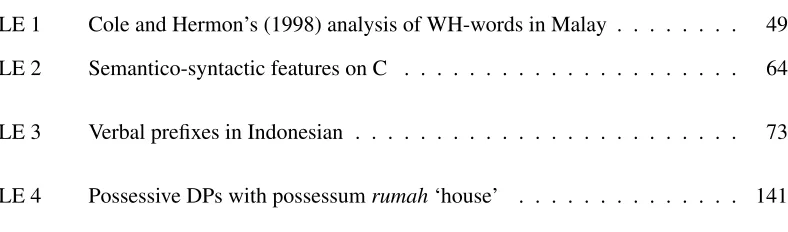
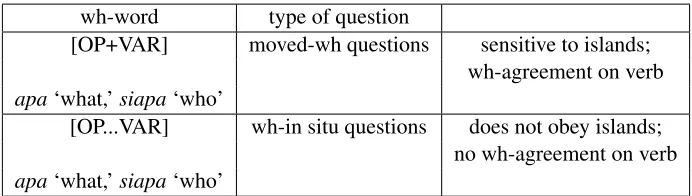
TABLE 1 Cole and Hermon’s (1998) analysis of WH-words in Malay . . . 49
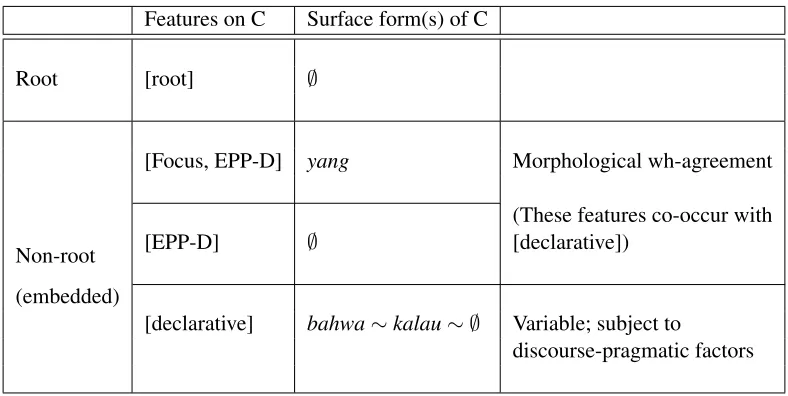
TABLE 2 Semantico-syntactic features on C . . . 64
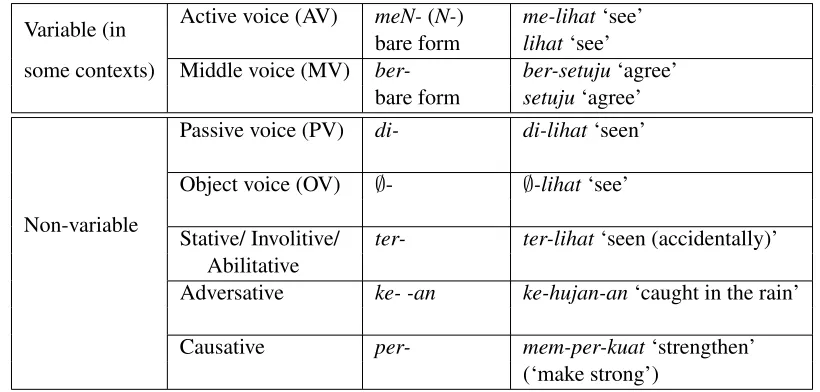
TABLE 3 Verbal prefixes in Indonesian . . . 73
CHAPTER 1 Introduction
In this dissertation I investigate the syntax and morphology of functional elements that display
op-tionality. Three case studies are presented in this dissertation, each of which discusses one or more
optional morphemes in Indonesian. The first case study examines the declarative complementizers
bahwaandkalauand their alternation with other forms of C; the second discusses the verbal pre-fixesmeN-andber-; the third observes the effect of possessor extraction on the nominal suffix-nya
that occurs in possessive DPs. These morphemes display surface optionality, as illustrated in the
examples below:
(1) Optional complementizers
Susan Susan
ber-pikir MV-think
{bahwa C
/ kalau /∅ }Tina Tina
mem-beli AV-buy
se-buah one-Class
tas bag
kemarin. yesterday ‘Susan thinks that Tina bought a bag yesterday.’
(2) Optional verbal prefix
meN-Aku 1s
{dapat receive
/ men-dapat AV-receive
}hadiah. gift ‘I received a gift.’
(3) Optional verbal prefix
ber-Dia 3s
{bahasa language
/ ber-bahasa MV-language
}Indonesia, Indonesian
aku 1s
{bahasa language
/ ber-bahasa MV-language
}Inggris. English ‘She spoke Indonesian, I spoke English.’
(4) Optional possessive suffix
nya-{Rumah house
Adi Adi
/ Rumah-nya house-D
Ali Ali
}di-rata-kan PV-flat-Appl
kemarin. yesterday ‘Adi’s house was destroyed yesterday.’
An individual speaker produces both the overt form and the non-overt form; the optional
mor-pheme may be present or omitted without any semantic consequence. This dissertation, then, is
concerned with the grammar of individual speakers, and the (intraspeaker) variability displayed by
particular morphemes, rather than variability among speakers or variability among different
operations that are relevant to the optional morphemes.
Two overarching questions drive this research. These are concerned with the interaction
between syntax and optionality:
(a) Which syntactic conditions constrain the surface optionality of the morpheme(s)?
(b) How does syntax interact with extra-syntactic factors to produce the overall distribution of
the optional forms?
Each case study addresses the questions in both (a) and (b). Because Indonesian has a number of
different functional morphemes that display surface optionality, this makes it possible to
investi-gate several different domains within one language (complementizers, verbal structure, possessive
nominals), while also observing interactions among these three elements within a single clause.
The approach to Question (a) begins with a descriptive account of the full range of variability
displayed by the morpheme(s), with a particular focus on contexts in which the morpheme isnot
variable. This dissertation contributes novel data from colloquial spoken Indonesian (and the related
languages Javanese and Madurese), with the goal of presenting observations and patterns that have
not been previously noted in the literature on these languages. Question (a) is concerned with taking
optionality seriously as part of syntactic analysis.
Question (b) takes an integrative approach to optionality by examining several factors that
affect optionality. This line of research is partially motivated by incomplete treatments of
vari-able morphosyntactic phenomena which do not include variability as a formal component of the
analysis. For example, the optional nature ofmeN- in clauses such as (2) has been long observed (Wouk 2004; Sneddon 1996; Sneddon et al. 2012). However, optionalmeN-is usually assumed to be “optional pronunciation” or “optional dropping” of the morpheme. This assumes that the
op-tionality is a PF phenomenon that has nothing to do with morphosyntax; cursory mentions of this
optional property omit any obligatory contexts in which the morpheme is required or disallowed. I
assume that a comprehensive account of the optional morphemes under study requires
and extra-grammatical (pragmatic, discourse-related) factors. The overall picture that emerges from
this approach is that the distribution of these functional morphemes in Indonesian can only be
ac-counted for by integrating syntactic structure/operations with extra-syntactic factors that influence
post-syntactic variability.
While the scope of this investigation is a language-internal account of variable elements in
Indonesian grammar, this research has cross-linguistic implications for our understanding of clause
structure more generally. I present findings that have consequences for our general
understand-ing of complementizer systems and wh-in situ questions; patterns of wh-agreement across several
domains; the phasehood of CP, VoiceP and DP; and possessor extraction. This dissertation also
con-tributes a syntactic treatment of morphemes that display optionality, with consequences for analyses
of surface variation cross-linguistically.
1.1. Standard and colloquial varieties of Indonesian
It is well-known among researchers studying Indonesian that Standard Indonesian (orBahasa
In-donesia, ISO: ind), the national language of Indonesia, is a prescriptive variety that few speakers claim as their native language. Standard Indonesian is used for official activities such as education,
business and government (see Sneddon 2003 for an overview and history). Colloquial Indonesian,
on the other hand, is not a monolithic variety but rather a diverse set of varieties of Indonesian
spoken by communities throughout Indonesia. While Standard Indonesian is well-documented in
grammars (Macdonald and Dardjowidjojo 1967; Dardjowidjojo 1978; Sneddon 1996; Sneddon et al.
2012; among others), colloquial varieties of Indonesian are generally under-described or
undocu-mented (with some exceptions, such as Sneddon 2006, which describes colloquial Jakartan
Indone-sian).
This dissertation is primarily concerned with the variety of colloquial Indonesian that is
spo-ken on the island of Java (outside of Jakarta), particularly East Java. Colloquial Indonesian
dif-fers from Standard Indonesian in a number of ways, but the two varieties are not completely
dis-tinct; many clauses are well-formed in both varieties. The distinction between Standard Indonesian
speech, which is an over-simplification. Although Standard Indonesian is associated with formal
situations and considered stiff if used in daily conversation, colloquial Indonesian is not strictly
informal. By referring to colloquial Indonesian, I mean the variety of language that is used
spon-taneously by speakers in everyday situations, and about which speakers have intuitions concerning
grammaticality and acceptability. Colloquial Indonesian, then, incorporates both informal, familiar
speech as well as polite speech (as when speaking to an important person or an elder).
Through-out this dissertation, data is generally from colloquial Indonesian, except where data is drawn from
written sources; all data from written sources has also been further checked by consultants.
One final note about Malay. Indonesian and Malay are closely related varieties, although
their syntax, morphology and phonology deviate in a number of significant ways. I cite literature
on Malay where it is significant to the analysis, but I do not assume that generalizations from Malay
will always carry over to Indonesian. I have indicated wherever other sources are based on Malay
data.
1.2. Data and methods
The speakers providing data for this research are from the island of Java, and were educated in
Standard Indonesian (speakers have at least a high school education; most have university education
as well). All speakers speak some colloquial variety of Indonesian on a daily basis with friends,
other students, colleagues, and strangers. In addition, all speakers, except one, are fluent in at least
one other language that is used in the home; these languages include Javanese and Madurese, which
are also prominent on the island of Java.
Research with Indonesian-speaking consultants took place over several periods, between
2015 and 2018. The research was conducted in several locations, including East Java, Indonesia
and Philadelphia, Pennsylvania. In addition, part of this research was also conducted by
communi-cating (typing) over the internet with Indonesian speakers with whom I had established a previous
working relationship during in-person research. Data were elicited directly from consultants, taken
from instances of spontaneous speech, or drawn from written sources. Because optionality is a
avail-ability of multiple realizations of a particular morpheme. All examples have been checked by at
least one speaker other than the speaker who provided the initial data.
1.3. Outline of the dissertation
In Chapter 2, I investigate the complementizersbahwaandkalau, which introduce embedded declar-ative clauses;kalauis an informal variant of C, whilebahwais a more formal variant. I claim that
yangand null C are part of the complementizer system in Indonesian; this proposal is the first to identify four forms of declarative C. Bahwa and kalau are optional in many embedded clauses. However, they are not completely in free variation with a null form: bahwaandkalau are disal-lowed in case of A-bar movement, which was first observed by Saddy (1991). I argue that this
pattern is a type of wh-agreement on C, and thatyangand null C also participate in wh-agreement; Indonesian complementizers instantiate a new pattern of wh-agreement that has not previously been
attested (cf. Reintges et al. 2006). Another novel finding in this chapter is thatbahwais disallowed in wh-in situ questions that do not involve movement. These facts are developed into an analysis of
wh-phrases and the structure of wh questions in Indonesian.
In Chapter 3 I consider the verbal prefixesmeN-andber-, which have received varied anal-yses in the literature. TakingmeN-andber-to occupy the position of the functional head Voice, I propose thatmeN-andber-participate in morphological wh-agreement: A-bar movement through SpecVoiceP requires a null prefix. I argue against previous analyses that assume that A-movement
also has the same morphological effect. In addition, I differentiate between deterministic properties
that are relevant in the syntax, and non-deterministic properties ofmeN- and ber-that are extra-syntactic. I propose that this distinction accounts for a number of puzzling properties that have been
observed for these prefixes.
Chapter 4 discusses possessor sub-extraction in Indonesian, with additional data from
sim-ilar constructions in Javanese and Madurese. I show that a clefted possessor occurring at the left
periphery of the clause is not merged in this high position, but rather that it is extracted from its
possessive DP, leaving the possessum in situ. The possessor undergoes successive-cyclic A-bar
con-sequence of this investigation is a novel analysis for-nya, which is optional in possessive DPs. I argue that in possessor extraction, this suffix is a pronunciation of the head D. I extend the analysis
of wh-agreement to the DP domain, arguing that-nyamarks A-bar movement on phase heads, with the consequence that DP is a phase for syntactic movement.
In Chapter 5 I summarize the main findings of the dissertation and present overall
CHAPTER 2 Complementizers
2.1. Introduction
2.1.1. Surface alternations in C
In this chapter I discuss the Indonesian complementizers bahwa, kalau andyang, as well as the absence of an overt complementizer, which I refer to as null C. In some contexts, realization of
C is deterministic, requiring a particular surface form. In other contexts however, the form of
C is optional, in the sense that semantic differences do not arise from the choice of form. The
overall goal of this chapter is to demonstrate that accounting for the distribution of complementizers
in Indonesian requires an analysis of the syntax and semantics of C; an explanation of surface
variability amongbahwa, kalau, yangand null C must incorporate grammatical factors.
As a brief overview of the data, these complementizers occur in finite clauses, including both
declarative and interrogative sentences. In sentences such as (1), the complementizer that introduces
an embedded declarative clause may occur asbahwa, kalauor null C (represented as∅). This is an optional alternation among the three realizations of C. (2) illustrates a different pattern. The wh
word siapa‘who’ has moved from an embedded clause, and occurs in a sentence-initial position, where it must be followed byyang. I propose thatyangdoes not mark focus on the nominal that it follows, as has been suggested in the literature, but rather that it is a form of C that alternates with
bahwa, kalauand null C.
(1) Susan Susan
ber-pikir MV-think
{bahwa C
/ kalau /∅/ *yang}Tina Tina
mem-beli AV-buy
se-buah one-Class
tas bag
kemarin. yesterday ‘Susan thinks that Tina bought a bag yesterday.’
(2) Siapa who
{*bahwa C
/ *kalau / *∅/ yang}Susan Suan
pikir think
{*bahwa C
/ *kalau /∅/ *yang}
mem-beli AV-buy
se-buah one-Class
tas bag
kemarin? yesterday
‘Who does Susan think bought a bag yesterday?’
all overt forms are disallowed and null C is required (2). I discuss the implications of this data
for our understanding of wh-agreement in complementizer systems, both for Indonesian and
cross-linguistically.
Long-distance movement over a complementizer, as in (2), is not the only environment that
disallows an overt form of C. In-situ questions such as (4) also disallow the overt complementizer
bahwa, even without overt movement.
(3) Pak Mr
Dadang Dadang
meng-harap AV-expect
{bahwa C
/ kalau /∅ }mereka 3p
akan will
men-diskusi-kan AV-discuss-Appl
masalah problem pertanian.
agriculture
‘Mr Dadang expects that they will discuss the issue of agriculture.’
(4) Pak Mr
Dadang Dadang
meng-harap AV-expect
{*bahwa C
/ kalau /∅ }mereka 3p
akan will
men-diskusi-kan AV-discuss-Appl
masalah problem apa?
what
‘What issue does Mr Dadang expect that they will discuss?’
The pattern in (3-4) is interesting because a wh phrase that remains in situ places constraints on
a higher complementizer. In addition, kalauhas been omitted from previous analyses of comple-mentizers in Indonesian, or mentioned only as a conditional morpheme. By treating kalau as a complementizer on par withbahwain this chapter, I show that the two morphemes pattern together in nearly every syntactic environment.Wh-in situ questions are the exception: in (4)bahwais disal-lowed whilekalauis possible, a pattern that has not previously been observed.
This chapter addresses both obligatory realizations of C as in (2), as well as optional
real-izations of C as in (1). I treatbahwa, kalau, yangand the null form as belonging to the category C whose realization is determined at various points in a derivation, rather than by one syntactic or
morphological process. The surface realization of C is first determined derivationally, that is, by
the synactic and semantic requirements of structure building, including A-bar movement and the
formation of questions; post-syntax, realization of C is also subject to variable operations that apply
variable surface realization of C are variable deletion, and pragmatic selection between formal and
informal vocabulary items. This approach relies on both features in the syntax as well as
extra-syntactic processes to derive the obligatory and optional alternations seen in (1-4). More broadly, I
demonstrate that an understanding of both internal (grammatical) and external (extra-grammatical)
factors is necessary to account for the distribution of forms that alternate in a single surface position.
2.1.2. Background: Complementizer-trace effects in other languages
Indonesian is not unique in having multiple forms of C, nor in allowing optional realization of
C. The Indonesian complementizer system shares a number of properties already attested in other
languages. In this section I discuss similarities between the Indonesian pattern and other
comple-mentizer systems.
Many languages have optional complementizers for introducing embedded clauses. For
ex-ample, the Swedish complementizerattis optional in (5). In cases of subject extraction however, it must be null (6). This contrasts with object extraction, where the complementizer retains its optional
realization (7).1
(5) Jag I
tycker think
(att) that
studenterna students.Def
borde should
komma come
i in
tid. time. ‘I think that the students should come on time.’
(6) Vem who
tror believe
du you
(*att) that should
skulle come
komma in
i time
tid?
‘Who do you believe should come on time?’
(7) Vad what
tror think
du you
(att) that
John John
k¨opte bought
?
‘What do you think that John bought?’
The same pattern is also well-known in English. The English complementizer that can be null, except in case of subject extraction or relativization:
(8) the guy (that) you claim (that) Carlos hired yesterday
1
(9) the guy (that) you claim (*that) hired Bill yesterday
This pattern is generally known as the Comp(lementizer)-trace effect, which has been observed in
a number of languages and has been much discussed (see e.g. Perlmutter 1968, 1971; Chomsky
and Lasnik 1977; Bresnan 1977; Rizzi 1982; Pesetsky 1982; Zaenen 1983; Lasnik and Saito 1984;
Culicover 1993; Pesetsky and Torrego 2000; Ishii 2004; among others.) Comp-trace effects are
observed both in languages that allow complementizers to be optionally null (like Swedish and
English), as well as languages in which the complementizer must be pronounced (such as French).
However, the Indonesian pattern differs from Comp-trace effects in two ways. One difference
is that in Comp-trace effects, the C that is local to extraction is affected, but not a higher C. Consider
long-distance subject extraction in English:
(10) Laura claims (that) Mary thinks (that) Bill will love the new film.
(11) Who does Laura claim (that) Mary thinks (*that) will love the new film?
In (11) the lower C is the first that is crossed by A-bar movement, and consequently must be null,
while the higher C may be overt. This contrasts with Indonesian long distance extraction, in which
multiple complementizers along the path of movement are affected:
(12) ?makanan food
yang C.Foc
kamu 2s
pikir think
∅
C Susan Susan
bilang say
∅
C Tina Tina
ambil take
.
‘the food that you think that Susan said that Tina took’
In Indonesian, every C that is crossed by nominal A-bar movement must be null. Note that for many
speakers, the extraction across multiple clause boundaries with active verbs in (12) is somewhat
de-graded in acceptability. However, there is a strong contrast between (12) and the ungrammaticality
of (13), which shows that extraction over any overt C is impossible.
(13) makanan food
yang C.Foc
kamu 2s
pikir think
{*bahwa C
/ *kalau}Susan Susan
bilang say
∅
C Tina Tina
ambil take
.
A second difference between Comp-trace effects and Indonesian C is that the alternations in
Indone-sian are not sensitive to a distinction between subjects and non-subjects. Comp-trace effects surface
in different ways cross-linguistically, but the range of effects shares the generalization that special
morphology on C is required when the (subject) argument immediately to the right of the
com-plementizer undergoes A-bar movement. Other arguments do not trigger the special morphology,
which means that various approaches to explaining Comp-trace effects must explain why subjects,
but not other arguments, require special marking on C. (A recent overview of analyses for
Comp-trace effects is summarized in Pesetsky 2017.)
Explanations for Comp-trace effects, then, will have something to say about subject
extrac-tion, but will not account for all the Indonesian facts, since null C is required with both subject and
object extraction. Instead, in this chapter I discuss this particular alternation in Indonesian C as a
type of wh-agreement.
2.1.3. Background: Wh-agreement in other languages
Wh-agreement is a type of morphological marking that occurs as a reflex of A-bar movement
(Chung 1982; Zaenen 1983; Georgopoulous 1985; Tuller 1986; Chung and Georgopoulos 1988;
Haik 1990; Watanabe 1996; among others).2 In a variety of languages, an A-bar dependency
trig-gers special morphology, which can surface on complementizers, agreement morphology on V or
special aspect marking. The appearance of the special morphology does not have any semantic
content, and appears to only reflect syntactic movement.
For example, McCloskey (2001, 2002) shows that Irish complementizers take a special form
if an A-bar dependency crosses the clause boundary. Finite declarative clauses are introduced by
the complementizergo(which is also marked for tense) (14). When there is A-bar movement that crosses the clause boundary, illustrated by the relative in (15), the complementizer must occur as
one of the allomorphs of aL.3 A third complementizer, aN, is used when a resumptive pronoun
2Or wh-movement in the sense of Chomsky 1977, 1995; I use the term A-bar movement to avoid confusion with
discussion that is specific to interrogative wh words and the movement of wh phrases.
3
occurs instead of a gap (16). (14) Deir say siad they gur C-[past] ghoid stole na the s´ıoga´ı fairies ´ı. her ‘They say that the fairies stole her away.’
(15) an the ghirseach girl a aL ghoid stole na the s´ıoga´ı fairies ‘the girl that the fairies stole away’
(16) an the ghirseach girl ar aN ghoid stole na the s´ıoga´ı fairies ´ı her
‘the girl that the fairies stole away’ (McCloskey 2001:67)
The difference betweenaL andaN is the type of element that occurs in the embedded clause. In McCloskey’s analysis, the complementizer is realized asaLwhen it binds a trace that is left behind by A-bar movement. aL introduces every clause from which extraction has occurred, so that it occurs recursively in long distance extraction:
(17) rud thing a aL gheall promised t´u you a aL dh´eanf´a do[COND-S2]
‘something that you promised that you would do’ (McCloskey 2001:68)
In contrast, the complementizeraN binds a resumptive pronoun (´ı‘her’ in 16). Interestingly, Mc-Closkey argues that in cases of resumption, no movement has occurred; rather, the head of the
relative is generated in its high surface position. This means thataN does not mark A-bar move-ment, but only the existence of an A-bar dependency.
Another language that exhibits wh-agreement is Chamorro (Chung 1998; Reintges et al.
2006). Chamorro exhibits two types of wh-agreement: with special inflection on the verb, and
also with different forms of C. The verbal type is illustrated below with the verbfa’gasi‘wash.’
(18) Ha-fa’gasi agr-wash si Juan Juan i the kareta. car ‘Juan washed the car.’
(19) Hayi who?
fuma’gasi
WH[nom].wash
t i the
‘Who washed the car?’
(20) Hafa what?
fina’gas´ese-n˜na
WH[obj].wash.Prog-agr si Henry Henry t p¨ara for hagu? you ‘What is Henry washing for you?’
(21) Hafa what? p¨ara Fut fa’gase-mmu WH[obl].wash-agr ni Obl kareta car t ?
‘What are you going to wash the car with?’ (Chung 1998:236)
In (19)-(21), A-bar movement of the question word occurs with special morphology on the verb
that indicates that the moved argument has nominative (19), objective (20) or oblique (21) Case.
This type of wh-agreement is recursive, occurring on every verb along the path of movement. The
second type of wh-agreement in Chamorro, which Chung calls “Operator-C agreement,” requires
special forms of the complementizer. A special form of C marks both Case and the type of argument
that has moved (wh phrase, relativized DP or focused element). As illustrated below, a moved
wh-phrase occurs with the complementizerna (22), while a locative phrase that has undergone focus
movement occurs withnai(23) and a relativized argument occurs with¨anai(24):
(22) Manu where?
na C.Q
sum´asaga AGR.live.PROG
hao? you ‘Where are you living?’
(23) Gi LOC gima’-mami house-AGR nai CEMPH sum´asaga AGR.live.PROG
si Jess Jess ‘Jess is living inour house.’
(24) Manggi where?.is i the gima’ house [¨anai CREL ma-sangani WH[obj2].AGR-tell
i the p¨ali’ priest [na C p¨ara FUT u-saga] AGR-live ]?
‘Where is the house where they told the priest that he should live?’
Unlike wh-agreement on Chamorro verbs, which is required on every verb along the path of
move-ment, Operator-C agreement occurs only on the highest complementizer. In the long distance
rel-ative in (24), wh-agreement is marked on the highest complementizer, ¨anai, while intermediate
complementizer occurs asna, which is the form that occurs when there is no movement.
complementizer system. I analyzebahwa, kalau, yangand null C as complementizers whose form is determined (in part) by overt A-bar movement. The optionality amongbahwa, kalauand null C is lost when a nominal is extracted across C, and obligatory forms of C occur instead.
Wh-agreement has a number of properties that are shared cross-linguistically. Reintges,
LeSourd and Chung (2006) characterize the “typological profile” of wh-agreement as follows:
(i) Wh-agreement occurs in constructions typically derived by wh-movement, that is, constituent
questions, focus constructions and relatives. This is true of the Indonesian pattern, which
occurs in relatives, clefted constructions and moved-wh questions.
(ii) Morphological wh-agreement surfaces on V and C/T.
(iii) The morphology of wh-agreement is not sensitive to DP-internal features (i.e. person,
num-ber, gender), even in languages that have a rich agreement system for phi features.
(iv) Wh-agreement can register other features of the moved argument, such as Case, grammatical
function or category (as already seen in Chamorro).
(v) Wh-agreement comes in two “flavors”: “Either (1) the agreement is recursive, in the sense that
it surfaces ineverydesignated head on the path ofwh-movement; or else (2) the agreement is nonrecursive, meaning that it surfaces only on thehighest designated head on the path of
wh-movement. As far as we know, no other patterns are attested.” (Reintges, LeSourd and Chung 2006:167)
Indonesian contributes a new perspective on the nature of wh-agreement, because
general-izations (ii) and (v) do not cover the full range of Indonesian data. I show that the morphology of
Indonesian wh-agreement does not fall into either of two patterns described in (v). In long-distance
A-bar movement, all complementizers crossed by movement must show wh-agreement, but the
highest C occurs in a different form from intermediate C (discussed in Section 2.3.6). Indonesian
A-bar movement therefore constitutes a third “flavor” of wh-agreement.
to occur in only two domains. Zaenen argues that morphological wh-agreement is only marked on
complementizers and verbs (Zaenen 1983; Watanabe 1996). This generalization finds some support
in Indonesian: Saddy (1991) first noted that wh-movement is not only marked in the complementizer
system, but also on active verbs. However, Indonesian also marks wh-agreement within the DP, in
cases of possessor sub-extraction (see Chapter 4). This extends the possible range of wh-agreement
to nominal morphology. Furthermore, the pattern exhibited by Indonesian wh-agreement suggests
that Zaenen’s generalization is better framed with reference to syntactic phases.
This chapter, then, is the first part of a three-part investigation into optional morphemes that
also participate in wh-agreement. In this chapter I focus on complementizers; Chapter 3 discusses
wh-agreement on verbs; Chapter 4 discusses wh-agreement within the DP. However, wh-agreement
is not the only factor that determines the distribution of complementizers in Indonesian; I show that
questions also constrain possible forms of the complementizer. I show that this is a mechanism
separate from wh-agreement.
2.1.4. Outline of chapter
The organization of this chapter is as follows. Section 2.2 shows that the declarative
complementiz-ersbahwaandkalaumay introduce embedded declarative clauses in Indonesian, but that they are optional. Section 2.3 shows that in certain syntactic contexts, this optionality is lost, i.e. in cases
of A-bar movement and in question formation. Section 2.4 presents an analysis that derives the
morphological forms of the complementizer. Section 2.5 concludes.
2.2. Embedded declarative clauses
2.2.1. Declarative complement clauses (finite)
I begin with finite declarative sentences that do not involve overt A-bar movement. Embedded
Polite/formal Indonesian and familiar/informal Indonesian are differentiated in a number of
ways, most notably in the choice of personal pronouns, but many lexical items are not specified for
a particular register. However, the complementizerbahwais clearly associated with formal, stan-dard Indonesian whilekalau is associated with informalbahasa sehari-hari ‘everyday language.’ Kushartanti (2014), citing work on Standard Indonesian by Kridalaksana (1975), identifies the use
ofbahwa as an indicator of children’s acquisition of formal Indonesian.4 This means that when
the complementizerkalau appears in written Indonesian, it is judged to be inappropriate or non-standard. (When the complementizerkalaudoes appear in informal texts, it is often spelledkalo). The examples given throughout this chapter that occur withkalaushould be taken as illustrations of colloquial, spoken Indonesian. Examples withbahwaare possible in both writing and speech.
Throughout much of this discussion, I show that bahwaandkalau can occur in the same position. Internal grammatical factors that affect one of these forms will affect the other as well,
and both forms are disallowed in the same contexts. The one exception is wh-in situ questions,
where bahwa is disallowed but kalau is possible (see Section 2.3.7). For now, I set aside this exceptional case, and treat the two forms as having the same syntactic distribution as declarative
complementizers.5 Since internal factors do not differentiate bahwa from kalau, the difference between the two forms is a pragmatic one, i.e. attributed to style and situational formality.Bahwais more common in formal or careful speech (as well as formal writing), whilekalauis prescriptively avoided in written Indonesian but occurs in informal speech.
In addition,bahwaandkalaumay be optionally absent, which I refer to as a null complemen-tizer and represent as∅. Null C is neutral with respect to register, and is possible in either formal or informal speech.
The result is in an optional three-way alternation in C:
(25) Kita 1p.Incl
tahu know
{bahwa C
/ kalau /∅ }uang money
itu that
harus must
di-alir-kan, PV-flow-Appl
bukan Neg
di-timbun. PV-hoard
4
However, the complementizerkalauis not discussed either of these studies.
5
‘We know that the money must be dispensed, not hoarded.’ (26) Sara Sara ber-pikir MV-think {bahwa C
/ kalau /∅ }Melly Melly
meng-harap AV-hope
{bahwa C
/ kalau /∅ }Susan Susan
akan will menang.
win
‘Sara knows that Melly hopes that Susan will win.’
Here, the alternation amongbahwa, kalauand null C is optional in the sense that all three realiza-tions are possible in the same position. Below, I show that no semantic differences arise from the
choice of one form over another; truth-conditions, presuppositions and entailments are not affected.
The three-way optionality is possible with verbs from a range of semantic classes. Verbs
of cognition such astahu ‘know’ andberpikir‘think’ are illustrated in (25-26) above. The same alternation is possible for verbs of communication, such asmelapor‘report’ andmengaku‘confess,’ as well as verbs of response such asmenolak‘deny.’
(27) Saya 1s belum not.yet me-lapor AV-report {bahwa C
/ kalau /∅ }saya 1s akan will meng-ikut-i AV-join-Appl kegiatan activity itu. that ‘I did not yet report that I would join the activities.’
(28) Dia 3s meng-aku AV-claim {bahwa C
/ kalau /∅ }ajaran lesson yang C.Foc mereka 3p anut follow ber-diri MV-stand sendiri alone tanpa without ber-sandar MV-lean dari from enam six agama religion yang C.Foc telah Perf di-akui PV-recognize negara. country
‘He claims that the teachings that they follow stand on their own without depending on the
six religions recognized by the state.’ (“Berkembang di Mojokerto Tahun 1980, Kini Punya
200 Penganut,” Jawa Pos Online, November 10, 2017)
(29) Zidane Zidane men-olak AV-reject {bahwa C
/ kalau /∅ }dirinya self sengaja intentional meny-ingkir-kan AV-discard-Appl James. James
‘Zidane denied that he intentionally got rid of James.’ (“James Rodriguez Tak Diizinkan
Hengkang Oleh Zidane,” Jawa Pos Online, August 2, 2016)
realizations of the complementizer: (30) Saya 1s meny-esal AV-regret {bahwa C
/ kalau /∅ }saya 1s tidak Neg datang come kemarin. yesterday ‘I regret that I didn’t come yesterday.’
(31) Ibu Mrs Melly Melly ingat remember {bahwa C
/ kalau /∅ }Ali Ali
lulus pass
ujian. exam ‘Mrs Melly remembered that Ali passed the exam.’
(32) Mereka 3p tidak Neg ingat remember {bahwa C
/ kalau /∅ }di at negara country orang person itu that ada exist undang-undang laws atau-pun or-PUN suatu some peraturan rule yang C.Foc harus must di-ketahui. PV-know
‘They didn’t remember that in a foreign country there are laws or rules that should be
known.’ (“Hendak membiayai anak, seorang TKI justru diperdagangkan,” BBC Indonesia
Online, March 7, 2017.)
These examples show that the presupposition required by factive verbs is not affected by the form
of C that it embeds. I conclude that the realization of C is not affected by the semantic class of verb.
Besides active verbs, other constructions that embed declarative clauses allow optionality
amongbahwa, kalauand null C. Passive verbs behave as their active counterparts do:
(33) Sudah already di-ketahui PV-discover {bahwa C
/ kalau /∅ }Tina Tina suka like kue cake coklat. chocolate ‘It was already discovered that Tina likes chocolate cake.’
(34) Jangan Neg.Imper di-kira PV-think {bahwa C
/ kalau /∅ }politik politics tidak Neg di-kait-kan PV-tie-Appl dengan with sepakbola. football ‘Don’t think that politics is not connected to football.’
Nominals and adjectival predicates can also embed declarative clauses with optional C:
(35) Susan Susan dapat get kesimpulan conclusion {bahwa C
/ kalau /∅ }Tina Tina suka like kue cake coklat. chocolate ‘Susan drew the conclusion that Tina likes chocolate cake.’
(36) Sudah already jelas clear {bahwa C
‘It is clear that Tina likes chocolate cake.’
Finally, examples (27, 32, 34) show that negation does not affect the embedded complementizer. In
all cases, the optional alternation amongbahwa, kalauand null C remains.
2.2.2. Sentence-initial C
Declarative root clauses must be introduced by null C:
(37) {*Bahwa C
/ *Kalau /∅ }Tina Tina
suka like
kue cake
coklat. chocolate ‘Tina likes cake.’
(38) {*Bahwa C
/ *Kalau /∅ }saya 1s
meny-esal AV-regret
Ali Ali
menang. win ‘I regret Ali won.’
Sentential subjects such as (39) are possible for some, but not all, Indonesian speakers.6 For
speak-ers who allow sentential subjects, the embedded clause must begin withbahwaorkalau:
(39) {Bahwa C
/ Kalau / *∅ }Tina Tina
suka like
kue cake
coklat, chocolate
sudah already
jelas. clear ‘That Tina likes cake, is clear.’
However, the embedded clause in subject position may not be extracted withyang:
(40) *{Bahwa C
/ Kalau /∅ }Tina Tina
suka like
kue cake
yang C.Foc
sudah already
jelas. clear (‘It is (the fact) that Tina likes cake that is clear.’)
In general, clauses cannot be extracted or clefted as in (40). This falls under the generalization that
in Indonesian, only DPs may be extracted or clefted.
6
2.3. Loss of optionality: A-bar movement and questions
The alternation among bahwa, kalau and null C is not completely free. We have already seen that in root (matrix) clauses, C must be null. Two further environments place constraints on the
realization of C, and disallow the optionality that is usually observed in embedded declaratives. The
two environments are: (1) nominal A-bar movement over C, which results in an obligatory form of
C; and (2) wh in situ questions, which are incompatible withbahwaeven though there is no overt movement of the wh phrase over C.
I begin with background discussion that introduces Indonesian A-bar movement (Sections
2.3.1 – 2.3.3) and strategies for question formation (Sections 2.3.4 – 2.3.5). I then show that A-bar
movement results in wh-agreement on C (Section 2.3.6) and that interrogative clauses also affect
the form of C (Section 2.3.7).
2.3.1. Properties of A-bar movement in Indonesian
A-bar movement is a well-studied topic in Indonesian (and its regional varieties, as well as in
Malay). In this section I summarize patterns that have previously been discussed in Saddy 1991;
Cole and Hermon 1998; Soh 1998; Voskuil 2000; Cole and Hermon 2005; Fortin 2006, 2009;
Aldridge 2008; Arka and Manning 2008; Cole et al. 2008b; Sato 2008b, 2012; Yanti 2010.
Indonesian exhibits properties that are typical of A-bar movement cross-liguistically,
includ-ing leftward displacement accompanied by a gap; long distance dependencies; sensitivity to
syntac-tic islands; and crossover effects. A nominal that has undergone A-bar movement occurs at the left
edge of the clause and leaves a gap. This is illustrated below with both constituent wh questions and
relative clauses.
(41) Tina Tina
suka like
kue. cake ‘Tina likes cake.’
(42) Siapa who
yang C.Foc
suka like
‘Who likes cake?’ (43) orang person yang C.Foc suka like kue cake ‘the person that likes cake’
(44) Lani Lani bel-ajar MV-study matematika. mathematics ‘Lani studies mathematics.’
(45) Apa what yang C.Foc Lani Lani bel-ajar MV-study ?
‘What does Lani study?’
(46) mata pelajaran subject yang C.Foc Lani Lani bel-ajar MV-study ‘the subject that Lani studies’
This movement can be long distance, i.e. can cross more than one clause boundary.
(47) Susan Susan tahu know Tina Tina suka like kue cake coklat. chocolate ‘Susan knows Tina likes chocolate cake.’
(48) Apa what yang C.Foc Susan Susan tahu know Tina Tina suka like ?
‘What does Susan know that Tina likes?’
(49) Kamu 2s pikir think Billy Billy beli buy sepeda motor motorbike baru. new ‘You thought Billy bought a new motorbike.’
(50) Sepeda motor motorbike yang C.Foc kamu 2s pikir think Billy Billy beli buy .
‘the motorbike that you thought Billy bought.’
While A-bar extraction over multiple clause boundaries is possible, it rarely occurs in natural
speech. While extraction out of one embedded clause is unexceptional, extraction over multiple
active verbs is usually judged less than natural, though not impossible. Long distance extraction
seems more likely to be accepted if only one clause boundary is crossed; if the matrix subject is a 1
‘say’ (informal). Where examples of long distance extraction are given (especialy to show relevant
morphology on complementizers and/or verbs), my consultants have accepted them as possible, but
less preferred than alternate constructions, such as wh-in situ questions.7
The displacement of nominals is sensitive to syntactic islands, from which movement is not
possible. Complex NPs and relatives are islands for movement:
(51) Susan Susan dapat get kesimpulan conclusion {bahwa C
/ kalau /∅ }Tina Tina
suka like
kue. cake ‘Susan drew the conclusion that Tina likes cake.’
(52) *Siapa who yang C.Foc Susan Susan dapat get kesimpulan conclusion {bahwa C
/ kalau /∅ } suka like
kue? cake?’ (‘Who did Susan draw the conclusion likes cake?’)
(53) *Apa what yang C.Foc Susan Susan dapat get kesimpulan conclusion {bahwa C
/ kalau /∅ }Tina Tina
suka like
?
(‘What did Susan draw the conclusion that Tina likes?’)
(54) Kamu 2s suka like cerita story yang C.Foc meng-eritik AV-criticize siapa who itu? that
‘You like stories that criticize who?’ (modified from Saddy 1991:190)
(55) *Siapa who yang C.Foc kamu 2s suka like cerita story yang C.Foc keritik criticize ?
(‘Who do you like stories that criticize?’) (modified from Saddy 1991:190)
A-bar movement out of adjunct clauses and PPs is likewise impossible:
(56) Ayah Father senang happy ketika when me-lihat AV-see film film itu. that ‘Father was happy when he saw that film.’
(57) *Apa what yang C.Foc Ayah Father senang happy ketika when lihat see ?
(‘What was Father happy when he saw?’)
(58) Aku 1s marah angry karena because dia 3s me-rusak AV-ruin proyek project kami. 1s.Excl ‘I was angry because he ruined our project.’
7
(59) *proyek project yang C.Foc aku 1s marah angry karena because dia 3s rusak ruin (‘the project that I was angry because he ruined’)
(60) Aku 1s mau want ber-temu MV-meet dengan with Ibu Mrs guru. teacher ‘I will meet with the teacher.’
(61) *Siapa who yang C.Foc aku 1s mau want ber-temu MV-meet dengan with ?
(‘Who will I meet with?’)
Crossover effects occur when a nominal undergoes A-bar movement over a coindexed
pro-noun. Both strong crossover (62-63) and weak crossover (64-65) are observed in Indonesian:
(62) *Siapa1
who yang C.Foc dia1 3s kira think akan will di-pecat? PV-fire (‘Who1does he1think will be fired?’)
(63) *Siapa1
who yang C.Foc mereka1 3p diskusi-kan discuss-Appl ?
(‘Who1are they1discussing?’)
(64) *Siapa1
who yang C.Foc ibu-nya mother-D sayangi love ?
‘Who1does his1 mother love?’
(65) *Siapa1
who yang C.Foc dosen professor mereka 3p hargai appreciate ?
‘Who1does their1 professor appreciate?’
In addition to exhibiting properties expected of general A-bar movement, two additional
properties are specific to Indonesian (and similar languages of the area). First, nominal A-bar
move-ment over an active verb has consequences for verbal morphology. The basic generalization is that
movement from the complement of a transitive active verb (i.e. a verb that can take the prefixmeN-) is only possible when the verb does not bear the voice prefix:
(67) *rahasia secret
yang C.Foc
aku 1s
meny-impan AV-keep
.
‘the secret I’m keeping’
(68) rahasia secret
yang C.Foc
aku 1s
simpan keep ‘the secret I’m keeping’
(69) Siapa who
yang C.Foc
Bill Bill
kira think
Tom Tom
harap expect
Fred Fred
cintai love
?
‘Who does Bill think Tom expects Fred loves?’ (adapted from Saddy 1991:187)
(70) *Siapa who
yang C.Foc
Bill Bill
meng-ira AV-think
Tom Tom
meng-harap AV-expect
Fred Fred
men-cintai AV-love
?
‘Who does Bill think Tom expects Fred loves?’ (adapted from Saddy 1991:187)
The movement of the object over the active verb requires a “bare” verb, i.e. without voice
morphol-ogy. This pattern has already been much discussed in the literature, and is summarized as follows:
(71) Cole and Hermon’s Generalization
The obligatory omission ofmeng- with verbs that would otherwise permitmeng-indicates the movement of an NP argument over the meng- + verb. (Sato 2008b, citing Cole and Hermon 1998:231)
This formulation does not specify whether both A and A-bar movement are implicated; I take the
generalization to apply only to A-bar movement.8
The second language-specific property of A-bar movement is that extraction always results
in a relative or pseudo-cleft structure; this is discussed in the next section.
2.3.2. Pseudo-cleft structure
In this section I look at the structure of pseudo-clefts in Indonesian. All cases of nominal extraction
(including constituent wh questions, relatives and declarative clauses with a clefted nominal) result
in a pseudo-cleft structure.9 Relatives and pseudo-clefts employ the same surface structure; for
8
Other authors, however, believe that A movement also requires omission of the prefixmeN-. I argue against this view in Chapter 3.
9
example, (68) can be interpreted as ‘the secret I’m keeping’ or ‘it is a secret that I’m keeping’ (even
though the distinction is usually made clear by context and intonation).
I illustrate pseudo-cleft structure in Indonesian using the object question in (72):
(72) Apa what
[yang C.Foc
Tina Tina
suka] like
?
‘What does Tina like?’
The head of the relative/pseudo-cleft occurs at the left periphery, separated from the rest of the
clause by the morphemeyang. The position of the head nominal is clearly an A-bar position, higher than the grammatical subject of the clause. Clefted arguments may either be definite or indefinite,
whereas subjects must be definite/specific in Indonesian.
Previous authors have concluded that the nominal head of the cleft is a predicate that has
raised to a focused position (see Kader 1976; Cole and Hermon 1998; Cole et al. 1999; Cole et al.
2005; Kroeger 2009 for Malay and Indonesian; also see Paul 2001; Pearson 2001; Massam 2003
for discussion on pseudo-clefts in other Austronesian languages). First, a null Operator undergoes
relative-internal movement to form a headless relative:
CP
C0
IP
I0
VoiceP
VoiceP0
VoiceP0
vP
VP
DP
OP V
suka
‘like’
v
Voice
[EPP-D]
∅ -DP
OP DP
Tina
I DP
Tina
C
[EPP-D]
[declartv]
yang
DP
OP
Relative-internal movement of OP is motivated by a D-feature on phase heads C and Voice, which
targets only DPs for movement. This feature on a phase head forces movement of the nominal
to its specifier, so I have labeled the feature [EPP-D]. This headless relative is interpreted as ‘(the
thing/the one) that Tina likes.’ This headless relative,yang Tina suka, is the subject of the copular clause in (74), and yangis embedded in the copular clause (cf. Cole et al. 1999). I assume the headless relative is an IP embedded under a DP projection when it is generated as the subject,
since the headless relative is always interpreted as a definite; furthermore, sentential subjects are
not possible for my consultants. The headless relative subject begins as the external argument of the
predicate in (74), and is raised to subject position in SpecIP.
CPCopular
C0
IP
I0
PredP
Pred0
DP
apa
‘what’ Pred
∅
DP I DP
OPyang Tina sukaOP ‘Tina likes’ C
[Focus]
[Q]
∅
DP
apa
‘what’
The nominal that surfaces as the head of the relative or cleft is generated low, as predicate of the
copular clause. This nominal is raised to a focused position at the left edge of the clause, which
derives the word order in (72). The structure in (74) shows the predicate nominal in both positions
(base position and raised to the left periphery). Note that in a cleft structure, matrix C is null, while
yang realizes the embedded C in the subject. This analysis is similar to that proposed by Cole, Hermon and Tjung (2005), who also argue that (Standard) Indonesian clefts have the form [NP NP]
rather than [NP VP].
This structure in (74) is supported by several pieces of evidence in Indonesian. First, the head
of the cleft can occur both in sentence-initial position and in post-verbal position, illustrated in the
following examples:
(75) Siapa who
yang C.Foc
suka like
kue cake
(76) Yang C.Foc suka like kue cake coklat chocolate siapa? who
‘(The one) that likes chocolate cake, is who?’
(77) Akibat consequence kesalahan mistake kamu 2s sendiri self yang C.Foc kamu 2s rasakan. feel ‘It is the consequence of your own mistake that you feel.’
(78) Yang C.Foc kamu 2s rasakan feel akibat consequence kesalahan mistake kamu 2s sendiri. self
‘(The thing) that you feel, is the consequence of your own mistake.’
In (76) and (78) the clefted nominal may occur low, which is its base position as predicate of the
matrix copular clause. Another argument for the predicative status of the clefted nominal comes
from the distribution of the question particle-kahthat focuses an element in polar questions. This particle may occur within the predicate, but cannot occur on subjects (this is true for both Malay and
Indonesian; see Kader 1976; Cole et al. 1999; Musgrave 2001; Paul 2001). -Kahoccurs on verbal predicates (79) as well as copular predicates (81). In both cases,-kahmay not attach to the subject of the clause.
(79) Mariam Mariam me-mukul AV-hit dokter doctor itu that -kah Q.Foc tadi? just.now ‘Was itthe doctorthat Mariam beat just now?’
(80) *Mariam Mariam -kah Q.Foc me-mukul AV-hit dokter doctor itu that tadi? just.now
(‘Was itMariamthat beat the doctor just now?’) (modified from Musgrave 2001:75)
(81) Ali Ali rasa feel Rahman Rahman se-orang one-person yang C.Foc
baik-kah? good-Q.Foc ‘Does Ali feel that Rahman is agoodperson?’
(82) *Ali Ali rasa feel Rahman-kah Rahman-Q.Foc se-orang one-person yang C.Foc baik]? good
(‘Does Ali feel thatRahmanis a good person?’) (modified from Cole, Hermon and Aman 1999:18)
I apply this diagnostic to (76) and (78). If the clefted nominal begins as predicate, it should be able
(83) Tina-kah Tina-Q.Foc [yang C.Foc suka like kue cake coklat]? chocolate ‘Is itTinathat likes chocolate cake?’
(84) [Yang C.Foc suka like kue cake coklat] chocolate
Tina-kah? Tina-Q.Foc ‘The one that likes chocolate cake, is itTina?’
(85) Akibat consequence kesalahan mistake kamu 2s sendiri-kah self-Q.Foc [yang C.Foc kamu 2s rasakan]? feel ‘Is itthe consequence of your own mistakethat you feel?’
(86) [Yang C.Foc kamu 2s rasakan] feel akibat consequence kesalahan mistake kamu 2s
sendiri-kah? self-Q.Foc ‘(The thing) that you feel, is itthe consequence of your own mistake?’
The head of the cleft, then, patterns as a predicate that can be focused with -kah. The headless relative cannot take-kah, patterning like a subject. A similar pattern also holds for the emphatic particle-lah, which occurs within predicates but not subjects (Sneddon 1996; Kroeger 2009). In the declarative sentences below,-lahcan occur on the clefted nominal but not on the relative:
(87) [Yang C.Foc suka like kue cake coklat] chocolate orang person itu that -lah. Emph ‘The one that likes chocolate cake, isthat person.’
(88) *[Yang C.Foc suka like kue cake coklat chocolate -lah] Emph orang person itu. that (‘The one that likes chocolate cake is that person.’)
Negation also supports the status of the clefted nominal as a predicate. Verbal and adjectival
predi-cates are negated by the morphemetidak, while nominal predicates are negated bybukan(Sneddon 1996; Kroeger 2009; Sneddon et al. 2012).10
(89) Ibu Mother tidak Neg sakit sick hari day ini. this ‘Mother is not sick today.’
10
(90) Ali Ali
tidak Neg
lulus pass
ujian. exam ‘Ali did not pass the exam.’
(91) Dia 3s
bukan Neg
pemenang winner
sebenarnya. really ‘He is not the winner really.’
Consistent with other predicate nominals, the clefted nominal can be negated withbukan, but not withtidak:
(92) {Bukan Neg
/ *tidak}dia 3s
yang C.Foc
ku 1s
cinta love
...
‘It’s not her that I love...’
(93) {Bukan Neg
/ *tidak}kau 2s
yang C.Foc
patut should
minta request
maaf. forgive
‘It’s not you who should apologize.’ (modified from Kroeger 2009:822)
I hereafter assume the structure in (74) for clefts, including all questions in which the wh phrase has
undergone movement. I later return to this structure in Section 2.3.7 to derive moved-wh questions.
I also assume that null operator movement is the strategy used for all cases of extraction,
including wh constituent questions, relatives and pseudo-clefts. In other words, the overt nominal
that occurs as head of the relative/cleft does not undergo movement within the relative clause. It
is a null operator that undergoes cyclic A-bar movement within a relative clause, rather than the
DP that is pronounced. Other authors have also treated null operator movement as the strategy
for wh movement or A-bar movement in various languages, assuming that surface displacement
obtains through movement of the operator, e.g. Chung 1998; Reintges et al. 2006; McCloskey 2001,
2002. All cases of nominal A-bar movement or wh movement, including relative formation, are
cases of null operator movement. For ease of exposition, where the distinction does not bear upon
the discussion, I sometimes refer to the syntactic operation simply as nominal movement or A-bar
extraction, abstracting away from the movement of the operator versus the interpretation of the overt
2.3.3. Nominal movement vs. non-nominal movement
The discussion that follows is specifically focused on nominal A-bar movement. Indonesian and
related languages differentiate nominal extraction from the movement of other categories, as noted
by many authors (see e.g. Cole and Hermon 1998; Sato 2008a,b). For example, PPs and other
adjuncts may occur in various positions, but cannot occur with the morphemeyang, which I take to be required in all cases of A-bar movement:
(94) Piala cup Dunia world akan will di-ada-kan PV-exist-Appl pada at tahun year 2018 2018 di at Rusia. Russia ‘The World Cup will be held in 2018 in Russia.’
(95) Pada at tahun year 2018 2018 (*yang) C.Foc Piala cup Dunia world akan will di-ada-kan PV-exist-Appl di at Rusia. Russia ‘In 2018 the World Cup will be held in Russia.’
(96) Tono Tono meng-erja-kan AV-work-Appl tugasnya task dengan with semangat. enthusiastic ‘Tono worked on the task enthusiastically.’
(97) Dengan with semangat enthusiastic (*yang) C.Foc Tono Tono meng-erja-kan AV-work-Appl tugas-nya. task-D. ‘Enthusiastically Tono worked on the task.’
Unlike DP movement, when non-nominal constituents cross over the verb, the movement does not
affect active verbal morphology, e.g. in (97) the verb retains its active prefix (meN-). Wh phrases also show a distinction between nominals and non-nominals. Adverbial and PP wh phrases
occur-ring in a sentence-initial position can occur with the active verbal prefix as in (98) and (99):
(98) Bagaimana how Ali Ali me-mandu AV-drive kereta? car
‘How did Ali drive the car?’ (Cole and Hermon 1998:226)
(99) Di at mana where Ali Ali mem-beli AV-buy pangsapuri? condominium
‘Where did Ali buy a condominium?’ (Cole and Hermon 1998:226)