International Journal of Advanced Technology in Engineering and Science www.ijates.com
Volume No 03, Special Issue No. 01, March 2015 ISSN (online): 2348 – 7550
1363 |
P a g e
A COMPARATIVE STUDY OF IMAGE ENCRYPTION
TECHNIQUES USING CHAOTIC MAPS
Bhagyashri R. Pandurangi
1,Dr.MeenakshiR.Patil
2,Vinay Sangolli
3 1AssistantProfessor, Department of Electronics and Communication,
KLS Gogte Institute of Technology, Belgaum (India)
2
Principal, Jain A.G.M Institute of Technology, Jamkhandi, (India)
3
Department of Electronics and Communication, Jain College of Engineering, Belgaum (India)
ABSTRACT
For secure image encryption techniques Chaos Based cryptographic algorithms have suggested some new and efficient ways. Image encryption based on chaos became very popular for cryptography since properties of chaos are related to confusion and diffusion, two basic properties of good cipher. In this paper the encryption algorithms using chaotic maps are proposed. The two algorithms proposed are encryption algorithms using compound sine and cosine chaotic map and encryption algorithm based on logistic map. Experiments are performed in Matlab. In order to evaluate performance, the proposed algorithms are tested to measure the security and effectiveness. These tests includes visual test through histogram analysis, correlation coefficient analysis, information entropy test, measurement of encryption quality and time taken analysis.
Keywords
:
Cryptography, Chaotic maps, Decryption, Image processing, Symmetric Encryption
I. INTRODUCTION
Cryptography is the science of information security. It deals with hiding the private information. Cryptography
is a method where in the data with useful information referred to as plain image is converted into random image
referred to as cipher image with the help of cipher i.e., algorithm and key. Visual images play a vital role in
information sharing. Due to extensive use of computers data integrity is of major concern. Chaotic systems are
defined on real numbers. Any encryption algorithm which uses chaotic maps when implemented on a computer finite-state machine becomes a transformation from a finite set onto itself. Because of its wide dynamic range, the floating-point implementation seems to be the most appropriate for software implementation of chaotic
maps. Conventional image encryption algorithms like DES, AES etc take more computational time and power
especially when the image is large. Whereas most of the multimedia applications like image transmission, video
etc require less computational time and power. Chaos based encryption algorithms offer good computational
efficiency along with the combination of secure image encryption, speed for all the practical purposes. Chaotic
systems are defined as dynamical systems with the following three properties: sensitivity to initial conditions,
topological mixing, and density of periodic orbits.
Chaos-based encryption algorithms are performed in two stages, confusion and diffusion. Usually a single
chaotic map or a set of maps are used for the generation of security keys. Mintu Philip[1] proposed encryption
International Journal of Advanced Technology in Engineering and Science www.ijates.com
Volume No 03, Special Issue No. 01, March 2015 ISSN (online): 2348 – 7550
1364 |
P a g e
In [2] the two-dimensional chaotic cat map is generalized to three dimensional for designing a real-time secure
symmetric encryption scheme. The most commonly used chaotic maps used for chaotic image encryption are
the baker map, tent map, the standard map [3-9]. Paper [9] employs the properties of chaotic systems to design a
random bit generator, called CCCBG (Cross coupled Chaotic Based Bit Generator). In [10], image is partially
encrypted using phase manipulation and sign encryption. Sign encryption finally provides the partially
encrypted image by extracting the sign bits of modified image. In [11], invertible two-dimensional chaotic maps
are employed on a torus or on a square for encryption using asymmetric block encryption schemes. Paper [12]
describes a symmetric key block cipher algorithm which uses multiple one-dimensional chaotic maps instead of
a one-dimensional chaotic map. For gray scale image there is no need of color transformation. Paper [13]
describes a data hiding and extraction procedure for AVI videos by inserting the secret message bits in the DCT
higher order co efficients. This method is tested for 28 frames by embedding 128 ×128 image.In [15] the Henon
chaotic map is used for generation of keys and layered encryption technique for enhanced security along with
color transformation technique for separation of color components in RGB images.
II PROPOSED WORK
2.1 Encryption Algorithm Based On Sine and Cosinechaotic Map
The proposed method is simple but highly secured image encryption and decryption algorithm which uses
compound sine and cosine maps. The process starts by reading the size of the read image. The image is then
prepared for diffusing. The original image is subdivided into three sub images based on the color component
that is R, G and B planes. Each sub image is then converted into matrix with the pixel values in them and each
pixel is converted into eight bit binary value, thereby resulting in binary matrix. Each pixel will be separated
into eight planes corresponding to binary bits, there by resulting in 24 sets of bit plane images represented in
matrix forms with single binary number in each pixel, these pixels are further ready for E-XOR with the keys.
The size of the input key is 16 alphanumeric characters which are used to form two set of ASCII codes, Xm and
Ym for setting initial conditions and parameters. The values of m range from 1 to 8. These values are converted
into 48 bit binary values which are used in the equations below for the generating initial conditions and the
control parameters.
(1)
(2)
Therefore, the values of initial conditions and parameters are genereated using the and values
(3)
(4)
The value generated by equations are too small to generate the required chaos, therefore they are enhanced by
International Journal of Advanced Technology in Engineering and Science www.ijates.com
Volume No 03, Special Issue No. 01, March 2015 ISSN (online): 2348 – 7550
1365 |
P a g e
generate the key
(5)
The initial value of xn will be 0.5.
These generated chaotic bits from (5) are XORed with the 24 sets of bit planes. The XOR operation gives the
result as “0” if two input bits are similar and “1” if the two input bits are different. The result obtained by this
XOR operation is 24 matrices with single binary number in each pixel. As a result, the encrypted image is
obtained.
The decryption process is exactly the reverse process of encryption with the input image as the encrypted image,
and the security keys being shared with the decryption algorithm.
2.2Encryption Algorithm Based On Logistic Map
The proposed encryption algorithm makes use of the logistic map for the generation of initial conditions and
parameters.
Step 1: The read color image is divided into three sub images based on R, G & B components.
Step 2: Then value from each sub image is converted into binary value. These values are converted into column
matrix and resized by combining with the size of the image.
Step 3: This is repeated for all the sub images, these sub images are concatenated to form one single binary
image which is used to do bit XOR with the key.
Step 4: The initial value of the parameter „a‟ is chosen as 4 in equation (9). As the signal generated by these
values (3.57 to 4) is completely chaotic.
Yn + 1 = a Xn (1 - Xn) (9)
Step 5: The input key will be seven bit alphanumeric which will be stored as an ASCII number, this input key
will be converted into binary number which is of length 40 bits. Finally by using equation (10) the initial value
for starting the execution of the chaotic function logistic map is obtained.
(10)
Step 6: The image is read part by part, for encrypting the pixels in each part of the image, the initial value of that
part and equation (10) are used as follows.
New value = Round (U) ⊕ Old value (11)
The bits generated by the chaotic series are bit XOR ed with the binary images there by resulting in an
encrypted binary values.
Step 7: These values are used to reconstruct the image. The first step will be to separate the R, G and
components.
Step 8: These components are converted into column vectors and are stored as binary values. These values are
stored in their respective planes. This procedure is repeated for green and blue components also. The stored
binary values from the respective planes are fetched and are converted into the decimal values.
Step 9: Finally these decimal values of all the planes are concatenated to form the encrypted image.
The decryption algorithm is similar to the encryption algorithm but receiving encryption key and operating with
International Journal of Advanced Technology in Engineering and Science www.ijates.com
Volume No 03, Special Issue No. 01, March 2015 ISSN (online): 2348 – 7550
1366 |
P a g e
III. SECURITY TEST AND COMPARATIVE STUDY
3.1Statistical Analysis
To prove the robustness of the proposed image encryption procedure, Statistical analysis is supported by the
histograms, the correlation between two adjacent pixels in the encrypted images and the correlation coefficient
for several plain images and their corresponding encrypted images.
3.1.1 Histogram analysis
An image-histogram indicates the image pixel distribution by indicating the number of pixels at each color
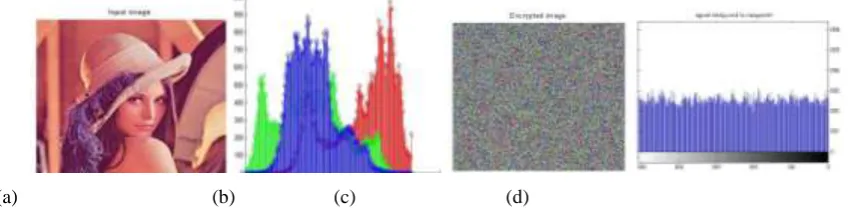
intensity level. In Fig. 1, the histogram of the original image of Lena of size 256 × 256 and the histogram of
corresponding cipher Image has been presented which depicts that the histogram of plain image has certain
pattern of R, G, and B components. But in the Cipher image all the pixels are uniformly distributed, thus making
the cryptanalysis difficult.
(a) (b) (c) (d)
Fig 1: (a) Plain original image, (b) histogram of original image (c) Encrypted Image, (d)
Histogram of encrypted image
This test is conducted for all the three algorithms and satisfactory results were obtained.
3.1.2 Correlation coefficient analysis
In most of the plain images, there exists high degree of correlation among adjacent pixels whereas poor
correlation between the neighboring pixels of corresponding cipher image is The correlation coefficient of the
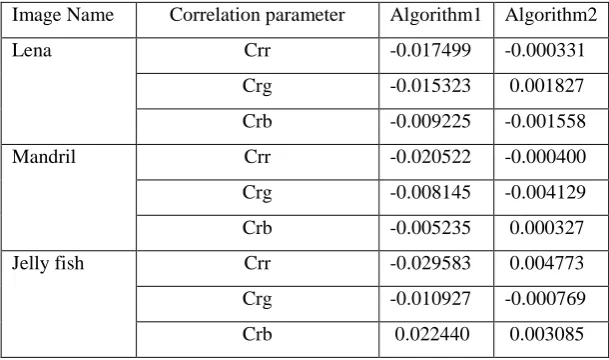
the R, G and B componentsfor the encryption algorithm using sine and cosine map, logistic map are shown in
the Fig. 2. The correlation between various horizontally, vertically and diagonally adjacent pixels of both the
plain and cipher image obtained using Encryption Algorithm based on logistic map are shown in Fig.3.
Fig 2: (a) Correlation of adjacent pixels of R, G and B components in plain image, (b)
encrypted image
International Journal of Advanced Technology in Engineering and Science www.ijates.com
Volume No 03, Special Issue No. 01, March 2015 ISSN (online): 2348 – 7550
1367 |
P a g e
Table 1.coefficientof horizontal, vertical, diagonal adjacentpixels of original and encrypted
images
Image
Name
Horizontal Correlation Vertical Correlation Diagonal Correlation
Plain
Image
Cipher
Image Plain Image Cipher Image Plain Image
Cipher
Image
Lena 0.9453 -0.0012 0.9716 -0.0095 0.9194 0.0078
Jellyfish 0.9669 0.0170 0.9694 0.0150 0.9531 -0.0106
Table1 shows the correlation coefficients between horizontal, vertical, diagonal adjacent pixels of original and
encrypted images. Table 2 shows the comparison of correlation coefficient of different encrypted images
obtained by encryption algorithms using sine and cosine map (Algorithm1) and logisticmap (Algorithm2).
Table 2.Comparasion of correlation co efficient of Different encrypted images
Image Name Correlation parameter Algorithm1 Algorithm2
Lena Crr -0.017499 -0.000331
Crg -0.015323 0.001827
Crb -0.009225 -0.001558
Mandril Crr -0.020522 -0.000400
Crg -0.008145 -0.004129
Crb -0.005235 0.000327
Jelly fish Crr -0.029583 0.004773
Crg -0.010927 -0.000769
Crb 0.022440 0.003085
3.2Information Entropy Analysis
Entropy measures the randomness that indicates the texture of an image. The entropy H(s) of a message source s
can be calculated as
H(s) = (12)
where represents the probability of message .When an image is encrypted, the ideal value of entropy
should be 8. If it is less than this value, there exists a certain degree of predictability which threatens its security.
Table 3 compares the entropy values for plain and encrypted images.
Table 3.Comparison of information entropy
Image Name
Plain Image entropy
Entropy with Algorithm1
Entropy with Algorithm2
Lena
7.44
7.991
7.9991
Jelly fish
6.35
7.998
7.9983
International Journal of Advanced Technology in Engineering and Science www.ijates.com
Volume No 03, Special Issue No. 01, March 2015 ISSN (online): 2348 – 7550
1368 |
P a g e
3.3Encryption Quality – NPCR, UACI And Time Taken Analysis
NPCR (number of pixel change rate) and UACI (unified average change in intensity) are generally considered to
evaluate the strength of the image encryption algorithm with respect to differential attacks. Opponent can create
a small change in the input image to observe changes in the result. By this method, the meaningful relationship
between original image and encrypted image can be found. To test the effect of one-pixel change on the image
encrypted by the proposed algorithm, two common measures were used – Number of Pixel Change Rate
(NPCR) , Unified Average Change in Intensity (UACI) . Consider two cipher-images, Ca(i, j) andCc(i , j) where
i = 0,1,2, … , M - 1 and j = 0,1,2, … , N - 1,whose corresponding plain-images have only one pixel difference.
Then NPCR and UACI are defined as
(13)
UACI = /255(14)
Table 4.Measurement of encryption quality and time taken
Apart from the security consideration, the speed of the algorithm is also an important parameter for a good
encryption algorithm. In this paper the encryption/decryption rate of several images of different sizes by using
the proposed image encryption algorithms are tested. The time analysis has been done on Intel i3 CPU with 4GB
RAM computer. Table 4 depicts the related results.
3.4Sensitivity Analysis
An ideal image encryption procedure should be sensitive with respect to the secret key i.e. the change of a single
bit in the secret key should produce a different encrypted image.
For Algorithm1, the encryption and decryption realizes the 16 – character ASCII code “ABCDEFG012345678”
as an input key. The resulting eight intial conditions and eight parameters, i.e a total of 16 keys, are represented
by 8 – digit floating – point numbers results in 128 uncertain digits, which is greater than the minimum
requirement of the 56 bit data encryption standard (DES) algorithm. For Algorithm2, plain image Lena of size
256 × 256 is considered as an example and is encrypted with x0 = 0.45001, y0 = 0.54001, µ1 = µ2 = 1.97. In
Fig.4,different cipher images of Lena of size 256 × 256 with minor changes in secret keys have been presented.
(a) (b) (c)
Fig 4: Key sensitivity test (a)Plain Image Lena of size 256 × 256 (b) Cipher image with chosen
key (c) Cipher image with change in x
0=0.45002, y
0= 0.54002
Image Lena
NPCR UACI Time Taken Image
Mandril
NPCR UACI Time Taken
Algo1 99.8889 33.6119 2.4694 Algo1 99.9619 30.3741 5.4219
International Journal of Advanced Technology in Engineering and Science www.ijates.com
Volume No 03, Special Issue No. 01, March 2015 ISSN (online): 2348 – 7550
1369 |
P a g e
In this algorithm, a 40 bit long key is used which produces a key space equivalent to 240 which is a very long
key. In order to test the sensitivity of the key the image is once encrypted with the proposed algorithm, the same
image is encrypted once again by changing the initial value of „a‟ from to a value lesser than 4 (say 3.9). The
encrypted images obtained are different from one another.
IV.
CONCLUSION
The experimental results show that chaotic map based encryption algorithms are robust for image encryption.
The encryption algorithm using sine and cosine chaotic map offers greater security as compared to the other two
methods but takes more time to encrypt and decrypt. The algorithm using logistic map is faster and applicable to
colour images but the algorithm with sine and cosine chaotic maps offers high level security hence is used for
private data protection.
REFERENCES
[1] M. Philip, "An Enhanced Chaotic Image Encryption" InternationalJournal of Computer Science, Vol.
1, No. 5, 2011.
[2] G. Chen, Y. Mao, CK Chui, "A symmetric image encryption schemebased on 3D chaotic cat maps", Chaos,
Solitons and Fractals, Vol.21,1992.
[3] H.K.L. Chang, J.L. Liu, “A linear quad tree compression scheme for imageencryption”, Signal Process.vol 4,
279–290, 1997.
[4] J. Scharinger, “Fast encryption of image data using chaotic Kolmogrovflow”, J. Electronic Engvol2, 318–
325, 1998.
[5] Fridrich Jiri, “Symmetric ciphers based on two dimensional chaoticmaps", Int. Journal of . Bifurcation
andChaos, vol 8, 1259–1284,1998.
[6] J.C. Yen, J.I. Guo, A new chaotic key based design for imageencryption and decryption, Proceedings of the
IEEE InternationalSymposium Circuits and Systems, vol. 4,. 49–52, 2000.
[7] J.C. Yen, J.I. Guo, “An efficient hierarchical chaotic image encryptionalgorithm and its VLSI realization”,
IEE Proc. Vis. Image Processing, 167–175,2000.
[8]Fridrich J. “Symmetric ciphers based on two-dimensional chaotic Maps“.International Journal of Bifurcation
and Chaos,vol8,1259 – 1284, 1998.
[9] Feng Y, Li L J, Huang F. “A symmetric image encryption approachbased on line maps”. In: Proceedings of
the 1st InternationalSymposium on Systems and Control in Aerospace and Astronautics, 2001.
[10] Parameshachari B D, K M SunjivSoyjaudah, Sumitrha Devi K A,“Secure Transmission of an Image using
Partial Encryption basedAlgorithm”, International Journal of Computer Applications, vol. 63, no.16,0975 –
8887, February 2013.
[11] Jiri Fridrich, “Symmetric Ciphers Based on Two-Dimensional ChaoticMaps”, International Journal of
Bifurcation and Chaos, Vol. 8, No. 6, 1998.
[12] N.K. Pareek, VinodPatidar, K.K. Sud, “Cryptography using multipleone-dimensional chaotic maps”,
Communications in Nonlinear Scienceand Numerical Simulation,vol10 , 715–723,2005.
[13] Vandana Thakur, MonjulSaikia. “Hiding Secret Image in Video” ,International Conference on Intelligent
International Journal of Advanced Technology in Engineering and Science www.ijates.com
Volume No 03, Special Issue No. 01, March 2015 ISSN (online): 2348 – 7550
1370 |
P a g e
[14] K. Sakthidasan and B.V. Santhosh Krishna, “A New Chaotic Algorithmfor image encryption and
Decryption of Digital Color Images”,International Journal of Information and Education Technology, Vol.
1,No. 2, June 2011.
[15] Ramesh kumaryadava, Dr. B. K. singh, S. K. sinha, K. K. pandey, “ANew Approach of colour image encryption based on Henon like Chaoticmap”, International Conference on Recent Trends in Applied
Scienceswith Engineering Applications, Vol.3, No.6, 2013
[16] N.K. Pareek, VinodPatidar, K.K. Sud, Cryptography using Multiple one-dimensional chaotic maps,
Communications in Nonlinear Science andNumerical Simulation, 2005.
[17] Kamlesh Gupta, Sanjay Silakari, “New Approach for Fast color imageencryption using chaotic Map”,
Journal of Information Security,vol 2,139-150, 2011.
[18] G.Chen, Y.Mao, and C.K. Chui,”ASymmetriEncryptionScheme Basedon 3D Chaotic Cat Map”, Chao,
Solitons& Fractals, 21,749-761,2004
[19] William Stalling, "Cryptography and Network Security”, 3rd edition,Prentice Hall of India, 2003.
[20] Narendra K Pareek, VinodPatidar, Krishan K Sud, “A Random BitGenerator using Chaotic maps”,