3518
E-Module Design Based Mathematics PBL
Learning Model To Enhance Creative Thinking
Skills
Siska Audhina Kusumaningtyas, Suparman
Abstract- One aspect of skills 4.0 existing industrial revolution in 21st-century learning is creativity. Creative thinking can be defined as the ability of a person or learners to create something new both in concept and in the works, but the lack of instructional media that enhances the creativity of learners is one of the obstacles that are often encountered. Efforts to improve the skills of creative thinking can be done using the learning model, one model of learning Problem Based Learning (PBL). PBL deemed appropriate to use because there is a process of creative thinking in it not only learning models, appropriate learning media and varied are also very likely to increase the creative thinking abilities of learners. This research aims to describe the need for teaching materials in by the PBL learning model that can improve the creative thinking of students. This research aims to develop the design of the E-Module based PBL learning model to enhance the creative thinking skills of students in statistics material. The method used in this paper is the ADDIE consisting of Analysis, Design, Development, Implementation, and Evaluation. Writing is using one instrument ratings given to the validator or expert to assess the E-Module designs. From the results of the assessment experts get scores top marks on the feasibility aspect of the presentation with a score of 5 or 'very worthy', followed by feasibility aspects of the contents with a score of 4.75 or 'very worthy' and then the feasibility aspect graphics with a score of 4:50 or 'very worthy'. Therefore, it can be concluded that the design of the module is designed very feasible to be developed into the E-Module that can be tested to students and is expected to enhance creative thinking skills.
Index of Terms ADDIE, Creative Thinking, E-module, Problem Based Learning, Statistics
--- ---
1 I
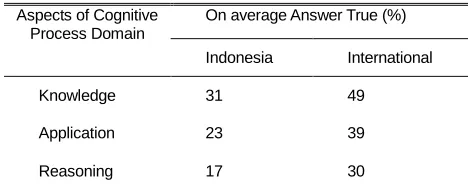
NTRODUCTIONEducation in the 21st century requires a variety of skills to be mastered by the learner. Learners are expected to prepare the ability to master a variety of skills, especially creative thinking skills to be people getting ahead in life [1]. Creativity is a result obtained from the process of interaction between the individual with the environment, other than that creativity is an essential element in building the quality of human resources [2]. Creativity can be seen as a product of creative thought, while creative activities are activities geared to encourage or bring creativity to make students think creatively [3]. Besides a term often used in the world of education is creativity can be defined as a person's ability to create something new both in concept and in the paper [4]. The creativity of learners in their development is closely related to the way teachers teach, learning in an atmosphere of non-authoritarian, learners who learn appropriate their initiative, as well as the learners, are given the confidence to think and dare to put forward new ideas [5]. One international study into the cognitive abilities of learners is TIMSS (Trends in Mathematics and Science Study) conducted by the IEA (International Association for the Evaluation of Educational Achievement). According to the table, the average percentage of correct answers learners Indonesia compared to international learners in the domain of cognitive processes in TIMSS 2011, as presented in Table 1.
Table 1. Percentage of Average Answer True Learners Indonesia and International Students
Aspects of Cognitive Process Domain
On average Answer True (%)
Indonesia International
Knowledge 31 49
Application 23 39
Reasoning 17 30
The fact the results of the TIMSS 2011 on cognitive processes domain shows that the reasoning ability is still weak learners into indications of weakness in critical and creative thinking skills. Also, based on observations made in Junior High School 4 Wonosari based on several indicators of creative thinking as summarized by Eric L. Mann that the four components of the indicator are repeated in every literature, among others, fluency, flexibility, originality, and elaboration [7], still many learners who have not been able to achieve such indicators. In addition to learning materials, learners also need effective learning methods to increase the creativity of learners [8]. Efforts to improve the skills of creative thinking can be done using appropriate learning methods, one of which Problem Based Learning (PBL) PBL seems right is used to improve creative thinking skills because there is a process of creative thinking in it [9]. PBL is a pedagogical approach that focuses on helping learners develop independent learning skills [10]. Not only that, but the learning method PBL is also an innovative learning method [11]. The learning method (PBL) changing the role of educators in developing factual learning so that learners can acquire and construct knowledge in an efficient manner and structured [12]. Steps in the PBL are; a) Orienting learners with contextual issues; b) Set the learners to study with help learners determine and organize learning tasks related to the problem; c) Directing the students to solve problems, to motivate learners to find the right information, to perform experiments, and to seek explanations and solutions; d) Improving and presented the results of the settlement of the problem; e) to analyze and _______________________________
Siska Audhina Kusumaningtyas is currently pursuing a master’s degree in a mathematics education program at Ahmad Dahlan
University, Indonesia, PH 082223660909.
Email:[email protected]
Supaman is an associate professor in mathematics at Ahmad Dahlan
University, Indonesia, PH 08132820119 8.
3519 evaluate the process and results of the completion of the issue
[13]. Teaching materials are needed as a means of presenting material in problem-based learning. Teaching materials serve to convey the message to learn from the teacher to the learner to be able to stimulate thoughts, feelings, interests and the willingness of students to learn [14]. Based on observations made, materials used learners are limited to books and book LKS government. Therefore, it is necessary supporting instructional material, one of the teaching materials that can be developed by a teacher is a module [15]. E-module is one kind of teaching materials prepared by teachers and given to students to support teaching and learning, by using e-modules anyway, learners have the opportunity to learn independently [16]. Supported by the results of writing done by Shurygin prove the importance of the effectiveness of electronic educational courses developed in the study of learning to improve the efficiency of learners in doing independent work [17]. Also according to the Hill of online resources designed to be used as pre-instructions can make a difference in the conceptual understanding and fluency representational learners and make them more aware that they face a learning process [18].On the other hand, the authors conducted an assessment of learning resources in the form of an existing module. Based on the results of expert validation material, obtained some results including; The highest percentage of 76% on language aspect. As for some of the shortcomings were found: (1) The example given is not much, (2) Presentation materials less attractive, so do not give an incentive to the students, (3) Do not include learning model, (4) Do not include the ability to improve. Based on the results of expert validation media, obtained some results, including; The highest percentage of 80% on the feasibility aspect of the content. As for some of the shortcomings were found: (1) There are no illustrations, (2) the cover design is less attractive. Therefore, E-module is deemed appropriate if developed according to the PBL learning model and is used to enhance the creativity of learners. Based on the explanation above, the purpose of this paper is to describe the analysis of the need for a media-based learning PBL learning model that can enhance creative thinking skills, develop the design of the E-Module-based learning model based PBL can improve creative thinking skills, produce a design E- modules are to be developed into the E-module.
2
R
ESEARCHM
ETHODThis writing is the writing of design development, namely mathematics module design based PBL learning model. The model used in this paper is the ADDIE (Analysis, Design, Development, Implementation, and Evaluation). ADDIE Model can be seen in Figure 1
Image 1, ADDIE model of [19]
The procedure includes the development of analysis, design,
development,implementation,and evaluation [20],[21],[22],[23]. ADDIE design model, is a model of teaching design of the most popular, because of its phases adjusted in detail [24]. Another thing that was expressed by the experts is that the model ADDIE provide detailed specifications intended to create and measure the practical and systematic learning [25]. ADDIE Model consists of five stages: analysis, design, development, implementation, and evaluation. Each stage has a goal of learning so that students can achieve good results, but there is the key, that is content to students who will spend time studying independently with a flexible approach as an effective tool [26]. The writing is only limited to the design phase to determine the design of PBL learning model based modules to enhance the ability to think creatively. The writing of data collection techniques such as observation, interviews, questionnaires and literature study. The observation guide used to collect data on the needs of learners to study media and know what kind of learning models used by teachers. Interview guidelines used to determine the use of instructional media during the process of learning and the creative thinking abilities of learners. The literature study was conducted to determine indicators of the ability to think creatively and the PBL learning model. The subject of this paper is learner class VIII Junior High School 4 Wonosari the school year 2018/2019.
3 R
ESULT ANDD
ISCUSSION3.1ANALYSIS PHASE
Based on the interview with the teacher Maryati S. Pd as a mathematics teacher in class VIII can be concluded that the learning process requires a model-based teaching materials PBL learning and statistical material in class VIII is considered difficult and precise when studied with electronic-based teaching materials. Observations during the learning process that shows that the instructional media used by learners is less varied. Questionnaire test and non-test were distributed to students in class VIII Junior High School 4 Wonosari results can be seen in Table 2 and Table 3
Table 2. Non Questionnaire Test Results Provided to Students
No. Aspect Information Percentage
1
Learners interested in teaching materials
Very interested 24
Interested 68
Less Interested 8
Not interested 0
Total 100
2
Learners materials based on electronic teaching
never use any 72
Have not used 28
Total 100
3520 to Students
No. Creative Thinking Skills
Indicators Achievement
1 Smoothness Reached
2 Flexibility Have not achieved
3 Originality Have not
achieved
4 Elaboration Have not achieved
Besides, there is also a literature study conducted by the authors, of some information, obtained, it can be concluded that both teachers and learners require a teaching material based electronics such as E-Module-based learning model PBL to increase the ability of creative thinking on the subject of statistics for class VIII Junior High School. The module is one form of teaching material that is packed full and systematic [27]. The module has a function as a self-learning tool, so learners can study at their own pace [28] [29]. While the E-Module is a module that is packaged in electronic form.
3.2DESIGN
The authors designed a module design that is composed of the cover, preface, table of contents, until the bibliography. The preparation of module design is based on the aspect of practicality and validity indicators. Besides, the formulation of module design is based on the results of a needs analysis has been done. Here is the cover design can be seen in Figure 2.
Figure 2. Cover design
Figure 2 is the cover design contains a module title, skills that will be achieved, the author's name, grade, and semester. In addition to the cover, there is a preface or foreword. Prefacing design can be seen in Figure 3.
Figure 3. foreword
Preface or foreword containing acknowledgments author to the parties involved in the preparation of the design. Next is a list of contents that can be seen in Figure 4.
Figure 4. table of contents
The table of contents contains information page layout from all parts there is in E-module design, to facilitate the E-Module found the material they are looking for. Next up is a syllabus that can be seen in Figure 5.
Figure 5. Syllabus
3521
Figure 6, Instructions for Use Module and syntax
Learning model
In addition to instructions of use modules in general, instructions for use of the E-Module also includes syntax learning model used is PBL, special design E-Module is the syntax of the learning model in the use of E-modules are listed in the form of the logo, while the skills to be achieved as well include the indicator in the form of a logo.
3.3DEVELOP PHASE
E-Module design that is designed to be valid in terms of appearance, content, and practicality. Therefore, the design of which was designed by the authors have been evaluated by two experts or validator which states that the design of the E-Module to be developed into the E-E-Module. This can be seen in Table 4.
Table 4. Data Validator and Conclusions of Design Evaluation
No. Name agency Conclusion
1 Rudhi Wijanarko, Kom, M.Sc
Gadjah Mada University
Very Worthy
2 Arinta Lipur Wijarwati, ST
Junior High School 1 Piyungan
Very Worthy
In addition to the data validator, the assessment is based on selection criteria that can be seen in Table 5.
Table 5, Assessment criteria mean Score Classification
Very Good (Very Worthy)
Well (Worth)
Enough
Less
Very less
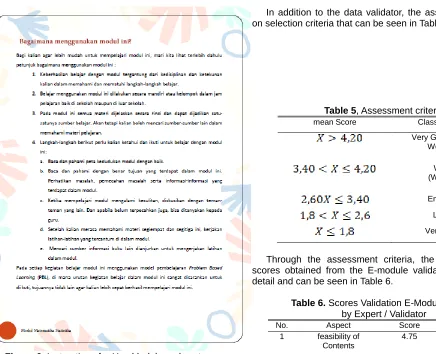
Through the assessment criteria, the authors conclude scores obtained from the E-module validation by experts in detail and can be seen in Table 6.
Table 6. Scores Validation E-Module Design by Expert / Validator
No. Aspect Score Information
1 feasibility of Contents
4.75 Very Worthy
2 feasibility Presentation
5 Very Worthy
3 feasibility Kegrafikan 4.5 Very Worthy
total Score 14:25
Average 4.75 Very Worthy
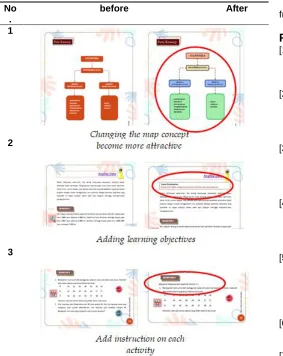
According to the table above, it can be concluded that the design of the E-Module to be developed into the E-Module. But before an assessment by experts, there are several revisions given to the author. Advice and input from both experts can be seen in Table 7.
Table 7. Suggestions and Feedback of Experts No. Suggestions and comments Follow Up
1 Change the map view concept became more colorful and appealing
The map view concept more colorful and attractive
amended
2 Adding learning objectives in every activity
The learning objectives of the operations have been
added
3 Giving
instructions/directives clear
Instructions/directives are evident in every activity has
been added
3522
Table 8. Design improvements according to Revision of Experts
4 C
ONCLUSIONBased on the results of the writing above it was found that: (1) The ability to think creatively learners still need to be improved. (2) The statistical material in class VIII is considered difficult by learners. (3) Instructional media are used not aim to develop the creative thinking abilities of learners. (4) Teachers and learners need E-module by the PBL learning model. (5) ADDIE development model used to generate the design of the E-module by the PBL learning model and integrating creative thinking skills. (6) Design E-Module designed by the authors obtained excellent evaluation score, including on the feasibility aspect of the presentation obtained a score of 5 was followed feasibility then feasibility graphics content of 4.75 4.5 acquire three very decent categories.
5
SUGGESTIONModule design-based learning model Problem Based Learning to improve the skills of creative thinking on the matter of statistics. This study uses a model of ADDIE development design. The stages in the model ADDIE consist of five stages, namely Analysis, Design, Development, Implementation, and Evaluation.
ACKNOWLEDGMENT
My thanks go to Allah, our Prophet Muhammad, and to all colleagues Involved in this study such as parents, validators, teachers, student SMP N 4 Wonosari, MPMAT UAD lecturers,
friends, and others who could not find one by one.
R
EFERENCES[1] Maulana, Monif & Supaman, "Development of Students Worksheet based on Realistic Mathematics Education in Indonesia", International Journal of Engineering & Technology, 7 (4.30) 45-49, 2018
[2] Setiawan, Juliatine, appendices .. "Development of Creativity Students Through The Application Of Problem Based Learning Model In Physical Education In-reviewed Of Adversity Quotient", University of Indonesia: Journal of Physical Education and Sport. Vol. 9, No. 2, 2017
[3] Ketut Urges Sarining Sekar. "The Analysis of Creative Thinking Ability in Science Subject Matter of the Fourth Grade Students in elementary N. 2 Pemaron Buleleng" Sub-District. Bali: Journal of Psychology and Instruction. Vol 1, No. 1. pp. 19-27, 2017.
[4] Cheung, RHP, "The challenge of developing creativity in a Chinese context: the effectiveness of adapting Western creative pedagogy to inform creative practice". Pedagogy, Culture & Society, 24 (1), 141-160. 2016 doi.org/10.1080/14681366.2015.1087419
[5] Nani Ratnaningsing, "The Analysis of Mathematical Creative Thinking Skills and self-efficacy OG High Students Built Through Implementation of Problem Based Learning and Discovery Learning", Tasikmalaya: Indonesian Journal of Mathematics Education, Vol. 2, No. 2. Page 42-45, 2017.
[6] Mullis, I., and MO Martin, "TIMSS: 2011 Item Writing Guidelines", Boston College, USA: TIMSS & PIRLS International Study Center, 2011
[7] EL Mann, Chamberlin SA, K. Graefe A, "The Prominence of Effect in Creativity: Expanding the Conception of Creativity in Mathematical Problem Solving". In: Leikin R., Sriraman B. (eds) Creativity and Giftedness. Advances in Mathematics Education, 2017.
[8] Suhendri and Supaman, "Mathematics Modules Development Based On Guided Discovery Learning Skills To Improve Creativity Of Blind Students", International Journal of Scientific and Technology Research, Volume 8, Issue 10, October 2019
[9] Febriani, Sudomo, Setianingsih, "Development Of Student Worksheet Based On Problem Based Learning Approach To Increase 7th Grade Student's Creative Thinking Skills", Yogyakarta: Journal of Science Education Research, Vol. 1, No. 1. 2017.
[10]And Ramli Awang. "Creative Thinking Skill Approach Through Problem-Based Learning: Pedagogy and Practice in the Engineering Classroom". Bandung: World Academy of Science, Engineering and Technology International Journal of Educational and Pedagogical Sciences Vol: 2, No. 4, 2008.
[11]Tio Akma & Supaman, "The Design of Student Worksheet Problem-based Learning to Improve Problem Solving Ability of the Eighth-Grade Students SMP in Indonesia", International Journal of Engineering & Technology, 7 (4.30) 11-15, 2018.
[12]Maudsley, G, "Roles And Responsibilities Of The Problem Based Learning Tutor In The Undergraduate Medical Curriculum". BMJ: British Medical Journal, 318 (7184), 657. 1999.
[13]Hendriana, Johanto, Sumarmo. "The Role Of Problem-Based Learning To Improve Students' Mathematical
No .
before After
1
2
3523 Problem-Solving Ability And Self Confidence". Bandung:
Journal on Mathematics Education, Volume 9, No. 2. Page 291-300, 2018.
[14]Serevina, Vina., Et al., "Development of E-Module Based on Problem Based Learning (PBL) on Heat and Temperature to Improve Student's Science Process Skills", TOJET: The Turkish Online Journal of Educational Technology. Vol. 17, no. 3, pp. 26-36, 2018.
[15]Aulia Fonda, and Sumargiyani, "The Developing Math Electronic Module With Scientific Approach Kvisoft Using Flipbook Maker Pro for Xi Grade of Senior High School Students", Infinity Journal, vol. 7, no. 2, doi: 10.22460 / infinity.v7i2. p109-122, 2018
[16]Ahmad, Arimuliani, "Developing Cooperative Learning-Based E-Module to Teach Basic English Grammar Of The First Half Of English Study Program Students At FKIP - UIR", Riau: J-SHMIC, Vol 4, No 2, 2017.
[17]Shurygin, VY, and Krasnova, LA, "Electronic Learning Courses as a Means to Activate Students' Independent Work in Studying Physics". International Journal of Environmental and Science Education, 2016.
[18]Hill, M., Sharma, MD, & Johnston, H., "How Online Learning Modules can Improve The Representational Fluency and Conceptual Understanding of University Physics Students", European Journal of Physics, 2015
[19]Melvinasari and Suparman, "Design Of Mathematics Module Based On Rme To Improving The Problem-Solving Ability", International Journal of Scientific and Technology Research Vol. 8, Issue 11, pp. 3918-3923, 2019.
a. Sulistyaningsih, Suparman, and E. Rakhmawati, "Mathematics Module Development Design Based On PBL To Improve Mathematics Problem-Solving Ability", International Journal of Scientific and Technology Research Vol. 8, Issue 11, pp. 2508-2516, 2019.
[20]F. Andrianingrum and Suparman, "Design Of Interactive Learning Media Based On Contextual Approach To Improve Problem-Solving Ability In Fourth Grade Students", International Journal of Scientific and Technology Research Vol. 8, Issue 11, pp. 3906-3911, 2019.
[21]Amirin and Suparman, " Worksheet Development Design To Improve Student Problem Solving Ability And Learning Motivation", International Journal of Scientific and Technology Research Vol. 8, Issue 12, pp. 3965-3970, 2019.
[22]Susiana and Suparman, " Design Of Mathematics Module For Mental Retardation Students In Mathematical Problem-Solving", International Journal of Scientific and Technology Research Vol. 8, Issue 11, pp. 3900-3905, 2019.
[23]Durak, G., & Ataizi, M., "The ABC's of Online Course Design According to Addie Model". Universal Journal of Educational Research, 4 (9), 2084-2091. 2016.
[24]Nichols Hess, A., & Greer, K., "Designing for engagement: Using the ADDIE Model to Integrate High-Impact Practices Into an Online Information Literacy Course", Communications in Information Literacy, 10 (2), 6, 2016.
[25]Wiphasith, H., Narumol, R., & Sumalee, C., "The design of the contents of an e-learning for teaching M. 5 English language using ADDIE model". International Journal of Information and Education Technology, 6 (2), 127. 2016.
[26]Voila Badengo & Supaman "Design Module Of Learning With RME Approach To Improve Creative Thinking Ability", International Journal of Scientific and Technology Research, Volume 8, Issue 10, October 2019.
[27]Gueudet, G., and L. Trouche. Re-sourcing teacher work and interaction: new perspectives on resource design, use and teacher collaboration. Ed. Birgit Pepin. Springer, 2013. [28]Bray, Aibhin. "Teachers' Experiences of the Integration of 21st